Linguistic relativity and cognitive processes in 2026
Theoretical Foundations of the Sapir-Whorf Hypothesis
The relationship between linguistic structure and human cognition forms the basis of one of the most enduring theoretical debates spanning linguistics, anthropology, and cognitive neuroscience. Central to this inquiry is the Sapir-Whorf hypothesis, which posits that the semantic structures and grammatical rules of a language influence the cognitive processes and worldview of its speakers 123. Historically, the hypothesis has been bifurcated into two distinct formulations: linguistic determinism (the "strong" hypothesis), which asserts that language strictly dictates the boundaries and architecture of thought, and linguistic relativity (the "weak" or "soft" hypothesis), which suggests that language facilitates probabilistic biases in attention, memory, and perception 34.
Contemporary cognitive science categorically rejects strict linguistic determinism. The notion that humans are entirely incapable of conceptualizing phenomena outside their linguistic repertoire is contradicted by the cognitive realities of pre-linguistic infants and the successful translation of complex ideas across structurally disparate languages 1. However, the softer interpretation of linguistic relativity has experienced a robust empirical resurgence over the past two decades 35. Modern research operates on a domain-centered approach, focusing on specific experiential domains - such as color, time, or spatial orientation - to determine precisely when, how, and under what conditions linguistic structures alter conceptual and perceptual processing 16.
Historical Trajectory and the Eskimo Vocabulary Debate
The early anthropological evidence supporting linguistic relativity often suffered from methodological exaggeration, leading to prolonged academic skepticism. The canonical example is the widespread assertion regarding "Eskimo words for snow." In 1911, anthropologist Franz Boas noted in the Handbook of American Indian Languages that Eskaleut languages utilized distinct root words for snow-related phenomena - such as aput for snow on the ground, qana for falling snow, piqsirpoq for drifting snow, and qimuqsuq for a snowdrift 47. This observation was intended to demonstrate that languages adapt their lexical categorizations to specific environmental and functional requirements 78.
Over subsequent decades, this observation was inaccurately inflated in popular and academic literature. Writers and theorists, including Benjamin Lee Whorf, expanded on Boas's foundational observation, and by the 1980s, media outlets routinely claimed that Eskimo languages possessed fifty or even hundreds of discrete words for snow 34. This prompted severe critiques from linguists, most notably Laura Martin in 1986 and Geoffrey Pullum in 1991, who characterized the inflation as the "Great Eskimo Vocabulary Hoax" 478. Pullum argued that the Eskaleut language family possesses a similar number of distinct word roots for snow as English, and that the perceived abundance of terms was merely a byproduct of the language's polysynthetic morphology, which allows multiple bases and affixes to combine into single, highly descriptive words 49.
However, recent cross-linguistic evaluations have reconsidered this critique. Studies by Krupnik and Müller-Wille (2010) analyzed extensive indigenous dictionaries and demonstrated that Inuit and Yupik languages do, in fact, possess a significantly richer array of distinct root words for frozen variants of water than English 489. This structural diversity is not an intellectual anomaly but a reflection of efficient communication optimized for specific environments; communities residing in cold climates predictably develop superior lexical resources for snow and ice, a phenomenon observed in both indigenous Arctic languages and Russian 89. While the exaggerated numerical claims of the 20th century were inaccurate, the core anthropological observation underlying the linguistic relativity hypothesis in this domain remains empirically supported 8.
Methodological Shifts in Cognitive Linguistics
A critical challenge in modern linguistic relativity research is isolating genuine modifications in low-level perception from post-perceptual, language-based cognitive strategies 10. Historically, evidence for linguistic relativity relied heavily on behavioral metrics, specifically choice reaction times and discrimination accuracy 1011. When speakers of a language with multiple distinct color terms react faster to color discrepancies than speakers of a language with fewer terms, the traditional interpretation asserted that language had permanently altered their perceptual apparatus.
Vulnerabilities of Behavioral Reaction Time Metrics
Studies relying solely on behavioral measures are notoriously susceptible to verbal interference and late-stage, post-perceptual strategic effects 10. Humans engage in silent sub-vocalization routinely, relying on the phonological loop of working memory to process visual and spatial stimuli 610. Consequently, responses derived from conscious decisions in purportedly nonverbal perceptual tasks are rarely free of verbal contamination 10.
To isolate the mechanism of linguistic influence, researchers frequently employ dual-task paradigms. Participants are asked to perform a primary perceptual discrimination task while simultaneously engaging in a verbal interference task, such as silently rehearsing a string of digits 612. In many cases, the reaction time advantages associated with language-specific categorizations disappear under verbal interference conditions, whereas nonverbal interference (such as tapping a spatial grid) leaves the advantage intact 1413. This phenomenon strongly implies that many observed Whorfian effects are not strictly embedded in the visual cortex, but are instead the result of rapid, real-time lexical access aiding the brain in rapid categorization and decision-making 1014.
Neuroimaging and Electrophysiological Applications
To bypass the confounds of behavioral reaction times and conscious decision-making, cognitive neuroscientists utilize advanced neuroimaging techniques, specifically functional magnetic resonance imaging (fMRI) and electroencephalography (EEG) 1516. These noninvasive modalities provide complementary data regarding the spatial and temporal dynamics of brain function 1517.
Functional MRI measures changes in blood oxygenation (the blood-oxygen-level-dependent, or BOLD, response), offering excellent spatial resolution to localize cognitive processes to specific neural networks 1516. Studies utilizing fMRI have demonstrated that semantic and syntactic processing activate distributed networks, including the temporal cortex, inferior frontal cortex, and the medial frontal cortex 1718. However, the BOLD signal is an indirect measure of neural activity, reflecting sub-threshold integrative processes (local field potentials) over several seconds, rendering it too slow to capture the split-second dynamics of perception 1617.
In contrast, EEG records the brain's continuous electrical activity with high temporal resolution, capturing neural fluctuations in milliseconds 1517. By averaging EEG signals over multiple trials, researchers isolate Event-Related Potentials (ERPs) that reflect the brain's synchronized response to specific stimuli 1019. Two ERP components are highly relevant for testing linguistic relativity:
- The P1 Component: Occurring roughly 100 milliseconds after stimulus onset over the parieto-occipital regions, the P1 peak indexes early, low-level visual processing in the primary and secondary visual cortices 20. Variations in P1 latency or amplitude suggest fundamental alterations at the initial stages of sensory perception.
- Visual Mismatch Negativity (vMMN): Occurring between 100 and 200 milliseconds, vMMN indexes automatic, pre-attentive change detection. It is elicited by rare or deviant stimuli within a standard sequence (an oddball paradigm), even when the participant's conscious attention is directed elsewhere 2021.
Because vMMN and P1 occur prior to conscious decision-making, variances in these components between speakers of different languages provide compelling evidence that language shapes foundational perceptual neurobiology, fulfilling the criteria for a robust interpretation of linguistic relativity 1924.
Language and Color Categorization
The domain of color categorization provides the most extensive empirical testing ground for examining the interface of language and thought. The human visual system can theoretically discriminate millions of continuous hues, yet individual languages compress this vast continuum into a highly restricted set of discrete linguistic labels 1422.
The Blue-Green Distinction in Cross-Linguistic Studies
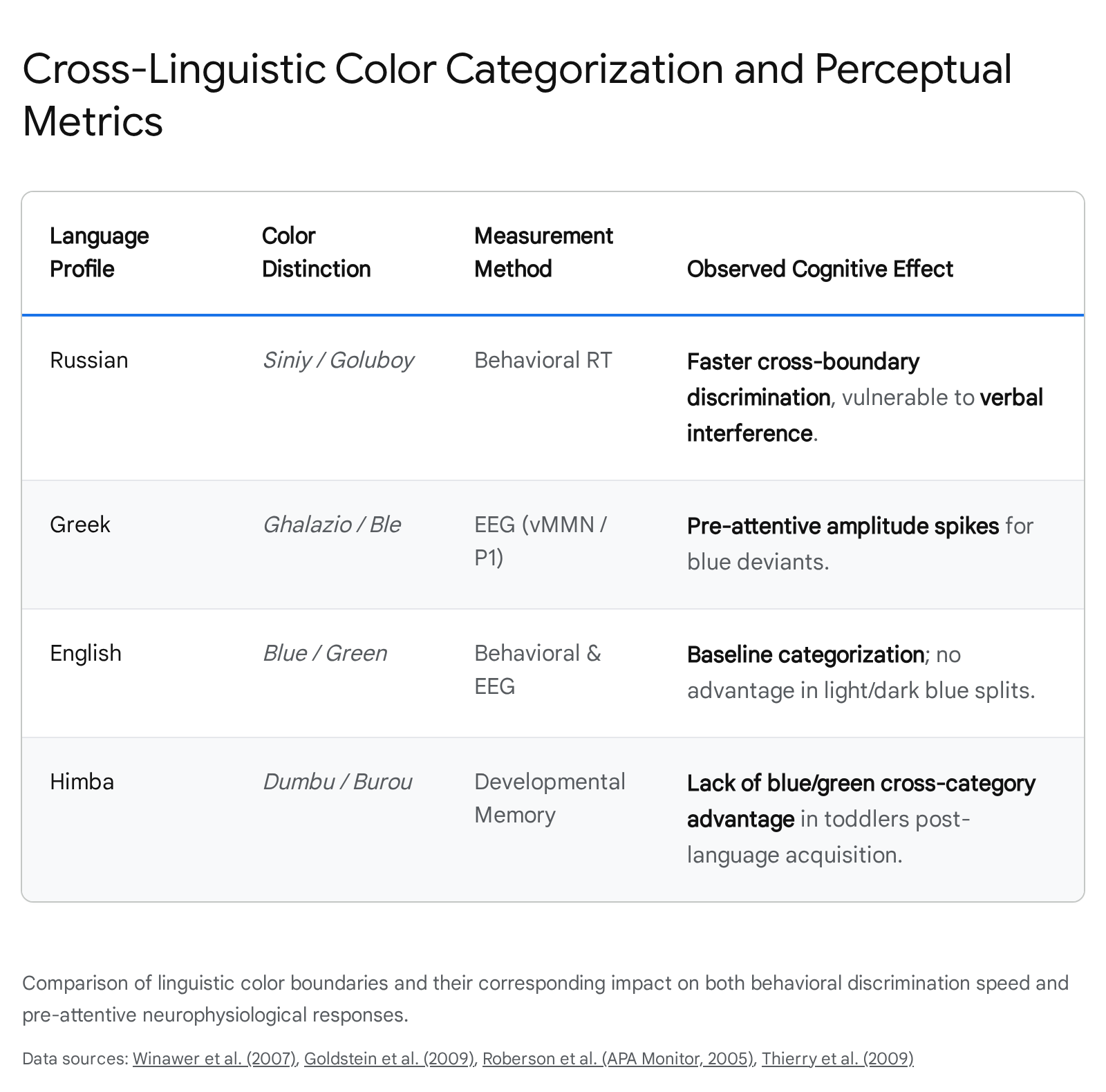
A primary focus of this research involves languages that divide the color spectrum differently than English. Russian, for example, lacks a single, all-inclusive word for blue; it strictly divides the spectrum into lighter blues (goluboy) and darker blues (siniy) 142324. Initial behavioral studies demonstrated that Russian speakers were significantly faster at discriminating between a siniy and a goluboy shade than between two perceptually equidistant shades of siniy, a category boundary advantage not shared by English speakers 1323. This advantage was most pronounced during difficult perceptual trials and was neutralized by verbal interference, indicating a reliance on silent linguistic categorization during the task 1323.
However, subsequent replications and exploratory analyses have introduced complexity. Some studies argue that the traditional goluboy/siniy boundary advantage may be influenced by stimulus frequency biases and lightness parameters rather than purely lexical access speed, noting that bilingual Russian speakers sometimes demonstrate slower baseline reaction times for dark blue stimuli overall 1224. To definitively test for pre-attentive Whorfian effects, researchers applied EEG methodologies to Greek speakers, whose language similarly mandates a distinction between light blue (ghalazio) and dark blue (ble) 2024.
Utilizing a visual oddball paradigm where color changes were irrelevant to the participant's active task (detecting square shapes amidst a stream of circles), researchers measured the vMMN response to luminance deviants 2024. Greek speakers exhibited a significantly larger and faster vMMN amplitude when presented with luminance deviants in the blue spectrum compared to the green spectrum. English speakers, conversely, showed a comparable vMMN response for both blue and green contrasts 2024. Because this effect occurred pre-attentively - and was also visible at the earlier P1 latency stage - it demonstrated that native language terminology fundamentally alters unconscious visual processing independently of deliberate cognitive strategies 2024.
Further evidence emerges from studies of bilingual populations, such as Mongolian and Chinese speakers. Mongolian strictly distinguishes between light blue (qinker) and dark blue (huhe), while Chinese utilizes a single primary word for blue (lan) and a single word for green (lv) 28. Visual search tasks reveal that Mongolian speakers discriminate visual targets across their native linguistic categories more rapidly than within categories 28. Interestingly, proficiency in Chinese among Mongolian bilinguals altered their pre-attentive categorical perception effects, indicating that acquiring a second language with differing categorical boundaries directly interferes with and reshapes pre-existing neuro-perceptual processing networks 28.
Developmental Acquisition of Color Categories
Cross-cultural developmental data provides further insight into the relativity of color cognition. A compelling line of research compares English-speaking children with children from the Himba tribe in Namibia. The Himba language utilizes only five broad color categories and does not strictly demarcate green from blue; instead, it uses the term burou for a range of blue and green hues, dumbu for earthy tones, and serandu for reds and pinks 2526.
Prior to acquiring robust color vocabularies, Himba and English toddlers exhibit remarkably similar error patterns in color memory tasks, with their mistakes driven entirely by the physical perceptual distances between color tiles rather than predetermined categories 26. This finding challenges universalist theories that propose the eleven basic English color terms are innately hardwired into the human visual system 26. As the children learn their respective languages, their cognitive color mapping diverges rapidly. Himba children fail to show a cross-category recognition advantage for the English blue-green boundary, responding similarly to English children who have not yet learned the relevant terms 27. In categorization and visual search paradigms, Himba children perform significantly better when distinguishing colors that cross their native boundaries (e.g., dumbu versus burou) than those that cross non-native boundaries 25. This developmental divergence strongly indicates that while basic visual perception is universal, the conceptual boundaries of the color space are learned and dynamically molded by cultural and linguistic scaffolding 2627.
Spatial Frames of Reference
The domain of spatial cognition demonstrates how lexical and grammatical structures impose implicit coordinate systems on human memory, reasoning, and environmental navigation. Languages encode spatial relationships using distinct frames of reference (FoR): relative, absolute, and intrinsic 2829.
English, Dutch, and Japanese predominantly rely on a relative (or egocentric) frame of reference. This system utilizes projective terms such as "left," "right," "in front of," and "behind," which calculate coordinates based directly on the speaker's own physical orientation 283031. Conversely, languages such as Guugu Yimithirr (an Australian Pama-Nyungan language) and Tzeltal (a Mayan language spoken in Tenejapa, Mexico) utilize an absolute (or geocentric) frame of reference 2829. Guugu Yimithirr relies exclusively on cardinal directions (north, south, east, west) for spatial descriptions at all scales, whereas Tzeltal utilizes the topographical slope of the local terrain, mapping relationships via terms meaning "uphill," "downhill," and "across" 283031.
Spatial Rotation Tasks and Memory Formulation
To test whether these linguistic constraints translate to non-linguistic spatial reasoning, researchers frequently employ the "Animals in a Row" spatial rotation task 2832. In this paradigm, participants are seated at a table and shown a spatial array - for example, three toy animals facing a specific direction. The participants are then physically rotated 180 degrees to face a second, identical table and asked to recreate the exact array from memory 2832.
The results of this task exhibit a striking correlation with linguistic typology 28.
| Linguistic Community | Dominant Frame of Reference (FoR) | Rotation Task Strategy (Following a 180° turn) | Cognitive Orientation Requirement |
|---|---|---|---|
| English / Dutch | Relative (Egocentric) | Preserves viewer-centric layout (e.g., animals remain "to the right") | Subject-dependent orientation |
| Guugu Yimithirr | Absolute (Cardinal) | Preserves absolute orientation (e.g., animals remain "facing North") | Continuous environmental tracking |
| Tzeltal (Tenejapa) | Absolute (Topographical) | Preserves geomorphic orientation (e.g., animals remain "facing uphill") | Macro-landmark orientation |
Speakers of relative languages consistently recreate the array egocentrically. If the animals originally pointed toward the participant's right hand, they arrange them pointing toward their right hand on the second table. In stark contrast, speakers of absolute languages recreate the array geocentrically. If the animals originally faced cardinal North, the Guugu Yimithirr participant arranges them facing North on the second table - which, due to the 180-degree rotation of their body, is now to their physical left 283233.
Because absolute speakers must always be prepared to describe spatial events using fixed environmental coordinates, researchers hypothesize that they actively encode primary visual perceptions alongside absolute directional data within their hippocampal cognitive maps 3034. This requires a cognitively intensive, continuous dead-reckoning process to maintain a constant awareness of their orientation within the broader landscape 534.
Contextual Critiques of Spatial Determinism
While the correlation between linguistic FoR and spatial memory is statistically robust, deterministic interpretations of these results are highly contested. Critics, such as Li and Gleitman (2002), argue that experimental parameters and environmental contexts heavily influence the deployed cognitive strategies 32.
Studies demonstrate that English speakers, when tested outdoors or within rooms providing highly salient environmental landmarks, frequently abandon their standard egocentric strategies in favor of absolute solutions 3235. Similarly, Tzeltal speakers - who typically rely on geocentric logic - can successfully utilize relative, egocentric strategies to solve rotation problems if the task instructions or subtle environmental hints encourage an egocentric interpretation 35. Even among Tzeltal children who have partial exposure to Spanish left-right terminology in educational settings, egocentric coordinate mapping remains accessible depending on the stringency of the task 33.
These findings suggest that language does not permanently blind speakers to alternative spatial coordinate systems 35. Rather, linguistic conventions establish a powerful default probabilistic bias. When confronted with an open-ended or ambiguous instruction (e.g., "make it the same"), participants naturally default to the spatial reasoning strategies most frequently lexicalized and practiced within their speech community 3235.
Embodied Cognition and Temporal Mapping
The human conceptualization of time relies extensively on spatial metaphors, demonstrating a profound fusion of linguistic mapping and embodied cognition 3637. In English, as in the majority of European languages, the sagittal (front-back) bodily axis acts as the primary metaphorical ground for time. This system operates on a dynamic Ego-reference-point model where the future is conceptualized as "in front" of the speaker (e.g., "looking forward to the weekend") and the past is conceptualized as "behind" (e.g., "putting the past behind us") 3637.
The Aymara language, spoken by indigenous populations in the Andean highlands of western Bolivia, provides a rare and striking contra-example to this supposedly universal spatialization 37. Aymara features a static, epistemic model of time where the past is conceptualized as resting in front of the speaker, denoted by the phrase nayra pacha (literally translated as "front time" or "eye time") 3738. Conversely, the future is conceptualized as resting behind the speaker, denoted by qhipa pacha (literally "back time") 38. This inverse linguistic mapping is grounded in a deep epistemological metaphor: the past is known, experienced, and has been visually witnessed, therefore it lies in the visual field ahead; the future is unknown and unseen, and thus rests securely behind one's back, out of sight 38.
The profound cognitive impact of this linguistic mapping is visible not only in speech but in the spontaneous, unconscious gestures of speakers 36. Research indicates that English speakers subconsciously sway or gesture forward when discussing future events and backward when referencing historical events 39. Aymara speakers exhibit the exact inverse. When participating in natural conversation, they reliably gesture forward into the space in front of their bodies when referencing the past, and gesture backward over their shoulders when discussing future eventualities 363839.
Developmental studies exploring space-time mappings in children reveal that these spatial metaphors are acquired gradually. While English-speaking adolescents reliably produce lateral (left-right) and sagittal (front-back) gestures congruent with adult norms, young children (ages 6 to 7) exhibit a higher frequency of incongruent spatial gestures, underscoring that culturally determined representations of time require sustained linguistic exposure to solidify into embodied cognitive habits 37. This robust gestural convergence across cultures provides crucial embodied evidence that the metaphorical language one acquires actively structures the spatial topography of abstract thought 3637.
Grammatical Gender and Conceptual Association
The hypothesis that arbitrary grammatical classifications, such as noun gender, influence the conceptual properties and semantic associations of objects has generated extensive, yet highly debated, empirical literature. Foundational behavioral studies, most notably by Boroditsky et al. (2003), observed bilingual speakers of Spanish and German - languages characterized by robust but frequently contrasting grammatical gender assignments for inanimate objects 4041.
In these initial experiments, participants were asked to generate three adjectives to describe an object presented as an English word. The results indicated that participants produced descriptions heavily aligned with the object's grammatical gender in their native language 4042. For instance, the word for "key" is masculine in German (Schlüssel) but feminine in Spanish (llave). German speakers predictably generated masculine-associated adjectives such as "hard," "heavy," "metal," and "jagged," whereas Spanish speakers generated feminine-associated adjectives such as "intricate," "little," "lovely," and "shiny" 4048. Similarly, the word for "bridge" is feminine in German (Brücke) and masculine in Spanish (puente); German speakers described bridges as "beautiful," "elegant," and "fragile," while Spanish speakers favored "big," "dangerous," and "sturdy" 48. In parallel studies, when participants rated the "potency" of objects, they consistently ranked grammatically masculine items in their native language as possessing higher potency than grammatically feminine items 40.
Methodological Critiques and Null Replications
Despite the significant early influence of the grammatical gender effect, subsequent rigorous replications have largely failed to produce equivalent results, leading contemporary researchers to question the depth of the phenomenon 4843. Studies by Mickan et al. and Peperkamp et al. (2026) highlight critical methodological vulnerabilities in the original 2003 designs 4843.
A primary critique targets the testing environment: the original studies evaluated bilinguals utilizing a non-gendered second language (English). This experimental paradigm may inadvertently force participants to rely on explicit mental translation heuristics, artificially heightening the salience of their L1 grammatical gender during the task 43. To address this, Peperkamp et al. (2026) tested French and German participants strictly within their native languages using carefully controlled stimuli that included gender-marked determiners (e.g., the French feminine determiner la) to naturally maximize grammatical salience 43. The researchers observed null effects of grammatical gender on adjective choice for inanimate objects 43. Based on these extensive null findings, the influence of grammatical gender is increasingly viewed by psycholinguists as a localized linguistic interference or a shallow semantic association, rather than a deep structural reorganization of conceptual object representation 4243.
Neural Networks and Cross-Lingual Semantic Representation
In the mid-2020s, the debate surrounding linguistic relativity expanded into the computational analysis of Large Language Models (LLMs) and artificial neural networks. Because LLMs process syntactic and semantic information across multiple typologically diverse languages within identical parameter weights, they provide a novel, highly controlled mechanistic sandbox for exploring whether complex reasoning is inherently tethered to a specific structural language, or if it exists in a universally accessible, language-agnostic latent space 5044.
The Semantic Hub Hypothesis
Emerging research in 2025 and 2026 introduced the "Semantic Hub Hypothesis," which proposes that multilingual language models map cross-lingual inputs into a shared, universal semantic representation space to execute logical reasoning 5052. When researchers analyze the internal hidden states of an LLM processing semantically equivalent sentences in different languages (e.g., English and Chinese), a distinct computational trajectory emerges 5045.
In the early layers of the neural network, processing focuses heavily on language-specific syntax, tokenization, and morphological rules; consequently, the internal representations of the English and Chinese sentences appear mathematically disparate 5045. However, as the information progresses into the middle layers of the model, these hidden representations converge dramatically. The middle layers act as a transmodal "meaning hub," achieving high cosine similarity across diverse linguistic inputs regardless of structural differences 5045.
This convergence suggests that to solve complex tasks, the model effectively strips away surface-level linguistic constraints, mapping inputs to an abstracted conceptual framework before translating the output back into the target language at the final layers 4546.
Function Vectors and Syntactic Circuits
Further probing of LLM factual recall mechanisms underscores this architectural separation of language from pure conceptual thought. In decoder-only language models, factual recall operates through a structured, multi-hop circuit 4647. Research demonstrates that the network first constructs a "Function Vector" that encodes the pure semantic relationship required by the prompt (e.g., extracting the concept of a capital city) 46. Only in a subsequent, localized phase do the attention mechanisms extract the specific token matching the requested output language 46.
The observation that subject and relation representations are formed independently of the final output language indicates that artificial reasoning networks function through conceptual abstractions divorced from specific syntax 46. However, an "English-centric" bias remains evident in modern AI architecture. Because the vast majority of pre-training data is overwhelmingly English, the abstract concept space within models like LLaMA naturally gravitates toward English structural norms 5044. When forced to generate explicit reasoning traces (such as via <think> tokens) in low-resource languages, models frequently exhibit performance degradation, indicating that while the process of semantic abstraction may be universal, the topology of the machine's conceptual space is heavily biased by the dominant language in its training corpus 5044.
Contemporary Perspectives on Universal Grammar
The intersection of extreme linguistic diversity with foundational cognitive constraints continues to generate theoretical refinement in 2026. For decades, the dominant paradigm in formal linguistics was Chomsky's Universal Grammar (UG) - the theory that an innate, universally shared biological faculty strictly dictates all possible human grammar structures, allowing infants to rapidly acquire language despite a "poverty of the stimulus" 565748.
However, the UG hypothesis has been significantly challenged by modern typological findings and interdisciplinary critiques 5648. Major academic forums, such as the 2026 University of Tübingen workshops on "Universal Grammar and Linguistic Diversity," highlight a critical friction point: linguistic typology has largely failed to identify an empirically observable syntactic universal across the globe's roughly 7,000 languages 5649. Phenomena once considered fundamental biological constraints, such as strict structural recursion, have been heavily disputed by field data from languages like Pirahã 56. Furthermore, constructionist approaches and usage-based models have demonstrated that complex grammatical networks can be acquired via general cognitive learning mechanisms (such as pattern recognition and statistical inference) without requiring an innate, language-specific module 4860.
Consequently, the argument that human cognition houses a rigid, pre-programmed grammatical template is increasingly viewed as conceptually restrictive 5648.
The Dynamic Integration of Language and Cognition
The modern synthesis of linguistic relativity and cognitive science rejects both the strict determinism of early Whorfian theory and the rigid biological modularity of classical Universal Grammar. Instead, the evidence supports a highly dynamic, interactive model 6050.
Human cognition operates on shared biological hardware and foundational conceptual capacities, such as basic spatial orientation, numerical estimation, and perceptual processing 5163. However, languages act as diverse cognitive toolkits. They provide specific lexical categories and grammatical algorithms that optimize attention toward culturally relevant stimuli, streamline memory encoding, and dynamically mold the underlying cognitive architecture based on environmental utility 93552.
Language, therefore, is not an inescapable prison house of thought, nor is it merely a neutral, transparent medium for expressing an entirely independent internal logic. Rather, linguistic structures construct deeply ingrained probabilistic pathways - scaffolding conceptual categorization, directing pre-attentive sensory resources, and ultimately serving as an active, continuous participant in the ongoing construction of the human cognitive experience.