
Land use and peri-urban expansion in hantavirus spillover dynamics
Introduction
Hantaviruses, distinct members of the Orthohantavirus genus within the family Hantaviridae (order Bunyavirales), represent a globally distributed class of zoonotic RNA viruses 123. Unlike many other zoonotic pathogens, hantaviruses do not rely on an arthropod vector for transmission. They establish persistent, asymptomatic infections within their primary reservoir hosts, which are predominantly specific species of rodents and eulipotyphlans (shrews and moles) 4567. These reservoir hosts chronically shed infectious viral particles into the environment through their urine, feces, and saliva. Human infection - known as a spillover event - most frequently occurs through the inhalation of aerosolized viral particles originating from disturbed, contaminated rodent excreta 158.
The clinical manifestations of human hantavirus infection bifurcate along geographic and phylogenetic lines. In Europe and Asia, "Old World" hantaviruses, such as the Puumala (PUUV), Dobrava-Belgrade (DOBV), and Hantaan (HTNV) viruses, primarily cause Hemorrhagic Fever with Renal Syndrome (HFRS) or its milder European variant, Nephropathia Epidemica (NE) 38910. These Old World strains generally exhibit a case fatality rate ranging from less than 1% to 15% 911. In the Americas, "New World" strains, including the Sin Nombre Virus (SNV) and the Andes Virus (ANDV), manifest as Hantavirus Pulmonary Syndrome (HPS) or Hantavirus Cardiopulmonary Syndrome (HCPS) 3912. New World strains are significantly more lethal, carrying case fatality rates between 20% and 50%, often precipitating rapid cardiopulmonary collapse driven by severe vascular leakage 9111213. Globally, an estimated 10,000 to over 100,000 hantavirus infections occur annually, with the vast majority of cases located in Asia and Europe 9.
Historically, hantavirus epidemiology was interpreted through the lens of static natural ecosystems and isolated occupational exposures. However, contemporary disease ecology recognizes that hantavirus transmission operates as a highly dynamic system that is acutely sensitive to anthropogenic perturbations 214. The exponential expansion of human populations, the shifting of agricultural frontiers, and the uncontrolled sprawl of peri-urban infrastructure have fundamentally altered the physical and ecological interface between humans and sylvatic rodent reservoirs 515. Land-use change acts as a powerful selective ecological force, modifying the structural complexity of habitats, altering rodent demographic profiles, and disrupting the community ecology that naturally regulates reservoir populations 214.
Ecological Mechanisms of Pathogen Maintenance
Understanding how anthropogenic land use alters spillover risk requires an analysis of the ecological and biological mechanisms governing hantavirus circulation within reservoir populations. The probability of human infection is mathematically and ecologically tied to three primary variables: the absolute density of the reservoir host population, the viral seroprevalence within that population, and the frequency of human-reservoir interaction 131617.
Host-Pathogen Ecology and Density-Dependent Transmission
Hantaviruses exhibit a high degree of host specificity, the result of extensive co-evolution with specific rodent lineages 18. The viral life cycle within these hosts involves binding to β3-integrin receptors on endothelial cells, followed by replication in the cytoplasm. This process generates infectious ribonucleoproteins without causing the severe cytopathic effects or immune overdrive observed in human hosts 39. Because transmission among rodents relies on direct contact (biting and scratching) or indirect environmental exposure in shared burrows, viral circulation operates on a density-dependent basis 41920.
When optimal environmental conditions or human-generated food subsidies allow a rodent population to exceed its historical carrying capacity, intraspecific encounter rates increase exponentially, triggering rapid amplification of viral seroprevalence. Long-term capture-mark-recapture studies on PUUV in bank voles (Myodes glareolus) demonstrate that the viral transmission rate closely tracks host abundance during the autumn accumulation phase, concentrating the infection within specific age cohorts just as they begin seeking winter shelter 19.
Landscape Connectivity and Niche Overlap
The geographic structure of a landscape heavily influences spatial transmission patterns and the persistence of the virus. Environmental factors that favor large, contiguous populations of hosts are more likely to serve as sites of permanent viral persistence. Conversely, if habitat patches become overly isolated, the virus may become extinct locally due to stochastic processes, even if the host population survives 21.
Spillover risk is ultimately determined by the "niche overlap" between humans and infectious hosts. Disease ecologists categorize these dynamics into distinct spatial systems. In "Boolean OR" systems, multiple host species can maintain and transmit the virus independently, extending the range of human risk across a wider variety of environmental conditions 21. In "Boolean AND" systems, the virus must move sequentially from a deep-wilderness host that rarely contacts humans to a second, synanthropic host that actively overlaps with human populations, requiring highly specific environmental conditions for both species to interact 21. Anthropogenic expansion into less human-modified environments effectively bridges these gaps, exposing human populations to pools of the virus that were previously isolated in deep-wilderness habitats 21.
Habitat Fragmentation and the Dilution Effect
A critical mechanism linking land-use change to increased hantavirus risk is the disruption of the "dilution effect." The dilution effect hypothesis posits that high biodiversity within an intact ecosystem naturally suppresses the prevalence of specific pathogens 1420. In a pristine, highly diverse habitat, the primary reservoir host shares the ecosystem with numerous other small mammal species that act as incompetent hosts for the virus, serving as ecological dead-ends 20. Furthermore, robust predator populations and intense interspecific competition keep the absolute density of the primary reservoir checked.
Spatial and Temporal Dimensions of Biodiversity Loss
When natural landscapes are cleared for agricultural or peri-urban development, habitat fragmentation ensues. This degradation triggers a predictable ecological cascade: specialist species, which require highly specific intact niches, experience population declines or local extinction 1422. Conversely, generalist, synanthropic species - those highly adaptable to human-dominated landscapes - thrive in the absence of competition and predation. Reservoir species for hantaviruses, such as the deer mouse (Peromyscus maniculatus) in North America or the black rat (Rattus rattus) in Madagascar, are quintessential generalists 3622.
Research indicates that the dilution effect operates across both spatial and temporal dimensions. A study conducted in Cascade, Montana, investigated the temporal dynamics of hantavirus infection in deer mice by examining the presence of ephemeral vole species. The findings demonstrated that the mere presence of competing voles was associated with a reduction in hantavirus estimated standing antibody prevalence (ESAP) among the deer mice, independent of the voles' absolute abundance 20. As biodiversity drops in fragmented peri-urban fringes, generalist reservoir species achieve overwhelming dominance.
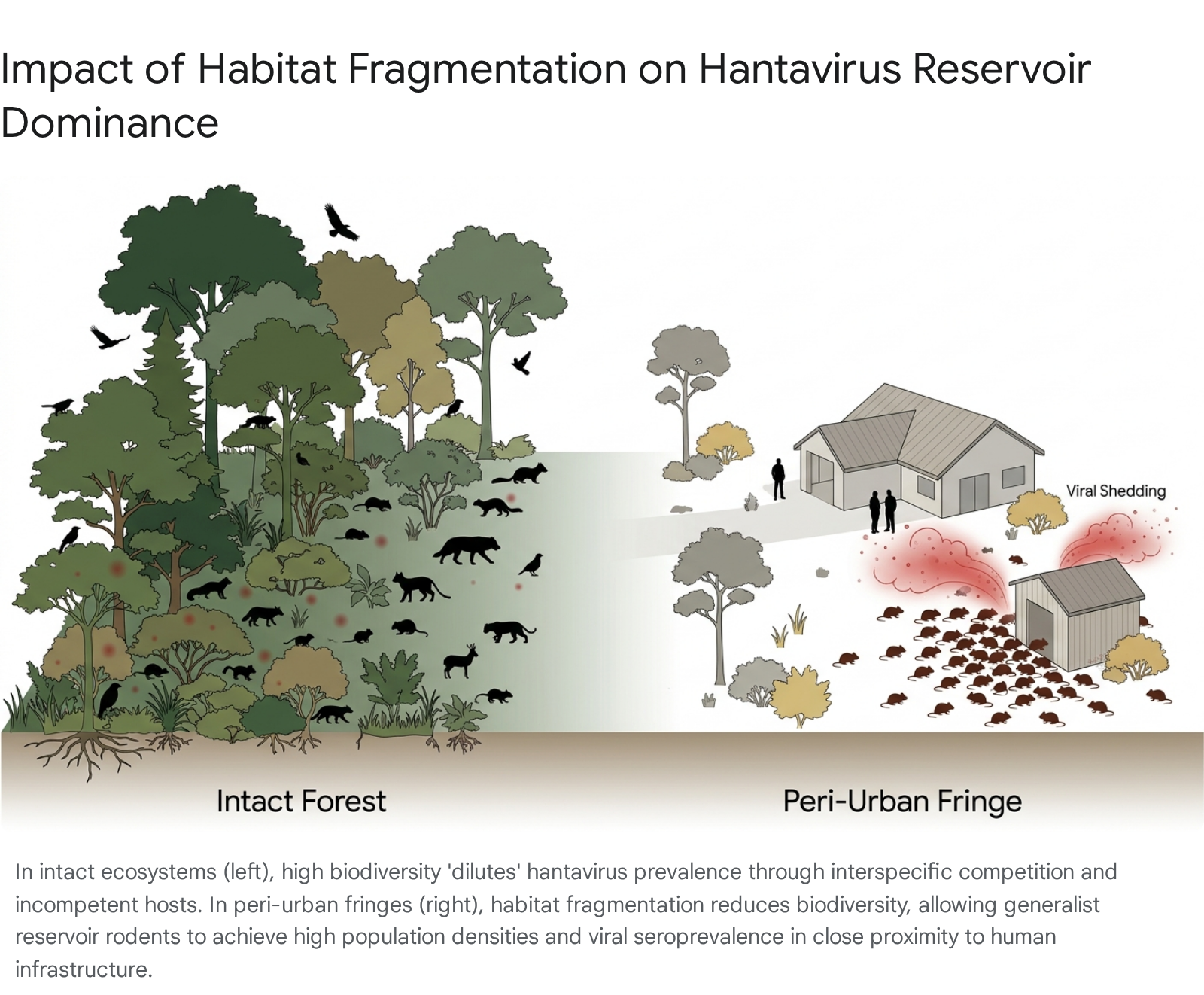
A selective species removal experiment in Panama further confirmed that the seroprevalence of hantaviruses in small mammals increased significantly in areas where species diversity was artificially reduced, concluding that habitat loss directly elevates encounter rates between infected and susceptible hosts 14.
Demographic Shifts and Selective Pressures
Land conversion alters not only species composition but also the demographic structure of the reservoir population itself. A comprehensive 2025 ecological study conducted in the SAVA region of northeastern Madagascar highlighted the microscopic mechanisms of land-use driven spillover 2223. Researchers trapped 1,681 small mammals across a land-use gradient ranging from pristine intact forests to highly modified agricultural matrices and rural settlements 2223.
The study found that hantavirus infection was exclusively concentrated in the invasive black rat, with an overall prevalence of 9.5% 2223. The probability of infection was dramatically higher in agricultural habitats (16.07% in flooded rice fields and 12.77% in agroforests) compared to secondary forests (4.03%), and the virus was entirely absent in the semi-intact deep forests of Marojejy National Park 2223. The mechanism driving this disparity was demographic: agricultural conversion provided dense caloric resources that allowed rats to grow physically larger and live longer. Because hantavirus infection correlates positively with body size and age, the agricultural landscape essentially manufactured a demographic cohort of highly infected 'super-spreaders' 2223.
Regional Land-Use Associations and Reservoir Specificity
The relationship between land use and hantavirus infection is not globally uniform; it is highly context-dependent, shaped by the distinct behavioral ecology of local reservoir species 2. Anthropogenic environments that present an extreme high risk in one continent may be considered comparatively low risk in another, necessitating a region-specific approach to spatial epidemiology.
Table 1: Comparison of Regional Hantavirus Dynamics and Land Use Associations
| Region | Primary Pathogens | Major Reservoir Hosts | Dominant Clinical Syndrome | Primary Land-Use Risk Drivers | Environmental Amplifiers |
|---|---|---|---|---|---|
| Europe | Puumala (PUUV), Dobrava (DOBV) | Bank Vole (Myodes glareolus), Apodemus spp. | HFRS / Nephropathia Epidemica (NE) | Proximity to broad-leaved forests, forestry work, rural cabins | "Mast years" (high seed production), mild preceding winters |
| North America | Sin Nombre (SNV) | Deer Mouse (Peromyscus maniculatus) | Hantavirus Pulmonary Syndrome (HPS) | Open scrublands, arid fringe development, agricultural edges | El Niño precipitation anomalies, dry aerosolization conditions |
| South America | Andes Virus (ANDV) | Sigmodontinae rodents (e.g., Oligoryzomys) | Hantavirus Pulmonary Syndrome (HPS) | Sugarcane and maize expansion, deforestation, landfills | Habitat fragmentation, structural housing vulnerabilities |
| Asia | Hantaan (HTNV), Seoul (SEOV) | Apodemus agrarius, Rattus spp. | Hemorrhagic Fever with Renal Syndrome (HFRS) | Rice paddies, orchards, early-stage rapid urbanization | Construction site disruption, poor sanitation at urban edges |
Data synthesized from established spatial epidemiological literature and global health reports 2782425.
Europe and Forest Fragmentation
In Western and Northern Europe, human hantavirus infection risk - specifically for NE caused by PUUV - exhibits a strong, consistent positive association with forest cover, particularly deciduous and mixed broad-leaved woodlands 226. The bank vole relies heavily on natural forest habitats and is less inclined to permanently colonize highly urbanized matrices 2. Therefore, fully built-up urban environments generally show an inverse or null association with PUUV risk 2.
European hantavirus outbreaks are intricately tied to ecological events known as "mast years" - periods of hyper-abundant seed production by oak and beech trees 28. Mast years, often triggered by optimal summer temperatures two years prior and mild preceding winters, provide bank voles with exceptional winter caloric resources, sparking a massive rodent population explosion 8. The risk profile in Europe is thus highest for rural and peri-urban populations living on the immediate forest edge, where recreational activities, forestry work, and domestic maintenance expose humans to dust laden with vole excreta 4827.
The Americas and Agricultural Frontiers
In stark contrast to Europe, hantavirus risk in the Americas is predominantly driven by agricultural expansion and infrastructure development in open or arid landscapes 224. Generalist rodents of the Sigmodontinae subfamily in South America, and the Peromyscus genus in North America, readily exploit the food subsidies provided by cultivated land 227.
In South America, robust positive associations have been established between the expansion of sugarcane and maize farming and the incidence of HPS 228. These massive agricultural monocultures provide immense, stable food sources and shelter, allowing reservoir rodents to achieve high densities 2. In the United States, ecological niche modeling utilizing data from 431 human cases of HPS between 1993 and 2022 revealed that hantavirus risk maps predominantly to the drier, western half of the country 2930. High-risk areas in North America are statistically characterized by high social vulnerability, open shrub/scrub environments, lower levels of overall development, and a high degree of landscape openness 243031.
Asia and Early-Stage Urbanization
In mainland China, which accounts for 70% to 90% of all global HFRS cases, the risk is overwhelmingly tied to agricultural land use, including irrigated farmland, orchards, and rice paddies 2. Approximately 91% of reviewed spatial epidemiological studies in China confirm a positive relationship between agriculture and HFRS incidence 2. Cultivated lands support dense populations of the striped field mouse (Apodemus agrarius) and the brown rat (Rattus norvegicus) 27.
Furthermore, urbanization in Asia follows an inverted U-shaped risk curve. During the initial, rapid phases of urban expansion, the disruption of natural land, the creation of active construction sites, and poor peripheral sanitation dramatically increase interactions between humans and displaced rodents. As urban infrastructure matures and housing quality improves, the infection risk subsequently declines, rendering the transitional peri-urban phase the most perilous period for hantavirus exposure 25.
Peri-Urban Expansion and the Human-Wildlife Interface
While distinct regions feature differing primary land-use drivers, the "peri-urban fringe" - the transitional, rapidly altering landscape where human development interfaces with natural ecosystems - has emerged universally as the most critical theater for hantavirus spillover 1529.
Edge Effects and Synanthropic Adaptation
Uncontrolled urban sprawl inherently maximizes the perimeter-to-area ratio of natural habitats, creating vast ecological "edge effects" or ecotones 1417. Hantavirus reservoirs are frequently synanthropic or semi-synanthropic, meaning they possess physiological and behavioral adaptations that allow them to thrive alongside human development 7. Ecotones provide rodents with the optimal combination of natural shelter (such as secondary forest or brush) and human-subsidized food sources (including agricultural runoff, pet food, and municipal garbage).
A 2025 study from Los Alamos National Laboratory explicitly concluded that "fringe" geographic areas are at the highest level of risk for human hantavirus contraction 2930. This heightened risk is not solely due to a higher absolute number of rodents, but rather because the intense environmental stress placed on fragmented habitats forces unique rodent species compositions into continuous, direct proximity with human activities 2930. When peri-urban development encroaches on established territories, rodents adapt by utilizing sheds, attics, and garages as shelter against extreme weather, transforming human domestic spaces into environments of chronic, low-dose viral aerosol exposure 22332.
Socioeconomic Vulnerability and Infrastructure Dysfunctions
The spatial distribution of hantavirus risk within the peri-urban fringe is inextricably linked to socioeconomic vulnerability 2930. Peri-urban environments frequently encompass informal settlements, rapidly constructed housing lacking rigorous architectural standards, and inadequate municipal sanitation services 2515.
When rapid urban growth outpaces municipal waste management infrastructure, the resulting accumulation of garbage subsidizes synanthropic rodent populations, drawing them directly into residential structures 5. The Los Alamos niche models identified "higher social vulnerability" as a leading predictor for HPS risk in the United States 30. Poorly sealed homes lacking adequate exclusion barriers allow rodents to easily enter wall voids and subfloors. Because urban residents in properly sealed environments experience significantly lower contact rates with rodents, the burden of hantavirus falls disproportionately on rural and peri-urban populations lacking access to resilient housing 33.
Occupational Hazards and Mechanical Exposure
Peri-urban expansion is accompanied by intensive infrastructure development, land clearing, and the construction of transport networks. These activities aggressively disturb established rodent habitats, displacing infected populations and aerosolizing decades of accumulated organic matter in topsoil and structural debris 25. Consequently, hantavirus infection behaves prominently as an occupational disease 10.
Table 2: Hantavirus Seroprevalence and Risk among High-Exposure Occupational Groups
| Occupational Group | Total Sample Size (Workforce) | Pooled Seroprevalence | Odds Ratio (OR) vs. Reference Population | 95% Confidence Interval (CI) |
|---|---|---|---|---|
| Farmers / Agricultural Workers | 15,043 (Combined) | 3.7% | 1.875 | 1.438 - 2.445 |
| Forestry / Land Clearing Workers | 15,043 (Combined) | 3.8% | 2.892 | 2.079 - 4.023 |
Data derived from a comprehensive global meta-analysis comprising 42 peer-reviewed articles evaluating occupational hantavirus exposure 1034.
As demonstrated in Table 2, a global meta-analysis evaluating the seroprevalence of hantaviruses in exposed workforces identified an infection rate of 3.7% in agricultural workers and 3.8% in forestry workers 1034. When compared to reference populations, the odds ratios (OR) for infection were highly elevated, particularly for forestry and land-clearing workers (OR 2.892) 1034.
Similar hazards confront construction workers, janitorial services, and pest control operators who navigate dusty, abandoned, or newly opened spaces in the peri-urban continuum 532. The mechanism of transmission is mechanical: sweeping, excavating, or demolishing structures lofts microscopic viral particles from dried rodent urine and feces directly into the respiratory focal zone of the worker 413. Health authorities strongly advise against dry sweeping or using regular vacuum cleaners in contaminated areas. Instead, risk-mitigation protocols mandate the use of N95 or FFP3 respirators and "wet-cleaning" techniques - specifically soaking the area with a 10% bleach solution - to neutralize and immobilize dried excreta before it can aerosolize 45323537.
Climate Variability as an Environmental Amplifier
While land-use change establishes the geographical scaffolding for hantavirus risk, climate variability serves as the temporal amplifier, triggering dramatic fluctuations in both reservoir density and the environmental stability of the virus 2728. The intersection of anthropogenic land modification and extreme climatic events regularly produces the most severe public health crises.
ENSO Precipitation Anomalies and Rodent Irruptions
The El Niño Southern Oscillation (ENSO) exerts a profound, documented impact on hantavirus ecology, primarily through the modification of regional precipitation patterns 27. In the Americas, El Niño events often bring anomalous, heavy rainfall to typically arid or semi-arid regions. This moisture triggers a cascade of primary productivity, resulting in explosive vegetation and seed growth. The unprecedented abundance of food resources temporarily elevates the ecological carrying capacity for rodents, leading to a massive population boom, often referred to as a rodent irruption 1227.
The archetypal example of this dynamic was the 1993 Four Corners outbreak in the American Southwest, which brought the Sin Nombre virus to global prominence. An exceptionally strong El Niño in 1991 - 1992 saturated the region, followed by a hypothesized 20-fold increase in the deer mouse population 1227. Subsequent drought conditions reduced the availability of wild forage, forcing these massively inflated, highly infected rodent populations to invade human structures in search of food and water, resulting in a severe cluster of HPS cases 12. Between 1993 and 2023, the United States reported a total of 890 laboratory-confirmed cases of hantavirus, demonstrating the persistent, long-term threat established following this initial irruption 3736.
Aerosolization Dynamics in Disturbed Landscapes
The physical persistence of hantaviruses in the environment is dictated by microclimate conditions 82937. In Europe, colder and humid conditions generally prolong the viability of PUUV outside the host 8. However, in the context of HPS in the Americas, arid conditions play a paradoxical and highly dangerous role.
While the virus itself degrades faster under direct ultraviolet light, the arid climates of the western United States and the dry seasons in Latin America facilitate the rapid desiccation of rodent feces and urine 2729. Once desiccated, this material becomes highly prone to aerosolization. As noted by Los Alamos researchers, the drier air in western geographic fringes allows viral particles to persist in dust and become airborne upon disturbance, rather than being washed harmlessly into storm drains by regular rainfall 29. In peri-urban construction zones, mechanical vibration easily lofts these dry, infectious particulates, creating a severe inhalation hazard 538.
Case Studies in Contemporary Spillover (2025 - 2026)
Recent epidemiological events provide concrete evidence of how the convergence of environmental perturbation, land use, and climate variability drives hantavirus emergence. Three significant case studies from 2025 and 2026 illustrate the breadth and severity of the evolving threat.
The 2025 Americas Resurgence
Predictive models indicate that climate-driven irruptions are becoming increasingly erratic. In late 2024 and through 2025, the compounding effects of a severe El Niño transitioning into a La Niña cycle triggered major precipitation anomalies across the Americas 3940. This climatic shift generated highly favorable conditions for rodent proliferation across human-modified agricultural frontiers.
In response, the Pan American Health Organization (PAHO) reported an aggregated total of 229 confirmed HPS cases and 59 deaths across eight countries in the Americas in 2025, yielding a regional case fatality rate of 25.7% 4144. The resurgence was particularly acute in the Southern Cone. Argentina reported 66 confirmed cases with a 32% case fatality rate (roughly double its historical average), while Brazil reported 20 cases with a highly elevated 55% fatality rate 4144. Bolivia and Paraguay experienced significant increases in incidence, heavily correlated with occupational exposure in rural and agricultural development zones 4144.
The 2026 Northern Europe Puumala Surge
Concurrently, in May 2026, health authorities in Sweden, Finland, and Norway reported an unprecedented surge in PUUV infections 35. The epidemiological curve of this outbreak was a direct, delayed response to a massive "mast year" event in 2025, which provided immense caloric resources that fueled an explosion in bank vole populations across the boreal forest fringes 35.
This outbreak was particularly alarming due to a noted shift in clinical presentation. While PUUV typically causes mild to moderate renal distress, the 2026 cases exhibited severe systemic inflammatory responses, including multi-organ involvement targeting the kidneys, lungs, and liver, placing immense strain on regional hospital capacity in cities like Umeå and Helsinki 35. High-throughput genetic sequencing efforts were immediately initiated by the Swedish Pathogens Portal and Finland's THL to determine if the heightened severity was due to a viral mutation, or simply a consequence of massive initial viral inoculums - a result of humans inhaling dense concentrations of aerosolized virus while clearing winter sheds or handling firewood in heavily infested peri-urban environments 35.
The 2026 Andes Virus Maritime Outbreak
In May 2026, an outbreak of hantavirus aboard the MV Hondius - a Dutch-flagged wildlife expedition cruise ship operating in the South Atlantic - resulted in multiple fatalities and forced an emergency international public health response 113642. The outbreak was notable not only for its unusual maritime setting but for the specific pathogen involved: the Andes virus (ANDV) 1136.
ANDV, endemic to the Southern Cone of South America, is the only known hantavirus strain capable of human-to-human transmission, typically requiring close, prolonged contact 1114344. Epidemiological investigations traced the likely index exposure to an elderly couple who participated in a bird-watching excursion near a landfill in Ushuaia, Argentina, prior to boarding 1145. Landfills represent the ultimate convergence of peri-urban infrastructure and rodent habitat, providing limitless artificial food subsidies that support hyper-dense, infected rodent populations 5.
The MV Hondius cluster, which resulted in at least eight confirmed cases and three deaths, vividly illustrates the modern vulnerability of interconnected global travel networks 4449. An infection acquired via a localized environmental exposure in a disturbed peri-urban interface was subsequently carried onto a densely packed cruise ship, resulting in medical evacuation flights to the Netherlands and extensive cross-border contact tracing by the World Health Organization 14244. The event underscores the warnings of disease ecologists: American hantavirus variants demonstrate an alarming "ecological plasticity," and the capacity for inter-human spread dramatically elevates the pandemic potential of localized spillover events 149.
Policy Frameworks and Landscape Immunity
The traditional public health response to hantavirus has been fundamentally reactive, focusing on clinical supportive care - such as extracorporeal membrane oxygenation (ECMO) for severe cardiopulmonary collapse - after spillover has already occurred 133649. However, the reality of the "latency penalty" - the critical delay between non-specific early symptoms and rapid organ failure - makes post-infection treatment highly perilous, particularly in remote or poorly resourced areas 513. Consequently, a paradigm shift toward pre-spillover prevention, rooted in spatial planning and ecological management, is imperative.
The One Health Approach to Land Use Planning
The "One Health" framework - which recognizes the inextricable interdependencies between human, animal, and environmental health - has been adopted by global institutions (including the Quadripartite of WHO, FAO, UNEP, and WOAH) as the primary policy mechanism to combat zoonotic emergence 46474849. The Lancet's One Health Commission emphasizes that integrating One Health into peri-urban development requires moving beyond medical interventions to include landscape architecture, agricultural policy, and urban planning 47495051.
Effective forecasting systems must synthesize traditional public health surveillance with real-time environmental monitoring 21. By utilizing satellite remote sensing data, ecologists can track vegetation blooms that precede rodent irruptions 1221. Combining these environmental indicators with machine learning allows for the creation of predictive Species Distribution Models (SDMs), enabling authorities to issue localized warnings months before an expected spike in reservoir density 2138. Furthermore, ensuring biosecurity and research transparency regarding high-risk pathogens, as highlighted by recent U.S. Government Accountability Office (GAO) reports, is essential for maintaining robust, safe surveillance systems 352.
Structural Interventions and Zoonotic Risk Credits
At the local level, minimizing the risk of hantavirus in expanding urban fringes requires rigorous architectural standards 51332. Peri-urban construction must incorporate "rodent-proofing" protocols - sealing foundational cracks, securing ventilation, and managing waste effectively to eliminate artificial food subsidies 32.
At the macro-policy level, the unchecked destruction of natural habitats presents a "Tragedy of the Commons," wherein private entities profit from land clearance while the public health system absorbs the catastrophic costs of disease spillover 13. To counteract this, global health experts increasingly advocate for the implementation of financial instruments, such as "Zoonotic Risk Credits" 13. This economic framework would internalize the public health costs of deforestation by mapping high-risk ecological "Hot Zones," restricting high-density development within ecotones, and financially incentivizing the preservation of intact, biodiverse habitats that provide natural "landscape immunity" against pathogen proliferation 1353. By recognizing that hantavirus transmission is primarily an ecological problem exacerbated by human encroachment, policymakers can deploy targeted land-use regulations to dismantle the pathways of spillover before they reach human populations.