Island formula and Page curve in the black hole information paradox
The Foundations of Black Hole Thermodynamics
The black hole information paradox represents a fundamental theoretical friction between the principles of general relativity and quantum mechanics 11. Formulated by Stephen Hawking in the 1970s, the paradox emerges from the semiclassical calculation of quantum fields propagating on the curved spacetime of a collapsing object. Classical general relativity posits that black holes are regions of spacetime from which nothing can escape, characterized by an event horizon that acts as a unidirectional causal boundary 1. However, when quantum field theory is applied in this curved background, Hawking demonstrated that the event horizon disrupts the vacuum state, leading to the spontaneous emission of particles. This emission, known as Hawking radiation, possesses a purely thermal spectrum dependent exclusively on the macroscopic parameters of the black hole: mass, electric charge, and angular momentum 12.
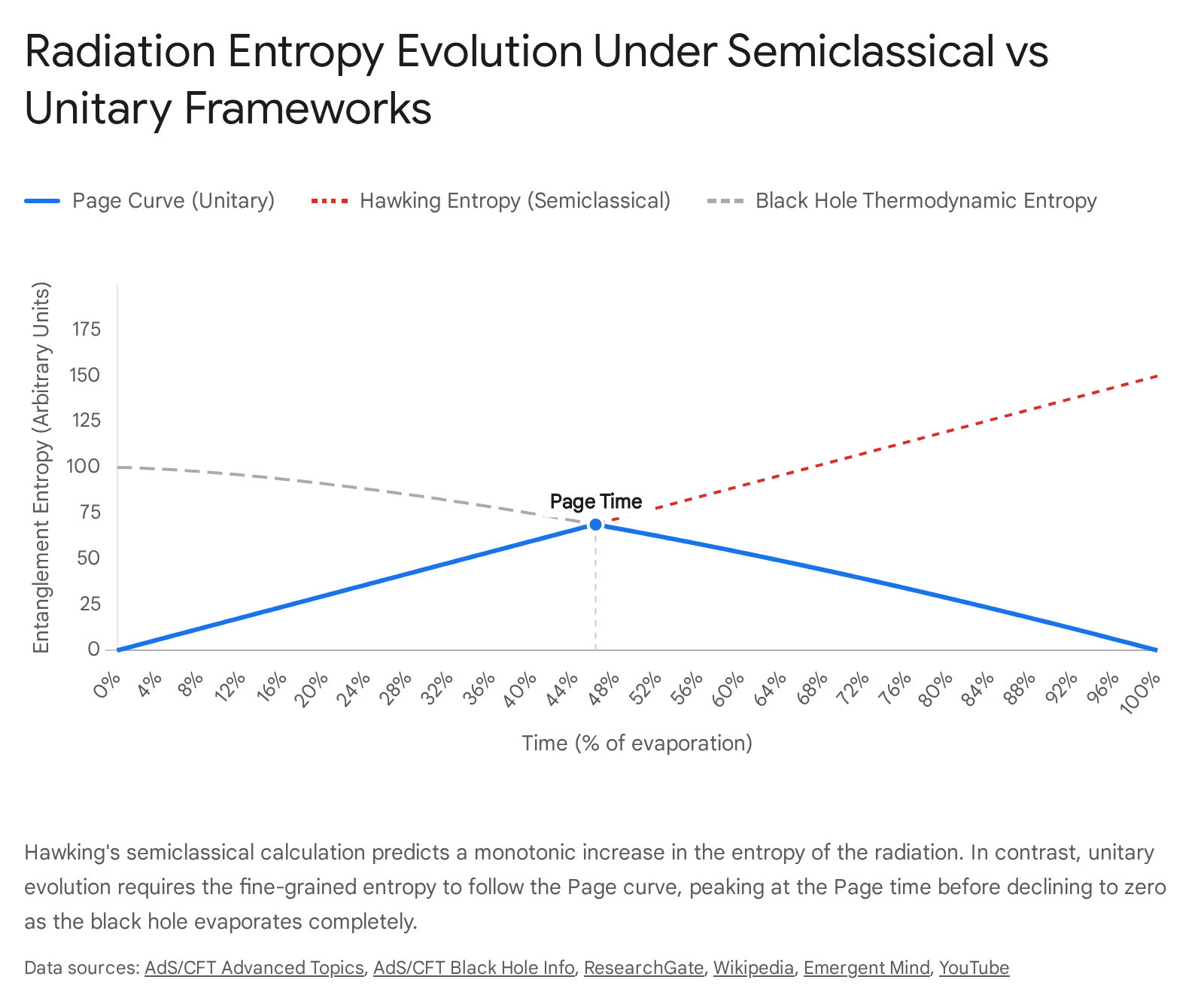
Because the emitted radiation is strictly thermal, it corresponds to a mixed quantum state devoid of any detailed information regarding the initial matter that formed the black hole. As the black hole radiates, it loses mass and eventually evaporates entirely. If the initial state of the collapsing star was a pure quantum state, the complete evaporation leaves behind only thermal radiation in a mixed state. This evolution from a pure state to a mixed state fundamentally violates unitarity, a core tenet of quantum mechanics which dictates that the time evolution of a closed system must be reversible and preserve quantum information 1. The von Neumann entropy of the radiation, calculated semiclassically, increases monotonically as the evaporation proceeds, indicating a continuous loss of information 34.
The paradox forces a choice between abandoning the unitarity of quantum mechanics or modifying the semiclassical understanding of gravity at the event horizon. For decades, the lack of a complete theory of quantum gravity prevented a rigorous resolution. Theories proposing long-lived remnants, baby universes, or firewalls at the horizon were advanced, but each introduced severe secondary theoretical challenges 576.
Quantum Entanglement and the Page Curve
In 1993, Don Page approached this problem through the lens of bipartite quantum entanglement and the statistical mechanics of random pure states. Page established that if the universe (the black hole and its emitted radiation) is treated as a closed quantum system evolving unitarily, the entanglement entropy of the radiation cannot grow indefinitely 17.
To understand this, a distinction must be made between coarse-grained thermodynamic entropy and fine-grained von Neumann entropy. The coarse-grained entropy of the black hole is given by the Bekenstein-Hawking formula, which states that the entropy is proportional to the surface area of the event horizon: $S_{BH} = \frac{A}{4G_N}$, where $A$ is the area and $G_N$ is Newton's constant 48. The fine-grained von Neumann entropy measures the actual quantum information content and entanglement of a specific state.
Initially, the fine-grained radiation entropy increases as the black hole emits entangled pairs, with one particle escaping to infinity and its partner falling behind the horizon 910. However, because the total number of degrees of freedom in the remaining black hole decreases as it evaporates, the dimension of the black hole's Hilbert space eventually becomes smaller than the dimension of the subsystem of the emitted radiation. At this juncture, known as the Page time, the fine-grained von Neumann entropy of the radiation must begin to decrease, returning to zero when the black hole vanishes 710.
The requirement that the fine-grained entropy follow this "Page curve" transformed the paradox from a qualitative debate into a precise quantitative calculation. If the entropy follows the inverted-V shape, information is preserved. If it follows the monotonically increasing line, information is destroyed 1011. However, achieving the unitary calculation within a strict gravitational framework remained elusive for nearly three decades. Semiclassical gravity seemed incapable of recognizing the macroscopic quantum correlations required to decrease the entropy of the outgoing radiation 1112.
The Central Dogma of Black Hole Physics
The theoretical necessity of the Page curve gave rise to the "central dogma" of black hole information physics. This dogma asserts that an external observer can describe a black hole as a standard quantum mechanical system possessing discrete internal states proportional to the exponential of its area, $e^{A/4G_N}$, which evolve unitarily 1314. The central dogma effectively posits that the horizon area constitutes the exact thermodynamic coarse-grained entropy limit of the black hole 15. The computation of the Page curve serves as the critical test of this dogma, requiring the fine-grained entropy of the external radiation to intimately track the decreasing thermodynamic entropy of the black hole after the Page time 1316.
Holographic Entanglement and Semiclassical Gravity
The path to computing the Page curve from first principles within a theory of gravity relies heavily on advancements in the Anti-de Sitter/Conformal Field Theory (AdS/CFT) correspondence 1718. AdS/CFT establishes a definitive holographic duality between a theory of quantum gravity in a negatively curved spacetime (the "bulk") and a non-gravitational conformal field theory residing on its lower-dimensional asymptotic boundary 1719. If the boundary CFT evolves unitarily - which it must, by definition - then any dual bulk gravitational processes, including black hole formation and evaporation, must also be fundamentally unitary.
The Ryu-Takayanagi and HRT Prescriptions
A pivotal development in this holographic framework was the geometric formulation of entanglement entropy. In standard quantum field theory, computing the entanglement entropy of a spatial subregion is a highly complex process involving trace operations over infinite degrees of freedom. The Ryu-Takayanagi (RT) formula provided a profound simplification, demonstrating that to leading order in the gravitational coupling (the $1/N$ expansion), the von Neumann entropy of a boundary CFT subregion $B$ corresponds to the area of a minimal codimension-2 surface in the AdS bulk that is homologous to $B$ 2023.
The classical RT formula was subsequently extended to general dynamical spacetimes via the Hubeny-Rangamani-Takayanagi (HRT) prescription, which utilized extremal rather than purely minimal surfaces to account for time evolution 2321.
Quantum Extremal Surfaces and Generalized Entropy
To accurately account for semiclassical effects - specifically the bulk quantum fields propagating on the curved background geometry - the classical RT/HRT formulas required modification. Faulkner, Lewkowycz, and Maldacena (FLM) demonstrated that the first-order quantum correction involves adding the bulk entanglement entropy of the quantum fields residing between the boundary region and the classical extremal surface 1321.
Building on the FLM correction, Engelhardt and Wall formalized the modern understanding by identifying that the appropriate surface must extremize the entire generalized entropy functional, leading to the formulation of the Quantum Extremal Surface (QES) 25. The generalized entropy functional for a candidate bulk surface $\Sigma$ is mathematically defined as:
$S_{\text{gen}}[\Sigma] = \frac{\text{Area}(\Sigma)}{4G_N} + S_{\text{bulk}}(\Sigma)$
Here, $G_N$ is Newton's constant, the area term represents the geometric contribution of the surface, and $S_{\text{bulk}}(\Sigma)$ is the fine-grained von Neumann entropy of the bulk quantum fields within the specific entanglement wedge bounded by $\Sigma$ 25. The QES is the unique surface that renders $S_{\text{gen}}$ stationary under infinitesimal spatial deformations. If multiple valid QESs exist, the physical fine-grained entropy is given by the surface that yields the global minimum value of the generalized entropy functional.
The Island Formula Mechanics
The modern resolution to the computation of the Page curve utilizes the "island formula," a direct conceptual extension of the QES prescription applied to an evaporating gravitating region coupled to an auxiliary non-gravitational bath. In 2019, independent teams - Penington, and Almheiri, Engelhardt, Marolf, and Maxfield - demonstrated that when a black hole is allowed to evaporate into an external reservoir, the generalized entropy functional must be evaluated over potentially disconnected subregions of the bulk 1026.
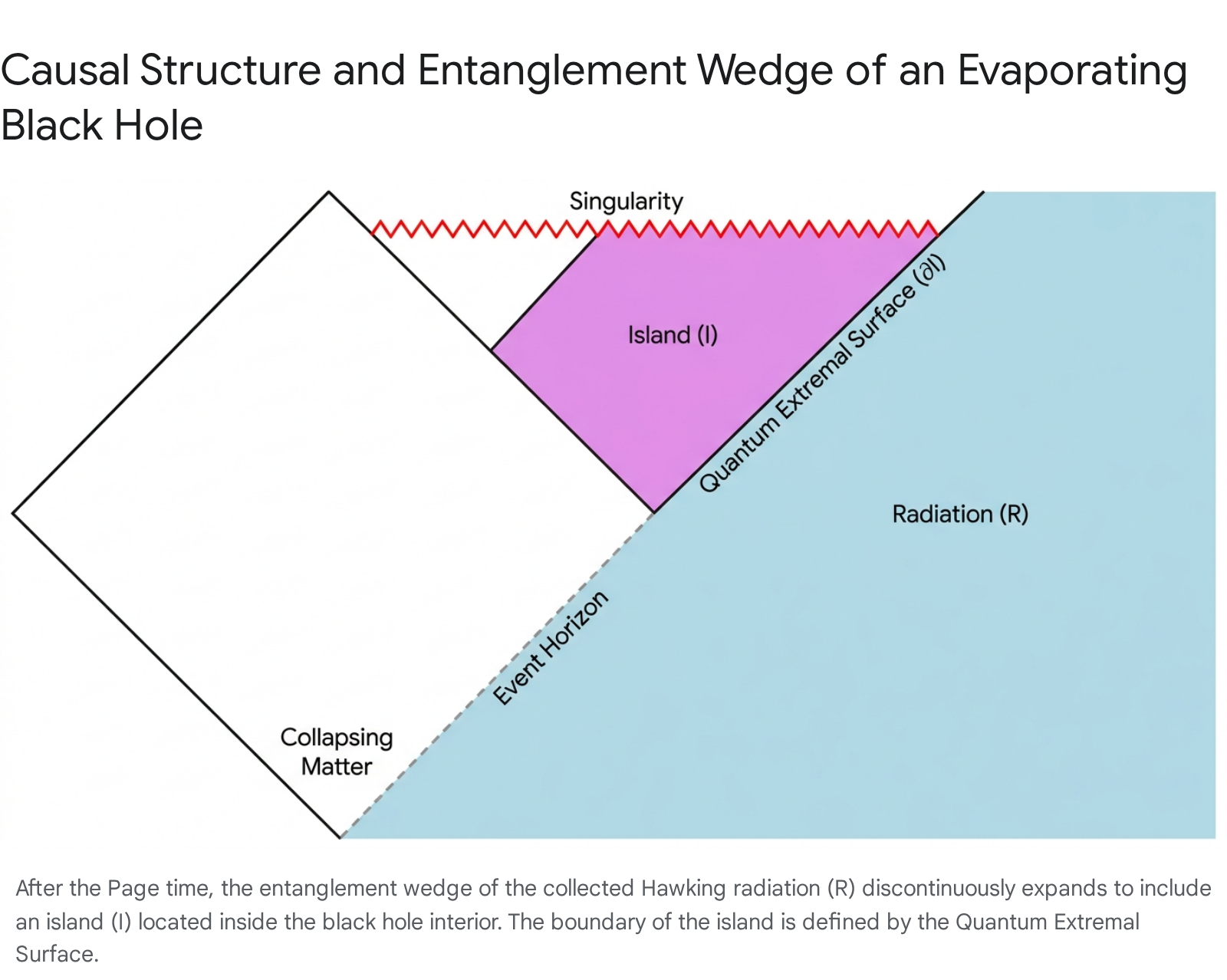
For a radiation region $R$ residing in the non-gravitational bath, the fine-grained entropy is not merely the entropy of the quantum fields contained within $R$. Instead, the semiclassical gravity path integral dictates that one must include a potential bulk region, $I$ (the "island"), which is located inside the gravitating spacetime, typically behind the black hole event horizon 22.
The fine-grained entropy of the radiation is given by extremizing the generalized entropy over all possible interior island configurations:
$S(R) = \min_{I} \, \operatorname{ext}{I} \left[ \frac{\text{Area}(\partial I)}{4G_N} + S{\text{bulk}}(R \cup I) \right]$
In this formula, $\partial I$ represents the boundary of the island, which is precisely the quantum extremal surface. The term $S_{\text{bulk}}(R \cup I)$ computes the joint entanglement entropy of the quantum fields residing in the exterior radiation region $R$ and the interior island region $I$ 2122.
Phase Transitions in Evaporation
The evaluation of this minimization protocol naturally results in a phase transition that reproduces the Page curve. At early stages of evaporation (prior to the Page time), the dominant mathematical saddle is the trivial empty set, where $I = \emptyset$. Under this condition, the geometric area term vanishes, and the entropy $S(R)$ is purely the entanglement entropy of the exterior fields, $S_{\text{bulk}}(R)$. Because the radiation is highly entangled with its interior partners (which are not included in the empty set island), this entropy grows monotonically, matching Hawking's original semiclassical calculation 322.
However, as the black hole continues to radiate, the entanglement between the radiation region $R$ and the interior partners grows substantially. Eventually, a critical threshold is reached at the Page time. At this point, a new non-empty island configuration emerges inside the black hole event horizon 313. Because the Hawking quanta in $R$ are heavily entangled with their interior partners located within $I$, the joint state of the fields in the union $R \cup I$ is essentially pure, meaning $S_{\text{bulk}}(R \cup I)$ is small 21.
Consequently, the generalized entropy is instead dominated by the geometric area term $\frac{\text{Area}(\partial I)}{4G_N}$. As the black hole continues to evaporate and shrink, the physical area of the quantum extremal surface $\partial I$ steadily decreases. Because the radiation entropy is bounded by this shrinking area, the fine-grained entropy of the radiation must decrease, perfectly tracking the Bekenstein-Hawking entropy down to zero and successfully reproducing unitary evolution 422.
The Replica Trick and Euclidean Wormholes
The physical origin of the island formula lies in the Euclidean gravitational path integral used to compute the von Neumann entropy via the replica trick. Because computing the von Neumann entropy $S = -\text{Tr}(\rho \log \rho)$ directly is mathematically prohibitive for path integrals, physicists calculate the Rényi entropies by evaluating the partition function on a manifold composed of $n$ replicas of the original geometry, eventually taking the analytical continuation limit $n \to 1$ 1323.
When gravity is dynamical, the path integral must integrate over all possible spacetime topologies that satisfy the prescribed boundary conditions. The calculation of the radiation entropy involves multiple copies of the black hole and the external bath. The competing phases of the Page curve correspond to two distinct classes of saddle points in this gravitational path integral 1213.
| Saddle Point Configuration | Topological Structure | Island Geometry | Entropy Behavior |
|---|---|---|---|
| Hawking Saddle | Replicas remain topologically disconnected in the bulk geometry. | Empty Set ($I = \emptyset$) | Entropy grows linearly, reflecting thermal radiation loss. |
| Replica Wormhole Saddle | Euclidean wormholes bridge the interior regions of different replicas. | Non-empty ($I \neq \emptyset$) | Entropy decreases proportional to the shrinking horizon area. |
At early times, the disconnected Hawking saddle possesses the lowest generalized entropy, dictating the monotonic growth. However, the action of the replica wormhole saddle depends on the extensive entanglement between the radiation and the interior. As this entanglement accumulates, the replica wormhole saddle eventually dominates the path integral at the Page time 13. As the analytic continuation $n \to 1$ is taken, the replica wormholes "pinch off," but their geometric footprint remains embedded in the single-copy spacetime as the interior island $I$ 1321. The replica wormholes therefore provide the underlying gravitational mechanism that forces the semiclassical approximation to recognize the macroscopic superposition required for unitary evaporation 12.
Implementations in Lower-Dimensional Toy Models
The initial proofs and explicit calculations of the island formula were confined to lower-dimensional toy models due to the intractable complexity of tracking quantum field entanglement in four-dimensional gravity. The most prominent of these are two-dimensional dilaton gravity theories, specifically Jackiw-Teitelboim (JT) gravity and the Callan-Giddings-Harvey-Strominger (CGHS) model 524.
In two dimensions, the Einstein-Hilbert action is purely topological, rendering standard general relativity trivial. However, by coupling the geometry to a scalar dilaton field, the dilaton effectively acts as the higher-dimensional area, allowing for black hole solutions with horizons and thermodynamics 25. In JT gravity, the spacetime is nearly $AdS_2$, providing an ideal testing ground for holographic principles where the metric reduces to algebraic equations 2531.
To model evaporation dynamically, researchers couple the $AdS_2$ black hole to an auxiliary, non-gravitational flat spacetime bath. Normally, AdS boundaries reflect radiation back into the bulk, preventing total evaporation. The introduction of transparent boundary conditions allows the Hawking radiation to leak from the gravitating region into the flat bath, where it is collected by the subregion $R$ 1922. The exact solvability of the boundary conformal field theory ($CFT_1$ or $CFT_2$) in these models allows the exact confirmation that the island emerges behind the horizon and the Page curve is recovered 2425.
Extensions to Four-Dimensional Spacetimes
A major focus of theoretical physics between 2024 and 2026 has been extending the island paradigm from 2D dilaton models to realistic four-dimensional spacetimes 5924. In four-dimensional, asymptotically flat spacetimes, the direct evaluation of quantum field entanglement entropy remains highly non-trivial. However, researchers have achieved breakthroughs by utilizing the $s$-wave approximation and near-horizon dimensional reduction techniques 2627.
Schwarzschild and Kerr-Newman Geometries
For a 4D Kerr-Newman black hole - which models a generalized rotating, charged mass - the scalar field dynamics near the event horizon can be mathematically reduced to an effective two-dimensional theory coupled to a dilaton field and a $U(1)$ gauge field 2627. Within this effective 2D framework, the entanglement entropy formula of $CFT_2$ can be adapted to calculate the generalized entropy.
Analyses of these effective models demonstrate that entanglement islands do indeed emerge in both non-extremal Kerr-Newman and Kerr-AdS backgrounds 2627. The inclusion of angular momentum and electric charge fundamentally alters the evaporation timeline and the geometry of the island.
| Parameter Variation | Impact on Page Time | Impact on Scrambling Time | Physical Implication |
|---|---|---|---|
| Increased Angular Momentum ($J$) | Increases | Increases | Rotation delays the emergence of the island and slows information extraction. |
| Increased Electric Charge ($Q$) | Decreases | Decreases | High charge density accelerates the dominance of the replica wormhole saddle. |
Extremal Black Holes and Schwarzian Dynamics
Near-extremal black holes - where the mass approaches the minimal possible value to sustain the specific charge and angular momentum without exposing a naked singularity - present unique theoretical challenges. The classical Hawking temperature and surface gravity of an exact extremal black hole are zero, which historically suggested absolute stability and the possibility of information-hoarding remnants.
However, calculations utilizing the extended island formula reveal that for regular (non-singular) black hole models acting as remnants, the entanglement entropy without islands diverges at the endpoint, indicating a severe breakdown of the semiclassical approximation 53435. Relying on the Kerr/CFT correspondence, the near-horizon geometry of a near-extremal Kerr-Newman black hole can be modeled as a warped AdS geometry. The low-energy effective degrees of freedom are dominated by Schwarzian dynamics, imposing a one-loop correction on the partition function.
Calculating the island formula under these quantum-corrected thermodynamic conditions reveals significant quantum delays in the Page time, suggesting that quantum fluctuations in the Schwarzian sector severely suppress the rate of information leakage 26. Furthermore, computations indicate that regular black hole remnants are likely unstable, decaying via quantum fluctuations into horizonless spacetimes, thereby mitigating the infinite remnant paradox 535.
De Sitter Spacetime and Cosmological Horizons
Adapting the island formula to de Sitter (dS) spacetime - the metric describing our accelerating, positive cosmological constant universe - imposes severe conceptual hurdles. Unlike Anti-de Sitter space, dS lacks a spatial boundary where a non-gravitational dual CFT can be anchored, and its cosmological horizon radiates analogously to a black hole horizon 1631.
When applying the central dogma to cosmological horizons, one assumes that an observer in a single static patch of dS space views the horizon as a quantum system with $e^{A/4G_N}$ degrees of freedom 36. However, the dS cosmological horizon is strictly observer-dependent, and the radiation remains in thermal equilibrium with the background space. A static observer does not witness a monotonically increasing radiation entropy unless the dS isometries are spontaneously broken, such as in an inflationary or quasi-dS cosmological phase 16.
When modeling entanglement in exact dS space, the conventional island formula designed for AdS systems encounters difficulties, failing to yield a physically plausible extremal surface 37. To bypass this, breakthroughs in 2024 utilized a doubly holographic model, embedding a $dS_2$ braneworld within an $AdS_3$ bulk spacetime. By computing the entanglement entropy via holographic correlation functions, researchers demonstrated that calculating entropy in dS gravity requires a non-extremal island 37.
During the island phase, the boundary of this non-extremal island is defined strictly at the edge of the dS gravitational region. Crucially, the analysis reveals that the entanglement wedge of the non-gravitational bath expands to encompass the entirety of the dS gravitational space 37. This geometric conclusion suggests that for an observer collecting radiation larger than the horizon entropy, the fine-grained entropy vanishes. This indicates a trivial, one-dimensional Hilbert space for an isolated dS universe when viewed globally, a highly debated feature linked to the broader dS swampland conjectures in string theory 162829.
To handle quantum field theory non-perturbatively in dS spaces, theorists have introduced the Kontorovitch-Lebedev-Fourier (KLF) momentum space representation. This framework relies on the unitary representations of the dS isometry group $SO(1, d+1)$, circumventing the lack of a global timelike Killing vector and asymptotic future states, enabling more rigorous structural definitions of cosmological correlation functions without relying on AdS boundary methodologies 31.
Theoretical Critiques and Alternative Resolutions
While the island formula provides a mathematical mechanism to recover the Page curve, intense debate persists regarding its physical validity when applied beyond simplified holographic setups. The primary structural critique is that the island formulation heavily relies on coupling a gravitating system to an auxiliary, non-gravitational thermal bath 930.
The Massive Graviton Requirement
In standard four-dimensional spacetime, gravity is long-range, mediated by a massless graviton, and local physical states are strictly constrained by the gravitational Gauss law. Every localized operator in the bulk must be gravitationally dressed to the asymptotic boundary 30.
When a gravitational region is coupled to a non-gravitational bath - as is required to collect Hawking radiation and evaluate the island formula - the graviton necessarily acquires a mass 3031. In a theory with massive gravity, the Gauss law is fundamentally altered. Critics argue that islands, defined as entanglement wedges disconnected from the asymptotic boundary, are only mathematically consistent in theories with massive gravitons. In standard massless gravity, the energy of an excitation localized inside an isolated island can technically be detected from the outside via its long-range gravitational field. This violates the fundamental principle that operators within an entanglement wedge must commute with operators in its complement 3032.
The Holography of Information Principle
Spearheaded by theoretical physicists at the International Centre for Theoretical Sciences (ICTS), including Suvrat Raju, the "Holography of Information" principle asserts that the island formula may be solving a paradox that does not truly exist in exact theories of massless gravity 1933.
In a standard quantum field theory without gravity, the "split property" allows the state of a system to be specified independently on a bounded subregion and its complement. Hawking's original paradox tacitly assumed this split property, positing that information inside the black hole interior is entirely inaccessible to the exterior 1931. However, the holography of information principle dictates that quantum gravity inherently violates the split property. Because of the constraints of the Hamiltonian and diffeomorphism invariance, a complete copy of all information present on any Cauchy slice is simultaneously available near the asymptotic boundary of that slice 3144.
According to this framework, information never falls exclusively into the black hole in a way that isolates it from the boundary. Precise quantum observations of the exterior spacetime, including the gravitational dressing, already contain the full interior state 3344. From this perspective, the Page curve generated by the island formula in coupled-bath scenarios merely measures the transfer of information between the artificial boundary and the auxiliary bath, rather than providing the actual physical mechanism of information extraction from an astrophysical black hole in flat space 3132.
Alternative Information Preservation Mechanisms
Beyond the island debate, parallel research spanning 2025 and 2026 has proposed alternative physical mechanisms for information preservation that do not rely on Euclidean wormholes or holographic bath coupling:
- Stimulated Emission Resurgence: Recent classical-quantum analyses argue that Hawking's original semiclassical derivation overlooked the role of stimulated emission. By resurrecting the contribution of stimulated emission accompanying the spontaneous Hawking radiation, calculations indicate a positive classical information transmission capacity. This suggests that information is fully recoverable at the horizon without invoking topologically disconnected islands 45.
- Quantum Error Correction Models: Other frameworks propose that the universe inherently resides in a quantum error-corrected state. Any local region that collapses into a black hole is already described by a mixed state locally. In this paradigm, the local black hole encodes no distinct information, bypassing the paradox by rejecting the premise that a localized pure state undergoes a non-unitary transition 34.
- Spontaneous Symmetry Breaking: A recent proposition links the information paradox to spontaneous symmetry breaking during the black hole's selection of a ground state. By summing over all possible order parameters (particle number operators), the density matrix of the mixed radiation spectrum can mathematically recover the trivial pure ground state prior to gravitational collapse 2.
Conclusion
The integration of the island formula and quantum extremal surfaces into semiclassical gravity marks a watershed moment in theoretical physics, providing the first first-principles derivation of the unitary Page curve. By permitting the Euclidean path integral to explore non-trivial topologies via replica wormholes, the gravitational framework inherently recognizes the macroscopic entanglement that purifies Hawking radiation.
The successful extension of this mathematical machinery from two-dimensional toy models to four-dimensional Kerr-Newman black holes and de Sitter cosmological horizons demonstrates the profound mathematical robustness of the generalized entropy functional. However, the precise physical mechanism by which information transitions from the interior to the exterior remains obscured by the abstract nature of the replica trick. Furthermore, the requirement of auxiliary non-gravitational baths and the tensions with the holography of information principle in exact massless gravity indicate that the island formula may be a structural proxy for deeper non-local encoding rules in quantum gravity. Resolving whether the island represents a literal geographic linkage via ER=EPR wormholes, or merely a mathematical accounting tool reflecting global boundary constraints, remains the definitive frontier in the ongoing synthesis of general relativity and quantum mechanics.