
Introduction to Tropical Geometry
Algebraic Foundations and Semiring Structures
The Tropical Semirings
Tropical geometry functions as a piecewise-linear, skeletonized version of classical algebraic geometry, operating over the tropical semiring. In its standard formulation, known as the min-plus semiring, the underlying set is the extended real numbers $\mathbb{R} \cup {\infty}$. This set is equipped with two modified operations: classical addition is replaced by the minimum function, and classical multiplication is replaced by ordinary addition 12. Formally, for any $x, y \in \mathbb{R} \cup {\infty}$:
$x \oplus y = \min(x, y)$ $x \otimes y = x + y$
This algebraic structure is fundamentally an idempotent semiring because the addition operation satisfies the property $x \oplus x = x$ 2. It inherently lacks additive inverses, meaning that classical subtraction is not strictly defined within the tropical framework 2. A parallel and mathematically isomorphic formulation is the max-plus semiring, which operates over $\mathbb{R} \cup {-\infty}$. In this convention, addition is defined as the maximum of two values ($x \oplus y = \max(x, y)$), while multiplication remains classical addition 2.
The choice between min-plus and max-plus conventions is typically dictated by the specific application domain. Minimization is frequently utilized in algebraic geometry, valuation theory, and combinatorial optimization (such as shortest-path algorithms), whereas maximization is often favored in dynamic programming, game theory, and machine learning architectures 13.
Maslov Dequantization and Valued Fields
The transition from classical geometry over a field to tropical geometry over a semiring can be understood formally through a process known as Maslov dequantization. This procedure treats the classical real semi-field $(\mathbb{R}_{>0}, +, \times)$ as a continuous deformation of the tropical semi-field 4. By introducing a parameter $t > 0$, one defines a parameterized addition and multiplication:
$x +_t y = \log_t(t^x + t^y)$ $x \times_t y = \log_t(t^x \cdot t^y) = x + y$
As the base $t$ approaches infinity, the parameterized addition $+_t$ converges asymptotically to the tropical maximum (when employing the max-plus convention):
$\lim_{t \to \infty} \log_t(t^x + t^y) = \max(x, y)$
This logarithmic limit illustrates precisely how the classical semi-field degenerates into the tropical semi-field. The process justifies the term "dequantization," positing that classical geometry acts as a "quantum" deformation of the piecewise-linear "classical mechanics" represented by tropical geometry 45.
To define the tropicalization of an algebraic variety rigorously, mathematicians often work over a field equipped with a non-Archimedean valuation. Common examples include the field of Laurent series or the field of formal Puiseux series over an algebraically closed field, where the valuation returns the smallest exponent appearing in the series 167. The fundamental theorem of tropical geometry asserts that the tropical variety of an ideal coincides exactly with the closure of the image of the variety under this coordinate-wise valuation map 6.
| Classical Operation / Structure | Classical Definition | Tropical Equivalent (Min-Plus) | Geometric Consequence |
|---|---|---|---|
| Addition | $x + y$ | $\min(x, y)$ | Polynomials degenerate into piecewise linear functions. |
| Multiplication | $x \times y$ | $x + y$ | Exponentiation becomes linear multiplication. |
| Additive Identity | $0$ | $\infty$ | Null values shift to the far boundaries of the domain. |
| Multiplicative Identity | $1$ | $0$ | Geometric scaling relies entirely on translation. |
| Algebraic Variety | Solutions to $P(x)=0$ | Locus where the minimum is achieved at least twice | Smooth geometric curves degenerate into polyhedral graphs. |
Amoebas, Spines, and Geometric Degeneration
Amoebas of Algebraic Varieties
An amoeba serves as a crucial intermediate geometric object that bridges classical complex algebraic varieties and their discrete tropical counterparts. For a complex algebraic variety $V \subset (\mathbb{C}^)^n$, the amoeba $\mathcal{A}(V)$ is defined as the image of $V$ under the logarithmic map $\text{Log}: (\mathbb{C}^)^n \to \mathbb{R}^n$, given by $\text{Log}(z_1, \ldots, z_n) = (\log|z_1|, \ldots, \log|z_n|)$ 87.
When $V$ is a hypersurface defined by a Laurent polynomial, its amoeba takes the shape of a continuously curved, tentacled domain in $\mathbb{R}^n$. The geometric properties of the amoeba strongly reflect the underlying topological properties of the complex variety. The connected components of the complement of the amoeba, $\mathbb{R}^n \setminus \mathcal{A}(V)$, correspond bijectively to the vertices of the Newton polytope associated with the defining polynomial, provided those components contain an affine convex cone with a non-empty interior 7.
Amoebas are deeply analyzed in terms of their sparsity and solidity. An amoeba is classified as "solid" if the number of connected components of its complement is minimal - specifically, equal to the number of vertices of the polynomial's Newton polytope 8. Solid amoebas are particularly well-adapted to tropical geometry, as they frequently correspond to maximally sparse polynomials where the support of summation is minimal 8.
Passare-Rullgård Spines and Polyhedral Skeletons
As the logarithmic base $t$ approaches infinity, the amoeba shrinks and retracts onto a piecewise-linear polyhedral complex known as the tropical variety, or the "spine" 48.
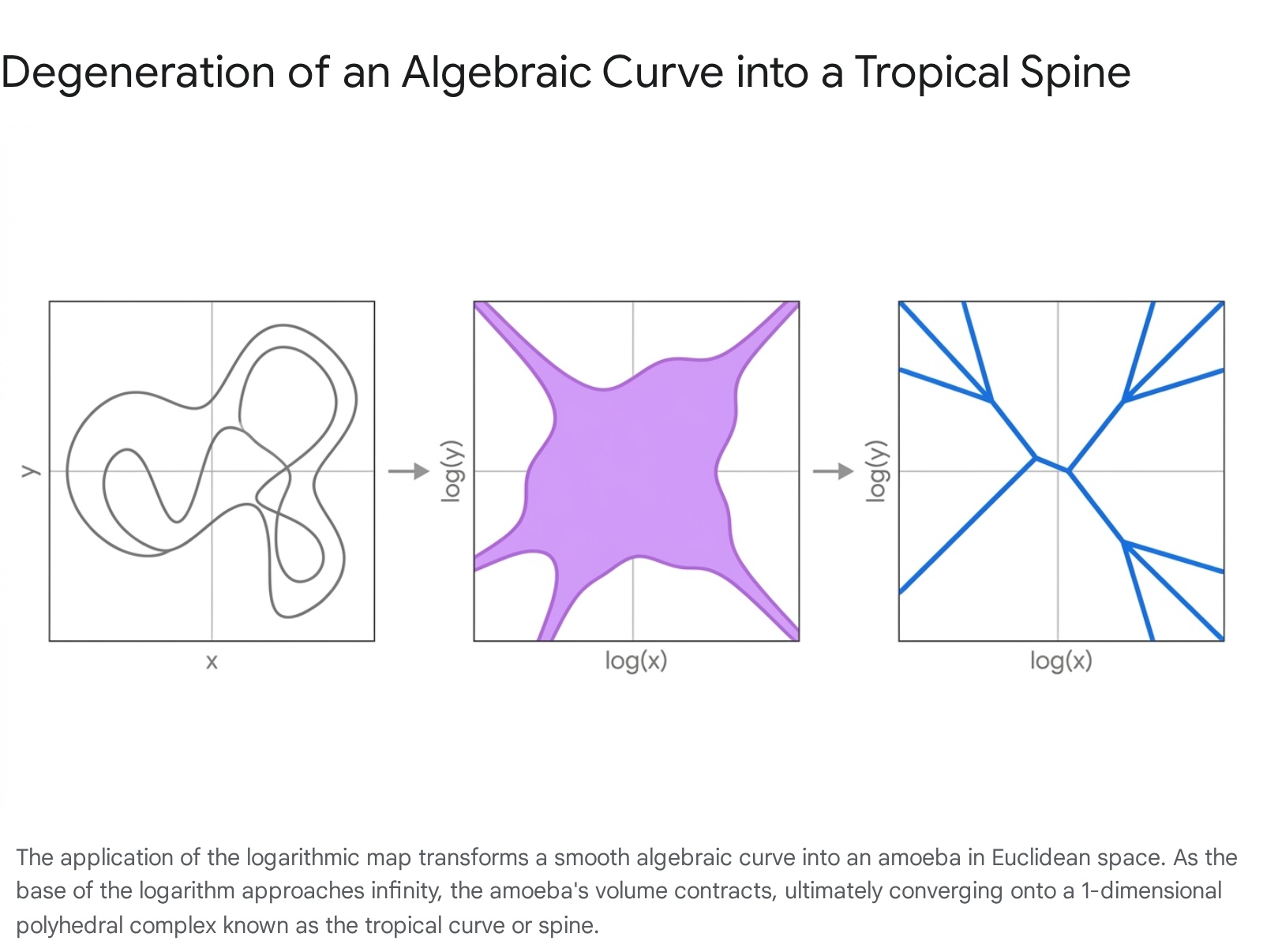
This convergence is dictated by the theorem of Mikhalkin and Rullgård, which states that for a sequence of curves parameterized by $t$, the amoeba $\text{Log}_t(C_t)$ converges precisely to the tropical curve defined by the corresponding tropicalized polynomial 4.
The Passare-Rullgård spine represents a specifically defined tropical variety inside the amoeba of a hypersurface, functioning mathematically as a deformation retract. In the case of rational complex curves, the tropical spine operates as a bounded approximation in the Hausdorff metric, maintaining a universally bounded distance from the original amoeba 88.
The resulting tropical varieties are purely polyhedral complexes that adhere to a specific zero-tension condition, commonly referred to as the balancing condition. This condition is analogous to Kirchhoff's current law in electrical networks. It dictates that at any given intersection point (vertex) of the tropical curve, the sum of the primitive integral vectors associated with the outgoing edges, weighted by their respective multiplicities, must exactly equal zero 4. Consequently, the global structure of a tropical polynomial's zero locus is a complex of interconnected, balanced linear segments.
Applications in Algebraic and Enumerative Geometry
Enumerative Geometry and Gromov-Witten Invariants
Tropical geometry has fundamentally restructured approaches to enumerative algebraic geometry, a discipline focused on counting the number of geometric objects that satisfy specific intersecting constraints. Classical enumerative problems - such as calculating the precise number of rational curves of a given degree and genus passing through a set of generic points in a projective space - are notoriously difficult and historically relied on highly complex algebraic machinery.
Tropical geometry simplifies this by mapping complex algebraic curves to tropical curves (metric graphs) in $\mathbb{R}^2$. This translates the continuous algebraic problem into a discrete combinatorial problem of counting lattice paths or planar graphs 1912. Grigory Mikhalkin's landmark correspondence theorem proved that the Gromov-Witten invariants, as well as Welschinger invariants for real algebraic geometry, can be computed exactly by counting the corresponding tropical curves and weighting each by a specific combinatorial multiplicity 1213. This dequantized approach provides computationally accessible algorithms and closed-form formulas, such as the Caporaso-Harris formula, for previously intractable enumerative systems 14.
Mirror Symmetry and the Gross-Siebert Program
In the context of theoretical string theory and algebraic geometry, tropical geometry provides the essential combinatorial scaffolding for the Gross-Siebert program. Mirror symmetry conjectures a deep dual correspondence between the symplectic geometry of a space (the A-model) and the complex algebraic geometry of its mirror space (the B-model) 1310. The Gross-Siebert program actively constructs these mirror manifolds by utilizing toric degenerations, a process wherein smooth Calabi-Yau manifolds degenerate into highly singular spaces whose resulting intersection complexes are inherently tropical manifolds 8.
Recent mathematical proofs have solidified these conceptual links. Researchers have demonstrated that proper Landau-Ginzburg superpotentials - which are defined in terms of tropical disks via a toric degeneration of a pair - equate precisely to the open mirror map for outer Aganagic-Vafa branes 10. Furthermore, it has been rigorously proven that these tropical superpotentials serve as exact solutions to the Lerche-Mayr Picard-Fuchs differential equations 10. In symplectic geometry, verifying the unobstructedness for Lagrangian submanifolds (such as Floer cochains) historically required complex deformation theory. Tropical geometry offers a combinatorially defined criterion for rigidity that, when satisfied, proves a corresponding Lagrangian submanifold is unobstructed, further cementing the correspondence between tropical combinatorics and symplectic topology 13.
Moduli Spaces, Hurwitz Spaces, and Severi Varieties
The analysis of moduli spaces of curves relies heavily on tropical methodologies. A significant recent breakthrough involves the proof of irreducibility for classical Hurwitz spaces, which parameterize simple $d$-sheeted coverings of the projective line by smooth genus-$g$ curves. Previously, irreducibility was only established when the characteristic of the ground field exceeded the degree $d$ 11.
By employing tropical geometry, researchers have resolved this limitation, proving irreducibility over algebraically closed fields in arbitrary characteristic 11. The core of this proof relies on a lifting result that successfully translates parametrized tropical curves back into the algebraic domain. This lifting guarantees a strong connectedness property within the tropical moduli spaces of parametrized curves 11. Consequently, this tropical machinery has been extended to establish the irreducibility of Severi varieties for a rich class of classical toric surfaces, entirely bypassing classical characteristic limitations 11.
Combinatorics, Matroids, and Hyperplane Arrangements
Bergman Fans and Matroid Subdivisions
The intersection of tropical geometry and combinatorial matroid theory centers on the concept of the Bergman complex. A matroid acts as a combinatorial abstraction of linear independence. Its associated Bergman fan functions natively as a tropical linear space. It is a fundamental result that every linear tropical variety is inherently connected to the Bergman fan of a realizable matroid 814.
The Bergman complex admits a highly structured combinatorial subdivision that is equivalent to the order complex of the lattice of flats of the associated matroid 8. This realization allows intersection theory to be applied directly to matroids. Consequently, researchers utilize tropical intersection products of Bergman fans to compute the realization numbers of minimally rigid bar-joint frameworks, deriving combinatorial upper bounds formulated using the evaluation of the Tutte polynomial 1417.
Hyperplane Arrangements and Yoshinaga's Contributions
The study of tropical and subtropical geometry is closely linked to the topology of hyperplane arrangements - collections of $(n-1)$-dimensional subspaces in an $n$-dimensional space. Masahiko Yoshinaga has significantly advanced this field by analyzing the freeness of the module of logarithmic vector fields associated with these arrangements 121314.
Yoshinaga's research bridges algebraic geometry, representation theory, and tropical combinatorics. He has established deep connections between the topological structure of the Milnor fiber of real line arrangements and characteristic quasi-polynomials derived from lattice point countings 1314. Through the study of Coxeter multiarrangements and totally free arrangements of hyperplanes, Yoshinaga's work has expanded the combinatorial generalizations of the Tutte polynomial to abelian Lie group arrangements and advanced the understanding of the Orlik-Solomon algebra and the Aomoto complex 1421. Furthermore, his categorification of enumerative problems utilizing the magnitude homology of metric spaces provides foundational combinatorial data that aligns with the structural requirements of tropical orientable matroids 1213.
Theoretical Physics and Dynamic Systems
Scattering Amplitudes and Dual Moduli Spaces
Tropical geometry has provided a remarkably compact and powerful mathematical language for quantum field theory, particularly concerning the formulations for scattering amplitudes. The Cachazo-He-Yuan (CHY) formula computes amplitudes via integrals over the moduli space $M_{0,n}$ of $n$ points on the projective line, localized to the solutions of scattering equations 2215. The tropicalization of this space directly encodes the biadjoint cubic scalar amplitude at the tree level, mapping singularities to the face lattices of the $(n-3)$-dimensional associahedron 22.
This framework naturally extends to generalized scattering amplitudes defined over twin moduli spaces $X(k,n)$ of $n$ generic points in higher-dimensional projective spaces $\mathbb{P}^{k-1}$. Analyzing the soft limits and singular solutions within these generalized spaces requires the construction of chirotopal Dressians and chirotopal tropical Grassmannians. These mathematical constructs rely on the combinatorial data of oriented matroids (chirotopes) to precisely map the polyhedral fan structures of scattering limits, revealing that fundamental particle physics dualities are manifestations of tropical geometric principles 2215.
Tropical Dynamics and Sandpile Models
Beyond static varieties, tropical geometry governs specific dynamical systems, notably abelian sandpile models and chip-firing games. These discrete dynamical systems model the distribution of resources (chips or sand grains) across the vertices of a graph. When the system is perturbed from a maximal stable state, the resulting relaxation process - dictated by a least action principle - produces soliton patterns and strings 16.
During relaxation, the locus of points differing from the maximal stable state forms a balanced graph. It has been rigorously proven that as the perturbation scales, the final stable state geometry converges precisely to a unique tropical curve that minimizes the action within the class of curves passing through the perturbation points 16. This demonstrates that tropical curves are not merely static algebraic artifacts but emerge naturally as the asymptotic limits of discrete optimization dynamics.
Biological Applications in Phylogenetics
In computational biology, tropical geometry perfectly dictates the geometric space of phylogenetic trees. A valid evolutionary tree requires its distance metrics to satisfy a strengthened triangle inequality, an essential condition for defining an ultrametric 25.
The tropical min-plus operation is fundamental to calculating the $\ell_\infty$-distance measure between an experimental dissimilarity map and idealized ultrametrics. Under the tropical geometric framework, the space of optimal phylogenetic reconstructions - those ultrametrics that minimize this specific distance - forms a bounded tropical polytope 25. Because classical representations of these extremes (such as Bernstein's characterization) were proven insufficient for trees with more than three leaves, advanced algorithms now leverage tangent hypergraph techniques to compute the extreme vertices of these polytopes 25. This geometric reformulation enables a mathematically rigorous tropical analog to Principal Component Analysis (PCA) designed specifically for analyzing complex phylogenetic datasets 25.
Economics, Trade Theory, and Mechanism Design
Subtropical Geometry in Ricardian Trade Theory
In economic theory, the Ricardian model of international trade (which analyzes international trade based on comparative advantage without input trade) possesses an underlying exotic geometric structure. Yoshinori Shiozawa formalized this behavior by utilizing "subtropical geometry" - a variant of tropical geometry that relies on max-times or min-times semirings rather than the standard max-plus structure 12617.
Within this subtropical algebra, the set of efficient production wage rate vectors and corresponding price vectors form convex structures. Together with the world production frontier, these create three distinct but isomorphic cell complexes 26. A simple logarithmic map naturally bridges the subtropical algebra of these trade variables to standard tropical algebra. This allows the vast machinery of tropical geometry - including tropical matroids, mixed subdivisions, cephoids, and Minkowski sums - to be applied directly to classical economic transportation problems, resolving structural ambiguities in historical trade equilibria frameworks 2617.
Tropical Frameworks for Auction Mechanisms
Tropical geometry also provides a formal geometric interpretation for mechanism design, specifically concerning finite-valued, multidimensional incentive-compatible mechanisms 1819. The fundamental goal of mechanism design in auction theory is to segment the type space (the private valuations of participating agents) in a manner that mathematically incentivizes truthful bidding.
In the tropical framework, the utility function of an agent participating in a deterministic auction correlates directly to a tropical polynomial 20. Incentive compatibility is perfectly characterized geometrically by the sectors or cells of a tropical convex hull dividing the type space 1931. These cells form tropical simplices spanned by generating payments 19.
This tropical methodology refines the analysis of complex multidimensional mechanisms. It offers intuitive geometric proofs for classical theorems like revenue equivalence and provides tools to analyze combinatorial allocations such as the Straight Jacket Auction (SJA) or Paul Klemperer's Product-Mix auction, which was famously utilized by the Bank of England during the financial crisis 12021.
Machine Learning and Artificial Intelligence
Neural Networks as Tropical Rational Functions
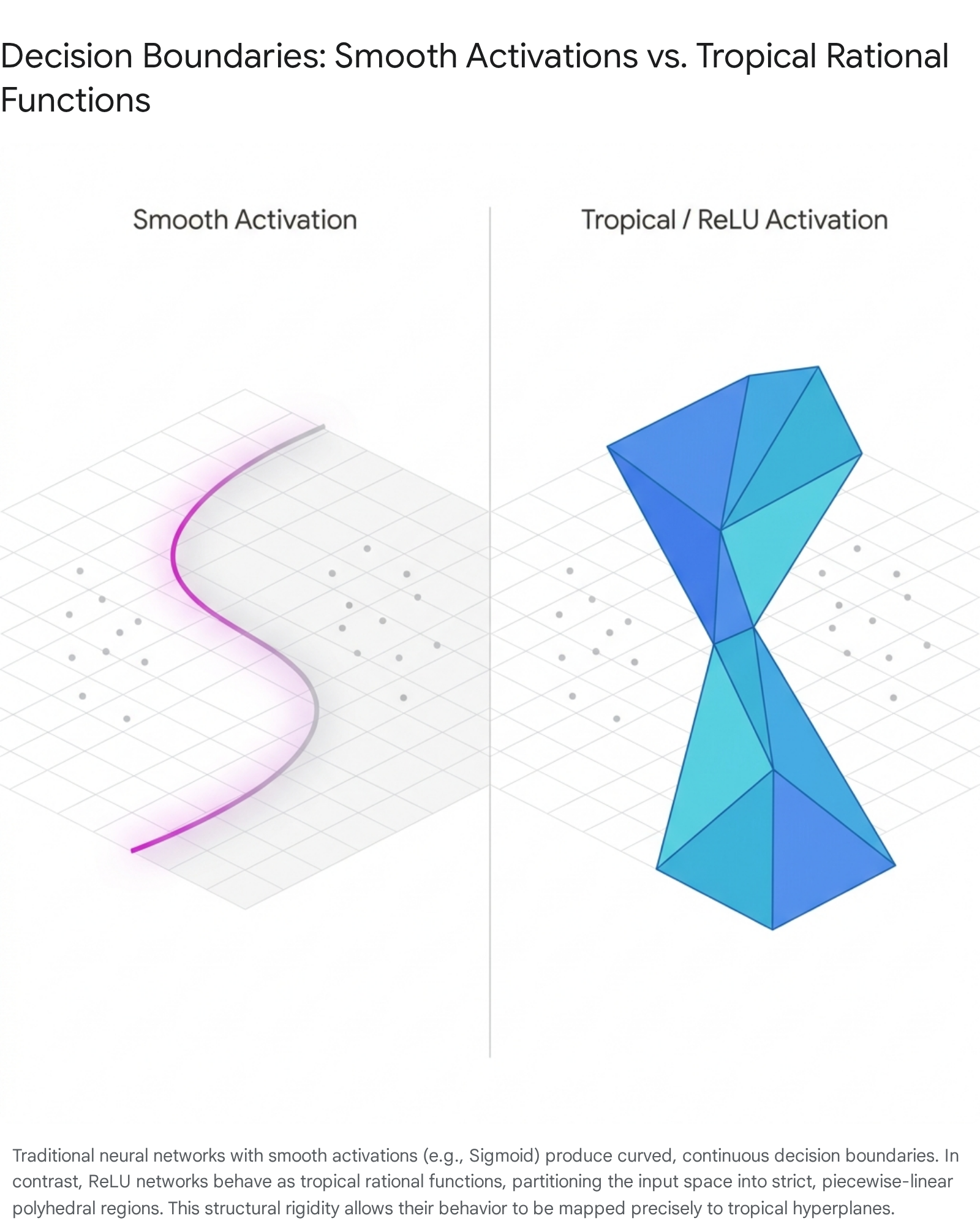
Recent theoretical advances have demonstrated a strict mathematical equivalence between deep neural networks utilizing Rectified Linear Unit (ReLU) activations and tropical geometry. The ReLU function, defined as $\max(0, x)$, acts natively as a tropical addition within the max-plus semiring 3334. Consequently, any feedforward neural network with ReLU activations computes a continuous, piecewise-linear function that can be expressed precisely as a tropical rational function - the difference between two max-plus tropical polynomials 3335.
This geometric perspective allows the decision boundaries of a network to be analyzed purely as tropical hypersurfaces. Instead of smooth gradient curves, the decision space is fractured into a complex arrangement of polyhedral cells, bounded by intersecting tropical hyperplanes 536.
Network Compression: TropNNC
The TropNNC (Tropical Neural Network Compression) framework utilizes this exact equivalence to achieve structured network pruning without requiring any access to the original training dataset. By evaluating the Hausdorff distance of zonotopes (Minkowski sums of line segments) associated with the weight tensors of each layer, TropNNC approximates positive and negative generators to systematically compress the network's tropical polynomials 3537.
The algorithm functions layer-by-layer, utilizing K-Means clustering combined with alternating minimization to find the optimal representative weights that maintain the simultaneous zonotope approximation. TropNNC is uniquely capable of pruning both linear and convolutional layers - the latter achieved by unraveling weight tensor kernels row-wise or column-wise prior to tropical reduction. Empirical evaluations on datasets such as MNIST, CIFAR, and ImageNet confirm that this geometrically derived pruning method matches or exceeds the performance of traditional data-driven baselines like ThiNet and CUP 353637.
Tropical Attention and Algorithmic Reasoning
Building upon the foundation of tropical neural networks, researchers have recently engineered Tropical Attention, a mechanism designed specifically for Neural Algorithmic Reasoning (NAR) over combinatorial optimization problems 3839. Standard Transformer architectures utilize a dot-product attention mechanism followed by Softmax normalization. However, the smooth, exponential weighting of Softmax artificially blurs the sharp polyhedral structures that are inherent to dynamic programming algorithms, often causing the model to fail when extrapolating to out-of-distribution (OOD) sequence lengths or values 322.
Tropical Attention completely bypasses this limitation by lifting the attention kernel directly into tropical projective space. By executing information routing using max-plus matrix multiplication and substituting the Softmax dot-product with the tropical Hilbert projective metric, the network's reasoning process becomes piecewise-linear, 1-Lipschitz (non-expansive), and idempotent 383922.
Mathematical proofs guarantee that stacks of Multi-Head Tropical Attention (MHTA) can universally approximate tropical circuits and simulate max-plus dynamic programming natively, realizing exact tropical transitive closures through composition 3841. Because the induced polyhedral decision boundaries remain sharp and scale-invariant, Tropical Attention models successfully execute NP-hard and NP-complete combinatorial tasks with high robustness against perturbative noise, operating significantly faster and with fewer parameters than recurrent or Softmax-based attention baselines 382343.
Beyond deep learning, the Universal Approximation Theorem (UAT) is currently being revisited through a tropical lens to design shape-driven, geometry-aware initialization techniques for Multi-Layer Perceptrons 3334. In computer vision, min-plus and max-plus algebras are being deployed to reformulate convolution and gradient computations for edge detection, utilizing multi-scale processing and Hessian filtering to capture dominant intensity variations without standard noise blurring 24.
| Machine Learning Concept | Standard Classical Approach | Tropical Geometry Approach | Primary Advantage |
|---|---|---|---|
| Activation Functions | Smooth non-linearities (Sigmoid, Tanh) | Max-plus operations (ReLU) | Explicit polyhedral mapping of decision regions. |
| Network Compression | Magnitude pruning via training data | Hausdorff distance of tropical zonotopes | Data-agnostic, mathematically bound compression. |
| Attention Mechanism | Dot-product with Softmax normalization | Max-plus aggregation via Hilbert projective metric | Scale-invariant, length/value OOD robustness. |
| Algorithm Simulation | Recurrent approximations (PTIME limits) | Tropical transitive closure compositions | Capable of exact reasoning on NP-hard problems. |
Computational Complexity and Algorithmic Bottlenecks
While the theoretical mapping between classical algebraic geometry and its tropical counterpart is profound, computing high-dimensional tropical varieties poses severe algorithmic challenges. Tropical computation algorithms rely heavily on tracking the tropicalization of polynomial ideals through a complex traversal of the Gröbner complex 25.
The primary algebraic bottlenecks in computing tropical varieties center on three highly intensive operations: computing generic initial ideals, checking those initial ideals for monomials, and executing the flip of standard bases 25. Specifically, the time complexity for calculating positive-dimensional tropical varieties is almost entirely dominated by the "Gröbner walk." Because Gröbner basis calculations can scale exponentially, calculating tropical intersections quickly becomes computationally intractable even in relatively low dimensions 926.
A parallel and equally difficult challenge exists in "positive tropicalization," which seeks to isolate the tropicalization of strictly the positive part of semi-algebraic sets and algebraic varieties 7. Calculating the positive tropicalization of linear spaces and certifying the containment of specific vectors within these bounds remains an active obstacle, primarily because the mathematical operation of tropicalization does not universally commute with the operation of intersection 747. While certain highly specific invariants, such as the tropical determinant, can be computed efficiently by circumventing polynomials entirely and using linear programming or combinatorial optimization techniques, general Gröbner-based structural computation remains a strict limitation for scalable applications 26.
Open Problems and Future Directions
Because tropical geometry is a relatively young field bridging discrete and continuous mathematics, it maintains a broad and active list of open theoretical problems 4727.
In pure mathematics, prominent unresolved challenges include determining the optimal axiomatization of tropical oriented matroids, classifying the exact face lattices of all tropical polytopes, and definitively establishing whether every valid tropical variety possesses the topological property of shellability 47. In tropical algebraic geometry, researchers are actively seeking a more robust formulation for the moduli space of curves of a specific degree $d$ and genus $g$ explicitly embedded within the tropical projective plane $\mathbb{TP}^2$ 47.
Within mathematical physics, there is an ongoing effort to define and classify compact tropical manifolds that are not strictly Calabi-Yau. This requires formulating procedures to choose polarizations (tropical Kähler classes) that allow the manifold to retain affine structures purely through algebro-geometric mechanics, independent of the chosen polarization 8. Finally, as tropical attention models and tropical neural network compression algorithms continue to demonstrate state-of-the-art results in artificial intelligence 2343, the optimization of massive max-plus and min-plus semiring computations in raw hardware remains a critical frontier for the next generation of algorithmic reasoning architectures.