
Inter-universal Teichmuller Theory and the abc conjecture
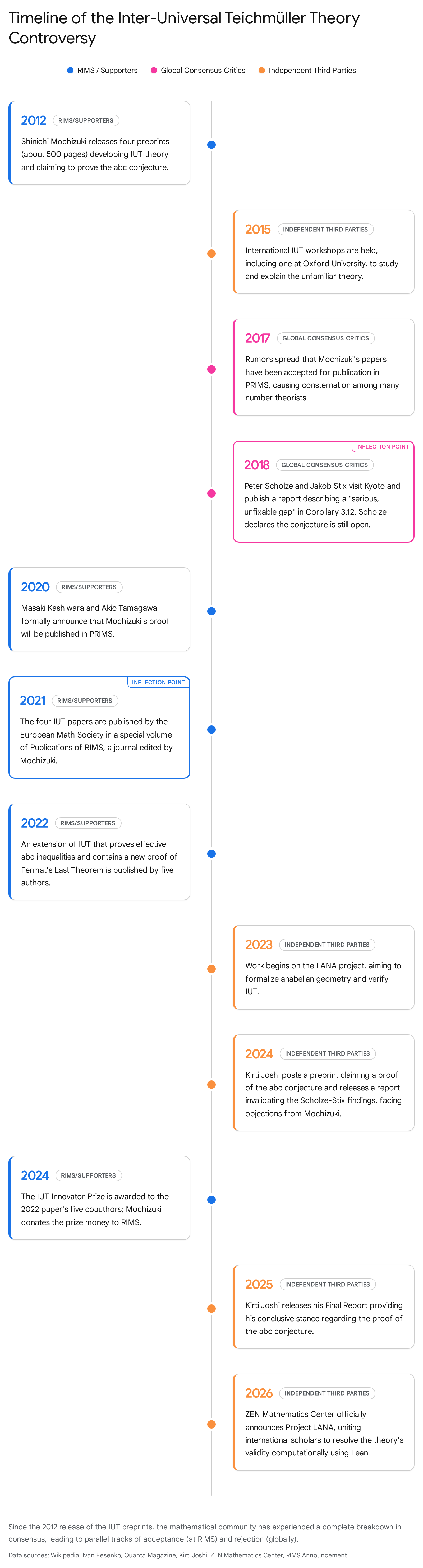
The abc conjecture remains one of the most profound and significant open problems in modern number theory, offering deep implications for Diophantine geometry and the fundamental relationship between the additive and multiplicative properties of integers. In August 2012, Shinichi Mochizuki, a highly respected mathematician at Kyoto University's Research Institute for Mathematical Sciences (RIMS), released a 500-page series of four preprints proposing a proof of the conjecture 12. This proof relied on an entirely novel, idiosyncratic, and extraordinarily complex theoretical framework named Inter-universal Teichmüller (IUT) theory. Over a decade later, the mathematical community remains deeply fractured. While a localized group of researchers centered around RIMS asserts the proof is complete, valid, and successfully peer-reviewed, the global mathematical consensus, spearheaded by prominent arithmetic geometers, maintains that the proof contains a fundamental, unfixable gap 345. The ensuing standoff has highlighted the limitations of traditional peer review, prompted private financial bounties, and accelerated the push toward the algorithmic formalization of mathematics.
Foundational Mathematics of the abc Conjecture
To comprehend the magnitude of the controversy, one must first understand the mathematical stakes of the abc conjecture. Formulated independently by Joseph Oesterlé and David Masser in 1985, the conjecture addresses the structural tension between addition and multiplication, specifically examining the prime factorizations of integers that satisfy a simple additive equation 56.
Formulations and the Concept of the Radical
The conjecture is stated in terms of three positive integers, $a$, $b$, and $c$, which are pairwise coprime (meaning they share no prime factors other than 1) and satisfy the additive equation: $$a + b = c$$
To articulate the conjecture, it is necessary to define the "radical" of an integer. For any positive integer $n$, the radical, denoted as $\text{rad}(n)$, is the product of its distinct prime factors 56. For example, if $n = 128$ (which is $2^7$), its only prime factor is 2, so $\text{rad}(128) = 2$. If $n = 300$ (which is $2^2 \times 3 \times 5^2$), its distinct prime factors are 2, 3, and 5, so $\text{rad}(300) = 2 \times 3 \times 5 = 30$.
The abc conjecture observes that when $a$ and $b$ are composed of small primes raised to large powers, their sum $c$ is typically not highly divisible by high powers of primes. The conjecture fundamentally posits that the product of the distinct prime factors of $a$, $b$, and $c$ cannot often be significantly smaller than $c$ itself. Specifically, the most standard formulation states that for any given positive real number $\epsilon > 0$, there exist only finitely many triples $(a, b, c)$ of coprime positive integers with $a + b = c$ such that: $$c > \text{rad}(abc)^{1+\epsilon}$$ The conjecture essentially bounds the size of $c$ relative to the distinct prime factors composing the entire equation 567.
Diophantine Consequences and Fermat's Last Theorem
The abc conjecture is heralded as a foundational pillar of Diophantine analysis because its assumption immediately resolves numerous long-standing theorems and conjectures across mathematics. Mathematician Dorian Goldfeld has described it as "the most important unsolved problem in Diophantine analysis" 5.
An effective version of the abc conjecture (or the mathematically equivalent modified Szpiro conjecture) provides outright proofs for broad classes of equations. The most famous consequence is a remarkably brief proof of Fermat's Last Theorem for sufficiently large exponents 56810. Fermat's Last Theorem states that there are no positive integer solutions to the equation $a^n + b^n = c^n$ for $n > 2$. If one assumes an explicit version of the abc conjecture (e.g., $c < \text{rad}(abc)^2$), one can substitute the Fermat equation parameters. Because the radical of $a^n b^n c^n$ is simply the radical of $abc$, which is less than or equal to $abc$, the explicit abc conjecture yields $c^n < (abc)^2 < (c \cdot c \cdot c)^2 = c^6$. This implies that $n < 6$, bounding the possible exponents to $n \leq 5$, which are easily solved using classical methods 6.
While Fermat's Last Theorem was proven unconditionally by Andrew Wiles and Richard Taylor in 1995 using modularity lifting theorems and Galois representations 89, the abc conjecture provides a generalized mechanism that explains exactly why such equations fail in broader contexts.
| Conjecture/Theorem | Relationship to the abc Conjecture | Current Status Independent of abc |
|---|---|---|
| Fermat's Last Theorem | Implied for sufficiently large exponents; outright proven by effective abc 58. | Proven independently by Andrew Wiles and Richard Taylor (1995) 89. |
| Modified Szpiro Conjecture | Mathematically equivalent to the abc conjecture 59. | Unproven globally. |
| Beal Conjecture | abc implies there are only finitely many counterexamples to the generalized equation $A^x + B^y = C^z$ 58. | Unproven. |
| Fermat-Catalan Conjecture | Generalized finiteness of solutions is implied by abc 58. | Unproven. |
| Roth's Theorem / Tijdeman's | Immediate consequences of the abc framework 5. | Proven independently via other methods. |
Shinichi Mochizuki and the Origins of IUT
To understand why the mathematical community dedicated years of intense labor to deciphering an ostensibly impenetrable 500-page manuscript, one must examine Shinichi Mochizuki's formidable reputation prior to 2012.
Early Career and Anabelian Geometry
Mochizuki was recognized globally as a mathematical prodigy and a rigorous, deep thinker. He completed his undergraduate studies rapidly and earned his Ph.D. in mathematics from Princeton University in 1992 at the age of 23. His doctoral dissertation, "The geometry of the compactification of the Hurwitz scheme," was supervised by Gerd Faltings, a Fields medalist and one of the preeminent arithmetic geometers of the 20th century 1101311.
During the 1990s, Mochizuki made profound contributions to anabelian geometry, a highly abstract branch of algebraic geometry originally envisioned by Alexander Grothendieck. Anabelian geometry studies the extent to which the arithmetic fundamental group of a geometric object determines the object itself. Mochizuki successfully proved the Grothendieck conjecture on anabelian geometry for hyperbolic curves over number fields in 1996. This achievement solidified his status as a world-class mathematician and earned him an invitation to speak at the 1998 International Congress of Mathematicians 110.
The Shift Toward Isolation and p-adic Teichmuller Theory
Following a brief tenure at Harvard University, Mochizuki returned to Japan in 1994 to join the Research Institute for Mathematical Sciences (RIMS) at Kyoto University, where he was promoted to full professor in 2002 113. Over the subsequent decade, Mochizuki became increasingly isolated from the international mathematical community. He largely ceased traveling abroad, declined invitations to international conferences, and focused entirely on developing new theoretical architectures from the ground up 11013.
During this period of intense isolation between 2000 and 2008, he discovered and published several new theories, including the theory of Frobenioids, mono-anabelian geometry, and absolute anabelian geometry 1. Because of his established pedigree and history of solving major conjectures, when he uploaded the four preprints detailing Inter-universal Teichmüller theory in August 2012, mathematicians initially assumed the work was a credible, serious attempt to solve the abc conjecture. The initial reception was enthusiastic, though experts were immediately baffled by the original language, unique formatting (such as extensive use of italics and dramatic punctuation), and unprecedented theoretical density 241013.
The Architecture of Inter-universal Teichmuller Theory
Inter-universal Teichmüller (IUT) theory is an extraordinarily complex conceptual framework. According to Mochizuki, it is an "arithmetic version of Teichmüller theory for number fields equipped with an elliptic curve" 2. The primary objective of the theory is to decouple the additive and multiplicative structures of the integers, which are inextricably linked in conventional algebraic geometry, allowing them to be evaluated independently 715.
Deconstructing Addition and Multiplication
Traditional arithmetic geometry evaluates mathematical objects within a single, fixed universe of set theory and arithmetic rules. Mochizuki argued that the abc conjecture could not be solved within a single framework because the rigid, conventional links between addition and multiplication prevent the necessary mathematical deformations required to isolate and bound the prime factors 7. To bypass this inherent limitation, IUT constructs a multi-layered framework consisting of independent mathematical universes.
Hodge Theaters and Frobenioids
The foundational structures of IUT are termed "Hodge theaters." A Hodge theater represents an independent mathematical universe, functioning as an abstract framework that holds the core arithmetic information of an elliptic curve. However, each theater views this information through a distinct, mathematically incompatible set of arithmetic rules 7.
To operate within these isolated theaters, Mochizuki utilized "Frobenioids" - abstract category-theoretic systems he developed in the early 2000s. Frobenioids encode self-similarities and arithmetic data in a manner akin to the Frobenius map in conventional algebraic geometry, providing a generalized geometry of line bundles and divisors 1712.
Theta-Links, Log-Links, and the Log-Theta-Lattice
Because the Hodge theaters represent strictly independent, "mutually alien" copies of arithmetic reality, data cannot be transferred between them using standard mathematical morphisms. To bridge these isolated universes, Mochizuki introduced specialized mapping mechanisms called "Theta-links" ($\Theta$-links) and "Log-links."
In the conceptual architecture of IUT, data regarding an elliptic curve is hosted in these isolated Hodge Theaters. The Theta-links and Log-links theoretically allow data translation across these incompatible arithmetic boundaries. Specifically, Log-links are obtained by applying the local $p$-adic logarithm at various valuations of a number field, allowing the construction of "log-shells" (adjusted forms of the image of local units). Theta-links, conversely, relate the different theaters horizontally. Together, these vertical and horizontal arrows form the "Log-Theta-Lattice," a highly non-commutative, two-dimensional diagram of distinct scheme theories 1213.
Multiradial Algorithms and Log-Volume Computations
By transferring data across the Log-Theta-Lattice, Mochizuki claimed to compute estimates for the log-volumes of specific arithmetic objects. Because standard operations break down across the alien copies of the Hodge theaters, this translation requires "multiradial algorithms" - algorithms specifically designed to make sense from the perspective of an alien arithmetic holomorphic structure 1213. Mochizuki asserts that the application of these multiradial algorithms to the log-shells yields a bounding inequality. Explicit computations of these log-volume estimates are then utilized to derive the diophantine bounds necessary to prove the abc conjecture 412.
The Scholze-Stix Intervention and Corollary 3.12
For the first few years following the 2012 release of the preprints, the mathematical community struggled to penetrate the density of IUT. Seminars organized in Kyoto, Beijing, and Oxford between 2015 and 2016 yielded little progress; mathematicians reported that the papers consisted of "vast fields of trivialities followed by an enormous cliff of unjustified conclusions" 24513.
The breakdown in the global mathematical community's acceptance of IUT centers almost exclusively on a single, critical step located in the third of the four papers: Corollary 3.12.
The Volume Measurement Analogy
In the IUT framework, the proof of the abc conjecture relies on demonstrating a specific inequality between two quantities associated with an elliptic curve. Corollary 3.12 is the exact locus where Mochizuki asserts this new, foundational inequality holds. Without this specific corollary, the proof of the abc conjecture collapses entirely 41415.
The arithmetic mechanism of Corollary 3.12 involves an averaging procedure for functions over spaces of specific data 15. To explain this mechanism in terms accessible to conventional arithmetic geometers, Jakob Stix and Peter Scholze framed Mochizuki's method as a comparison of the volumes of two sets residing in different copies of the real numbers 4. Because these volumes exist in different, isolated Hodge theaters, comparing them accurately requires a "measuring stick" that can translate scale across the $\Theta$-links without distorting the underlying values 4.
The Kyoto Meeting and the Identification of the Gap
By 2018, the confusion surrounding the proof prompted direct intervention from the highest levels of the mathematical establishment. Peter Scholze, a prominent algebraic geometer at the University of Bonn who would shortly thereafter win the Fields Medal, and Jakob Stix, an expert in anabelian geometry at Goethe University Frankfurt, traveled to RIMS in March 2018. They spent a week engaging in intensive, one-on-one discussions with Mochizuki and his colleague Yuichiro Hoshi to systematically verify the logic of Corollary 3.12 41316.
Following this meeting, Scholze and Stix published a 10-page report titled Why abc is still a conjecture 41116. They concluded that Corollary 3.12 contains a "serious, unfixable gap."
Their objection centers on how Mochizuki tracks the "measuring stick" across the various alien copies of the real numbers within the Log-Theta-Lattice. According to Scholze and Stix, when moving through the complex series of mappings, the measuring stick becomes warped. Stix likened the logic to Escher's winding staircase: moving through the locally compatible steps ultimately results in a globally incompatible scale 4. When Scholze and Stix attempted to resolve this structural incompatibility by simplifying the mappings - identifying the identical objects across the morphisms to enforce consistency and make the diagram commutative - the resulting inequality collapsed into a mathematically trivial statement ($0 \leq 0$). A trivial inequality provides no bounding constraints and fails to prove anything regarding the abc conjecture 141621. Scholze noted that outside of RIMS, no expert claiming to understand IUT has been able to justify the logic of Corollary 3.12 without resorting to these simplifications 4.
Mochizuki's Rebuttal and the Redundant Copies School
Mochizuki forcefully rejected the Scholze-Stix report, publishing extensive rebuttals on his website. He claimed that Scholze and Stix suffered from a profound misunderstanding of the foundational principles of IUT, characterizing their objections as reflecting ignorance of basic elementary theories 1718.
Mochizuki argued that identifying the objects across different Hodge theaters - as Scholze and Stix did to force commutativity - destroys the "indeterminacies" and "multiradial" representations that are the core distinguishing feature of his theory. Mochizuki stated that the entire purpose of IUT is to tolerate these structural ambiguities while still extracting bounded volume estimates 181925. He criticized the Scholze-Stix simplifications as an invalid reversion to conventional arithmetic geometry, derisively labeling their approach the "Redundant Copies School" (RCS) 1326. Mochizuki insisted that treating the mutually alien copies as identical erases the topological variations essential to computing the log-volumes correctly.
Despite Mochizuki's extensive written defenses and dramatic rhetoric, the overwhelming majority of the global arithmetic geometry community found Scholze and Stix's critique mathematically sound and Mochizuki's defense unconvincing. The prevailing view crystallized: the proof was fatally flawed 17262728.
The Institutional Schism and PRIMS Publication
The inability to reconcile Corollary 3.12 led to an unprecedented geographical and institutional schism in modern mathematics. Within RIMS, the proof was treated as settled fact. Outside of Kyoto, it was almost universally rejected.
The 2021 Publication Decision
The controversy intensified in early 2020 when it was announced that the four IUT papers would be officially published. In March 2021, the European Mathematical Society Press published the entire 500-page treatise in a special volume of Publications of the Research Institute for Mathematical Sciences (PRIMS) 1229.
This publication drew intense criticism regarding optics and conflicts of interest, as Mochizuki himself serves as the editor-in-chief of PRIMS. While Mochizuki formally recused himself from the editorial decision - leaving it to an appointed committee of highly decorated Japanese mathematicians including Masaki Kashiwara, Akio Tamagawa, and Hiraku Nakajima - critics argued the peer review essentially occurred within a closed circle of Mochizuki's direct colleagues and sympathizers 13272930. Reviewing the published papers for zbMATH, Peter Scholze explicitly noted that his fundamental concerns from 2018 had not been addressed or rectified in the final published versions 2.
Global Reception and the Absence of Proof of Concept
Outside of Japan, the publication in PRIMS did little to alter the consensus that IUT was flawed. Prominent mathematicians, including Fields medalist Terence Tao, highlighted a structural red flag regarding the theory's utility: the distinct lack of a "proof of concept."
Tao noted that in typical breakthrough mathematics, newly invented frameworks can quickly be applied to yield non-trivial results in existing fields. For example, Grigori Perelman's proof of the Poincaré Conjecture yielded a novel interpretation of Ricci flow and a "no breathers" theorem within the first seven pages. Yitang Zhang's breakthrough on bounded gaps between primes yielded non-trivial observations shortly after the initial lemmas were established 31. In stark contrast, IUT appeared to exist solely to output the massive abc proof, without offering any stepping stones, intermediate theorems, or shorter proofs of concept in standard arithmetic geometry. Tao observed that expecting the mathematical community to absorb 500 pages of entirely alien notation without a smaller, verifiable proof of concept was highly irregular 53132.
| Faction | Stance on the abc Proof | View of Corollary 3.12 | Primary Figures |
|---|---|---|---|
| RIMS / IUT Supporters | Proven and successfully peer-reviewed in PRIMS (2021). | Valid. Scholze-Stix simplifications destroy necessary multiradial indeterminacies. | Shinichi Mochizuki, Yuichiro Hoshi, Ivan Fesenko, Go Yamashita 1429. |
| Global Mathematical Consensus | Unproven. abc remains an open conjecture globally. | Invalid. Contains a fatal logical gap leading to trivial inequalities if scaled correctly. | Peter Scholze, Jakob Stix, Brian Conrad, Terence Tao, Peter Woit 4526. |
Independent Verification and Extension Attempts
The profound stagnation surrounding the original 2012 papers spurred independent actors to attempt to either bypass the flawed architecture of IUT, translate it into standard mathematical frameworks, or apply it to derived theorems.
Kirti Joshi and Arithmetic Teichmuller Spaces
Between 2021 and 2026, Kirti Joshi, a mathematician at the University of Arizona, undertook a multi-year effort to reconstruct the valid elements of Mochizuki's theory using standard $p$-adic Teichmüller theory. Joshi proposed the construction of "Arithmetic Teichmüller Spaces," aiming to provide a mathematically rigorous, universally understandable foundation for the operations Mochizuki described 15192034.
In early 2024, Joshi uploaded a series of preprints to the arXiv claiming to have formalized a proof of a local prototype of Corollary 3.12, ultimately asserting a complete, corrected proof of the abc conjecture 2634. However, Joshi's independent work faced immediate rejection from both sides of the geographical divide.
Shinichi Mochizuki published sharply worded reports dismissing Joshi's work entirely. Mochizuki stated that it was "conspicuously obvious" that Joshi was "profoundly ignorant" of the actual content of IUT, claiming Joshi's preprints lacked any meaningful mathematical content 26. Conversely, Peter Scholze engaged technically with Joshi's preprints but remained entirely unconvinced. Scholze documented precisely on forums like MathOverflow where Joshi's attempted proofs ran into identical or analogous structural gaps regarding the scaling of inequalities 262835. As of May 2026, Joshi maintains that his independent Arithmetic Teichmüller Theory is canonical and logically underpins the abc claims, though his work has not achieved community consensus, leaving his proof unverified globally 203536.
Zhou Zhongpeng and the Fermat Application
In mid-2025, a different vector of IUT research emerged from China. Zhou Zhongpeng, a 28-year-old former Peking University doctoral student working as a software algorithm engineer at Huawei, published preprints claiming to have demystified IUT. Mentored by Ivan Fesenko (a vocal proponent of Mochizuki's work who had relocated to Westlake University), Zhou claimed to use the effective bounds generated by IUT to produce a significantly shorter, computationally viable proof of Fermat's Last Theorem 372139.
Mainstream media outlets and technology press heavily promoted Zhou's work, framing him as an outsider genius who cracked the "alien language" of IUT during grueling 14-hour corporate shifts 372122. Fesenko praised the work extensively, declaring Zhou's results "infinitely stronger than Wiles" 37.
However, the broader mathematical community remained highly skeptical of these claims. Experts noted that Zhou's paper effectively "black-boxes" the controversial proofs of IUT 1022. Because it is already a well-established mathematical fact that an effective abc inequality implies Fermat's Last Theorem, Zhou's derivations are mathematically straightforward if one assumes the foundational abc inequality is true 510. Therefore, Zhou's work relies entirely on the premise that Mochizuki's unverified Corollary 3.12 is correct; it does not resolve or address the fundamental gap identified by Scholze and Stix in 2018 1039.
```xml
Financial Incentives and the Inter-Universal Geometry Center
As the academic stalemate persisted into the mid-2020s, private financial incentives were introduced to artificially stimulate engagement with IUT. Nobuo Kawakami, a Japanese businessman best known as the founder of the telecom and media company Dwango, launched the Inter-Universal Geometry Center (IUGC) at the newly established, online-focused ZEN University 304142. The IUGC was founded explicitly to promote the dissemination and development of IUT, with Kawakami appointing staunch IUT supporters Fumiharu Kato as Director and Ivan Fesenko as Vice-Director 3041.
The IUT Challenger and Innovator Prizes
To force engagement with the theory, the IUGC established two highly publicized financial awards: 1. The IUT Challenger Prize: A $1 million bounty offered to the first mathematician to publish a peer-reviewed paper exposing a fundamental, inherent flaw in IUT 3042. 2. The IUT Innovator Prize: An annual prize of $20,000 to $100,000 awarded over a ten-year span to papers containing new developments, applications, or analyses of IUT 4142.
The introduction of these prizes was met with heavy skepticism outside of Japan. Critics noted that mathematical journals are generally reluctant to publish papers whose sole purpose is to point out gaps in other papers. Furthermore, leading critics like Peter Scholze considered the matter already conclusively settled by their 2018 report, making the pursuit of a $1 million bounty a redundant exercise in public relations 2630.
In April 2024, the inaugural IUT Innovator Prize of $100,000 was awarded to a five-author paper published in 2022 that proved effective abc inequalities. Controversially, the authors of the winning paper included Shinichi Mochizuki himself, alongside his close collaborators Hoshi, Minamide, Porowski, and Fesenko 302324. While Fesenko declined his portion of the funds, Mochizuki announced the remaining money would be donated back to RIMS to further support anabelian geometry 23. Critics outside Japan cited the awarding of a privately funded prize to the theory's own creator and chief proponents as definitive evidence of an insular, self-validating echo chamber 30.
The Mechanization of Mathematics and Lean Formalization
By 2025, it became entirely apparent that conventional mathematical discourse - seminars, peer review, published rebuttals, and international conferences - had failed to resolve the IUT controversy. The debate had devolved into ad hominem attacks, claims of intellectual ignorance, and cultural friction 1045. Consequently, mathematicians began exploring automated formalization using proof assistants, specifically Lean 4, to objectively verify the logical structure of the theory.
The RIMS Approach to Formal Communication
In April 2026, Mochizuki announced preliminary progress on a Lean formalization project conducted by his research group at RIMS 464748. However, Mochizuki explicitly clarified that his group's interest was not in verifying the mathematical correctness of IUT, which they already consider absolutely proven. Instead, they view the Lean formalization process as a necessary "communication tool" 4647.
Mochizuki's group focused on reorganizing the theory into "purely formal combinatorial boxes" (categorized as Stages 1 through 5) 46. By recording the exact logical structure of the highly scrutinized final portion of IUT-III (the transition surrounding Corollary 3.11 and 3.12), they aim to produce a machine-readable record that is immune to what Mochizuki terms "false misinterpretations" and the human mental fatigue inherent in studying alien mathematical structures 464749. To execute this within the Lean environment, Mochizuki noted the technical necessity of formalizing Zermelo-Fraenkel set theory with the Axiom of Choice (ZFC) as a first-order theory, enabling the system to handle the specific indeterminate set-theoretic formulas required by IUT's multiradial algorithms 4647.
Project LANA and the Push for Objective Arbitration
Simultaneously, a separate, international formalization effort was launched to impartially assess the theory from the outside. On March 31, 2026, the ZEN Mathematics Center (ZMC) announced "Project LANA" (an acronym for Lean for ANAbelian geometry) in collaboration with researchers from Utrecht University and the University of Alberta 49.
Project LANA operates with a rigorous dual mandate: 1. Formalize the major, universally accepted theorems of classical anabelian geometry to build a foundational mathematical library. 2. Attempt to formalize and objectively verify the heavily disputed IUT theory 49.
Translating Mochizuki's dense natural language and non-standard notation into the strict functional programming syntax of Lean requires systematically eliminating all ambiguity 49. The LANA team noted that placing IUT within a strict formalizable framework forces a harsh clarification of exactly what is mathematically sound and what remains unresolved. Project LANA scheduled an interim progress report regarding their verification of IUT for July 17, 2026, promising to make detailed findings public regarding the viability of Corollary 3.12 49.
Implications for the Future of Mathematical Truth
The IUT saga has catalyzed broader discussions about the vulnerabilities of peer review in highly specialized domains. Prominent mathematicians, including Terence Tao, have noted that while formal verification is not a flawless "silver bullet," the mechanization of complex, contested proofs like IUT may be the only viable path forward. Tao warned of the "politicization of mathematical truth," where consensus breaks down not over objective facts, but over ideological or sociological divides 4550. In an era where human reviewers are increasingly overwhelmed by the density and length of cutting-edge proofs, automated theorem provers and AI-assisted formalization may become necessary arbiters to restore global consensus and ensure the integrity of the mathematical canon 455152.
As of May 2026, the status of Shinichi Mochizuki's Inter-universal Teichmüller theory and its claimed proof of the abc conjecture remains deeply contested. The situation represents an unprecedented fracture in the mathematical community's peer review mechanisms. While Mochizuki and a dedicated group of researchers at RIMS treat the 2021 PRIMS publication as a definitive resolution of the abc conjecture, the overwhelming global consensus aligns with Peter Scholze and Jakob Stix in identifying a fatal, unaddressed flaw in Corollary 3.12. Independent attempts to translate the theory, such as Kirti Joshi's Arithmetic Teichmüller Spaces, have failed to gain traction with either side. Until impartial formalization initiatives like Project LANA conclude, or a simpler, universally verifiable application of IUT is produced, the abc conjecture remains officially open to the broader world, while sitting as an accepted theorem in Kyoto.