
Instagram Algorithm and Recommendation Mechanics in 2026
Architectural Foundations of the Recommendation System
By 2026, Instagram has fundamentally completed its transition from a social-graph-based chronological delivery system to a highly complex, interest-graph-driven recommendation engine. The platform no longer utilizes a single, monolithic "algorithm" to curate user experiences. Rather, it deploys a decentralized array of distinct, surface-specific artificial intelligence models that govern the Feed, Reels, Stories, Explore, and Search environments 12345. This architectural evolution reflects Meta's broader strategic pivot toward intent-based content delivery, prioritizing user retention and semantic discovery over legacy follower-to-following ratios.
Decentralized Machine Learning Infrastructure
The technical scale of Instagram's content delivery relies on a vast network of over 1,000 distinct machine learning (ML) models operating simultaneously 6. These models dictate not only primary content surfaces but also granular interface interactions, such as which specific comments surface highest in a crowded feed, which push notifications are deemed high-priority for device delivery, and which users the system suggests for photo tagging 6.
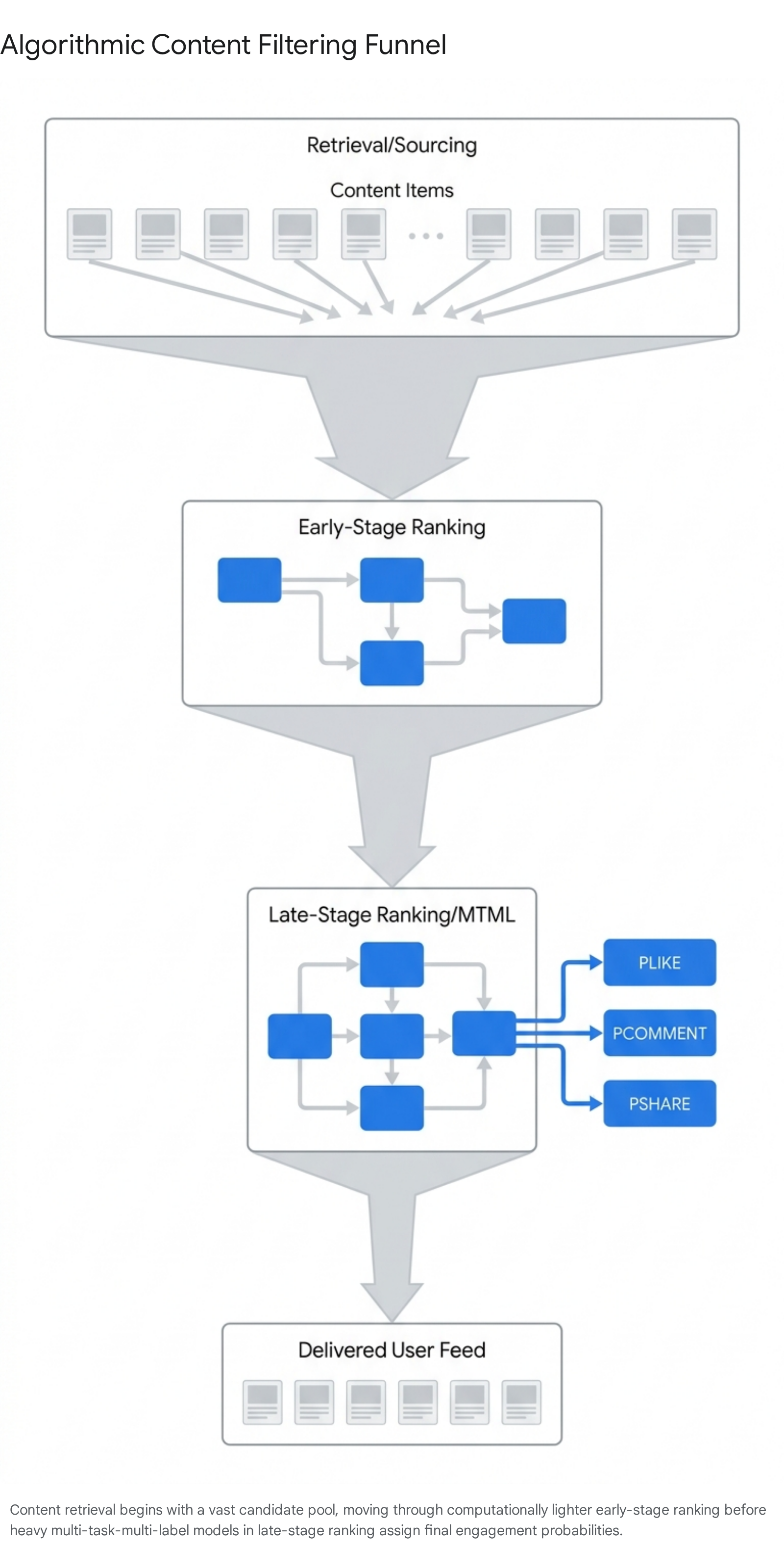
To manage the immense computational load of processing billions of global posts daily, Instagram engineers utilize a structured "ranking funnel" that filters content through progressively more resource-intensive stages. The initial phase, known as Sourcing or Retrieval, casts a wide computational net to retrieve thousands of potentially relevant content candidates based on a user's historical interaction graph 6. Because evaluating thousands of posts with deep neural networks is computationally prohibitive, these candidates are immediately passed to the Early-Stage Ranking (ESR) layer. The ESR acts as a lightweight computational filter that rapidly scores and narrows down the candidate pool, discarding content with low predicted engagement potential 6.
The remaining, highly targeted content candidates are then processed through the Late-Stage Ranking (LSR) layer. The LSR relies on heavy multi-task-multi-label (MTML) models. Instead of assigning a single chronological or popularity score, these MTML models generate specific probability scores predicting discrete, nuanced user actions. For example, the system calculates the exact probability of a user liking a post (PLIKE), commenting on a post (PCOMMENT), or following the creator after viewing (PFOLLOW) 6. These composite scores are weighted according to the specific priorities of the surface being generated, ultimately determining the exact sequence of content rendered on the user's mobile device.
Quality Assurance and Model Stability
The efficacy of the late-stage ranking layer relies entirely on the precision of its predictive modeling. To maintain recommendation quality at scale, Instagram relies on a strict "Model Stability" metric, which serves as a binary indicator of whether a deployed ML model's underlying predictions remain accurate against real-world user behavior 6.
This stability is measured using two critical engineering metrics: model calibration and model normalized entropy. Model calibration evaluates the ratio of the machine's predicted click-through-rate (CTR) against the empirical, actual CTR generated by the user base. A perfect predictor remains centered at a 1:1 ratio. Simultaneously, the system evaluates the predictor's discriminative power by calculating the normalized entropy, measured as the ratio of average log-loss per impression 6. When models deviate from these baseline accuracy metrics, user engagement across the platform reliably and immediately drops. Consequently, Instagram utilizes an automated launching platform that performs rigorous offline performance evaluations using recorded traffic data before shifting any live user traffic to new algorithmic models 6.
The Adaptive Ranking Model Implementation
In response to both the exponential growth of AI-generated content and increasingly stringent data privacy regulations that limit traditional demographic targeting, Meta deployed the Adaptive Ranking Model for advertising and organic content delivery in late 2025 and early 2026 7. The Adaptive Ranking Model utilizes large language model (LLM) scale intelligence to process vast arrays of real-time user engagement signals simultaneously.
By applying LLM-scale intelligence to behavioral data, the model optimizes the matching of user intent with content while actively reducing the physical computing resources required by Meta's server infrastructure 67. Early deployment data reported by Meta's engineering teams indicated that Instagram advertisements processed through this adaptive model experienced a 3% increase in downstream conversions and a 5% increase in click-through rates. This signals a heightened algorithmic efficiency in mapping semantic intent and behavioral interaction patterns, shifting the platform away from reliance on legacy demographic categorization 7.
Core Ranking Signals and Distribution Logic
While the backend machine learning infrastructure is unified, the frontend application operates via discrete, highly specialized ranking models tailored to the specific user interface surface. Content formatted for the main Feed is evaluated entirely differently than content presented in the Reels tab or the Explore grid 345.
The Shift to Intent-Driven Metrics
Across all surfaces, Instagram has instituted a paradigm shift in how it measures and rewards content value in 2026. Vanity metrics such as follower counts and raw public likes have been systematically deprioritized in the ranking weights. Instead, the algorithm aggressively prioritizes signals that indicate deep user intent, community sharing, and session retention 18.
The foremost algorithmic signal governing distribution is "Sends Per Reach," representing the frequency with which users share a piece of content privately via Direct Messages (DMs) relative to the number of people who saw it 1249. Private sharing is interpreted by the algorithm as the ultimate validation of content quality; if users consistently send a post to their connections, the MTML models categorize the asset as highly distributable and immediately inject it into the Explore pages of lookalike audiences. Consequently, direct message shares carry substantially more computational weight than public comments or saves in 2026 12410.
For video content, "Watch Time" and retention curves serve as the primary performance gating mechanisms. The critical algorithmic threshold is retention past the initial three seconds of playback. Content that fails this early retention check, resulting in an immediate swipe or bounce, is actively throttled by the system 1311. Conversely, content that maintains viewership through to completion, or generates repeat plays, receives a massive multiplier in the Early-Stage Ranking phase 3. While raw likes have diminished in value, the ratio of "Likes Per Reach" remains a tertiary qualifying signal, serving primarily to measure resonance within a creator's existing follower base before broader unconnected distribution is authorized 811.
Surface-Specific Optimization Variations
Because user behavior differs fundamentally across the application, the algorithm applies distinct weighting criteria to the same core signals depending on where the user is browsing.
The main Feed and Stories surfaces are designed to nurture existing relationships, focusing on "Connected Reach." The algorithm populates these areas by evaluating a user's interaction history, calculating closeness based on two-way DM exchanges, comment frequencies, and profile taps 129. Accounts that consistently engage in genuine back-and-forth communication are mathematically boosted to the top of the feed and the front of the Stories tray.
In stark contrast, the Reels and Explore surfaces operate as the platform's primary discovery engines, prioritizing "Unconnected Reach." The Explore algorithm tests content on cold audiences, evaluating the immediate engagement velocity - how quickly a post accumulates saves, shares, and watch time in the minutes following its publication. It aggressively penalizes negative signals, such as rapid scrolls or explicit "Not Interested" taps 19. Search functionality, meanwhile, has evolved into a semantic indexing system. Algorithm discovery via Search relies almost entirely on keyword density within captions, on-screen text recognition, and alt-text, effectively rendering legacy hashtag stuffing obsolete 349.
The divergent priorities of these individual AI systems require content to be highly tailored to its intended surface. A broad overview of these specific ranking mechanisms is outlined in the comparative table below.
| Platform Surface | Primary Algorithmic Objective | Top-Weighted Ranking Signals | Algorithmic Mechanisms and Evaluation Criteria |
|---|---|---|---|
| Feed | Connected Reach (Nurturing existing relationships) | Interaction history, Two-way DMs, Saves, Meaningful comments | Prioritizes content from accounts the user actively converses with. Heavily factors in reciprocal messaging and historical profile visits. Limits back-to-back posts from identical creators. |
| Reels | Unconnected Reach (Entertainment and discovery) | Watch Time (Completion Rate), Sends per Reach | Evaluates the first 3 seconds of retention heavily. Uses the "Audition System" to test viability on non-followers before scaling distribution. Completion rate dictates CPM pricing for boosted ads. |
| Explore | Broad Discovery (Interest graph matching) | Immediate Engagement Velocity, Saves, Profile Follows | Tests content on entirely cold audiences. Requires immediate, undivided reactions. Heavily penalizes content that receives immediate bounces or manual "Not Interested" feedback. |
| Stories | Recency and Relational Closeness | Direct replies, View history, "Close Friends" designation | Exclusively surfaces followed accounts. Emphasizes recency and prioritizes accounts that users frequently interact with via DM. |
| Search | Intent-Driven Discovery (Semantic indexing) | Keyword density in captions, Handle relevance, Alt-text | Operates as a semantic SEO engine. Fully indexable captions have replaced hashtag lists as the primary discovery driver. Scans voiceovers and on-screen text to categorize intent. |
Discovery Mechanics and Trial Reels
To facilitate unconnected reach without alienating a creator's established audience, Instagram relies on an internal testing mechanism commonly referred to as the "Audition System." When a piece of content - particularly a Reel - is published, the algorithm presents it to a localized sample of non-followers based on the content's semantic categorization. This categorization is inferred via advanced AI analysis of the video's visuals, audio, and text overlays 911. The engagement metrics generated within this isolated audition block determine the content's ultimate trajectory.
To formalize and commercialize this mechanic, Instagram introduced the "Trial Reels" feature in late 2025. This tool allows creators to publish a Reel exclusively to non-followers, completely circumventing their main feed. This provides pure, unbiased performance data from cold audiences. If the Trial Reel achieves high retention and send rates, the creator can then opt to push the content to their established follower base, carrying over the algorithmic momentum generated during the trial phase 2358. Due to the computational load of processing these isolated tests, Instagram has instituted limits on this feature, capping some users at a maximum of five Trial Reels per day 10.
Content Provenance and the Originality Mandate
A central pillar of Instagram's 2026 strategy is the preservation of platform authenticity and the curation of proprietary, high-quality human data. This objective has driven aggressive algorithm updates targeting content provenance, specifically aimed at eliminating content scraping and unauthorized curation.
Aggregator Penalties and Reach Redistribution
The most structurally impactful algorithm update of the year occurred in late April 2026, when Meta fundamentally altered its distribution logic to unilaterally reward original creators while intentionally suppressing the organic reach of curation and "aggregator" accounts 812.
Under this new framework, the algorithm utilizes advanced reverse image search, audio fingerprinting, and posting pattern analysis to classify the originality of every upload 13. Content that retains more than 70% of pre-existing visual or audio elements without transformative, value-additive editing is immediately flagged as unoriginal 13. Accounts identified as aggregators - defined by the algorithm as profiles where the majority of posts over a 30-day rolling window consist of reposted material - are systematically removed from the Explore page and Reel recommendation feeds 812. Furthermore, a strict threshold was established: accounts posting 10 or more reposts within a 30-day period are entirely excluded from all non-follower recommendation surfaces 8.
If an aggregator manages to post a high-performing piece of recycled content, Instagram's system will actively intervene, attempting to replace the aggregator's post in the recommendation feed with the original creator's source upload 112. This policy also severely punishes cross-platform recycling. The algorithm specifically scans for visual watermarks from competing platforms, such as TikTok or Snapchat logos, applying an immediate and severe distribution penalty to any watermarked media 151114.
The quantitative impact of the April 2026 algorithmic update was immediate and drastic, effectively transferring millions of organic impressions from curators to original creators. The data surrounding this systemic reach redistribution is summarized below 813.
| Account Classification | Definition & Algorithmic Thresholds | Empirical Impact on Organic Reach | Algorithmic Enforcement Actions |
|---|---|---|---|
| Original Creators | Accounts publishing content that is >30% visually/audibly transformative or entirely native. | +40% to +60% Gain | Priority indexing in Explore and Reels recommendation feeds; protection against content scraping. |
| Aggregator Accounts | Profiles publishing >10 unoriginal reposts per 30-day rolling window. | -60% to -80% Loss | Complete exclusion from non-follower recommendation surfaces; posts actively replaced by original source material in feeds. |
Synthetic Media and the Raw Content Movement
The proliferation of generative AI tools has saturated digital ecosystems with technically flawless, synthetically generated media. In response, user behavior and Meta's subsequent algorithmic tuning have pivoted sharply toward authenticity. On the final day of 2025, Instagram Head Adam Mosseri issued a platform-wide directive explicitly stating that Instagram would prioritize "raw, real human content" over highly polished or AI-generated material throughout 2026 581516.
Because deepfakes and AI image generators have made aesthetic perfection cheap, frictionless, and infinitely reproducible, high production value is no longer a competitive differentiator. Instead, the algorithm has been tuned to view flawless, professional aesthetics as a potential indicator of synthetic origins 15. Consequently, the system disproportionately rewards content demonstrating distinct human imperfection - such as unedited behind-the-scenes footage, variable lighting, conversational pacing, and genuine environmental context 51516.
To maintain transparency amidst this shift, Instagram implemented an "AI Creator" label system 1718. While automated backend tools attempt to flag individual synthetic posts, the platform now encourages accounts that heavily rely on generative AI to apply voluntary, account-wide disclosures 1718. However, this labeling system faces significant technical limitations. Meta's automated detection infrastructure frequently struggles to accurately catch all modified content, leading to industry concerns regarding algorithmic bias, inconsistent enforcement, and the erosion of user trust 17.
Algorithmic Suppression and Recommendation Eligibility
The concept of a "shadowban" - a silent, unannounced restriction on an account's visibility - has historically been dismissed by platform executives as a myth. However, by 2026, Meta's transparency documentation formally acknowledges the mechanics of algorithmic suppression under the operational term "Recommendation Eligibility" 141920.
Diagnostic Delineation of Reach Restrictions
When an account is flagged for violating community guidelines, utilizing banned hashtags, or exhibiting spam-like behavior, it is rarely deleted outright. Instead, the account's Recommendation Eligibility status is revoked 141920.
This revocation means the algorithm ceases to push the creator's content to the Explore page, Search results, and non-follower Reels feeds 1420. Because the content continues to be delivered to a fraction of existing followers, the penalty is often masked from the creator until they analyze their backend insights and observe a sudden collapse in unconnected reach 14. It is vital to note that the vast majority of perceived reach restrictions are not manual punitive actions, but rather algorithmic responses to weak content signals - such as high bounce rates, low video completion rates, or abrupt shifts in content niche 19.
Automation Policies and Trust-Based Velocity
Throughout early 2026, Instagram executed massive, systemic purges of bot accounts and inauthentic engagement networks. This resulted in sudden, substantial follower drops for creators, brands, and celebrities, reflecting a sophisticated evolution in Instagram's machine learning moderation systems 22.
A core component of this moderation is the implementation of "Trust-Based Velocity" 20. Historically, Instagram applied static automation limits (e.g., a universal cap of 50 likes per hour). In 2026, the AI calculates a dynamic action ceiling based directly on the quality of audience interaction. If an account utilizes API-approved software to send automated direct messages, but receives a 90% human reply rate, its Trust-Based Velocity ceiling expands exponentially 20. Conversely, if an account deploys an auto-commenter generating generic text, and the moderation AI detects a 70% or higher similarity rate across those comments, the account is immediately flagged for inauthentic behavior and subjected to severe reach restrictions 202122. Furthermore, strict hard caps have been placed on certain API endpoints, limiting automated direct messages to 200 per hour per account, regardless of trust score 22.
Legitimate automation - such as API-compliant post scheduling, conversational auto-reply funnels triggered by specific user keywords, and advanced comment moderation - remains fully supported and essential for enterprise scale, provided it does not attempt to mimic human organic engagement 212223.
Algorithmic Recovery Protocols
When an account suffers a genuine loss of Recommendation Eligibility, recovery requires strict adherence to clean operational behavior. Backend data analysis indicates that standard algorithmic restrictions typically last between 14 and 30 days 1920.
However, this recovery period is dynamic. If an account continues to engage in the flagged behavior - such as leaving an unauthorized third-party scraper attached to the profile, or repeatedly utilizing banned hashtags - the invisible 30-day timer resets instantly to zero 20. Successful recovery necessitates an immediate cessation of all automated growth tools, a 48-hour pause on new content publishing to allow the system to reset, and a return to highly consistent, niche-specific posting designed to rapidly rebuild positive retention signals 192024.
Regulatory Influence on Algorithmic Operations
Instagram's algorithm mechanics in 2026 are not shaped solely by internal engineering goals or user engagement optimization; they are profoundly constrained by global regulatory frameworks, most notably the European Union's Digital Services Act (DSA) and Digital Markets Act (DMA).
The Digital Services Act and Algorithmic Autonomy
The implementation of the DSA mandates that Very Large Online Platforms (VLOPs), a classification that includes Instagram, provide users with the fundamental autonomy to opt out of AI-profiled, personalized content recommendation systems 252627. In compliance, Instagram introduced a chronological, non-personalized feed option for European users, restricting the AI from utilizing historical behavioral data to rank content 2527.
However, Meta's implementation of this mandate faced severe legal challenges. In October 2025, a Dutch court ruled that Meta actively violated the DSA by utilizing deceptive design patterns. The court found that Meta purposefully obscured the non-personalized option and forced users to repeatedly re-select it upon every new session, defaulting back to the highly profitable, data-driven feed 26. The court imposed significant fines of €100,000 per day until Meta structurally altered the application to make the non-profiled feed a persistent, easily accessible choice that did not restrict access to core app functionality, such as direct messaging 26.
These regulatory pressures have also exposed distinct operational asymmetries in how the algorithm treats different classes of users. An analysis of Facebook and Instagram activity during the Hungarian parliamentary elections in early 2026 revealed significant anomalies in political content performance. Data demonstrated that while two opposing political figures achieved nearly identical video reach (approximately 2 million views), the figure utilizing a personal profile generated a 40.9% engagement conversion rate, compared to just 13.7% for the figure operating an official political Page 30. This suggests that platforms operating under the DSA's Rapid Response System may be applying divergent rule regimes, algorithmic constraints, and moderation mechanisms based strictly on account classification rather than pure content resonance 30.
Content Safety Over-Calibration
Regulatory pressure regarding minor protection has also deeply impacted algorithmic operations. Following preliminary findings by the European Commission that Meta's age verification systems were deficient and that its algorithmic exposure of minors to inappropriate content breached DSA guidelines, Meta faced massive liability risks 28.
This directly informed Meta's subsequent implementation of highly aggressive automated enforcement against Child Sexual Exploitation (CSE) material. Unfortunately, this AI-driven crackdown resulted in severe over-calibration. By early 2026, thousands of false-positive account bans were issued to standard family, business, and educational accounts 32. The fallout from this algorithmic overreach was compounded when a New Mexico court ruled Meta liable for misleading the public on child safety, ordering a $375 million penalty in March 2026 32. The cascading effect of these legal battles forces Instagram's AI to prioritize aggressive, risk-averse content filtering over open distribution.
User Autonomy via Topic Controls
Partially as a preemptive measure to satisfy global regulators demanding algorithmic transparency and user control, Instagram globally launched the "Your Algorithm" feature in early 2026 911131629. Located deep within the content preferences menu, this tool provides users a dashboard displaying the exact semantic topics the AI associates with their profile.
Users can manually audit this list, actively adding, removing, or resetting these categorizations to fundamentally override the machine learning predictions 9111316. For content strategists, this represents a major operational shift. Generating high watch time is no longer sufficient; content must align precisely with the specific semantic topics that a target audience has actively whitelisted in their settings, or the algorithm will completely bypass them 1329.
Advertising Infrastructure and Data Transparency
The European regulatory environment has not only altered organic content delivery but has also forced a restructuring of Instagram's advertising infrastructure and the data pipelines that feed its commercial algorithms.
Cross-Platform Data Integration
The DMA strictly governs how Meta combines cross-platform data to personalize advertising algorithms 30. Meta's 2026 compliance reporting details extensive modifications to its data infrastructure, outlining new consent flows that require EU users to explicitly permit the combination of their Instagram, Facebook, and newly integrated WhatsApp data 30.
This integration is handled via the Accounts Center, where users must actively opt-in to allow their interactions across the ecosystem - including WhatsApp Status views - to feed Instagram's ad targeting models. This structural shift coincides with controversial updates to Meta's primary privacy policy in May 2026, in which 438 sentences were removed and 656 were added to explicitly state that interactions with Meta AI chat assistants across all platforms will now directly inform and train personalized advertising algorithms 31.
Third-Party Intermediary Disclosures
Simultaneously, Meta fundamentally updated its developer policies regarding third-party ad platforms and social media management APIs 3233. Marketing intermediaries must now provide full cost transparency to end-advertisers.
If requested, ad-buying solutions are required to disclose the specific amount spent on Meta advertising separately from their own proprietary service fees and markup structures 3233. Furthermore, they must disclose campaign configurations and post-campaign reporting using Meta's standardized terminology rather than proprietary naming conventions 33. This structural change significantly reduces the opacity of programmatic ad buying on Instagram, shifting competitive advantages toward agencies offering genuine strategic value, creative optimization, and algorithmic alignment rather than mere media arbitrage 33.
Empirical Benchmarks and Metric Discrepancies
Assessing algorithmic success in 2026 requires contextualizing internal performance against baseline industry benchmarks. However, the data landscape is notoriously fragmented, and platform-wide organic reach continues to experience a gradual, multi-year decline as the raw volume of uploaded content exponentially outpaces available user attention spans 343935.
The Transition to View-Centric Reporting
To align its analytics with the algorithm's heavy prioritization of session retention and replay value, Meta officially deprecated several legacy metrics in early 2026 36. The traditional metric of "Impressions" has been entirely replaced by "Views," which explicitly counts every instance a piece of content is rendered on screen, heavily weighting repeat exposures 1936. "Reach" has been replaced by "Viewers," intended to more accurately reflect the unique individuals who meaningfully engaged with the content, resulting in generally lower baseline totals than legacy reach reporting 36. Finally, general "Engagement" has been replaced by "Interactions," stripping away passive behavior to focus exclusively on intentional actions such as saves, shares, and comments 36.
Methodological Divergence in Analytics
When evaluating what constitutes a "good" engagement rate on Instagram, marketing professionals face wild discrepancies between leading analytics providers. These discrepancies stem from fundamentally different mathematical definitions of engagement 4243.
Providers like RivalIQ calculate engagement rate by dividing total interactions by total follower count. Using this methodology, the all-industry median Instagram engagement rate in 2026 sits exceptionally low, tracking at 0.48% (a 4% drop from the previous year) and falling as low as 0.30% in subsequent data expansions 393542. Conversely, platforms like Hootsuite calculate engagement rate by dividing interactions by total impressions (or views per post). This per-post methodology yields significantly higher perceived engagement rates, averaging approximately 3.50% across industries 4243.
Understanding these definitions is critical for performance evaluation. For example, a financial services brand evaluating its Instagram strategy might see a 0.26% rate reported by RivalIQ and assume total failure, while Hootsuite reports a 3.80% rate for the exact same industry dataset, leading to a wildly different strategic conclusion 4243. The following table highlights the severe discrepancies across key industries based on reporting methodology.
| Industry Vertical | RivalIQ Median Engagement Rate (Interactions / Followers) | Hootsuite Average Engagement Rate (Interactions / Impressions) | Methodological Discrepancy Multiplier |
|---|---|---|---|
| Financial Services | 0.26% | 3.80% | ~14.6x |
| Nonprofits | 0.56% | 4.40% | ~7.8x |
| Media & Publishing | 0.44% | 3.00% | ~6.8x |
| Technology | 0.33% | 3.30% | ~10.0x |
| Higher Education | 2.10% | Data Unavailable | N/A |
Format Efficacy and Follower Size Dynamics
Despite declining aggregate engagement and methodological confusion, empirical studies analyzing tens of millions of Instagram posts in 2026 identify clear format hierarchies that align with the algorithm's intent-driven priorities:
- Carousels: This format retains the highest interaction resilience on the platform, holding a steady average engagement rate of 0.55% (on a follower basis) and generating 1.36% for top-tier influencers. Crucially, carousels drive the highest volume of "Saves," which aligns directly with the algorithm's prioritization of intent-driven, reference-worthy value 3738.
- Reels: Video posting volume increased 33% year-over-year. While short-form video engagement rates have stabilized slightly lower than carousels (averaging 1.24% for influencers), Reels remain the absolute dominant format for unconnected reach and follower acquisition 373839. An estimated 73% of top-performing business accounts now utilize a Reels-first strategy, driven by completion rates that frequently exceed 72% for videos under 30 seconds 39. Furthermore, algorithm updates in 2026 expanded distribution eligibility for longer Reels, allowing videos up to three minutes to penetrate the Explore feed, provided they maintain high retention curves 128.
- Static Images: The traditional single-photo post continues its severe decline, suffering a 17% drop in engagement year-over-year. The format is heavily deprioritized by both creators and the recommendation engine, lacking the retention depth of video or the swipe-interaction data of carousels 3840.
Finally, empirical data confirms that follower size inversely correlates with engagement efficiency. Nano-influencers (accounts with 1K - 10K followers) command engagement rates nearly double those of macro-influencers and celebrities 3941. This reinforces the core algorithmic reality of 2026: the system prefers tight, highly conversational communities that generate high send rates over broad, passive audiences that fail to interact.