
Influence of culture on brain structure
The synthesis of cultural psychology, cognitive neuroscience, and neurogenetics has established the interdisciplinary domain of cultural neuroscience. This field investigates the bidirectional relationship between socio-cultural environments and the structural and functional organization of the human brain. The foundational premise of cultural neuroscience rests on neuroplasticity - the brain's capacity to structurally and functionally adapt to sustained environmental stimuli, behavioral practices, and cognitive demands over a lifespan 123.
Early evidence of experience-dependent neuroplasticity demonstrated that rigorous, sustained activities physically alter cortical and subcortical structures. Structural imaging studies revealed increased gray matter volume in the posterior hippocampi of London taxi drivers engaged in complex spatial navigation, and increased cortical tissue in the bilateral midtemporal area and left posterior intraparietal sulcus among individuals who engage in sustained juggling 1. Similarly, the repeated use of cultural tools, such as the abacus for mental arithmetic, shifts neural processing from language-centered brain regions to posterior spatial processing areas 2. Building upon these neurobiological principles, cultural neuroscience posits that continuous immersion in a specific cultural environment - with its distinct values, social scripts, languages, and behavioral norms - acts as a sustained stimulus that fundamentally wires the neural architecture of the brain 134. Learning and socialization do not merely alter psychological software; they systematically alter human physiology and neuroanatomy 35.
Theoretical Frameworks in Cultural Brain Research
The dominant theoretical lens through which cultural neuroscience has historically interpreted global brain differences is the independence-interdependence paradigm, which largely maps onto the individualism-collectivism cultural dimensions 16. Western cultural contexts generally emphasize independence, self-expression, self-promotion, and personal autonomy, rooted in frameworks such as neoclassic economics and Protestantism 2. In contrast, East Asian cultural contexts typically prioritize interdependence, social harmony, relational adjustment, and empathy, often rooted in Confucianism and other collectivist philosophies 27.
An analysis of extant cultural neuroscience literature indicates a heavy theoretical bias toward this single dimension. A systematic review of early experimental neuroimaging studies found that the absolute majority of comparative research focused exclusively on individualism-collectivism 68. While this paradigm has yielded highly replicable functional differences in specific cortical regions, researchers emphasize that an overreliance on the independence-interdependence framework restricts the interpretation of data and obscures a more granular understanding of how fragmented cultural value systems map onto neural processing 68.
| Cultural Value Dimension | Number of Associated Neuroimaging Studies | Proportion in Early Systematic Reviews |
|---|---|---|
| Individualism-Collectivism | 37 | Absolute Majority |
| Affectivity-Neutrality | 11 | Moderate Representation |
| Tightness-Looseness | 6 | Minor Representation |
| Power Distance | 3 | Marginal Representation |
| Indulgence / Long-Term Orientation | 2 | Marginal Representation |
| Uncertainty Avoidance | 1 | Marginal Representation |
To account for the dynamic interplay between culture, behavior, and neural function, contemporary frameworks such as the Neuro-Cultural Interdependence Model have been proposed. This model delineates specific modes of cultural interaction - including competitive interdependence, conditional interdependence, selective interdependence, and communal interdependence - suggesting an isomorphic relationship between these distinct cultural orientations and their corresponding neural signatures 8.
Structural and Functional Neuroanatomy
Long-term engagement in culturally specific cognitive strategies leads to macroscopic structural alterations in the brain. Comparative structural neuroimaging studies utilizing Voxel-Based Morphometry (VBM) and cortical thickness measures indicate that socio-cultural experiences correlate with regional gray matter variations, even when controlling for baseline cognitive function and genetic variation 9.
Cortical Volume and Morphometry
Structural magnetic resonance imaging (MRI) reveals measurable morphometric divergences across distinct cultural populations. Studies comparing healthy adults of Western descent with East Asian cohorts (e.g., Taiwanese and Singaporean participants) utilizing VBM following the Diffeomorphic Anatomical Registration Through Exponentiated Lie algebra (DARTEL) approach have isolated specific regional volume differences 9.
Western participants consistently demonstrate greater regional gray matter volume and thicker cortical gray matter in the fronto-parietal network, specifically the superior medial frontal gyrus, superior frontal gyrus, and postcentral gyrus 9. Conversely, East Asian participants exhibit greater regional gray matter volume in temporal and occipital regions, including the left and right middle temporal gyrus, right inferior temporal gyrus, and calcarine sulcus 9.
These structural variations align with established behavioral evidence suggesting divergent visual and cognitive processing strategies. Western cognitive strategies tend toward analytic processing, focusing on focal objects and utilizing the fronto-parietal attentional control network. East Asian cognitive strategies lean toward holistic processing, distributing attention broadly across contexts and visual scenes, thereby relying more heavily on temporal-occipital networks associated with perceptual processing 19. Functional MRI (fMRI) data further supports this, showing differential activations in the ventral visual cortex - areas highly associated with object versus context visual processing - when individuals from different cultures perform perceptual tasks 1.
Mathematical Processing and Linguistic Encoding
The cultural transmission of language and symbol systems necessitates unique biological encoding mechanisms within the brain. The parietal lobe, constituting approximately 20% of the human brain, is a multifaceted region involved in sensory processing, spatial awareness, language processing, and mathematical reasoning 10. Mathematical processing and numerical quantity comparison provide a clear example of how educational systems and visual reading experiences shape the functional connectivity of these parietal regions.
When native English speakers and native Chinese speakers perform simple arithmetic tasks (such as evaluating the equation 3 + 4 = 7), they recruit divergent neural networks despite generating the identical behavioral output from identical visual input 11. Native English speakers generally rely on language-processing regions for mental calculation, specifically the left perisylvian cortices, including the supplementary motor area (SMA), Broca's area, and Wernicke's area 1112. This suggests that Western arithmetic education often encodes basic calculation as a rote verbal memory retrieval task.
In contrast, native Chinese speakers execute the same arithmetic tasks using a visuo-premotor association network, showing significantly larger brain activation in regions between Brodmann areas 6, 8, and 9 11. While both cultural groups demonstrate activation in the inferior parietal cortex (specifically the horizontal segment of the intraparietal sulcus, or hIPS) for understanding numerical quantity and magnitude, functional connectivity analyses reveal stark functional distinctions in the broader supporting networks 1113.
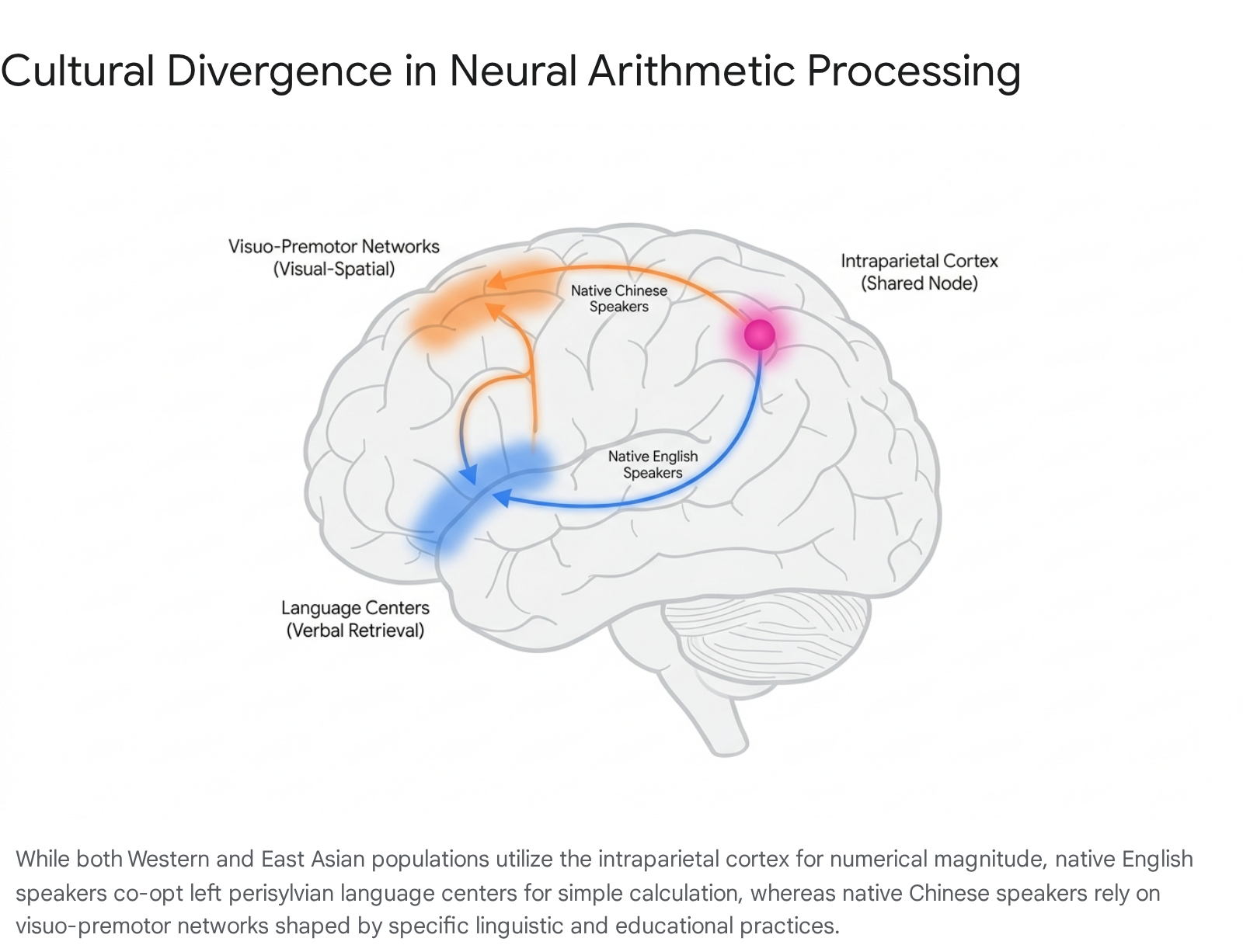
Researchers hypothesize that these differential encodings are shaped by the visual demands of reading logographic Chinese characters during early language acquisition, combined with distinct mathematics learning strategies that go beyond language-related experiences, illustrating that cultural educational practices dictate which cortical regions are co-opted for higher-order reasoning 211.
Social Cognition and Interpersonal Perception
Social cognition - the capacity to infer the behavioral intentions, social beliefs, goals, and enduring personality traits of others - relies heavily on a distributed neural network, with the medial prefrontal cortex (mPFC) and the temporoparietal junction (TPJ) serving as core hubs 141516. Meta-analyses of over 200 functional MRI studies indicate a functional dissociation within this network 1415.
The TPJ, extending from the superior temporal sulcus to the inferior parietal lobule, is heavily engaged in inferring temporary states, real-time goals, and immediate intentions, operating as a mirror system at a relatively perceptual level of representation 141517. It is frequently linked to self-other discrimination, attentional reorienting, and empathy 17. The mPFC, possessing high interconnectivity with the dorsolateral prefrontal cortex (DLPFC) and the TPJ, operates at a more abstract cognitive level. It integrates social information over time, allowing for reflection and the representation of interpersonal norms, enduring dispositions, and self-identity 141516.
The Medial Prefrontal Cortex and Self-Representation
The neural representation of the self is subject to profound cultural modulation. When individuals evaluate whether specific social or psychological attributes (e.g., "kind," "a good group member") describe themselves, they consistently recruit the mPFC 218. Multilevel Kernel Density Analysis (MKDA) of neuroimaging studies confirms that while the mPFC is active for both self and other judgments, self-judgments are more strongly associated with the ventral mPFC 1618.
However, cross-cultural neuroimaging demonstrates that the neural boundaries of self-representation within the mPFC are highly dependent on cultural self-construal. When Western European or North American participants are asked to make trait judgments about themselves versus a close relative (e.g., their mother), the mPFC shows strong activation primarily during self-referential judgments. Judgments regarding the mother or public figures recruit distinctly separate neural populations, such as the TPJ, indicating a discrete neurological boundary between the self and others 219.
Conversely, when Chinese participants perform the identical task, the mPFC demonstrates significant activation for both self-judgments and mother-judgments 219. This neural overlap provides biological evidence for interdependent self-construal, demonstrating that for individuals raised in collectivist cultures, close in-group members are fundamentally integrated into the neural representation of the self. Representational similarity analysis (RSA) of fMRI data further supports this, showing that multivariate brain response patterns in the mPFC group individuals based on subjective connection, mapping close others similarly to the self 1620.
Further functional connectivity analyses show that when reflecting on social attributes, the co-activation between the mPFC and bilateral TPJ is significantly stronger in Chinese cohorts than in Western (e.g., Danish) cohorts 19. A significant negative correlation exists between right TPJ and mPFC activity during self-reflection on social attributes; individuals' self-reported interdependence scores negatively correlate with mPFC activity but positively correlate with bilateral TPJ activity, illustrating that cultural belief systems systematically recalibrate the functional balance between these two social cognition hubs 19.
Infant Social Evaluation and Early Development
The functional specialization of the mPFC in social perception emerges extremely early in human ontogeny, challenging theories that complex social cognition is an entirely late-maturational outcome. Developmental social neuroscience utilizing functional near-infrared spectroscopy (fNIRS) and fMRI in awake infants aged 2 to 9 months reveals face-selective, socially evaluative activity in the mPFC 2122.
The infant mPFC proactively processes socially relevant information, facilitating brain-to-brain coupling during reciprocal interactions with caregivers and processing third-person social interactions 21. Longitudinal data indicates that the degree of mPFC activation in response to social smiles at 11 months is predictive of overt prosocial behavior and sociability at 18 months 2122. This suggests that cultural socialization acts upon an already functional social-evaluative neural network from the first year of life, underscoring the foundational significance of the mPFC for early human social development 2122.
Emotional Processing, Threat, and Social Hierarchies
Cultural values not only shape cognitive abstraction but also dictate the neurobiological processing of emotion, threat, and social hierarchy. The amygdala - a subcortical structure central to salience detection, fear processing, and autonomic arousal - shows highly specific reactivity patterns contingent on cultural context and socialization 323.
Amygdala Reactivity and Ingroup/Outgroup Dynamics
Behavioral responses to emotional expressions are influenced by cultural familiarity, an effect that extends to subcortical neural mechanisms. Research examining Japanese and Caucasian targets demonstrates that individuals from both cultures show heightened amygdala activation in response to fear expressions on the faces of their own cultural in-group members 3. Furthermore, this activation is modulated by gaze direction: averted gaze provokes greater amygdala response for same-culture faces, while direct gaze provokes greater amygdala response for other-culture faces 3.
Social integration and neighborhood demographics also modulate threat processing. In functional MRI studies controlling for overall psychological health, minority populations living in areas of low "own-group ethnic density" (neighborhoods where they are highly outnumbered by a dominant outgroup) exhibit significantly greater right amygdala reactivity to outgroup faces 24. This hyper-reactivity to outgroup social stimuli correlates directly with neighborhood variables associated with elevated psychosocial stress and increased long-term psychosis risk, indicating that the ambient cultural and demographic landscape directly tunes the brain's threat-detection threshold 24.
Social Value Orientation and Inequity Aversion
A person's internalized social value orientation - whether they are culturally oriented to be prosocial/collectivist or individualistic - dictates how the brain processes reward distributions and social inequity. During economic distribution games evaluated in fMRI scanners, "prosocial" individuals (defined as those who culturally prioritize maximizing overall resources while minimizing the gap between the self and others) display distinct amygdala activity linked to inequity aversion 25.
When prosocial individuals observe a highly unequal distribution of reward, dorsal amygdala activity increases significantly; this activity positively correlates with the individual's subjective dislike of the resource imbalance 25. In contrast, "individualists" (who prioritize maximizing personal reward regardless of others) exhibit a slight negative correlation in amygdala activity under identical inequity conditions 25. Crucially, the amygdala response to inequity in prosocials occurs automatically and remains unaffected by cognitive load, suggesting that the cultural orientation toward fairness relies on automatic emotional processing in subcortical structures rather than deliberate, top-down prefrontal control 25.
Social Ascent and Descent
In addition to resource distribution, social neuroscience has identified standing, certainty, connection, control, and equity as fundamental triggers hardwired into the amygdala 23. Changes in social hierarchy induce profound neurobiological shifts. Experimental models studying social transitions in mammals demonstrate that the medial amygdala is central to regulating social transitions 26. When social hierarchies are shuffled, individuals forced into a downward social descent experience significant changes in gene expression within the medial amygdala, alongside increased physiological stress hormones 26. The loss of social status - a potent cultural stressor equivalent to job loss or financial hardship in humans - triggers widespread neurobiological reorganization, underscoring how deeply social structure is embedded in biology 26.
Socioeconomic Status as a Cultural Context
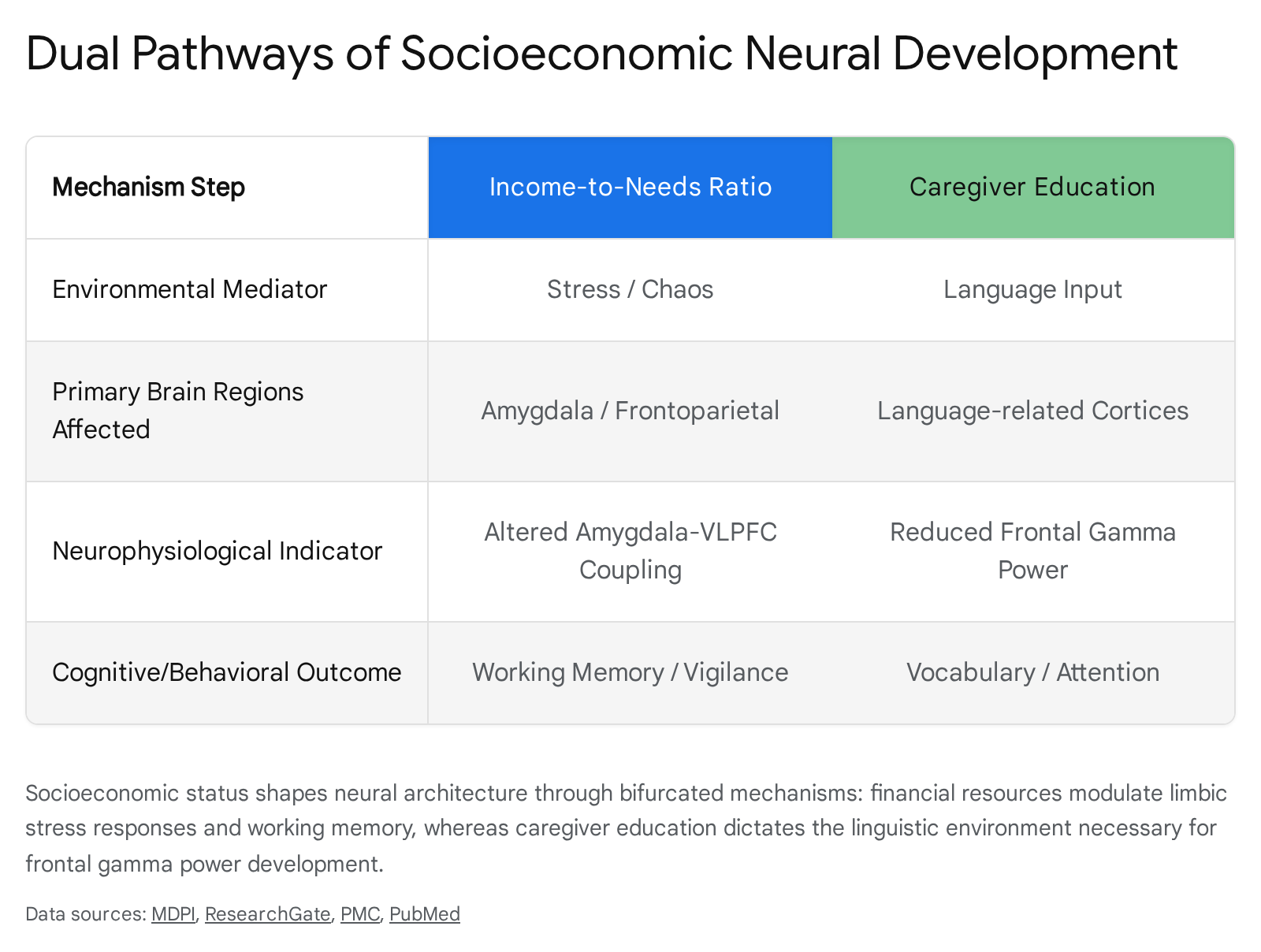
Recent literature strongly advocates for the conceptualization of Socioeconomic Status (SES) as a distinct form of cultural context. Divergent social class ecologies systematically provide different environments that promote distinct values, behavioral scripts, and environmental constraints. These factors accumulate within and across generations to manifest reliable structural and functional changes in the brain 427. SES acts upon the developing brain through multiple distinct pathways, primarily driven by two highly correlated but mechanically separate variables: family income-to-needs ratio and maternal education 272829.
Dual Pathways of SES Impact
-
The Income and Threat/Stress Pathway: Lower family income and chronic financial instability are linked to elevated physiological stress, household chaos, and exposure to environmental threats (e.g., violence, noise) 282930. This ecology results in heightened vigilance and adaptations in the limbic system. Functional MRI reveals altered connectivity between the amygdala and the ventrolateral prefrontal cortex (VLPFC) in individuals from low-income households, manifesting as reduced VLPFC efficiency in down-regulating amygdala activation during emotional distress 2731. Furthermore, chronic cognitive deprivation and stress related to low early-childhood income alter activation in the frontoparietal network and ventral visual stream, resulting in lower working memory performance and reduced global connectivity in the dorsolateral prefrontal cortex (DLPFC) 2730.
-
The Maternal Education and Language Pathway: Caregiver educational attainment directly dictates the quality, diversity, and quantity of the day-to-day language environment to which a child is exposed 272829. Differences in cognitive stimulation lead to downstream effects on the functional development of language-related cortical regions. Resting-state electroencephalography (rsEEG) studies demonstrate that children from higher SES backgrounds exhibit significantly greater high-frequency gamma and alpha power over frontal channels compared to lower SES peers 272832. This frontal gamma power serves as a critical neural indicator, predicting subsequent vocabulary outcomes, mean length of utterance, and working memory capacity 2728.
While structural brain reductions in regions like the hippocampus and cortex are frequently observed in contexts of extreme poverty and social isolation 3334, cultural neuroscience cautions against interpreting these differences purely through a "deficit" perspective. In environments characterized by high threat and low resources, hyper-reactivity of the amygdala and mirror neuron systems may represent highly functional, adaptive neurobiological strategies necessary for survival 4. Furthermore, positive cultural engagement has been shown to exert a profound salutogenic effect; active cultural participation predicts a 48% lower risk of depression over a 12-year period, with SES variables explaining only roughly half of this association 35.
Genomic association studies encompassing nearly one million individuals reveal that differences in socioeconomic status are a likely causal risk factor in the accumulation of white matter hyperintensities - a condition affecting thinking skills and dementia risk in later life 36. However, researchers note that the majority of differences in cognitive health are explained not by genetic factors, but by environmental and social conditions, specific policies, and resource allocation 36.
Methodological Challenges and Epistemic Biases
Despite rapid technological advancements in human brain mapping, the field of cultural neuroscience faces significant methodological limitations that threaten the generalizability, validity, and epistemic justice of its findings 3738.
The WEIRD Demographic Bias
The most pervasive limitation in cognitive and cultural neuroscience is the overwhelming reliance on WEIRD (Western, Educated, Industrialized, Rich, and Democratic) participant samples 3941. An initial audit in 2010 revealed that 96% of psychological research samples were drawn from countries representing just 12% of the global population, with the United States alone supplying nearly 70% of these subjects 4243. In human neuroimaging specifically, approximately 90% of peer-reviewed studies are derived from Western countries 42.
Subsequent audits indicate that this demographic imbalance has remained largely static. Analyses of top-tier journals published by the American Psychological Association (APA) and the British Psychological Society (BPS) between 2014 and 2023 demonstrate that WEIRD populations continue to comprise 80% to 95% of experimental samples 414244. Africa, which holds approximately 17% of the global population, contributes less than 1% to behavioral and neuroscientific datasets 4144. A structured review of 919 published MRI and fMRI studies from 2019 found that only 14.8% of studies even reported participant racial or ethnic identity 45.
| Demographic Category | Share of Global Population (~2010-2024 Estimates) | Share of Psychology/Neuroscience Research Samples |
|---|---|---|
| WEIRD Nations (US, Western Europe, Australia) | ~12% | 80% - 96% |
| Non-WEIRD / Rest of World | ~88% | 4% - 20% |
| Africa | ~17% | < 1% |
This massive sampling bias leads to a false sense of universality; researchers mistakenly project Western neuro-cognitive baseline behaviors (which frequently deviate significantly from the rest of humanity in areas like moral reasoning, visual perception, and fairness) onto the global population 4143. The trend of referring to any study outside of North America or Western Europe as "non-WEIRD" creates an artificial dichotomy that reinforces stereotypes and strips specific populations of their individuality and nuance 39.
Indigenous Epistemologies and the Global South
The lack of representation from the Global South and Indigenous communities severely restricts the theoretical capacity of the field to understand how diverse ecological pressures and knowledge systems shape the brain 374041. For instance, despite relatively higher rates of Alzheimer's disease and related dementias among Indigenous populations globally, research has historically focused on individual modifiable risk factors (e.g., smoking, physical inactivity) while ignoring crucial systemic factors like colonial oppression, isolation, and unequal care 40.
A scoping review of neuroscience literature regarding Indigenous peoples identified a heavy focus on communities in North America and Oceania, with almost no representation from Africa or Asia 41. To correct this, researchers advocate for "Two-Eyed Seeing" - the intentional integration of Indigenous knowledge systems and epistemologies with biomedical neuroscience approaches to foster cultural humility and produce a more expansive understanding of the human brain 404243.
Statistical Power and Replicability
Compounding the demographic bias is a crisis of replicability driven by systemic statistical underpowering in functional MRI research 444546. To adequately separate true neural signals from background physiological and scanner noise when measuring cognitive phenomena, neuroimaging studies require substantial participant numbers. However, due to the high financial costs and logistical complexities of brain imaging, the median sample size for task-based fMRI studies is generally around 30 participants, with averages spanning roughly 55 participants across major journals 454748.
Meta-reviews of independent fMRI datasets demonstrate that typical sample sizes (N≈30) yield only modest replicability; independent attempts to repeat such experiments are frequently as likely to challenge the original findings as to confirm them 4855. In evaluations of voxel-level and cluster-level replicability using Jaccard overlap, samples of N=30 frequently fail to reach an overlap ratio of 0.5 4755. Robust replicability in neuroimaging, particularly when investigating complex cultural variables, often requires sample sizes exceeding 100 participants 4855. When small, homogenous WEIRD samples are combined with low statistical power, the risk of generating false-positive associations between culture and brain function increases significantly, leading to an inflation of reported effect sizes 464756.
Disentangling Culture from Genetic Ancestry
A final methodological hurdle lies in distinguishing the effects of cultural evolution from those of genetic ancestry. Gene-culture coevolutionary theory (or dual-inheritance theory) posits that cultural practices can act as profound evolutionary selection pressures, ultimately altering human genotypes over millennia. The classic example is the coevolution of dairy farming practices and the spread of lactase persistence alleles; the cultural invention of dairy farming created conditions that made the biological production of lactase advantageous in adults 49.
However, modern neurogenetics frequently struggles to cleanly separate inherited cultural environments from biological genetics. Traits and abilities are passed down through epigenetic, somatic, cultural, and ecological inheritances, which often inflate mathematical estimates of genetic heritability 49. Furthermore, cumulative culture can effectively mask or unmask the effects of specific genes. A highly protective cultural environment can mask genetic deficiencies, making it statistically easier for researchers to discover genes associated with deficiencies than genes associated with positive abilities 5059.
When genome-wide association studies (GWAS) rely exclusively on WEIRD samples, the resulting polygenic scores fail to translate across different ancestry groups or distinct societal contexts 4959. For example, European ancestry-derived polygenic scores for educational attainment have been shown to explain only a fraction of the variance when applied to African ancestry samples 4959. Because statistical associations between genes and cognitive traits are highly dependent upon the surrounding cultural environment, failure to account for cultural constraints in neurogenetic models compromises the generalizability of neuroscience across time and geography 5059.
Conclusion
Cultural neuroscience demonstrates that the human brain is not a static, universally uniform biological organ, but rather a highly plastic processor continuously sculpted by its sociological environment. From the structural thickening of specific cortical networks to the spatial routing of mathematical calculations, the practices, values, and languages inherent in a culture physically dictate neural architecture. Social cognition - particularly the neurobiological boundaries between the self and others located in the medial prefrontal cortex - and the subcortical assessment of threat, reward, and social inequity are deeply calibrated by ambient cultural beliefs and socioeconomic ecologies.
However, the field's heavy reliance on homogenous WEIRD samples and underpowered imaging paradigms severely limits the current generalizability of its models. To fulfill its mandate of accurately mapping the relationship between human experience and biology, future cultural neuroscience must transcend the independence-interdependence binary, integrate cross-generational and Indigenous research perspectives, secure the statistical power necessary for replicability, and systematically disentangle environmental enculturation from genetic inheritance.