Impact of global nationalism on individual identity and wellbeing
Foundational Definitions of National Identity
To assess how the contemporary rise of global nationalism affects individual identity and psychological wellbeing, it is necessary to establish the theoretical boundaries separating nationalism, patriotism, and their respective sub-categories. These concepts, while frequently conflated in public discourse, have distinct historical origins and produce divergent sociological and psychological outcomes.
Patriotism Versus Nationalism
The concept of patriotism predates the modern nation-state by approximately two millennia. Rooted in Greek and Roman antiquity, classical patriotism centers on loyalty to the patria - a political conception of the republic based on a love of law, common liberty, and the pursuit of the common good 1. This classical framework reemerged during the Renaissance in the Italian city-republics of the 15th century, where thinkers such as Niccolò Machiavelli framed the love of common liberty as a mechanism for citizens to subordinate private interests to the common good, thereby resisting corruption and tyranny 1. Patriotism, in this traditional sense, is a civic spirit and a political virtue 1.
Nationalism is a modern ideological construct that emerged primarily in the 18th and 19th centuries. It demands that an individual's loyalty and devotion to the nation-state surpass other individual or group interests 12. Unlike patriotism's focus on political liberty, nationalism is fundamentally concerned with cultural unity, emphasizing a spiritual or intrinsic attachment to a shared history, geography, language, or ethnicity 12. German philosopher Johann Gottfried von Herder articulated an early iteration of this shift, suggesting that the "fatherland" is defined by its distinct language and culture rather than its political institutions, moving the focal point of attachment from the preservation of liberty to the preservation of cultural coherence 1.
This historical development was deeply influenced by structural factors. As theorized by Benedict Anderson in Imagined Communities, national identities, particularly in the Americas, were catalyzed by administrative discrimination (e.g., European-born peninsulares versus New World-born criollos), vast geographical distances, and the advent of "print capitalism" 3. The proliferation of localized print media allowed disparate individuals to conceptualize themselves as part of a cohesive community moving simultaneously through time 3. This phenomenon was largely top-down, driven by political elites to forge cohesion prior to the widespread development of a national consciousness among the general populace 3.
Civic and Ethnic Nationalist Frameworks
Within the study of nationalism, scholars broadly differentiate between two dominant models: civic nationalism and ethnic nationalism. These frameworks dictate how a state defines citizenship, formulates social solidarity, and integrates or excludes minority populations.
Civic nationalism is defined by unity through citizenship and shared political principles 456. Associated predominantly with Western democracies, it posits that a nation is a voluntary association of individuals who subscribe to the state's political values, laws, and democratic institutions, regardless of their ancestral background 45. A prominent theoretical extension of this is Jürgen Habermas's concept of "constitutional patriotism," which advocates allegiance to democratic institutions and constitutional principles rather than cultural heritage 4. In practice, constitutional patriotism operates as a modernized, liberal iteration of civic nationalism, offering an inclusive model of identity designed for pluralistic societies 4.
Ethnic nationalism defines membership through a common heritage, ancestral bloodlines (jus sanguinis), and cultural homogeneity 52. In this paradigm, national identity is a pre-existing condition of birth rather than a chosen political commitment 6. The political structure is viewed as a product of the ethnic nation, and minorities are often expected to fully assimilate into the dominant culture or face systemic exclusion 63.
While these frameworks provide a useful theoretical binary, pure implementations are rare. The legal systems of most countries integrate elements of both definitions 2. Furthermore, scholars such as Bernard Yack argue that the distinction between the two frequently blurs in practice 4. Civic nationalism can still retain exclusionary cultural roots; the expectation that immigrants must adopt a specific dominant political culture can marginalize ideological or religious groups, creating boundaries that mirror ethnic exclusion 4.
| Feature | Civic Nationalism | Ethnic Nationalism |
|---|---|---|
| Basis of Membership | Legal citizenship, shared political values, voluntary association, and political equality 456. | Common ancestry (jus sanguinis), shared cultural heritage, and ethnicity 52. |
| Primary Loyalty | Democratic institutions, the constitution, the rule of law, and civic engagement 43. | The ethnic group, shared language, historical lineage, religion, and traditions 23. |
| Approach to Minorities | Multiculturalism permitted; acceptance granted through legal compliance and acculturation to political values 623. | Assimilation expected; systemic exclusion or marginalization of out-groups due to perceived "ethnic threat" 23. |
| Psychological Impact | Predicts higher empathy for out-groups, lower fear toward minority groups, and support for immigrant rights 2. | Correlates with out-group derogation, fear of demographic change, and intentions to engage in pro-majority collective action 2. |
Post-Pandemic Trajectories of Nationalism
The global landscape has witnessed a measurable surge in nationalist sentiment over the past decade. This trend was significantly accelerated by the COVID-19 pandemic, which altered the environment in which global politics operates and elevated the nation-state as the primary actor capable of securing resources, managing borders, and enforcing public health mandates 456.
Crisis Responses and the State
During the pandemic, governments rapidly implemented protectionist policies. Borders were closed, export restrictions were placed on medical supplies, and "vaccine nationalism" emerged as states prioritized their own citizens over equitable global distribution frameworks 467. This retreat into the nation-state highlighted humanity's shared vulnerability while simultaneously exposing the limitations of global citizenship as a functional concept during acute crises 7. The social contract theory, predicated on the state providing security in exchange for order, drove governments to prioritize national interests to maintain domestic legitimacy 7.
While some observers initially hypothesized that these nationalist moves might be temporary policy responses, they effectively mainstreamed exclusionary nationalism. In Europe and North America, this acceleration built upon a pre-existing baseline of nationalist sentiment established during the migration crises and major political elections of 2015 and 2016 5. The pandemic provided an environment where populist politicians could successfully mobilize patriotic and nationalist sentiments to secure public support for unprecedented restrictions on individual liberties, reframing lockdowns and border closures as acts of national defense and moral obligation 6.
Terror Management and Existential Security
Psychological frameworks, notably Terror Management Theory (TMT), provide insight into this phenomenon at the individual level. TMT, validated across numerous behavioral studies, posits that when individuals are made acutely aware of their own mortality - as was ubiquitous during the global health crisis - they experience profound insecurity 48. To mitigate this existential anxiety, individuals tend to cling more tightly to their cultural worldviews and group identities, seeking psychological safety in the familiar structures of nationalism, status, and in-group allegiance 48. Consequently, health crises arouse nationalist emotions, triggering greater internal cohesion while simultaneously generating hostility toward external groups 4.
Research indicates that nationalism acts as an illusory concept driven by a fundamental psychological need for identity and security 8. The perception of belonging to a specific group with shared beliefs assuages feelings of separation. This group identity is frequently fortified by perceiving the in-group in direct opposition to rivals or enemies, providing a common purpose 8. Conversely, individuals who report exceptionally high levels of personal wellbeing and a broad sense of connection to humanity - often following profound personal transformation - frequently exhibit a reduced need for rigid group or national identity, lacking the fragility and insecurity that drives hyper-nationalism 8.
Digital Algorithms and Political Polarization
The contemporary resurgence of nationalism is inextricable from the digital architecture that mediates public discourse. Social media platforms do not merely reflect pre-existing political divisions; their underlying recommendation algorithms actively shape, amplify, and entrench them 91011.
Algorithmic Amplification Mechanisms
Driven by an engagement-based business model, social media algorithms systematically prioritize emotional, shocking, and contentious content, as outrage consistently generates higher interaction rates than nuanced debate 1112. This dynamic creates a feedback loop: algorithms reward polarization, which conditions user behavior, which in turn feeds the algorithm more polarizing data 91013.
The result is the formation of ideological echo chambers - digital environments where competing ideas are minimized and confirmation bias thrives 1112. Research simulating the behavior of young European adults on platforms like TikTok, Instagram, and X demonstrated this effect vividly. Algorithms disproportionately amplified sensationalist, polarizing, and often right-wing content (which accounted for 58% of politically classified posts), overriding explicit user preferences for alternative viewpoints 14. This ongoing deterioration of social media quality prioritizes monetization over user experience, actively surfacing unverifiable, emotional content that leaves significant portions of young users reporting feelings of fear, anger, and sadness 14.
Theoretical models suggest that introducing an "engagement tax" on social interactions could alter platform incentives, mitigating the negative externalities of misinformation and extreme polarization 13. However, in the absence of robust digital literacy policies and platform regulation, personalized algorithms continue to function as accelerators for nationalist and exclusionary rhetoric 1315.
Experimental Evidence on Affective Polarization
This digital environment produces "affective polarization" - a phenomenon characterized not merely by ideological disagreement, but by profound emotional hostility and animosity toward perceived political out-groups 1116. A landmark 2025 study published in Science demonstrated the causal relationship between algorithmic ranking and affective polarization, providing empirical evidence that platform architecture directly alters political attitudes 91718.
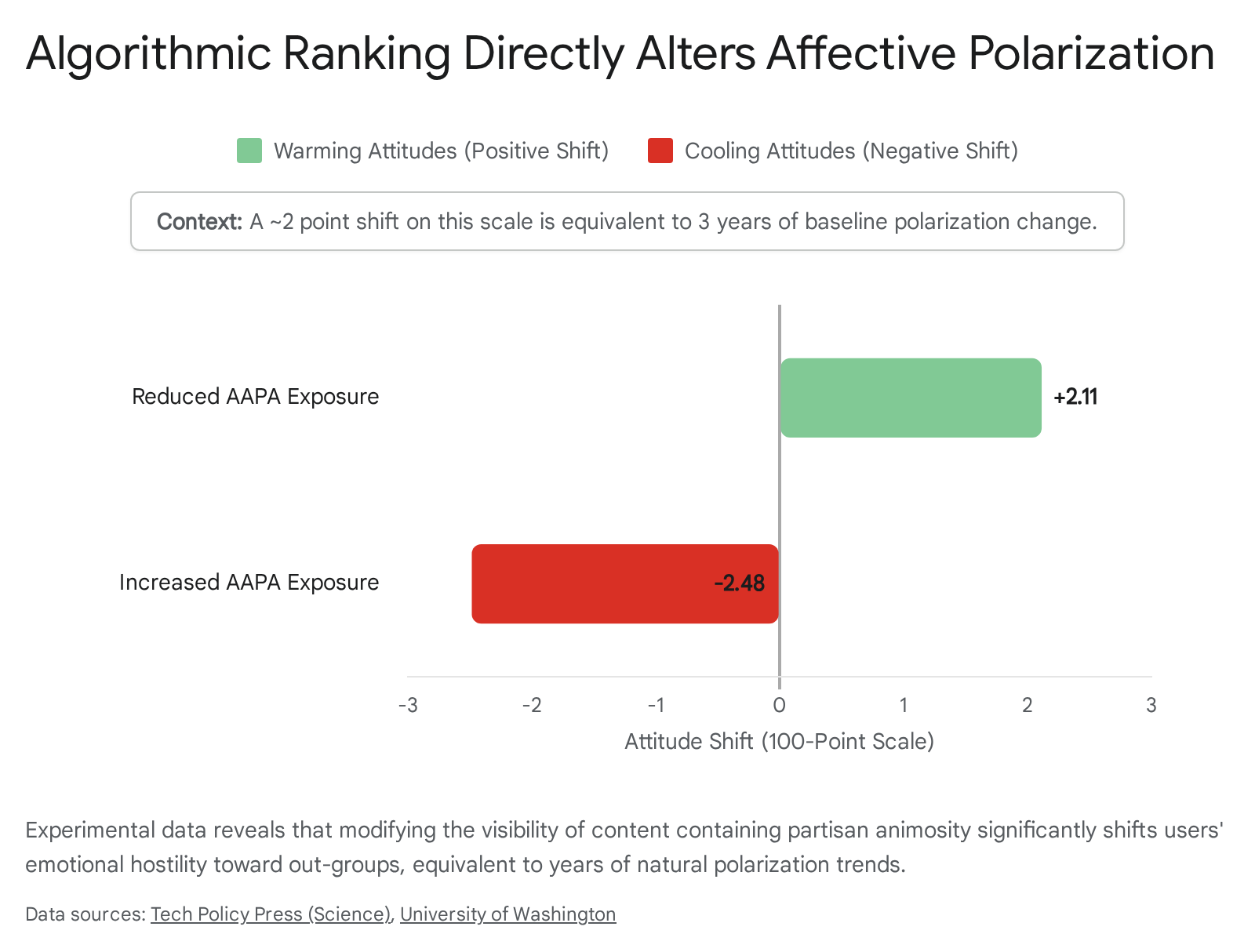
Researchers built a browser extension that independently reranked the feeds of 1,256 X (formerly Twitter) users in real time over a multi-week period during the highly charged 2024 US presidential election cycle 917. The tool utilized a large language model (LLM) to identify and adjust the visibility of content containing "antidemocratic attitudes and partisan animosity" (AAPA) 1718.
The findings revealed that users exposed to the modified algorithm experienced a measurable reduction in animosity toward the opposing political party 1819. Specifically, reducing AAPA exposure warmed feelings toward the out-group by 2.11 points on a 100-point scale - a shift equivalent to three years of natural demographic polarization trends in the United States 91819. Conversely, algorithms that maximized exposure to extreme content caused a symmetrical cooling effect of 2.48 degrees 9.
The magnitude of this finding lies in its demonstration of causation without altering the underlying content or the user's network; merely reordering the feed was sufficient to induce psychological shifts below the threshold of user awareness 917. This underscores the critical need for policy interventions aimed at structural mechanisms and algorithmic transparency rather than geographic censorship or content moderation alone 918.
Political Stress and Mental Health Pathways
The intersection of macro-level political phenomena and micro-level psychological health operates through complex, bidirectional pathways. Nationalism is neither universally protective nor uniformly detrimental; its psychological impact depends heavily on how the identity is constructed, the security of the socio-political environment, and an individual's relationship to the dominant group.
The Political Stress Model
When national identity functions as a unifying civic construct, it can significantly enhance individual and collective wellbeing. Cross-cultural empirical studies repeatedly demonstrate a positive correlation between strong national identity and individual self-esteem 2021. Identifying closely with a national group provides individuals with a sense of meaning, purpose, and belonging, which serves as a psychological buffer against isolation and bolsters collective resilience during crises 202122.
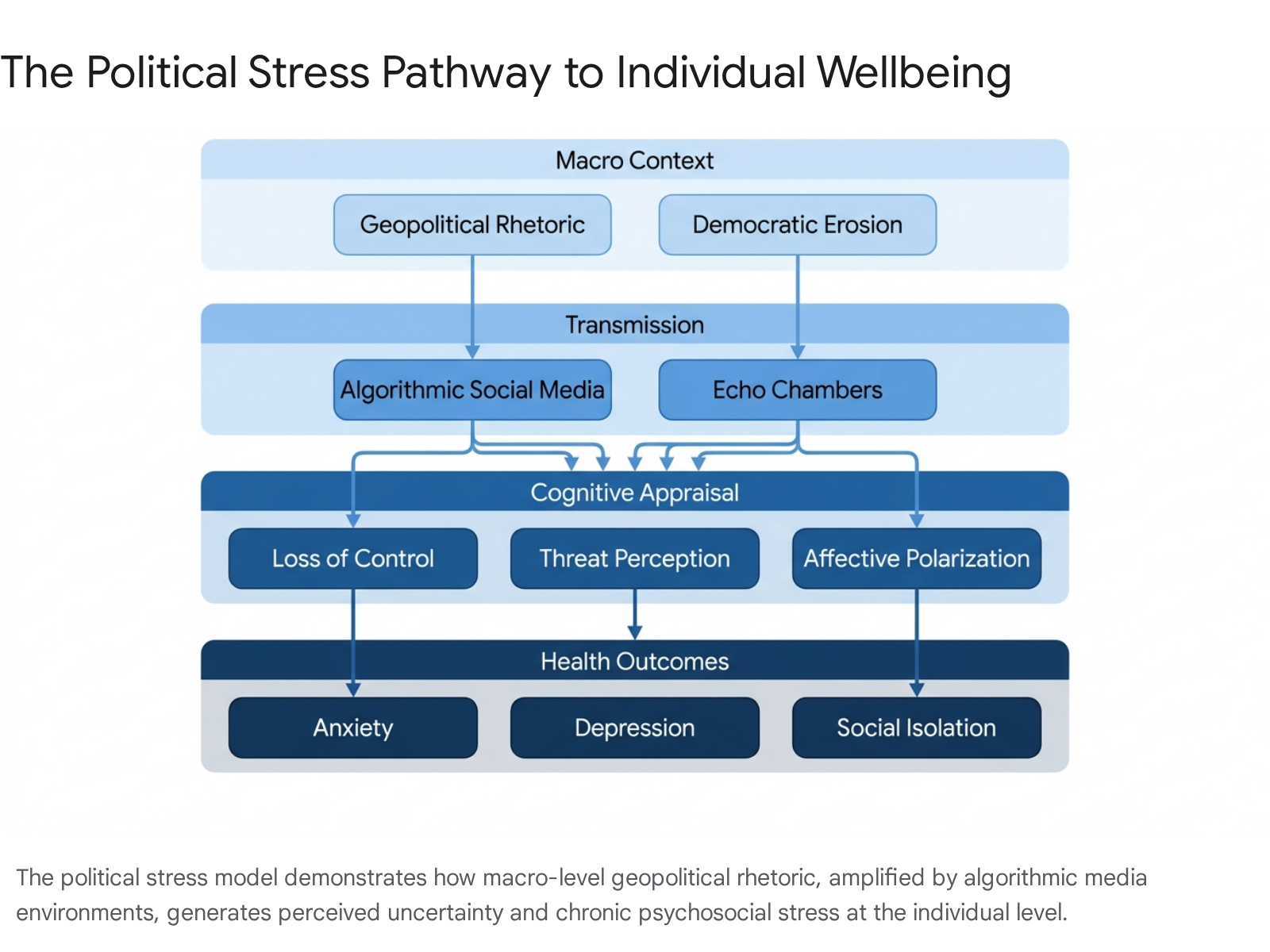
However, the pervasive exposure to divisive, threat-oriented geopolitical rhetoric exacts a severe toll on population mental health. The emerging "Political Stress" model integrates stress-process and psychosocial theories to explain how macro-level political turbulence translates into micro-level emotional strain 2324. Drawing upon Bronfenbrenner's Ecological Systems Theory, this framework posits that a person's macrosystem (the overarching sociopolitical culture) and chronosystem (major historical events, such as elections or pandemics) exert profound downward pressure on their immediate psychological state 25.
Under this model, nationalist rhetoric characterized by territorial competition, securitization, or existential threat acts as a chronic psychosocial stressor analogous to prolonged symbolic threat 24. Constant exposure to such discourse via mass communication and algorithmic media amplifies perceived uncertainty and diminishes an individual's sense of control over their environment 2431. This ambient social stress interacts with micro-level vulnerabilities - such as unemployment, poverty, or pre-existing psychiatric diagnoses - to elevate the risk of emotional exhaustion, generalized anxiety, and hopelessness 2324. The politicization of everyday life disrupts institutional confidence and strains interpersonal trust networks, shifting the emotional tone of communities toward anticipatory pessimism 2331.
Affective Polarization and Intrapersonal Harm
Affective polarization driven by competitive nationalism damages not only the broader sociopolitical environment but also the polarized individual. Rooted in Social Identity Theory, strong in-group identification frequently leads to hyper-vigilance regarding out-group behaviors, triggering automatic perceptions of threat 16.
Prolonged political stress is associated with increased rates of clinical depression, anxiety, and sleep disruption, leading some researchers to classify it as a distinct public health concern 3233. The American Psychological Association explicitly identifies politics as a major source of stress, with significant portions of the population reporting fatigue, damaged friendships, and sleep loss due to political upheaval 3326.
Furthermore, affective polarization indirectly harms mental health by constricting an individual's social support network. The drive for ideological homophily leads individuals to sever relationships across political lines, increasing social isolation - a primary risk factor for adverse psychological outcomes 16. While longitudinal studies mapping the precise causal direction between affective polarization and well-being yield complex results, cross-sectional data consistently demonstrate that individuals with high affective polarization suffer from lower social support, greater stress, and worse overall health 16. Furthermore, evidence suggests that elevated baseline stress acts as a catalyst, increasing subsequent levels of affective polarization and creating a deleterious cycle of psychological deterioration 16.
Mental Health Disparities in Minority Populations
The psychological burden of rising nationalism is not distributed equally. For minority populations, immigrants, and marginalized intersectional groups, the shift toward exclusionary ethnic nationalism presents acute psychological hazards, exacerbating existing health inequities.
The Mental Health Paradox and Pandemic Shifts
Prior to the onset of the COVID-19 pandemic and the accompanying surge in nationalist populism, public health data in the United States routinely demonstrated a phenomenon known as the "mental health paradox." Despite facing higher levels of systemic disadvantage, poverty, and exposure to racism, Black, Hispanic, and Asian adults frequently reported lower baseline rates of clinical depression and psychiatric disorders compared to the non-Hispanic White majority 2728.
However, recent longitudinal data indicates that the geopolitical and social turbulence of the early 2020s fundamentally altered this dynamic. During periods of heightened sociopolitical stress - including the pandemic and highly publicized incidents of racial violence - the mental health of Black, Hispanic, and Asian populations deteriorated at steeper rates relative to White populations 28. Systemic advantages buffered the majority population from unexpected crises, while marginalized groups experienced significant spikes in acute emotional distress, depression, and anxiety 28.
When national identity leans toward an ethnic definition, minorities are structurally denied in-group acceptance, exposing them to heightened discrimination, acculturation stress, and profound anguish 229. Research on African asylum seekers and refugees residing in Asian nations highlights this severity, showing high prevalence rates of depression directly associated with language barriers, isolation, and elevated exposure to discrimination in host societies 29. Intersectional analyses confirm that groups designated as psychologically vulnerable - such as immigrants and ethnic minorities - were disproportionately likely to exhibit profiles of "generalized suffering" during the pandemic 30.
Healthcare Access and Structural Barriers
These psychological vulnerabilities are compounded by profound systemic disparities in healthcare access. Even in high-income nations, minority populations consistently demonstrate higher levels of unmet mental health care needs 2831. In the United States, recent survey data shows that among adults reporting fair or poor mental health, White adults were significantly more likely (50%) to receive mental health services compared to Black (39%) and Hispanic (36%) adults 31.
Structural barriers, scheduling difficulties, and cost concerns disproportionately affect marginalized groups 31. Furthermore, mental illness among people of color is frequently underdiagnosed or improperly treated due to a lack of culturally sensitive screening tools and a shortage of culturally competent practitioners 3132. Consequently, ethnic minorities are less likely to receive the best available evidence-based treatments and more likely to terminate treatment prematurely when they do enter the healthcare system 27.
| Disparity Metric | Majority Population (e.g., US White Adults) | Minority/Racialized Populations |
|---|---|---|
| Historical Baseline (Pre-Pandemic) | Higher lifetime risk of reported psychiatric disorders 2728. | Lower reported rates of psychiatric disorders (the "mental health paradox") 2728. |
| Pandemic-Era Mental Health Decline | Buffered by systemic advantages; more stable mental health trajectories 28. | Steeper declines; significant spikes in depression and anxiety relative to majority 28. |
| Treatment Access (Fair/Poor Health) | 50% report receiving mental health services 31. | 36%-39% report receiving mental health services 31. |
| Unmet Care Needs (Pandemic Era) | Lower prevalence of unmet mental healthcare needs 28. | Higher unmet needs; Asian populations reporting the highest deficit in access 28. |
Regional Manifestations of Nationalist Politics
The mechanisms by which nationalism reshapes identity are heavily context-dependent. Across the Global South and emerging economies, nationalism interacts with historical legacies of colonialism, resource extraction, and complex ethnic demographics to produce unique socio-political and psychological outcomes. The "Global South" is not a monolith; rather, it represents a dynamic category defined by shared historical trajectories of dependency and collective aspirations to challenge prevailing global orders 33.
Resource Nationalism in Latin America
Latin America presents a distinct dynamic where national identity is deeply intertwined with economic sovereignty. Recent geopolitical shifts toward a decarbonized global economy have reignited "Green Resource Nationalism" (GRN) in the region 3435. Nations such as Chile, Bolivia, Argentina, and Mexico - which control over half of the world's identified lithium reserves - are asserting state control over extraction to secure greater economic benefits and ensure environmental sustainability 343536.
This rhetoric frames natural resources as belonging explicitly to the nation rather than foreign corporations, blending economic policy with nationalist pride 35. While GRN policies aim to rectify historical exploitation and transform the region from a victim of the "resource curse" to a green energy powerhouse, they also carry inherent psychosocial risks 3738. The pressure to meet social commitments and redistributive promises without deterring necessary foreign investment creates political volatility. When governments fail to deliver on the economic benefits of resource wealth, it frequently leads to boom-and-bust cycles that destabilize local economies and heighten political anxiety among the populace 3638.
Furthermore, regional identity remains fractured. Despite external perceptions of a cohesive "Latin American" bloc, internal surveys reveal that populations in regional powers like Brazil predominantly self-identify via national demonyms rather than as "Latin Americans," illustrating ongoing competition for regional hegemony and the persistence of distinct national identities 39.
Ethnic Fragmentation in Africa
In many African states, post-colonial nationalism initially emerged as a unifying, emancipatory force aimed at dismantling imperial rule 48. However, the post-independence era frequently revealed contradictions, as the borders drawn by colonial powers encapsulated highly diverse populations. Contemporary survey data indicates a subtle shift in identity priorities: over the past decade, attachment to an overarching national identity has decreased across the continent, while preference for ethnic allegiance has gained traction 40.
In South Africa, the historical contestation between White Afrikaner nationalism and African nationalism has transitioned into a highly fractured contemporary landscape 50. Despite the efforts of the Truth and Reconciliation Commission to forge an inclusive civic identity post-apartheid, deep socio-economic inequalities persist 41. Today, the failure of the state to mediate poverty and unemployment has eroded public trust, fostering a nationalism characterized by racial division and xenophobia. Foreigners from other African nations are frequently viewed as rivals for limited resources, resulting in social hostility and violence 48.
In Ethiopia, the nation's history is marked by cyclical tension between centralizing imperial ambitions and the pursuit of regional ethnic autonomy 41. The institutionalization of ethnic federalism, intended to accommodate diversity, has frequently entrenched identity politics, resulting in resource conflicts, ethnic disenfranchisement, and deep communal tensions that undermine the psychological security of its citizens 41.
Authoritarian Populism in Asia
In Asia, nationalism is frequently deployed by the state to consolidate authority and define geopolitical posture. In China, nationalism under current leadership is underpinned by the memory of the "Century of Humiliation," leveraging historical trauma to forge a unified national identity 42. This manifests domestically as a "moral nationalism," where the restriction of individual civil liberties is framed as a necessary and justified trade-off for economic growth, security, and public health 42. This dynamic demands psychological compliance and high trust in the government, heavily influencing the political behavior and mental resilience of the populace 43.
Across South Asia, including India, the rise of populist leadership relies on distinct cultural and religious narratives (e.g., Hindu nationalism) that frequently alienate minority populations 5042. This political instability interacts with severe existing vulnerabilities. The broader South Asian region faces a profound mental health crisis characterized by widespread poverty, climate change impacts, and fragile public health systems 54. Stigma surrounding mental disorders is exceptionally high, and geopolitical determinants of mental health are largely neglected in academic research and clinical services 54.
| Region | Primary Form of Nationalism | Key Drivers and Rhetoric | Impact on Identity and Wellbeing |
|---|---|---|---|
| Latin America | Green Resource Nationalism (GRN) | Transition minerals (lithium), state sovereignty over resources, overturning the "resource curse" 343537. | High expectations for redistributive wealth; economic volatility contributing to political anxiety 3638. |
| Africa | Ethnic Nationalism / Post-colonial fragmentation | Historical colonial borders, unequal resource distribution, xenophobia over job competition 4840. | Erosion of state trust, violent out-group hostility, communal conflict, and psychological insecurity 4841. |
| Asia | Moral / Populist Nationalism | Historical trauma, religious identity, prioritizing collective economic goals over individual liberties 504243. | High demand for political compliance; marginalization of religious minorities; exacerbation of regional mental health crises 424354. |
Global Health Interventions and Institutional Responses
The psychological toll of political instability, rising polarization, and social fragmentation represents a burgeoning global health crisis. However, mental health infrastructures worldwide are inadequately equipped to handle the compounding burden.
The Economic and Societal Burden of Mental Illness
The World Health Organization (WHO) estimates that over one billion people currently live with a mental health condition, driving up healthcare costs and stripping the global economy of approximately $1 trillion annually in lost productivity 5544. Despite this staggering burden, institutional responses remain drastically underfunded. Median government spending on mental health globally is stalled at merely two percent of overall health budgets; in low-income nations, per capita spending can be as low as four cents 55.
Investment case studies conducted in sub-Saharan Africa and Asia demonstrate that the economic burden of mental health conditions ranges from 0.5% to 1.0% of a nation's Gross Domestic Product 4546. The cost to deliver evidence-based interventions is remarkably low - estimated at $0.40 to $2.40 per capita annually 45. The return on investment is substantial, ranging from a break-even point to a 30.3-to-1 return when the intrinsic economic value of health is considered 4546.
Institutional Mandates for Social Connection
Recognizing that isolation, loneliness, and social division severely harm both physical and psychological health, the WHO has recently elevated social connection to a global health priority 47. The newly launched Commission on Social Connection (2024 - 2026) aims to assist member states in developing cross-sector strategies to rebuild community ties that have been frayed by urbanization, technology, and political polarization 47.
These institutional mandates recognize that mental health must be treated not as a medical privilege, but as a foundational human right inextricably linked to human development and social cohesion 554448. Addressing the micro-level mental health impacts of macro-level nationalism requires systemic interventions that extend beyond clinical psychology. Because digital environments serve as the primary conduit for political stress and affective polarization, regulatory and structural reforms to platform architecture are essential 91524.
Interventions must shift focus from geographically blocking foreign actors to altering the fundamental mechanisms of algorithmic recommendation 9. Promoting algorithmic transparency, instituting models that de-incentivize the promotion of outrage, and fostering media literacy education are critical steps toward de-escalating partisan animosity and rebuilding trust within democratic frameworks 1315. Ultimately, mitigating the global mental health burden driven by political fragmentation will require robust investment in culturally competent public health infrastructure and aggressive structural reform of the digital architectures that currently profit from division.