
Impact of early attachment on adult brain and relationship patterns
The theoretical and empirical frameworks of attachment theory represent a profound paradigm shift in developmental psychology, affective neuroscience, and evolutionary biology. Originally formulated to explain the proximity-seeking behaviors of human infants, the science of attachment has expanded over six decades to map how early relational bonds construct the neurobiological architecture of the human brain. The internalization of early caregiving experiences directly shapes adult structural and functional neuroanatomy, neuroendocrinology, and epigenetic expression. This analysis examines the multidisciplinary science of attachment, tracing the biological embedding of relational patterns from infancy into adulthood, evaluating cross-cultural methodological debates, and detailing the neuroplastic mechanisms that facilitate earned secure attachment later in life.
Foundational Literature and Theoretical Framework
The developmental history of attachment theory constitutes a movement away from psychoanalytic drive-reduction models - which posited that infants bond with caregivers primarily for physiological nourishment - toward an ethological, relationship-based model of human development 123.
Bowlby's Ethological Model and Internal Working Models
John Bowlby conceptualized attachment as an innate, biologically driven behavioral system evolved to ensure species survival. By maintaining infant-caregiver proximity under conditions of threat or distress, the attachment system regulates affective responses to the environment 145. Drawing extensively on ethology, cybernetics, information processing, and primate research - such as Harry Harlow's studies demonstrating that infant macaques prioritize contact comfort over nourishment - Bowlby argued that the attachment bond is a primary, rather than secondary, human drive 235.
A central tenet of Bowlby's framework is the formation of internal working models 146. Through repeated, daily interactions with a primary caregiver, an infant constructs mental representations of the self and others. If a caregiver is consistently responsive and attuned, the infant develops an internal working model of the self as worthy of care and of others as reliable and safe. Conversely, if care is inconsistent, intrusive, or neglectful, the infant develops a model characterized by anxiety or avoidance. This internalized template functions as a cognitive-affective schema, filtering social information and guiding behavioral strategies in all future interpersonal relationships 1678.
Ainsworth and the Strange Situation Classification
Mary Ainsworth advanced Bowlby's theoretical blueprint by establishing the empirical methodology required to observe and categorize attachment behaviors 129. Based on her initial observational field research in Uganda and subsequent longitudinal studies in Baltimore, Ainsworth formulated the sensitivity hypothesis. This hypothesis posits that secure attachment is directly predicated on a caregiver's ability to accurately perceive and promptly respond to an infant's cues in a context-appropriate manner 291011.
To standardize the measurement of infant attachment, Ainsworth developed the Strange Situation Procedure. This observational laboratory protocol is designed to gently activate the infant's attachment behavioral system through a standardized twenty-one-minute series of separations and reunions involving the caregiver and a stranger 671112. The procedure assesses the balance between the infant's attachment system (proximity seeking) and exploration system (curiosity about the novel environment) 312.
Ainsworth's research yielded three primary classifications of infant attachment. Secure infants utilize the caregiver as a secure base from which to explore, display distress upon separation, seek proximity upon reunion, and are swiftly soothed, allowing them to return to play 91213. Insecure-avoidant infants show minimal overt distress upon separation and actively avoid or ignore the caregiver upon reunion, focusing instead on toys or the environment as a deactivating coping strategy 91213. Insecure-anxious/resistant infants exhibit intense distress upon separation but display ambivalent, angry, or resistant behavior upon reunion, failing to be easily soothed and remaining preoccupied with the caregiver's availability 1213.
Mary Main and the Adult Attachment Interview
As attachment research evolved to encompass lifespan development, Mary Main and her colleagues shifted the analytic focus from overt infant behavior to adult linguistic representations of childhood experiences 13141516. The Adult Attachment Interview (AAI) was developed as a semi-structured protocol that evaluates an adult's current state of mind with respect to attachment 131417.
Rather than verifying the factual accuracy of an individual's childhood, the AAI assesses the coherence of their narrative. Subjects are asked to provide adjectives describing their early relationships and are then prompted to supply specific autobiographical memories to instantiate those adjectives 1617. The classifications broadly mirror infant typologies. Autonomous (secure) individuals provide coherent, collaborative narratives, valuing attachment relationships regardless of whether their childhoods were positive or adverse 1415. Dismissing (avoidant) individuals minimize the impact of attachment relationships, often idealizing parents without supporting specific episodic memories, or claiming a lack of memory altogether 1314. Preoccupied (anxious) individuals present entangled, angry, or passive narratives, remaining cognitively overwhelmed by past relationships and demonstrating linguistic signs of ongoing role reversals 14.
Crucially, Main and Solomon also identified a fourth category across both infant and adult populations: disorganized or unresolved attachment 6131517. In infants, this manifests as contradictory, disoriented, or freezing behaviors, often stemming from environments where the caregiver is simultaneously a source of fear and the sole source of comfort, leaving the infant without a coherent behavioral strategy 6121518. In adults, an unresolved state of mind is marked by lapses in metacognitive monitoring and disjointed discourse specifically when discussing loss or abuse. This lack of resolution serves as a significant risk factor for subsequent psychopathology, post-traumatic stress disorder, and internalizing symptoms such as depression and anxiety 131417.
Structural and Functional Neurobiology of Attachment
The application of advanced neuroimaging techniques has provided robust empirical support for the biological instantiation of internal working models. Attachment orientations systematically modulate both basic affective evaluation systems within subcortical networks and elaborate cognitive control processes within cortical networks 1920.
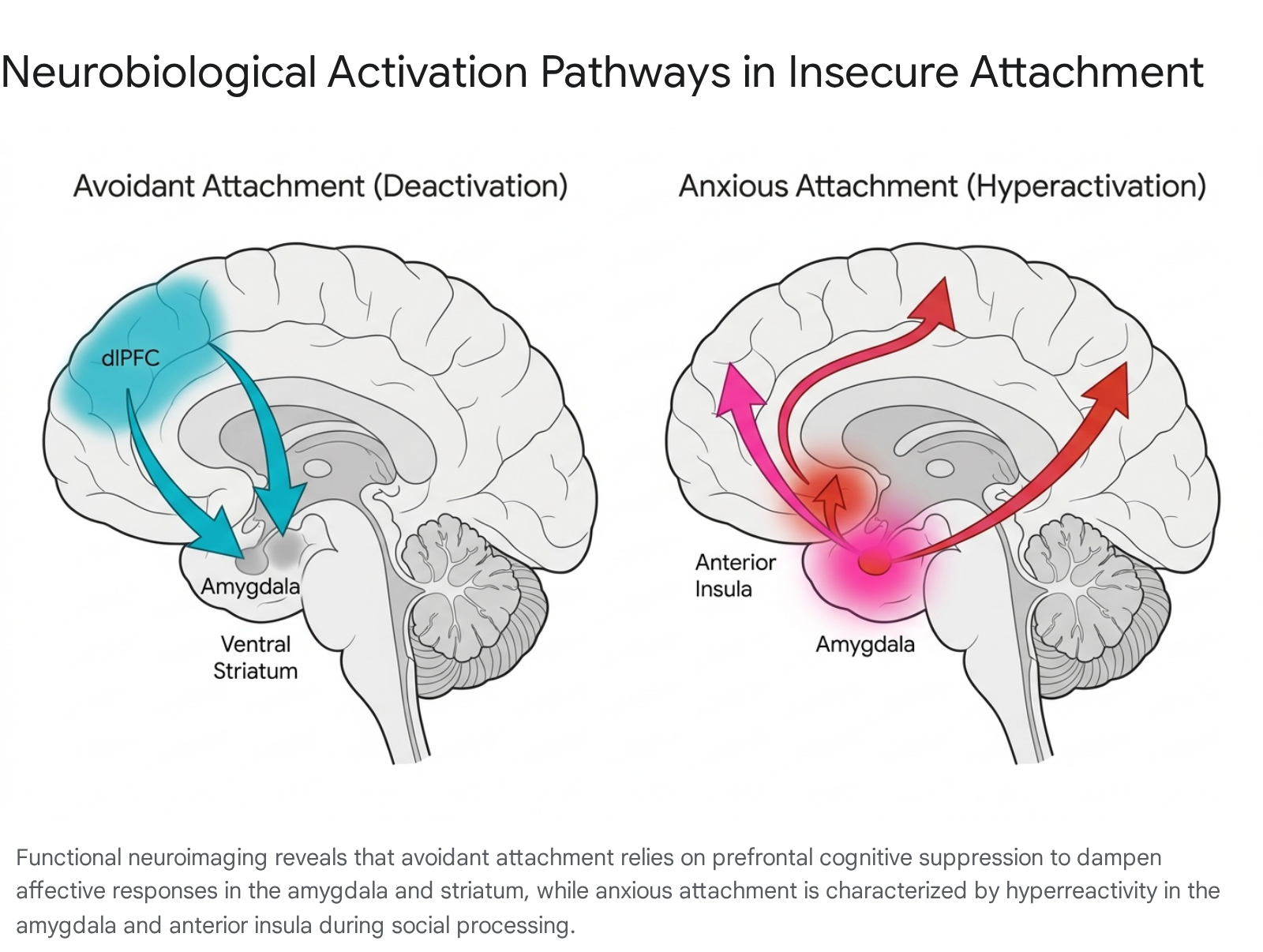
The neural substrates underlying attachment behaviors involve a complex network consisting of the ventral tegmental area, striatum, amygdala, hippocampus, insula, anterior cingulate cortex, and medial prefrontal cortex 1921.
Cortico-Limbic Activation Patterns and Social Processing
Adult attachment styles govern the encoding of approach versus aversion tendencies during social encounters 19. These tendencies dictate how the brain allocates metabolic resources to process social threats, social rewards, and empathy.
Individuals with high avoidant attachment utilize deactivating strategies to minimize the conscious experience of attachment-related distress 22. Functional magnetic resonance imaging (fMRI) reveals that during exposure to negative social stimuli, avoidant individuals exhibit relative deactivation in brain areas associated with social aversion and pain. For instance, in studies utilizing the "Cyberball" social rejection paradigm - a virtual ball-tossing game designed to induce the feeling of social exclusion - avoidantly attached subjects demonstrated decreased activations in the anterior insula and dorsal anterior cingulate cortex 19. Furthermore, avoidant individuals show reduced activation in reward-related areas, such as the ventral striatum and ventral tegmental area, when receiving positive social feedback, suggesting a generalized dampening of social reward sensitivity 192324. To maintain this emotional suppression, avoidant attachment is consistently associated with increased activation in the dorsolateral prefrontal cortex, an area heavily implicated in the top-down cognitive control and suppression of emotional states 2025.
Conversely, anxious attachment relies on hyperactivating strategies, characterized by heightened vigilance to social threat, an exaggerated need for reassurance, and emotional dysregulation 2224. Neurobiologically, this manifests as heightened reactivity in the amygdala when processing social punishment or viewing angry facial expressions 1923. During social exclusion tasks, anxiously attached individuals show pronounced hyperactivation of the anterior insula and dorsal anterior cingulate cortex, mirroring an acute, amplified sensitivity to social rejection 19.
Recent fMRI paradigms investigating empathetic responses further differentiate these attachment styles. Tasks that require individuals to overcome their own emotional responses to infer the preferences or emotional states of a partner demonstrate that avoidantly attached individuals exhibit lower activation in the anterior insula and require greater cognitive effort (indexed by inferior parietal lobule activation) to reason through ambiguous social preferences 2225. Anxiously attached individuals, however, exhibit heightened activation in neural networks associated with both approach and aversion during moments of social complicity and comfort, reflecting their profound ambivalence and underlying fear of abandonment even during positive interactions 192226.
Structural Brain Alterations and Resting-State Connectivity
Beyond functional activation in response to discrete stimuli, attachment patterns correlate with enduring structural variations in brain morphology 20. Secure attachment in infancy predicts larger gray matter volumes in areas related to social cognition over a longitudinal trajectory into late childhood 28. In contrast, adult neuroimaging studies indicate that high avoidant attachment is negatively correlated with bilateral hippocampal gray matter volume, whereas anxious attachment correlates negatively with left hippocampal volume 20. As the hippocampus is crucial for contextualizing memories and regulating stress responses, these structural reductions may impair an insecure individual's ability to differentiate past relational trauma from present, neutral interpersonal scenarios 1927. Furthermore, research on individuals subjected to early life stress and insecure attachment reveals a propensity for amygdala enlargement, reflecting a structural adaptation to environments that demand chronic threat detection 2728.
Resting-state functional connectivity studies provide additional insight into the intrinsic neural architecture of attachment systems. In populations with severe psychopathology, such as poly-drug use disorder, highly insecure attachment profiles demonstrate time-stable alterations in network connectivity 21. Specifically, insecure attachment is linked to increased resting-state connectivity between the lateral parietal default mode network and bilateral components of the salience network, paired with decreased connectivity between the lateral and medial parts of the default mode network 21. These network alterations closely parallel the difficulties insecure individuals face in integrating self-referential thought with emotional regulation.
| Neurobiological Domain | Secure Attachment Profile | Avoidant Attachment Profile | Anxious Attachment Profile |
|---|---|---|---|
| Functional Activation | Balanced amygdala response; efficient medial prefrontal cortex activation. | Increased dlPFC activation (suppression); decreased anterior insula and ACC response to social pain. | Heightened amygdala and anterior insula reactivity to social threat; heightened parahippocampal activation. |
| Reward Circuitry | Robust ventral striatum and VTA activation to positive social feedback. | Reduced striatal response to social reward; limited oxytocinergic reward binding. | Variable response; simultaneous approach and aversion module activation during positive stimuli. |
| Structural Volume | Normative hippocampal volume; well-developed orbitofrontal cortex. | Reduced bilateral hippocampal gray matter volume. | Reduced left hippocampal gray matter volume; structural markers of DMN hyper-connectivity. |
The Right Hemisphere and Relational Neurobiology
The integration of developmental psychology with affective neuroscience has been heavily advanced by Allan Schore, who delineated the critical role of hemispheric lateralization in attachment formation 29303132. Schore's research demonstrates that the right hemisphere - which dominates the implicit, nonverbal, intuitive, and holistic processing of emotional information - undergoes a substantial growth spurt during the first three years of life, directly corresponding to the primary window of attachment 29303133.
During early interactions, an infant and caregiver engage in rapid, face-to-face exchanges of visual-facial, auditory-prosodic, and tactile-gestural information 2931. This right-brain-to-right-brain communication facilitates profound bio-behavioral synchrony 29303133. In moments of infant distress, a sensitive caregiver utilizes this nonverbal channel to modulate the infant's arousal, effectively acting as an external regulator for the child's immature nervous system. This repeated interactive regulation catalyzes the structural maturation of the infant's orbitofrontal cortex, a critical region Schore describes as the senior executive of the emotional brain 2930.
Consequently, attachment is fundamentally defined as the interactive regulation of biological synchronicity between organisms 3033. Relational trauma or chronic misattunement during this critical window deprives the right hemisphere of the experience-dependent input necessary for optimal growth 2933. This deprivation inhibits the development of the orbitofrontal cortex, creating lasting deficits in self-regulation and serving as the neurological etiology for pathological dissociation - a defense mechanism rooted in the early right brain's inability to process overwhelming affective states 2933.
Neuroendocrinology: The Stress Response and Oxytocin
The psychological experience of attachment is inextricably linked to the neuroendocrine regulation of psychosocial stress, mediated primarily by the interactions between the hypothalamic-pituitary-adrenal axis and the oxytocinergic system 3435.
The HPA Axis and Cortisol Reactivity
The hypothalamic-pituitary-adrenal axis controls the systemic release of cortisol in response to environmental and psychological threats 35. Experimental paradigms, notably the Trier Social Stress Test, reveal marked differences in HPA axis reactivity that align closely with Adult Attachment Interview classifications 3436.
When subjected to standardized psychosocial stress, autonomously (securely) attached adults report relatively low subjective stress and display a moderate, adaptive physiological response in both adrenocorticotropic hormone and cortisol levels, coupled with high levels of circulating oxytocin 34. In stark contrast, individuals with a dismissing (avoidant) classification consistently self-report low to moderate subjective stress; however, their physiological markers indicate highly elevated HPA axis activation 34. This discrepancy confirms the resource-intensive nature of deactivating strategies: dismissing individuals require substantial physiological exertion to suppress the conscious awareness of emotional distress.
Preoccupied (anxious) individuals generally report moderate to high subjective stress, accompanied by moderate physiological HPA responses but relatively low oxytocin secretion 34. Most notably, individuals categorized as unresolved due to trauma or loss report highly elevated subjective stress but exhibit a blunted or suppressed HPA axis response 3436. This suppressed cortisol profile is characteristic of the biological collapse often observed in chronic trauma exposure, where the stress response system downregulates to protect the organism from sustained, toxic neurochemical flooding.
The Oxytocin System and Stress Buffering
Oxytocin, synthesized in the paraventricular nucleus of the hypothalamus, functions both as a neurotransmitter in the central nervous system and a hormone in the periphery. It is widely recognized as a powerful anti-stress agent that facilitates social bonding, enhances parental synchrony, and dampens amygdala reactivity 273537.
Oxytocin signaling operates through widely distributed oxytocin receptors located in critical HPA-mediating regions, including the hippocampus, amygdala, and frontal cortex 3537. Under conditions of social stress or upon the activation of attachment cues, securely attached individuals generally exhibit robust oxytocin secretion, which successfully buffers HPA axis hyperreactivity and moderates fear responses 3436. Conversely, avoidant attachment mechanisms are associated with less active oxytocin systems and reduced opioid receptor availability, limiting the biological reward derived from social connection and impeding the organism's ability to utilize social support for stress regulation 243738.
| Attachment Classification (AAI) | Subjective Stress Report (TSST) | HPA Axis Reactivity (Cortisol/ACTH) | Oxytocin Response Profile |
|---|---|---|---|
| Autonomous (Secure) | Low to Moderate | Moderate (Adaptive) | High (Strong buffering effect) |
| Dismissing (Avoidant) | Low to Moderate | Highly Elevated | Moderate |
| Preoccupied (Anxious) | Moderate to High | Moderate | Relatively Low |
| Unresolved (Trauma) | Highly Elevated | Suppressed / Blunted | Moderate |
Epigenetic Mechanisms and Gene-Environment Interactions
Current scientific consensus rejects strict genetic determinism in favor of gene-by-environment interactions. Attachment theory provides a prototypical model for this dynamic, mediated through epigenetic mechanisms - specifically DNA methylation. Epigenetic processes involve biochemical modifications that attach methyl groups to specific cytosine-phosphate-guanine sites on DNA, effectively turning gene transcription off without altering the underlying genomic sequence 384142.
Recent research has focused intensively on the epigenetic modification of two critical stress-regulating genes: the oxytocin receptor gene and the glucocorticoid receptor gene 3839. The glucocorticoid receptor gene dictates the availability of receptors essential for the negative feedback loop that safely terminates the HPA axis stress response 3842.
Studies examining peripheral tissues in young, healthy adults reveal that high attachment avoidance is significantly and selectively associated with increased promoter methylation of both the oxytocin receptor gene and the glucocorticoid receptor gene 384239. Increased methylation silences these genes, reducing receptor density. Consequently, an epigenetically modified glucocorticoid receptor gene results in an inability to efficiently shut down the cortisol stress response, while an epigenetically modified oxytocin receptor gene dulls the prosocial, soothing effects of oxytocin 3839. This dual epigenetic profile provides a compelling biological explanation for why avoidant individuals struggle to utilize social connection for emotional regulation.
The epigenetic alterations observed in insecure adults are frequently traced back to early childhood adversity. Research on cohorts of children who suffered childhood maltreatment demonstrates distinct hypermethylation of the oxytocin receptor gene compared to non-maltreated controls 40. Crucially, this specific hypermethylation acts as a biological mediator for structural brain deficits; it correlates strongly with a reduction of gray matter volume in the left orbitofrontal cortex, which subsequently predicts the development of disorganized and insecure attachment styles 40. Similar epigenetic findings have been replicated in cross-species animal models, including domestic dogs exposed to early life neglect, reinforcing the evolutionary conservation of environmental programming on the neuroendocrine system across mammalian species 284241.
The Temperament Versus Attachment Debate
A persistent methodological debate within developmental psychology centers on whether infant behavior in the Strange Situation simply reflects endogenous genetic temperament rather than the relational history between caregiver and child 424344. Critics hypothesized that the intense distress observed in anxiously attached infants was merely a manifestation of innate biological irritability, rather than an indication of maternal insensitivity 43.
Recent pre-registered, individual participant data meta-analyses have largely refuted the strong temperament hypothesis. Findings indicate that negative emotionality - a core dimension of difficult temperament encompassing fearfulness and irritability - is only weakly associated with attachment outcomes 454647. Specifically, negative emotionality predicts a slight increase in the likelihood of insecure-resistant attachment, likely because highly irritable infants challenge caregiver capacity, increasing the risk of inconsistent caregiving 45. However, negative emotionality has virtually no predictive value for insecure-avoidant or disorganized attachment styles, nor does it strongly predict the absence of secure attachment 4547.
Genetic studies further separate temperament from attachment security. Research examining the serotonin transporter polymorphism - a known genetic marker for temperamental sensitivity to negative affect - demonstrates that while the short allele significantly predicts an infant's raw proneness to distress, it does not predict the infant's actual attachment security or disorganization 44. The prevailing consensus concludes that attachment is a fundamentally relational construct. While infant temperament may dictate the specific flavor of insecurity or influence the dyadic goodness of fit, attachment security ultimately reflects the history of mutual affective regulation between caregiver and child 43444849.
Cross-Cultural Perspectives and Methodological Critiques
The assertion that attachment theory's core hypotheses - universality, normativity, sensitivity, and competence - apply uniformly across all human societies has faced intense scrutiny regarding cultural bias 4910. Anthropologists and cultural psychologists argue that the Strange Situation Procedure, and its associated definitions of developmental competence, imposes heavily Western values of autonomy, individuation, and independence onto non-Western populations 91012.
Van Ijzendoorn and Kroonenberg's landmark cross-cultural meta-analysis across eight countries demonstrated that while secure attachment remains the most prevalent classification globally, the distribution of insecure attachment types varies profoundly based on culturally specific child-rearing norms 7115450.
In collectivist cultures, such as Japan, there is a striking absence of insecure-avoidant infants; insecurely attached Japanese infants fall almost exclusively into the insecure-resistant (anxious) category 71154. Traditional Japanese child-rearing involves nearly constant physical proximity and emphasizes profound interdependence. Consequently, the brief separation episodes engineered by the Strange Situation induce extreme, non-normative distress in Japanese infants. Behaviors interpreted by Western researchers as resistant or overly dependent reflect normative cultural expectations rather than clinical psychopathology 7101256.
Conversely, studies in individualist societies like Northern Germany found exceptionally high rates of insecure-avoidant classifications 1112. In German culture, parents traditionally emphasize early independence and discourage emotional clinginess. As a result, infant behaviors marked as avoidant by the Strange Situation were actually socially reinforced indicators of culturally appropriate autonomy rather than markers of maternal rejection or neglect 1218.
Furthermore, cross-cultural data reveal that intracultural variation - differences between socioeconomic cohorts within the same country - is up to one and a half times larger than intercultural variation between distinct countries 115450. This suggests that socioeconomic stress, poverty, and local community support structures exert a more profound impact on attachment security than broad national culture alone.
| Cultural Context | Dominant Insecure Typology | Cultural Driver of Child-Rearing Behavior | Methodological Critique of the Strange Situation |
|---|---|---|---|
| United States / UK | Avoidant | Valuation of moderate independence and self-reliance. | Often serves as an unexamined baseline (imposed etic) against which other cultures are judged. |
| Japan (Collectivist) | Resistant / Anxious | Emphasis on physical proximity and interdependence. | Separation protocols induce acute, non-normative stress, artificially inflating anxious classifications. |
| Northern Germany | Avoidant | Strong cultural emphasis on early autonomy and stoicism. | Misinterprets culturally mandated self-reliance as pathological avoidance and maternal rejection. |
| Non-Western (e.g., Africa) | Variable | Alloparenting and communal caregiving models. | Fails to accurately capture or assess attachment networks distributed across multiple community caregivers. |
Neuroplasticity and Earned Secure Attachment
While internal working models established in infancy demonstrate significant longitudinal stability and neurobiological embedding, they are not permanently deterministic. The adult brain retains experience-dependent neuroplasticity - the ability to reorganize neural pathways and synaptic connections - across the lifespan 82757. This plasticity allows individuals who experienced severe early adversity to develop earned secure attachment 8575159.
Earned secure attachment is clinically defined as the state in which individuals with insecure childhood attachment histories develop functional, secure relationship patterns and coherent internal working models in adulthood 85160. This transformation is not achieved purely through cognitive insight or intellectual understanding, but through sustained neuroplastic changes driven by repeated, emotionally significant, and safe relational experiences 8576052.
These corrective emotional experiences can occur within stable romantic partnerships or community mentorships, but they are most systematically facilitated within the therapeutic alliance 85759605253. Utilizing the framework of interpersonal neurobiology, psychotherapy functions as a right-brain-to-right-brain regulatory experience 293257. When a therapist consistently provides attunement, emotional safety, and successful repair following relational ruptures, it provides the client's nervous system with novel biological data that directly contradicts early traumatic templates 605253. Over time, this consistency facilitates the rewiring of implicit memory networks.
Research indicates that adults who have achieved earned security function neurobiologically and psychologically on par with continuous secure individuals - those who were securely attached from birth 605254. Earned secure individuals demonstrate comparable baseline cortisol stress responses, advanced mentalizing capabilities, and robust emotional regulation 6052. Moreover, longitudinal neuroimaging data suggest that the establishment of secure adult relationships and successful psychotherapeutic interventions can increase functional connectivity between prefrontal regulatory regions and subcortical threat circuits, mitigating the hyper-reactivity of the amygdala originally caused by early trauma 282759. Ultimately, while early attachment experiences map the foundational architecture of the developing brain, the ongoing plasticity of the neuroendocrine and cortico-limbic systems ensures that attachment remains a dynamic, evolving capacity throughout the human lifespan 8282757.