
Homotopy type theory as a foundation for mathematics
Homotopy type theory constitutes a major paradigm shift in mathematical logic and theoretical computer science, synthesizing constructive intensional type theory with abstract homotopy theory 11. Under this foundational paradigm, logical types are interpreted not merely as collections of unstructured elements, but as spatial mathematical objects - specifically, homotopy types or $\infty$-groupoids 125. This spatial interpretation provides a robust structural foundation for mathematics in which isomorphic structures are formally and logically identified, offering a powerful framework for mechanized proof verification in computer software 345.
Historical Evolution of the Discipline
The development of homotopy type theory bridges distinct mathematical lineages spanning several decades, culminating in a unified foundational system.
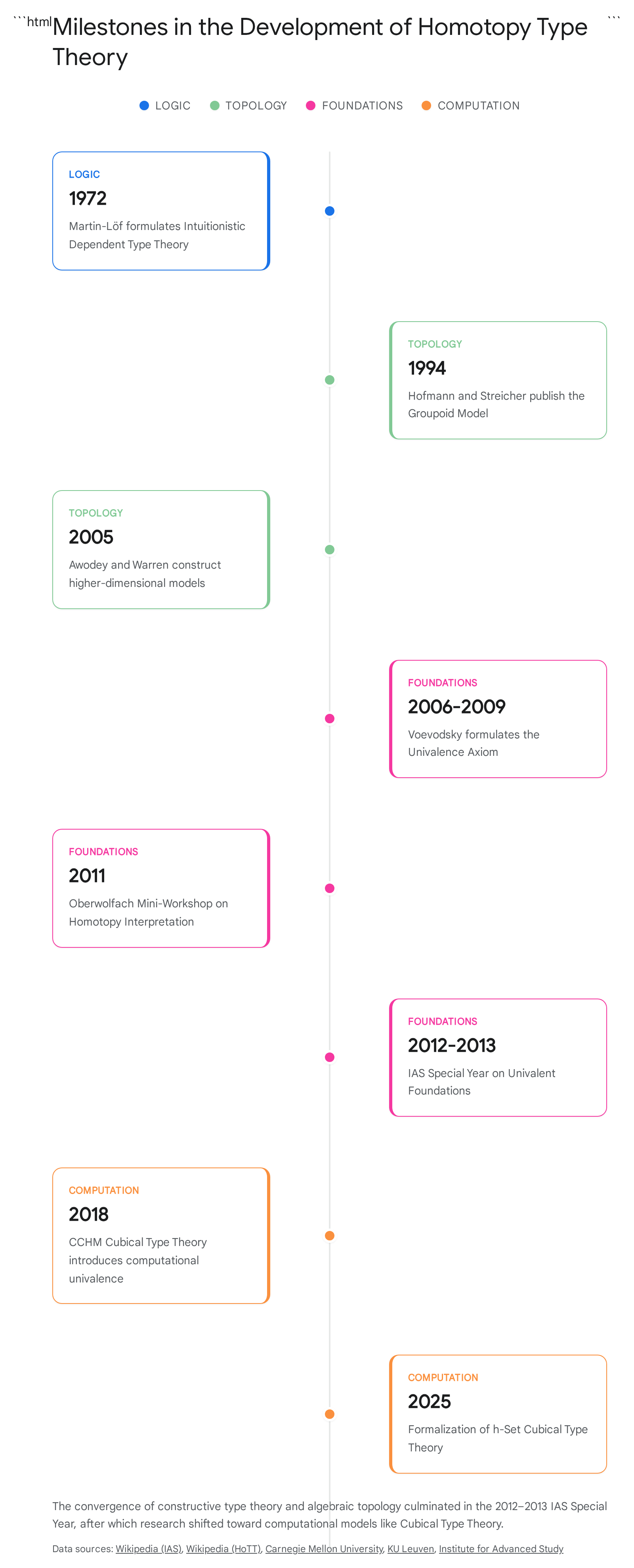
The logical substrate of the discipline is Per Martin-Löf's intuitionistic dependent type theory, introduced in the 1970s as a constructive alternative to classical set theory 67. In Martin-Löf's foundational system, equality is treated not as a boolean predicate but as a type itself, known as the identity type. Consequently, an assertion of equality requires an explicit proof or "witness," reflecting the constructive philosophy that mathematical truth necessitates explicit construction 1.
For decades, the geometric nature of these identity proofs remained obscured. However, in 1994, Martin Hofmann and Thomas Streicher introduced the groupoid model of type theory. This model demonstrated that identity types could be modeled as morphisms within a groupoid, effectively refuting the long-held assumption that all proofs of equality between two elements are necessarily identical - a property known as the Uniqueness of Identity Proofs (UIP) 111. This crucial realization marked the first recognition that intensional type theory harbored higher-dimensional geometric structures 1.
In 2005, Steve Awodey and Michael Warren extended this insight by constructing higher-dimensional models of intensional type theory using Quillen model categories. This formalized the connection between the identity types of mathematical logic and the path spaces of abstract homotopy theory 1. Simultaneously, Vladimir Voevodsky, working independently on a vision for computer-verified mathematics, recognized that the traditional concept of an $\infty$-groupoid from algebraic topology could model the nested identity types of Martin-Löf's theory 1. Between 2006 and 2009, Voevodsky introduced the concept of a univalent fibration and formulated the Univalence Axiom, which provided a rigorous syntactic mechanism for identifying equivalent types natively within the logic 1.
These parallel discoveries catalyzed a major international collaborative effort. A pivotal mini-workshop at the Mathematical Research Institute of Oberwolfach in 2011, organized by Awodey, Richard Garner, Martin-Löf, and Voevodsky, set the stage for broader integration 1. Subsequently, during the 2012 - 2013 academic year, the Institute for Advanced Study (IAS) in Princeton - an independent center historically associated with scholars like Albert Einstein and John von Neumann - hosted the Special Year on Univalent Foundations of Mathematics 368.
Organized by Awodey, Thierry Coquand, and Voevodsky, this program assembled over thirty leading researchers in computer science, logic, and topology 38. The collaboration resulted in the drafting of a 600-page foundational text, Homotopy Type Theory: Univalent Foundations of Mathematics (commonly referred to as the HoTT Book), which was collaboratively written in under six months and released as an open-source project on GitHub 36910. This text consolidated the field's core definitions and established synthetic homotopy theory as a viable and independent mathematical discipline 91112.
Principles of Dependent Type Theory
To comprehend the spatial interpretation introduced by homotopy type theory, it is necessary to examine the underlying mechanisms of dependent type theory. Unlike classical mathematics, which primarily utilizes the boolean logic of propositions, type theory utilizes a "propositions as types" interpretation, wherein mathematical propositions are represented by types, and the proofs of those propositions are represented by the terms inhabiting those types 15.
The logic depends heavily on type families that vary over a base type. A dependent type $B(x)$ is a type that is indexed by a term $x$ of another type $A$ 513. The fundamental operations on dependent types mirror logical quantifiers. The dependent product, denoted $\Pi_{(x:A)} B(x)$, generalizes the concept of a function; it represents the type of functions that take an input $x \in A$ and return an output in $B(x)$ 518. Logically, this corresponds to the universal quantifier ("for all $x \in A$, $B(x)$"). Conversely, the dependent sum, denoted $\Sigma_{(x:A)} B(x)$, represents the type of pairs $(x, y)$ where $x \in A$ and $y \in B(x)$, functioning logically as the existential quantifier ("there exists an $x \in A$ such that $B(x)$") 518.
Within this framework, everything is intrinsically typed; a term cannot exist independent of its type, and there is no absolute or global membership predicate equivalent to the $\in$ relation found in set theory 219.
The Homotopical Interpretation of Types
The most profound paradigm shift in homotopy type theory is the geometric reinterpretation of these logical primitives. In topology, mathematical spaces are studied through properties that remain invariant under continuous deformation 1421. The homotopical interpretation directly maps the syntax of dependent type theory onto these continuous geometric concepts 18.
In this interpretation, the elements of a logical type correspond directly to points residing within a topological space. When a proof of identity is established between two elements, this identity proof is visualized not as a static equation, but as a continuous geometric path connecting those two points within the space 111516. Furthermore, because identity proofs are themselves elements of an identity type, one can establish equalities between two different identity proofs. This higher-order equality corresponds to a continuous homotopy - a two-dimensional surface that continuously deforms one path into another 215. This recursive structure generates an infinite-dimensional geometric environment representing complex logical architectures.
Dependent types are interpreted as fibrations (specifically, Serre fibrations in classical homotopy theory) 1317. A dependent type $x : A \vdash B(x)$ acts as a fiber bundle where the base space is $A$, the total space is the dependent sum $\Sigma_{(x:A)} B(x)$, and the individual type $B(x)$ constitutes the fiber over the specific point $x$ 13. Functions between types represent continuous maps between spaces, ensuring that logical functions fundamentally respect the continuous path structures of the spaces they map between 1617.
Stratification by Homotopy Levels
Because identity types can be infinitely nested, HoTT characterizes spaces by their homotopy level, or $n$-type, which measures the structural depth at which higher-dimensional paths become trivial 217.
A type is considered contractible (a $-2$-type) if it contains exactly one element up to path equality, geometrically resembling a space that can be continuously shrunk to a single point 217. One level higher are "mere propositions" ($-1$-types), which are types that are either empty or entirely contractible. In mere propositions, any two proofs are structurally identical, successfully recovering the classical notion of proof-irrelevance within the constructive framework 117.
Sets are categorized as $0$-types. In a set, the identity between any two elements is a mere proposition, meaning that while distinct elements exist, there is at most one path between them, precluding any higher-dimensional geometric deformations 217. Standard mathematical structures, such as the natural numbers $\mathbb{N}$ and the real numbers $\mathbb{R}$, function as $0$-types 2. Advancing up the hierarchy, groupoids ($1$-types) permit multiple distinct paths between points, but path-between-paths (homotopies) are trivial. The type of all $0$-types inherently acts as a $1$-type, illustrating how the universe of sets requires a higher-dimensional perspective to fully describe its internal equivalences 21718.
Comparison with Classical Set Theory
Homotopy type theory offers a putative foundation for mathematics that diverges sharply from Zermelo-Fraenkel set theory with the Axiom of Choice (ZFC), the dominant foundation of the 20th century 1819.
ZFC operates as a material set theory, wherein the fundamental ontology consists exclusively of sets, and mathematical structures are built by nesting sets within one another 19. Consequently, propositions such as $3 \in \mathbb{R}$ or ${ \emptyset } \in 4$ are valid, albeit practically nonsensical, syntactic formulations in ZFC because all objects share the same material substance 719. In contrast, HoTT functions as a structural theory. Elements do not exist independently of their types, rendering cross-type membership questions syntactically invalid 219.
The following table summarizes the foundational differences between the two frameworks.
| Foundational Feature | Zermelo-Fraenkel Set Theory (ZFC) | Homotopy Type Theory (HoTT) |
|---|---|---|
| Fundamental Ontology | Material sets. Every mathematical object is fundamentally a set built from the empty set 719. | Homotopy types ($\infty$-groupoids) containing points, paths, and higher homotopies 219. |
| Membership and Typing | Global membership predicate ($\in$). Elements can theoretically belong to multiple nested sets 19. | Intrinsic typing judgment ($a : A$). An element belongs strictly to its defining type 219. |
| Nature of Equality | Propositional and strict. Two sets are equal if they contain exactly the same elements 1919. | Proof-relevant and path-based. Equality is a geometric path; multiple distinct equality proofs can exist 119. |
| Treatment of Subsets | Formed natively via the Axiom of Separation (e.g., ${x \in A \mid P(x)}$) 19. | Represented structurally via $\Sigma$-types over a characteristic function $P : A \to Prop$, or equivalence classes of injective maps 19. |
| Constructivism | Inherently classical. Relies heavily on the Law of Excluded Middle and the Axiom of Choice 1819. | Inherently constructive. Computable by default, though classical axioms can be safely adjoined to $0$-types (sets) 71918. |
| Structural Identity | Isomorphic structures are technically distinct entities that merely share behavioral properties 15. | Isomorphic structures are formally and logically identical via the Univalence Axiom 71516. |
The Univalence Axiom
The conceptual centerpiece of homotopy type theory is the Univalence Axiom, devised by Vladimir Voevodsky. It bridges a persistent gap between informal mathematical practice and formal logic. In conventional practice, mathematicians treat isomorphic structures - such as two groups with identical algebraic behavior but different underlying set elements - as interchangeable 1516. However, classical formal logic demands manual, tedious translation of theorems between these technically distinct objects. Univalence elevates this informal practice to a rigorous logical axiom 15.
Within HoTT, a function $f : A \to B$ is defined as an equivalence if its fiber over every point $y : B$ is contractible. This means that for any $y$ in $B$, there is exactly one element $x$ in $A$ accompanied by a path establishing $f(x) = y$ 152021. The type of all such equivalences between $A$ and $B$ is denoted as $A \simeq B$ 15.
Through path induction, there exists a canonical function that maps any proof of identity between two types to an equivalence between them: $idtoequiv : (A = B) \to (A \simeq B)$ 1522
The Univalence Axiom boldly asserts that this canonical map $idtoequiv$ is itself an equivalence 1522. Informally, the axiom states $(A = B) \simeq (A \simeq B)$, positing that the type of paths between two types in a universe is entirely equivalent to the type of equivalences between them 51522. This profound symmetry implies that if two types are shown to be equivalent, they can be substituted for one another in any context, guaranteeing representation independence and streamlining the mechanization of complex proofs 1516.
Higher Inductive Types and Synthetic Geometry
Ordinary inductive types, such as the natural numbers, are generated by point constructors (e.g., $0$ and the successor function) 1732. Homotopy type theory expands this mechanism through the introduction of Higher Inductive Types (HITs). HITs permit the definition of spaces using both point constructors and path constructors, natively embedding topological features into the logic 161732.
A primary example is the homotopical circle, denoted $S^1$. In conventional analytic topology, a circle is constructed as a set of points equidistant from a center in $\mathbb{R}^2$, or as a quotient space 1833. In HoTT, $S^1$ is defined synthetically as a HIT comprising exactly two constructors: 1. A point constructor: $base : S^1$ 2. A path constructor: $loop : base = base$ 1732.
This intrinsic definition perfectly captures the topological concept of a fundamental group without invoking a background metric space or the real numbers 1733. By iterating this methodology, one can construct higher-dimensional spheres ($S^n$) via the topological operation of suspension. Suspending a space generates two new point constructors (a North and South pole) and a family of path constructors connecting them for every point in the original base space 1632.
HITs also enforce specific logical constraints. Propositional truncation ($||A||_{-1}$) utilizes a path constructor to assert paths between all elements of $A$, forcibly collapsing the space into a mere proposition (a $-1$-type) and erasing its computationally relevant data 161723. Furthermore, quotients by equivalence relations - historically cumbersome to formalize in intensional type theory - are natively and elegantly realized as HITs by simply adding path constructors corresponding to the specific relation 151632.
The Computational Challenge of Univalence
While the Univalence Axiom provides exceptional mathematical elegance, its initial introduction into Martin-Löf type theory created a severe computational bottleneck. In a strictly constructive type theory, the system possesses the property of "canonicity," meaning that every closed term (a term without free variables) of a base type must evaluate to a canonical form 243725. For instance, a closed term of the natural number type must ultimately compute to a numeral like $0$ or a specific successor of $0$ 2425. This ensures that existence proofs intrinsically yield executable algorithms.
However, because the Univalence Axiom was introduced simply as an axiom in the foundational 2013 HoTT Book, the computational evaluator lacked instructions on how to compute functions defined via transport along univalent paths 52425. Consequently, computation would "get stuck" whenever it encountered the bare univalence term ua, destroying the system's canonicity and undermining its status as a fully constructive programming language 524.
Cubical Type Theory
To restore computational viability, theorists - including Cyril Cohen, Thierry Coquand, Simon Huber, and Anders Mörtberg - developed Cubical Type Theory in 2015 5233726. Drawing inspiration from cubical sets, this framework replaces the standard primitive identity types with an explicitly geometric formulation 2337. Paths are modeled not as inductively defined equalities, but as functions from a formal interval type $\mathbb{I}$ to a space $A$ 537. By iterating this interval type, Cubical Type Theory natively manipulates higher-dimensional structures such as squares, cubes, and hypercubes 537.
Cubical Type Theory replaces the standard Martin-Löf J-eliminator with Kan composition operations 52728. The core operational primitives include:
* Homogeneous Composition (hcomp): An operation that mathematically constructs the "missing face" of an open higher-dimensional box, providing a computational mechanism for path transitivity and equivalence 5252728.
* Generalized Transport (transp): An operation designed to move terms along paths, resolving the exact computational blockage that previously crippled the evaluation of univalence 52028.
* Glue Types: A specialized construction that allows a base type to be "glued" together with a partial family of equivalent types. Glue types are the technical engine that renders the Univalence Axiom a provable theorem with direct, executable computational content, rather than an opaque axiom 511202943.
Truncated Cubical Variants and "h-Set" Developments
The infinite hierarchy of equality levels present in full HoTT and Cubical Type Theory can become burdensome when formalizing structures that do not necessitate higher homotopy, such as standard computer science data types 1129. In conventional type theory, systems often employ the Uniqueness of Identity Proofs (UIP) to simplify equality reasoning 29. However, UIP and the Univalence Axiom are fundamentally incompatible; univalence demands multiple distinct paths between types, whereas UIP strictly limits paths to reflexivity 1529.
Recent theoretical advancements in late 2025 by Yee-Jian Tan, Andreas Nuyts, and Dominique Devriese introduced "h-Set Cubical Type Theory" 293045. The researchers demonstrated that by excising the "Glue" types from Cubical Type Theory - thereby removing univalence - one can safely postulate UIP without causing inconsistency 112930. This truncation collapses the equality hierarchy into zero-dimensional h-Sets, yet critically preserves highly desirable features of HoTT, such as functional extensionality and Quotient Inductive Types (QITs) 112930. This truncated variant provides a rigorous, highly optimized environment for verifying classical code and basic mathematics without the computational overhead of tracking higher $\infty$-groupoids 112930.
Mechanization and the Proof Assistant Ecosystem
The formalization of mathematics within homotopy type theory relies extensively on interactive proof assistants. The software landscape is bifurcated based on the underlying logical kernels of these tools and their capacity to support cubical geometric features 314732.
| Proof Assistant | Core Framework & HoTT Support | Primary Mathematical Libraries |
|---|---|---|
| Agda (Cubical Agda) | Native implementation of Cubical Type Theory. Features computational univalence and robust support for Higher Inductive Types (HITs) 202833. | agda/cubical, 1Lab. Specializes in synthetic homotopy theory, higher category theory, and topological computing 20283233. |
| Coq (Rocq Prover) | Based on the Calculus of Inductive Constructions (CiC). Supports HoTT axiomatically and utilizes private inductive constructs to simulate HITs 325034. | Coq-HoTT, UniMath. Focuses on foundational univalent mathematics without a fully cubical computational engine 325034. |
| Lean 4 | Based on classical dependent type theory with built-in UIP. Abandoned native HoTT to prioritize scalable classical mathematics and AI integration 31323553. | Mathlib. Dominates classical formalization (e.g., IMO challenges, Terence Tao's research). HoTT exists only in experimental, restricted libraries like ground_zero 3235533655. |
| Arend | Specifically designed for HoTT with a built-in interval type, but lacks the exhaustive computational infrastructure of full CCHM cubical theory 313256. | Arend Lib. Developed by JetBrains; provides a streamlined learning curve for univalence without heavy cubical syntax 3132. |
The Agda Paradigm
Cubical Agda represents the vanguard of computational homotopy type theory 1127. Because the univalence axiom and HITs are embedded natively in the language's kernel - utilizing hcomp, transp, and Glue - proofs relying on univalence compute efficiently and seamlessly 52728. Cubical Agda has been instrumental in formalizing complex topological concepts. Notable achievements include the machine-verified computation of the Brunerie number $\pi_4(S^3) \cong \mathbb{Z}/2\mathbb{Z}$, a result showcasing the increasing computational sophistication of higher-dimensional type theory 57, as well as the formalization of synthetic cohomology rings and general algebraic structures 5737.
The Divergence of Lean
While older iterations like Lean 2 featured a dedicated HoTT mode, the development trajectories of Lean 3 and Lean 4 deliberately excised native HoTT support for technical and social reasons 31325338. Lean's primary directive evolved toward digitizing classical, research-level mathematics via the massive Mathlib project, which by 2025 had formalized over 210,000 theorems 355336. Mathlib fundamentally relies on classical logic, including the Law of Excluded Middle, the Axiom of Choice, and crucially, the Uniqueness of Identity Proofs (UIP) 313553.
Because UIP directly contradicts univalence, mainstream Lean architectures cannot support full homotopy type theory 153253. Furthermore, Lean has become the premier testing ground for Artificial Intelligence theorem proving. In 2025 and 2026, AI models such as DeepMind's AlphaProof, ByteDance's Seed-Prover, and Math Inc.'s Gauss achieved historic milestones in Lean 4, resolving International Mathematical Olympiad (IMO) problems and completing the formalization of the strong Prime Number Theorem in weeks instead of years 353639. These staggering advancements solidify Lean's dominance in classical formalization, relegating HoTT within the Lean ecosystem to experimental, user-space libraries like ground_zero, which emulate HITs via basic quotients to bypass the kernel's limitations 55.
Synthetic Homotopy Theory in Practice
The synthesis of topology and type theory permits a novel methodology known as synthetic homotopy theory 1217. Rather than constructing topological spaces analytically from infinite sets of points in $\mathbb{R}^n$ and proving properties using classical continuous functions and limits, mathematicians operating in HoTT derive topological invariants purely through the logical manipulation of types, paths, and constructors 1733.
This synthetic approach has yielded highly efficient mechanized proofs. For example, the calculation of the fundamental group of the circle, $\pi_1(S^1) \cong \mathbb{Z}$, was formalized early on in Coq-HoTT 4. The framework scales effectively to highly advanced algebraic topology, including the development of synthetic cohomology, the calculation of general cohomology rings, and the formalization of the Serre spectral sequence within univalent foundations 26555761.
By fundamentally treating isomorphism as strict equality, HoTT drastically reduces the volume of verification code required. In standard set-theoretic formalizations, representing the same mathematical object in two different ways (e.g., natural numbers defined as unary Peano integers versus binary sequences) requires tedious, manual translation of properties from one structure to the other 5. Univalence allows algorithms and theorems proven on one structure to be automatically transported to any equivalent structure with zero loss of computational fidelity 525.
Recent Advancements and Future Trajectories
Research entering 2025 and 2026 increasingly targets the refinement of cubical theories and the expansion of HoTT into richer, higher-dimensional mathematics. At premier theoretical computer science symposiums, such as the Certified Programs and Proofs (CPP) 2026 conference and the TYPES 2025 conference at the University of Strathclyde, academic focus has pivoted toward geometric homotopy theory, cocompleteness in simplicial HoTT, and the formal axiomatization of $\infty$-categories 4041424344.
A major frontier is the formalization of the metatheory of type theory inside type theory itself. Researchers face significant challenges, often referred to colloquially as "transport hell," when attempting to achieve syntax strictification and prove complex normalizations 434546. Utilizing advanced constructs like quotient inductive-inductive-recursive types (QIIRTs) to build natural models in Cubical Agda has allowed researchers to formalize intrinsic type theory without relying on unsafe postulates, though sophisticated metatheory remains arduous 454647.
Simultaneously, theorists are constructing extensions like "real-cohesive homotopy type theory" designed to bridge synthetic geometry with pure abstract homotopy, allowing for the formalization of classical Lie groups, manifolds, and topological K-theory natively within the logic 43. While the proof assistant community remains structurally bifurcated - with Lean prosecuting the vanguard of classical mathematics and Cubical Agda dominating univalent foundations - homotopy type theory endures as a profound demonstration that constructive logic, computation, and continuous geometry are intimately, inextricably linked 72653.