The Hodge Conjecture
Foundations of Algebraic Geometry and Topology
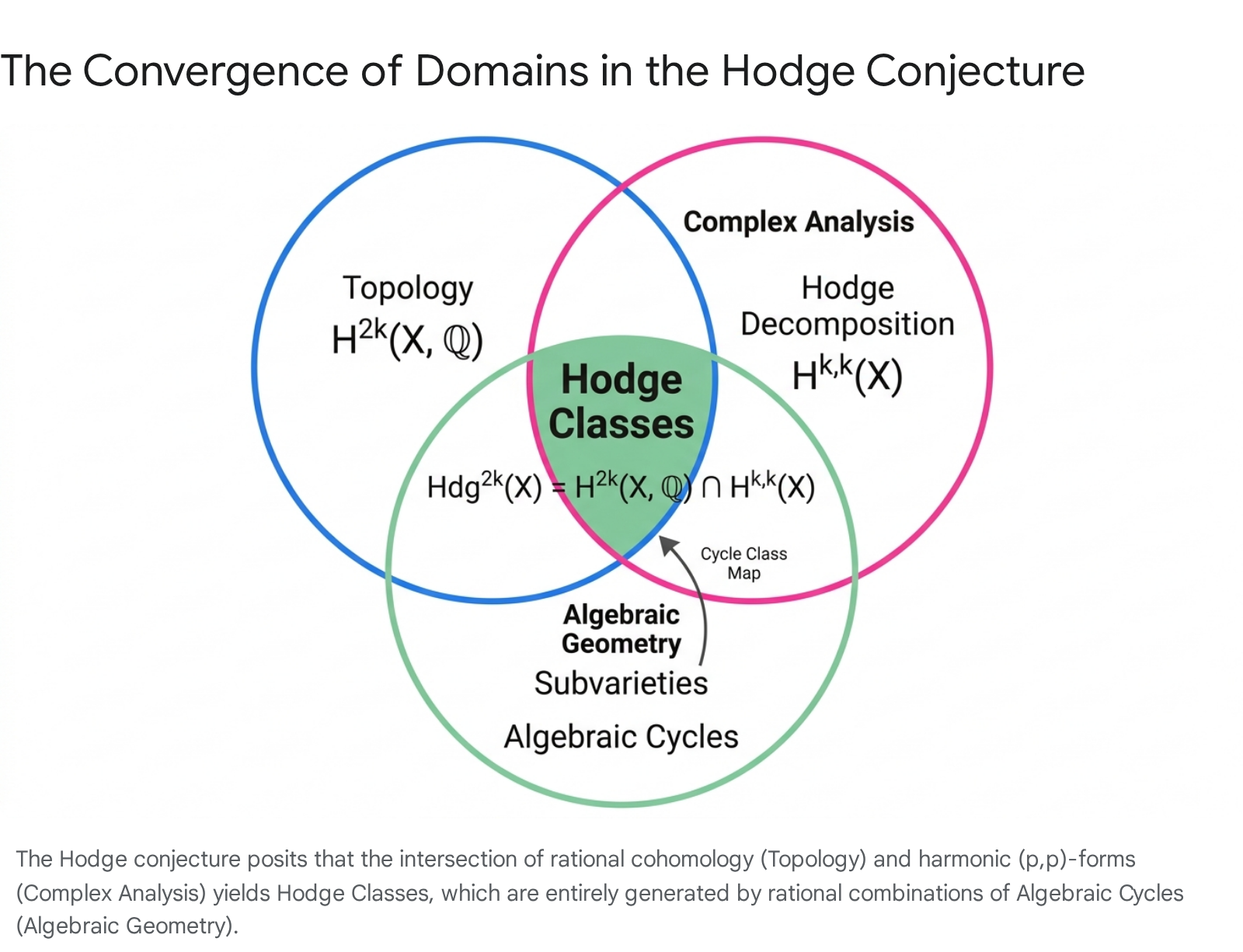
The Hodge conjecture represents one of the most profound and technically demanding unsolved problems in modern mathematics, acting as a structural bridge between algebraic topology, complex analysis, and algebraic geometry. Initially conceptualized by the Scottish mathematician William Vallance Douglas Hodge during the 1930s and formally presented at the 1950 International Congress of Mathematicians in Cambridge, Massachusetts, the conjecture posits that the topological structure of certain highly regular geometric spaces can be entirely characterized by the polynomial equations defining their internal sub-shapes 12. Recognized globally as one of the seven Millennium Prize Problems established by the Clay Mathematics Institute in 2000, its eventual resolution would provide a unifying framework proving that topological "holes" in complex algebraic varieties are not merely abstract topological artifacts, but are rigorously generated by algebraic geometry 134.
To evaluate the conjecture, one must first establish the rigorous mathematical framework within which it operates. The hypothesis does not apply to all continuous spaces or even all complex manifolds; it is strictly limited to projective non-singular algebraic varieties over the field of complex numbers, denoted as $\mathbb{C}$ 14. A projective complex manifold is a geometric space that can be analytically embedded into a complex projective space $\mathbb{P}^N(\mathbb{C})$. Due to this embedding, the ambient projective space equips the manifold with a natural Kähler metric - specifically, the Fubini - Study metric - which guarantees that the manifold behaves consistently under the laws of complex differential geometry 14. By Chow's theorem, closed analytic submanifolds of a complex projective space are invariably algebraic, meaning they correspond precisely to the common zero loci of finite sets of homogeneous polynomial equations 4.
This assumption of a projective structure is foundational. Without it, the fundamental connection between analytic geometry and polynomial algebra deteriorates. The conjecture explicitly cannot be generalized to arbitrary compact Kähler manifolds, as counterexamples involving complex tori (which admit Kähler metrics but fail to be algebraic and lack projective embeddings) demonstrate that non-projective spaces contain topological classes divorced from any underlying algebraic structure 45.
De Rham Cohomology and the Hodge Decomposition
The mechanism by which mathematicians measure the topology of these algebraic varieties relies on singular cohomology. In algebraic topology, the presence of non-zero cohomology classes, denoted $[ \alpha ] \in H^k(X, \mathbb{C})$, typically indicates that the space $X$ contains a $k$-dimensional hole or void 12. Through de Rham's theorem, the singular cohomology of a smooth manifold with complex coefficients is isomorphic to its de Rham cohomology, which is constructed from the vector spaces of closed differential $k$-forms modulo exact forms 46.
The presence of a pseudo-complex structure on a $C^\infty$-manifold $X$ of real dimension $2n$ introduces a $\mathbb{C}$-module structure on the tangent bundle $TX$. This allows any complex-valued differential $k$-form to be uniquely decomposed into a sum of forms of type $(p, q)$, where $p$ counts the number of holomorphic differentials (e.g., $dz$) and $q$ counts the number of antiholomorphic differentials (e.g., $d\bar{z}$), such that $p + q = k$ 4.
For a compact Kähler manifold, the Laplacian operator respects this $(p, q)$ bidegree. Consequently, Hodge theory establishes the Hodge Decomposition Theorem, asserting that the $k$-th cohomology group splits into a direct sum of harmonic $(p, q)$-forms: $$H^k(X, \mathbb{C}) = \bigoplus_{p+q=k} H^{p,q}(X)$$ This decomposition is entirely independent of the choice of the Kähler metric, relying solely on the complex structure of the manifold 17. The dimensions of these respective vector spaces are denoted as the Hodge numbers $h^{p,q} = \dim_\mathbb{C} H^{p,q}(X)$. These numbers govern the topological fingerprint of the manifold and adhere to rigid symmetries, notably Hodge symmetry ($h^{p,q} = h^{q,p}$) and Serre duality ($h^{p,q} = h^{n-p,n-q}$) 88.
Algebraic Cycles and the Cycle Class Map
While cohomology measures the abstract topology of the space, algebraic geometry focuses on the explicit shapes sitting inside it. An algebraic cycle $Z$ on $X$ is defined as a formal linear combination $Z = \sum c_i Z_i$, where each constituent $Z_i$ is an irreducible, reduced closed algebraic subvariety of $X$ 5. If these subvarieties possess a complex codimension $k$ (equating to a complex dimension of $n-k$ and a real dimension of $2n-2k$), the composite cycle is said to be of codimension $k$.
In the language of algebraic topology, any closed, oriented, real submanifold of dimension $2n-2k$ naturally defines a homology class in $H_{2n-2k}(X, \mathbb{Z})$. Through the duality established by Henri Poincaré, this homology class corresponds uniquely to a cohomology class in $H^{2k}(X, \mathbb{Z})$. This precise theoretical bridge is known as the cycle class map, which associates an algebraic cycle $Z$ to a topological cohomology class denoted $[Z]$ 4910.
The critical intersection between these disciplines arises when analyzing the integration currents defined by complex submanifolds. A complex submanifold of dimension $n-k$ inherently annihilates all differential forms of type $(r,s)$ unless $(r,s) = (n-k, n-k)$ 711. Consequently, when localized within de Rham cohomology, the Poincaré dual of an algebraic cycle of codimension $k$ is represented by a closed differential form strictly of type $(k,k)$ 17. Therefore, if $[Z]$ represents the rational cohomology class of an algebraic cycle of codimension $k$, it is subjected to two unyielding constraints: it must be a rational class (lying within the image of $H^{2k}(X, \mathbb{Q}) \to H^{2k}(X, \mathbb{C})$), and it must possess a Hodge bidegree of $(k,k)$, placing it securely within $H^{k,k}(X)$.
The intersection of these two distinct mathematical requirements defines the subgroup of Hodge classes: $$\operatorname{Hdg}^{2k}(X) = H^{2k}(X, \mathbb{Q}) \cap H^{k,k}(X)$$ It is a foundational, rigorously proven theorem of complex geometry that every algebraic cycle generates a rational Hodge class 56. The Hodge conjecture asserts that the inverse is also universally true.
Formal Formulation of the Conjecture
The Rational Hodge Conjecture
The modern, universally accepted formalization of the problem is deliberately restricted to rational coefficients. The official statement reads: Let $X$ be a non-singular complex projective manifold. Then every Hodge class on $X$ is a linear combination with rational coefficients of the cohomology classes of complex subvarieties of $X$ 111.
Under this formulation, if a cohomology class $\alpha$ is an element of $\operatorname{Hdg}^{2k}(X)$, the conjecture predicts that there exist irreducible algebraic subvarieties $Z_i$ of codimension $k$ and associated rational coefficients $c_i \in \mathbb{Q}$ such that the class can be expressed perfectly as $\alpha = \sum c_i [Z_i]$ 411. Hodge originally intended the conjecture to apply to integer coefficients, but early topological discoveries necessitated amending the hypothesis strictly to the field of rational numbers to avoid fatal contradictions involving high-dimensional topological twisting 112.
Absolute Hodge Classes and the Mumford-Tate Group
A secondary mechanism for understanding Hodge classes on abelian varieties involves the Mumford-Tate group, denoted $\operatorname{MT}(A)$. The Mumford-Tate group governs the vector space of Hodge classes; by Mumford's theorem, the Hodge classes present on all powers of a given abelian variety $A$ are precisely the invariants of the $\operatorname{MT}(A)$ group 13. Deligne subsequently proved a powerful rigidity property establishing that all such invariant classes are "absolute Hodge" classes. This property indicates that the classes maintain their Hodge status under any automorphism of the complex numbers 13.
While the absolute Hodge property is a profound structural rigidity, it falls short of proving algebraicity. Absolute Hodge classes resist known algebraicity methods when variables such as complex multiplication (CM) isolation or secant geometry are absent 13. Demonstrating that an absolute Hodge class is generated by algebraic cycles without relying on discriminant-specific bounding remains a primary obstacle in completing the proof for abelian geometries.
Counterexamples to the Integral and Real Formulations
While the rational Hodge conjecture remains plausibly true and serves as a Millennium Prize problem, mathematicians have systematically disproven its sibling formulations over the past six decades, revealing the deep pathological behaviors of algebraic cycles when subjected to integral constraints.
Torsion and Infinite Order Obstructions
The Integral Hodge Conjecture posited that integral Hodge classes $H^{2k}(X, \mathbb{Z}) \cap H^{k,k}(X)$ would perfectly correspond to integral algebraic cycles 612. This assertion was definitively disproven in 1961 by mathematicians Michael Atiyah and Friedrich Hirzebruch. Utilizing the emerging tools of topological K-theory, they successfully constructed a smooth projective variety containing a torsion cohomology class $\alpha$ 11214. A torsion class is an element that, when multiplied by some positive integer $n$, collapses to zero ($n\alpha = 0$). Atiyah and Hirzebruch demonstrated that such an $\alpha$ can exist as a valid Hodge class while simultaneously failing to be the class of any algebraic cycle 15. Because scalar multiplication by $n$ annihilates the class, torsion classes are entirely erased when mapped from integral to rational cohomology, explaining why this failure strictly breaks the integral conjecture without invalidating the rational one 1. Totaro later reinterpreted these counterexamples in 1997 through the framework of complex cobordism, discovering a vast array of torsion classes manifesting within Godeaux-Serre varieties 114.
A second distinct failure mechanism within the integral domain was identified by János Kollár in 1990. Kollár generated "second type" counterexamples consisting of integral Hodge classes of infinite order (meaning they are non-torsion and do not collapse to zero when multiplied) that are nonetheless not algebraic. However, Kollár found that for these specific classes $\alpha$, there exists some integer multiple $m \geq 2$ such that the scaled class $m\alpha$ suddenly becomes algebraic 114. This demonstrated that integral generation is fundamentally obstructed even in infinite-order topological scenarios.
The 2025 Abelian Variety Breakthrough
The domain where the integral Hodge conjecture was believed to hold was further shattered by a major theoretical breakthrough published in July 2025. Researchers Philip Engel, Olivier de Gaay Fortman, and Stefan Schreieder proved that the integral Hodge conjecture completely fails for abelian varieties of dimension 4 or higher 1516.
The research team proved that the cohomology class of any curve situated on a very general principally polarized abelian variety of dimension $\ge 4$ is inherently an even multiple of the minimal class 1517. This even-multiple constraint serves as an insurmountable algebraic obstruction, preventing the integral generation of all Hodge classes 1718. The proof's architecture was uniquely motivated by tropical geometry, bypassing traditional analytic calculus 15. The authors employed multivariable Mumford constructions to generate degenerations of abelian varieties over higher-dimensional complete rings, fundamentally translating the complex algebraic problem into a combinatorial one 1519. They utilized the combinatorial theory of matroids, specifically demonstrating that the graphic matroid $M(K_5)$ associated with the complete graph $K_5$ lacks a required cographic structure at rank 4, thereby ensuring the failure of the integral conjecture for corresponding curve classes on very general fibers 1719.
Furthermore, the researchers applied this exact matroidal framework to the intermediate Jacobian of a very general cubic threefold 1518. Because the integral Hodge conjecture fails for these spaces, the theorem consequentially proved that very general cubic threefolds are not stably rational, successfully resolving a long-standing question introduced by Clemens, Griffiths, and Voisin 151819.
Variants in Real and Non-Archimedean Geometry
Mathematicians have also tested the conjecture over the field of real numbers $\mathbb{R}$. The Real Integral Hodge Conjecture investigates whether integral Hodge classes are generated by algebraic cycles on real algebraic varieties 2022. In a 2018 study (refined in 2020), Benoist and Wittenberg demonstrated that rationally connected threefolds defined over non-archimedean real closed fields do not universally satisfy the real integral Hodge conjecture 2021. Over such fields, Bröcker's EPT theorem remains true for simply connected surfaces of geometric genus zero, but fundamentally fails for specific K3 surfaces 2021. However, the real integral variant is not universally false; it has been rigorously established for 1-cycles on specific uniruled threefolds, including conic bundles and Fano threefolds that possess no real points 2021.
For spaces lacking a projective embedding (arbitrary complex Kähler manifolds), a coherent sheaf version of the conjecture was proposed. This variant hypothesized that every rational Hodge class on a Kähler manifold is a linear combination of the Chern classes of coherent sheaves 1. Claire Voisin (2002) disproved this generalized optimism, demonstrating that while the Chern classes of coherent sheaves yield strictly more Hodge classes than vector bundles, they remain insufficient to generate the entirety of the Hodge classes, closing off that avenue of proof 1.
| Variant of Conjecture | Coefficient Field | Status | Principal Counterexamples & Discoveries |
|---|---|---|---|
| Rational Hodge Conjecture | $\mathbb{Q}$ over $\mathbb{C}$ | Open (Millennium Problem) | None. Universally believed to hold for projective manifolds 112. |
| Integral Hodge Conjecture | $\mathbb{Z}$ over $\mathbb{C}$ | False | Torsion classes via K-theory (Atiyah-Hirzebruch 1961) 114; Infinite order non-algebraic multiples (Kollár 1990) 14; Curve classes on Abelian varieties of $\dim \ge 4$ (Engel, de Gaay Fortman, Schreieder 2025) 1517. |
| Real Integral Conjecture | $\mathbb{Z}$ over $\mathbb{R}$ | False | Fails for rationally connected threefolds over non-archimedean real closed fields (Benoist & Wittenberg) 2021. |
| Coherent Sheaf Formulation | $\mathbb{Q}$ over Kähler metric | False | Chern classes of coherent sheaves are insufficient to generate all Hodge classes (Voisin 2002) 1. |
Proven Geometric Cases and Dimensional Limits
Despite the formidable resistance of the general Rational Hodge Conjecture, algebraic geometers have successfully carved out broad classifications of projective manifolds where the hypothesis is unequivocally true. These proven cases typically rely on bounding the dimension or the codimension of the space, or exploiting highly symmetric algebraic properties inherent to specific families of equations 112.
The Lefschetz Theorem on (1,1)-Classes
The most crucial foundational proof of the Hodge conjecture actually predates Hodge's formalization of the problem. The Lefschetz (1,1) Theorem, formulated by Solomon Lefschetz in 1924, successfully proves the conjecture for divisors - algebraic cycles of complex codimension 1 1910.
The theorem guarantees that any integral cohomology class located in the intersection $H^2(X, \mathbb{Z}) \cap H^{1,1}(X)$ precisely corresponds to the first Chern class of a holomorphic line bundle. On a projective variety, holomorphic line bundles operate in bijection with the linear equivalence classes of divisors, meaning the first Chern class is Poincaré dual to the homology class of an algebraic divisor 911. Lefschetz originally completed this proof using Poincaré's concept of normal functions combined with Jacobi inversion on projective surfaces 912. However, as the codimension increases past 1, the Jacobi inversion principle fails, which is why Lefschetz's methodology could not be scaled to resolve the entire Hodge conjecture 1012. Modern algebraic geometry simplifies Lefschetz's proof by deploying the exponential exact sequence of sheaves $0 \to \mathbb{Z} \to \mathcal{O} \to \mathcal{O}^* \to 0$, mapping the long exact sequence in cohomology to verify that the cycle class map to $H^{1,1}$ is surjective 1911.
Furthermore, the Hard Lefschetz Theorem dictates that multiplying a lower-degree class by the Kähler class (which corresponds to intersecting a subvariety with a generic hyperplane) preserves algebraicity. Through this inductive structure, establishing the base case of degree 2 via the Lefschetz (1,1) theorem automatically guarantees the algebraicity of classes in degree $2n-2$ (curve classes) 711.
Hypersurfaces, Fermat Varieties, and Fourfolds
Because the conjecture is mathematically trivial in degree 0 and maximum degree $2n$, and is resolved for degrees 2 and $2n-2$ by Lefschetz, simple dimensional exhaustion proves the Rational Hodge Conjecture for all projective complex manifolds of dimension $n \leq 3$ (complex curves, surfaces, and threefolds) 1610.
For manifolds expanding into dimension $n \ge 4$, researchers have secured proofs for highly specialized architectural families: * Hypersurfaces: A hypersurface of degree $d$ is defined by a single polynomial equation in projective space. The Hodge conjecture has been proven for all hypersurfaces of degree 1 (linear varieties) and degree 2 (quadrics) regardless of dimension, as their cohomology rings possess cellular decompositions generated entirely by Schubert cycles 1222. * Fermat Varieties: Varieties defined by the symmetric Fermat equation $x_0^m + x_1^m + \dots + x_n^m = 0$ were extensively studied by Shioda and Ran during the 1970s and 1980s. Shioda established that when the degree $m$ is a prime number or equals 4, the cohomology ring of the Fermat variety is generated entirely by linear subspaces, confirming the Hodge conjecture for these specific iterations 102225. * Fourfolds: The complexity scales exponentially in dimension 4. Nonetheless, Zucker (1977) proved the conjecture for cubic fourfolds by utilizing the relative Fano variety of lines, converting the structure into an accessible threefold. Murre (1977) proved it for unirational fourfolds, and Conte and Murre subsequently expanded the proof to cover all uniruled fourfolds 122226.
Abelian Fourfolds and Hyperkähler Resolutions
Abelian varieties - projective algebraic groups topologically isomorphic to complex tori - represent one of the most rigorously contested battlegrounds in Hodge theory. For a vast majority of abelian varieties, the Hodge algebra $\operatorname{Hdg}^*(X)$ is generated entirely in degree one (meaning it is built from products of divisor classes), satisfying the conjecture via Lefschetz 1. However, Mumford (1969) and Weil (1977) engineered abelian varieties possessing complex multiplication by an imaginary quadratic field where the Hodge ring is strictly larger than the subalgebra generated by divisors, rendering standard inductive proofs inert 1.
Throughout 2024 and 2025, pure mathematics saw rapid breakthroughs regarding these higher-dimensional abelian spaces. Historically, Markman had proven the conjecture for abelian fourfolds of Weil type by deploying hyperholomorphic sheaves on hyperkähler varieties of generalized Kummer type 2324. In April 2025, mathematicians Salvatore Floccari and Lie Fu provided a wholly distinct proof for abelian fourfolds of Weil type with discriminant 1 23. Instead of constructing explicit algebraic cycles, they leveraged a direct geometric connection mapping the abelian fourfold to six-dimensional hyperkähler varieties ($\widetilde{K}$) of O'Grady type (OG6) 23. These OG6-type varieties arise as crepant resolutions of a locally trivial deformation of a singular moduli space of sheaves situated on an abelian surface. By formalizing this resolution, Floccari and Fu simultaneously verified both the Hodge conjecture and the Tate conjecture for all OG6-type hyperkähler varieties and all of their powers 23.
A parallel non-constructive methodology was successfully executed in June 2025 to verify the (1,1)-type Hodge conjecture for a highly specific class of 5-dimensional Calabi-Yau manifolds constrained by exceptional $E_7$ Lie group symmetry. In instances where algebraic varieties completely lack continuous geometric deformation families, classical variational Hodge theory breaks down. Researchers bypassed this by computing bounds on the abstract Spencer cohomology kernel; representation theory established a lower bound dimension of 56, while the degenerate Spencer-de Rham mapping capped the upper bound at $h^{1,1}(X)$. By forcing these dimensional bounds into a mathematical singularity where $h^{1,1}(X) = 56$, the researchers verified the conjecture for the space through pure abstract dimensional equilibrium without ever identifying a single physical algebraic cycle 29.
| Manifold Classification | Dimension Limitation | Status of Rational Conjecture | Methodological Proof / Authors |
|---|---|---|---|
| All Projective Manifolds | $\dim \le 3$ | Proven | Dimensional exhaustion via Lefschetz (1,1) & Hard Lefschetz Theorems 1612. |
| Projective Hypersurfaces | Any (Degrees 1 & 2) | Proven | Cellular decomposition by Schubert cycles 12. |
| Cubic & Uniruled Fourfolds | $\dim = 4$ | Proven | Relative Fano varieties of lines (Zucker, Murre, Conte) 1226. |
| Weil-Type Abelian Fourfolds | $\dim = 4$ | Proven | Crepant OG6 hyperkähler resolutions (Floccari & Fu, April 2025) 23. |
| E7 Calabi-Yau Manifolds | $\dim = 5$ | Proven for (1,1) | Abstract dimensional bounding via Spencer cohomology kernel constraints (June 2025) 29. |
| General Abelian Varieties | $\dim \ge 4$ | Open | High-weight Kuga-Satake correspondence generation remains fundamentally unverified 130. |
Theoretical Physics and Mirror Symmetry
While the Hodge conjecture was conceived exclusively within pure mathematics, its implications have bled extensively into theoretical physics, fundamentally underpinning string theory, quantum field theory, and the geometric study of D-branes 5253226.
String Compactifications and Calabi-Yau Geometries
Theoretical string theory models a 10-dimensional universe, requiring the six macroscopic extra dimensions to be compacted into a vanishingly small, unobservable geometric space. To preserve the unbroken supersymmetry required by quantum mechanics and general relativity, these compactified spaces must be Calabi-Yau manifolds 8252735. Calabi-Yau manifolds are Kähler manifolds equipped with a unique Ricci-flat metric (proven by Yau's resolution of the Calabi conjecture) and a vanishing first Chern class 2735.
The physical characteristics of the observable universe - including particle masses and fundamental force couplings - are explicitly dictated by the topological holes within the Calabi-Yau manifold, which are mathematically quantified by the Hodge numbers ($h^{1,1}$ and $h^{2,1}$) 83528. Within string theory, physical endpoints of open strings must anchor themselves to higher-dimensional membranes known as D-branes. In the mathematical framework of the A-model and B-model topological string theories, these D-branes correspond directly to algebraic subvarieties 53227. The Hodge conjecture provides the vital mathematical assurance that if a physical topological charge (a Hodge class) exists within the compacted geometry, a physically realizable membrane (an algebraic cycle) exists to generate it. As described by physicist Johannes Walcher, the conjecture serves as the ultimate metaphor for transforming abstract, transcendental quantum computations into rigorous algebraic realities 25.
Homological Mirror Symmetry and D-Branes
During the late 1980s, physicists uncovered a bizarre duality known as mirror symmetry: two distinct Calabi-Yau manifolds, $X$ and $Y$, possessing vastly different geometries, could produce entirely indistinguishable physical string theories when used for compactification 8272938. The topological signature of this duality is the flipping of the Hodge diamond, where the complex invariants of $X$ map perfectly to the symplectic invariants of $Y$ via the relation $h^{p,q}(X) = h^{n-p,q}(Y)$ 83830.
In 1994, Maxim Kontsevich mathematically formalized this phenomenon through the Homological Mirror Symmetry (HMS) conjecture 827. Kontsevich proposed that the equivalence between the two manifolds is deeply categorical. Specifically, HMS posits an absolute equivalence between the derived category of coherent sheaves on the complex manifold $X$ (the B-model) and the Fukaya category of Lagrangian submanifolds equipped with unitary flat connections on the symplectic mirror $Y$ (the A-model) 8322729. Extracting quantifiable metrics from this categorical equivalence relies heavily on tracking Hodge-theoretic invariants across the mirror map, enabling mathematicians to solve famously intractable enumerative geometry problems, such as computing genus-zero Gromov-Witten invariants (counting rational curves) on a Calabi-Yau threefold by mapping them to the classical period integrals of its mirror 25293831.
Non-Commutative Hodge Structures
As theoretical physicists expanded mirror symmetry beyond pristine Calabi-Yau manifolds to include geometries with non-zero first Chern classes (such as Fano manifolds), the corresponding mirror architectures transformed. The mirror to a compact Fano manifold is not another compact manifold, but a Landau-Ginzburg model - an affine, non-compact manifold equipped with a proper holomorphic function called a superpotential 32333435.
Because classical Hodge theory breaks down over non-compact spaces, Ludmil Katzarkov, Maxim Kontsevich, and Tony Pantev engineered a radical mathematical framework known as Non-commutative (nc) Hodge Structures to maintain the duality 263545. Non-commutative Hodge structures abandon classical integration over physical cycles. Instead, they operate on the homological invariants of categorical D-branes - specifically extracting data from the periodic cyclic homology and Hochschild homology of matrix factorizations within the Landau-Ginzburg models 2632.
In this non-commutative regime, Hodge structures are defined through variations of infinite-dimensional complex vector spaces paired with an everywhere holomorphic differential operator of order $\le 1$, effectively manifesting as Gauss-Manin connections (systems of linear differential equations with complex coefficients) mapped over a punctured complex line 263334. The non-commutative Hodge conjecture extends the classical problem into derived algebraic geometry, proposing that the presence of algebraic cycles on a classical manifold translates directly into the topological stability and unobstructed deformation of categorical D-branes within the mirrored quantum field theory 2226.
Algorithmic Verification and Machine Learning
The primary obstacle to empirically testing the Hodge conjecture and its mirror symmetry implications is the exponential scaling of computational complexity. Analyzing the intersection rings of complex manifolds in higher dimensions vastly exceeds manual capability, prompting a shift toward algorithmic brute-force calculation and artificial intelligence.
Exhaustive Computation with CYTools
To systematically study the landscape of string vacua, physicists constructed the Kreuzer-Skarke database, an algorithmic enumeration of over 473 million 4-dimensional reflexive polytopes, each corresponding to a unique Calabi-Yau threefold hypersurface via Batyrev's construction 3528. Determining whether a specific geometry satisfies localized Hodge conditions requires computing its Fine, Regular, Star Triangulations (FRSTs) and calculating its triple intersection numbers 2836.
Historically, general-purpose computational geometry algorithms suffered catastrophic memory failures when analyzing manifolds with Hodge numbers exceeding $h^{1,1} \approx 10$ due to the combinatorial explosion of triangulation configurations 28. To break this bottleneck, researchers developed CYTools, a highly specialized software package designed exclusively for toric Calabi-Yau geometry. Utilizing advanced geometric optimization, CYTools bypasses the exponential scaling trap, computing exact effective cones, Mori cones, and intersection matrices in under a second, even for the most complex polytope in the Kreuzer-Skarke landscape possessing the maximum known Hodge number of $h^{1,1} = 491$ 28.
Artificial Intelligence and Topological Prediction
Where exact computation remains intractable, neural networks have been deployed to predict topological constraints. The application of machine learning to algebraic geometry originated with multilayer perceptrons analyzing datasets of Complete Intersection Calabi-Yau (CICY) manifolds 3738. By inputting the weight vectors and defining polynomial degrees of the ambient projective spaces, neural networks have successfully learned to predict the Hodge numbers ($h^{1,1}, h^{2,1}, h^{3,1}, h^{2,2}$) of unseen manifolds with remarkable statistical accuracy, operating orders of magnitude faster than algebraic calculation 3037.
Recently, convolutional neural networks, such as the Inception V3 architecture, have been adapted to predict triple intersection numbers and divisibility invariants 38. Furthermore, researchers are attempting to predict the Crowley-Nordström invariants for 7-dimensional Sasakian links and $G_2$-geometries 30. By treating the spectral expansions of Hodge cycles as quantifiable "spectral fingerprints," machine learning models are assisting researchers in identifying phase-attractors where rational coefficients are most likely to align with algebraic boundaries 395152.
However, the integration of AI into pure mathematics has introduced significant noise. As noted by the Epoch AI research group in early 2026, the capabilities of Large Language Models (LLMs) have evolved to the point where frontier models can generate highly plausible, yet structurally flawed, mathematical proofs regarding the Hodge conjecture 40. This has resulted in a surge of algorithmically hallucinated preprint papers appearing in academic repositories, complicating the peer-review landscape 40. While LLMs lack the rigid logical constraints to independently solve a Millennium Problem, their capacity to synthesize obscure algebraic concepts highlights a transformative shift in how theoretical mathematics is processed and hypothesized.
Conclusion and Future Research Horizons
Approaching its centenary, the Hodge conjecture remains a formidable nexus of pure mathematics and theoretical physics. The landscape of the problem has sharply contracted following the July 2025 disproof of the integral formulation for higher-dimensional abelian varieties, reinforcing that the conjecture's structural integrity relies exclusively on the fluid properties of rational coefficients 1516.
Simultaneously, the methodology required to attack the rational conjecture is evolving. The traditional strategy of explicitly constructing algebraic subvarieties to match topological voids is yielding to non-constructive abstract mathematics. Approaches utilizing crepant hyperkähler resolutions, Lie group symmetries, and Spencer cohomology bounds demonstrate that topological-algebraic equivalences can be proven purely through dimensional equilibrium 2329. Furthermore, the translation of classical Hodge structures into the non-commutative differential equations of Homological Mirror Symmetry ensures that the conjecture will continue to dictate the geometric development of string theory and quantum field models 3435.
Whether the rational Hodge conjecture is ultimately proven true, or dismantled by a highly complex algebraic counterexample, its final resolution will permanently solidify the boundary between analytic geometry and mathematical topology, offering a complete, rigorous architecture upon which the fundamental dimensions of the universe can be mapped.