
Hantavirus aerosolization and environmental stability in 2026
Introduction to Hantavirus Environmental Dynamics
Hantaviruses, classified within the family Hantaviridae of the order Bunyavirales, represent a diverse group of zoonotic, negative-sense, single-stranded RNA viruses 12. These pathogens maintain a persistent, largely asymptomatic infection within specific rodent and insectivore reservoir hosts 234. Upon transmission to human populations, however, hantaviruses act as the etiologic agents for two severe, multisystemic clinical syndromes: Hemorrhagic Fever with Renal Syndrome (HFRS) and Hantavirus Pulmonary Syndrome (HPS), the latter occasionally referred to as Hantavirus Cardiopulmonary Syndrome (HCPS) 156.
The global distribution and pathogenic profile of these viruses are broadly dichotomized into Old World and New World lineages. Old World hantaviruses, including the Hantaan virus (HTNV), Puumala virus (PUUV), Seoul virus (SEOV), and Dobrava-Belgrade virus (DOBV), are endemic across Europe and Asia 17. These viral species are primarily responsible for HFRS, a syndrome characterized by acute kidney injury, thrombocytopenia, and internal hemorrhaging, with case-fatality rates ranging from less than 1% for the milder nephropathia epidemica caused by PUUV, up to 15% for severe HTNV infections 1789. New World hantaviruses, including the Sin Nombre virus (SNV), Andes virus (ANDV), Bayou virus, and Black Creek Canal virus, circulate throughout the Americas and precipitate HPS 4810. HPS is defined by a rapid onset of severe pulmonary edema, hypoxia, and cardiogenic shock, resulting in substantially higher mortality rates that frequently approach 35% to 40% 4811.
Unlike many other members of the Bunyavirales order, hantaviruses are not arthropod-borne 37. Their transmission relies almost entirely on the environmental shedding of the virus by rodents and the subsequent human exposure to contaminated matrices 3712. Rodents excrete high viral loads via saliva, urine, and feces 21314. When these biological excretions are deposited in the environment, they desiccate and integrate with ambient dust and organic matter 15. Human infection generally occurs when mechanical or aerodynamic forces disturb these dried matrices, lifting microscopic, virus-laden particles into the air where they can be inhaled deeply into the respiratory tract 141516.
Because human infection depends heavily on this sequence of shedding, desiccation, mechanical aerosolization, and inhalation, a comprehensive understanding of hantavirus environmental stability is vital. Research conducted between 2024 and 2026 has increasingly focused on the biophysical mechanics governing viral persistence in the environment. Methodologies deploying the Biological Aerosol Reaction Chamber (Bio-ARC) and advanced biophysical models assessing aerosol pH and relative humidity (RH) have elucidated the exact conditions under which hantavirus aerosols persist or decay 171819. Furthermore, an anomalous outbreak of the Andes virus aboard the MV Hondius cruise ship in May 2026 underscored the epidemiological threat posed by these viruses in enclosed, engineered microenvironments, driving renewed urgency to understand the aerodynamic and chemical boundaries of hantavirus viability 91120.
Table 1: Dominant Hantavirus Species, Reservoir Hosts, and Pathological Profiles
| Viral Species | Geographic Distribution | Primary Reservoir Host | Associated Clinical Syndrome | Estimated Case Fatality Rate | Source |
|---|---|---|---|---|---|
| Hantaan Virus (HTNV) | Asia | Striped field mouse (Apodemus agrarius) | Hemorrhagic Fever with Renal Syndrome (HFRS) | 1% - 15% | 168 |
| Puumala Virus (PUUV) | Europe / Russia | Bank vole (Clethrionomys glareolus) | Mild HFRS (Nephropathia epidemica) | 0.2% - 1% | 678 |
| Seoul Virus (SEOV) | Global | Brown rat (Rattus norvegicus) | Hemorrhagic Fever with Renal Syndrome (HFRS) | < 1% | 678 |
| Dobrava-Belgrade (DOBV) | Europe | Yellow-necked mouse (Apodemus flavicollis) | Severe HFRS | Up to 12% | 6710 |
| Sin Nombre Virus (SNV) | North America | Deer mouse (Peromyscus maniculatus) | Hantavirus Pulmonary Syndrome (HPS) | 35% - 40% | 1410 |
| Andes Virus (ANDV) | South America | Long-tailed pygmy rice rat (Oligoryzomys longicaudatus) | Hantavirus Pulmonary Syndrome (HPS) | 35% - 50% | 11021 |
Viral Architecture and Structural Vulnerability
To properly model the environmental stability of hantaviruses, it is first necessary to examine the architectural composition of the virion. The structural properties of the viral envelope and its internal nucleocapsid dictate the pathogen's sensitivity to ambient temperature, absolute humidity, ultraviolet radiation, and oxidative stress 222.
Genome Organization and Internal Components
Hantavirus particles are generally spherical to pleomorphic, with mean diameters spanning from 80 to 120 nanometers, though some tubular morphologies have been recorded measuring up to 180 nanometers in length 122. The total viral genome is comprised of three negative-sense, single-stranded RNA segments denoted as Small (S), Medium (M), and Large (L) 222. The total RNA genome size varies slightly between species, ranging from approximately 11,845 nucleotides for HTNV to 12,317 nucleotides for SNV 2.
These genomic segments encode highly specific functional proteins. The L segment encodes the viral RNA-dependent RNA polymerase (RdRp), which mediates transcription via a cap-snatching mechanism similar to that utilized by orthomyxoviruses 223. The S segment encodes the nucleocapsid (N) protein, while the M segment translates into the glycoprotein precursor, which is subsequently cleaved into the envelope glycoproteins Gn and Gc 22223.
Unlike many other viruses within the Bunyaviridae family, hantaviruses do not possess a defined structural matrix protein situated beneath the viral envelope 2. Instead, the N protein trimerizes and directly complexes with the viral RNA, forming discrete ribonucleoprotein (RNP) structures 225. These RNPs selective encapsidate the negative-sense viral RNA and interact directly with the inner cytoplasmic tails of the envelope glycoproteins to maintain the physical integrity of the virion 2. The N protein confers substantial protection to the viral nucleic acids, an important factor in environmental sampling, as hantavirus RNA frequently remains detectable via reverse transcription-polymerase chain reaction (RT-PCR) long after the outer envelope has degraded and the virion has lost infectious viability 17.
The Lipid Bilayer and Glycoprotein Spikes
The outermost structural barrier of the hantavirus particle is a fragile lipid bilayer envelope 2225. This envelope is acquired from the host cell during viral assembly and budding; Old World hantaviruses typically bud into the intracytoplasmic membranes of the Golgi apparatus, whereas New World hantaviruses, such as SNV, generally bud directly from the host cell's plasma membrane 13. The lipid envelope is enriched with host-derived cholesterol, which is essential for successful viral entry and membrane fusion 21.
Studding this lipid bilayer is a dense, grid-like lattice of viral surface glycoproteins 22. The Gn and Gc glycoproteins assemble into heterodimers that protrude approximately 10 nanometers outward from the lipid membrane 122. The structural integrity of these glycoproteins is absolute requisite for viral infectivity 21. Pathogenic hantaviruses (causing HPS and HFRS) attach to host cells primarily via interactions with β3-integrin receptors on the surface of human endothelial, epithelial, and macrophage cells, while non-pathogenic variants frequently utilize β1-integrins 2322.
Cellular Entry and Conformational Shifts
Following attachment to the host cell integrins, the hantavirus virion is internalized via clathrin-dependent endocytosis or macropinocytosis, transporting the virus into host endosomes 1821. Within the endosome, the progressively acidic environment (pH ~5.5) triggers a critical biological mechanism: the dissociation of the Gn/Gc complex and an irreversible, post-fusion conformational shift in the Gc glycoprotein 182124. This shift exposes a tripartite fusion loop that inserts into the endosomal membrane, facilitating the fusion of the viral lipid bilayer with the host membrane and allowing the RNPs to exit into the host cytoplasm to initiate replication 21.
The reliance on this highly specific, pH-driven conformational shift is a significant vulnerability for the virus when outside the host. If the external environment mimics the acidity of an endosome, the glycoproteins may undergo this structural shift prematurely. Once the fusion loop is exposed in the ambient air, the virus becomes biologically inert and incapable of attaching to a host cell upon inhalation 1824. Consequently, the survival of hantavirus in an aerosolized state is inexorably linked to the chemical composition and pH of the microscopic droplet carrying it 1819.
Physics of Bioaerosolization and Resuspension
The transmission of hantaviruses across the environmental bridge from rodent reservoir to human host is fundamentally a physical process. The virus does not possess mechanisms for active locomotion; it relies entirely on the mechanical disruption of dried matrices and the aerodynamic properties of the resulting particulate matter 121516. A nuanced understanding of this process requires analyzing the mechanics of substrate adhesion, inceptive motion, and aerodynamic suspension.
Substrate Adhesion and the Detachment Phase
Infected rodents excrete high titers of virus into their immediate environment. SEOV and HTNV, for instance, are shed heavily in feces and urine, persisting in the microenvironment of agricultural facilities, basements, or nesting materials 21315. As these excretions dehydrate, the viral particles become embedded within a composite matrix of dried biological salts, proteins, and ambient dust 1525.
The mobilization of these matrices into the air is a two-phase process, initiating with the detachment phase 16.
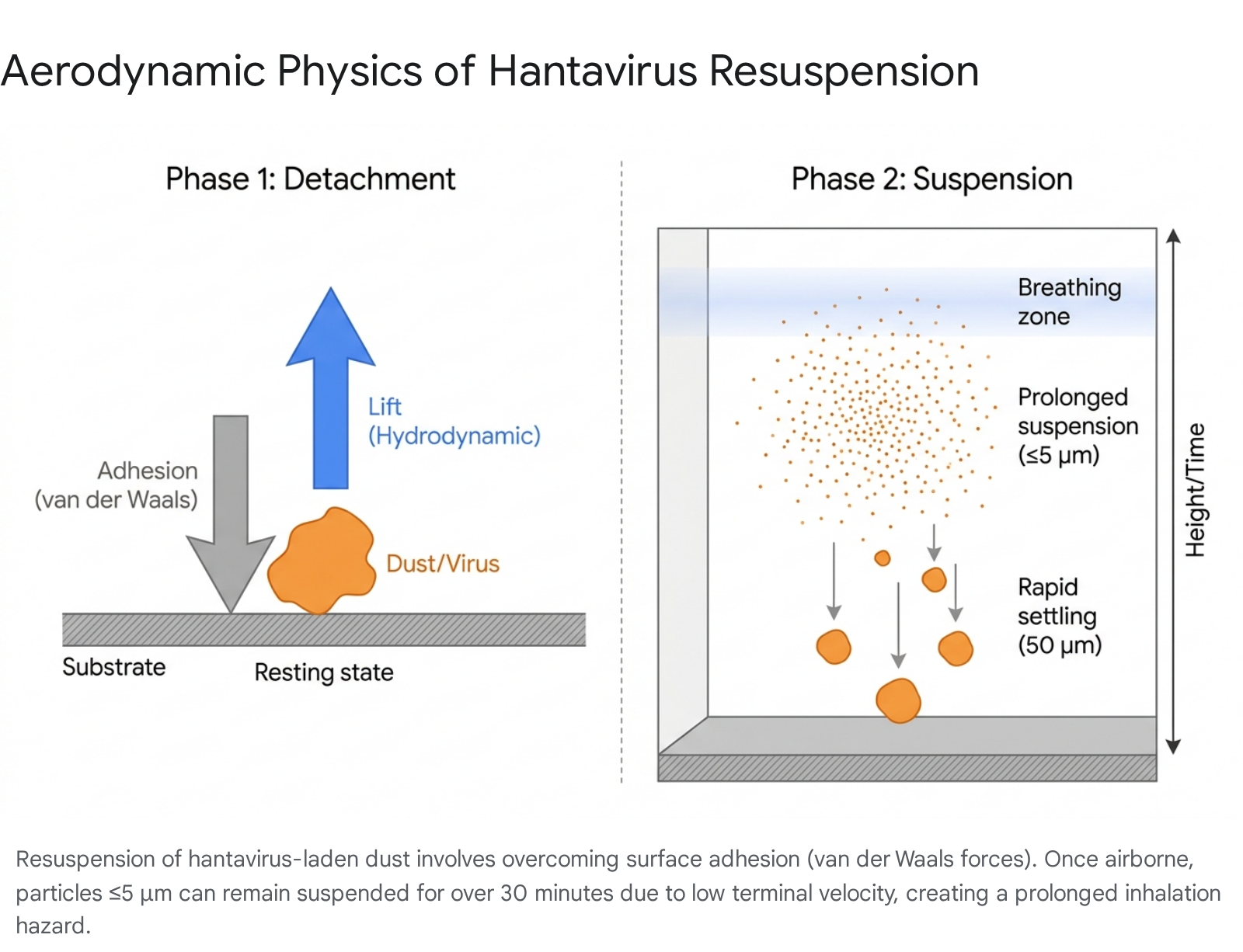
At rest, the dried, virus-laden dust particles are bound to substrate surfaces primarily by van der Waals forces 16. In environments with residual moisture, capillary forces also contribute significantly to adhesion, while electrostatic forces may play a role on certain synthetic materials 16. The strength of these adhesive forces is heavily influenced by the microtopography of the substrate. Smooth, non-porous surfaces, such as glass or finished metal, maximize the contact area, resulting in stronger adhesion 16. Conversely, rough or porous surfaces, such as unfinished hardwood, dirt floors, and the fibrous material of rodent nests, exhibit weaker adhesive bonds, lowering the energy threshold required for particle detachment 16.
To dislodge a particle, mechanical or aerodynamic energy must exceed these binding forces 16. Vibrational forces induced by human activities - such as walking, moving stored goods, or the acoustic vibration of machinery - transmit energy into the substrate, initiating inceptive motions. Biophysical modeling indicates that particles rarely lift directly off a surface; rather, detachment is primarily driven by a "rolling" mechanism, wherein lateral aerodynamic shear forces induce rotation until the particle overcomes the adhesive boundary layer 16.
Aerodynamic Constraints and Settling Times
Following detachment, the second phase is aerodynamic suspension 16. The trajectory and lifespan of a hantavirus bioaerosol in the breathing zone are governed by the dynamic equilibrium between gravitational acceleration and opposing aerodynamic drag forces, defined by Stokes' Law 1626. The terminal velocity of a particle - and thus its settling time - is highly sensitive to its aerodynamic diameter.
Large particles, generated by the bulk fracturing of dried feces, measure 50 μm or greater in diameter. These macro-particles possess significant mass relative to their surface area, resulting in high terminal velocities. For example, a 50 μm particle falls at approximately 6.8 cm/s, settling out of the breathing zone within seconds to minutes 1626. While these large particles pose a risk for direct contact and fomite transmission if transferred to mucous membranes via the hands, they represent a low risk for deep inhalation 1226.
The primary vectors for HPS and HFRS transmission are fine aerosols and droplet nuclei with aerodynamic diameters of 5 μm or less 16. As particle size decreases, the influence of gravity diminishes relative to aerodynamic drag. A 10 μm particle exhibits a terminal velocity of just 0.35 cm/s, remaining airborne for extended periods 16. Particles measuring between 1 μm and 5 μm can remain suspended in relatively still air for over 30 minutes, penetrating deeply into the alveolar regions of the human lung upon inhalation 1516. Droplet nuclei smaller than 1 μm, formed by the near-complete evaporation of liquid droplets, can remain entrained in ambient air currents for up to 12 hours, facilitating dispersion across large indoor spaces and ventilation networks 16.
Mechanical Disturbances and High-Risk Human Activities
The physics of resuspension clarify why specific occupational and domestic activities are strongly correlated with hantavirus outbreaks. Dry sweeping and vacuuming rodent-infested areas are universally categorized by public health agencies as high-risk activities 15272829.
From a materials science perspective, dried rodent feces are brittle biological matrices. The mechanical friction exerted by broom bristles effectively grinds this matrix, shattering it into highly concentrated, microscopic dust particles 1532. Concurrently, the sweeping motion generates localized turbulent airflows and aerodynamic lift vectors, actively propelling these droplet nuclei into the breathing zone 1516. Standard vacuum cleaners carry a comparable or greater risk; unless equipped with specialized High-Efficiency Particulate Air (HEPA) filtration, the exhaust jets of standard vacuums aerosolize settled particles and expel them at high velocity, rapidly contaminating the entire air volume of a room 152730.
Furthermore, agricultural environments and large-scale facilities present additional aerodynamic risks. The doffing of contaminated personal protective equipment (PPE), the sorting of contaminated materials, and the high-velocity airflows generated by exhaust fans and mechanical ventilation systems provide sufficient turbulent energy to maintain the suspension of respirable particles 16. In laboratory environments, the simple act of dumping soiled bedding from rodent cages generates highly concentrated clouds of infectious bioaerosols 31.
Thermal and Desiccation Kinetics in the Environment
Once successfully aerosolized, the temporal window during which a hantavirus particle remains infectious is dictated by its environmental stability. Historically, enveloped viruses were presumed to be highly fragile in the environment. However, comprehensive biophysical evaluations conducted in 2025 utilizing the Tula virus (TULV), Hantaan virus (HTNV), and Andes virus (ANDV) revealed that hantaviruses possess remarkable resilience under specific ambient conditions 5.
Viability Under Ambient and Elevated Temperatures
Hantavirus infectivity exhibits an inverse relationship with environmental temperature. Thermal energy destabilizes the non-covalent interactions maintaining the viral envelope and accelerates the denaturation of the internal nucleoprotein and RNA polymerase 56. The 2025 stability studies established precise thermal decay profiles for various viral strains:
- Ambient to Body Temperature (21°C to 37°C): When suspended in liquid biological media and maintained at 37°C, TULV demonstrates an estimated half-life of roughly 13 hours 5. The viral population experiences a slow, logarithmic decay, with infectious particles remaining detectable for 10 to 14 days before reaching complete inactivation 5. HTNV exhibits similar durability, retaining infectious viability for up to 7 days in cell culture media at 37°C 5. At room temperature (21°C), the baseline stability is further extended, facilitating prolonged fomite persistence 5.
- Moderate Thermal Stress (42°C to 50°C): Brief exposures to moderately elevated temperatures do not ensure immediate sterilization. Heating TULV to 42°C for 15 minutes resulted in no statistically significant loss of viral titer 5. When the temperature was increased to 50°C for 15 minutes, viral titers dropped considerably, with less than 10% of infectious particles remaining, though total inactivation was not achieved 5.
- Rapid Thermal Inactivation (≥56°C): The threshold for rapid envelope destruction and protein denaturation appears to begin at 56°C. Exposure to 56°C or higher for 15 minutes results in a complete loss of infectious titers (exceeding a 26,000-fold reduction) 5. At 60°C, the decay kinetics accelerate dramatically: TULV titers are reduced by roughly 700-fold within 30 seconds, and nearly completely eliminated (~30,000-fold reduction) within one minute 5. A 5-minute exposure at 60°C guarantees complete biological inactivation (>369,000-fold reduction) across the spectrum of tested viruses, including TULV, ANDV, and HTNV 5.
Resilience to Freezing and Cold Stress
In stark contrast to their vulnerability to heat, hantaviruses exhibit profound resilience to cold stress and freezing. Laboratory analyses demonstrate that a single severe freeze-thaw cycle inflicts negligible damage on the viral structures of TULV and HTNV, resulting in no statistically significant reduction in infectious titer 5. The New World ANDV demonstrates a slightly higher sensitivity to cold stress, suffering an approximate 37% reduction in titer following a single freeze-thaw cycle; however, the remaining 63% of the viral population remains highly infectious 5.
This resilience to freezing temperatures is a critical epidemiological factor. It explains the persistence of the virus within overwintering rodent populations in temperate zones and accounts for human infections contracted in the spring when unheated, isolated structures - such as rural cabins and storage sheds - thaw and are subsequently cleaned or disturbed by returning inhabitants 615.
The Shock of Dehydration and Subsequent Persistence
In natural transmission cycles, hantaviruses are shed in liquid or semi-liquid states, primarily urine and wet feces 1215. The transition from an aqueous state to a dry matrix exacts a heavy toll on the viral population. The immediate physical stress of desiccation disrupts the osmotic balance and damages the lipid bilayer 5.
Data indicates that immediately following complete dehydration at room temperature (21°C), the vast majority of the viral population is destroyed, with only 5% to 36% of TULV, ANDV, and HTNV particles remaining infectious compared to their pre-hydrated states 5.
However, the epidemiological danger lies in the persistence of this surviving minority fraction. The subset of virions that withstands the initial shock of desiccation proves remarkably stable. When stored in a dehydrated state at 21°C, viable TULV particles can be recovered sporadically for up to 5 days, with a complete loss of detectability (~90,000-fold reduction) occurring only after 7 days 5. Comparative studies indicate that ANDV remains similarly infectious on stainless steel surfaces for more than 5 days post-dehydration 5. This multi-day window of viability in dry dust presents the core occupational hazard for agricultural workers, pest control operators, and rural inhabitants who disturb previously deposited rodent waste 512.
Table 2: Viability and Decay Kinetics of Tula (TULV) and Andes (ANDV) Hantaviruses
| Physical Environmental Stressor | Parameter / Variable Tested | Observed Decay Kinetics and Viability Limits | Source |
|---|---|---|---|
| Ambient Heat | 37°C in Biological Media | Estimated half-life of ~13 hours; complete loss of viability after 10 to 14 days. | 5 |
| Moderate Heat | 42°C for 15 minutes | Negligible decay; no significant loss of viral titer observed. | 5 |
| High Heat | 50°C for 15 minutes | Substantial decay; >90% reduction in infectious titer, but incomplete sterilization. | 5 |
| Sterilizing Heat | 60°C for 5 minutes | Complete biological inactivation for TULV, ANDV, and HTNV. | 5 |
| Cold Stress | 1 Freeze-Thaw Cycle | Negligible loss for TULV/HTNV; ~37% titer loss for ANDV. | 5 |
| Desiccation | Immediate (at 21°C) | High initial mortality; only 5% to 36% of original viral population remains viable. | 5 |
| Desiccation | Sustained (at 21°C) | Survivor fraction remains viable in dry dust/surfaces for up to 5 to 7 days. | 5 |
The Influence of Relative Humidity on Aerostability
While baseline temperature and initial desiccation dictate the survival potential of the virus on fomites, Relative Humidity (RH) is arguably the most dynamic and critical variable governing the stability of the virus once it has been aerosolized 1926. Explicit hantavirus-specific aerosol studies analyzing full RH spectrums are limited; therefore, researchers rely heavily on biophysical models established for analogous enveloped, respiratory-transmitted RNA viruses - such as Influenza A (IAV), Severe Acute Respiratory Syndrome Coronaviruses (SARS-CoV-1 and SARS-CoV-2), and the Murine Hepatitis Virus (MHV) surrogate - due to their shared biophysical vulnerabilities regarding lipid envelopes and fusion glycoproteins 25263233.
The viability of enveloped viruses as a function of RH consistently conforms to a "U-shaped" curve 192526. Viral survival is maximized at the extreme ends of the humidity spectrum (very dry or very humid conditions) and minimized at intermediate, midrange humidities (40% to 60% RH) 192526.
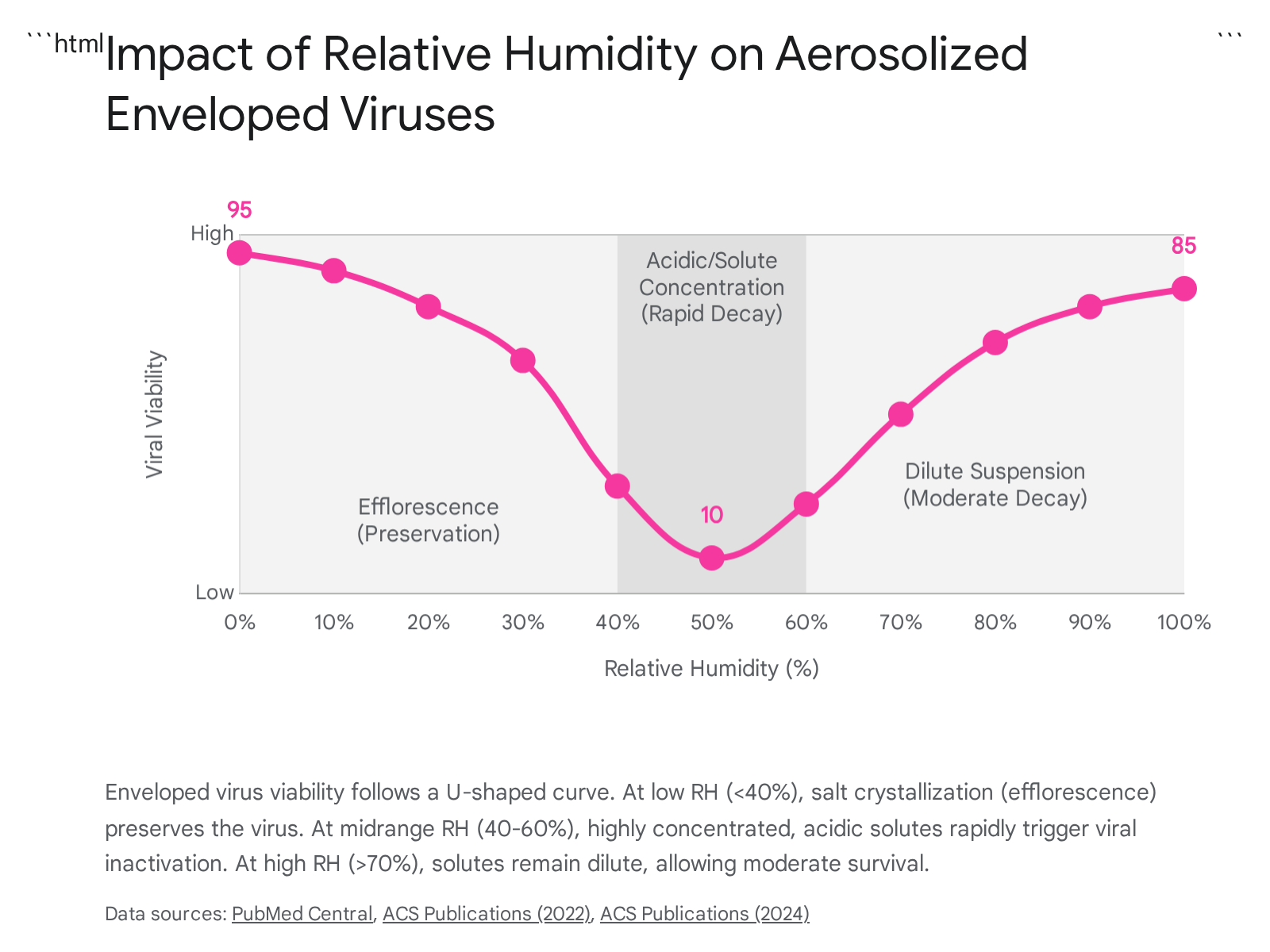
Two dominant, potentially complementary biophysical models explain this phenomenon in 2026 literature.
The Efflorescence-Deliquescence Divergent Infectivity (EDDI) Model
The EDDI model approaches viral decay through the phase state physics of the aerosol droplet 1926. When a biological droplet (composed of water, salts, and organic proteins from rodent excretions or saliva) is resuspended into the air, its chemical composition is highly responsive to the ambient RH 2532.
- High Humidity Environments (>70% RH): In highly humid conditions, the aerosol droplet retains a large mass of water. The internal solutes (salts and proteins) remain dilute. The virus is maintained in a relatively stable, aqueous equilibrium, resulting in slow decay and moderate viability 19.
- Low Humidity Environments (<40% RH): As the ambient air becomes increasingly dry, water rapidly evaporates from the suspended droplet. The internal salt concentration rises until it reaches a critical threshold where the salts crystallize out of solution - a physical phase transition termed efflorescence 1937. This crystallization effectively dehydrates the virion and locks it into a rigid, glassy, vitrified state. In this solid phase, harmful aqueous chemical reactions are halted, effectively preserving the structural integrity of the virus for extended periods 193237.
- Intermediate Humidity Environments (40% - 60% RH): Midrange humidity, which is typical of indoor, climate-controlled environments, presents the most hostile conditions for enveloped viruses. At these RH levels, the droplet loses enough water to drastically concentrate its internal salts and organic compounds, but the ambient moisture remains just high enough to prevent the phase shift into full efflorescence 19. The droplet rests in a state of deliquescence - a hyper-concentrated brine. The extreme molarity of these solutes physically damages the lipid envelope and accelerates viral inactivation, resulting in the rapid nadir of the U-shaped viability curve 19.
Aerosol pH-Driven Inactivation Mechanics
A second major paradigm shift in aerovirology involves the role of aerosol pH. Atmospheric chemistry models have recently demonstrated that aerosol particles exhaled or resuspended into indoor environments rapidly absorb ambient acidic gases, such as nitric acid (HNO3) and carbon dioxide (CO2), causing the micro-droplet to acidify significantly, frequently reaching a pH of ~4 182434.
This acidification is lethal to viruses that rely on pH-sensitive glycoproteins for cell entry. Hantavirus glycoproteins (Gn/Gc), much like the hemagglutinin of IAV or the spike proteins of coronaviruses, are biologically programmed to undergo an irreversible conformational change when exposed to the acidic environment of a host endosome (pH ~5.5) 182124.
When an aerosol droplet at an intermediate RH (≥50%) acidifies to pH 4 in the ambient air, it prematurely triggers this glycoprotein structural shift. The virus undergoes its post-fusion transformation while still suspended in the environment, effectively "misfiring" 1824. Consequently, when the virus is eventually inhaled by a human host, its glycoproteins are already locked in a post-fusion state, rendering it biologically inert and incapable of binding to human cellular receptors 1824.
Synergistic Effects of Temperature and Humidity
Temperature and humidity do not act in isolation. Increases in ambient temperature lower the relative humidity, shifting the aerosol particles along the RH continuum 2634. Furthermore, thermal energy exponentially accelerates the chemical kinetics within the aerosol droplet 34. At low temperatures (e.g., 10°C) and low RH (40%), enveloped viruses can persist for extended periods, maintaining half-lives exceeding 24 hours 3435. However, as the temperature approaches 27°C and the RH is adjusted to a mid-to-high range (65%), the half-life plummets to roughly 1.5 hours 3435. This synergy underscores why enclosed, cool, dry spaces heavily contaminated with rodent excreta present the most persistent risks for hantavirus infection 61415.
Atmospheric Stressors: Ultraviolet Radiation and Ozone
While temperature and relative humidity modulate the passive decay rate of hantaviruses, active atmospheric forces - specifically ultraviolet (UV) radiation and oxidative gases - aggressively dismantle the viral architecture 1740.
The Biological Aerosol Reaction Chamber Methodology
To accurately quantify the impact of these atmospheric variables on airborne hantaviruses, researchers in 2025 utilized the Biological Aerosol Reaction Chamber (Bio-ARC) 17. The Bio-ARC is a high-containment, flow-through system designed to rapidly expose generated bioaerosols to carefully controlled environmental parameters - including humidity, simulated solar radiation, and reactive gas species - allowing researchers to calculate precise aerodynamic decay rates 17.
Simulated Solar Radiation and Ultraviolet Decay
Natural sunlight is a potent virucidal agent 1436. Ultraviolet light dismantles enveloped viruses through two distinct mechanisms: short-wave UVB radiation causes direct genomic damage by inducing the crosslinking of viral RNA, preventing replication, while longer-wave UVA radiation induces photosensitization and the formation of highly reactive singlet oxygen radicals that degrade the lipid envelope and embedded glycoproteins 141740.
In Bio-ARC trials, SNV was aerosolized under a baseline, midrange relative humidity (~48.5% RH). Under these baseline conditions (in the dark), the virus exhibited a log decay rate of 0.6 ± 0.2 log/min 17. However, upon the introduction of Simulated Solar Radiation (SSR), the decay rate more than doubled to 1.3 ± 0.3 log/min 17. In static laboratory settings utilizing high-intensity, short-wavelength UVC irradiation (254 nm), TULV exhibited a ~10-fold reduction in infectious titers after an exposure of 300 mJ/cm2, with further logarithmic reductions achieved at higher energetic doses 5.
These data provide empirical, quantitative backing for traditional epidemiological observations: hantavirus transmission events are exceedingly rare in open, sunlit environments 141727. This also underpins the standard public health recommendation to thoroughly ventilate and illuminate abandoned structures, cabins, and storage sheds before initiating any cleaning procedures 142737.
Oxidative Inactivation via Ozone Gas
Ozone (O3) is a highly reactive, unstable allotrope of oxygen characterized by an extremely short half-life and potent oxidative properties 4038. Exhibiting a high oxidation-reduction potential (+2.07 V), ozone attacks the carbon-carbon double bonds found within the viral lipid envelope - a process known as ozonolysis - and degrades the vital surface glycoproteins 1740.
The 2025 Bio-ARC experiments demonstrated that aerosolized SNV is exceptionally vulnerable to ozone exposure. The continuous introduction of just 1.0 ppm of ozone gas into the aerosol chamber induced a rapid SNV decay rate of 2.6 ± 0.1 log/min - representing the most precipitous aerosol clearance curve among all the variables tested, far outpacing the efficacy of simulated sunlight 17.
The biocidal efficacy of ozone is further enhanced by ambient humidity; the presence of atmospheric moisture facilitates the generation of hydroxyl radicals, compounding the oxidative stress placed on the suspended virions 403839. These findings suggest that commercial ozone generators, deployed properly in unoccupied, rodent-infested spaces, could serve as a highly effective pre-remediation countermeasure, neutralizing suspended and surface-bound viruses prior to human entry 174038.
Table 3: Bio-ARC Analysis of Sin Nombre Virus (SNV) Aerosol Decay Rates
| Environmental Variable | Base Conditions | Active Stressor Applied | Resulting Decay Rate (log/min) | Source |
|---|---|---|---|---|
| Baseline Midrange RH | ~48.5% RH, Dark | None | 0.6 ± 0.2 log/min | 17 |
| Simulated Solar Radiation | ~48.5% RH | UVA / UVB Exposure | 1.3 ± 0.3 log/min | 17 |
| Ozone Fumigation | ~48.5% RH | 1.0 ppm Ozone Gas | 2.6 ± 0.1 log/min | 17 |
| Organic Matrix | Mouse Bedding Matrix | None | 0.9 ± 0.4 log/min | 17 |
Chemical Inactivation and Disinfection Protocols
Given the high pathogenicity of HPS and HFRS strains, combined with the lack of widely available, FDA-approved antiviral therapeutics, mitigating transmission relies heavily on the thorough surface decontamination of microenvironments prior to human disturbance 540. Detailed 2025 virological studies have systematically assessed the efficacy of standard chemical agents against hantaviruses, demonstrating that their delicate lipid envelope renders them highly susceptible to specific chemical disruption 5.
Efficacy of Alcohols, Aldehydes, and Detergents
- Alcohols: Hantaviruses are neutralized by high concentrations of alcohol. Exposure to ethanol solutions of 40% or higher results in complete inactivation, causing a ≥100,000-fold reduction in TULV titers. However, dilution significantly impairs efficacy; solutions containing only 20% ethanol proved largely ineffective, reducing viral titers by a mere 17.8-fold 5.
- Aldehydes: Formaldehyde is highly effective against the virus. At a final concentration of 1% or higher, formaldehyde completely inactivates TULV, ANDV, and HTNV across both cell-free and cell-associated sample contexts 5.
- Detergents and Surfactants: Detergents operate by intercalating into and physically dissolving the lipid bilayer 5. The efficacy, however, is heavily dependent on the specific chemical nature of the detergent. Strong non-ionic detergents, such as NP-40 at 0.5% concentration and Triton X-100 at 1.0% concentration, successfully achieve complete viral inactivation 5. Conversely, ionic detergents like Sodium Dodecyl Sulfate (1% SDS), or lower concentrations of non-ionic variants (0.1% Triton X-100), reliably lower viral titers but frequently fail to achieve complete sterilization, particularly when the virus is heavily shielded within cell-associated organic matrices 5.
- Nucleic Acid Extraction Buffers: Commercial RNA extraction buffers, including TRI Reagent, AVL Buffer, and RLT Buffer, reliably and completely inactivate hantaviruses, a critical validation for ensuring laboratory biosafety during molecular diagnostics and analysis 5.
Guidelines for Decontamination of Enclosed Spaces
Translating biophysical vulnerability into actionable public health policy, authorities universally mandate strict "wet-cleaning" protocols to neutralize the virus and prevent mechanical aerosolization 27282937.
The standard remediation sequence dictates that workers first ventilate closed, potentially infested spaces for a minimum of 30 minutes to facilitate air exchange and dilute ambient airborne virus loads 272837. Disinfection is subsequently performed using a 10% household bleach solution (mixed at a ratio of 1.5 cups of bleach to 1 gallon of water), which serves as a potent oxidant, operating via similar mechanisms to ozone 282937.
Contaminated matrices - including droppings, dead rodents, nesting materials, and surfaces - must be thoroughly saturated with the bleach solution and allowed to soak for an uninterrupted contact time of 5 to 10 minutes 273746. This saturation process neutralizes the threat through two simultaneous mechanisms: the fluid weight significantly increases the mass and capillary adhesion of the particles, eliminating the potential for aerodynamic liftoff during cleanup, while the hypochlorite ion irreversibly destroys the viral lipid envelope 283746. Personnel are strictly advised to utilize appropriate personal protective equipment (PPE), including rubber gloves and, where aerosolization risks remain, air-purifying respirators equipped with P100 or HEPA filters 153037.
Epidemiological Implications of Environmental Viability
The biophysical constraints governing hantavirus aerosolization traditionally restrict infection events to specific spatial contexts - primarily rural, agricultural, or peridomestic settings characterized by poor ventilation, heavy rodent infestation, and mechanical dust disturbance 91541. However, anomalous outbreaks in 2026 underscored the severe dangers posed by enclosed microenvironments and highlighted the unique transmission dynamics of specific viral strains 112042.
The 2026 MV Hondius Cruise Ship Outbreak
On May 2, 2026, international health monitoring bodies, including the European Union Early Warning and Response System (EWRS) and the World Health Organization (WHO), were notified of a cluster of Severe Acute Respiratory Illness (SARI) aboard the MV Hondius, a commercial cruise ship operating in the South Atlantic Ocean 112043. The vessel, carrying 147 passengers and crew, had departed from Ushuaia, Argentina - a geographic region highly endemic for the Andes virus (ANDV) - on April 1, 2026 91120.
By May 8, 2026, health authorities had identified eight definitive cases within the cluster (six confirmed via PCR/sequencing and two clinically suspected) 9. The outbreak resulted in three fatalities, yielding an exceptionally high Case Fatality Rate (CFR) of 38% 9. The rapid clinical progression of the patients, who presented with fever, gastrointestinal distress, and acute pneumonia culminating in cardiogenic shock, confirmed the outbreak as Hantavirus Pulmonary Syndrome caused by ANDV 2043.
Dynamics of Person-to-Person Transmission
The MV Hondius outbreak emphasized a critical deviation in standard hantavirus epidemiology: the Andes virus remains the only recognized hantavirus species capable of sustained human-to-human transmission 11152044.
While species such as Sin Nombre and Puumala require mechanical aerosolization directly from rodent excreta to initiate human infection, epidemiological tracking of ANDV indicates that close, prolonged contact with an infected individual - particularly during the initial symptomatic or early acute phase - can result in secondary transmission 1120. Transmission risk correlates strongly with disease severity; critically ill patients typically present with higher systemic viral loads and broader viral shedding profiles, facilitating spread 20.
The cruise ship environment exacerbated this risk profile by providing a closed, densely populated microenvironment with shared social areas and heavily recirculated air 2043. Under these confined conditions, standard environmental exposure paradigms were superseded by direct human-to-human spread. Initial hypotheses posited that the index case contracted ANDV via traditional environmental routes in Argentina prior to embarkation; however, the subsequent clustering of cases onboard heavily implicated secondary transmission facilitated by the closed setting 112043.
This incident mandated strict airborne infection isolation protocols (including N95 respirators, eye protection, and negative pressure isolation rooms) for the clinical management of the evacuated patients - a significant escalation from the standard contact precautions usually deemed sufficient for managing non-ANDV hantavirus infections 111545.
Current Therapeutic Context and Medical Countermeasures
The severity of the 2026 outbreak and the persistent threat of environmental exposure are compounded by a lack of targeted medical countermeasures. As of 2026, there are no FDA-approved vaccines or specific, widely available antiviral therapeutics for the treatment of hantavirus infections 54052.
Investigational Therapeutics and Supportive Care
The clinical management of severe HPS and HFRS remains heavily reliant on aggressive, early supportive care 1125. For patients suffering from HPS presenting with acute respiratory distress and cardiogenic shock, extra-corporeal membrane oxygenation (ECMO) has been deployed to bypass the failing cardiopulmonary system, significantly improving survival rates (up to ~80%) if initiated promptly during the rapid deterioration phase 11. For HFRS, management centers on extracorporeal blood purification, mechanical ventilation, and careful fluid balancing to manage acute kidney injury 25.
While broad-spectrum antivirals like ribavirin and favipiravir have shown limited efficacy in reducing viral RNA loads if administered exceedingly early during HFRS, their utility in treating the rapid, overwhelming immune-inflammatory cascade of HPS is constrained, and high doses carry risks of hemolytic anemia 222553. Consequently, research has pivoted toward advanced immunotherapy. Investigational agents, such as SAB-163 - a pan-hantavirus therapeutic comprised of fully human polyclonal immunoglobulin purified from transchromosomic bovines vaccinated with HTNV, PUUV, SNV, and ANDV plasmids - have demonstrated potent neutralizing capabilities and extended bioavailable half-lives (10 - 15 days) in animal models, offering a promising, post-exposure prophylactic option for high-risk environmental or occupational exposures in the future 54.
Conclusion
The environmental stability and aerosolization mechanics of hantaviruses are governed by a complex, highly dynamic interplay of host biology, physical chemistry, and aerodynamic forces. Advancements in biophysical research conducted in 2025 and 2026 have clarified that while hantaviruses possess the inherent architectural vulnerabilities of a lipid-enveloped virus - being readily inactivated by temperatures exceeding 56°C, solar ultraviolet radiation, oxidative agents like ozone, and lipid-solubilizing detergents - they exhibit profound endurance under specific, commonly encountered ambient conditions 517.
The suspension of fine droplet nuclei and dust particles (<5 μm), generated through the mechanical disruption of desiccated rodent excreta by human activities such as sweeping or vacuuming, creates a temporary but highly lethal bioaerosol hazard capable of deep pulmonary penetration 16. The persistence of the virus within this aerosol state is heavily dictated by relative humidity. Current models indicate that low-humidity environments preserve the virus via solute efflorescence, while intermediate indoor humidities (40 - 60%) induce rapid viral decay through hyper-concentrated acidification and premature glycoprotein triggering 1819.
Understanding these physical parameters is critical not only for designing effective occupational remediation protocols but also for assessing broader epidemiological risks. As human encroachment into sylvatic rodent habitats continues, and as anomalous outbreaks like the 2026 MV Hondius event demonstrate the severe consequences of closed-environment exposures and potential person-to-person spread, leveraging the biophysical vulnerabilities of hantaviruses - through forced ventilation, targeted wet-cleaning, and potentially active atmospheric interventions like ozone - remains the primary and most effective defense against Hantavirus Pulmonary Syndrome and Hemorrhagic Fever with Renal Syndrome 172037.