
Global violence trends in 2026
The trajectory of global violence in 2026 presents a highly complex, multifactorial, and frequently contradictory paradigm. Analyzing the macro-level data surrounding lethal violence requires navigating a distinct bifurcation in global trends: while historical, long-term per capita rates of violence remain statistically lower than in previous centuries, the period from the early 2010s through 2026 has witnessed a severe erosion of the post-Cold War peace dividend. The contemporary security landscape is definitively characterized by the resurgence of high-intensity state-based warfare, the proliferation of hyper-lethal non-state armed groups, and a chronically high baseline of intentional homicide driven by transnational organized criminal syndicates.
Evaluating whether the world is objectively becoming more or less violent depends fundamentally on the categorical definitions of violence being measured - specifically organized armed conflict, global terrorism, and intentional homicide - as well as the methodological frameworks utilized by major global monitors. The empirical data from 2024 through early 2026 indicates the firm consolidation of a "new normal" in international security. This operational environment is marked by overlapping, protracted conflicts that increasingly disregard traditional humanitarian norms and civilian protections, even as highly specific and historically prominent phenomena, such as transnational international terrorism in the West, experience statistical declines.
Methodological Frameworks for Measuring Violence
Discrepancies in public perception regarding the scale of global violence are often rooted in the disparate methodologies employed by international institutions and research monitors. Because violence manifests across different sociological and geopolitical spectrums, no single dataset captures the entire operational reality. Understanding the findings for 2025 and 2026 requires contextualizing the specific mechanisms used to track lethality.
The Uppsala Conflict Data Program (UCDP) utilizes a stringent, "top-down" strategy to measure armed conflict. It defines a state-based armed conflict as a contested incompatibility concerning government or territory that results in at least 25 battle-related deaths in a calendar year, requiring the identification of specific dyadic engagements 123. This approach provides highly reliable, structurally sound data on organized warfare but inherently filters out lower-intensity skirmishes or politically ambiguous violence. Conversely, the Armed Conflict Location & Event Data Project (ACLED) employs a "bottom-up" methodology, recording any discrete event of political violence - including riots, protests, and localized explosions - without requiring a minimum fatality threshold or the formal identification of a named rebel apparatus 245. Consequently, ACLED tracks hundreds of thousands of events annually, capturing a much broader spectrum of political instability and civilian exposure.
To track terrorism, the Global Terrorism Database (GTD) and subsequent analyses like the Global Terrorism Index (GTI) rely on defining violence based specifically on the intent of a non-state actor to achieve a political, economic, religious, or social goal through systemic fear and coercion 67. This distinguishes terrorism from purely profit-driven cartel violence, although the operational realities and tactics on the ground increasingly overlap. Finally, intentional homicide is tracked primarily by the United Nations Office on Drugs and Crime (UNODC), which aggregates criminal justice records sourced from law enforcement and public health data derived from death certificates 89. While this provides a robust global baseline for lethal violence outside of declared war zones, it remains vulnerable to underreporting in jurisdictions with weak institutional capacity or where authorities manipulate statistics for political expediency 10.
Trajectories of Organized Armed Conflict
The landscape of organized armed conflict has deteriorated significantly over the past decade. Following a period of relative decline in the late 1990s and early 2000s, the number of active conflicts and their associated fatalities has surged, driven by intensified great power competition, state fragility, and the increasing regionalization of localized civil wars.
State-Based Conflicts and Global Fatalities
Data from the UCDP demonstrates a stark and sustained upward trajectory in the frequency of state-involved conflicts. In 2024, UCDP recorded 61 active conflicts involving at least one state, the highest absolute number recorded since the program began aggregating statistics in 1946 1112. Of these active engagements, eleven reached the intensity level of a full-scale war - defined by UCDP as causing at least 1,000 battle-related deaths in a single calendar year - marking the highest number of concurrent high-intensity wars since 2016 11.
The absolute number of conflict fatalities has mirrored this rise in conflict frequency, displaying massive volatility driven by specific regional escalations. In 2022, global battle-related deaths spiked to an estimated 237,000, representing a 97 percent increase from 2021 131314. This escalation established 2022 as the deadliest year for organized armed conflict since the 1994 Rwandan genocide 1314. This profound surge was primarily driven by the resurgence of conventional trench warfare and the deployment of human wave tactics in the Russian invasion of Ukraine, alongside the highly lethal civil war in the Tigray region of Ethiopia; together, these two theaters accounted for approximately 180,000 fatalities 1314.
While 2024 saw a slight statistical contraction to an estimated 160,000 total deaths in organized violence, it remained the fourth most violent year since the end of the Cold War 1112. Preliminary data compiled by ACLED for 2025 indicates that the high baseline of violence has not only been sustained but has accelerated. ACLED recorded over 185,000 to 204,605 violent events globally over the course of 2025, yielding an estimated 240,000 conflict-related fatalities 45. This data demonstrates a consistent upward trend in global lethality compared to the relatively stable baselines observed prior to 2020.
| Year | Estimated Global Conflict Fatalities | Primary Monitoring Source | Key Drivers of Lethality |
|---|---|---|---|
| 2021 | ~120,000 | UCDP | Persistent insurgencies in Afghanistan and Yemen prior to major shifts in territorial control. 1314 |
| 2022 | ~237,000 | UCDP | Massive escalation driven by conventional interstate warfare in Ukraine and the Tigray conflict in Ethiopia. 131314 |
| 2024 | ~160,000 | UCDP | Widespread fragmentation of conflicts; sustained intense fatalities in Ukraine, Gaza, and systemic violence across the Sahel. 1112 |
| 2025 | ~240,000 | ACLED | Unabated high-intensity warfare in Ukraine and Palestine, compounded by the severe escalation of the Sudanese civil war and gang insurgency in Haiti. 515 |
Regional Theaters of Intense Warfare
The distribution of armed conflict is not uniform; it is heavily concentrated in specific geographic corridors experiencing compounding crises of state fragility, demographic pressure, and active external proxy intervention.
Europe experienced a massive paradigm shift with the 2022 Russian invasion of Ukraine, initiating the first major interstate war on the continent in decades. Through 2024 and 2025, Ukraine continued to be the deadliest single conflict theater globally, with ACLED and UCDP reporting between 76,000 and 82,298 battle-related deaths annually 1116. The operational landscape in Ukraine has been defined by the integration of legacy artillery attrition with advanced drone technology and highly lethal trench combat 414.
Sub-Saharan Africa remains the most broadly conflict-affected region globally in terms of the number of active insurgencies and the geographic diffusion of violence. In 2024, the region registered 28 internal conflicts 17. The fragmentation of Sudan, driven by the brutal conflict between the Sudanese Armed Forces (SAF) and the Rapid Support Forces (RSF), has generated the world's largest contemporary displacement crisis. By late 2025, the conflict had forcibly uprooted over 12.8 to 14.3 million people and resulted in widespread atrocities, mass killings in El Fasher, and severe famine conditions across Darfur and Khartoum 151819. Concurrently, militant Islamist violence in the Sahel - particularly in Mali, Burkina Faso, and Niger - has expanded aggressively following a series of military coups that dismantled existing security architectures. This expansion resulted in over 22,000 fatalities in 2025 and an increased number of attacks spilling over into coastal West African states 18.
In Asia, Myanmar represents the world's most highly fragmented conflict environment. Following the 2021 military coup, resistance to the junta has metastasized into a multifaceted civil war. ACLED tracks over 1,200 distinct armed groups - ranging from established ethnic armies to newly formed local defense forces - involved in violent events across the country, as the military relies increasingly on indiscriminate air campaigns 45. In the Middle East, the cascading effects of the Israel-Hamas war, the subsequent Israel-Hezbollah conflict in Lebanon, and direct military engagements between Israel and Iran have fundamentally destabilized the region, creating a highly lethal, geographically dense conflict zone characterized by heavy urban bombardment and severe civilian exposure 51116.
Targeted Violence Against Civilians
A defining and deeply concerning characteristic of the contemporary conflict landscape is the increasing lethality directed toward non-combatants, signaling a systemic weakening of adherence to the laws of armed conflict and international humanitarian norms 4. UCDP data isolates the metric of "one-sided violence" - defined as the intentional and targeted killing of civilians by governments or formally organized armed groups. In 2024, UCDP recorded 13,900 civilian deaths in explicitly targeted attacks, a 31 percent increase compared to the previous year 11.
However, this metric captures only direct, intentional killings and excludes civilians killed in crossfire, indiscriminate aerial bombardment, or the secondary epidemiological effects of war. When analyzing broader civilian danger, the figures escalate drastically. The conflicts in Gaza and Lebanon in 2024 resulted in approximately 26,000 direct deaths, of which 94 percent were reported as civilians or individuals of unknown identity 11. Across all global theaters, ACLED recorded a 40 percent surge in civilian deaths in 2024, reaching nearly 50,000 16. Between January and mid-October 2025, an estimated 56,000 civilians were killed in active conflict zones worldwide 19. Furthermore, women and girls in humanitarian and conflict settings experience gender-based violence (GBV) at an estimated rate of 70 percent, compared to the global baseline of 35 percent, indicating that sexual violence remains a pervasive, weaponized feature of modern systemic conflict 20.
The Proliferation of Non-State Armed Groups
The profound increase in global armed conflict cannot be understood purely through the traditional paradigm of interstate warfare. The fundamental character of modern violence has been altered by the unchecked proliferation of Non-State Armed Groups (NSAGs) and the sophisticated resurgence of proxy warfare.
Governance and Territorial Control
NSAGs - ranging from ideologically driven rebel militias to transnational terrorist syndicates and highly militarized criminal cartels - have gained unprecedented prominence as autonomous geopolitical actors. As of mid-2025, the International Committee of the Red Cross (ICRC) recorded over 380 active armed groups of humanitarian concern operating globally 1516. It is estimated that approximately 204 million people currently live under the full or contested administrative control of these groups 1516.
The operational evolution of NSAGs severely complicates traditional state-centric frameworks of conflict analysis and resolution. In areas of limited statehood, these groups frequently supplant the government; 85 percent of tracked NSAGs provide some form of public service - including rudimentary healthcare, local security, and education - or extract systematic taxes from the civilian populations they control 16. In regions suffering from systemic governance vacuums, such as the Sahel, the Lake Chad Basin, and fragmented territories in the Middle East, these groups function as the de facto sovereign authority.
Furthermore, the politicization of inherently criminal NSAGs represents a dangerous merging of profit-driven and political violence. Powerful criminal syndicates in Colombia, Mexico, and Haiti have progressively evolved beyond mere smuggling operations into formidable actors that exert lethal influence over domestic politics, corrupt state institutions, and imitate sovereign functions to fiercely safeguard their expanding economic portfolios 16.
The Resurgence of Proxy Warfare
The contemporary security environment has witnessed a definitive return to proxy warfare, heavily driven by multipolar geopolitical competition rather than the rigid bipolar ideological divides characteristic of the Cold War. Authoritarian and revisionist states, alongside ambitious regional powers, increasingly utilize NSAGs to project military power, erode the institutional capacity of adversaries via persistent "gray-zone" operations, and maintain strategic plausible deniability on the international stage 21. In 2022, UCDP noted that 22 of the 55 active armed conflicts globally were internationalized, meaning that one or both local parties received direct troop or sophisticated material support from a foreign sovereign government 13.
The strategic implications of this trend are highly detrimental to global violence mitigation. Empirical research indicates that violent non-state actors supported by external state sponsors are significantly more lethal and operationally resilient than independent, self-funded actors 2223. The steady influx of external funding, advanced weaponry, sophisticated intelligence apparatuses, and specialized training allows proxies to sustain high-intensity operations against state militaries far longer than their organic capabilities would permit 2224. This dynamic has rendered modern civil conflicts incredibly resistant to traditional diplomatic resolution; securing a lasting cessation of hostilities now requires intricate alignment not only among the local belligerent factions but also among their competing external patrons, creating highly intractable geopolitical quagmires 132526.
Global Terrorism Trajectories
While aggregate armed conflict has escalated, the specific phenomenon of transnational terrorism has followed a markedly divergent statistical trajectory. The data reveals a systemic decline in the absolute volume of international terrorist incidents, counterbalanced by a severe geographic consolidation of lethality.
Aggregate Statistical Declines
Global terrorism fatalities reached an unprecedented peak in 2014 with approximately 45,000 deaths, an escalation driven almost entirely by the rapid territorial expansion of the Islamic State (ISIL) across Iraq and Syria, and the simultaneous peak of the Boko Haram insurgency in Nigeria 62728. Since that specific zenith, the aggregate global impact of terrorism has consistently waned.
According to the 2026 Global Terrorism Index (GTI), total deaths from terrorism worldwide fell by 28 percent in 2025 to 5,582 fatalities 2930. The absolute number of terrorist attacks also declined by nearly 22 percent to 2,944 incidents, resulting in 81 countries recording a tangible improvement in their overall terrorism impact score 2930. The average lethality of individual terrorist attacks has also decreased, dropping from 2.1 deaths per attack in 2024 to 1.8 in 2025 2930. Furthermore, the prevalence of spectacular, mass-casualty events has diminished significantly; in 2025, only one attack globally killed more than 100 people, compared to five such attacks of that magnitude in the prior year 2930.
Geographic Consolidation in the Sahel
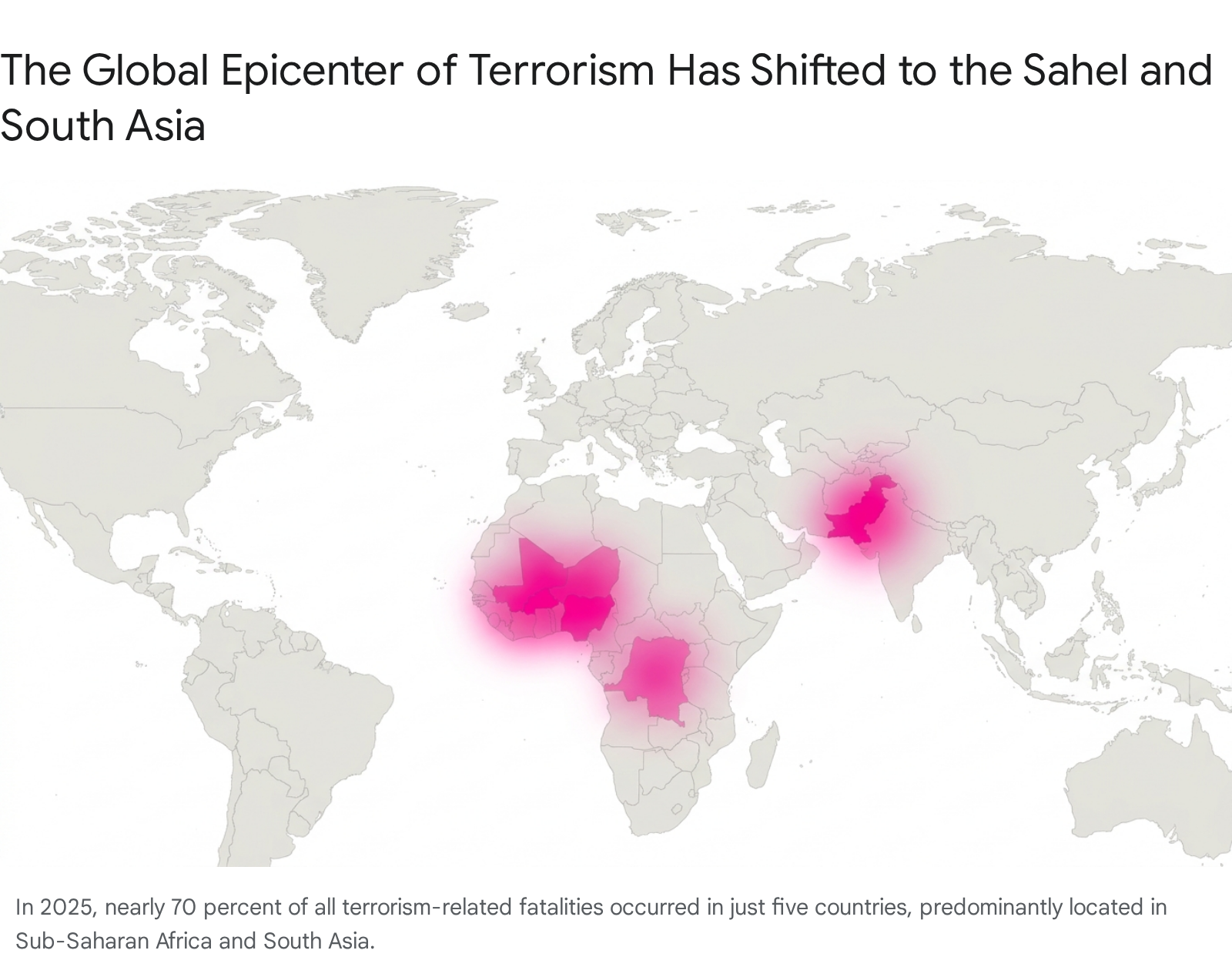
The most defining contemporary trend in global terrorism is its profound geographic relocation. The epicenter of terrorist violence has definitively shifted away from the Middle East and North Africa (MENA) and localized deeply within Sub-Saharan Africa, specifically the Sahel region, alongside persistent volatility in South Asia.
Terrorism is now hyper-concentrated in conflict-afflicted zones. In 2025, just under 70 percent of all deaths from terrorism globally occurred in only five countries: Pakistan, Burkina Faso, Nigeria, Niger, and the Democratic Republic of the Congo (DRC) 2930.
The Islamic State (IS) and its diverse regional affiliates remained the deadliest terrorist network globally, despite operating in fewer countries (15 in 2025, down from 22) 2930. The four deadliest individual organizations in 2025 - IS, Jamaat Nusrat Al-Islam wal Muslimeen (JNIM), Tehrik-e-Taliban Pakistan (TTP), and al-Shabaab - were collectively responsible for 70 percent of all global terrorism fatalities 2930.
| Rank (2025) | Country | 2025 Terrorism Deaths | Trajectory and Primary Drivers |
|---|---|---|---|
| 1 | Pakistan | 1,139 | Recorded the highest GTI score globally following a sharp resurgence of TTP activity catalyzed by the 2021 Taliban takeover in neighboring Afghanistan. 2930 |
| 2 | Burkina Faso | 846 | Despite a 45% decrease in fatalities from 2024, the nation suffered the deadliest single attack in 2025 when JNIM killed 120 soldiers. 30 |
| 3 | Nigeria | 750 | Experienced a 46% increase in fatalities compared to 2024, driven by the enduring presence of ISWAP and Boko Haram in the Lake Chad Basin. 30 |
| 4 | Niger | 703 | Fatalities decreased from 944 in 2024, but structural violence remains chronic following the destabilizing 2023 military coup. 30 |
| 5 | DR Congo | 467 | Sustained, complex violence driven by ISCAP and a multitude of localized ethnic militias competing for resources in the eastern provinces. 30 |
This extreme concentration fundamentally highlights the intrinsic link between terrorism and systemic state failure. Over 95 percent of all deaths from terrorism occur in countries already suffering from ongoing armed conflict, demonstrating conclusively that modern terrorism functions primarily as an asymmetrical operational tactic utilized within broader civil wars, rather than operating as a standalone phenomenon targeting peaceful states 272931.
Ideological and Transnational Shifts
While the epicenter has moved South, ideological terrorism outside of traditional conflict zones presents evolving challenges. The increasingly fragmented global political environment has fostered a rise in ideologically motivated attacks. Politically motivated terrorist attacks increased by almost 20 percent in 2025, with South America accounting for 75 percent of all terrorism deaths specifically linked to political ideology rather than religious extremism or separatism 2930.
Furthermore, while the absolute numbers remain low, Western countries experienced a sharp 280 percent increase in terrorism deaths in 2025, resulting in 57 fatalities across regions like North America and Western Europe 2930. Security services point to a deeply concerning sub-trend in these regions: the rapid radicalization of youth through digital environments. In 2025, minors accounted for a disproportionate 42 percent of terror-related investigations in Europe and North America, illustrating how "low-level" terrorism functions as a highly reproducible, digitally instructed phenomenon capable of generating persistent, mass-impact fear 30.
Intentional Homicide and Organized Crime
While conventional warfare and international terrorism dominate geopolitical discourse and media coverage, empirical epidemiological data consistently demonstrates that intentional homicide is the most pervasive and prevalent form of lethal violence globally. The UNODC defines intentional homicide strictly as the unlawful death inflicted upon a person with the deliberate intent to cause death or serious injury 932.
Baseline Lethality and Demographic Impact
Globally, intentional homicide accounts for vastly more deaths than armed conflict and terrorism combined. Between 2019 and 2021, an annual average of roughly 440,000 deaths were caused by homicide, compared to an average of 94,000 conflict-related deaths and 22,000 terrorism deaths over the same timeframe 8. In 2021, the absolute number of homicides spiked to approximately 458,000 - averaging 52 individuals killed every single hour - driven heavily by the severe socioeconomic repercussions of the COVID-19 pandemic and an escalation in gang-related violence 833.
Because the global population has grown rapidly, the global homicide rate has seen a general historical decline, dropping from 7.2 victims per 100,000 people in 1992 to approximately 5.8 per 100,000 by 2021 834. However, progress in reducing this rate has stagnated significantly. Extrapolating current trends to 2030 suggests the global rate may only decrease to 4.5 per 100,000, falling drastically short of the United Nations Sustainable Development Goal 16 imperative to significantly reduce all forms of violence 33.
Furthermore, homicidal violence is heavily gendered in its execution and victimization. Roughly 80 percent of all homicide victims worldwide are men, who are primarily killed in public spaces in the context of gang violence, organized crime, or interpersonal disputes 333536. Conversely, women and girls bear the overwhelming burden of lethal violence within the domestic sphere. In 2024, an estimated 50,000 women and girls were intentionally killed by family members or intimate partners, equating to an average of 137 women losing their lives to domestic femicide every day 20.
Criminal Insurgency in Latin America
Homicide rates are subject to extreme regional disparities, heavily influenced by the presence of organized crime. In 2023, the rate of intentional homicide in Eastern and South-Eastern Asia was remarkably low, registering at just 0.8 per 100,000 population 33. In stark contrast, Sub-Saharan Africa recorded a rate of 11.9, while Latin America and the Caribbean (LAC) maintained its position as the world's most violent region outside of active war zones, recording a devastating rate of 19.7 per 100,000 33. Together, these two regions accounted for almost two-thirds of all global homicides 33.
The violence in the LAC region is overwhelmingly driven by the operational imperatives of organized crime. Sophisticated criminal syndicates are responsible for up to 19 percent of all homicides globally; since the start of the 21st century, these organizations have killed approximately as many people as all global armed conflicts combined 34.
In 2024 and 2025, the LAC region experienced a highly fragmented and complex criminal dynamic. The overall regional homicide rate declined by roughly 5 percent, largely due to significant numerical reductions in heavily populated nations like Brazil and Mexico 374041. In Brazil, which recorded around 45,000 killings in 2024, the slight decrease was attributed in part to criminal enterprises migrating toward highly lucrative, non-kinetic digital crimes and cybergang operations 37. In Mexico, the 19.6 percent drop observed into 2025 was linked to shifts in federal security postures and internal cartel restructuring following the capture of high-profile syndicate leaders 4142.
| LAC Nation | 2024/2025 Homicide Trajectory | Drivers of Criminal Lethality |
|---|---|---|
| Brazil | Modest Decrease (~5% drop) | Sustained but stabilizing gang equilibrium; strategic migration of criminal resources toward lucrative cybercrime. 3741 |
| Mexico | Significant Decrease (~19.6% drop) | Adjusted federal security strategies; internal fracturing and temporary stabilization within major syndicates following high-profile arrests. 4142 |
| Haiti | Extreme Increase (Rate ~62/100k) | Total collapse of state security infrastructure; massive territorial and political control exerted by heavily armed gang coalitions. 3738 |
| Ecuador | Severe Increase (Rate ~38.8-45.7/100k) | Violent turf wars between transnational drug trafficking cartels and local gangs over strategic coastal ports and transit routes. 413839 |
However, this aggregate regional decrease masked catastrophic localized surges that mimic the intensity of civil war. Ecuador, long considered a relatively peaceful transit nation, saw its homicide rate violently escalate to 45.7 per 100,000 in 2023, driven by cartel clashes over international drug trafficking routes, and experienced further sharp increases through 2025 413839. Similarly, following the total collapse of state security infrastructure and the assassination of the president in 2021, gang violence in Haiti reached record levels, with a homicide rate surging to 62 per 100,000 in 2024 as gangs seized control of critical national infrastructure 3740. In these extreme environments, the organizational density, financial resources, and military-grade armament of criminal gangs blur the traditional lines between civilian homicide and non-state armed conflict.
The Academic Debate on the Trajectory of Violence
The fundamental question of whether the world is becoming more or less violent remains the subject of intense, often polarized academic debate. The conclusions drawn are heavily contingent upon the chosen historical timeframe of analysis and the statistical methodologies prioritized by researchers.
Evolutionary Optimism Versus the New Normal
The prevailing optimistic framework, popularized extensively by scholars such as Steven Pinker in The Better Angels of Our Nature, posits that over macro-historical and evolutionary timelines, human violence has precipitously and undeniably declined 454041. This thesis relies on analyzing violence rates relative to total global population size. By this per capita metric, even the catastrophic casualty figures of the 2020s pale in comparison to the proportional death tolls generated by the Second World War, the Mongol conquests, or pre-state tribal warfare 40. From a strictly long-term epidemiological standpoint, an individual living in 2026 is statistically less likely to die a violent death than an individual living in almost any previous century.
However, a growing consensus of critics, security analysts, and conflict monitors argue that an over-reliance on macro-level per capita rates dangerously obscures the severe, structural deterioration of global security in the short-to-medium term. Analysts point to the period between 2012 and 2026 as the definitive emergence of a "New Normal" - a structural shift away from the post-Cold War peace dividend into an era of heightened volatility 442.
This modern era is characterized not by historical peace, but by an absolute increase in the volume of armed conflicts, the highest number of conflict fatalities since the mid-1990s, and a return to highly destructive great-power proxy warfare 1342. Furthermore, critics note that focusing solely on traditional battlefield deaths ignores the systemic evolution of violence into new domains. The weaponization of offensive cyber capabilities, the deployment of autonomous drone technology, crippling economic blockades, and the sophisticated coercion utilized by transnational criminal organizations serve to destabilize whole societies and erode the rule of law without necessarily generating the massive kinetic casualties required to trigger traditional definitions of warfare 2343.
The 2026 Global Conflict Assessment underscores this systemic fragility, describing the current geopolitical environment as a "G-Zero" world facing a critical "Strategic Valley." Driven by the expiration of legacy arms-control guardrails like the New START Treaty, the rapid integration of artificial intelligence into military command structures, and the emergence of a tripolar nuclear dynamic between the United States, China, and Russia, the assessment calculates an aggregate 5.8 percent probability of a global kinetic exchange within the calendar year 50. Ultimately, the findings suggest that the global state has shifted from a post-Cold War peace into a "Perpetual Gray Zone," where international security is no longer maintained by multilateral treaties but by the delicate, high-stakes management of localized friction and technological interdependency 50.
Conclusion
The empirical data available in 2026 reveals a global security landscape that is highly fractured and undergoing rapid transformation. From a macro-historical perspective, the statistical probability of a human being dying violently remains lower than in antiquity, largely due to the massive expansion of the global population and the general, albeit fragile, absence of systemic thermonuclear warfare between superpowers.
However, within the context of modern history, the trajectory is acutely negative. The world is unequivocally more violent today than it was at the dawn of the 21st century. The post-Cold War decline in armed conflict has reversed, replaced by a "New Normal" of highly fragmented, multi-actor proxy wars that have driven conflict fatalities to their highest absolute levels in three decades. While the specific phenomenon of global terrorism has receded from its 2014 peak and shifted into concentrated regional pockets in the Sahel and South Asia, the operational void has been filled by the unchecked expansion of heavily armed non-state actors and organized criminal syndicates. These groups not only sustain a massive baseline of intentional homicide - killing over 400,000 people annually - but increasingly leverage sophisticated violence to challenge the fundamental sovereignty and stability of the nation-state itself.