Global trends in interpersonal and institutional trust
Trust functions as the fundamental social capital that sustains community cohesion, underpins macroeconomic stability, and validates the legitimacy of governance structures. An extensive analysis of contemporary global data indicates that humanity is not experiencing a uniform, ubiquitous evaporation of trust, but rather a profound structural stratification. Social trust is increasingly consolidating within localized, homogenous networks while eroding rapidly at the broader institutional and outgroup levels. This phenomenon reflects a worldwide transition from generalized trust - the civic belief that most unknown members of society are inherently reliable - to particularized trust, a defensive posture wherein confidence is strictly reserved for immediate familial, occupational, and ideological cohorts.
Evaluating this structural shift requires an exhaustive examination of demographic, geopolitical, economic, and technological indicators. By synthesizing longitudinal data from the World Values Survey (WVS), the Edelman Trust Barometer, the Pew Research Center, and regional barometers (Latinobarómetro, Afrobarometer, and Asian Barometer), distinct causal mechanisms emerge. Severe income inequality, affective political polarization, the fragmentation of shared epistemic environments via artificial intelligence, and the highly uneven distribution of state welfare all act as the primary structural drivers shaping the contemporary landscape of human trust.
The Global Architecture of Trust
Sociological frameworks traditionally bifurcate the architecture of societal confidence into two distinct but interacting domains: institutional trust, which measures public confidence in macro-level entities such as national governments, media syndicates, corporate enterprises, and non-governmental organizations (NGOs); and interpersonal trust, which measures an individual's faith in the general reliability of other human beings within their society. Recent cross-national data indicates a severe decoupling of these domains, heavily influenced by an overarching societal crisis of confidence and a retreat into insularity.
The Trajectory of Institutional Confidence
Global institutional trust has experienced a precipitous and sustained decline across almost all measurable sectors over the past two decades. Between the early 2000s and 2025, public trust in national governments, scientific and academic institutions, multinational corporations, the United Nations, and NGOs all suffered notable and continuous contractions 12. National governments, in particular, currently operate with a massive trust deficit. In numerous developed markets throughout Europe and North America, a larger percentage of the population actively distrusts major institutions than trusts them, frequently placing government entities in direct competition with global media organizations for the lowest credibility ratings 1.
Across 26 nations surveyed in early 2026, 69 percent of respondents expressed the active fear that government leaders are deliberately misleading the public - a stark 11-point increase since 2021 345. Furthermore, perceptions of institutional competence and ethics are severely depressed. While business remains the only institution broadly perceived as both competent and ethical by the global aggregate, global companies headquartered in foreign nations remain among the least-trusted entities, revealing a deep-seated skepticism regarding corporate commitments to societal impact outside of localized, nationalistic frameworks 14.
The Divergence Toward Insularity and Particularized Trust
While institutional trust has collapsed, generalized interpersonal trust has not uniformly evaporated; rather, its nature has transformed into defensive insularity. Data from 2026 reveals an acute shift from a "we" mentality to a "me" mentality. Globally, 70 percent of individuals report hesitation or outright unwillingness to trust someone who differs from them in cultural values, problem-solving approaches, or political backgrounds 46. This rising insularity is highest in developed markets, reaching 90 percent in Japan, 81 percent in Germany, and 70 percent in the United States 4.
Consequently, trust is being reallocated away from the generalized public sphere and concentrated into proximate, familiar entities. Globally, the most trusted figures are scientists (74 percent), teachers (70 percent), and immediate neighbors (61 percent), whereas journalists (48 percent), CEOs (48 percent), and government leaders (43 percent) face acute skepticism 6.
This systemic insularity is most prominently evidenced by the extraordinary psychological reliance currently placed upon the employer-employee relationship. In a landscape largely devoid of institutional credibility, "my employer" has emerged as the premier trust broker. Upwards of 78 percent of employees globally trust their employer, leading business and government institutions by significant margins 47. However, this hyper-localized trust also enforces ideological purity. An estimated 42 percent of employees state they would actively seek to change departments rather than report to a manager holding contrasting social or political values, and 34 percent would deliberately reduce their effort for a project lead with opposing beliefs 68.
Economic Stratification and Income Inequality
Economic indicators, particularly wealth inequality and the Gini coefficient, serve as the most reliable statistical predictors of generalized trust across global populations. Cross-national comparative studies unequivocally demonstrate that as a nation's income inequality rises, interpersonal and institutional trust correspondingly fall 910.
The Success and Well-Being Theory of Trust
Sociologists categorize this dynamic under the "success and well-being theory of trust," which posits that individuals possessing a higher subjective sense of control over their lives can afford to absorb the inherent risks of trusting strangers 11. Generalized trust always carries the latent risk of betrayal by unfamiliar actors. High-income individuals enjoy greater economic security, stable employment, and systemic insulation from macroeconomic shocks. Consequently, they view the surrounding world as predictable, benign, and trustworthy 911.
Conversely, low-income individuals, lacking a robust financial safety net, cannot afford the material costs of betrayal and thus adopt highly defensive, low-trust postures. Furthermore, vast economic disparities lead to geographic and social stratification, minimizing egalitarian social contact between different socioeconomic classes. This lack of interaction curtails the development of shared social capital, fostering outgroup derogation and localized suspicion 912.
The Expanding Mass-Class Divide
This macroeconomic reality is mirrored at the individual level through the widening "mass-class divide." Longitudinal data reveals that the global trust gap between high-income and low-income respondents is expanding at an alarming rate. In 2012, the global trust gap between the highest and lowest earners was a relatively modest six points. By 2026, this gap had more than doubled to an average of 15 to 16 points globally, and surged to a massive 29-point divide in the United States 4613.
High-income earners consistently report significantly higher levels of generalized trust and institutional confidence, largely because existing systems yield tangible dividends for this demographic 1314. Low-income respondents, by contrast, rate major institutions as 18 points less competent and 15 points less ethical than their high-income counterparts 45. This lack of trust correlates strongly with economic anxiety and a collapse in optimism; only 32 percent of global respondents believe the next generation will be better off, with optimism dropping to historic lows of 6 percent in France, 8 percent in Germany, and 21 percent in the United States 45.
| Metric Category | Low-Income Respondents | High-Income Respondents | Global Trust Gap (2026) |
|---|---|---|---|
| Institutional Trust Index | 54% | 70% | 16 Points |
| Perception of Institutional Competence | Baseline | +18 Points | 18 Points |
| Perception of Institutional Ethics | Baseline | +15 Points | 15 Points |
| Optimism for the Next Generation | Lower Baseline | Higher Baseline | Severely Divergent |
System Justification and Intergroup Bias
Curiously, experimental economics utilizing behavioral trust games reveals that interpersonal trust biases are heavily influenced by the psychological need for system justification. Humans are fundamentally motivated to rationalize and defend the social and economic systems upon which they depend, even if those systems generate inequality that is disadvantageous to them 15.
In behavioral trials, higher-income individuals frequently demonstrate ingroup favoritism, exhibiting higher levels of unreciprocated trust toward other wealthy individuals than toward those with lower incomes. Conversely, lower-income individuals - influenced by the psychological imperative to view the overarching system as legitimate - frequently exhibit outgroup favoritism. They reliably extend more trust toward higher-income individuals than toward their fellow lower-income peers, essentially penalizing members of their own socioeconomic stratum in interpersonal interactions 15.
Geographic Disparities and Regional Dynamics
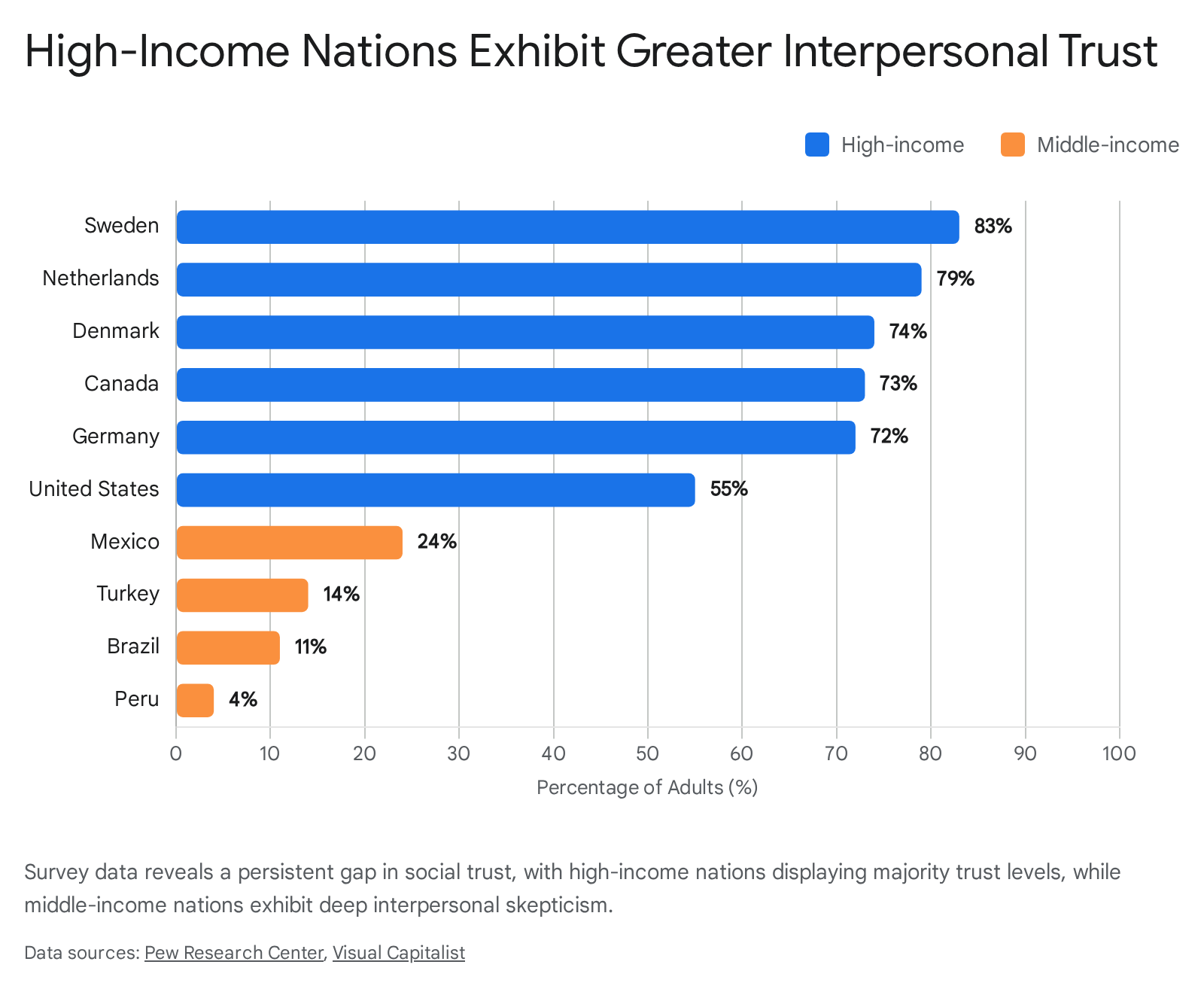
The distribution of interpersonal trust is highly uneven across the global landscape and correlates robustly with per capita gross domestic product (GDP), institutional stability, and the structural integrity of social welfare systems 1617. Nations that successfully mitigate economic volatility and maintain transparent civil services consistently register the highest levels of interpersonal trust. In contrast, nations suffering from acute political instability, high violent crime rates, and stark wealth stratification register severe trust deficits.
The following table synthesizes the stark regional contrasts in generalized trust, comparing the percentage of citizens who agree that "most people can be trusted" across selected global markets based on data spanning 2024 to 2026.
| Region | Country | Generalized Interpersonal Trust | Income Classification | Structural Context |
|---|---|---|---|---|
| Northern Europe | Sweden | 83% | High-Income | Robust welfare state, low corruption 1618. |
| Northern Europe | Denmark | 74% | High-Income | High social safety net, civic transparency 19. |
| North America | Canada | 73% | High-Income | Moderate polarization, stable institutions 18. |
| East Asia | China | 63% | Upper-Middle Income | Collectivist traditions, high state capacity 19. |
| North America | United States | 55% | High-Income | Severe polarization, vast mass-class divide 1618. |
| Latin America | Mexico | 26% | Middle-Income | High violent crime, volatile economy 2021. |
| Middle East | Turkey | 14% | Middle-Income | Political volatility, economic instability 1618. |
| Latin America | Brazil | 11% | Middle-Income | Extreme inequality, institutional corruption 1922. |
| Latin America | Peru | 4% | Middle-Income | Chronic political crises, deep stratification 19. |
The Nordic Trust Paradigm
The Nordic states - comprising Denmark, Norway, Sweden, and Finland - consistently dominate global indices for both institutional and interpersonal trust. In these societies, upwards of 60 to 83 percent of respondents believe that most people can be trusted 10161819. This phenomenon is deeply intertwined with the robust Nordic welfare model, which ensures low income inequality, extensive social safety nets, and highly reliable public services. The predictable and fair delivery of these services engenders deep institutional legitimacy, which subsequently translates into a highly trusting civic culture. Citizens in these nations generally feel that they receive a fair return on their high taxation rates 122324.
However, regional sociologists identify this high baseline trust as a structural "double-edged sword." The sustainability of a high-tax, high-benefit welfare state relies implicitly on a vast majority of "hard-riders" - law-abiding citizens who are industrious, honest, and contribute more than they extract 25. Extremely high levels of unverified social trust render these welfare systems highly vulnerable to exploitation by "easy-riders," individuals who seek illegitimate social benefits without participating equitably. Consequently, the maintenance of the Nordic trust model necessitates the presence of "tough-riders" within the population who are willing to informally discipline norm violations and prevent blind trust from enabling systemic abuse 25.
Latin America and the Security Deficit
Conversely, Latin America exhibits some of the lowest interpersonal trust metrics in recorded global data. The regional average for interpersonal trust has languished between 12 and 18 percent for over a decade, indicating a chronic deficit of social capital 26. Extreme outliers such as Peru, Nicaragua, and Colombia register generalized trust levels at or below 6 percent, while in Brazil, less than 15 percent of the population believes others can be trusted 192122. Mexico represents the regional ceiling, with interpersonal trust at merely 26 percent as of 2024 2021.
The primary causal mechanisms for this deficit include chronic political instability, systemic institutional corruption, and severe, pervasive violent crime. Decades of state failure have forced populations to rely exclusively on immediate familial and neighborhood networks for economic survival and physical security, actively cultivating deep suspicion of strangers as a necessary protective mechanism 121926. Interestingly, while institutional trust in Latin American governments saw a brief, localized resurgence between 2018 and 2020 - driven by pandemic-era relief policies and the election of outsider candidates challenging traditional party systems - this temporary political optimism did not generate a corresponding recovery in interpersonal trust, underscoring how deeply entrenched civic suspicion has become 12.
The African Context and Interethnic Dynamics
Across the African continent, historical legacies of colonialism, fragile state institutions, and arbitrarily drawn borders significantly complicate the trust landscape. Data from the 2021 - 2023 Afrobarometer (encompassing surveys across 39 countries) highlights profound societal struggles with interethnic trust. On average, only 21 percent of citizens trust individuals from other ethnic groups "a lot," while 36 percent trust them "somewhat" 2728.
Despite these low baseline trust indicators regarding outgroups, the data reveals a remarkable resilience in the desire for social coexistence. Fully 90 percent of surveyed Africans report no objection to having neighbors from different ethnic backgrounds, and 89 percent are open to interethnic marriages within their immediate families 27. Identity politics, however, reflect growing administrative friction. The share of citizens who feel primarily connected to their national identity over their localized ethnic identity has dropped by 12 percentage points over the last decade. Concurrently, 41 percent of respondents report that their specific ethnic group is treated unfairly by their government, highlighting how perceived institutional bias degrades broader social cohesion 27.
The Asian Bimodal Distribution
The Asia-Pacific region demonstrates a distinct bimodal distribution of trust. High-trust societies include China and India, where upwards of 56 to 63 percent of the population reports high generalized trust 1922. Australia similarly maintains strong social trust at approximately 69 percent 18.
In stark contrast, nations such as South Korea, Thailand, and Malaysia register significantly lower trust metrics, creating distinct "medium" and "low" tiers within the region 2229. Research utilizing the Asian Barometer Survey indicates that in many Asian contexts, traditionalist and authoritarian cultural values act as powerful moderating variables. These values can occasionally reinforce interpersonal trust and social cohesion at the local, communal level, while simultaneously buffering populations against the negative societal impacts of declining political trust and a fragmented media landscape 30. However, even within the Asia-Pacific region, an inward-looking trust environment is expanding, with respondents displaying a growing preference for domestic corporations over foreign entities and a marked hesitancy to engage with ideologically dissimilar individuals 13.
Political Polarization and Social Identity
Political polarization has fundamentally altered the radius of human trust in the twenty-first century, transforming generalized social capital into weaponized tribal loyalty. Trust is increasingly deployed not as a neutral assessment of a stranger's basic reliability, but as a politically signaled heuristic designed to identify ingroup affiliation.
The measurement of generalized trust is now inextricably entangled with affective polarization - the tendency of citizens to view out-party members negatively while exhibiting blind loyalty to their own political faction. However, empirical research indicates it is not merely actual polarization that destroys trust, but perceived polarization. Longitudinal panel data from the United States demonstrates that when citizens perceive the average person in their nation to be highly partisan, extreme, and close-minded, it induces profound feelings of estrangement from society at large 31. This perception alone drives down generalized trust, reducing the average citizen's willingness to cooperate with unfamiliar others or contribute to public goods 313233.
Furthermore, strong partisan identities act as a powerful linkage mechanism to political institutions. Increases in partisan strength are positively related to political trust for the individual's preferred party, but operate at the direct expense of generalized interpersonal trust 33. As citizens align more closely with distinct political identities, their capacity to trust the "average" member of society diminishes.
Bureaucratic Encounters and Political Signaling
This dynamic extends deeply into the administrative functions of the state. Elected officials, grassroots coalitions, and political elites routinely engage in "political signaling" to distinguish publicly salient policies and establish partisan battlelines 34. These signals cascade down to the citizenry, shaping how individuals respond to survey data and how they interact with government bureaucracy.
Research indicates that cognitive responses to elite signals dictate public preference and trust. Politically sophisticated citizens are more likely to receive and internalize these signals, aligning their trust judgments with their partisan identity 35. This signaling also influences frontline administrative law. If policymakers are conditioned by group reputations or negative stereotypes (e.g., signaling regarding low-income constituents or minority groups), these biases are often absorbed by administrative law judges and hearing examiners, leading to procedural disadvantages for marginalized groups 34. When citizens perceive that administrative outcomes are driven by political signaling rather than objective fairness, trust in both the government and the broader society erodes 3436.
The Religiosity Paradox
Religious affiliation provides a highly complex lens through which to view trust formation, presenting a well-documented sociological paradox. Regular participation in religious institutions fosters high levels of localized social capital, solidarity, and mutual support 3738. This active social belonging is a strong predictor of elevated interpersonal trust within the immediate community.
However, the nature of this trust is deeply particularized. Research utilizing the General Social Survey and the World Values Survey demonstrates a clear divergence: while social religiosity (e.g., attending services, belonging to a congregation) increases ingroup trust, strict individual religiosity and the prioritization of exclusive theological belief frequently predict lower generalized trust toward outgroups 3738. In highly fundamentalist or exclusive denominations, religion directs trust entirely inward, leading to the isolation of social groups and a measurable decrease in the willingness to trust strangers or individuals of different faiths 3739.
Interestingly, this paradox is heavily mediated by the overarching national context. In nations characterized by high baseline religious pluralism, strong personal religious belief can act as a psychological buffer that protects an individual's self-rated health and well-being, successfully offsetting the negative psychological impacts of holding low trust in outgroups 39.
Technological Disruption and the Information Environment
Technological disruption, driven by algorithmic social media feeds and the rapid proliferation of artificial intelligence (AI), is radically reshaping human cognitive processing and social interaction. These technologies present entirely new vectors for the rapid deterioration of interpersonal and institutional trust.
Algorithmic Amplification and Psychological Distress
Social media platforms operate as persuasive technologies engineered explicitly to capture and retain user attention via algorithmic curation 4140. These underlying structures inherently prioritize sensationalism, emotional resonance, and outrage over factual accuracy or nuanced discourse. For younger demographics particularly, this creates a deeply paradoxical environment: platforms theoretically designed to enhance social connectivity ultimately breed cultures of superficiality, comparison, and profound psychological distress 4140.
The constant curation of online personas and the endless scrolling facilitated by infinite content feeds erode the societal capacity for deep, authentic conversation and critical thinking 4140. When digital interaction relies on the constant need for social validation and exposes users to cyberbullying and curated perfection, it inherently hollows out the psychological bedrock required to form resilient interpersonal trust in the physical world.
Artificial Intelligence and Epistemic Fragmentation
Generative AI and advanced conversational agents present an even more intimate disruption to human socialization. Human-AI interaction studies, grounded in Media Equation Theory, reveal that humans readily anthropomorphize algorithms, projecting emotion, intentionality, and empathy onto non-human computational systems 41. This dynamic has given rise to robust parasocial relationships, wherein individuals form intense, one-sided emotional attachments to AI chatbots 4142.
As internet usage has skyrocketed and human loneliness reaches epidemic proportions globally, significant segments of the population are turning to virtual agents for emotional regulation and therapeutic discussion rather than seeking human connection 4142. A recent survey highlighted that 25 percent of young adults believe AI possesses the potential to entirely replace real-life romantic relationships 42.
While AI can provide highly accessible emotional support, it poses a severe, long-term threat to social cohesion. The distinct lack of genuine human empathy in AI retards the development of complex human conflict-resolution skills. Furthermore, an overreliance on frictionless, algorithmically tailored AI companions actively diminishes a user's psychological tolerance for the inherent friction, unpredictability, and emotional labor required to maintain real human relationships 4142. When individuals retreat into personalized digital echo chambers that never challenge their biases, the social muscle memory required to trust, negotiate with, and cooperate with unpredictable human strangers atrophies.
Simultaneously, the proliferation of generative AI outputs, deepfakes, and highly convincing synthetic media has triggered a profound epistemic crisis. When digital evidence can no longer be easily authenticated by the average citizen, the foundational baseline for verifying reality collapses. This epistemic uncertainty directly undermines public trust in digital media, journalistic institutions, and the very concept of shared objective truth 41.
Conclusions and Future Outlook
The empirical data across the global landscape points to a distinct evolution rather than a simple, linear evaporation of trust. Trust is a highly reactive and rational phenomenon, intricately calibrated to the economic security, institutional fairness, and technological environment of the individual.
Where governance is transparent, social welfare is guaranteed, and economic inequality is minimal - as observed primarily in Northern Europe - generalized trust thrives, facilitating robust economic growth and societal resilience. Conversely, the vast majority of the global population resides in middle- to low-income environments characterized by widening wealth gaps, rising political sectarianism, and highly unreliable institutions. In these environments, human beings are highly rational actors who adapt to systemic risk by withdrawing their trust from the unpredictable generalized public sphere and consolidating it strictly within familiar, ideologically pure, and highly localized networks.
Reversing this global slide into insularity requires interventions that extend far beyond corporate public relations or political rhetoric. The data overwhelmingly suggests that broad-scale interpersonal trust can only be regenerated through the implementation of structural policies that materially reduce economic stratification, secure transparent and highly accountable civic institutions, and deliberately moderate the polarizing, isolating effects of persuasive digital technologies. Until the material and psychological risks of trusting strangers are minimized by stable societal safety nets, the global trust recession will likely deepen, further fragmenting nations into guarded, alienated, and defensive enclaves.