
Global trends and drivers of public trust in science
Baseline Measurements of Scientific Authority
The intersection of scientific inquiry and public policy constitutes a foundational element of modern governance. In recent years, driven by the acute pressures of the COVID-19 pandemic, the rapid deployment of artificial intelligence, and the escalating imperatives of climate change mitigation, the public's reliance on scientific expertise has faced unprecedented scrutiny. A pervasive narrative within media and political discourse suggests that a systemic, global crisis of public trust in science has taken root, fueled by misinformation, political polarization, and rising anti-establishment populism. However, comprehensive empirical data collected across dozens of nations reveals a far more complex reality. Rather than a uniform collapse in epistemic authority, global surveys indicate that baseline trust in science and scientists remains remarkably resilient, even as specific vulnerabilities surrounding transparency and public engagement become increasingly pronounced.
Stability in Aggregate Global Trust
To properly evaluate the assertion that epistemic authority is in decline, it is necessary to examine aggregate global data collected through standardized psychometric instruments across diverse populations. The largest post-pandemic empirical investigation to date, a 2025 study published in Nature Human Behaviour by the Trust in Science and Science-Related Populism (TISP) consortium, utilized a massive sample of 71,922 respondents across 68 countries. This study established a weighted grand mean trust score of 3.62 on a 5-point scale, where 1 represents very low trust and 5 represents very high trust 12345. Crucially, the researchers observed that in no single country did the average trust level fall below the midpoint of the scale, effectively refuting the notion of a universal crisis of confidence 467.
This baseline stability is strongly corroborated by longitudinal tracking from the Wellcome Global Monitor, widely considered the world's largest study on how populations perceive science and health challenges. In its 2018 assessment covering over 140 countries, the Monitor found that globally, 18% of people reported a "high" level of trust in scientists, while 54% exhibited a "medium" level, and only 14% registered "low" trust 89. Following the onset of the COVID-19 pandemic, the 2020 iteration of the Wellcome Global Monitor revealed that the percentage of individuals expressing "a lot" of trust in science actually increased globally, rising from 34% in 2018 to 43% in late 2020 across a common set of 113 countries 101112. This aggregate rise likely reflected the highly visible, critical role of medical scientists during the acute phase of the global health emergency.
Furthermore, the 2024 Edelman Trust Barometer, an annual survey of 28 countries, reported that 74% of global respondents trust scientists to tell the truth about new innovations and technologies. In this context, scientists rank alongside peers as the most trusted sources of information, significantly outpacing business CEOs, journalists, and government leaders 1314.
Structural Dimensions of Trust
Trust in scientific institutions is not a monolithic construct; it is a multidimensional phenomenon shaped by distinct attributes. Researchers typically disaggregate epistemic trust into four constituent components: competence (qualifications and intellectual ability), integrity (honesty and adherence to rigorous methods), benevolence (concern for the public good), and openness (willingness to listen and accept external feedback) 1516. When global trust is broken down into these constituent parts, a distinct "openness deficit" emerges across the scientific enterprise.
The 2025 TISP consortium data clearly illustrates this structural imbalance. The public overwhelmingly recognizes the intellectual rigor of the scientific community. Over 75% of the global public agrees that scientific methods represent the optimal framework for determining the validity of a claim 134. Consequently, 78% of global respondents perceive scientists as highly competent and qualified to conduct impactful research 235. However, indicators of social integration and moral alignment score significantly lower. Only 57% of respondents believe that most scientists are honest, and just 56% feel scientists are actively concerned about public well-being 235.
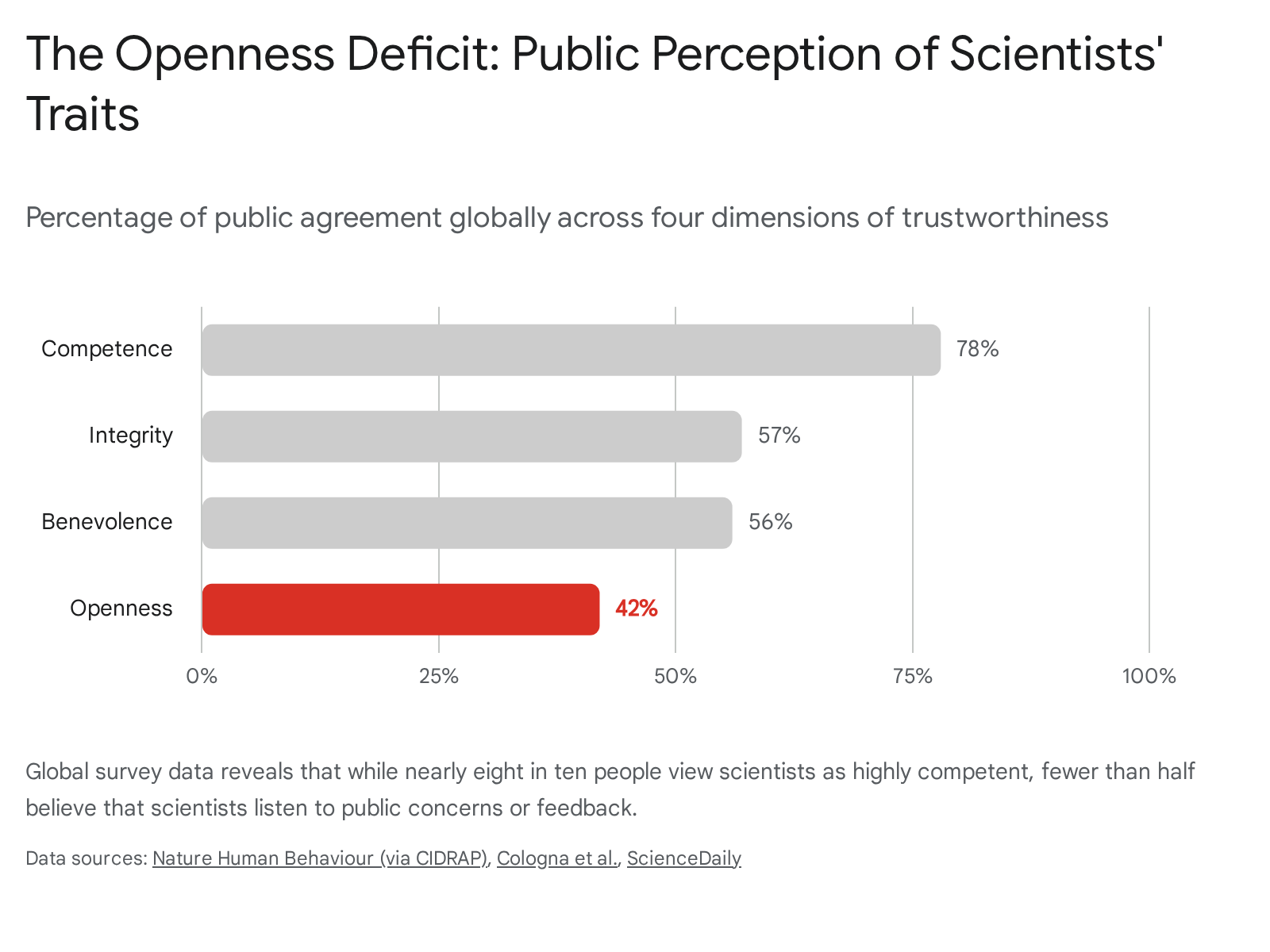
The most severe vulnerability lies in the domain of openness. Less than half of the global population - merely 42% - believes that scientists pay attention to the views, concerns, and feedback of ordinary citizens 25. This openness deficit indicates that the scientific establishment is frequently viewed as an insulated elite. While the public relies on scientists to generate unilateral technical knowledge, they do not necessarily feel represented by scientific institutions, fostering an environment where misplaced skepticism and populism can easily take root 71718.
Regional Variations in Epistemic Trust
While the global mean indicates moderate stability, geographic disaggregation reveals significant variance shaped by historical development, institutional capacity, and regional politics. Trust in science operates within the broader context of a population's general trust in state institutions and the localized impacts of global crises.
Trust Dynamics in the Global South
Survey data consistently highlights a higher baseline of trust in scientific institutions within many nations of the Global South compared to highly developed Western democracies. In the 2025 multi-national study, the highest aggregate trust scores were recorded in Egypt (4.30 out of 5), India (3.86), and Nigeria (3.82) 319. In contrast, nations exhibiting the lowest - though still moderate - levels of trust included Albania (3.05) and Colombia (3.13), alongside several Eastern European nations 37.
In Africa, data from the Afrobarometer suggests that trust in science and health professionals often serves as a stabilizing force amid fluctuations in domestic political trust. For instance, longitudinal data from Ghana demonstrated a collapse in public trust in the Electoral Commission and the presidency between 2014 and 2022, with confidence in the Electoral Commission falling to just 33% 20. Yet, despite this institutional fatigue, trust in the health sector and medical science remained robust, serving as a critical predictor of citizen compliance with public health mandates and non-pharmaceutical interventions during the COVID-19 pandemic 20. Research across multiple African contexts confirms that trust in the health sector and medical information sources was significantly associated with lower COVID-19 vaccine hesitancy 21.
Similarly, a comprehensive survey of seven large Global South countries (Chile, Colombia, India, Kenya, Nigeria, South Africa, and Vietnam) evaluating attitudes toward climate change found that scientists ranked as the most trusted source of information in all surveyed nations except Vietnam, where television programming ranked marginally higher 222324.
| Ranking | Trusted Information Source (Global South Average) |
|---|---|
| 1 | Scientists / Scientific Institutions |
| 2 | Mainstream Newspapers / Television |
| 3 | Environmental Non-Governmental Organizations |
| 4 | National Government Authorities |
| 5 | Friends and Family |
| 6 | Social Media Platforms |
| 7 | Religious Leaders |
| Table 1: Relative ranking of trust in various information sources regarding climate change across seven Global South nations. Data synthesized from Carson et al., Nature Climate Change, 2025. 222324 |
While trust in scientists is high in the Global South, it is highly pragmatic. When respondents in these regions were asked to rank the importance of climate change against 13 other policy priorities, climate action ranked ninth, trailing behind immediate socio-economic imperatives such as improving healthcare, decreasing political corruption, and increasing employment 222324. This illustrates a crucial tension: high epistemic trust in science does not automatically translate into public support for policies that mandate economic tradeoffs in resource-constrained environments.
Institutional Skepticism in Western Democracies
In contrast to the Global South, Western democracies are exhibiting higher levels of institutional fatigue and acute politicization of science. In the United States, longitudinal data from the Pew Research Center traces a distinct trajectory of declining confidence. The percentage of Americans expressing a "great deal" of confidence in scientists spiked to 39% in early 2020 during the initial mobilization against COVID-19. However, as the pandemic endured and public health measures became entangled in partisan conflict, this figure plummeted to 23% by late 2023, before stabilizing slightly in 2024 2526. As of 2024, approximately a quarter of Americans (27%) express "not too much" or "no confidence" in scientists to act in the public's best interests, representing a sharp increase from 12% in April 2020 26.
The Canadian population mirrors this trend of mounting skepticism. The 2025 Edelman Trust Barometer for Canada revealed a deepening crisis of institutional trust driven by economic grievance. While Canadians maintain strong baseline trust in scientists (78%), broader institutional confidence is faltering. Fully 67% of Canadians believe government leaders actively mislead the public, and 62% believe business leaders do the same 27. Economic fears regarding offshoring, automation, and inequality have fostered an environment where 40% of Canadians approve of at least one form of hostile activism to effect change - a sentiment that rises to an alarming 67% among respondents aged 18-34 27. When the broader institutional fabric is distrusted, scientific institutions inextricably linked to government funding and corporate research inherently suffer reputational damage.
The Asian Context and Science Communication
Asian nations present a unique profile in the global trust landscape. Data from the Asian Barometer and related multinational surveys suggest that despite high levels of technological advancement, public trust in science in several East Asian nations is lower than the global average. In the 68-country TISP survey, Taiwan ranked 61st out of 68 countries in aggregate trust, while Japan (3.45) and Hong Kong (3.65) also exhibited scores slightly below the global mean 31928.
This lower baseline does not appear to stem from anti-intellectualism, but rather from a hyper-critical public expectation of scientific communication. Surveys indicate that a significant majority of Taiwanese citizens (80%) feel that news media oversimplifies scientific findings, and 85% express concern that scientists actively overstate the implications of their research - figures drastically higher than global averages 28. This highlights a distinct regional challenge where public relations officers within scientific organizations identify transparency, productivity, and competent science communication as vulnerabilities in their institutional legitimacy 28.
Demographic and Ideological Correlates
The variance in epistemic trust is not merely geographic; it is deeply stratified by demographic markers and ideological orientations. Understanding these correlates is essential for deciphering the precise mechanisms that drive skepticism.
Education and Economic Grievance
Across virtually all global surveys, there is a consistent, positive correlation between trust in science and socio-economic advantage. Higher levels of formal education, higher personal household income, and urban residency are robust predictors of scientific trust 126918.
The Pew Research Center notes a stark educational divide in the United States. As of 2024, 34% of individuals with a four-year college degree express "strong trust" (a great deal of confidence) in scientists, compared to only 22% of those without a college degree 25. The Wellcome Global Monitor similarly found that individuals who self-report finding it "difficult to get by" on their current income exhibit significantly lower confidence in their nation's hospitals, health clinics, and scientific institutions 89.
This economic stratification suggests that mistrust in science is often intertwined with broader systemic grievances. When marginalized or economically insecure populations feel abandoned by the state and the elite establishment, that alienation frequently extends to the scientific institutions perceived as intertwined with that establishment 272930. Trust requires a perception of shared fate; if segments of the population do not believe they are reaping the economic or health benefits of scientific advancement, their baseline trust inevitably erodes.
The Limits of Political Polarization
The relationship between political ideology and trust in science is highly contingent on national context. In the United States and several Western European nations, science has become acutely politicized. The Pew Research Center highlights a widening partisan gap in the U.S.: 88% of Democrats and Democratic-leaning independents express confidence in scientists, compared to 66% of Republicans 25. This polarization accelerated rapidly during the COVID-19 pandemic, as epidemiological modeling, vaccine efficacy, and non-pharmaceutical interventions became proxies for political tribalism 163132.
However, the assumption that right-leaning or conservative political ideology inherently breeds anti-science sentiment is a Western-centric fallacy. The 68-country study by Cologna et al. explicitly tested this correlation globally and found that while right-leaning orientations negatively predicted trust in North America and parts of Western Europe, this relationship was absent in the majority of global jurisdictions 33. In fact, in several Eastern European, Southeast Asian, and African nations, right-leaning and conservative individuals reported higher levels of trust in scientists than their left-leaning counterparts 3334.
This divergence indicates that "science" is not inherently ideologically aligned. Rather, trust fractures when scientific consensus directly conflicts with the core values, economic interests, or identity markers of a specific political coalition within a specific domestic context 13.
Domain-Specific Variations in Scientific Trust
The public does not evaluate "science" as a homogenous monolith. Epistemic trust is highly differentiated based on the specific scientific discipline, its perceived proximity to public values, and the immediate societal consequences of its application 615.
The Authority of Medical and Climate Science
Medical science generally enjoys the highest baseline of public trust, benefiting from highly visible institutional pathways (hospitals, clinics) and direct, personal utility. Despite the friction of the pandemic, 73% of people globally report that they would trust a doctor or nurse more than any other source of health advice, including family and religious leaders 89.
Climate scientists also maintain robust levels of public trust globally, particularly given the contentious, high-stakes policy implications of their work. A meta-analysis comparing climate scientists to scientists in general found that trust in climate researchers is only marginally lower than trust in the broader scientific community, though this gap widens significantly among politically conservative respondents in Western nations where fossil fuel dependency and regulatory ideology are highly politicized 333435. In the Global South, as previously noted, climate scientists wield immense epistemic authority, and regular exposure to climate science is strongly correlated with increased objective climate literacy 222324.
The Prudence Deficit in Artificial Intelligence
A highly distinct phenomenon is occurring regarding the public reception of Artificial Intelligence (AI). While AI represents the vanguard of modern technological innovation, the scientists developing it face a unique and severe deficit of public trust. A 2025 study published in PNAS Nexus utilizing the Factors Assessing Science's Self-Presentation (FASS) framework compared public perceptions of AI scientists against climate scientists and general scientists 363738.
The findings were stark: AI scientists scored significantly lower on nearly every measure of trustworthiness. On a 5-point scale, AI scientists received a mean trustworthiness score of just 2.97, compared to 3.62 for climate scientists and 3.56 for scientists generally 3637.
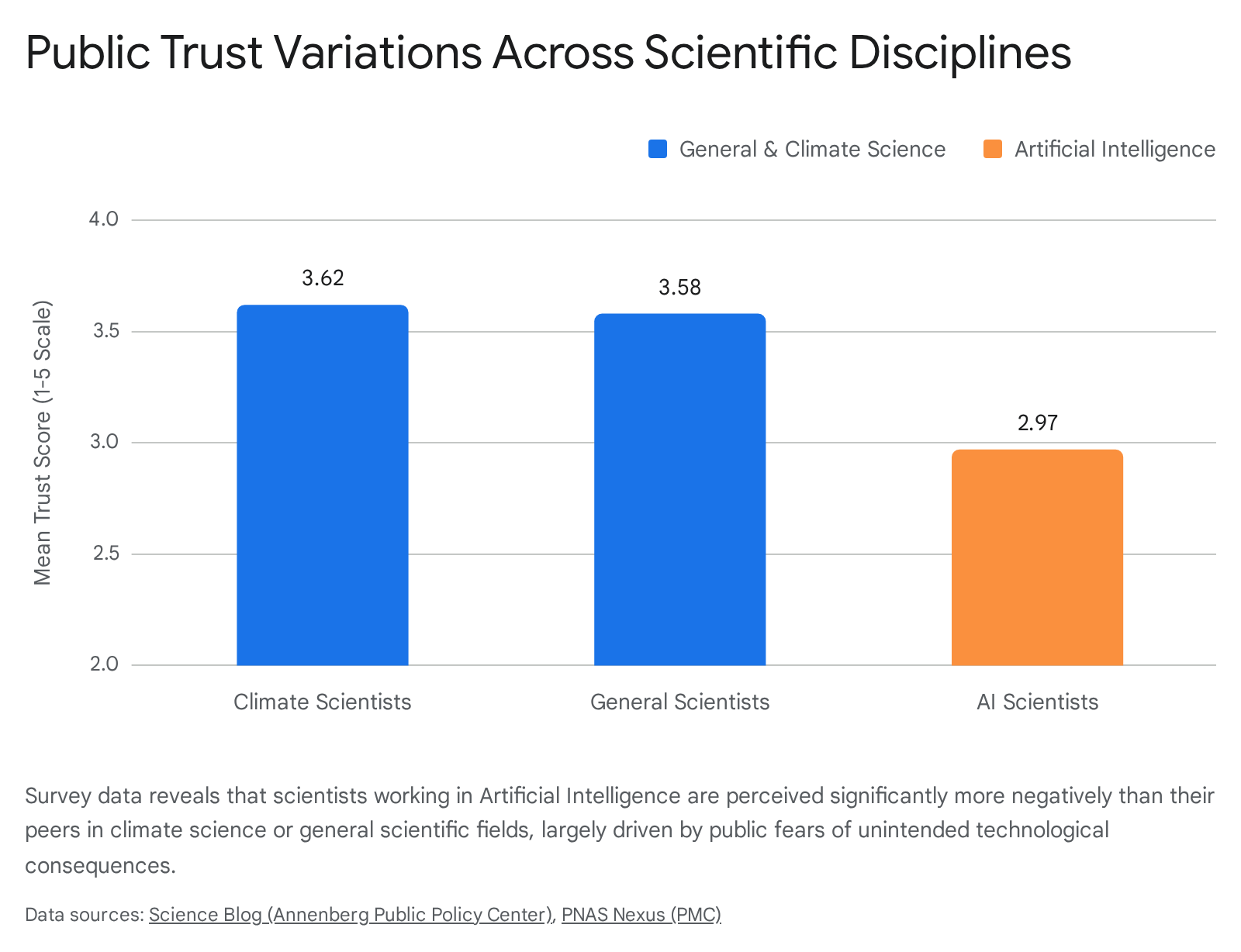
This negativity is driven almost entirely by the "prudence" metric within the FASS framework - specifically, the widespread public belief that AI research is actively causing dangerous, unintended consequences. On the specific sub-metric of "unintended consequences," AI scientists averaged a dismal 2.33 out of 5 in 2025 363738.
Crucially, unlike the skepticism directed at climate science, the distrust of AI cuts across political boundaries. Political ideology explained only 2% to 7% of the variance in AI perceptions, compared to 31% for climate science 3637. Longitudinal tracking between 2024 and 2025 showed that increased familiarity with AI applications in daily life did not breed public acceptance; skepticism remained virtually unchanged 3638. This indicates that the scientific community is confronting a novel form of skepticism: widespread anxiety regarding technological risk that transcends partisan tribalism, rooted in a perceived lack of ethical foresight by the developers.
| Dimension of Trust | AI Scientists | General Scientists | Climate Scientists |
|---|---|---|---|
| Overall Trustworthiness | 2.97 | 3.56 | 3.62 |
| Value Alignment | 2.67 | 3.19 | 3.31 |
| Bias Concerns | 2.79 | 3.24 | 3.31 |
| Table 2: Mean scores (1-5 scale) reflecting public perceptions across scientific fields. AI scientists consistently rank lower in public estimation than peers in other domains. Data sourced from the Annenberg Public Policy Center PNAS Nexus study (Walter et al., 2025). 3637 |
The Impact of the Reproducibility Crisis
Beyond external political pressures and domain-specific anxieties, the scientific community has grappled with internal methodological crises that have profound implications for public trust. The most significant of these is the "reproducibility crisis" - the growing recognition that a substantial portion of published, peer-reviewed findings, particularly in the social, behavioral, and biomedical sciences, cannot be replicated by independent researchers 39404142.
Methodological Failures and Public Perception
Empirical assessments of reproducibility have yielded troubling statistics. The landmark 2015 Reproducibility Project: Psychology, led by the Center for Open Science, attempted to replicate 100 studies from leading journals. While 97% of the original studies reported statistically significant results, only 36% of the replications achieved significance, with effect sizes averaging roughly half the magnitude of the originals 4042. Similar analyses evaluating thousands of social science claims over a seven-year period found that only roughly 50% of findings were precisely reproducible 43. Furthermore, analyses of in-house drug target validation projects have shown reproducibility rates as low as 20% to 25% 42.
The communication of these systemic failures to the public has measurable, detrimental effects on the epistemic authority of science. Experimental studies demonstrate that when lay participants read detailed accounts of low replication rates (e.g., learning that only 39 out of 100 psychology studies replicated), their overall trust in the scientific community drops significantly compared to control groups who are presented with higher replication rates 4445. The failure of landmark studies exposes policymakers to the risk of relying on fragile evidence, leading to ineffective or harmful interventions, and provides rhetorical ammunition for populist actors seeking to delegitimize scientific expertise 71740.
Trust Repair and Open Science
The scientific community faces a severe communication paradox regarding reproducibility: suppressing the realities of methodological failure violates the core scientific tenet of transparency, yet aggressively broadcasting a "crisis" provides fodder for science denialism 39.
Research into trust-repair strategies suggests that the framing of the reproducibility issue is paramount. Short, superficial news reports emphasizing a "crisis" invariably damage public trust 45. However, experiments utilizing comprehensive, in-depth explanations that not only detail the replication challenges but also highlight the robust reforms being implemented (e.g., pre-registration, open data mandates, and statistical power analyses) yield a different result. Educating the public on these self-correcting mechanisms actually increases trust in current and future researchers, even as it rightfully calibrates - and lowers - trust in past, un-replicated findings 4145. This suggests that public scientific literacy must evolve beyond merely understanding basic facts to grasping the iterative, deeply self-correcting process of scientific methodology.
The Information Ecosystem and Misinformation
The persistent friction points identified in the data - the openness deficit, partisan polarization in the West, and domain-specific anxieties - are profoundly catalyzed by the modern digital media ecosystem. Fragmented information environments and social media algorithms are optimized to prioritize conflict, novelty, and sensationalism. This ecosystem facilitates the rapid dissemination of misinformation, conspiracy theories, and out-of-context scientific disagreements 174647.
Digital Media and Science-Related Populism
When scientists are viewed as technically competent but morally disconnected from the populace, they become highly vulnerable to "science-related populism." This phenomenon, distinct from traditional political populism, posits a fundamental antagonism between the "common sense" of ordinary people and the epistemological monopoly of an academic elite 171730. Science-related populism does not necessarily reject the scientific method; rather, it rejects the institutional authority of scientists to dictate societal values and policy without public consent.
In highly polarized media environments, scientific uncertainty - a normal and necessary component of the research process - is frequently weaponized to manufacture doubt. During the COVID-19 pandemic, the necessary evolution of scientific advice regarding epidemiology and transmission was often framed by partisan media not as healthy scientific revision, but as evidence of institutional incompetence or deception 1332.
However, targeted interventions in these ecosystems show promise. Experimental research in the Global South demonstrates that sustained exposure to factual corrections via short text messages or audio podcasts can effectively inoculate citizens against specific strands of health misinformation, altering political attitudes and compliance behaviors even if broader media consumption habits remain unchanged 48. Nevertheless, the data clearly indicates that misplaced trust in untrustworthy, alternative information sources - facilitated by digital platforms - is a primary vector for the erosion of confidence in institutional science 1348.
Conclusion
A rigorous analysis of global survey data systematically refutes the dramatic narrative that public trust in science has collapsed. The empirical reality across both the Global North and the Global South is that scientists remain among the most trusted actors in society, their competence is widely acknowledged, and the public fundamentally believes that the scientific method is the best tool for uncovering objective truth.
However, the current crisis is one of institutional relationship, not of intellectual capacity. The persistent gap in perceived openness, the sharp partisan polarization in Western democracies, the unique and acute skepticism facing Artificial Intelligence development, and the fallout from the reproducibility crisis all point to a singular conclusion: the scientific community can no longer rely on a "deficit model" of public interaction. Simply broadcasting more facts to a public presumed to be ignorant is an insufficient strategy to maintain authority in the 21st century.
To bridge the trust gap, the scientific establishment must transition to an "engagement model." This requires institutionalizing transparency, explicitly communicating the uncertainties and self-correcting mechanisms inherent in research, and critically, establishing two-way dialogues that incorporate public values and concerns into the prioritization of scientific research. Trust in science is not an entitlement granted by virtue of an academic credential; it is a continuously negotiated social contract that must be actively earned and maintained through demonstrable benevolence, methodological rigor, and radical openness.