Global empathy trends across countries and generations 2000 - 2024
Introduction
Empathy - the multifaceted psychological capacity to understand, share, and respond to the emotional states of others - has long been considered the bedrock of human prosocial behavior, moral reasoning, and social cohesion. Historically conceptualized as a stable dispositional trait, empathy is broadly categorized into two primary domains within psychological literature: cognitive empathy, which encompasses perspective-taking and theory of mind, and affective empathy, which involves emotional congruence, empathic concern, and personal distress 1234. Over the past two decades, the prevailing academic and cultural narrative surrounding empathy has been one of precipitous decline. This perspective was heavily influenced by early longitudinal studies indicating that younger generations were becoming increasingly self-centered, individualistic, and emotionally detached from their peers and broader communities.
However, emerging research conducted between 2020 and 2024 fundamentally challenges this linear narrative of moral and emotional decay. Utilizing advanced cross-temporal meta-analyses, cross-cultural comparative methodologies, and large-scale global behavioral datasets, contemporary psychology and sociology reveal that empathy is not simply disappearing. Instead, it is highly mutable, fluctuating in response to macroeconomic shifts, global crises such as the COVID-19 pandemic, and profound changes in interpersonal dynamics and digital environments. The concept of empathy itself has undergone rigorous re-evaluation, dispelling prominent myths - such as the idea that empathy is a uniform construct, that it inherently leads to burnout, or that recent generations are uniformly devoid of compassion 4.
Furthermore, the expansion of research methodologies beyond Western, Educated, Industrialized, Rich, and Democratic (WEIRD) populations has exposed significant cultural biases in how empathy is measured and expressed. These global investigations highlight a critical divergence between self-reported psychological traits and actual prosocial behavior across different geographic regions 567. This comprehensive research report investigates the evolving landscape of empathy from a global perspective. It critically examines the recent quantitative rebounds in dispositional empathy among American youth, contrasts these findings with empirically observed trends in Asia, Africa, and Latin America, and investigates the behavioral proxies of empathy, such as longitudinal trends in charitable giving and volunteering. Crucially, the report addresses alternative frameworks for understanding modern empathic deficits, including the rise of parochial empathy, empathy fatigue, and the profound impacts of economic stress, political polarization, and the contemporary loneliness epidemic on the human capacity to care.
1. The Longitudinal Trajectory of Empathy: Reassessing the "Decline"
For years, the empirical cornerstone of the "empathy decline" narrative was a landmark 2011 cross-temporal meta-analysis conducted by Dr. Sara Konrath and colleagues, which analyzed the Interpersonal Reactivity Index (IRI) scores of American college students from 1979 to 2009. The IRI, developed by Mark Davis in 1980, is a widely utilized and highly validated psychometric tool that measures four distinct subscales of dispositional empathy: Perspective Taking (PT), Empathic Concern (EC), Fantasy (FS), and Personal Distress (PD) 389. The initial 2011 study revealed a stark 40% overall decline in dispositional empathy among undergraduates - specifically in the PT and EC subscales - which was most notably pronounced after the year 2000 91012. This steep drop coincided with the rise of social media and individualistic cultural values, leading many to conclude that the digital age had permanently stunted the emotional development of emerging adults.
1.1 The Post-2008 Rebound in Youth Empathy
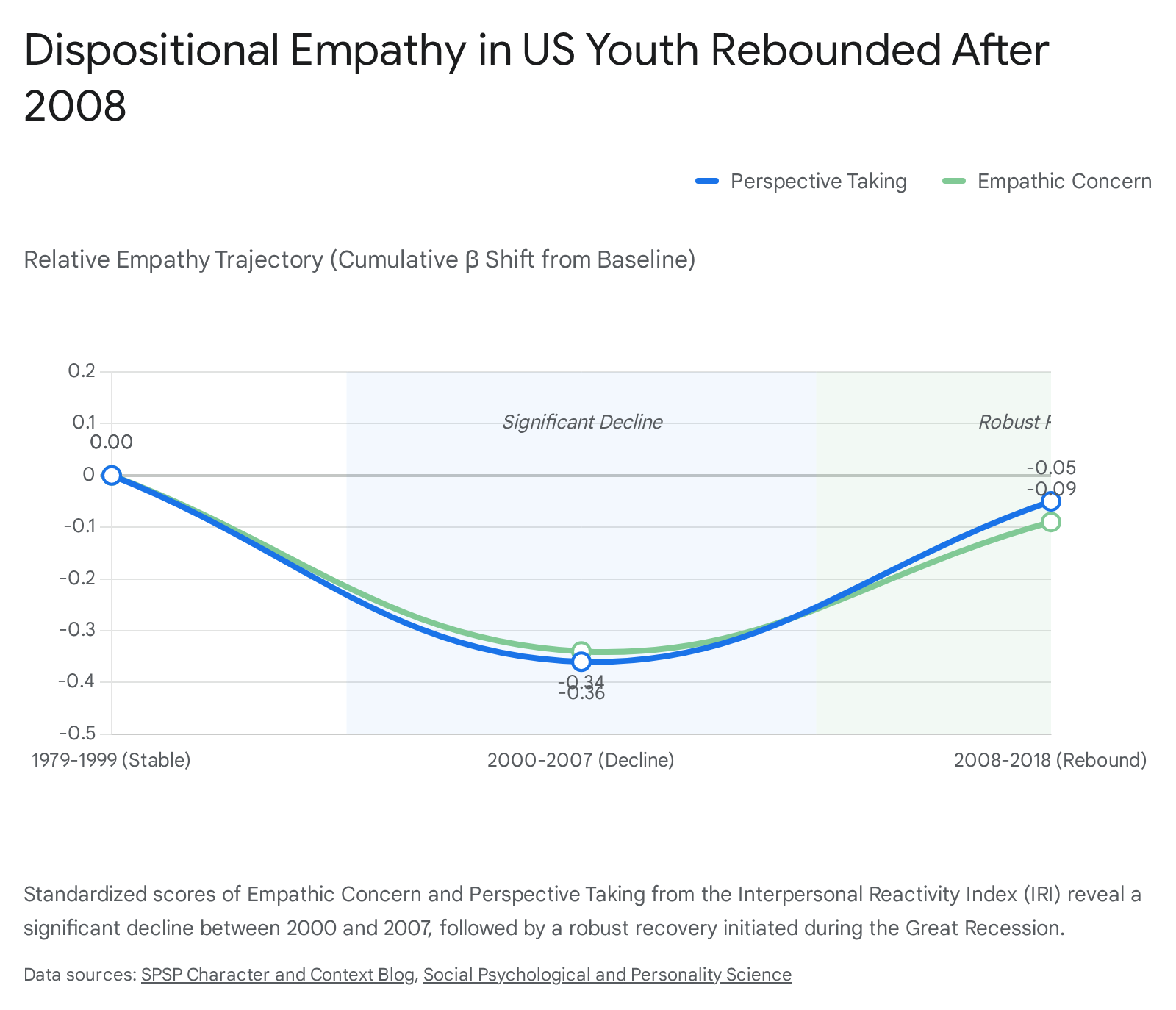
In a vital 2024 update to this foundational research published in Social Psychological and Personality Science, researchers Konrath, Martingano, Davis, and Breithaupt extended the temporal analysis to the year 2018. This updated study incorporated 126 new studies and surveyed the responses of 38,693 undergraduates, alongside conceptually replicating the findings using massive nationally representative datasets such as the American Freshman Survey and the Monitoring the Future Survey 13111213. Contrary to the hypothesis of continuous generational decline, the updated meta-analysis revealed a statistically significant, non-linear cubic trend.
Rather than a steady erosion, population-level empathy operates cyclically. While the researchers confirmed the significant decline in Perspective Taking and Empathic Concern between 2000 and 2007, they documented a previously undiscovered and highly robust rebound in these exact traits from 2008 onward 111214. By 2018, empathy levels among late Millennials and emerging Generation Z adults were rising significantly, approaching levels reminiscent of the late 1970s and 1980s 15. This finding directly challenges historical tropes - dating back as far as Peter the Hermit in the 11th century - that young people are perpetually declining in moral character and compassion 1116.
1.2 Quantitative Shifts by Subscale and Era
The recent fluctuations were most pronounced in the "other-oriented" dimensions of empathy. Perspective Taking - the cognitive ability to spontaneously adopt the psychological viewpoint of others - saw no significant change between 1979 and 1999, declined sharply between 2000 and 2007, but then saw a significant rise ($\beta = .31$, $p < .001$) between 2008 and 2018 12. Similarly, Empathic Concern - the affective capacity to experience "other-oriented" feelings of sympathy and compassion toward unfortunate individuals - exhibited a concurrent increase ($\beta = .25$, $p = .008$) during the exact same post-2008 period 12.
Conversely, the self-oriented Personal Distress subscale, which measures personal anxiety and unease in tense interpersonal settings, and the Fantasy subscale, which measures imaginative engagement with fictional characters, remained relatively stable across the generations 391718. This stability is crucial, as it suggests that the recent generational shifts are specific to prosocial orientations and genuine interpersonal concern, rather than mere variations in general emotional reactivity or neuroticism.
Table 1: Standardized Shifts in Dispositional Empathy Subscales Among US Youth (1979 - 2018)
| Time Period | Perspective Taking (PT) Trend | Empathic Concern (EC) Trend | Primary Contextual Factors & Drivers |
|---|---|---|---|
| 1979 - 1999 | Stable ($\beta = -.10$, $p = .61$) | Stable ($\beta = .16$, $p = .42$) | Pre-digital era; baseline societal stability; established modes of civic engagement. |
| 2000 - 2007 | Significant Decline ($\beta = -.36$, $p = .036$) | Significant Decline ($\beta = -.34$, $p = .037$) | Rise of individualism, early social media emergence, emphasis on self-esteem over communal values. |
| 2008 - 2018 | Significant Increase ($\beta = .31$, $p < .001$) | Significant Increase ($\beta = .25$, $p = .008$) | Post-Great Recession landscape, ubiquitous digital exposure to global narratives, rising societal loneliness. |
Data derived from cross-temporal meta-analysis of the Interpersonal Reactivity Index (IRI) across 38,693 undergraduate participants. 1213.
1.3 Drivers of the Rebound: Interpersonal Dynamics Over Economics
To isolate the mechanisms driving this cyclical behavior, researchers rigorously tested various covariates - including economic conditions, worldview, and interpersonal dynamics. Surprisingly, macroeconomic indicators, such as the unemployment rates during the 2008 Great Recession, did not directly predict the empathy fluctuations 1215. While earlier theories suggested that economic downturns might foster communitarianism as a survival mechanism, the data indicated that changing interpersonal dynamics played a much larger role in these empathy fluctuations.
Counterintuitively, the data demonstrated that empathy increased during periods of elevated societal loneliness and decreased socialization frequency 1115. While chronic objective isolation is universally recognized as deleterious to mental and physical health, the subjective experience of loneliness during the 2010s appears to have acted as a motivational catalyst. The prevailing theory suggests that when young people experienced profound social disconnection, their hunger for connection and their acute awareness of others' suffering heightened, prompting a compensatory increase in their motivation to empathize 1115. This aligns with recent experimental studies demonstrating that inducing feelings of loneliness in participants actually increases their immediate motivation to engage in perspective-taking and empathic concern.
2. A Global Perspective: De-Centering WEIRD Populations
A critical vulnerability in the historical study of empathy is its profound over-reliance on WEIRD (Western, Educated, Industrialized, Rich, Democratic) sample populations, which represent only about 11% of the global population 519. Foundational empathy scales, such as the IRI, were developed, calibrated, and validated primarily on American undergraduate populations. Consequently, these metrics embed Western conceptualizations of the self, emotional regulation, and social relations into the very instruments used to evaluate global populations 68. Recent comparative psychological studies spanning Asia, Africa, and Latin America between 2020 and 2024 have interrogated these assumptions, revealing that the expression and measurement of empathy are highly contingent on broader cultural paradigms, such as Individualism versus Collectivism (I-C) and relational mobility 620.
2.1 The Empathy Paradox in Asia: Self-Reporting vs. Empathic Accuracy
When Western psychometric instruments are deployed globally, a methodological paradox frequently emerges. In large-scale, cross-country meta-analyses, researchers have documented that individualistic Western nations - such as the United States, parts of Western Europe, and Australia - often report higher aggregate scores in self-assessed trait empathy compared to highly collectivist nations in East and Southeast Asia 212223. For instance, a 2024 study examining empathy among healthcare professionals in Singapore found that local nurses and allied health professionals scored significantly lower on the Jefferson Scale of Empathy (JSE) than their American counterparts, recording a mean score of 101.3 compared to the American nursing average of 117.2 23. Similarly, East Asian adolescents frequently report less empathic concern and greater personal distress than Western peers when assessed via the IRI 22.
However, cultural psychologists caution that these lower self-reported scores do not equate to a genuine "empathy deficit" in non-Western populations. In fact, laboratory-based behavioral studies demonstrate the exact opposite. When measuring empathic accuracy - the objective ability to correctly identify and infer the complex emotional states of others from visual cues or narratives - East Asian participants significantly outperform White British and European American participants 24.
This discrepancy fundamentally stems from cultural self-construal. In Western, independent cultures, the "self" and the "other" are viewed as distinct, autonomous entities. Therefore, individuals must exert conscious cognitive effort to bridge this gap (Perspective Taking), which is highly valued, culturally reinforced, and readily self-reported on questionnaires 2024. Conversely, in interdependent, collectivist cultures, the self is defined inherently by its relationships. Emotion sharing and affective resonance are baseline expectations of social harmony rather than exceptional traits to be proudly claimed on a survey 62025. Furthermore, cultures with high "relational mobility" - where people have the freedom to choose and discard social ties, such as the US - foster explicit, high-arousal expressions of positivity to build new relationships. In East Asian cultures with lower relational mobility, positive emotions are not expressed as frequently as a social strategy, leading to lower self-reported scores on Western metrics that equate high positivity with empathy 625. Consequently, East Asians exhibit high behavioral empathy and acute interpersonal accuracy, but lower self-aggrandizement on Western psychometric scales 24.
2.2 Latin America: Emotion Sharing as the Core of Compassion
In Latin America, cultural norms place a premium on deep social connectivity and a unique approach to emotional resonance. A recent empirical study investigating how individuals in Ecuador and Mexico conceptualize compassion found a marked departure from WEIRD psychological norms. Latin Americans place a significantly higher cultural emphasis on "emotion sharing" - specifically the sharing of sadness and pena (sorrow) - as the defining characteristic of an empathic and compassionate response 19.
Unlike European Americans, who often prioritize emotion regulation, the avoidance of negative states, and the projection of positivity, individuals in the Andean region and Central America exhibit a robust willingness to co-experience distress with others 19. This cultural tendency translates into exceptionally high global rankings for dispositional empathy; in a comprehensive 63-country survey evaluating over 100,000 individuals, Ecuador ranked as the single most empathetic country in the world, with Peru and Costa Rica also placing prominently in the top ten 2026.
Despite this high general disposition toward empathy in the populace, maintaining empathy in professional contexts remains challenging. A large-scale 2025 assessment of health sciences professors across six Latin American countries found predominantly moderate-to-low levels of professional empathy, indicating that modern institutional pressures and rigid biomedical teaching models can suppress even culturally innate empathic tendencies when placed in high-stress academic or clinical environments 2728.
2.3 Africa: Emic Approaches and Longitudinal Resiliency
Lifespan developmental research and longitudinal empathy studies are virtually absent outside the West, a critical gap currently being addressed by the Africa Long Life Study (ALLS). Launched in 2022, ALLS tracks the psychological development of young adults in Namibia, Kenya, and South Africa by integrating etic (imported Western scales) and emic (bottom-up, Africentric) approaches to test the universality of psychological traits 5.
Early longitudinal data regarding empathy in the African context shows a strong baseline of communal resilience, heavily influenced by philosophies of Ubuntu (interconnectedness). For example, a prospective four-year longitudinal study of medical students in South Africa revealed that while empathy levels naturally fluctuated throughout their rigorous and stressful training, targeted educational interventions significantly raised empathy levels, though sustaining these gains required continuous reinforcement and clinical role-modeling 2930. Furthermore, an empathy training trial among healthcare providers in Ethiopia demonstrated robust, measurable improvements in clinical empathy with medium-to-large effect sizes (Cohen's $d = 0.55$ to $0.60$), proving that empathic skills can be successfully cultivated and objectively measured in resource-constrained environments when interventions are culturally calibrated 31.
Table 2: Conceptual and Empirical Disparities in Empathy (Western vs. Non-Western Contexts)
| Region | Primary Cultural Driver & Self-Construal | Performance on Western Trait Scales (e.g., IRI, JSE) | Observed Behavioral & Cognitive Empathy |
|---|---|---|---|
| Western (US/UK) | High Individualism, High Relational Mobility, Independent Self. | High self-reported Empathic Concern and Perspective Taking 2224. | Lower baseline empathic accuracy; highly reliant on formal modes of prosociality (e.g., structured donations) 2432. |
| East Asia | High Collectivism, Interdependent Self, Low Relational Mobility. | Lower self-reported Empathic Concern; higher Personal Distress 2022. | Superior empathic accuracy; strict adherence to in-group social harmony and subtle emotional resonance 2425. |
| Latin America | Collectivism, High Value on Emotion Expression. | Extremely high global ranking in trait empathy 2026. | High tolerance for shared negative emotions (pena); strong informal helping behaviors and community cohesion 1932. |
| Africa | Africentric Communalism, High Subjective Well-being despite constraints. | Variable; often scores high when scales are adapted contextually 21. | Exceptionally high rates of direct, informal helping behaviors and community volunteering; strong interpersonal reliance 733. |
3. Behavioral Proxies: Contrasting Self-Reports with Actions
To validate self-reported psychological surveys, researchers rely on behavioral proxies - quantifiable, real-world actions such as charitable giving, volunteering, and spontaneous helping behaviors. The most comprehensive, longitudinal data on these metrics is derived from the Charities Aid Foundation (CAF) World Giving Index and the Gallup World Poll data utilized in the World Happiness Report (2020 - 2025) 323435.
3.1 The "COVID-19 Bump" and Subsequent Stabilization
The global response to the COVID-19 pandemic provided a massive natural experiment in macro-level empathic behavior. While self-reported psychological stress, anxiety, and depression skyrocketed during the pandemic, actual benevolent actions surged globally, contradicting theories that crisis uniformly breeds selfishness. Between 2020 and 2022, virtually every region in the world experienced a "benevolence bump," witnessing historic, simultaneous increases in volunteering, donating, and assisting strangers 3234.
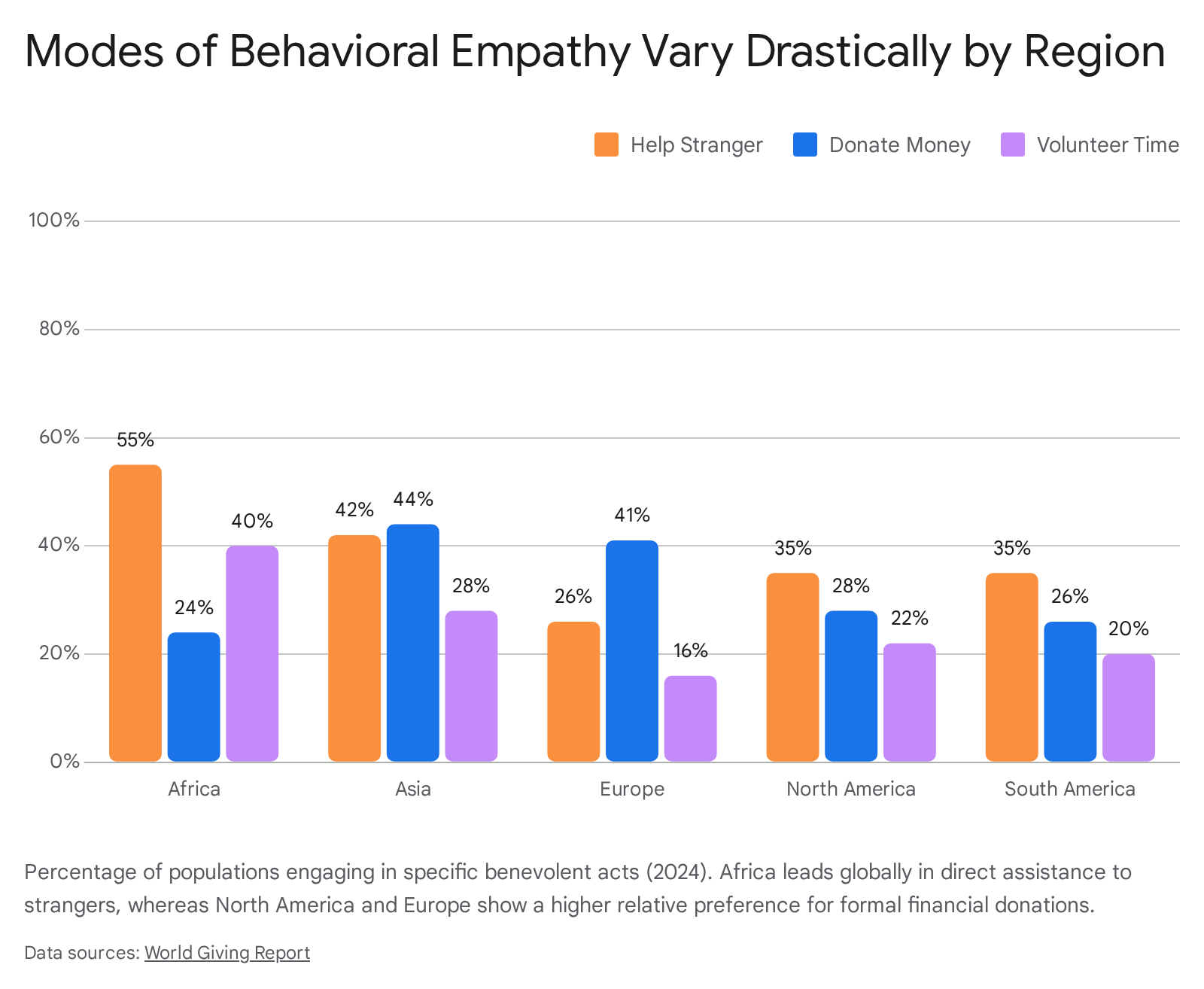
By 2024, as the immediate crisis faded, the frequency of these acts saw a mild global contraction. Globally, the act of helping strangers decreased from 61.4% in 2023 to 58.8% in 2024, donating fell from 34.6% to 31.7%, and volunteering declined from 24.2% to 22.9% 32. However, this normalization is not indicative of an empathy collapse. Even accounting for the 2024 dip, global benevolent acts remain more than 10% higher than their pre-pandemic (2017 - 2019) baselines 3236. In 2023, an astounding 73% of the global adult population (roughly 4.3 billion people) engaged in at least one form of prosocial behavior, maintaining historic highs of global generosity against a backdrop of severe economic inflation and geopolitical instability 35.
3.2 Divergent Modes of Generosity: Formal Philanthropy vs. Direct Action
The behavioral data underscores a sharp geographic divide in how empathy is operationalized and expressed globally.
In the Global North (Western Europe, North America, and Oceania), empathy is heavily institutionalized and mediated through organizations. Donating money to established charities is a dominant mode of benevolence 3241. In the United States, despite a concerning long-term sociological decline in the rate of individual households participating in formal charity (dropping below 50% for the first time in recent years) 3738, the absolute monetary value of donations reached a record $592.5 billion in 2024. This massive volume is driven heavily by philanthropic foundations, corporate giving, and wealthy individuals, indicating a professionalization of empathy 4144.
Conversely, in the Global South (Africa, Southeast Asia, and Latin America), where relational mobility is lower and community bonds are tighter, empathy manifests directly, informally, and intimately. In Sub-Saharan Africa and Latin America, donating to formal charities is the least common behavior 3236. Instead, direct interpersonal assistance is paramount. Africa currently ranks as the world's most generous continent in terms of the percentage of people participating in giving (72%) and the proportion of personal income donated (1.54%, compared to Europe's 0.64%) 73339. The vast majority of these resources are given directly to individuals in need or to local religious organizations, rather than international NGOs 7. Furthermore, Indonesia continues to rank as the number one most generous nation globally for the seventh consecutive year, heavily influenced by the deep-seated cultural practice of Gotong Royong (the joint bearing of burdens) and Islamic religious tithes (Zakat), demonstrating how profound empathy is embedded in daily civic duty rather than occasional philanthropic acts 3540.
4. The Pathologies of Modern Empathy: Fatigue and Parochialism
While the data decisively refutes the hypothesis of a wholesale disappearance of empathy, it strongly supports contemporary psychological theories of shifting and exhausted empathy. The modern polycrisis - characterized by the pandemic, persistent geopolitical conflicts, and systemic economic instability - has forced a cognitive and emotional rationing of compassion.
4.1 Empathy Fatigue in Healthcare and the General Population
"Empathy fatigue" (frequently used interchangeably with compassion fatigue or secondary traumatic stress) was traditionally studied almost exclusively within high-stress caregiving professions, such as nursing, emergency response, social work, and oncology. It is defined as the deep emotional, physical, and spiritual exhaustion resulting from chronic, unmitigated exposure to the trauma and suffering of others 414243. During the COVID-19 pandemic, healthcare workers experienced unprecedented levels of empathy fatigue. A 2024 cross-sectional survey of physicians in Southwest China found that a staggering 51.8% of doctors exhibited severe empathy fatigue, fundamentally driven by heavy workloads, lack of rest, and chronic exposure to patient distress, which severely impacted job satisfaction and led to high turnover intentions 4445.
Crucially, psychological studies indicate that empathy does not uniformly lead to burnout; it depends entirely on the type of empathy employed. Cognitive empathy (Perspective Taking) and healthy Empathic Concern are actually protective against burnout, correlating with higher personal accomplishment. It is high Personal Distress - the inability to separate one's own emotional arousal from the suffering of the other - that erodes emotional resilience and leads directly to depersonalization and emotional exhaustion 252.
However, sociological studies from 2021 to 2024 reveal that empathy fatigue has escaped the confines of healthcare and permeated the general population 4153. The constant, unavoidable barrage of distressing global news via 24/7 digital media cycles has severely depleted the public's emotional reserves 425455. Symptoms of societal empathy fatigue manifest as emotional numbness, political apathy, and a withdrawal from civic engagement, serving as a psychological defense mechanism against overwhelming feelings of helplessness in the face of continuous global trauma 4155.
4.2 Selective Compassion and Parochial Empathy
When empathy becomes a scarce cognitive resource due to fatigue, it is often deployed highly selectively, leading to the phenomenon of parochial empathy. Parochial empathy occurs when individuals exhibit intense, immediate empathic concern for their perceived in-group (defined by nationality, political affiliation, or socioeconomic class) while displaying profound apathy - or even schadenfreude (taking pleasure in misfortune) - toward an out-group 4657.
This narrowing of empathy is heavily influenced by systemic political polarization and perceived societal injustice. A vivid indicator of this shift in public sentiment occurred in late 2024 with the assassination of UnitedHealthcare CEO Brian Thompson, and the highly unusual public reaction to the suspect, Luigi Mangione. Rather than unified condemnation, large swaths of the American public expressed distinct apathy toward the victim and hailed the suspect as a folk hero 47. Social psychologists analyze this not as a total absence of empathy in the populace, but as a deliberate moral calculation regarding who deserves empathy. In a highly unequal society experiencing severe economic and healthcare stress, the public's limited empathy was directed intensely toward the perceived victims of the insurance system, effectively freezing out the executive who represented that system 5347. This dynamic confirms that empathy is increasingly tribalized, operating robustly within specific moral boundaries while shutting down almost completely across ideological or class divides.
5. Mechanisms and Drivers of Modern Empathy Shifts
To understand the volatile and cyclical trajectory of modern empathy, it is necessary to examine the primary environmental, psychological, and physiological drivers actively reshaping human cognition in the 2020s.
5.1 The Loneliness Epidemic and the "Perception Gap"
In 2023, the U.S. Surgeon General officially declared loneliness a public health crisis, equating its mortality risk to smoking 15 cigarettes a day 5960. Objectively, chronic social isolation triggers a physiological stress response (activating the hypothalamic-pituitary-adrenal axis), accelerates cognitive decline, and increases risks of severe depression, anxiety, and cardiovascular disease 596061.
However, the relationship between loneliness and empathy is highly paradoxical. Recent analyses of the Interpersonal Reactivity Index during the pandemic revealed that individuals scoring high in Empathic Concern and Fantasy actually experienced greater levels of vicarious stress and loneliness during lockdowns, as their dispositional need for connection was thwarted by physical isolation 48. Conversely, as Konrath's 2024 update highlights, the subjective experience of societal loneliness has driven the recent increase in youth empathy 1115. When young people experience isolation, it often triggers a prosocial motivation to reach out and mitigate the suffering of others.
A significant cognitive barrier to this connection is the "empathy perception gap." A massive 2025 study published in Nature Human Behavior involving over 5,000 Stanford University students found that while students are overwhelmingly willing to help others, they consistently underestimate the empathy of their peers 49. This false belief that "nobody else cares" fosters behavioral withdrawal and perpetuates the loneliness cycle. When researchers corrected this misperception through simple messaging interventions based on real data, students' willingness to take "social risks" - such as initiating conversations or helping strangers - increased by nearly 90% 49. This aligns with global findings from the World Happiness Report, which notes that people are universally too pessimistic about the kindness of their communities, and that expecting benevolence from others is a massive predictor of individual happiness 3234.
5.2 The Double-Edged Sword of the Digital Environment
Social media is frequently blamed as the primary culprit for the empathy deficit, and evidence confirms its detrimental effects on depth of processing. The architecture of modern digital platforms incentivizes outrage, shock, and superficial engagement, which reliably drowns out nuanced perspective-taking 5355. It creates environments ripe for "performative empathy," where users verbally express concern online to signal moral virtue without engaging in any tangible action or behavioral support in the real world 54.
Yet, the digital environment is also a primary driver of the post-2008 empathy rebound. The proliferation of smartphones and social media has exposed youth to diverse global perspectives, social justice movements, and human suffering at an unprecedented scale 1312. While this relentless exposure risks compassion fatigue, it has undeniably broadened the cognitive boundaries of young adults, forcing them to confront viewpoints outside their immediate physical geography and contributing to the documented rise in cognitive Perspective Taking over the last decade 1312.
5.3 Economic Stress, Cortisol, and the "Rich Protection Hypothesis"
Economic realities and class mobility fundamentally alter empathic processing. The "rich protection hypothesis" and related psychological models suggest that individuals from lower socioeconomic statuses (SES) consistently display higher levels of affective empathy than their wealthier counterparts 5051. Because lower-SES individuals have fewer financial resources to buffer against environmental shocks, they are highly dependent on community cooperation and prosocial networks for survival. Consequently, they develop heightened emotional vigilance and emotional contagion 50. Conversely, wealthy individuals, isolated by financial security, often exhibit higher egocentricity, attribute poverty to personal failings rather than systemic issues, and struggle with outward empathic orientation 51.
Furthermore, acute economic or psychosocial stress acts as a critical physiological modifier of empathy. A 2022 neuroendocrinological study utilizing the Trier Social Stress Test revealed that acute stress does not uniformly cause a "fight-or-flight" selfish response. Instead, stress amplifies a person's baseline traits. For individuals with high trait empathy, an elevation in stress-induced cortisol triggers a "tend-and-befriend" response, resulting in highly generous, prosocial behavior (e.g., allocating more money in a Dictator Game) 52. For those with low trait empathy, the exact same stressor triggers egocentric, selfish hoarding behavior 5253. This implies that in times of severe economic recession or global crisis, society polarizes: the naturally empathic become hyper-prosocial, while those lacking baseline empathy become radically individualized. Concurrently, functional magnetic resonance imaging (fMRI) studies show that while acute stress increases emotional reactivity in the brain's empathy network, it simultaneously deteriorates cognitive perspective-taking skills, forcing individuals to rely on instinctual emotion rather than complex understanding 53.
Conclusion
The exhaustive synthesis of psychological, sociological, and global behavioral data from 2020 to 2024 dismantles the simplistic, linear narrative that humanity is suffering from a terminal decline in empathy. Instead, the capacity for compassion is highly dynamic, continuously adapting to the extreme pressures of the 21st century.
Among Western youth, dispositional empathy has actually rebounded significantly since 2008, driven by a compensatory response to the loneliness epidemic and increased digital exposure to diverse global narratives. Globally, the reliance on Western psychometric tools has historically obscured the profound, behavior-driven empathy present in Latin America, Asia, and Africa - regions where community cohesion, emotion sharing, and direct, informal assistance to strangers remain robust and culturally central.
However, this resilience is under severe threat from empathy fatigue. The relentless pace of global crises, compounded by algorithmic polarization and extreme economic inequality, is forcing individuals to ration their emotional bandwidth. This rationing gives rise to parochial empathy, where intense in-group solidarity is mirrored by profound out-group apathy. Ultimately, the future of global empathy does not depend on reviving a lost psychological trait, but rather on recognizing its fluid nature and designing social, digital, and economic architectures that reduce chronic exhaustion, correct perception gaps, and transform latent empathic concern into sustainable, cross-boundary action.