
Global decline in reading and cognitive attention
Global reading behaviors are undergoing a profound structural transition. As digital media saturation increases across all demographics, the allocation of leisure time toward traditional print reading has steadily declined, accompanied by measurable shifts in cognitive processing, reading comprehension, and sustained attention. Longitudinal demographic data, time-use surveys, and recent neurocognitive meta-analyses indicate that the transition from print to digital formats fundamentally alters reading mechanics. This report synthesizes multi-regional data, cognitive science research, and neuroanatomical studies to examine the underlying mechanisms of the screen inferiority effect, the fragmentation of deep attention, and the broader implications for global literacy.
Foundational Literacy and Educational Disparities
Before analyzing leisure reading habits and format preferences, it is necessary to establish the baseline of global literacy. The transition from print to digital reading presumes a foundational ability to decode and comprehend text - a capacity that remains unevenly distributed worldwide.
Adult Illiteracy Demographics
Despite decades of educational advancement, significant disparities in foundational literacy persist. As of 2024, approximately 739 million adults globally lack basic literacy skills 12. The geographical distribution of this population is highly concentrated, with nearly 77% residing in sub-Saharan Africa (225 million) and Central and Southern Asia (347 million) 1. More than half of the world's illiterate adults - 441 million individuals - are concentrated in just ten countries 1.
Gender and age demographics reveal further structural inequalities. Women account for nearly two-thirds (466 million) of all illiterate adults, a proportion that has remained unchanged over recent decades 13. The disparities are particularly acute among older populations in developing regions. For instance, in several sub-Saharan African countries, the literacy rate for elderly women was estimated to be as low as 10% to 31% in 2022, contrasting sharply with near-universal male literacy rates (99%) in Europe and North America 13. In Brazil, despite national illiteracy dropping to 5.6% by 2022, regional and racial disparities remain prominent, with the Northeast region housing 55.3% of the nation's illiterate population, and illiteracy rates among black and brown populations remaining substantially higher than among white populations 4.
The Learning Poverty Crisis
Among younger populations, the expansion of basic education has pushed the global youth literacy rate (ages 15 to 24) to 93% 1. However, nominal literacy often does not equate to functional reading comprehension. Data from the World Bank indicates that 70% of children in low- and middle-income countries (LMICs) suffer from "learning poverty," meaning they cannot read and understand a simple, age-appropriate text by age ten 5.
A comprehensive study analyzing early grade reading assessments across over 500,000 students in 48 LMICs (spanning 96 languages) revealed that after three years of schooling, over 90% of students fail to identify letter names, letter sounds, or read simple words at expected levels 5. This foundational deficit severely limits the population capable of advancing to complex, long-form reading, regardless of the medium of consumption.
Time Allocation and the Decline of Leisure Reading
Among literate populations, the amount of time dedicated to reading varies significantly by region, age cohort, and educational background. Survey data indicates an overarching trend: while overall textual consumption (including social media and digital scanning) remains high, dedicated leisure reading of long-form text is contracting, largely displaced by screen-based entertainment.
Regional Variances in Reading Time
Self-reported time spent reading reveals significant geographic variations, though these figures often encompass a mix of print, digital, and academic reading. The following table summarizes reading frequency and habits across select regions based on recent survey data.
| Country/Region | Average Weekly Reading Time | Key Reading Demographics and Behaviors |
|---|---|---|
| United States | ~7 hours | The highest globally reported reading hours, equating to ~357 hours or 17 books per year. Print remains the dominant format (64% read a physical book in the past year vs 31% e-book) 67. |
| India | ~7 hours | Weekly reading rate is marginally behind the US. Youth readership is strong, with 83 million non-syllabus book readers, though massive urban/rural divides persist 67. |
| United Kingdom | ~6.5 hours | High average hours, yet a 2024 National Literacy Trust survey recorded the lowest level of youth reading enjoyment (34.6%) since 2005 68. |
| Indonesia | ~2.5 hours | Ranks 70th in PISA reading scores. Surveys show 88% youth interest in reading, but heavily skewed toward digital platforms like Fizzo and Wattpad rather than print 10119. |
| South Africa | Unavailable | 26% identify as "regular readers." High mobile reliance; few households own physical books. Reading is primarily for communication and information over leisure 1011. |
| Latin America | Unavailable | 57.9% of youth identify as readers, but primarily for school rather than leisure. 44% cite intensive internet use as the main obstacle to regular reading 12. |
These regional profiles highlight distinct reading ecosystems. In developing regions like South Africa and Indonesia, infrastructural limitations regarding physical book access drive readers toward mobile-first consumption 1010. Conversely, in established markets like Mexico, overall reading participation has declined to record lows (71.6% of literate adults read any material in 2021), yet the subset of the population that continues to read is consuming more books on average (3.7 per year) 13.
Generational Shifts in the United States
Longitudinal data from the United States Bureau of Labor Statistics' American Time Use Survey (ATUS) provides precise measures of how reading habits are changing across generations. The data highlights a severe divergence in daily leisure time allocation.
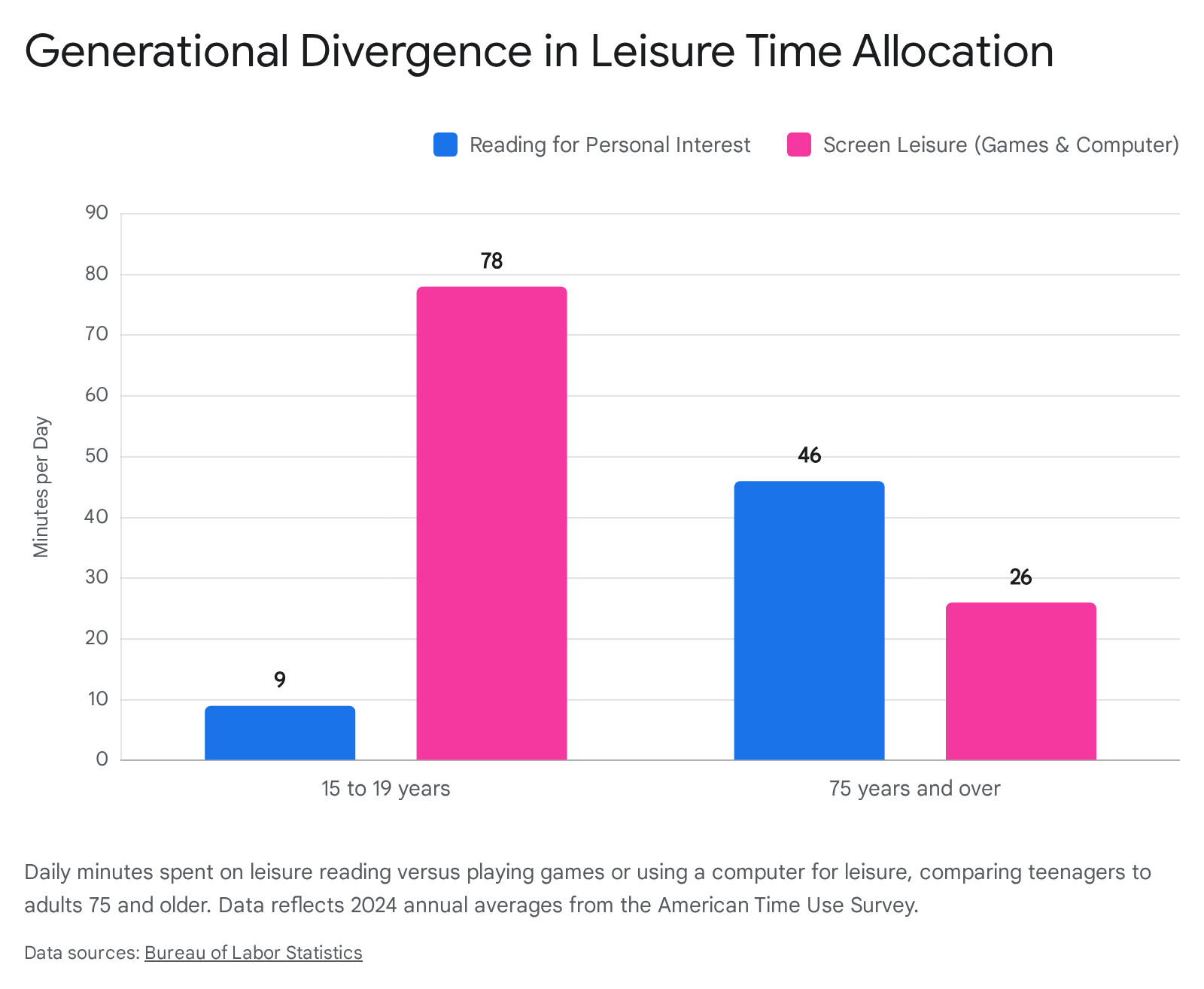
In 2024, the average American teenager (ages 15 to 19) spent just 9 minutes per day reading for personal interest 14. In stark contrast, adults aged 75 and over spent 46 minutes per day reading 14. This disparity is part of a broader historical decline. In 2004, the average daily reading time for the general US population was 23 minutes; by 2019, it had fallen to 16 minutes 15.
The ATUS data also illustrates a clear correlation between educational attainment and reading frequency. College graduates are substantially more likely to engage in reading, reading for an average of 50 minutes per session compared to 35 minutes for those without a college degree 1315. However, the percentage of intensive readers (those reading more than 20 minutes a day) has dropped across all educational levels over the past two decades, falling from 22.3% of the population in 2003 to 14.6% in 2023 16.
Screen Time Substitution Trends
The decline in reading minutes is directly mirrored by the explosion in digital screen time. Global internet users currently average approximately 6 hours and 40 minutes to 6 hours and 58 minutes of screen time per day, representing an increase of nearly 50 minutes per day since 2013 172122. Among Generation Z, daily screen time averages reach approximately 9 hours 2122.
The ATUS 2024 data explicitly captures this substitution effect: while teenagers read for only 9 minutes a day, they spent 1.3 hours (78 minutes) playing games or using a computer strictly for leisure, excluding academic screen time or general television watching 14. This shift accelerated significantly during the COVID-19 pandemic, during which total and leisure screen time increased across all age groups, with primary-aged children (6 - 10 years) reporting the largest increases in usage 18.
This substitution is increasingly prevalent among developing readers. In the United Kingdom, analysis of 76,000 children and young people in 2024 showed that only 20.5% of 8- to 18-year-olds read daily in their free time, marking the lowest level recorded since measurement began in 2005 8. The steepest drop occurred among secondary school pupils, indicating that as children enter adolescence and acquire personal digital devices, long-form leisure reading collapses 8.
The Cognitive Science of Reading Modalities
As reading shifts from printed pages to digital screens, an extensive body of educational and cognitive psychology research has sought to determine whether the medium alters the message. A strong scientific consensus has emerged identifying a persistent "screen inferiority effect."
Empirical Evidence of Screen Inferiority
Meta-analyses covering decades of research indicate that reading comprehension, information retention, and deep processing are significantly weaker when text is consumed on digital devices compared to paper 71925.
A comprehensive 2024 meta-analysis encompassing 49 studies and over 161,000 participants compared reading comprehension across print and digital handheld formats (tablets and e-readers). The findings revealed a statistically significant negative effect for digital handheld reading (Hedges' g = -0.113 for between-participant designs and -0.103 for within-participant designs) 20.
Similarly, a 2023 meta-analysis of 25 correlational studies involving nearly 470,000 participants across three dozen countries examined the relationship between leisure digital reading habits and text comprehension. The study found that while frequent print reading heavily correlates with higher comprehension, the association for leisure digital reading is nearly zero (r = -0.06) 202128. Extrapolating from these findings, researchers estimate that for developing readers, the cognitive payoff of spending 10 hours reading print books is six to eight times greater than spending the same 10 hours reading on a digital device 202822.
Mechanisms of Digital Comprehension Deficits
The discrepancy between print and digital comprehension is not a result of textual differences, but is instead driven by several interacting cognitive and neurobiological mechanisms. The physical interaction with a medium fundamentally dictates the mental framing applied to it.
First, physical books possess a fixed topography that facilitates stable spatial memory. Readers unconsciously use tactile and spatial cues - such as the thickness of the pages read versus unread, or the physical location of a paragraph on a left or right page - to construct a "mental map" of the narrative or argument 1925. Digital texts, particularly when scrolling is required, lack these stable spatial anchors. The shifting layout prevents the brain from sequencing and recalling information efficiently, leading to inferior retention 2523.
Second, digital devices introduce severe cognitive overload. Tablets and smartphones serve multiple functions, inherently exposing the reader to notifications, hyperlinks, and the temptation to multitask 2528. The mere potential for multi-tasking fragments attention and burdens working memory, disrupting the deep immersion required to construct complex mental models of the text 25.
Third, eye-tracking research reveals that readers approach digital screens with a conditioned habit of shallow processing. Because screens are frequently used for fast-paced social media and skimming news, readers apply the same superficial scanning habits to long-form digital texts. Digital readers tend to read faster, skip details, and display an unwarranted overconfidence in their comprehension levels, whereas print readers read more carefully and frequently re-read complex passages 192522.
Educational Stage Moderation
The severity of the screen inferiority effect is highly dependent on the reader's developmental stage. Meta-analytic data demonstrates that the negative impact of digital reading is most pronounced in primary and middle school students 2022. Developing readers lack the sophisticated executive function and self-regulation required to navigate digital distractions 22.
Conversely, the relationship turns slightly positive for high school and university students 202122. Older, proficient readers have fully automated their decoding skills and possess greater cognitive control, allowing them to leverage the accessibility, searchability, and sheer volume of digital texts without suffering the same catastrophic drops in comprehension 2022.
Comparative Analysis of Audio and Print Formats
As the audiobook market expands rapidly - with 26% of US adults reporting having listened to an audiobook in 2025 7 - researchers have evaluated auditory comprehension against visual print comprehension.
Auditory Processing and Comprehension Parity
A review of 32 studies involving over 2,300 school-aged participants between 1970 and 2020 found that for early learners, listening comprehension actually outperforms reading comprehension up to approximately age 13 or 14 2432. For adults, functional MRI (fMRI) studies reveal that the semantic representations and brain activation patterns evoked by listening to a narrative versus reading it are nearly identical in both the cognitive and emotional centers of the cortex 2425.
When tested on narrative fiction and general knowledge retention, adults receive nearly identical scores regardless of whether the passage was read or listened to, suggesting that once basic decoding is bypassed, the brain utilizes the same underlying language processing mechanisms 25.
Limitations of Audio for Academic Texts
However, format efficacy is heavily dependent on text type, complexity, and reader intent. While audiobooks are highly effective for narrative fiction and assist students with reading difficulties, they present distinct challenges for dense informational texts or academic studying.
Self-reported data and behavioral tracking indicate that mind wandering is significantly more common when listening to audiobooks compared to reading physical print 26. Print allows readers to visually backtrack, re-read complex sentences, and pause to reflect - actions that require active physical intervention (rewinding) during auditory consumption. Consequently, when time is constrained or the material requires heavy inferential reasoning, print readers consistently outperform auditory learners 3527.
Neurobiological Impacts of Digital Substitution
The decline in long-form reading is not merely a shift in leisure preferences; it coincides with measurable neuroanatomical and functional changes resulting from heavy digital media consumption.
Dopaminergic Reward Systems and Attention Fragmentation
The rapid expansion of short-form video platforms (e.g., TikTok, YouTube Shorts) directly competes for the leisure time formerly occupied by reading. A 2025 narrative review of the neurobiological impact of short-form video addiction reveals profound alterations in user attention spans 28.
Short-form digital media provides rapid, repetitive bursts of rewarding stimuli that exploit the brain's mesolimbic dopamine pathway, paralleling substance addiction mechanisms 28. This hyper-stimulation conditions the brain to expect constant novelty and immediate gratification. Over time, heavy users demonstrate altered neuroanatomy, including abnormal white matter linked to behavioral control and enlargement of the orbitofrontal cortex (OFC), a region associated with reward processing 28.
Functionally, heavy users exhibit reduced midfrontal theta power on EEGs, a marker of diminished prefrontal executive function 28. The resulting "TikTok brain" phenomenon is characterized by high impulsivity, a preference for novelty, low tolerance for delayed gratification, and a measurable deficit in the capacity to sustain attention on slow-paced, non-interactive tasks - such as reading a printed book 28.
The Degradation of Cognitive Endurance
Deep reading requires "cognitive endurance" - the ability to sustain focus and perform cognitively demanding tasks over an extended duration. As digital fragmentation reduces the daily practice of sustained focus, overall cognitive endurance weakens.
A large-scale field experiment involving over 1,600 primary school students in India demonstrated that cognitive endurance is highly malleable and operates much like physical stamina 29. Researchers found that subjecting students to additional periods of sustained cognitive practice (via academic tasks or non-academic puzzles) reduced their performance decline in the latter half of demanding tests by 22% 29. These gains persisted for months after the intervention 29.
Because reading a physical book inherently demands sustained, linear concentration without algorithmic interruptions, it acts as a primary vehicle for building and maintaining cognitive endurance. The global decline in deep reading hours thus represents a widespread reduction in the daily "cognitive practice" necessary to maintain robust executive function and academic stamina.
Future Implications for Education and Policy
The data presents a complex paradigm for educators, policymakers, and public health officials. Digital digitalization has democratized access to information; mobile platforms are vital in regions where physical book distribution is nonexistent, and digital tools offer essential accessibility features for marginalized learners 1020.
Policy Reversals in European Education
However, the empirical evidence is clear that screen-based reading impairs deep comprehension and information retention, particularly for the young 20. In response, several European educational systems are actively reversing digital-first policies. The Swedish government recently announced plans to halt digital learning for students aged six and under, pivoting back to printed textbooks to ensure foundational literacy 19. Similarly, the Netherlands has moved to ban non-essential mobile phones and electronic devices from classrooms to minimize cognitive distraction 19.
Developing Digital Literacy Strategies
Moving forward, addressing the decline of deep reading requires a bifurcated approach. For early childhood and primary education, the rigorous protection of print reading is essential to develop spatial memory, comprehension skills, and cognitive endurance. For older adolescents and adults, who have already established neurological decoding pathways, the focus must shift to teaching digital literacy. This includes explicitly training readers to consciously combat the skimming mindset, manage cognitive load, and apply deep-reading strategies - such as active annotation and structured backtracking - to screen-based environments 3530.
While digital formats will inevitably dominate the distribution of information, preserving the cognitive capacity for deep, sustained attention remains fundamentally tethered to the practices established by traditional print reading.