Global comparison of wellbeing and social progress
The measurement of human flourishing has historically been dominated by Western-centric, economically driven paradigms. For decades, the global community has relied upon Gross Domestic Product (GDP) and related macroeconomic aggregates as the de facto proxies for societal progress and human wellbeing. However, the multifaceted crises of the 21st century - ranging from global pandemics and ecological degradation to rising income inequality and widespread mental health epidemics - have exposed the profound limitations of measuring a good life solely through the lens of economic output and material accumulation. As a result, a critical paradigm shift is currently underway within the disciplines of sociology, psychology, and development economics. Researchers and policymakers are increasingly questioning not only the hegemony of GDP but also the methodological assumptions underpinning prominent subjective wellbeing metrics, such as the Cantril Ladder utilized by the World Happiness Report (WHR).
This comprehensive research report evaluates the post-pandemic state of global wellbeing, prioritizing recent data from 2023 to 2026. It explicitly addresses the methodological limitations and cultural biases of dominant Western measurement instruments, systematically dismantles the misconception that absolute economic wealth is the universal primary driver of the good life, and elevates alternative, culturally diverse frameworks originating from the Global South. By exploring paradigms such as Bhutan's Gross National Happiness (GNH) index, Latin America's indigenous concept of Buen Vivir, and the rigorously non-economic Social Progress Index (SPI), this analysis illustrates how culturally sensitive, multidimensional metrics offer a vastly more accurate, actionable, and equitable understanding of global life satisfaction.
The Misconception of Absolute Economic Wealth as the Sole Driver of Wellbeing
For nearly a century, GDP per capita has served as the paramount indicator of national success and international development. Yet, development economists and social scientists increasingly stress that GDP was never designed or intended to function as a holistic measure of human wellbeing or social progress 12. Developed primarily to fill significant information gaps regarding the state of the economy during the Great Depression, GDP merely aggregates the financial value of marketed economic activity within a given timeframe 23.
The Structural Failures of GDP as a Progress Metric
The contemporary academic critique of GDP centers on its inherent blindness to non-market contributions and its perverse treatment of negative externalities. GDP is entirely mute regarding the distribution of wealth and income, effectively ignoring the rising socioeconomic inequalities that continually fracture social cohesion 4. Furthermore, it fails to account for unpaid domestic and caregiving labor - activities that are foundational to societal survival, community health, and human development 1. It also inherently treats the depletion of natural capital as immediate income rather than an irreversible loss of intergenerational assets 13. By measuring only marketed economic activity, nominal GDP ignores changes in the natural, social, and human components of community capital on which populations rely for continued existence 35.
A comprehensive 2023 review commissioned by Carnegie UK highlighted that an increase in GDP is neither necessary nor sufficient to indicate whether a nation is fundamentally improving its citizens' quality of life 3. The relentless pursuit of nominal and real GDP growth has frequently occurred to the detriment of democratic, social, and environmental priorities 13. Because GDP merely measures the volume of financial transactions, activities that actively harm long-term community wellbeing - such as post-disaster reconstruction, the continuous treatment of preventable chronic diseases, or the massive expansion of the penal system - perversely contribute to GDP growth 3. Furthermore, traditional economic paradigms relying on cost-benefit analyses based on "willingness to pay" are fundamentally flawed in an unequal world, as a population's willingness to pay often differs vastly from its actual capacity to pay 4.
The Emergence of the Wellbeing Economy and "Beyond GDP" Metrics
In response to these deep structural limitations, there is a burgeoning drive among national governments, the United Nations (UN), and global coalitions like the Wellbeing Economy Alliance (WEAll) to operationalize alternative measures 6. The concept of a "Wellbeing Economy" formally shifts the ultimate objective of public policy from ever-increasing economic growth to the promotion of human wellbeing, inclusive equity, and ecological balance 4. This shift is rapidly moving from academic theory to practical governance. For instance, New Zealand's 2019 Well-being Budget officially prioritized holistic living standards - spanning economic, social, human, and natural capital - over limited economic metrics 4. Similarly, Wales instituted the Well-being of Future Generations Act, placing a legal duty on public entities to consider the long-term impact of their decisions on social and cultural health, and Australia recently released a national wellbeing framework utilizing 50 distinct economic, social, and environmental indicators 24.
Comprehensive alternative macroeconomic indicators, such as the Genuine Progress Indicator (GPI), have demonstrated robust methodological coverage by directly accounting for market-based welfare, services from essential capital, and various environmental and social costs 6. A comprehensive 2024 analysis by Jansen et al., which reviewed 65 "beyond GDP" metrics, found that indices explicitly linking wellbeing, inclusion, and sustainability are far more predictive of actual life satisfaction than raw economic output 6. The GPI emerged as one of the few indices that successfully addresses the core triad of environmental sustainability, diverse aspects of wellbeing, and social inclusion 6.
Empirical evidence from the Global South continuously challenges the primacy of income as the singular arbiter of happiness. Several Latin American countries consistently outperform expectations based on their GDP per capita 7. For example, residents of Costa Rica and Mexico report life satisfaction levels equal to or higher than those in the United States, despite possessing a fraction of the absolute economic wealth 78. This phenomenon highlights that societies can effectively "buy" wellbeing more efficiently when strong social networks, cultural capital, and community trust are prioritized over sheer material accumulation 7.
Methodological Limitations and Cultural Biases of the Cantril Ladder
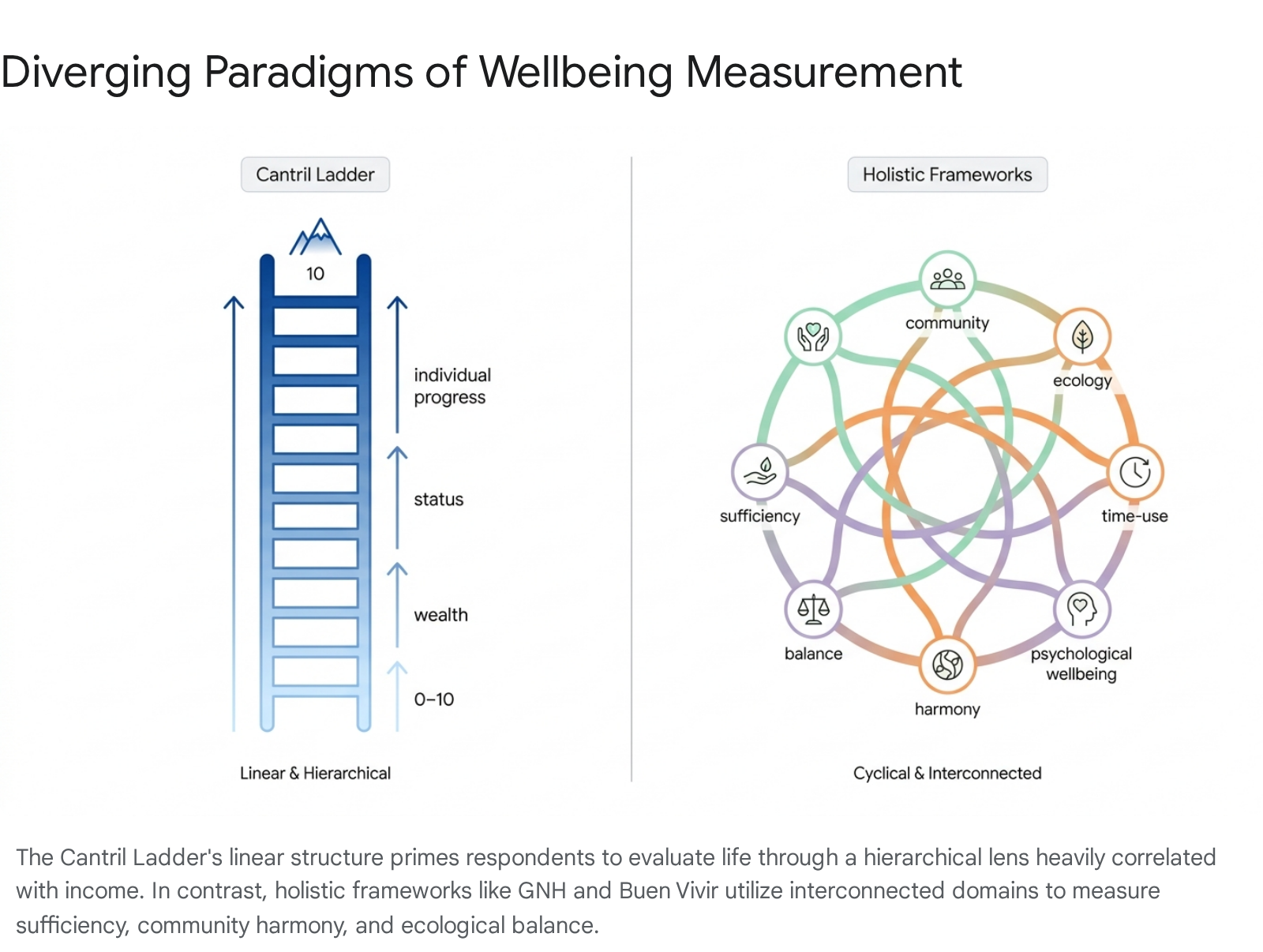
While the institutional shift away from GDP has led to the proliferation of subjective wellbeing metrics, the psychological instruments used to capture these subjective states are not immune to profound cultural and methodological biases. The most prominent of these instruments is the Cantril Ladder, which asks respondents to evaluate their current lives on a hypothetical ladder with steps numbered from 0 (representing the worst possible life) to 10 (representing the best possible life) 578. This single-item metric forms the primary basis for the annual country rankings published in the World Happiness Report (WHR), drawing on data from the Gallup World Poll across more than 140 nations 5912.
The Socioeconomic Framing of the Ladder
Despite its widespread global adoption, recent sociological and psychological research has exposed significant limitations in how different cultural populations cognitively interpret the Cantril Ladder. Crucially, the Cantril Ladder has been heavily criticized for capturing a narrow, Western-centric view of wellbeing that over-indexes on absolute wealth, social status, and hierarchical achievement 7. At the individual level, Cantril Ladder scores correlate far more strongly with personal income and one's relative position in the income distribution than with emotional wellbeing or daily affective states 57.
A pivotal 2024 language analysis study by Nilsson et al., employing dictionary, topic, and word embedding techniques, explored how respondents cognitively interpret the Cantril Ladder 510. The researchers analyzed word responses from 1,581 UK adults and found that the very framing of the ladder imagery, combined with the anchors of "worst" to "best" possible life, disproportionately emphasizes concepts of power, wealth, and material success over broader constructs of wellbeing, relational harmony, or mental peace 510. When the researchers altered the framings and removed the ladder imagery, preferred scale levels increased significantly 5. Furthermore, when the study introduced "harmony" as an alternative anchor for the highest score, it yielded the strongest divergence from the standard Cantril responses, significantly reducing the cognitive retrieval of power and wealth topics (Cohen's d = -0.76) 5. The linear, upward-striving metaphor of a ladder inherently aligns with capitalist, Western cultural ideals of individualistic progress and social mobility. This metaphor may not resonate with, or accurately capture the lived experience of, wellbeing in cultures that prioritize cyclicality, community equilibrium, and egalitarianism.
Divergence from Overall Life Satisfaction and Predictive Validity
The limitations of the Cantril Ladder become even more pronounced when measuring the wellbeing of diverse demographic groups, particularly adolescents. Research published in 2024 by Marquez et al. analyzing single-item indicators of adolescent wellbeing across 6,445 students in 24 countries found that while the Cantril Ladder (CL) and Overall Life Satisfaction (OLS) questions are often used interchangeably, they capture distinctly different constructs 1112.
The OLS format typically asks respondents to rate their satisfaction with life as a whole, rather than asking them to rank their position against a hypothetical "best possible" maximum. Comparative confirmatory factor analysis revealed that OLS showed stronger predictive validity than the Cantril Ladder across measures of emotional affect and eudaimonic wellbeing (which relates to meaning, purpose, and self-realization) 1112. Furthermore, the Cantril Ladder demonstrated a much stronger convergence with "subjective social status" than with actual emotional contentment, and it displayed substantially lower strength and betweenness centrality than OLS, indicating fewer and weaker meaningful links to multiple aspects of daily wellbeing 511.
Aggregated at the national level, the Cantril Ladder groups tightly with a socioeconomic progress factor rather than a pure wellbeing factor 5. Consequently, wealthier nations - particularly the Nordic countries - consistently rank at the very top of the WHR 7. However, an extensive analysis of Gallup World Poll data (over 2.5 million participants across 158 countries) sought to isolate the components of wellbeing that are not strictly tied to wealth. When researchers residualized the data to control for the variance explained strictly by national income - deriving what they termed "the life evaluation money cannot buy" - the Nordic countries dropped significantly to a mean rank of 35, and Central American countries rose to the absolute top of the global rankings 7. This suggests that the Cantril Ladder functions heavily as a proxy for economic security and state infrastructure rather than an unadulterated measure of human joy, community vitality, or psychological health.
Post-Pandemic Shifts in Global Life Satisfaction: The Youth Wellbeing Crisis
The global landscape of life satisfaction has undergone profound and uneven shifts in the wake of the COVID-19 pandemic. While early academic narratives often focused on broad national averages, recent data sets disaggregated by age, generation, and region reveal a complex, deeply fractured picture of global mental health and subjective wellbeing. For the first time, global surveys are reflecting a distinct divergence in how the old and the young experience life satisfaction.
The Inversion of the Age-Happiness Curve in the West
Historically, wellbeing literature in the West suggested a "U-shape" in happiness across the lifespan: young people were generally considered the happiest cohort, with life satisfaction declining through middle age before experiencing a substantial recovery in later years 8. However, comprehensive data from the 2024 World Happiness Report indicates that this received wisdom has collapsed completely in high-income Western nations 8.
Since the 2006 - 2010 baseline, happiness among the young (aged 15 - 24) has fallen sharply in North America, Western Europe, Australia, and New Zealand 8913. In the United States, the decline in youth happiness has been so severe that it drove the country entirely out of the top 20 happiest nations for the first time since the WHR's inception in 2012, plummeting to 23rd place globally 141516. Germany similarly fell out of the top 20, dropping to 24th 20. Today, the young in North America report significantly lower life satisfaction than the elderly, representing a complete inversion of historical trends 814.
The drivers of this generational decline are multi-causal but are heavily linked to the modern digital environment and shifting social fabrics. The WHR and independent psychological research highlight the role of social media in fundamentally altering social connection, trust, and shared developmental experiences 9. In numerous countries surveyed, adolescents who consume social media for more than seven hours a day report vastly lower wellbeing compared to those who engage with it for less than one hour 9. Concurrently, Sapien Labs' Mental State of the World 2024 Report - drawing from comprehensive profiles of over 1 million internet-enabled participants across 82 countries - identifies smartphone use, profound social disconnection, consumption of ultra-processed foods, and environmental factors as primary contributors to the diminishing cognitive and emotional health of younger populations 1718. The report notes a severe deterioration in the ability to control and regulate emotions, leading to high rates of functionally debilitating distress: 41% of 18- to 34-year-olds in advanced economies now experience debilitating psychological struggles, scoring an average of just 38 on the Mind Health Quotient (MHQ) scale, compared to a globally stable score of 101 for older adults (55+) 171819.
Resilience and Rebound in the Global South and Eastern Europe
Conversely, trends outside the Anglosphere and Western Europe present a remarkably different narrative of recovery and resilience. In Central and Eastern Europe, happiness at every age has risen sharply, actively narrowing the historical wellbeing gap with Western Europe; youth in these transitioning regions are now equally as happy as their Western counterparts 814. Countries such as Serbia, Bulgaria, and Latvia have recorded some of the most substantial long-term increases in global life evaluation scores, climbing 69, 63, and 44 places respectively since 2013 1416. Lithuania has notably emerged as the absolute top-ranked country globally for life satisfaction among children and young people under 30 16.
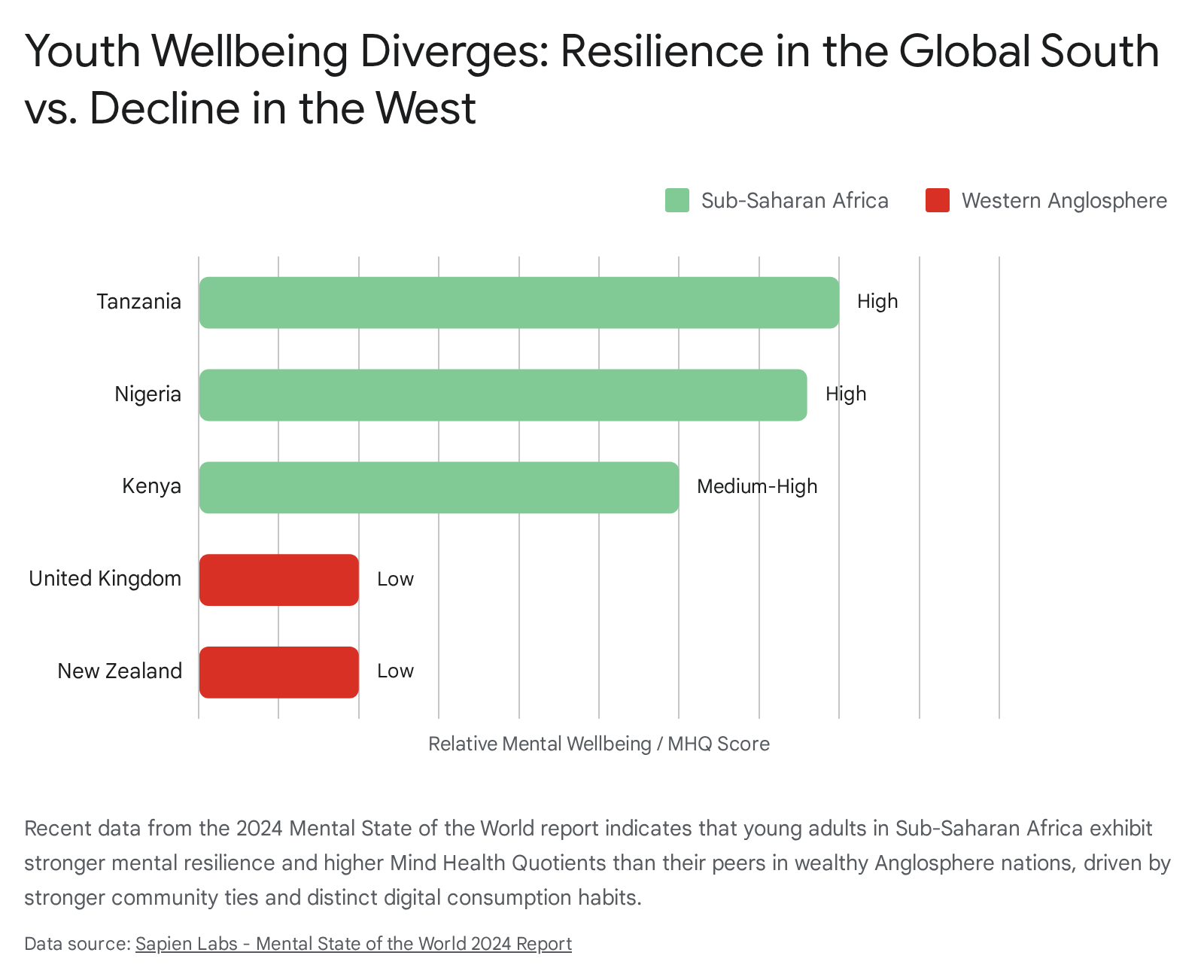
Perhaps most striking are the findings from the Global South regarding youth mental resilience. While Western youth struggle immensely, the Sapien Labs 2024 report reveals that young adults in Sub-Saharan Africa exhibit significantly stronger mental resilience compared to their peers in high-income nations 1819. Tanzania ranks highest globally in youth mental wellbeing on the MHQ, with younger adults in Nigeria and Kenya also scoring vastly higher than the youth in the United Kingdom, the United States, and New Zealand 18.
The relative protection of youth mental wellbeing in these African nations is attributed by researchers to stronger community and family ties, later exposure to smartphones during critical developmental windows, and a much higher prevalence of face-to-face social interactions 18. Furthermore, a flourishing index developed independently by scientific researchers found that populations in African nations frequently score exceptionally high in dimensions of meaning, character, and social relationships despite widespread and severe economic hardship 24. Nations like Nigeria rank among the top 5 globally in flourishing scores when financial indicators are excluded, demonstrating vast cultural strengths in social cohesion, forgiveness, and mutual aid that Western metrics often fail to capture 24.
Globally, there are also highly optimistic indicators regarding experiential wellbeing. The Gallup Global Emotions 2024 report - based on nearly 146,000 interviews in 142 countries - highlighted that worldwide positive emotions (such as laughing, smiling, feeling respected, and learning something new) have rebounded to their highest levels since 2020 20. Concurrently, negative emotions declined globally for the first time since 2014 2021. Southeast Asian countries play a significant role in this positive trend. Indonesia, Malaysia, the Philippines, and Thailand recorded some of the highest positive experiences globally; nine in ten adults in Indonesia reported smiling or laughing a lot the day prior to the survey, and Vietnam led the world in feelings of being well-rested 21.
Alternative and Culturally Diverse Frameworks for Wellbeing
Recognizing the deep conceptual traps of the Cantril Ladder and the structural blindness of GDP, a variety of multidimensional, culturally attuned frameworks have been developed to measure progress. These metrics bypass pure economic proxies to directly assess the lived realities, environmental sustainability, and holistic harmony of populations, establishing sophisticated methodologies for beyond-GDP accounting.
Bhutan's Gross National Happiness (GNH)
Perhaps the most famous and institutionally integrated departure from GDP is Bhutan's Gross National Happiness (GNH) framework, a term coined in the 1970s by His Majesty the Fourth King of Bhutan, Jigme Singye Wangchuck 2223. The GNH paradigm operates on the foundational principle that sustainable development requires an equal level of importance to be placed on the non-economic aspects of wellbeing and happiness.
Methodologically, the GNH Index is not a vague philosophical concept but a highly robust, multidimensional econometric tool constructed using the Alkire-Foster method, a widely respected technique co-created by researchers at the Oxford Poverty and Human Development Initiative for assessing complex, multidimensional phenomena 292425. The GNH Index actively eschews a single sliding scale in favor of 33 specifically weighted indicators categorized across nine constituent domains. These domains are: Psychological Wellbeing, Health, Education, Time Use, Cultural Diversity and Resilience, Good Governance, Community Vitality, Ecological Diversity and Resilience, and Living Standards 2225.
This framework operationalizes culturally specific definitions of a "good life" by unpacking 124 distinct variables underlying the 33 indicators 26. For instance, the "Psychological Wellbeing" domain measures not just the frequency of positive and negative emotions, but also the depth of spirituality and the prevalence of meditation; "Time Use" critically examines the balance between billable work, non-billable community work, leisure, and adequate sleep; and "Community Vitality" measures relationships of trust, family bonds, charity work, and safety 2627. "Cultural Diversity" evaluates the practice of Driglam Namzha (Bhutanese etiquette) and native languages 24.
The GNH Index measures whether individuals have attained a specific "sufficiency threshold" across these 33 indicators 2327. People who achieve sufficiency in at least 77% of the weighted indicators are categorized as "deeply happy," while those meeting 66% to 76.9% are "extensively happy" 24. Those who meet less than 66% are considered "not-yet-happy," a framing that directs policy toward fulfilling their unmet needs 23. Despite the severe economic shocks of the COVID-19 pandemic, Bhutan's 2022 national survey revealed an increase in the overall GNH Index to 0.781 (up from 0.743 in 2010 and 0.756 in 2015) 2324. This growth was driven by tangible improvements in housing, services, and positive emotions 24. The index serves not merely as a descriptive dashboard but as an active governance tool; policy planning, project clearances by the GNH Commission, and national resource allocations in Bhutan are explicitly aligned with increasing sufficiency across these nine domains 292526.
Latin America's Buen Vivir
In Latin America, the indigenous concept of Buen Vivir (Living Well) has emerged as a radical, de-colonial counter-narrative to Eurocentric models of development 28. While traditional Western metrics prioritize individualistic utility maximization, endless economic growth, and upward mobility, Buen Vivir posits that human wellbeing is fundamentally impossible outside of a balanced, reciprocal relationship with the local community and the natural environment 2835. It is rooted in indigenous epistemologies that view humans as a component of nature, rather than its master.
Buen Vivir has transitioned over the past two decades from grassroots indigenous social movements into formal institutional frameworks, particularly within the constitutional revisions of Ecuador and Bolivia 28. Measuring Buen Vivir quantitatively presents immense complexities due to its holistic, qualitative nature, but recent empirical efforts by economists have successfully constructed measurable indicators. For instance, the Buen Vivir Indicator (BVI) developed by Mero-Figueroa et al. (2020) for Ecuador synthesizes variables such as individual happiness, life satisfaction, trust in government, community satisfaction, security, physical housing characteristics, and, crucially, environmental concern 3536.
Methodologically, the BVI assigns the highest statistical weighting to environmental concern and community sub-indicators, reflecting the philosophical core of Buen Vivir - that respectful coexistence with nature and society are the fundamental prerequisites for individual wellbeing 36. Empirical data analyzing the Ecuadorian population from 2014 to 2016 yielded a national indicator of 68 out of 100 36. This demonstrates that traditional indigenous and rural paradigms of living can produce robust levels of holistic wellbeing and high life satisfaction irrespective of maximal economic output 3536.
The Global Social Progress Index (SPI)
For a globally comparative yet rigorously non-economic assessment of human flourishing, the Social Progress Index (SPI) provides a critical alternative to GDP. Created by the Social Progress Imperative, the SPI explicitly and intentionally excludes all indicators of economic performance (such as GDP, income levels, or wealth accumulation) in order to cleanly disentangle the measurement of actual social outcomes from economic inputs 372930.
The SPI assesses 57 meticulously curated outcome-based indicators across three fundamental dimensions: Basic Human Needs (encompassing nutrition, medical care, water, sanitation, shelter, and personal safety), Foundations of Wellbeing (access to basic knowledge, access to information and communications, health, and environmental quality), and Opportunity (personal rights, personal freedom and choice, inclusiveness, and access to advanced education) 293132. The 2024 iteration of this index evaluates data from 2011 to 2023, covering over 170 countries and representing more than 99.85% of the global population 3033.
The 2024 SPI findings underscore the peril of relying on GDP as a proxy for social health. The aggregate data reveals that the world has recently fallen into its first-ever "social progress recession" 30. In total, 61 countries saw a significant decline in social progress in 2023, driven primarily by deteriorations in health outcomes, a contraction in rights and voice, and declining press freedoms 30. Even high-income G7 nations have seen progress stall or decline; the United Kingdom, for example, has seen its rank drop across all 12 SPI components since 2011, suffering particularly steep losses in Rights & Voice and Inclusive Society 30.
However, because the SPI successfully separates social outcomes from wealth, it is particularly adept at highlighting over-performance in the Global South. The index demonstrates that targeted, outcome-based interventions in basic human needs often yield higher relative scores in lower-income contexts 37. By shifting the focus from input (how much money is spent) to outcome (are citizens actually safe and healthy), the SPI offers a granular roadmap for policy prioritization that transcends traditional economic dogma.
Comparative Analysis of Global Wellbeing Indices
To synthesize the diverse approaches to measuring human flourishing, the following table compares the core dimensions, philosophical underpinnings, and methodological mechanisms of four distinct global indices.
| Feature / Index | World Happiness Report (WHR) / Cantril Ladder | Bhutan's Gross National Happiness (GNH) Index | Social Progress Index (SPI) | Buen Vivir Indicator (Ecuador / Latin America) |
|---|---|---|---|---|
| Core Philosophy | Individual subjective evaluation of one's current life relative to a hypothetical "best possible" life. | Holistic, multidimensional sufficiency across spiritual, material, and communal domains to achieve balance. | Achievement of direct, verifiable social and environmental outcomes, assessed independently of economic proxies. | Harmonious coexistence and reciprocity between the individual, the community, and the natural environment. |
| Primary Dimensions / Variables | Single variable: 0-10 Cantril Ladder scale. (Researchers then correlate this against 6 factors: GDP, social support, life expectancy, freedom, generosity, corruption) 43. | 9 Domains (Psychological wellbeing, time use, community vitality, ecological diversity, health, education, culture, governance, living standards) utilizing 33 indicators 2526. | 3 Dimensions: Basic Human Needs, Foundations of Wellbeing, Opportunity (Aggregating 57 specific outcome indicators) 3044. | Synthesizes environmental concern, community trust, security, housing characteristics, and individual happiness 35. |
| Weighting & Aggregation | National average of single-item individual responses derived from the Gallup World Poll 43. | Alkire-Foster method; 33 indicators are equally weighted across the 9 domains to assess individual "sufficiency" thresholds (cutoff at 66%) 222926. | Principal Component Analysis; Tiered scoring of 57 social and environmental indicators converted into a 0-100 scale 30. | Data-driven weighting approaches, with the maximum mathematical weight intentionally assigned to environmental and community factors 36. |
| Strengths | Global coverage (>140 countries); easy to administer; allows for massive longitudinal and cross-sectional age/gender comparisons 58. | Highly actionable for policy and budget allocation; culturally resonant; elegantly balances objective conditions with subjective states and time allocation 2627. | Rigorously disentangles social progress from GDP, allowing for the clear identification of nations that "punch above their economic weight" 30. | De-centers Eurocentric individualism; explicitly integrates ecological health as a non-negotiable, intrinsic component of human wellbeing 28. |
| Methodological Limitations & Biases | Heavily biased toward individualistic wealth, power, and status; the "ladder" metaphor lacks cultural universality; weak at capturing emotional harmony 5710. | Data-intensive survey requirements; highly specific to Bhutanese cultural/spiritual values (e.g., Driglam Namzha), making direct global replication difficult 2426. | Heavily reliant on the availability of reliable secondary data from global institutions; "Opportunity" metrics (e.g., personal rights) possess subjective Western definitions 29. | Scarcity of widespread standardized data; extremely difficult to operationalize deep qualitative indigenous philosophies into continuous statistical scales 36. |
Regional Baselines: The Global South vs. High-Income Nations
An analysis of regional leaders across these wellbeing metrics reveals diverse archetypes of social progress. While absolute wealth secures the baseline of physical human needs in the West, robust social networks, cultural capital, and state welfare efficiency drive significant over-performance in the Global South.
| Region | Highest-Scoring Nations (2024 WHR & SPI context) | Dominant Drivers of Wellbeing & Social Progress | Contextual Analysis of Performance |
|---|---|---|---|
| Nordic Europe | Finland, Denmark, Iceland, Sweden | High GDP per capita, robust universal welfare states, institutional trust, egalitarian social structures 1434. | The Nordics consistently top the WHR. Their success represents the pinnacle of the "Cantril" ideal: immense material security combined with universal health/education access and strong work-life balance 1434. However, residualized data shows they struggle with negative emotions and stress levels comparable to global averages, and their youth are experiencing declines 714. |
| Latin America & Caribbean | Costa Rica, Mexico, Uruguay, El Salvador | Exceptional social support, high positive affect, strong family/community networks, cultural emphasis on interpersonal joy 820. | Latin America exhibits an "over-performance" anomaly; countries like Costa Rica (ranked 12th globally in WHR) and Mexico report subjective wellbeing on par with the richest Western nations despite possessing a fraction of the GDP 720. They lead globally in positive daily experiences, reflecting the tenets of Buen Vivir 21. |
| Sub-Saharan Africa | Mauritius, Libya, South Africa, Algeria | Stable democracies (Mauritius), resource-driven welfare (Libya), resilient community ties, rising mental health quotients among youth 354849. | Though Africa holds many of the world's lowest WHR scores due to extreme poverty and conflict (e.g., Sierra Leone and Lesotho), outliers exist 49. Mauritius leads in both WHR and SPI due to comprehensive welfare and stability 3548. Crucially, African youth display leading global metrics in mental resilience, emotional wellbeing, and meaningful social connection, contrasting sharply with Western youth 1824. |
| Southeast Asia | Singapore, Vietnam, Thailand, Philippines | State efficiency and physical safety (Singapore); profound community ties, high positive daily experiences, and optimistic future outlooks 5051. | Singapore leads the region in WHR rankings via immense economic strength and governance 50. However, countries like Vietnam and the Philippines completely dominate in experiential wellbeing; Vietnam has the lowest negative daily experiences globally, while the Philippines excels in learning and daily joy 21. |
Contextualizing the Regional Divides
The regional comparison elucidates the core fallacy of relying upon a single global metric to evaluate the human condition. The Nordic countries undoubtedly exemplify infrastructural and economic mastery. By utilizing high GDP to fund expansive welfare states, they effectively eliminate the structural anxieties related to poverty, healthcare, and education, thereby securing the top spots on the wealth-correlated Cantril Ladder 34. However, rigorous statistical isolation of data reveals that this high life evaluation does not seamlessly translate to higher daily joy, greater psychological harmony, or the absence of negative emotions 7. Furthermore, the creeping decline in youth happiness within these advanced economies signals vulnerability in the modern Western model 8.
In stark contrast, the Global South provides highly resilient alternative templates for flourishing. Latin America's documented ability to decouple high life satisfaction from high GDP demonstrates the profound, insulating value of social capital. The cultural emphasis on family cohesion, social gathering, and community resilience acts as a powerful buffer against economic volatility 78. Similarly, the data emerging from Sub-Saharan Africa regarding youth mental resilience serves as an urgent, empirical corrective to Western assumptions regarding the prerequisites for psychological health 24. The extraordinarily high Mind Health Quotients (MHQ) observed in Tanzania, Nigeria, and Kenya suggest that the modern, hyper-individualized, digitally saturated environments of the high-income West are actively eroding psychological wellbeing, whereas the community-centric, interdependent social structures prevalent in the Global South actively preserve it 1819.
Conclusion
The empirical evidence accumulated from 2023 to 2026 demonstrates irrevocably that the pursuit, measurement, and conceptualization of the "good life" must evolve far beyond the mere accumulation of capital. While Gross Domestic Product remains a necessary accounting tool for macroeconomic tracking, its uncritical application as the primary barometer for human progress is fundamentally flawed. It ignores ecological boundaries, dismisses the foundational value of unpaid labor, and is dangerously blind to the corrosive effects of inequality and social alienation.
Simultaneously, the global academic and policymaking community must approach its subjective metrics with critical nuance. The pervasive use of the Cantril Ladder has inadvertently established a Western-centric, wealth-oriented paradigm of success as the global standard for happiness. When researchers and policymakers rely exclusively on hierarchical, linear metaphors of evaluation, they systematically obscure the profound reservoirs of wellbeing found in the Global South - wellbeing derived from community integration, spiritual sufficiency, and environmental harmony rather than individualistic status.
The post-pandemic divergence in youth wellbeing - where adolescents in affluent Western nations face a steep, unprecedented decline in mental health while youth in Sub-Saharan Africa and Eastern Europe demonstrate remarkable resilience - should serve as a final clarion call. A society that generates massive GDP per capita but simultaneously fosters epidemic levels of loneliness, anxiety, and digital alienation among its youngest generations is failing to deliver on the ultimate promise of social progress.
To build genuinely flourishing societies, international institutions, national governments, and development economists must rapidly adopt multidimensional, culturally pluralistic frameworks. By integrating the profound ecological and communal wisdom of Buen Vivir, the structured, holistic sufficiency domains of Bhutan's Gross National Happiness index, and the rigorous, non-economic outcome measurement of the Social Progress Index, policymakers can successfully chart a course toward a global Wellbeing Economy. Only by explicitly measuring what truly matters - social connection, mental and physical health, inclusive equity, and ecological balance - can policy be effectively directed toward generating sustainable, universal human flourishing.