
Global analysis of startup founder time allocation 2023 - 2026
The architecture of a founder's schedule is arguably the most predictive, yet least rigorously analyzed, variable in startup success. For decades, the entrepreneurial narrative has been dominated by a monolithic archetype: the sleep-deprived visionary working 100-hour weeks in a Silicon Valley garage, single-handedly coding, selling, and strategizing their way to a unicorn valuation. However, recent empirical data, macro-level workplace shifts, and advances in time-tracking methodologies have thoroughly dismantled this caricature. The modern allocation of a founder's time is not a mere test of endurance; it is a highly dynamic resource allocation challenge that shifts radically as a company scales, varies profoundly across geographic and cultural boundaries, and is currently undergoing a massive structural reorganization driven by the advent of generative artificial intelligence (AI) and asynchronous work models.
This comprehensive report examines the empirical reality of entrepreneurial time allocation. By deliberately contrasting peer-reviewed behavioral research and empirical calendar audits against self-reported venture capital surveys and cultural commentary, the ensuing analysis deconstructs pervasive myths surrounding "hustle culture" and performative busyness. It provides a granular examination of how time is distributed across specific functional buckets - recruiting, product development, fundraising, and sales - at distinct stages of company maturity. Furthermore, it contextualizes these behaviors within a global framework, contrasting Western paradigms with emerging technological hubs in Asia, Latin America, and Europe, ultimately investigating the empirical return on investment (ROI) of strategic downtime in high-stakes environments.
The Epistemology of Entrepreneurial Time: Methodological Discrepancies
To understand how founders spend their time, one must first critically examine how that time is measured within the existing literature. The prevailing research on entrepreneurial behavior is deeply divided into two methodological camps: self-reported surveys - often published by venture capital institutions, trade publications, and cultural commentators - and empirical observational studies, which include calendar audits, digital exhaust analysis, and peer-reviewed cognitive research.
The Illusion of Control in Self-Reported Data
The vast majority of popular statistics regarding founder time allocation are derived from self-reported surveys. While these instruments capture broad industry sentiment and the cultural zeitgeist, they are heavily contaminated by cognitive biases inherent to the entrepreneurial mindset. Peer-reviewed academic research indicates that entrepreneurs consistently exhibit higher levels of overconfidence, the illusion of control, and self-serving attribution biases compared to the general managerial population 12. In methodological studies controlling for common method bias, researchers note that self-assessment in entrepreneurship often reflects idealized self-perceptions rather than operational realities 3.
When founders self-report their time allocation, they are highly susceptible to the "spontaneous trait inference" bias. This is a well-documented phenomenon in social psychology where individuals automatically equate physical or digital presence with commitment and dependability, operating entirely below the level of conscious awareness 4. Consequently, self-reported data often vastly overestimates the hours spent on high-level strategic thinking, visionary leadership, or product innovation. Founders believe they are prioritizing growth; yet, detailed questioning and empirical tracking reveal a starkly different reality. The average entrepreneur actually loses up to 36% of their work week (approximately 16 hours, or roughly one hour and 36 minutes daily) to low-value administrative tasks such as data entry, scheduling, logging expenses, and invoicing 545. Despite this, 89% of these same entrepreneurs self-categorize as "expert" or "good" delegators, highlighting a profound blind spot in their temporal self-awareness 56.
Data from side-by-side comparisons of self-reported surveys and empirical audits indicates a massive perception gap. Founders vastly underestimate the administrative drag, which consumes over a third of their week, while overestimating strategic work. Furthermore, self-reported data fails to capture the cognitive drain of "fauxductivity" or performative busyness. Founders often mistake the motion of reacting to an overflowing inbox or sitting in low-stakes meetings for the progress of deep work 9. In self-assessments, clearing emails is logged as "management," masking the reality that such activities are largely reactive rather than strategic.
The Rise of Empirical Calendar Audits
In contrast to surveys, empirical calendar audits and the analysis of digital exhaust (e.g., active screen time, Git commits, communication logs, and asynchronous time tracking) provide an unvarnished view of operational reality. The practice of calendar auditing - reviewing past calendar data to calculate exact time percentages across categories and comparing them to ideal allocations - reveals severe misalignments between stated priorities and actual time usage 1011.
A landmark case study in empirical tracking is the 17,784-hour longitudinal audit conducted by Sam Corcos, CEO of the metabolic health tracker startup Levels, over five years. When every minute is accounted for, the self-deception regarding what activities actually "move the needle" evaporates 7. Audits of this nature demonstrate that as a company scales, the anticipated shift from operational coding to pure strategic thinking is rarely as clean or linear as founders predict. Instead, time allocation becomes highly fragmented. Real-time objective tracking reveals that without ruthless calendar defense, the default state of a scaling founder is a descent into a purely reactive, meeting-heavy schedule that stifles innovation 7814. The professionalization of time management requires treating calendars as financial statements that reveal misallocation, waste, and systemic drift 15.
The Chronometrics of Scaling: Stage-by-Stage Granular Task Breakdowns
Treating founders as a monolith is a critical error in organizational research. The role of a founder at the Pre-Seed stage shares almost no operational DNA with the role of that same founder at the Series B stage. As venture capital milestones have shifted dramatically in the 2024 - 2026 macroeconomic environment, the duration founders spend in each distinct operational phase has lengthened considerably. The median time between a Seed round and a Series A has stretched to 774 days (approximately 2.1 to 2.4 years), an 84% increase from 2021 baselines, fundamentally altering how founders must allocate their effort to survive the interim 9101112.
The Pre-Seed and Seed Stage: The Maker's Sanctum
At the earliest stages of venture building, the primary directive is achieving product-market fit. During this bootstrapping and Pre-Seed phase, product iterations, coding, and initial customer discovery consume the vast majority of waking hours 13.
Operational frameworks define this as the "V1" or "Bootstrap Phase," characterized by a heavy skew toward the "Maker's Schedule" 21. Paul Graham's seminal dichotomy between the Maker's and Manager's schedules dictates that creative work - such as software engineering, product design, and architectural planning - requires uninterrupted blocks of at least a half-day. Conversely, managerial work is executed in fragmented 30-minute to one-hour intervals 822. The cost of context switching for a Maker is catastrophic; a single five-minute interruption can cost a developer over 23 minutes of focus recovery time, effectively incinerating the productivity of an entire working block 212324.
At the Seed stage, where rounds currently average $2.5 million to $3.5 million on $12 million to $15 million post-money valuations 1214, data indicates that the optimal founder schedule is up to 80% Maker time 21. During this phase, founders must also be heavily involved in direct customer development. However, behavioral research reveals a "Lead Gen Paradox" among early-stage founders: while 38% explicitly cite market research and validation as their top challenge, data shows that 35% are actually struggling with customer development but misdiagnose their core problem. Many founders jump prematurely into product building and sales outreach before securing a solid market thesis, resulting in wasted cycles of "performative" product development that fails to address actual market needs 2615.
The Series A Transition: The Chief Recruiting and Sales Officer
Graduating from Seed to Series A is currently one of the most perilous transitions in the startup ecosystem. The seed-to-Series A conversion rate has plummeted from historical highs of roughly 25% down to 15 - 20% 1016. Once a company successfully secures a Series A - typically $10 million to $15 million on a $40 million to $55 million post-money valuation 1214 - the founder's time allocation undergoes a violent restructuring.
The founder must transition from "Chief Building Officer" to "Chief Decision Officer." With a minimum viable product established and institutional capital secured, the majority of the founder's time is rapidly absorbed by human capital acquisition and top-of-funnel revenue generation 13. For companies scaling from 11 to 50 employees, recruiting, interviewing, and onboarding absorb up to a third of the founder's total time 13. Founders at this stage often report spending up to six hours a day conducting interviews to ensure the cultural and technical baseline of the early team is preserved 13.
Simultaneously, the founder must transition to intense founder-led sales. Until the company reaches roughly $1 million to $3 million in Annual Recurring Revenue (ARR) - the new baseline required by Series A investors 1012 - the founder must be heavily and personally involved in closing deals. Only once a repeatable lead-generation process is established can the founder shift to hiring a "sales pioneer" to share the load 13. Consequently, the uninterrupted Maker time entirely evaporates, replaced by the rigid, fragmented Manager's schedule defined by 1:1s, sales calls, and candidate screening. This transition is further complicated by equity realities; following a Series A, median founding team ownership drops to roughly 36%, introducing new pressures from institutional board members 17.
The Series B+ Stage: Manager Dominance and Strategic Alignment
By Series B, where average funding amounts reach $30 million to $45 million and post-money valuations hit $120 million to $160 million 1012, the founder's ownership is typically diluted to under 30% while investors own more than 55% of the entity 30. The burden of day-to-day execution must be entirely delegated. The schedule at this stage is fundamentally managerial, requiring the implementation of advanced organizational design.
The primary functional buckets for a Series B CEO shift to executive alignment, board relations, continuous fundraising preparation, and strategic resource allocation. The most effective late-stage founders operationalize their calendars into strict feedback loops, utilizing frameworks like the "10-80-10 Rule" to dictate involvement in projects (providing the first 10% of vision, delegating the middle 80% of execution, and stepping in for the final 10% of polish) 31. They actively engage in "calendar audits," ruthlessly purging low-value recurring meetings. Firms that successfully navigate this stage often enforce strict communication architectures, such as "No-Meeting Wednesdays" or 25-minute default meeting times, to protect the remaining Maker time of their engineering teams while optimizing the Manager time of the leadership suite. Data from Shopify's internal meeting audits demonstrates that eliminating mid-week meetings can increase engineering velocity by 37% and reduce annual meeting costs by millions 32.
Empirical Estimates of Founder Time Allocation by Stage
To visualize the radical transformation of the entrepreneurial workload, the following table synthesizes data from calendar audits, venture capital scale-up models, and behavioral surveys, breaking down the percentage of a founder's weekly hours dedicated to specific functional buckets as the company matures.
| Functional Focus Area | Pre-Seed / Seed Stage | Series A Stage | Series B+ Stage |
|---|---|---|---|
| Product Development & Design | 60% - 80% | 15% - 25% | < 5% |
| Customer Discovery & Direct Sales | 10% - 20% | 30% - 40% | 10% - 15% |
| Recruiting & Human Capital | 5% - 10% | 25% - 35% | 15% - 25% |
| Fundraising & Board Relations | 5% - 10% | 15% - 20% | 25% - 35% |
| Strategy & Executive Alignment | < 5% | 10% - 15% | 30% - 40% |
(Note: Data derived from composite averages of founder calendar audits, self-reported VC survey medians, and organizational design frameworks. Allocations may fluctuate based on macroeconomic fundraising cycles and specific industry verticals, such as deep-tech versus SaaS 714132130.)
Geographic Diversification: The Global Variance in Founder Rhythms
While the Silicon Valley paradigm - emphasizing flat hierarchies, autonomous "two-pizza" teams, and aggressive equity incentivization - dominates Western literature, founder behavior varies dramatically across global ecosystems. Macro-cultural norms, economic realities, and structural constraints deeply influence how founders manage their own time and the time of their subordinates. Treating the US baseline as the global standard results in a critically incomplete view of entrepreneurial behavior.
The Asia-Pacific Context: Autonomy Versus Expected Face Time
In the Asia-Pacific (APAC) region, rapid economic growth and distinct cultural paradigms shape the founder schedule in ways that often contradict Western best practices. A 2024/2025 comparative analysis of startup ecosystems highlights sharp divergences in management styles, particularly when contrasting Indian tech hubs with their American counterparts.
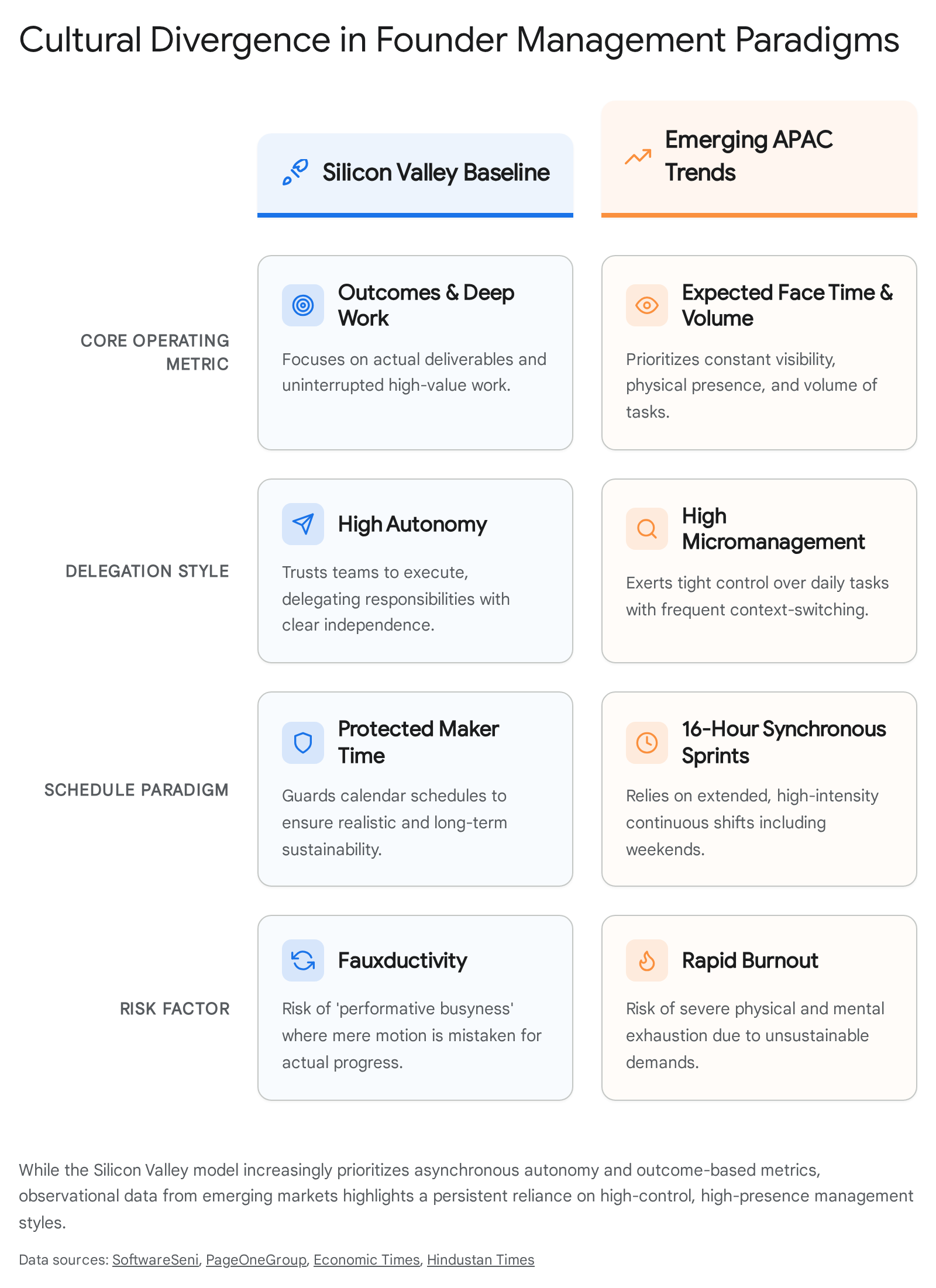
Observations from the engineering workforce consistently point to a stark contrast in delegation and trust. The traditional Western model relies heavily on a Manager's schedule optimized for asynchronous work and high autonomy; American founders are generally perceived as trusting their teams' expertise, delegating tasks effectively, and valuing quality and user-centric problem solving over sheer output volume 181920.
Conversely, in emerging hyper-growth hubs like India, cultural legacies of hierarchical management often result in a phenomenon of profound micromanagement. Qualitative reports and cultural commentary indicate that many regional founders struggle to delegate, leading to constant context-switching, a lack of clear product direction, and a propensity to dictate solutions outside their domain of expertise 1820. Furthermore, the temporal expectation placed on teams is immense. The normalization of the 16-hour workday and weekend sprints remains a deeply entrenched metric of "hustle," prioritizing "expected face time" and raw output volume over sustainable innovation 41820.
This tendency toward micromanagement significantly distorts the Indian founder's time allocation. By refusing to relinquish operational control, these founders remain trapped in lower-level administrative and "Do" tasks rather than graduating to "Delegate" or "Direct" tasks 14. This effectively stunts the organizational maturity required to scale a company to a Series B or C round. Additionally, broader APAC CEO surveys reveal a distinct focus on the near-term; over 60% of regional CEOs report having no plans for international investments over the next 12 months, preferring to allocate time and capital to local alliances and immediate revenue generation, reflecting a more cautious, region-centric approach to scaling amidst global disruption 2122.
Latin America: Structural Constraints and the Value of Unpaid Time
In Latin America and the Caribbean, the entrepreneurial ecosystem must be analyzed through the lens of structural socio-economic constraints. Time-use surveys (TUS) spearheaded by organizations like the Economic Commission for Latin America and the Caribbean (ECLAC) and the United Nations Entity for Gender Equality and the Empowerment of Women provide critical context that is largely absent in Silicon Valley literature 232425.
These surveys utilize specific classifications, such as the Classification of Time Use Activities for Latin America and the Caribbean (CAUTAL), to measure the stark realities of daily life 24. The data reveals that the allocation of a founder's time in this region is heavily influenced by the burden of unpaid domestic services and caregiving work, which disproportionately affects female founders 232526. In Western hubs, well-funded founders often rely on robust gig economies and personal capital to outsource domestic tasks, allowing them to dedicate 60 to 80 hours a week exclusively to their ventures. In contrast, time-use data in Latin America exposes daily bottlenecks where the entrenched "sexual division of labour" directly limits the sheer volume of hours available for entrepreneurial, remunerated productive work 23.
Therefore, for a significant demographic of founders operating outside the Western baseline, "time management" is not merely a philosophical choice between a Maker or Manager schedule; it is a profound intersectional challenge. It requires balancing unavoidable reproductive and care work with the rigorous, time-intensive demands of early-stage venture building.
Europe: Diminishing Returns and the Push for Sustainability
In the European ecosystem, research points to a growing cultural rejection of the American hustle culture. A comprehensive survey of 230 founders of venture capital-backed companies conducted by the UK-based firm Balderton Capital provides clear evidence of this shift 27. While 82% of European founders acknowledge that working long hours is historically viewed as an inevitable part of entrepreneurship, 83% firmly believe that past a certain point, there are severe diminishing returns to simply putting in more hours 27.
European founders are increasingly linking excessive stress to organizational failure. Within this cohort, 64% assert that constant high pressure negatively impacts business performance, and 88% agree that excessive stress directly results in bad decision-making, reducing the capacity for long-term strategic thinking 27. This reflects a broader European regulatory and cultural environment that prioritizes sustainability, work-life balance, and long-term viability over the rapid, often destructive growth cycles characteristic of the Silicon Valley model.
Macroeconomic Shocks (2023 - 2026): The Redefinition of the Workday
The daily distribution of a founder's time has been fundamentally altered by two recent, overlapping macroeconomic shifts: the permanent establishment of remote and hybrid team structures, and the rapid enterprise adoption of generative artificial intelligence (AI).
The Remote/Hybrid Paradox: Focus Versus Friction
The debate over remote work productivity, which dominated executive discussions throughout 2024 and 2025, has largely settled into an empirical consensus: location flexibility significantly increases individual focus time, but requires highly intentional frameworks to prevent collaboration decay.
Workforce analytics utilizing objective time-tracking software reveal that remote workers spend 59.48% of their week in focused, uninterrupted work, compared to just 48.5% for in-office workers 24. By escaping the spontaneous, often unnecessary interruptions of the physical office, remote workers average 4.55 hours of deep focus time per day, translating to roughly 22% more deep work time overall 24. Furthermore, remote workers experience 18% fewer disruptions, saving the average 23 minutes required to refocus after each context switch 24. This recaptures over 60 hours of productive time annually that office workers lose simply to regaining their train of thought.
However, the physical office still retains distinct advantages for specific managerial and developmental functions. Empirical studies demonstrate that in-office workers spend roughly 40 more minutes per week mentoring colleagues and 25 more minutes on formal training than their remote counterparts 28. Furthermore, the lack of proximity in remote settings has given rise to new challenges, such as "polyworking" (holding multiple jobs simultaneously, reported by 28% of remote workers) and "coffee badging" (showing up to the office briefly just to register attendance, a practice admitted by 44% of hybrid workers) 29.
For founders, managing a distributed team requires shifting from synchronous, time-based surveillance to asynchronous, outcome-based measurement 1045. The most effective leaders utilize hybrid models not as a reluctant compromise, but as a strategic tool. They optimize remote days strictly for the Maker's schedule - prioritizing deep work, coding, and strategy design - and utilize in-office days exclusively for the Manager's schedule, clustering 1:1s, mentoring, and collaborative whiteboarding to maximize the value of physical proximity 222946.
Generative AI as a Temporal Arbitrage Mechanism
The integration of generative AI tools into the enterprise stack represents the most significant time-saving development for founders in the past decade. Enterprise adoption of generative AI surged by over 50 percentage points between 2023 and 2024, with 65% of U.S.-based enterprises leveraging these tools 30. By automating routine operations, AI enables temporal arbitrage - allowing founders to literally buy back hours previously lost to administrative drag.
A comprehensive 2024/2025 study by the Federal Reserve Bank of St. Louis found that 31.9% of regular generative AI users spend an hour or more per day utilizing the tools, resulting in an average time savings of 5.4% of total work hours . Among frequent users, 20.5% reported saving four hours or more per week .
For highly leveraged roles like software development, the impact is even more profound. Observational studies of developers using AI coding assistants (e.g., GitHub Copilot) reveal that users decreased time spent on project management and non-coding tasks by a staggering 24.9%, while increasing core coding activities by 12.4% 31. Interestingly, peer collaboration time dropped by nearly 80%, as AI absorbed the friction of routine troubleshooting and code review 31. Corporate surveys support these findings, with 82% of organizations planning to integrate autonomous AI agents for tasks like email generation, coding, and data analysis within the next one to three years 32.
For founders, who inherently wear multiple hats and suffer from severe context switching, integrating AI agents allows them to reclaim the 36% of their week historically lost to administrative duties 551. This reclamation allows a reallocation of cognitive capital toward high-leverage activities: building strategic alliances, deeply understanding customer pain points, and preparing for increasingly rigorous Series A and B fundraising cycles.
| Technological Impact Area | Metric | Source Insight |
|---|---|---|
| Remote Focus Time | 59.48% (Remote) vs 48.5% (Office) | Remote work increases deep work capacity by 22% 24. |
| Interruption Cost | 23 minutes | The time required to regain focus after a spontaneous office interruption 24. |
| AI Time Savings | 5.4% of total work hours | Average time saved by workers utilizing generative AI daily . |
| AI Coding Shift | +12.4% Coding / -24.9% Management | AI coding assistants significantly reduce administrative drag for developers 31. |
Deconstructing the Hustle Myth: Performative Busyness and the ROI of Strategic Downtime
Perhaps the most damaging misconception within the entrepreneurial ecosystem is the glorification of the 100-hour work week. Supported by survivorship bias, VC cultural commentary, and social media posturing, "hustle culture" posits a linear relationship between hours worked and enterprise value created. Empirical science, biology, and economic data flatly contradict this narrative.
The Mathematics of Diminishing Returns and Burnout
The assumption that a founder can continuously scale output through brute-force hours is biologically and economically false. Landmark economic research from Stanford University provides a stark mathematical boundary: employee output falls precipitously after a 50-hour workweek 33. For individuals logging 70 to 80 hours, the study concluded that the extra 15 to 30 hours of labor yield almost zero additional results 33. Past a certain threshold, the brain's cognitive functioning degrades, severe decision fatigue sets in, and emotional exhaustion takes over 933. In auditing and accounting studies, research shows that when professionals are depleted and pressured by time, they instinctively tackle easy tasks first, degrading their performance and judgment on critical, complex issues 34.
The physical cost of overwork is not just psychological distress; it is lethal. A massive study by the World Health Organization (WHO) and the International Labour Organization found that working 55 hours or more per week is the single largest risk factor for occupational disease. This level of overwork kills more than 745,000 people annually through strokes (a 19% increase in risk) and ischemic heart disease (a 42% increase in risk) 54. Burnout resulting from this chronic stress remains one of the primary reasons early-stage startups fail, as it destroys the founder's capacity to lead and innovate 2754.
The Pathology of Performative Busyness
If the data clearly illustrates that working 80 hours is inefficient and physically dangerous, why do founders continue to do it? The answer lies in the psychology of "performative busyness" or "fauxductivity" 935.
In the modern knowledge economy, where daily physical output (like assembly line widgets) is invisible, busyness has become a crude proxy for value. Looking busy operates as a status symbol and a psychological defense mechanism, signaling importance to investors and peers 454. Founders, acutely anxious about the high failure rates of startups (where 90% fail overall and 70% fail between years two and five 15), fall into what psychologists call the "Clarity Trap." They believe that doing more - sending emails at 2:00 AM, attending low-value networking events, endlessly tweaking non-essential product features - will eventually yield the clarity required for success 56.
However, neuroscientific and organizational research proves that this digital hyperconnectivity is highly deleterious 36. A Harvard Business Review analysis of enterprise calendar data found that meeting volume is up 60% since 2020, yet 67% of recurring meetings include individuals who do not need to be there, generating negative ROI 32. Every moment a founder spends in performative, reactive activity is a moment stolen from true strategic leverage.
The Tangible ROI of Strategic Rest
Elite founders treat time as a financial portfolio, actively measuring the return on investment (ROI) of every hour 15. Within this framework, rest is not viewed as a luxury, nor is it merely corporate "wellness"; it is decision engineering and essential performance maintenance 15.
Research into high-performance coaching suggests that strategic downtime must be systematically engineered into the founder's calendar, aligning with operational cycles of output and pressure 15. Just as elite athletes utilize load management, founders require macro, micro, and deep recovery blocks to consolidate learning, clear decision fatigue, and enable long-term strategic vision 155658. The largest global trial of the four-day workweek (spanning 2,896 employees across 141 companies) published in Nature Human Behaviour demonstrated the efficacy of this approach. Working 32 hours instead of 40 resulted in 70% of employees reporting less burnout, improved mental health, and better sleep, while organizational productivity was not only maintained but frequently improved 37.
For the founder, adopting concepts like "career minimalism" and strategic boundary-setting is essential 60. By deploying the Pareto Principle (the 80/20 rule) - acknowledging that 80% of business value is generated by 20% of highly focused activities - and utilizing frameworks like the 4D matrix (Do, Delegate, Defer, Delete) 1438, a founder can finally sever the toxic link between sheer hours worked and perceived productivity. The transition from an amateur operator to an elite professional requires abandoning the ego-driven need to be constantly visible, instead embracing the disciplined, outcome-based execution that allows for compound growth.
Conclusion
The architecture of a successful founder's time is not forged through sleeplessness, relentless motion, or the performative theater of the 100-hour work week. The empirical literature - ranging from calendar audits to cognitive behavioral studies - unequivocally shows that the most effective entrepreneurs do not work endlessly; they work surgically.
As a startup matures from the product-obsessed Maker rhythms of the Seed stage to the complex Manager demands of Series A and B, the founder must actively dismantle their own job description and rebuild it. They must recognize and correct for their own cognitive biases, utilizing rigorous calendar audits to aggressively eliminate the 36% administrative tax and the fauxductivity that quietly erodes enterprise value.
Furthermore, founders must adapt to the geographic and macroeconomic realities of the modern era. By leveraging the temporal arbitrage offered by generative AI, respecting the structural constraints highlighted by global time-use surveys, and harnessing the deep-work capabilities of hybrid team structures, modern founders can reclaim the bandwidth required for high-level strategy. Ultimately, the empirical data provides a clear mandate: sustainable hyper-growth relies not on maximizing the quantity of hours worked, but on engineering strategic downtime to ruthlessly protect the quality of the decisions made within those hours.