
Geometric Langlands program and the 2024 proof
The Langlands program represents one of the most expansive and unifying frameworks in modern mathematics. First proposed by Robert Langlands in 1967, the program originally sought to establish a fundamental symmetry between algebraic number theory and the representation theory of continuous groups 1234. Over the decades, this vision expanded via the "function field analogy" to encompass continuous geometric spaces, culminating in the geometric Langlands program 4566.
In 2024, a team of nine mathematicians, led by Dennis Gaitsgory and Sam Raskin, published a comprehensive proof of the categorical, unramified geometric Langlands conjecture 278. Spanning more than 800 pages across five principal manuscripts, the proof represents the culmination of thirty years of mathematical infrastructure development 29101112. This achievement resolves a central component of the geometric Langlands correspondence, establishing an exact equivalence of derived categories that links the moduli stack of principal bundles on a Riemann surface to the moduli stack of local systems 141316.
Origins of the Langlands Paradigm
To understand the geometric Langlands program, it is necessary to trace its lineage from classical number theory and trace its evolution across the three distinct domains of mathematics that constitute "Weil's Rosetta Stone" 21213.
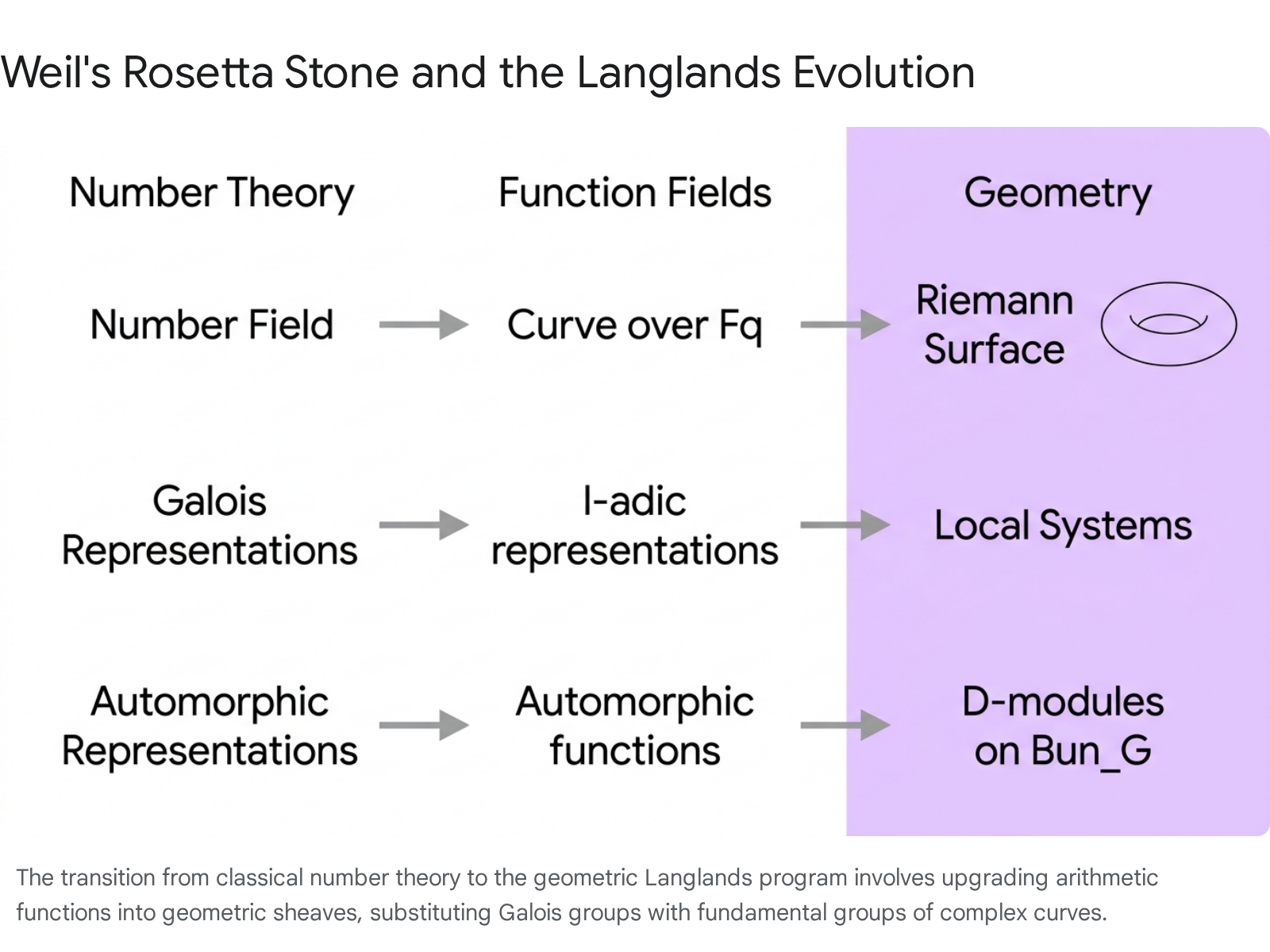
The Arithmetic Foundations
In a 17-page handwritten letter to André Weil in 1967, Robert Langlands proposed a vast generalization of class field theory and Fourier analysis 124. He conjectured that $n$-dimensional representations of the absolute Galois group of a number field (algebraic objects encoding the symmetries of polynomial roots) uniquely correspond to automorphic representations of the general linear group $GL(n)$ over the adele ring of that field (analytic objects resembling complex waves) 46.
This correspondence relies on the precise matching of analytic invariants known as $L$-functions 141516. The classical Langlands correspondence posits that the symmetries of arithmetic objects perfectly mirror the symmetries of continuous geometric spaces, primarily through the matching of Galois symmetries with Hecke operators 31416. A highly celebrated consequence of a special case of this theory - the Shimura-Taniyama-Weil conjecture - enabled Andrew Wiles and Richard Taylor's 1994 proof of Fermat's Last Theorem 2461721. However, the full arithmetic Langlands correspondence over number fields remains an open problem due to the profound difficulty of isolating and manipulating these infinite-dimensional analytic spaces 4918.
The Function Field Analogy
The second column of the Rosetta Stone bridges number theory and pure geometry by replacing number fields (such as the rational numbers $\mathbb{Q}$) with global function fields, specifically the field of rational functions on an algebraic curve defined over a finite field $\mathbb{F}_q$ 619. This setting retains an arithmetic Galois group - driven by the Frobenius automorphism - but introduces a geometric interpretation, allowing mathematicians to deploy powerful cohomological methods 2021.
In the 1980s, Vladimir Drinfeld achieved a major breakthrough by proving the Langlands correspondence for $GL(2)$ over function fields 461922. Drinfeld introduced algebraic structures known as "shtukas" to build a rigorous bridge between two-dimensional $\ell$-adic representations of the fundamental group of a curve and cuspidal automorphic representations 427. In 2002, Laurent Lafforgue extended this framework to $GL(n)$ over function fields, an achievement that earned him the Fields Medal 1922. Later, in 2018, Vincent Lafforgue established the "automorphic to Galois" direction of the global Langlands correspondence for general connected reductive groups over function fields 6212223.
The Transition to Complex Geometry
The third column of the Rosetta Stone shifts entirely into the geometric realm. Instead of operating over curves defined over finite fields, mathematicians analyze smooth projective algebraic curves - Riemann surfaces - defined over the complex numbers $\mathbb{C}$ 561213.
In this purely geometric setting, the arithmetic machinery of the Frobenius automorphism and point-counting over finite fields is absent. To preserve the correspondence, the fundamental mathematical objects must undergo a process of "categorification" or "geometrization" 62723. Automorphic functions are upgraded to categories of sheaves (specifically, $\mathcal{D}$-modules), and Galois representations are replaced by topological local systems (flat connections) 6132723. Formulated initially by Drinfeld and Gérard Laumon in the 1980s, and vastly expanded by Alexander Beilinson and Drinfeld in the 1990s, the geometric Langlands conjecture seeks to establish a canonical equivalence between these categorical structures 561418.
Dictionary of the Langlands Correspondences
The translation across the three columns of Weil's Rosetta Stone requires mapping specific algebraic and analytic structures from arithmetic to their geometric analogues. The following table summarizes this dictionary 66121316.
| Structural Feature | Arithmetic Langlands (Number Fields) | Arithmetic Langlands (Function Fields) | Geometric Langlands (Complex Curves) |
|---|---|---|---|
| Base Space | Number field $F$ (e.g., $\mathbb{Q}$) | Curve $X$ defined over a finite field $\mathbb{F}_q$ | Compact Riemann surface $X$ over $\mathbb{C}$ |
| Fundamental Elements | Prime ideals / places of $F$ | Points of the curve $X(\mathbb{F}_q)$ | Points of the Riemann surface $X(\mathbb{C})$ |
| Symmetry Group | Absolute Galois group $Gal(\bar{F}/F)$ | Étale fundamental group $\pi_1(X, \bar{x})$ | Topological fundamental group $\pi_1(X)$ |
| Spectral Side (A-side) | Continuous $n$-dimensional Galois representations | $\ell$-adic representations of the étale fundamental group | Local systems (flat connections) mapping into Langlands dual group $\hat{G}$ |
| Automorphic Side (B-side) | Automorphic representations of $GL_n(\mathbb{A}_F)$ | Space of automorphic functions on $Bun_G(\mathbb{F}_q)$ | Derived category of $\mathcal{D}$-modules on the moduli stack of bundles $Bun_G(X)$ |
| Transformation Operators | Classical Hecke operators | Hecke operators | Geometric Hecke functors |
| Core Harmonic Objects | Eigenfunctions | Eigenfunctions | Hecke eigensheaves |
| Fundamental Equivalences | Satake Isomorphism | Satake Isomorphism | Geometric Satake Equivalence |
| Nature of Output | Equality of $L$-functions | Equality of functions and traces | Equivalence of derived categories |
Mathematical Architecture of the Geometric Conjecture
The geometric Langlands program posits an exact structural equivalence between two infinitely complex geometric spaces associated with a smooth projective curve $X$ and a reductive algebraic group $G$ 513. In the 1990s, Beilinson and Drinfeld shifted the focus from proving a pointwise correspondence of functions to defining a global, categorical equivalence 26162329.
The Spectral Side: Local Systems and the Dual Group
The "spectral side" (often referred to as the Galois side in the arithmetic context) deals with the representation of the geometry of $X$. For a compact Riemann surface with genus $g$, its topological fundamental group $\pi_1(X)$ tracks the diverse ways closed loops can wind around the surface's topology 21213.
The primary object of study on this side is the moduli stack of local systems, denoted $LocSys_{\hat{G}}(X)$ 141629. A local system is the geometric realization of a flat connection, dictating how mathematical vectors twist and undergo parallel transport as they traverse the loops of the Riemann surface.
Crucially, these local systems map into the Langlands dual group, denoted $\hat{G}$ (or ${}^L G$), rather than the original reductive group $G$ 121327. The Langlands dual group is derived by exchanging the root lattice and the weight lattice of a Lie group 513. Consequently, while the general linear group $GL(n)$ acts as its own dual (it is self-dual), the dual of the special orthogonal group $SO(2n+1)$ is the symplectic group $Sp(2n)$ 51213. This introduces a highly non-trivial asymmetry into the correspondence.
On this moduli space, modern geometric Langlands theory dictates the study of the derived category of quasi-coherent sheaves 1629. More precisely, following a vital refinement by Dima Arinkin and Dennis Gaitsgory in 2012, the correct categorical object is the category of Ind-coherent sheaves with nilpotent global singular support, denoted $IndCoh_{Nilp}(LocSys_{\hat{G}}(X))$ 2121424. This restriction ensures the category perfectly balances its counterpart on the automorphic side, correcting earlier naive formulations that Vincent Lafforgue proved false for general groups 2425.
The Automorphic Side: Moduli of Bundles and D-modules
The "automorphic side" operates on the moduli stack of principal $G$-bundles on the curve $X$, denoted $Bun_G(X)$ 71329. $Bun_G$ is a complex, infinite-dimensional algebraic stack that parametrizes all holomorphic structures and possible configurations of the algebraic group $G$ over $X$ 1324.
In the arithmetic setting, researchers study automorphic functions operating on the analogous space. In the geometric paradigm, functions are categorified into $\mathcal{D}$-modules 6132723. A $\mathcal{D}$-module is an algebraic construct that encapsulates a system of linear partial differential equations on an algebraic variety 13. By shifting focus to the derived category of $\mathcal{D}$-modules on $Bun_G$, denoted $\mathcal{D}\text{-}mod(Bun_G)$, mathematicians study the holistic space of solutions to these differential equations rather than isolated instances 729.
Within this vast category, highly specific $\mathcal{D}$-modules known as Hecke eigensheaves act as the geometric equivalents of the pure sine waves (eigenfunctions) found in classical Fourier harmonic analysis 2814. Through the geometric Satake equivalence, geometric Hecke functors act on these categories, flawlessly intertwining the representation theory of the group $G$ with the geometry of its dual group $\hat{G}$ 62723.
The Categorical Equivalence
The "best hope" formulated by Beilinson and Drinfeld proposed a sweeping spectral theorem for these sheaves 2131629. The categorical unramified geometric Langlands conjecture states that there exists a canonical equivalence of derived categories:
$$\mathcal{D}\text{-}mod(Bun_G(X)) \simeq IndCoh_{Nilp}(LocSys_{\hat{G}}(X))$$
This exact equivalence requires that every structure, operation, and Hecke eigensheaf on the highly non-linear automorphic side has a perfect, unique mirror image on the highly singular spectral side 101424. Establishing a rigorous, bijective functor between these infinite-dimensional derived categories demands profound technical precision and relies heavily on the architectures of derived algebraic geometry and higher category theory 31226.
Deep Connections to Quantum Physics and S-Duality
While the Langlands program originated strictly within pure mathematics, its geometric formulation harbors an exact and profound parallel to theoretical physics - specifically, quantum field theory and string theory 3193327. In 2006, theoretical physicists Anton Kapustin and Edward Witten authored a 225-page treatise demonstrating that the geometric Langlands correspondence is the mathematical manifestation of S-duality in four-dimensional $\mathcal{N}=4$ supersymmetric Yang-Mills (SYM) theory 117183327.
S-Duality in Super Yang-Mills Theory
S-duality, also known as Montonen-Olive duality, is a phenomenon in quantum field theory wherein a theory evaluated at a strong coupling constant ($e^2 \gg 1$) is mathematically equivalent to a different theory evaluated at a weak coupling constant ($e^2 \ll 1$) 527. In classical electromagnetism, this roughly translates to the interchangeable nature of electric and magnetic fields. In non-abelian gauge theory, S-duality posits that a gauge theory defined by a group $G$ is functionally equivalent to a gauge theory governed by the Langlands dual group $\hat{G}$ 51317.
Kapustin and Witten demonstrated that topological Wilson operators (representing electric observables) in the $G$ gauge theory physically translate into topological 't Hooft operators (representing magnetic observables) in the $\hat{G}$ gauge theory 1728. In the mathematical realm, the action of these physical operators perfectly mirrors the action of Hecke operators on eigensheaves 1528.
Dimensional Reduction and Mirror Symmetry
By taking this four-dimensional SYM theory and compactifying it onto a Riemann surface $X$ (reducing the dimensions), the physics reduces to a two-dimensional topological sigma model 173328. The target space of this sigma model corresponds precisely to Hitchin's moduli space, which is intimately related to the moduli spaces $Bun_G$ and $LocSys_{\hat{G}}$ studied by algebraic geometers 13172829.
In this two-dimensional setting, Kapustin and Witten showed that S-duality physically manifests as homological mirror symmetry 173328.
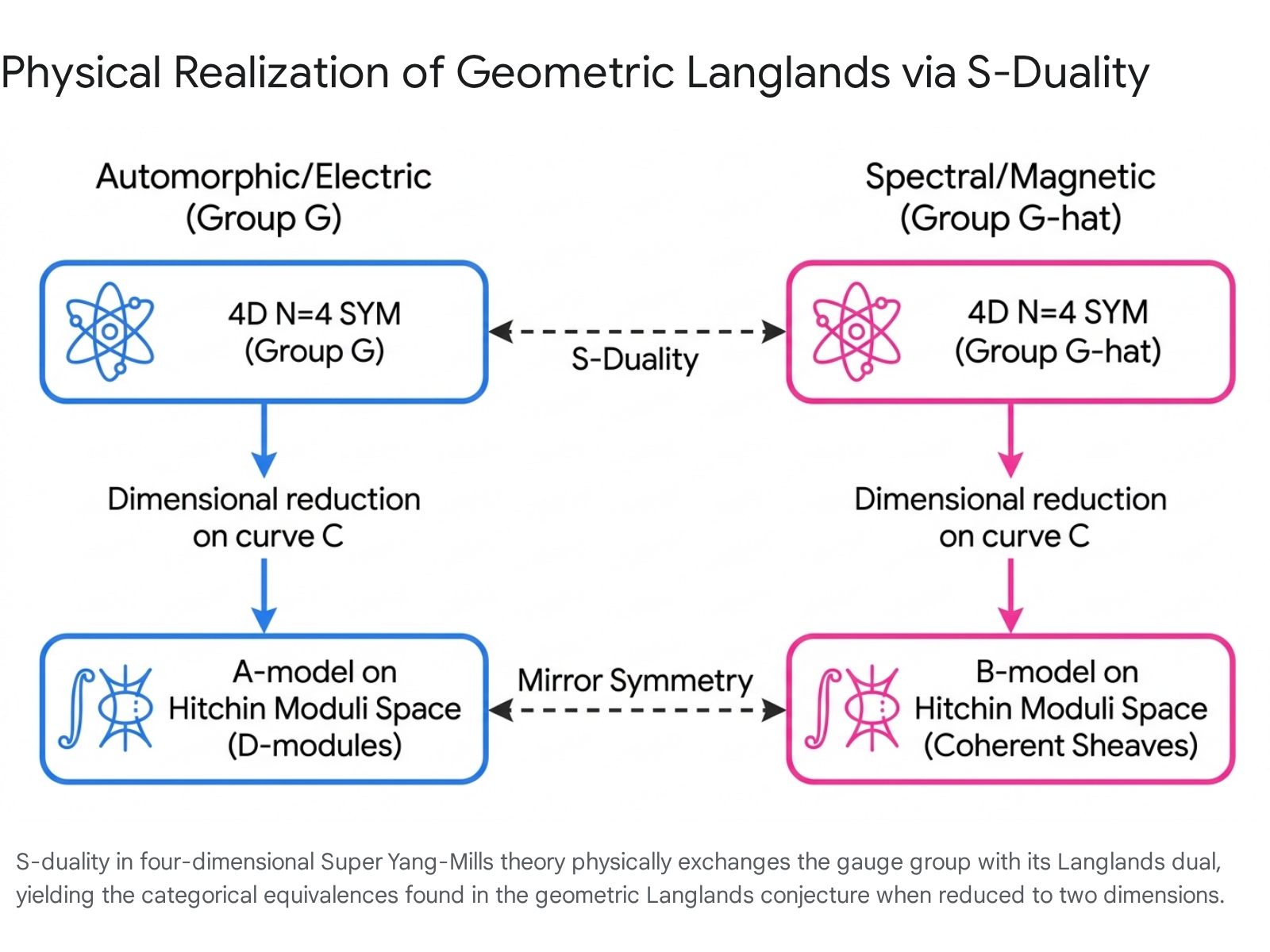
Electric eigenbranes in the A-model map to magnetic eigenbranes in the B-model 17. The mathematical $\mathcal{D}$-modules on the automorphic side correspond to physical configurations known as "coisotropic A-branes" 17. Consequently, the vast, abstract mathematical conjecture of Beilinson and Drinfeld is confirmed to be deeply embedded in the foundational fabric of quantum physics, theoretical M-theory, and the symmetries of fundamental forces 24332730.
The 2024 Proof of the Geometric Langlands Conjecture
While the geometric Langlands correspondence had been proven for the abelian case (specifically the general linear group $GL(1)$) using the geometric Fourier-Mukai transform formulated by Laumon and Rothstein, a comprehensive proof for general non-abelian reductive groups remained elusive for decades 182924.
In May 2024, a team led by Dennis Gaitsgory of the Max Planck Institute for Mathematics and Sam Raskin of Yale University announced a complete proof of the categorical, unramified geometric Langlands conjecture for general reductive groups over fields of characteristic zero 2893038. The nine-person collaborative team included mathematicians Dima Arinkin, Dario Beraldo, Justin Campbell, Lin Chen, Joakim Færgeman, Kevin Lin, and Nick Rozenblyum 2781012.
The Rising Sea Methodology
The successful proof represents the culmination of thirty years of singular dedication by Gaitsgory, whose initial exposure to the subject occurred via Beilinson's lectures in 1994 22125. The methodology embodied the philosophy of the renowned 20th-century mathematician Alexander Grothendieck, known as the "rising sea" approach 23931.
Rather than attacking the central categorical equivalence with direct, localized logic, the team spent decades gradually raising the baseline of mathematical theory. They developed vast new theoretical frameworks in derived algebraic geometry, higher category theory, and infinite-dimensional stacks 212. In 2013, Gaitsgory drafted a precise map of the intermediate theorems required, leading to a multi-volume codification of derived algebraic geometry authored by Gaitsgory and Rozenblyum, totaling nearly 1,000 pages 21232. By the time the final proof was assembled in early 2023 and published in 2024, the surrounding mathematical "sea" had risen to a level where the summit of the conjecture was finally structurally accessible 230.
Architecture of the Five Papers
The comprehensive proof is articulated across a series of five papers, totaling more than 800 pages 21011. This massive architectural structure breaks the categorical equivalence into specialized, highly technical theorems, isolating distinct mechanical requirements of the equivalence into individual volumes.
| Paper | Title | Core Objective and Theorems Proved |
|---|---|---|
| GLC I | Construction of the functor | Constructs the geometric Langlands functor from the automorphic to the spectral side in characteristic zero settings (de Rham and Betti). Proves various forms of the conjecture (restricted vs. non-restricted, tempered vs. non-tempered) are logically equivalent 7111238. |
| GLC II | Kac-Moody localization and the FLE | Links the representation theory of affine Lie algebras to geometric spaces. Establishes the Fundamental Local Equivalence (FLE) relating Kac-Moody algebras and semi-infinite flag varieties, providing necessary local-to-global properties 111216. |
| GLC III | Compatibility with parabolic induction | Establishes the Langlands functor's compatibility with geometric Eisenstein series and constant term operations. Deduces that the functor induces a strict equivalence on Eisenstein-generated subcategories 11123343. |
| GLC IV | Ambidexterity | Manages the complex behavior of integration, trace formulas, and duality within infinite-dimensional categories, ensuring symmetries are preserved flawlessly when migrating between the spaces 1112. |
| GLC V | The multiplicity one theorem | Analyzes the geometry of the stack of local systems to prove that for any irreducible local system, there exists a unique Hecke eigensheaf (up to tensoring by a vector space), successfully concluding the proof 101112. |
Methodological Innovations: Categorical Traces and the Poincaré Sheaf
A defining innovation required to bypass the final barriers of the proof was the mastery of categorical traces, an element deeply inspired by physics 6823. In classical harmonic analysis, a mathematician isolates pure frequencies (eigenfunctions) from complex noise via the Fourier transform 221. In the geometric Langlands program, the team had to identify pure eigensheaves in an infinite-dimensional derived category 234.
Gaitsgory, Arinkin, and their collaborators achieved this by utilizing an object called the Poincaré sheaf, which acts as the geometric equivalent of mathematical "white noise," encompassing all possible continuous frequencies 2834. By meticulously filtering this categorical noise and analyzing its structural compatibility across the automorphic and spectral categories, the team verified that the intricate relationships predicted by Beilinson and Drinfeld held universally, devoid of contradictions 28.
Implications and Future Research Horizons
The 2024 validation of the geometric Langlands conjecture provides a monumental degree of stability to the broader Langlands program, earning Gaitsgory the 2025 Breakthrough Prize in Mathematics 8213546. However, the resolution of this paradigm inherently initiates several new frontiers in arithmetic and mathematical physics 2125.
Decategorification and Arithmetic Applications
Historically, discoveries in arithmetic guided geometric conjectures. Following the 2024 proof, the flow of innovation has explicitly reversed 23623. The advanced categorical techniques forged to prove the geometric Langlands conjecture are actively being exported back to the classical number theory columns of the Rosetta Stone 26.
By deploying Grothendieck's sheaf-to-function dictionary, mathematicians "decategorify" the geometric theorems to extract novel functions and unearth new arithmetic truths 62123. Recently, researchers such as Peter Scholze and Laurent Fargues have devised theoretical "wormholes" (such as the Fargues-Scholze program and the categorical arithmetic local Langlands program) that allow sophisticated concepts from the geometric column to bypass traditional boundaries and be mapped directly into the arithmetic column 222725. This ensures that the geometric proof will rapidly accelerate discoveries in prime numbers and polynomial roots 2.
Ramification and the Local Geometric Langlands Program
The 800-page proof firmly resolves the unramified geometric Langlands conjecture over complex numbers 7111636. An immediate directive for the mathematical community is extending this framework to handle ramification - situations where the algebraic curves possess punctures, poles, or singularities (often classified as tame or wild ramification) 12162548. The local geometric Langlands program, which focuses specifically on the behaviors near these singular points, relies on structures like the affine Grassmannian and remains in active development 12222748.
Quantum Geometric Langlands
Furthermore, the physical insights articulated by Kapustin and Witten point toward a vastly more complex symmetry known as the quantum geometric Langlands correspondence 12292429. In this advanced quantum framework, the duality is modified by a deformation or "quantum parameter," which blurs the rigid distinction between the automorphic and spectral sides, establishing a relationship where both sides are treated as automorphic 2929. This introduces new equivalences bridging Whittaker modules and Kac-Moody algebras, creating a mathematical environment even closer to the pure topological field theories of string theory 1229.
Ultimately, the resolution of the geometric Langlands conjecture serves as an unprecedented structural blueprint for modern mathematics. The proof formally confirms that the deep symmetries predicted to govern the mathematical universe do exist - bridging arithmetic properties, topological surfaces, and the fundamental dualities of quantum physics into a single, cohesive framework 2393037.