
Geographic variation in human personality
The spatial distribution of human personality - the systematic ways in which thoughts, feelings, and behavioral tendencies aggregate across geographic boundaries - has emerged as a highly scrutinized intersection of cross-cultural psychology, human geography, and sociology. Historically, behavioral variations across populations were broadly categorized under informal national character stereotypes or rigid, deterministic geographical models. However, the advent of large-scale, geo-coded personality assessments and advanced spatial econometrics has allowed researchers to map psychological trait distributions at both the macro level of international populations and the micro level of municipalities and postal codes.
The prevailing empirical evidence indicates that personality traits are not randomly distributed. Instead, they cluster in recognizable geographic patterns that correlate significantly with key political, economic, social, and health indicators 12. Despite these robust spatial correlations, the causal mechanisms driving regional personality differences - ranging from selective migration and ecological adaptation to historical cultural subsistence practices - remain a subject of intense academic debate. Furthermore, the extensive reliance on Western psychometric instruments in non-Western populations raises critical questions regarding the cross-cultural universality of trait models, demanding careful methodological scrutiny of geographic psychology as a discipline.
Foundational Frameworks and Cross-Cultural Universality
The foundation of geographic personality research relies heavily on the Five-Factor Model, often referred to as the Big Five. Extracted initially via lexical analyses of natural language, the Five-Factor Model categorizes human personality into five broad, cross-cutting dimensions: Openness to Experience, Conscientiousness, Extraversion, Agreeableness, and Neuroticism 344. To establish geographic differences, researchers must first determine if these traits are universal constants or cultural artifacts.
The Five-Factor Model in Literate Populations
The initial consensus in cross-cultural psychology supported the Five-Factor Model as a biologically based human universal. Extensive international studies translating the Big Five Inventory into dozens of languages consistently recovered the five-factor structure across multiple continents and language families 56. A seminal 56-nation study analyzing self-reports from 17,837 individuals found that the five-dimensional structure was structurally robust across major global regions 67.
At a mean-level geographic analysis, significant variations emerge between continental populations. Extraversion generally registers at higher average levels in Europe and the Americas, while consistently scoring lower in East Asia 56. Agreeableness scores exhibit high complexity, with some individualist cultures scoring surprisingly high, whereas Conscientiousness shows substantial variation, with certain Northern European geographic samples consistently peaking 56. Openness to Experience displays significant deviations among inhabitants of South America and East Asia compared to other regions 56. Additionally, within-country sex differences in these traits demonstrate remarkably similar geographic patterns across varying geographic locations, with women generally scoring higher on Neuroticism and Agreeableness globally 38.
Further large-scale data aggregation from online platforms, drawing on samples exceeding 40 million respondents, corroborates these broad regional patterns while highlighting distinct national extremes. For instance, data indicates that Nicaragua, Lebanon, and Rwanda rank among the most extroverted national populations, whereas Lithuania, Chile, Algeria, the Faroe Islands, and Brazil rank among the most introverted 911. Within Europe specifically, Albania, Montenegro, and Switzerland map as the most extraverted environments 10. However, researchers note that online assessments inherently capture an overrepresentation of introverted and internet-active demographics, a self-selection bias that must be accounted for in geographic comparisons 910.
Assessment Challenges in Non-Western Populations
Despite widespread replication in literate, urban environments, the cross-cultural universality of the Five-Factor Model faces severe criticism when applied to populations outside the Western, Educated, Industrialized, Rich, and Democratic demographic sphere 45. In low-literacy and small-scale indigenous societies, standard psychometric instruments frequently fail to measure the intended psychological constructs, suggesting that geographic variation in personality may extend to the very structure of personality itself.
A comprehensive study of the Tsimane, a forager-horticulturalist indigenous society in the Bolivian Amazon, failed to find robust support for the Five-Factor Model 11. Examining 632 participants using a translated 44-item Big Five Inventory, researchers found poor internal consistency, low response stability, and a factor structure that did not align with the standard Big Five 11. Instead, the analysis identified a "Big Two" structure oriented around immediate socioecological imperatives: prosociality and industriousness 11.
Similarly, an analysis of personality structure among the Khoekhoe in Africa yielded unique dimensions that do not cleanly map to Western geographic models. Their localized trait structure included factors such as "Prosocial Diligence" (which collapses Western concepts of Agreeableness and Conscientiousness), "Bad Temper," and "Fear versus Courage" 4. In South India, an exploratory factor analysis of a Kannada-translated Big Five assessment administered to 400 community participants identified neither the Big Five nor a General Factor of Personality. Instead, the analysis revealed a distinct, geographically localized five-factor solution: Social Effectiveness, Interpersonal Ability, Altruism, Emotional Instability, and Innovativeness 1213. Chinese psychologists have also developed an indigenous psychometric instrument, the Chinese Personality Assessment Inventory, which captures a geographically unique dimension termed "Interpersonal Relatedness" that the standard Big Five fails to encapsulate 14.
Methodological Artifacts in Face-to-Face Surveys
Broader psychometric evaluations of populations in the Global South demonstrate that geographic differences in measured personality are frequently contaminated by survey methodology. An extensive analysis encompassing 94,751 respondents across 29 face-to-face surveys in 23 low- and middle-income countries demonstrated that standard personality questions exhibit dangerously low validity in these environments 415.
When assessed via face-to-face enumeration, the data failed standard psychometric validity tests, heavily distorted by enumerator interactions, systematic response biases, and the lower average education levels of the respondents 415. Strikingly, when researchers collected data through internet surveys from 198,356 self-selected respondents in the exact same set of 23 countries, the traditional Big Five factor structure successfully emerged 415. This discrepancy indicates that the apparent failure of the Five-Factor Model in certain geographic regions may sometimes be an artifact of data collection methods rather than an intrinsic difference in human psychological structure.
The Cross-Country Similarities Hypothesis
Even in regions where the Five-Factor Model holds structural integrity, the sheer magnitude of personality variation attributable to geographic location is contested. A major analysis of 130,602 individuals across 22 countries proposed the "Similarities Hypothesis," postulating that aggregate trait differences between nations are statistically minor and frequently exaggerated by small sample sizes or low scale reliabilities in historical studies 316.
This comprehensive study found that the overall contribution of the country of residence to an individual's personality traits accounted for less than 2% of the total variance 316. While geographic clusters are mathematically detectable and statistically significant, within-country variation vastly outweighs between-country variation. This suggests that humans across highly disparate geographic environments share far more psychological commonalities than geographic differences, challenging the assumption that geography exerts a dominant, overriding force on individual psychology 38.
Mechanisms of Regional Personality Differentiation
When regional clustering of traits is successfully identified and validated, researchers generally attribute these geographic disparities to three primary mechanisms: selective migration, ecological adaptation, and social contagion 171819. These processes do not operate in isolation; they form a continuous feedback loop wherein physical environments shape cultural practices, which subsequently attract specific personalities, who then reinforce the local norms.
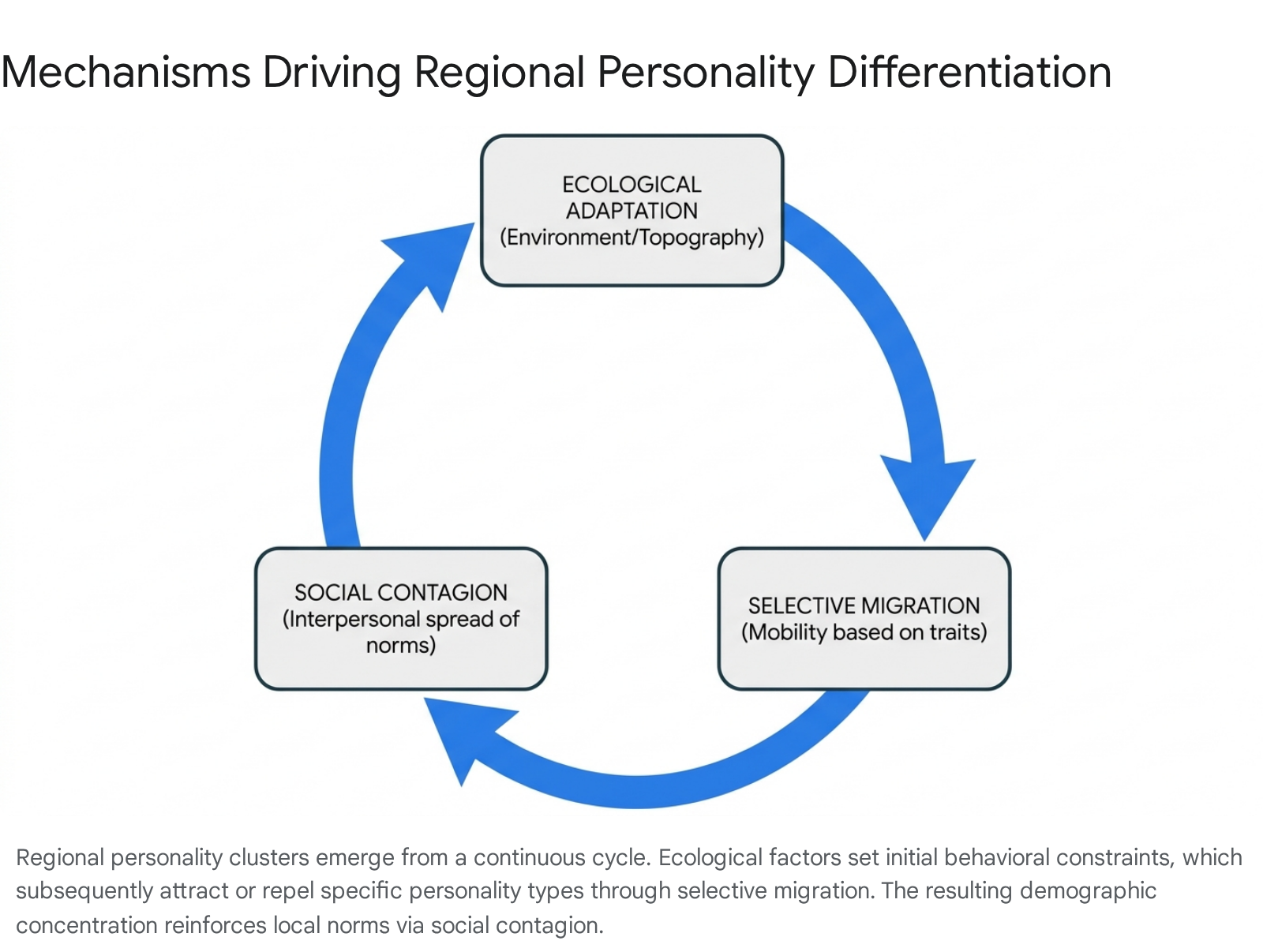
Ecological Adaptation and Environmental Constraints
The physical environment inherently dictates the types of activities, agricultural practices, and survival strategies available to its inhabitants, establishing a foundation for localized psychological adaptation. Climate heavily influences social interaction networks; regions with warmer climates and greater direct sunlight generally foster increased outdoor activity, facilitating broader social contact that can elevate regional Extraversion 19. Conversely, geographic areas prone to extreme winters, prolonged cold, or low sunlight aggregation can foster traits linked to seasonal affective disorder, subsequently elevating baseline regional Neuroticism 19.
Topography also exerts subtle but measurable psychological pressures. Using geographic measures of "mountainousness," researchers analyzing United States data have found that residents of highly mountainous geographic regions generally exhibit lower levels of Agreeableness, Extraversion, Neuroticism, and Conscientiousness, coupled with significantly higher Openness to Experience 20. The physical isolation and harsh conditions of mountainous terrain historically rewarded self-reliance, introversion, and a tolerance for novel problem-solving (Openness), while penalizing intense social interdependence (Agreeableness). While the individual-level effect sizes are mathematically small - an increase of one standard deviation in mountainousness is associated with a change of approximately 1% in personality - scaling these topographic adaptations across entire regional populations correlates with notable shifts in macro-level geographic innovation and voting behavior 20.
Selective Migration and Mobility
Geographic personality differences are highly fluid, driven persistently by selective migration. Individuals are not geographically static; they actively seek out habitats that align with their temperaments, career aspirations, and psychological needs. Studies tracking migration propensity indicate that individuals scoring high in Extraversion and Openness to Experience are the most likely demographics to change their residential locations, migrating away from conventional or rural environments 17. Openness specifically is a strong predictor of between-state migration in the United States 17.
Consequently, geographic regions that offer diverse economic, artistic, and intellectual opportunities - such as the American West Coast, cosmopolitan capitals, or major technology hubs - act as magnets for individuals high in Openness and Extraversion 19.
| Demographic Variable | High Geographic Mobility Traits | Low Geographic Mobility Traits |
|---|---|---|
| Primary Big Five Dimension | High Openness, High Extraversion | High Agreeableness, High Conscientiousness |
| Psychological Motivation | Seeking diversity, novel stimuli, career advancement, and intellectual environments. | Seeking stability, community integration, familial proximity, and predictable routines. |
| Typical Destination | Dense urban centers, diverse coastal regions, academic or technology hubs. | Rural environments, agricultural centers, hometowns, and conventional heartlands. |
| Resulting Regional Profile | Relaxed, creative, uninhibited, and highly dynamic. | Friendly, conventional, highly socially cohesive, and traditional. |
This dynamic is sharply visible in the rural-urban geographic divide. Longitudinal studies utilizing the Midlife in the United States (MIDUS) and Health and Retirement Study (HRS) datasets reveal that Americans living in deeply rural areas tend to exhibit lower levels of Openness, Conscientiousness, and psychological well-being, alongside higher baseline levels of Neuroticism, compared to their urban counterparts 21. The selective out-migration of highly open and conscientious individuals from rural regions leaves behind a concentrated population profile that subsequently defines the geographic stereotype of the area 2021.
Social Contagion and Institutional Reinforcement
Once a critical mass of specific personality types settles in a geographic region through historical adaptation or selective migration, social contagion solidifies the local psychological profile. Emotions, behavioral norms, and attitudes are transmissible through daily interpersonal contact 19. If a geographic area aggregates highly anxious, tense, and temperamental individuals, the local culture begins to reflect these traits. Residents 'catch' negative affect simply through regular social proximity, elevating the regional Neuroticism score beyond what individual baseline genetics would predict 19.
Furthermore, as a dominant personality profile takes hold, the civic institutions, local labor markets, and political structures of the region adapt to reward behaviors that align with the local ideal 24. In highly agreeable and conventional geographic areas, strong social capital and community participation are rewarded, socializing subsequent generations and incoming migrants to adopt similar patterns of behavior 122. Conversely, in regions characterized by high Openness, local institutions reward disruption, artistic expression, and individualism, perpetually reinforcing the geographic divergence 119.
Macro-Level Geographic Determinism versus Possibilism
When attempting to explain the psychological and economic variations across distinct geographic zones, the discipline must navigate the fraught history of environmental modeling. Extrapolating cultural or psychological outcomes exclusively from physical geography courts the historical errors of geographic determinism.
Historical Determinism and Imperialist Critiques
In the 19th and early 20th centuries, strict environmental determinism - championed by geographers such as Carl Ritter, Ellen Churchill Semple, and Ellsworth Huntington - posited that the physical environment was an immutable force that inevitably dictated human behavior, societal development, and psychological capacity 2623. This philosophy argued that humans were merely passive agents molded by their geographic coordinates 2624.
This framework has been heavily criticized and largely abandoned by modern scholars because it was frequently weaponized to justify racism, colonialism, and ethnocentrism. Imperial powers utilized deterministic arguments to claim that tropical environments inherently produced "lazy," morally inferior, or intellectually stunted populations, while temperate climates supposedly bred industriousness, rationality, and advanced civilization 232425. By attributing all human activity and economic disparity strictly to physical climatic influences, archaic determinism rationalized massive global inequalities and the exclusion of tropical populations from "proper" societal recognition 2324.
Modern Environmental Possibilism
Modern geographic and psychological scholars broadly reject hard determinism in favor of "environmental possibilism" - the principle that the physical environment establishes parameters and limits the range of possible human adaptations, but it does not dictate a singular, inevitable social outcome 2624. The environment offers a set of possibilities from which human societies actively choose based on technology, culture, and agency.
Contemporary macro-level debates emphasize that human agency, institutional development, and technological infrastructure play vastly more significant roles in determining regional success and psychological stability than the raw physical environment 2326. Economists and institutionalists, such as Daron Acemoglu and James A. Robinson, argue that geographic factors primarily influenced early historical state formation and colonialism, but cannot directly explain modern economic growth disparities 23. Instead, humanly devised constraints - property rights, legal systems, and political structures - are the true determinants 2326.
Conversely, scholars like Jeffrey Sachs maintain that tropical geography still imposes severe economic and psychological penalties due to high pathogen prevalence, unreliable rainfall, and poor soil, which create massive barriers to regional development 26. Regardless of the exact balance, modern geographic psychology views variables such as climate and topography as passive constraints operating within complex socioeconomic networks, rather than active, determining forces of human psychological destiny.
The Subsistence Theory of Culture: The Rice-Wheat Paradigm
To explain how specific geographic parameters shape deeply ingrained cognitive and behavioral patterns without falling into strict determinism, anthropologists and cross-cultural psychologists frequently examine historical agricultural legacies. The most prominent and heavily scrutinized framework in this domain is the Subsistence Theory of Culture, colloquially known as the "Rice Theory" 2728.
The Rice-Wheat Paradigm and Cultural Psychology
Focusing primarily on the historical agricultural border within China, the Rice Theory postulates that the specific physical demands of a region's historical staple crop permanently shaped local cultural psychology, creating geographic divides in personality that persist into the modern era 2829.
Traditional paddy rice farming is immensely labor-intensive, requiring roughly twice the labor hours of wheat farming, and is fundamentally interdependent 2829. Because paddy rice depends on standing water, it requires complex, community-managed irrigation networks. Farmers in a geographic region must coordinate their water usage strictly, flood their fields simultaneously, and share massive amounts of physical labor for canal maintenance and harvesting 2829. Wheat farming, by contrast, relies heavily on natural rainfall and requires significantly less communal infrastructure. A single family can manage a wheat farm independently without coordinating with their neighbors 2728.
Proponents of the Subsistence Theory argue that the environmental necessity of rice farming forged collectivist cultures characterized by "tight" social norms, intense interdependence, and strong in-group loyalty. Conversely, the geographic regions suited for wheat farming engendered looser, more individualistic cultures 2728.
Experimental Evidence of Cognitive Divergence
To test the Rice Theory and isolate geographic causality, researchers have utilized quasi-experimental designs to bypass the confounding variables of broad cross-country comparisons. A landmark 2024 study published in Nature Communications analyzed historical state farms in Ningxia Province, China, established after World War II 27. Because the Chinese government quasi-randomly assigned incoming populations to farm either rice or wheat on adjacent farms sharing identical environmental conditions (rainfall, temperature, and soil), the researchers possessed a rare natural experiment 27.
Evaluating 234 farmers across these adjacent geographic sites, researchers found compelling cognitive divergences. In categorization tasks, rice farmers exhibited holistic cognitive styles - grouping objects based on functional relationships and environmental context (e.g., pairing a train with tracks) 27. Wheat farmers favored analytical cognitive styles, grouping objects based on abstract shared categories (e.g., pairing a train with a bus) 27.
| Cognitive and Social Variable | Rice-Farming Geographic Regions | Wheat-Farming Geographic Regions |
|---|---|---|
| Cognitive Style | Holistic (context-dependent, relational grouping). | Analytical (abstract, categorical grouping). |
| Implicit Individualism | Low. Individuals draw themselves smaller or equal in size to peers in sociograms. | High. Individuals self-inflate, drawing their own node significantly larger than peers. |
| Social Orientation | Interdependent, collectivist, prioritizing strong in-group loyalty. | Independent, individualist, prioritizing personal autonomy. |
| Friend-Stranger Distinction | High. Sharp behavioral differences; highly generous to friends, harsher to strangers. | Low. More uniform treatment across social networks; less severe nepotism. |
Furthermore, tests of implicit individualism revealed that wheat farmers tended to self-inflate their egos, drawing themselves significantly larger than their social contacts in sociogram tasks. Rice farmers drew smaller ego-centric networks, signifying a collectivist minimization of the self 27. Rice farming environments also predicted tighter social norms and a starker distinction between friends and strangers, highlighting a localized culture of nepotism and intense in-group reliance 2428. The psychological imprint of these geographic practices proved highly persistent; even when farmers rotated off rice crops for a single year due to water shortages, their holistic and collectivist cognitive patterns remained unchanged, indicating that accumulated geographic culture shapes the mind deeper than temporary labor 27.
Methodological Critiques and Replication Failures
While the Rice Theory offers an elegant geographic explanation for psychological differences, rigorous methodological critiques have heavily challenged its validity and universality. Re-evaluations of the original 2014 experimental data by agricultural economists uncovered severe vulnerabilities related to sample bias, measurement errors, and model misspecifications 30.
Critics noted that the original geographic sample distribution was highly uneven and unrepresentative. In tests for holistic thought, Guangdong and Fujian provinces were heavily oversampled relative to their populations, while some northern wheat-farming provinces (such as Beijing and Qinghai) featured sample sizes of fewer than three individuals 30. Because geographic psychology relies on detecting spatial variations, these extremely small observation pools drastically skewed the statistical estimates.
Furthermore, the measurement of implicit individualism - where subjects draw circles representing themselves and friends - was allegedly confounded by inconsistent experimental conditions and tools (e.g., varying paper and pencil types) across different geographic test sites 30. Subjects from the exact same province reported wildly different individualism scores depending on which city they were tested in. When researchers corrected for these errors by dropping heavily oversampled regions and applying relative difference measures to the sociograms, the statistically significant psychological differences between rice and wheat farming populations vanished 30.
Crucially, the original Rice Theory models frequently tested agricultural practices independently of macroeconomic geographic variables. When subsequent researchers added controls for broader geographic factors such as regional per capita GDP (the modernization hypothesis) and historical pathogen prevalence into the regression models, the specific cultural impact of rice farming lost its predictive power across holistic thought, implicit individualism, and nepotism 30. Claims that rice farming hindered modern innovation (measured via patents) or predicted lower divorce rates were also debunked using updated longitudinal data, which showed rice-cultivating regions accelerating in patent growth and divorce rates faster than wheat-cultivating areas in recent decades 30. These replication failures highlight the fragility of monocausal geographic explanations for complex human cognitive differences.
Sub-National Personality Clustering in North America
While national averages can obscure intense localized cultural variation, high-resolution sub-national mapping has revealed deep psychological divides within single countries. By mapping personality at the state, county, and municipal levels, researchers demonstrate that distinct regions operate as self-contained psychological ecosystems.
Psychological Topography of the United States
The most exhaustive sub-national geographic personality mapping has been conducted across the United States. Utilizing cluster analyses on massive datasets exceeding 1.5 million individuals collected over 12 years, researchers identified three robust geographic personality profiles that challenge traditional demarcations based purely on economic status, historical borders, or political voting lines 13132.
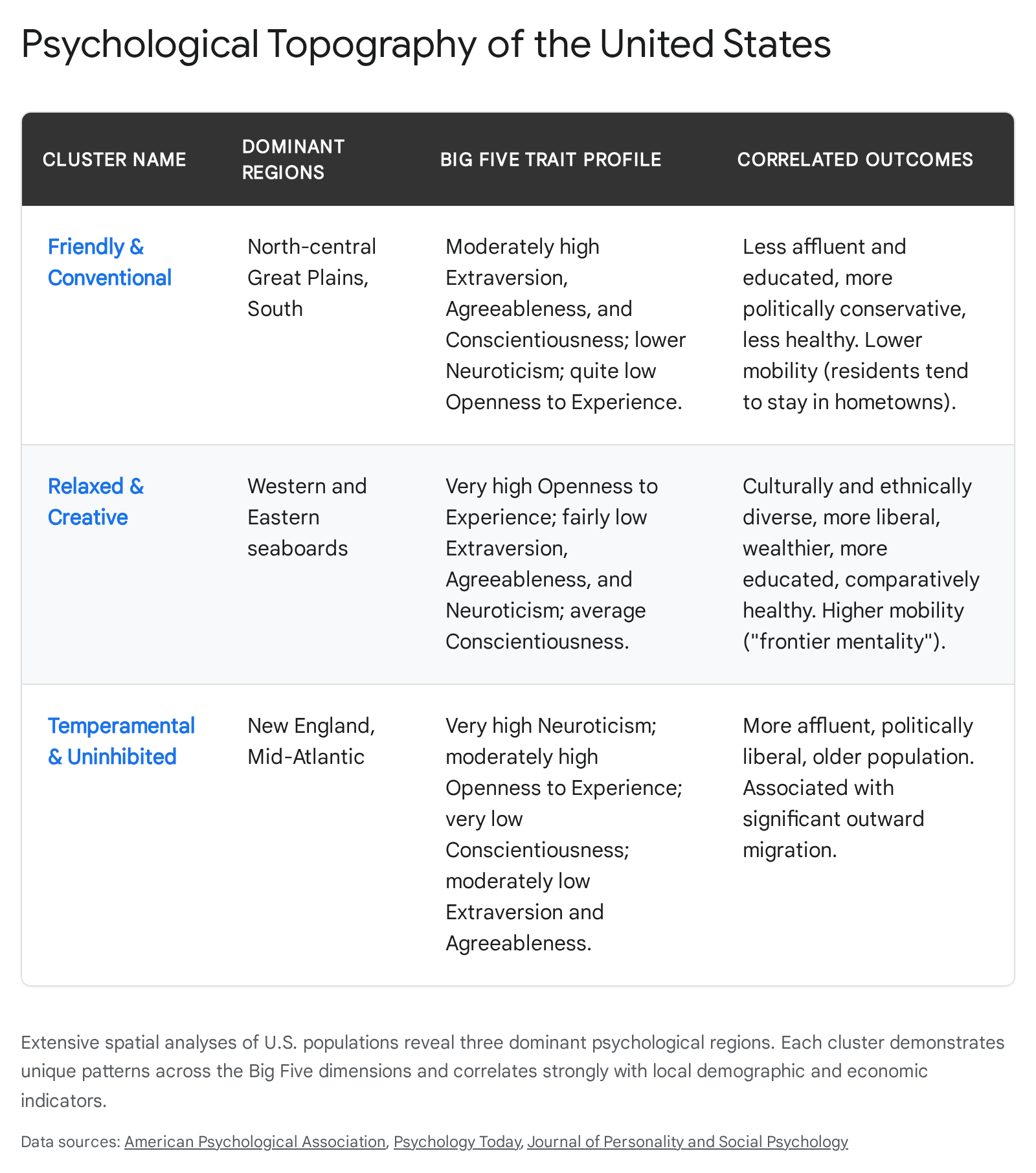
The first cluster, labeled Friendly and Conventional, dominates the north-central Great Plains and the Deep South 122. Residents in this geographic cluster display moderately high levels of Extraversion, Agreeableness, and Conscientiousness, coupled with lower Neuroticism and quite low Openness to Experience 122. Demographically, this region features significantly lower residential mobility, reflecting the tendency of highly agreeable and conventional individuals to remain in their home states 1. Macro-level correlates demonstrate that this geographic region is predominantly politically conservative, heavily Protestant, generally less affluent, and characterized by poorer overall physical health compared to other profiles 1.
The second cluster, Relaxed and Creative, is centered predominantly along the Western seaboard, the Rocky Mountains, and the Sunbelt, spilling into some Eastern seaboard states 12031. This profile is characterized by very high Openness to Experience, high emotional stability (low Neuroticism), and average Conscientiousness 2231. This geographic cluster heavily attracts geographically mobile individuals, young professionals, and immigrants seeking educational and employment opportunities, a dynamic linked to an enduring "frontier mentality" 133. Consequently, this region exhibits greater cultural and ethnic diversity, higher overall wealth, greater educational attainment, and heavily liberal political orientations 122.
The third cluster, Temperamental and Uninhibited, is clustered tightly in the Northeast and Mid-Atlantic states, particularly New England 12031. This profile is marked by starkly high Neuroticism, moderately high Openness to Experience, very low Conscientiousness, and moderately low Extraversion and Agreeableness 122. Residents here are more prone to stress, anxiety, and irritability. The geographic region features a larger proportion of women and older adults who are affluent and politically liberal 1. Furthermore, this region experiences significant out-migration; residents who leave the Northeast typically possess traits (high Openness and Conscientiousness, low Neuroticism) that are the precise opposite of the region's dominant profile, distilling the remaining population into a denser concentration of the temperamental archetype 133.
Correlates of Regional Clusters and Stereotype Accuracy
These geographic personality variations hold profound consequences for regional outcomes, but they also highlight the bizarre paradoxes of spatial aggregation. Curiously, the associations between traits and outcomes at the geographic aggregate level frequently contradict the known laws of individual-level psychology 22.
For instance, at the individual level, high Conscientiousness is universally linked to occupational success, higher income, longevity, and superior health behaviors 22. However, spatial econometrics reveals that U.S. states with the highest average levels of Conscientiousness actually exhibit lower life expectancies 22. Furthermore, gross state product in the United States is negatively correlated with both regional Agreeableness and regional Conscientiousness, meaning the most agreeable and organized geographic regions are often the poorest 22.
Geographic variations in personality also predict highly specific sociological trends, such as regional fertility patterns. Research mapping Big Five traits at the U.S. state level found that geographic regions high in Agreeableness and Conscientiousness exhibit highly traditional fertility patterns (higher birth rates, earlier maternal age). Conversely, states dominated by high Neuroticism and Openness display distinctly nontraditional fertility patterns (delayed childbearing, fewer children), even after controlling for regional demographics, religiosity, and voting behavior 3439.
Despite the complexity of these macro-level associations, humans are surprisingly adept at sensing geographic psychological variations. Studies evaluating the accuracy of U.S. regional personality stereotypes found that participants showed considerable accuracy - well above random chance - in judging how Openness to Experience and Neuroticism vary across different geographic regions of the country, likely deriving these accurate stereotypes from observable cues such as regional population density and local political voting patterns 40.
Sub-National Clustering in Europe and the Global South
The phenomenon of sub-national psychological clustering is not unique to the vast geography of North America; it replicates consistently across the denser, older geographic divisions of Europe and is beginning to be mapped across the Global South.
Spatial Econometrics in European Regions
In Great Britain, comprehensive geographic mapping across 380 Local Authority Districts analyzed a sample of nearly 400,000 residents. The spatial data revealed that traits like Agreeableness and Openness form highly localized clusters, where neighboring districts display mathematically similar personality profiles 2. These granular regional differences correlated robustly with key macro-level outcomes, mirroring the U.S. data: regional personality predicted geographic voting patterns, the density of start-up businesses, patent production, and mortality rates across the UK 220. In contrast to the United States, however, median regional incomes in the UK are associated with lower Conscientiousness 22.
In Sweden, Hot Spot spatial analysis (utilizing the Getis-Ord Gi statistic) of 22,225 geo-coded personality assessments demonstrated stark geographical differences despite the nation's global reputation for extreme socio-economic equality 41. The data identified that the southern Scania region operates as a concentrated "hot spot" for overlapping high Extraversion, Conscientiousness, and Emotional Stability - traits predictive of superior psychological functioning 41. Conversely, regions in central Sweden constituted significant "cold spots" for these exact traits, correlating broadly with municipal-level disparities in health and subjective well-being 41.
Analyses from the Estonian Biobank, utilizing an unprecedented sample representing 7% of the entire adult population (N = 72,268), further validate these geographic nuances 3536. Researchers documented that regional Big Five scores varied by 1.19 (Extraversion) to 2.78 (Openness) T-score units across Estonia's 15 counties, and up to 4.74 units across its 74 municipalities 3536. While the researchers noted that Estonian residents remained broadly similar in personality regardless of location (supporting the Similarities Hypothesis), controlling for spatial dependency, age, and gender confirmed that even these micro-regional personality deviations significantly and reliably correlated with local political, economic, social, and health indicators 3536. Regional differences in personality also demonstrate real-world behavioral consequences during global crises; meta-analyses of longitudinal studies during the COVID-19 pandemic revealed that geographic regions scoring higher in aggregated Extraversion experienced significantly sharper increases in societal loneliness compared to highly introverted regions 37.
Mapping Personality Profiles in Latin America
Sub-national geographic mapping outside of the WEIRD demographic sphere is increasingly prominent, challenging the assumption that spatial personality models are uniquely Western phenomena. Recent cross-cultural applications of the Revised International Personality Item Pool across 12 Latin American nations have identified broad clustering profiles that preserve the individual differences characterizing each geographic territory 3839.
Preliminary geographic mapping classifies South American countries into four main clusters of personality profiles. Geographic areas such as Ecuador are strongly associated with higher Agreeableness; Brazil and Paraguay skew heavily toward Openness to Experience and Conscientiousness; Peru, Chile, Argentina, and Uruguay form a distinct geographic cluster characterized by strong Extraversion and Emotional Stability; and nations like Bolivia, Venezuela, and Colombia display mixed profiles without a single dominant Big Five characteristic 39.
Within these nations, the psychometric validation of these instruments is advancing rapidly to ensure geographic data is reliable. In Brazil, a rigorous cross-cultural adaptation of the 44-item Big Five Inventory (BFI) across 490 participants from various regions yielded excellent psychometric properties (GFI: 0.924, CFI: 0.920, RMSEA: 0.044), confirming that the geographic assessment of the Big Five can be reliably deployed to map spatial psychopathology and local demographic trends outside of English-speaking populations 4041.
Personality Trait Development in Sub-Saharan Africa
Longitudinal geographic variation in Sub-Saharan Africa demonstrates that severe environmental and developmental factors can prompt regional trait shifts that contradict Western psychological models. Data from the Africa Long Life Study tracked personality development in 2,301 young adults across Kenya, Namibia, and South Africa over a one-to-two-year period 5042. Because the Big Five is often debated in African contexts, researchers focused on the broad, cross-cultural "Big Two" personality traits: Agency and Communion 5042.
In Western, WEIRD geographies, normative personality development during young adulthood almost universally features increases in traits related to Communion (Agreeableness) and Conscientiousness 1450. Contrary to these geographic expectations, the Sub-Saharan study observed significant normative decreases in both Agency and Communion across the study period 5042. The researchers utilized open-ended surveys to track local life changes, discovering that the occurrence and severe perception of environmental life events in these regions directly predicted the downward shift in personality traits 5042. This geographic variance proves that psychological maturation is not a globally uniform biological clock, but rather a flexible mechanism highly responsive to the specific ecological and cultural stressors of the local environment 42.
Analytical Hazards in Geographic Psychology
As geographic psychology advances in scope and technical capability, the discipline faces persistent methodological and statistical challenges that threaten the accurate interpretation of spatial personality data.
The Ecological Fallacy and Robinson's Paradox
The most critical statistical hazard in geographic psychology is the ecological fallacy. First formally codified by sociologist H. C. Selvin in 1958, the ecological fallacy is a logical error that occurs when researchers improperly deduce the characteristics, behaviors, or psychological states of an individual based solely on aggregate data derived from the group or geographic region to which they belong 434445.
The fallacy manifests primarily in three forms: the fallacy of composition (assuming what is true for the geographic group is true for the individual), the fallacy of division (assuming what is true for the individual applies to the geographic group), and the fallacy of misplaced concreteness (treating aggregate regional data as if it were individual-level data) 43. The root cause of the ecological fallacy is that geographic group data mathematically averages out the extreme intrinsic variance between individuals living within the exact same environment 4345.
This leads directly to Robinson's paradox - a phenomenon named after a landmark 1950 demographic study - where the statistical correlation between two variables at the regional aggregate level can differ substantially, or even invert entirely, compared to the correlation of those exact same variables at the individual level 434445. For example, observing that a specific U.S. geographic state averages high in Openness to Experience and high in median income does not mathematically imply that the highly open individuals within that state are the ones generating the high income 4445. A state may appear wealthy not because the average open individual is affluent, but because the geography contains a small number of ultra-wealthy individuals that drag the aggregate average upward 44.
Treating macro-level spatial clustering as a direct proxy for micro-level individual psychology fundamentally misrepresents the data 4546. The ecological fallacy demonstrates why geographic psychology must rely on complex multi-level spatial econometrics rather than simple regional averages to avoid generating heavily distorted public policies and inaccurate clinical assessments 4656. Geography provides the broad statistical constraints and the cultural atmosphere of an environment, but it does not uniformly mandate the psychological profile of the citizen.