
Founder influence on organizational culture and performance
Organizational culture operates as the invisible architecture of a corporate enterprise, dictating how human capital interacts, solves problems, and adapts to external stimuli. While historically marginalized as a "soft" human resources concern, empirical research over the past three decades demonstrates that culture is a structural determinant of long-term financial performance, asset valuation, and competitive resilience. The degree to which founders intentionally architect this culture in the early stages of enterprise development - and actively manage it against the accumulation of systemic "cultural debt" - directly influences a firm's trajectory from initial scaling to mature market dominance.
This report examines the quantitative evidence linking organizational culture to financial outcomes, analyzes the diagnostic frameworks used to measure cultural variables, and explores how founder-led decisions, particularly in modern remote environments and complex statutory landscapes, shape operational efficiency.
Empirical Foundations of Culture and Economic Outcomes
The premise that organizational culture drives financial performance rests on the theory that shared attitudes, behavioral patterns, and values reduce transaction costs within a firm, align employee motivation with corporate strategy, and facilitate rapid adaptation to market changes. Research has increasingly sought to quantify these dynamics, moving from anecdotal case studies to rigorous longitudinal and cross-sectional analyses to establish a definitive link between the psychosocial environment of a firm and its balance sheet.
Longitudinal Analysis of Cultural Adaptation
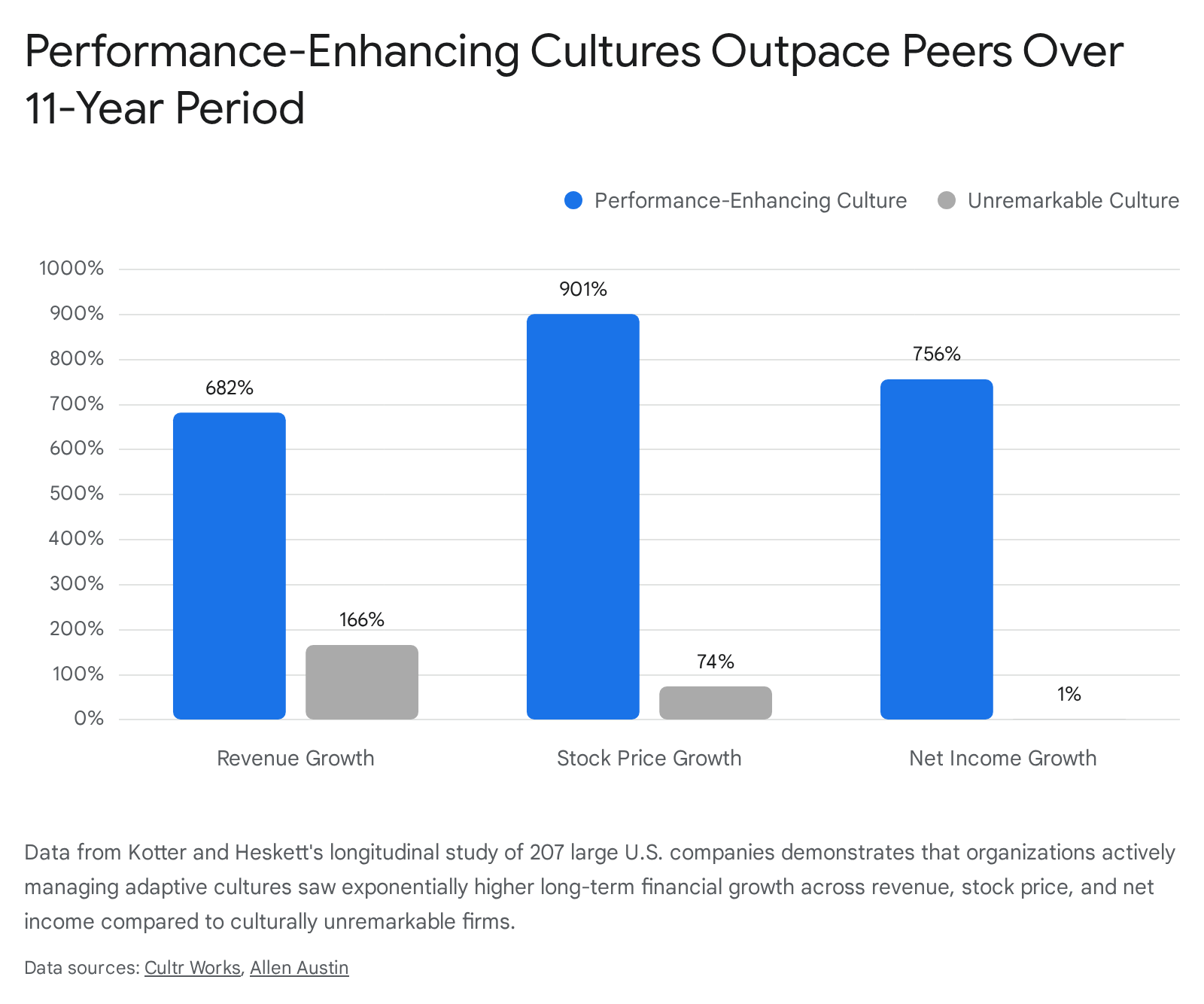
The most frequently cited benchmark for the financial impact of corporate culture is the longitudinal research conducted by John P. Kotter and James L. Heskett, published in their seminal 1992 text, Corporate Culture and Performance 1234. Analyzing 207 large United States companies across 22 different industries over an 11-year observation window, Kotter and Heskett sought to isolate the variable of organizational culture to determine its long-term economic effect 15.
The researchers established a critical theoretical distinction: merely possessing a "strong" culture, defined as an environment where values are widely shared and deeply held, is insufficient to guarantee financial success 2. If a strong culture is inward-looking, rigid, or resistant to external macroeconomic shifts, it can calcify an organization, resulting in strategic myopia and eroded performance 24. Instead, the decisive factor is whether a culture is fundamentally "adaptive." Adaptive cultures highly value external constituencies, including customers and stockholders, while simultaneously prioritizing internal stakeholders 24. Furthermore, adaptive cultures distribute autonomy, encouraging leadership and problem-solving at all levels of the firm rather than strictly at the executive tier 24.
The financial divergence between firms with adaptive, performance-enhancing cultures and those with culturally unremarkable or rigid environments was highly pronounced 1. Over the 11-year observation period, companies that actively managed adaptive cultures saw revenue increases of 682%, compared to a mere 166% for the control group of companies lacking such cultural frameworks 15. The disparity extended to market capitalization, with adaptive cultures achieving stock price growth of 901%, compared to 74% for non-adaptive cultures 15. The most dramatic variance was documented in profitability, with adaptive cultures reporting a 756% increase in net income, versus a negligible 1% increase for the control group 155.
Subsequent empirical studies have corroborated these foundational findings. Modern meta-analyses suggest that effective culture management can account for 20% to 30% of the differential in corporate performance when compared with culturally average competitors operating within the same sector 1. A comprehensive 10-year study conducted by the Queen's University Centre for Business Venturing found that organizations with highly engaged cultures experienced a 65% greater share-price increase, 26% less employee turnover, 15% greater employee productivity, and 30% greater customer satisfaction levels than their peers 1. Similarly, the "Firms of Endearment" longitudinal study validated the profit paradox, demonstrating that firms optimizing for stakeholder value and culture rather than short-term shareholder primacy outperformed the S&P 500 by a ratio of 9:1 over a ten-year period 5.
The Dimensions of Cultural Performance
Contemporary research has attempted to move beyond broad definitions of "strong" culture to isolate the specific cultural traits that drive profitability, utilizing standardized psychometric and operational models. One prominent tool is the Denison Organizational Culture Model, which assesses corporate environments across four primary traits: involvement, consistency, adaptability, and mission 687.
The application of the Denison model has yielded significant insights into how specific cultural attributes map to financial metrics. A study assessing United States insurance companies identified that cultural strength and adaptability predict short-to-medium-term asset growth and return on sales (ROS) 8. Similarly, researchers analyzing 137 public companies in the U.S. using the Denison framework found that cultural consistency had a significant positive relationship with market-to-book ratios and sales growth when coupled with high levels of employee involvement and mission orientation 8. Conversely, high consistency without adaptability occasionally yielded negative relationships with return on assets (ROA), underscoring the danger of rigid cultures 8. Furthermore, recent research within the banking sector indicated that an organization's mission is the most crucial predictor of overall organizational performance, followed sequentially by employee involvement, internal consistency, and environmental adaptability 7.
Other conceptual frameworks, such as the Organizational Culture Profile (OCP) developed by O'Reilly, Chatman, and Caldwell, measure cultures across dimensions including innovation, stability, respect for people, outcome orientation, and team orientation 910. Across these varied models, the recurring academic consensus is that a strategic alignment between a company's espoused cultural values, its internal operational systems, and its external market environment generates a competitive advantage that is rare, valuable, and exceedingly difficult for rival firms to imitate 11. This alignment extends into risk management and governance; for example, studies indicate that organizations exhibiting superior cultures characterized by high integrity and teamwork are more likely to utilize shorter-term debt structures, signaling a willingness to undergo frequent external monitoring due to reduced internal agency conflicts 12. Such firms also frequently achieve higher long-term credit ratings 12.
| Cultural Dimension | Primary Focus | Correlated Financial/Operational Outcomes |
|---|---|---|
| Mission / Purpose | Strategic direction, long-term vision, and meaningful intent 7. | Strongest predictor of overall organizational performance and long-term asset growth 78. |
| Adaptability | Sensing external market changes and organizational agility 8. | Increased short-term revenue growth, product innovation, and higher return on sales (ROS) 18. |
| Involvement | Employee empowerment, team orientation, and capacity building 8. | Reduced voluntary turnover, enhanced productivity, and higher customer satisfaction metrics 178. |
| Consistency / Stability | Core values, agreement, coordination, and integration 78. | High market-to-book ratios and operational efficiency; however, can reduce ROA if overly rigid 8. |
The Reverse Causality Debate in Organizational Research
Despite the robust correlative evidence linking positive organizational culture to superior financial outcomes, academic literature published in top-tier peer-reviewed journals, such as the Academy of Management Journal (AMJ) and Administrative Science Quarterly (ASQ), urges methodological caution regarding causal inferences 111314. A persistent challenge in organizational behavior research is the potential for "reverse causality" or endogeneity 13151816.
The reverse causality hypothesis posits an alternative explanation: rather than an engaged, humanistic culture driving high financial performance, preexisting high financial performance provides the "organizational slack" and excess capital necessary to afford and sustain a positive culture 11. Under this theory, highly profitable firms possess the gross margins required to invest in generous employee benefits, extensive leadership training, robust diversity initiatives, and highly collaborative, low-stress workspaces 11. Conversely, struggling firms facing severe margin compression and existential market threats may default to rigid, hierarchical, and high-pressure cultures out of pure survival necessity. In this view, culture is a luxury purchased by financial success, not the engine generating it 11.
Furthermore, self-reported limitations in management literature frequently cite the constraints of cross-sectional survey designs 131417. When all cultural variables and financial metrics are measured simultaneously via employee questionnaires and concurrent financial disclosures, separating the antecedent (culture) from the outcome (profitability) becomes statistically problematic 1317. To address these endogeneity concerns, researchers are increasingly employing sophisticated econometric techniques. Methods such as panel vector autoregression (PVAR) and Granger lead-lag tests are utilized to explore directional causality between variables - for example, determining whether team diversity and inclusive cultures precede high audit quality, or if high-performing audit teams simply attract more diverse talent 15. While the debate continues, the prevailing synthesis is that culture and performance operate in a cyclically reinforcing feedback loop; however, the early, intentional establishment of a healthy culture by founders acts as a critical leading indicator of future adaptability and resilience 1211.
Diagnostic Frameworks for Cultural Measurement
To effectively manage and shape culture, founders and executives must possess the tools to measure, classify, and diagnose it. The academic and corporate consulting communities rely primarily on two foundational frameworks to decode the complex psychological and structural layers of corporate environments: Edgar Schein's Three Levels of Culture and the Competing Values Framework.
Schein's Three Levels of Culture
Developed by Edgar Schein, a pioneering social psychologist and former professor at the MIT Sloan School of Management, this framework posits that organizational culture is not a monolithic entity but rather exists at varying depths of visibility and consciousness 181920. Schein's model is critical for founders attempting to align what the company publicly claims to value with how its personnel actually behave in practice. The model breaks culture down into three distinct strata:
First are Artifacts, representing the overt, visible, and tangible elements of an organization 6181920. Artifacts include physical office design, dress codes, technological infrastructure, corporate branding, published policies, and the observable public behavior of employees 1819. While artifacts are the easiest elements for an outsider to observe, they are highly ambiguous and subject to misinterpretation. For example, an open-plan office might ostensibly signal a culture of collaborative transparency, but it could simultaneously function as a mechanism for management surveillance and the erosion of employee privacy 18.
Second are Espoused Values, which represent the explicitly stated norms, strategies, goals, and philosophies of the organization 181920. Found in mission statements, employee handbooks, onboarding materials, and executive speeches, espoused values dictate how the company wishes to be perceived by both the public and its workforce. However, these stated values frequently fail to reflect the actual operational reality of the firm 19.
The third and deepest level consists of Basic Underlying Assumptions. This is the true core of the organizational culture, comprising unconscious, taken-for-granted beliefs, perceptions, and feelings that drive behavior 6181920. These deeply embedded assumptions dictate the unwritten rules of the organization: how work is genuinely accomplished, how interpersonal conflict is resolved, whose voices are prioritized, and who wields actual political power 919. Schein theorized that misalignment between espoused values (what the company says) and underlying assumptions (what the company actually believes and rewards) is the primary source of organizational dysfunction, political friction, and employee cynicism 91920.
The Competing Values Framework
While Schein's model focuses on analyzing the depth and authenticity of a culture, the Competing Values Framework (CVF), developed by researchers Robert Quinn and John Rohrbaugh, provides a diagnostic typology to categorize the functional orientation of a firm 2122. Based on extensive empirical factor analysis regarding the indicators of organizational effectiveness, the CVF maps culture across two intersecting tensions or axes: Internal versus External Focus and Flexibility versus Stability and Control 2324252627.
This matrix produces four distinct cultural archetypes. The framework's core premise is that these values inherently compete for limited corporate resources, time, and strategic focus 2325. No single quadrant is universally superior; rather, organizational effectiveness relies on balancing these competing values to match the firm's strategic goals and external environment 2127.
The Clan Culture occupies the internal focus and flexibility quadrant 92127. It operates similarly to an extended family, heavily emphasizing collaboration, team cohesion, consensus-building, and employee mentorship 2127. Leaders in Clan cultures function as facilitators rather than dictators. This archetype typically yields high employee satisfaction, deep corporate loyalty, and seamless internal communication 2127.
The Adhocracy Culture occupies the external focus and flexibility quadrant 92127. This environment is highly dynamic, entrepreneurial, and focused on creation, rapid innovation, and risk-taking 212627. Leaders are viewed as visionaries who champion agility. Adhocracies excel at achieving first-to-market advantages, driving product innovation, and rapidly adapting to technological disruption 212627.
The Market Culture occupies the external focus and stability quadrant 92127. Organizations with this culture are fiercely competitive, results-oriented, and externally driven 212627. The focus is entirely on capturing market share, achieving profitability targets, and outpacing industry rivals. The primary outcomes of a Market culture are aggressive goal attainment and financial dominance 212627.
The Hierarchy Culture occupies the internal focus and stability quadrant 92127. This culture is highly structured, formalized, and controlled 212627. Leadership focuses on organizing, coordinating, and optimizing internal processes. The defining outcomes of a Hierarchy culture are operational consistency, rigorous risk mitigation, and smooth, predictable execution at scale 212627.
| Framework Feature | Edgar Schein's Three Levels of Culture | Competing Values Framework (CVF) |
|---|---|---|
| Primary Objective | To uncover hidden psychological assumptions and assess the authenticity of stated values 1827. | To diagnose the cultural typology of a firm and balance competing strategic priorities 212227. |
| Core Dimensions | 1. Artifacts (Visible) 2. Espoused Values (Stated) 3. Underlying Assumptions (Unconscious) 1819. |
Axis 1: Internal vs. External Focus Axis 2: Flexibility vs. Stability 2627. |
| Resulting Classifications | None (Provides a methodology for individual depth analysis rather than strict categorization) 18. | Clan (Collaborate), Adhocracy (Create), Market (Compete), Hierarchy (Control) 92127. |
| Primary Use Case | Diagnosing the root causes of failed change initiatives or misaligned political behavior 920. | Quantifying current vs. preferred culture to guide structural transformations and M&A integration 232527. |
| Measurement Methodology | Primarily Qualitative: Requires ethnographic observation, open interviews, and long-term assessment 6. | Primarily Quantitative: Uses the Organizational Culture Assessment Instrument (OCAI) to score profiles 627. |
Cultural Debt: The Accumulation of Systemic Dysfunction
As startup enterprises transition into scale-ups, founders inevitably confront severe resource constraints. The intense pressure to prioritize rapid product development, immediate customer acquisition, and aggressive headcount expansion frequently leads to the systemic neglect of intentional culture management. This dynamic gives rise to a phenomenon known as "cultural debt."
Defining Cultural Debt in the Corporate Ecosystem
Borrowing conceptually from the software engineering principle of "technical debt," cultural debt refers to the long-term, compounding negative consequences an organization accumulates by failing to establish, communicate, or defend a healthy workplace environment early in its lifecycle 2829303132.
When leadership teams make short-term operational trade-offs - such as promoting a highly productive but toxic employee, ignoring communication silos, implementing performance metrics that incentivize selfish behavior, or rapidly expanding the workforce without adequate onboarding regarding core values - they accrue cultural debt 2931. Much like financial or technical debt, cultural debt accrues interest. Over time, these seemingly minor, unaddressed friction points compound into massive systemic dysfunctions that throttle the company's ability to innovate, retain talent, or scale effectively 303132.
The Financial and Operational Consequences
Cultural debt is notoriously difficult to diagnose in its nascent stages because its symptoms are highly subtle. Early warning signs include slight dips in baseline morale, increased hesitation during strategic meetings, the slowing of cross-departmental communication, or a rise in minor interpersonal conflicts 3136. Unlike technical debt, which frequently triggers clear performance alerts, server latency, or system crashes, cultural debt hides within the nuances of human interaction and team dynamics 36.
However, if leadership fails to actively pay down this debt through intervention, it manifests in severe financial and operational penalties:
First, a misaligned or toxic work environment drives high voluntary turnover. The direct cost of replacing specialized talent, coupled with the loss of institutional memory and the time required to retrain new teams, poses a massive financial burden. On a macroeconomic scale, disengaged workers were estimated to cost the global economy approximately $438 billion in 2024 alone 3033. Furthermore, 62% of U.S. companies report that retaining existing employees is currently more challenging than finding new hires, underscoring culture's direct role in mitigating turnover costs 33.
Second, cultural debt causes innovation stagnation, frequently referred to in organizational literature as "dark debt" 29. This occurs when an organization lacks psychological safety, preventing employees from taking calculated risks or reporting early-stage failures. When failures inevitably occur and lead to systemic finger-pointing and blame rather than blameless post-mortems and organizational learning, dark debt accumulates rapidly 29. This environment completely stifles a firm's "Adhocracy" capabilities, ensuring that employees optimize for personal safety rather than corporate innovation 29.
Third, the introduction of Generative Artificial Intelligence (AI) into the workplace is creating new vectors for cultural debt 2834. A 2026 Deloitte Global Human Capital Trends survey found that 80% of corporate leaders, managers, and workers are deeply concerned that their coworkers and teams are utilizing AI to appear more productive than they actually are 34. This technological abstraction erodes foundational workplace trust. When individuals work less with one another due to an increased reliance on AI agents, the fundamental human-to-human connections that sustain corporate culture weaken, resulting in a unique, modern form of cultural debt 34.
| Indicator Category | Active Culture Management | High Cultural Debt |
|---|---|---|
| Turnover Dynamics | Low voluntary attrition; high retention of top talent; robust internal promotion pipelines 130. | High voluntary turnover; loss of tribal knowledge; difficulty recruiting top talent due to poor employer brand 3031. |
| Psychological Safety | Failures treated as systemic learning opportunities; high candor; open communication 1929. | Failures lead to immediate finger-pointing; lack of candor; "good news only" reporting to executives 2931. |
| Performance Metrics | KPIs align with long-term strategic value; metrics measure actual business throughput 29. | Metrics incentivize undesirable behavior ("gaming" the system); focus on busyness over business value 2931. |
| Innovation Velocity | Rapid adaptation to market changes; high employee autonomy and calculated risk tolerance 2135. | Slow decision-making; systemic resistance to new processes; rigid reliance on outdated procedures 293136. |
| Technological Trust | Transparent use of AI as an enablement tool; maintained human-to-human connection 34. | Widespread suspicion of AI-faked productivity; erosion of interpersonal trust and collaboration 34. |
Strategic Architecture: Founder Influence on Early-Stage Culture
The etiology of any organization's culture begins unequivocally with its founders. According to organizational scholars, an enterprise's initial culture is essentially the externalization of the founder's personal values, biases, work habits, and problem-solving methodologies 1836.
Culture typically forms organically in the earliest days of a startup as the core team works closely together. However, organizational theorists suggest that a critical inflection point occurs when a company reaches roughly 60 to 70 employees 36. At this size, the founding team can no longer maintain direct, daily interpersonal relationships with every staff member. If cultural values are not explicitly codified and structurally reinforced by this stage, the culture will inevitably fragment, isolated subcultures will develop, or a corporatized, inauthentic version of the culture will be imposed top-down by human resources departments 36.
Divergent Paths to Success: Zappos versus Amazon
A comparative analysis of two highly successful e-commerce entities - Zappos and Amazon - illustrates how dramatically different founder philosophies can dictate organizational architecture, while still yielding exceptional, albeit distinct, market performance 3541.
Zappos: Culture as the Primary Product Under the leadership of the late Tony Hsieh, Zappos operated on the foundational belief that maximizing employee happiness creates a systemic "trickle-down" effect that results in unparalleled customer service 3541. Zappos categorized itself functionally as a customer service company that simply happened to sell shoes 37. To ensure absolute cultural alignment, Zappos instituted extreme protective measures, including an intensive four-week cultural bootcamp for all new hires 35. Famously, the company offered new employees a cash buyout to quit immediately after completing the training, ensuring that only those truly committed to the company's ethos remained - a mechanism that helped maintain an unusually low turnover rate of roughly 12% 3538.
Operationally, Zappos prioritized teamwork, an extremely flat hierarchy, and ultimately transitioned to "Holacracy" - a radical, decentralized governance structure devoid of traditional managers, where autonomous teams self-organize to solve problems 353839. The culture explicitly optimized for a blend of "Clan" and "Adhocracy" typologies, driven by codified core values such as "Create Fun and A Little Weirdness" and "Be Humble" 3640.
Amazon: Data, Scale, and Internal Competition Conversely, Amazon, led by founder Jeff Bezos, constructed a culture anchored firmly in the Competing Values Framework's "Market" and "Hierarchy" quadrants 3541. Amazon's culture is famously performance-driven, hierarchical, and relentlessly focused on data-driven decision-making, operational efficiency, and massive global scale 3541.
While Zappos emphasizes emotional connection and team harmony, Amazon's environment embraces high pressure and competitive internal rivalries explicitly designed to push employees to their absolute limits 3541. Amazon's operational systems incentivize continuous measurement, rapid execution, and disruption, utilizing mechanisms like employee-initiated data tracking to optimize output and identify low performers 35. While overall turnover and employee stress are significantly higher, Amazon's culture functions as a highly effective filter, attracting and retaining highly ambitious, resilient talent capable of executing at an unprecedented scale 35.
Ironically, despite possessing diametrically opposed cultural frameworks, Amazon recognized the distinct economic value of Zappos's model, acquiring the shoe retailer in 2009 for $1.2 billion and largely allowing it to operate as an independent cultural subsidiary to preserve its unique operational dynamics 3539.
| Cultural Dimension | The Zappos Model | The Amazon Model |
|---|---|---|
| Primary Focus | Employee happiness and engineering customer "WOW" moments 3537. | Operational efficiency, scale, and rigorous consumer data optimization 41. |
| Organizational Structure | Flat hierarchy transitioning to Holacracy (autonomous, self-governing teams) 353839. | Clear lines of authority, hierarchical structure, strict vertical accountability 41. |
| Internal Environment | Highly collaborative, fun, prioritizing team cohesion and personal relationships 4140. | High-pressure, competitive, rivalrous, and intensely performance-driven 3541. |
| Hiring and Retention | Obsessive focus on cultural fit; intensive bootcamp; buyout offers to weed out unaligned hires 3541. | Focus on technical competence, raw ambition, and ability to survive a demanding environment 35. |
| Decision-Making Style | Distributed, consensus-oriented, client-focused autonomy 3541. | Top-down, deeply empirical, reliant on statistical models and strict KPIs 3541. |
The Codification and Propagation of Values
Founders who successfully scale their cultures engage in active and relentless codification. This transcends hanging a generic mission statement in the corporate lobby. Effective codification integrates the culture directly into daily operational artifacts and performance reviews. For example, Netflix revolutionized cultural propagation by publishing its internal "Culture Deck" in 2009, detailing highly specific, non-negotiable behavioral expectations surrounding its "Freedom and Responsibility" ethos 3640. Zappos similarly published an annual "Culture Book," composed of unedited essays from employees detailing exactly what the culture meant to them, serving as both an internal artifact and an external recruiting tool 36. By turning abstract psychological values into physical manifestations, founders translate their basic underlying assumptions into tangible artifacts that guide massive workforces at scale 1936.
Cultural Adaptation in Hybrid and Distributed Environments
The post-2020 macroeconomic transition to remote and hybrid work models has severely tested traditional methods of cultural transmission. The physical office historically served as the primary artifact for cultural immersion. Without physical proximity, casual, unplanned interpersonal interactions - which are vital for building general trust and emotional rapport - are exceptionally difficult to replicate, leading to widespread executive concerns regarding team cohesion, siloed communication, and the rapid erosion of brand loyalty 4741.
Evolving Performance Metrics in Distributed Teams
Early debates regarding remote work centered simplistically on raw productivity metrics. However, recent empirical research conducted between 2024 and 2025 demonstrates a much more nuanced reality: productivity is highly contingent upon the specific job type, individual disposition, and exactly how hybrid policies are deployed by management 4742. While nearly 90% of workers report feeling equally or more productive at home, the lack of a shared physical environment can fragment a company's "Culture Multiplier Effect" - the reinforcing cycle where strategic alignment improves employee wellbeing, which bolsters intrinsic motivation, thereby driving sustained performance 4344.
Furthermore, the distributed nature of modern work has given rise to new behavioral trends, such as "polyworking," where employees secretly maintain multiple full-time jobs. Recent data indicates that up to 28% of employees maintain additional jobs or side hustles, a phenomenon particularly prevalent among Generation Z and Millennial cohorts 42. This trend, combined with the aforementioned use of AI to mask true productivity levels, poses unprecedented challenges to cultural trust and engagement 3442.
The Role of Intentional System Design
To maintain strong cultures in distributed environments, successful founders and executives are shifting away from rigid, one-size-fits-all mandates, such as arbitrary return-to-office policies enforcing a specific number of days in a physical building. Research consistently shows that forced office returns can severely damage talent retention, breed internal resentment, and inadvertently decrease productivity 4744.
Instead, forward-thinking organizations are implementing highly sophisticated, intentional hybrid models. This involves shifting the operational focus from where employees sit to how work is fundamentally structured, utilizing concepts like designated "core collaboration hours" versus protected "focus time" 4745. Furthermore, organizations are replacing passive, mandatory office attendance with highly structured virtual team-building exercises and high-quality, periodic in-person gatherings 4745. In this new paradigm, culture is sustained not by physical proximity, but by a consistent system of behaviors, hyper-clear communication of organizational purpose, and demonstrable leadership care 43.
Statutory Constraints and Scaling Friction: The European Context
While founders exert immense influence over the internal culture of their enterprises, their operational canvas is ultimately bounded by the legal and statutory frameworks of the specific jurisdictions in which they operate. This friction is particularly evident in the European technology sector, where unique legal structures heavily impact startup culture, operational agility, and scaling velocity.
The Impact of European Co-Determination Models
In stark contrast to the highly flexible "at-will" employment models prevalent in the United States, several European nations, most notably Germany, operate under comprehensive statutory systems of "co-determination" (Mitbestimmung) 5346. Co-determination mandates that employees possess a legal right to participate directly in the management of the company, a right typically executed through the formation of powerful internal works councils and mandatory employee representation on corporate supervisory boards 53.
For early-stage startup founders, the demand from employees to establish a works council is frequently viewed with significant trepidation 55. It introduces a permanent layer of organizational hierarchy and procedural bureaucracy that can directly conflict with the agile, fast-moving, "Adhocracy" culture that is generally considered vital for early-stage tech ventures 55. However, from the perspective of the workforce, co-determination is often viewed as a natural, legally protected extension of the "act like an owner" mentality - a critical mechanism to ensure employees retain a powerful voice during periods of rapid scaling, cross-border M&A activity, or macroeconomic downturns resulting in layoffs 55.
Empirical research presents a highly complex, dual narrative regarding the impact of co-determination on performance. On one hand, robust evidence suggests that co-determined companies operate with significantly greater long-term sustainability, train more personnel, provide greater job security, and serve as an essential, stabilizing counterweight to the intense short-term scaling pressures often applied by venture capital investors 53. Furthermore, academic studies utilizing patent data have found suggestive evidence of a positive impact of co-determination laws on long-term corporate innovation rates, indicating that job security may foster the psychological safety necessary for complex R&D 56. On the other hand, the intense administrative friction associated with navigating varied, strict labor laws across 27 different EU member states severely impedes the rapid scaling capabilities of European startups, placing them at a distinct structural disadvantage compared to their American counterparts 4647.
The "28th Regime" and the Harmonization of Scaling
To combat the severe regulatory fragmentation that currently forces many of Europe's most promising startups to flip their legal incorporation to the United States (often Delaware) in order to fundraise and scale, the European Commission has aggressively debated the implementation of a "28th Regime" 4648.
Expected to be formally unveiled in 2026, the 28th Regime proposes an optional, EU-wide company legal status designed specifically from the ground up for startups 4648. This framework would allow a new enterprise to incorporate exactly once and subsequently operate seamlessly across all 27 EU member states under a single, unified set of rules regarding corporate governance, tax reporting, and the issuance of employee stock options 4648. By circumventing the maze of national-level administrative hurdles and harmonizing labor relations, the 28th Regime aims to preserve the immense cultural and innovative talent pools residing within Europe, while simultaneously providing the structural agility necessary to generate globally dominant technology firms 4648.
Conclusion
The extensive body of academic research, longitudinal studies, and corporate case histories confirms definitively that organizational culture is not a peripheral administrative function, but rather a core, structural driver of financial performance. Firms that intentionally cultivate adaptive cultures - characterized by acute external market awareness, high levels of employee involvement, and robust strategic mission alignment - demonstrate exponentially higher growth in revenue, market valuation, and net income over extended periods.
Conversely, the failure of founding teams to codify and actively manage culture, particularly during critical phases of rapid scaling, results in the silent, compounding accumulation of cultural debt. This systemic debt inevitably exacts a heavy toll on the enterprise through elevated voluntary attrition, the suppression of internal innovation, and widespread operational inefficiency. Whether navigating the unprecedented complexities of highly distributed hybrid workforces or the intricate statutory realities of global expansion and co-determination, modern enterprises must treat culture as a rigorously measurable, engineered system. It remains the primary mechanism through which corporate strategy is executed, and ultimately, the ultimate determinant of organizational survival and market leadership.