
Factors influencing marriage delay and family formation
The Global Reconfiguration of Nuptiality
Across the developed world, the institution of marriage is undergoing a profound structural, economic, and ideological transformation. Historically functioning as the foundational gateway to adulthood - a cornerstone upon which young adults built their economic and social lives - marriage has increasingly been delayed, reimagined, or bypassed entirely 113. This demographic shift is not merely a statistical anomaly or a temporary generational fluctuation; it represents a fundamental rewiring of the social contract. Driven by a complex matrix of post-pandemic economic realities, the rising premium on higher education, shifting gender dynamics, and the pursuit of individual self-actualization, young people are redefining the timelines and prerequisites of family formation.
Sociologists characteristically refer to this contemporary shift as the "deinstitutionalization of marriage," a macroscopic process wherein the rigid social norms governing marriage have weakened 323. Under this theoretical framework, marriage has transitioned from a mandatory social obligation and an essential unit of economic survival into an optional, highly individualized achievement 36. As this transition unfolds globally, a fierce ideological and academic debate has emerged. On one side, conservative think-tanks and family scholars frame the retreat from marriage as an acute societal crisis that threatens to destabilize communities, isolate individuals, and exacerbate economic inequality. On the other side, demographic and sociological researchers interpret this trend as a rational adaptation to an increasingly precarious economic landscape, evolving labor markets, and the dismantling of outdated patriarchal structures 4567.
This comprehensive report delivers an exhaustive analysis of the structural and cultural factors driving the delay and rejection of marriage among young adults. By synthesizing recent post-pandemic data spanning 2022 to 2024 regarding macroeconomic inflation, housing market spikes, and the entrenchment of remote work, this document uncovers the underlying economic mechanisms of modern family formation. Furthermore, by analyzing the profound class divides in nuptiality and examining radical cultural movements in East Asia, the analysis provides a holistic view of global demographic trends. Ultimately, it evaluates the persistent societal misconception that the delay of legal marriage equates to a generational abandonment of long-term commitment.
The Demographics of Delay: A Historical Comparative Perspective
To understand the current state of marriage, it is necessary to track its historical trajectory over the past half-century. Over the past five decades, the median age at first marriage has surged across virtually all post-industrial nations. This delay is heavily correlated with the expansion of higher education, the mass entry of women into the labor force, and the widespread availability of modern contraception, which effectively decoupled sexual intimacy from marital reproduction 8913.
The upward trend is starkly visible across different geopolitical regions, though the baseline ages and specific cultural contexts vary significantly. In the United States, the median age at first marriage has increased by roughly seven years since 1970 3141011. In the Nordic countries, known for their robust social welfare systems, high rates of secularization, and early adoption of progressive gender norms, the age of first marriage routinely exceeds 33 years. In these nations, long-term cohabitation has largely replaced early marriage as the normative context for young adulthood and even early childbearing 1218.
In East Asia, a region characterized by rigid corporate work cultures and exorbitant costs of living, the delay has been particularly acute in recent decades, pushing the average age of first marriage well into the thirties 131415. The rapidity of the shift in East Asia is staggering; for instance, the average age of first marriage for South Korean men increased by nearly six years between 1994 and 2024, representing a massive cultural shift in just a single generation 1314.
Table 1: Historical Shift in Average/Median Age at First Marriage Across Key Regions (1970 - 2024)
| Country / Region | 1970 (Men / Women) | 1990 (Men / Women) | 2010 (Men / Women) | Post-Pandemic (2020 - 2024) (Men / Women) |
|---|---|---|---|---|
| United States | 23.2 / 20.8 | 26.1 / 23.9 | 28.2 / 26.1 | 30.5 / 28.6 |
| Sweden | ~27.2 / 24.3 | ~29.5 / 27.0 | 32.8 / 30.5 | 35.0 / 33.3 |
| Denmark | ~26.5 / 23.8 | 30.1 / 27.6 | 32.2 / 30.0 | ~34.0 / 32.0 |
| Norway | ~26.0 / 23.5 | ~29.0 / 26.5 | 31.5 / 29.8 | ~37.6 / 36.8 |
| Japan | 26.9 / 24.2 | 28.4 / 25.9 | 30.5 / 28.8 | 31.1 / 29.4 |
| South Korea | 27.1 / 23.4 | 27.8 / 24.8 | 31.8 / 28.9 | 33.9 / 31.6 |
Note: Data aggregated from national census bureaus, Eurostat, and demographic tracking indices. Values reflect median or average estimates depending on national reporting standards. Exact historical parity varies by data collection methodologies, but the overarching chronological trend is uniform 1011121314162324.
This statistical progression reveals a critical second-order insight: marriage is no longer the catalyst for adulthood; it has become the capstone. Young adults are systematically utilizing their twenties to accumulate human capital, establish financial solvency, and explore individual identity. Consequently, the period of "emerging adulthood" has elongated, effectively pushing family formation into the third decade of life and beyond.
The Theoretical Divide: Societal Crisis Versus Rational Adaptation
The interpretation of these profound demographic shifts has generated a polarizing ideological debate between conservative think-tanks and academic sociologists. This ideological schism frames not only how the data is interpreted but also the future of family policy and cultural messaging across Western societies.
Table 2: Contrasting the Framing of Nuptial Decline
| Dimension | Decline as Societal Crisis (Think-Tanks / Conservative Institutes) | Decline as Rational Adaptation (Peer-Reviewed Sociological Journals) |
|---|---|---|
| Primary Institutional Proponents | Institute for Family Studies (IFS), Heritage Foundation, National Marriage Project 131726. | Academic Demographers, Sociologists (e.g., Andrew Cherlin, SDT theorists) 32478. |
| Core Theoretical Framework | "Cornerstone Marriage" - Marriage should function as the foundation upon which young adults jointly build their lives 11314. | "Second Demographic Transition" (SDT) & "Pattern of Disadvantage" - Individuals optimize for self-actualization or are structurally boxed out 78913. |
| Perspective on Delayed Marriage | Detrimental. Delaying creates a "settled self" that is rigid. It causes demographic collapse and denies youth the happiness found in early marriage 131327. | Logical optimization. Allows individuals (especially women) to establish economic independence and secure higher-quality, equitable matches 4828. |
| Interpretation of Alternative Models | Cohabitation is a substandard substitute lacking "enforceable trust," leading to relationship instability and social atomization 126. | Cohabitation and LAT are valid evolutionary adaptations to changing gender roles, housing shortages, and the modern need for relational flexibility 81819. |
| Dominant Policy Prescriptions | Cultural renewal of traditional family values, promoting the "Success Sequence," and destigmatizing early marriage 12631. | Structural economic reform, legally recognizing diverse family models, subsidizing childcare, and addressing the "marriage bar" 420. |
The Crisis Narrative: The Advocacy for "Cornerstone" Marriage
Organizations operating within the think-tank sphere, such as the Institute for Family Studies (IFS), the Heritage Foundation, and the Wheatley Institution, consistently argue that the shift toward the "capstone" model of marriage represents a profound societal failure. They contend that the contemporary cultural script - which demands that young adults "get their lives together" financially and professionally before considering marriage - creates an impossibly high standard. This standard ultimately leaves millions of working-class adults permanently unpartnered and exacerbates systemic inequality 3141721.
These groups heavily promote the "cornerstone" model, advocating for marriage in the early twenties (typically ages 20 - 24). Their ideological framework asserts that early-married couples who build their lives jointly form a shared "we-dentity." This shared identity is argued to be more resilient and adaptable than the merger of two rigidly independent individuals who have spent a decade cultivating a "settled self" 11721. Furthermore, think-tank data frequently contradicts the popular assumption that early marriages are intrinsically doomed to failure. Recent reports indicate that cornerstone marriages report equivalent, and in some metrics slightly higher, levels of relationship quality, teamwork, and sexual satisfaction compared to later capstone marriages 31721. From this perspective, the delay of marriage is not a rational optimization, but a tragic consequence of a culture that has devalued "enforceable trust" and family obligations in favor of a hyper-individualistic pursuit of careerism and optionality 1131.
The Rational Adaptation Narrative: The Second Demographic Transition
Conversely, the peer-reviewed demographic and sociological literature heavily contextualizes the decline of marriage within the framework of the "Second Demographic Transition" (SDT) and rational choice theory 7813. Developed by demographers Ron Lesthaeghe and Dirk van de Kaa, the SDT theory posits that as societies achieve higher levels of economic affluence and basic physiological needs are met, cultural values naturally shift. Societies move away from traditional, survival-based obligations and religious constraints, leaning heavily into post-materialist values that emphasize individual autonomy, gender equality, and psychological self-actualization 78913.
Within the SDT framework, the delay of marriage is viewed as an entirely rational adaptation strategy. For women, whose earning power and educational attainment have surged over the past few decades, the traditional patriarchal utility of marriage has plummeted. Theoretical perspectives suggest that the rising value of women's time, combined with their economic independence, drastically lowers the urgent need for a marital union 4. Delaying family formation allows women to establish robust careers, thereby reducing their vulnerability to the well-documented "motherhood penalty" and ensuring they enter eventual partnerships on egalitarian terms rather than as economic dependents 428.
Furthermore, the rational adaptation narrative points out that for economically disadvantaged individuals, delaying or avoiding marriage is a highly logical response to the "marriage squeeze" - a localized lack of economically stable, employable partners. In unstable economic environments, tying one's legal and financial fate to a precarious partner is an irrational risk that rational actors seek to avoid 48. Thus, the delay is not a moral failing, but a strategic repositioning to survive complex structural constraints.
Post-Pandemic Economic Constraints: Inflation, Housing, and the Marriage Bar
The period between 2022 and 2024 introduced unprecedented macroeconomic shocks that further altered the calculus of family formation. The post-COVID-19 era was characterized by historic global inflation, severe spikes in housing markets, and major shifts in the labor market 2236. Together, these factors created an environment where the traditional prerequisites for marriage became increasingly unattainable for a vast segment of the young adult population.
The "Marriage Bar" and the Crisis of Affordability
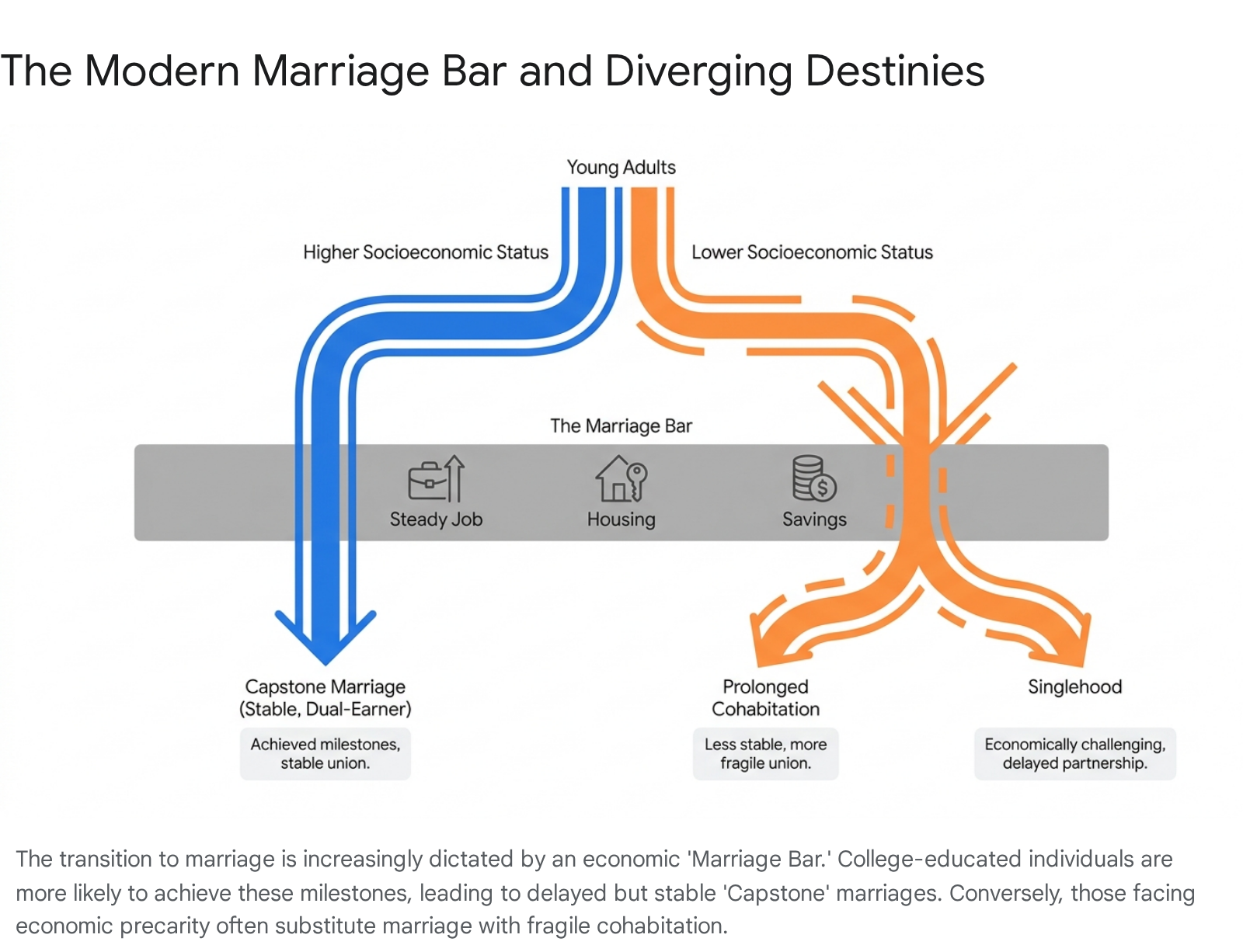
Central to understanding the economic delay of marriage is the sociological concept of the "marriage bar." This theory explains that contemporary couples feel a pervasive societal pressure to achieve specific, highly visible economic milestones before they consider themselves "ready" for marriage 2123. These milestones universally include steady employment and the reduction of debt, but for college-educated demographics, the bar is set even higher to include homeownership and the resources to afford a culturally validated, expensive wedding 23. Marriage is heavily intertwined with the concept of middle-class respectability; if couples cannot afford a household that signifies financial stability, they choose to delay the institution or remain in prolonged cohabitation to pool resources 23.
Between 2022 and 2024, sustained inflationary pressures and soaring interest rates severely undermined young adults' purchasing power. Housing market spikes transformed homeownership from a standard developmental milestone into an exclusionary luxury good 2224. As property values vastly outpaced wage growth, the perceived financial readiness for marriage evaporated for millions of young adults. This economic vise operates as a rational deterrent: from an economic standpoint, rational actors facing poor or highly uncertain economic prospects tend to heavily discount the future 4. For young adults navigating this landscape, postponing marriage is not an indicator of commitment-phobia, but a strategic, rational adaptation to mitigate severe financial risk and avoid the compounding stressors of forming a household under economic duress 42225.
The "Weathering Hypothesis" and Resource-Based Flexibility
The impact of these economic constraints is not distributed equally. Sociological models highlight the "weathering hypothesis," which suggests that for individuals living in poverty, highly stressful lives lead to deteriorating health in early adulthood. In these specific circumstances, early family formation - sometimes manifesting as early non-marital childbearing - can actually be an inventive and rational response to profound social hardship, securing familial bonds before health declines 45.
However, for the broader population, the prevailing dynamic is one of resource-based flexibility. Individuals with high levels of education and resources have the flexibility to time their marriages and births strategically across their life course, navigating around economic downturns. Those with fewer resources find themselves with less flexibility, often resulting in permanent delays as the "marriage bar" moves perpetually out of reach due to localized inflation and stagnant wages 48.
The Paradoxical Impact of Remote Work on Family Formation
The mass adoption of remote work, initially a public health necessity that transitioned into a structural norm by 2024, has had profound yet paradoxical implications for family formation timelines. By the end of 2024, approximately one in five American workers operated remotely, with higher concentrations observed among white-collar, college-educated professionals and Asian Americans 364026. On the surface, remote work provides significant lifestyle benefits that should theoretically foster family formation: it eliminates arduous commute times, substantially reduces self-reported stress, and allows young adults to relocate away from hyper-expensive urban centers to more affordable regions, ostensibly accelerating their path to homeownership 4042.
However, detailed demographic and economic data reveals complex third-order effects that actively inhibit marriage. Remote work has inadvertently exacerbated existing gender disparities in the division of domestic labor. A crucial 2022 - 2024 longitudinal study of dual-earner spouses operating under remote work mandates demonstrated that the benefits of remote work were profoundly gendered. While male remote workers frequently experienced gains in salary and extended their productive work hours, female remote workers saw their professional gains curtailed by a disproportionate increase in household chores and caregiving responsibilities 27.
This disparity creates severe relational friction. When the home becomes the office, the traditional boundaries that shield women from the "second shift" of domestic labor dissolve. The visible asymmetry in remote-work environments serves as a potent disincentive for young women to enter formal marital contracts, wherein they logically anticipate bearing the brunt of domestic management 2027.
Furthermore, while remote work provides geographic flexibility, it heavily isolates young adults during their prime dating and socialization years 2836. The drastic reduction in serendipitous in-person interactions - historically a primary driver of romantic assortative mating - has disrupted traditional pathways to finding a partner. Interestingly, Generation Z, despite being digital natives, reported the lowest application rates to remote roles (just 35.5% for 20-24 year olds), citing a craving for the social interactions that facilitate both professional and personal networking 40. Consequently, remote work functions as both an economic enabler and a social restrictor, contributing to the broader delay in relationship progression by narrowing the organic dating pool.
The Class Divide in Marriage: Diverging Destinies
As visually modeled above, the narrative of marriage decline is not a uniform societal experience; it is starkly stratified by socioeconomic class. Sociologists have rigorously documented a phenomenon known as "diverging destinies," wherein the family formation patterns of the highly educated and the less educated have radically polarized over the past few decades 7828.
For adults with a four-year college degree, marriage has experienced only a very slight decline 31. This demographic group strongly adheres to the "capstone" model of marriage. They methodically delay family formation to complete higher education, establish dual-career households, and achieve financial security 13123. Once these economic and developmental milestones are met, they marry at high rates and experience significantly lower rates of divorce compared to other groups. For this cohort, marriage remains a powerful, highly functional institution that consolidates wealth, amplifies social capital, and pools intensive parenting resources, functioning as a protective moat that guards their offspring against downward mobility 133123.
Conversely, among the working class and those without a college degree, marriage rates have effectively collapsed. This demographic is significantly less likely to meet the socially constructed middle-class expectations of the marriage bar, which for this group often still relies heavily on the traditional male-breadwinner model 23. The decades-long decline in real wages and labor force participation among young men without college degrees has severely diminished their "marriageability" in a traditional economic sense 445.
Faced with these insurmountable structural constraints, working-class adults do not necessarily forgo romantic partnerships or childbearing; rather, they decouple procreation from marriage entirely. This decoupling has led to a massive surge in serial cohabitation and non-marital childbearing - a demographic reality strictly labeled the "pattern of disadvantage" 792829. In this specific socioeconomic environment, cohabitation is not merely a transitional stepping-stone to an eventual marriage, but a permanent, often highly fragile, end-state 8. The ultimate result is a profound class divide where the institution of marriage - once a universal cultural baseline and unifier - has transformed into an exclusionary luxury good available primarily to the socioeconomically secure.
East Asian Cultural Rebellions: Institutional Boycotts
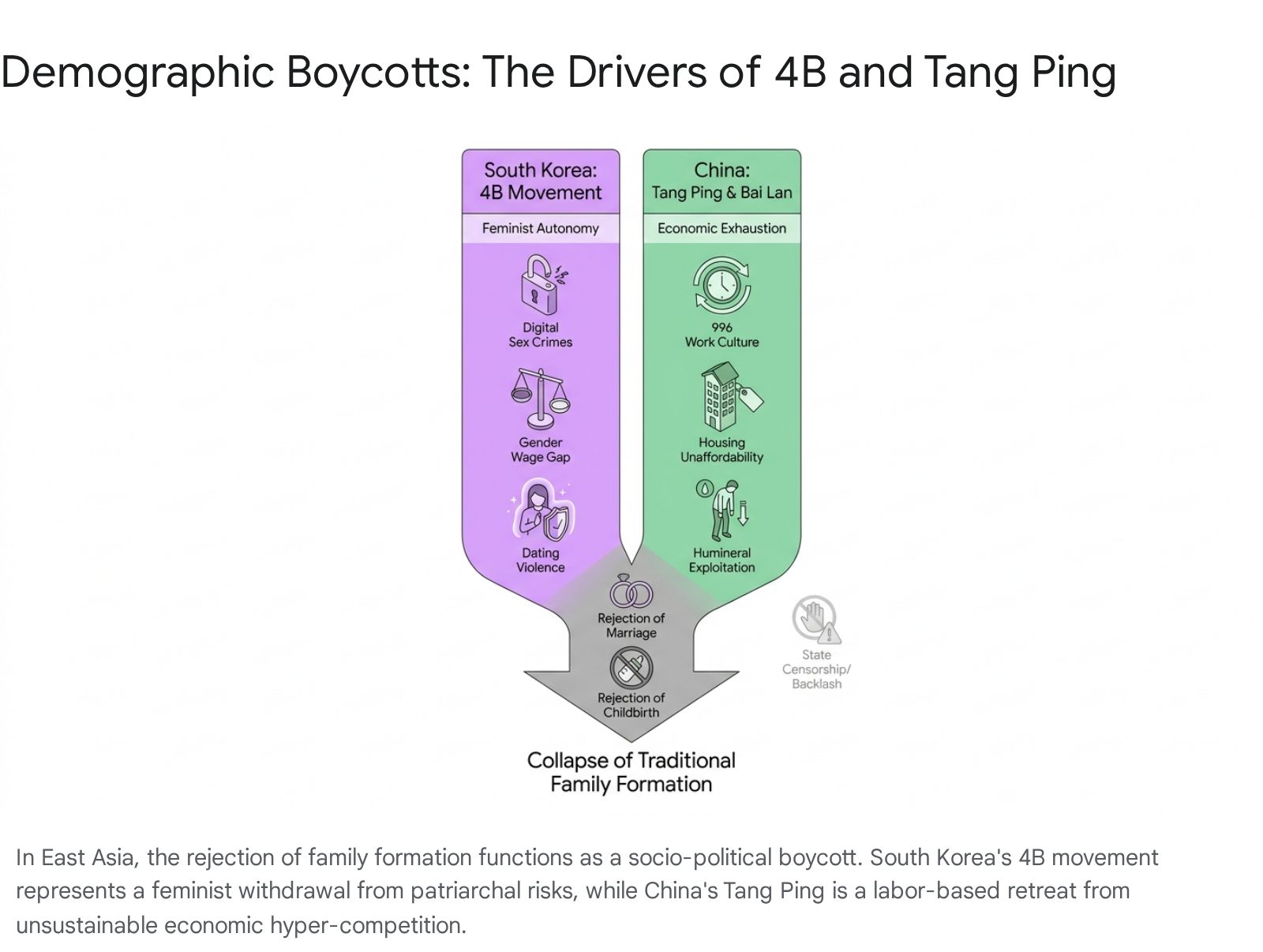
While Western demographic discourse often focuses heavily on individual economic optimization and shifting class structures, the rejection of marriage in East Asia has manifested as overt, highly organized cultural rebellions. In nations where rigid government policy, hyper-competitive capitalism, and deeply entrenched patriarchal norms collide, young adults have effectively weaponized their demographic power. They are utilizing the refusal of marriage and family formation as a direct tool of political and social protest.
China's Tang Ping and Bai Lan
In China, a profound demographic crisis is currently underway, marked by plummeting marriage rates and a shrinking overall population 1524. This demographic decline is inextricably linked to the rapid emergence of the tang ping ("lying flat") and bai lan ("let it rot") cultural movements 243031.
These movements represent a massive grassroots counterculture among Chinese youth who are profoundly exhausted by the "996" work culture (the expectation to work 9 a.m. to 9 p.m., six days a week) and the hyper-competitive Gaokao academic environment 3031. Faced with an inverted demographic pyramid caused by decades of the One-Child Policy, where a single child is expected to support two parents and four grandparents, the pressure is immense 2430. Coupled with massive youth unemployment and real estate markets where basic apartments cost extreme multiples of the average salary, young adults realize that the traditional milestones of marriage, homeownership, and child-rearing are mathematically unattainable 243049.
Tang ping operates as an ideological boycott - a rational adaptation where individuals consciously choose to lower their economic ambitions, refuse to participate in the exhausting consumerist rat race, and prioritize basic psychological health over material success 24. Bai lan represents an even more cynical evolution of this trend; it is a voluntary retreat and an active embrace of a deteriorating situation, reflecting deep youth disillusionment 2449. By refusing to buy homes, marry, or procreate, these youth are denying the state the "huminerals" - exploitable labor and new consumers - it requires to sustain rapid economic growth 30. The Chinese Communist Party (CCP) views this widespread non-participation as a severe threat to national rejuvenation. Consequently, this has resulted in the heavy censorship of tang ping and bai lan content by the Cyberspace Administration of China, accompanied by state media campaigns attempting to shame the youth back into marriage, productivity, and "positive energy" 24313251.
South Korea's 4B Movement
If China's movement is rooted primarily in economic exhaustion and labor exploitation, South Korea's 4B Movement is a radical, highly gendered revolt against systemic patriarchal violence and inequality. South Korea currently holds the lowest fertility rate in the world (0.72) and simultaneously boasts the highest gender wage gap among OECD nations 52333435.
The 4B movement, which gained significant mainstream traction around 2016 following a high-profile femicide in Seoul, is defined by four deliberate and absolute refusals: bihon (no marriage), bichulsan (no childbirth), biyeonae (no dating men), and bisekseu (no sex with men) 5235363758. Unlike involuntary singlehood caused by economic friction, 4B is a strategic, political withdrawal from heteronormative institutions entirely. South Korean women face profound systemic risks in traditional relationships, including an epidemic of digital sex crimes (hidden cameras or molka), escalating dating violence (which spiked to 77,000 reported cases in 2023), and a government that recently abolished the Ministry of Gender Equality and Family while publicly blaming feminists for the birth rate collapse 52333458.
For 4B adherents, the total refusal to marry or date is a necessary mechanism for physical safety and emotional survival 3337. It is a complete rejection of the state's ideology of "reproductive futurism," wherein women's bodies are treated merely as national resources to solve the demographic crisis - a sentiment starkly illustrated when the Korean government disastrously released a "National Birth Map" tracking women of reproductive age by municipality 33353839.
Strikingly, following the 2024 U.S. Presidential election and the continued erosion of reproductive rights (e.g., the aftermath of the overturning of Roe v. Wade), the 4B movement rapidly went viral among young liberal American women. This cross-cultural phenomenon demonstrates how localized East Asian feminist resistance models are now being exported globally as compelling templates for rejecting patriarchal life scripts in the face of conservative political backlashes 52333437583840.
Alternative Relationship Models: Cohabitation and LAT
The widespread rejection of formal marriage does not equate to the rejection of human intimacy. As the legal, religious, and economic imperatives of marriage have faded, alternative relationship structures have gained massive institutional validity and social acceptance. Two prominent models have emerged to fill the void: long-term cohabitation and Living Apart Together (LAT).
Cohabitation: From Prelude to End-State
Historically viewed as a brief, taboo testing ground before marriage, cohabitation has increasingly become a long-term substitute. Among Millennials and Generation Z, nearly half cohabit before marriage, largely driven by the massive economic incentive of shared living costs. In an era of hyper-inflated rent and post-pandemic housing crises, couples report saving upwards of $12,000 annually by merging households without merging their legal identities 62.
However, cohabitation experiences differ vastly by class and geography. For the highly educated, cohabitation remains a relatively short phase preceding a capstone marriage 8. For the working-class, as discussed in the "diverging destinies" framework, serial cohabitation is common. It offers the benefits of shared expenses and intimacy without the legal and financial entanglements of marriage, which are viewed as incredibly risky when both partners face economic precarity 4862. Yet, this lack of "enforceable trust" - the public, legal commitment that binds assets and futures - often results in significantly higher rates of relationship dissolution compared to formal marriages 1641.
Living Apart Together (LAT): The Rise of Relational Autonomy
Perhaps the most fascinating and rapidly growing evolution in family structure is the rise of Living Apart Together (LAT) relationships. In a LAT arrangement, a couple maintains a committed, monogamous, long-term romantic relationship but chooses to reside in entirely separate households 1842.
While LAT is gaining popularity among young adults who value intense autonomy and wish to avoid the friction of merging domestic lives or suffering through the inequities of the "second shift," it has actually seen massive adoption among older demographics 28424344. In the United Kingdom, approximately 4% of adults over the age of 60 are in a LAT relationship, and it is overwhelmingly the preferred relationship destination for single women over 60 - up to 10 times more likely than cohabitation or marriage 44. Data from the German Ageing Survey corroborates this, showing that while men are more likely to want to eventually move in together, older women heavily favor LAT arrangements to maintain independence and avoid being drafted into unpaid caregiving roles for aging partners 45.
LAT operates as a highly rational adaptation. It allows individuals to enjoy the emotional support, companionship, and measurable mental health benefits of a committed partnership while retaining total control over their finances, daily routines, and property 1844. Furthermore, LAT circumvents the profound legal vulnerabilities associated with marriage and divorce, though it concurrently creates new systemic challenges for migration law and the legal definitions of "family" in the eyes of the state 1846. This model proves that humans are actively innovating intimacy to fit contemporary needs, rather than simply abandoning it out of apathy.
Deconstructing the Misconception: The Enduring Desire for Commitment
A pervasive misconception surrounding the decline in marriage rates is the assumption that young adults have become inherently commitment-phobic, overly individualistic, or fundamentally opposed to the concept of lifelong partnership. Comprehensive sociological and survey data robustly contradict this reductionist narrative.
When analyzing the attitudes of Millennials, Generation Z, and the broader population of never-married adults, the intrinsic desire for long-term commitment remains overwhelmingly high. Gallup and Pew Research Center data reveal that upwards of 81% of single, never-married U.S. adults explicitly state they would like to get married someday 47. The desire for emotional connection, shared life-building, and family has not vanished; rather, the sequencing and the institutional threshold for entering into that commitment have shifted dramatically.
Young adults increasingly view marriage not as a mandatory rite of passage to enter society, but as a prestigious "capstone" achievement that requires a high degree of prior financial and personal optimization 1114. Therefore, the delay in marriage is often a symptom of deep reverence for the institution, rather than disdain for it. Many young adults refuse to enter into marriage until they feel they can absolutely guarantee its success. They fear the high emotional and financial costs of divorce - a fear heavily instilled by witnessing the high divorce rates of preceding generations (specifically the Boomers and Gen X) 62162. This sentiment is mirrored globally; longitudinal panel data from Japan shows that single individuals maintain a high desire for marriage throughout their twenties and thirties, with the desire only dropping precipitously in their forties when it becomes socially and biologically less feasible 48.
However, a highly concerning gender divergence is beginning to appear in the absolute youngest cohorts, signaling potential future shifts. While the overarching desire for marriage remains high currently, 2023 data tracking high school seniors in the United States showed a precipitous 13-point drop over three decades in the percentage of girls who desire marriage (falling to 74%), while boys' desires remained relatively stable 27. Furthermore, young women are increasingly more likely than young men to state they never want children (21% to 15%) 27. This data firmly indicates that while the desire for romantic partnership remains universal, women - who traditionally bear the asymmetrical burdens of child-rearing, domestic labor, and severe career penalties within formal marriage - are increasingly scrutinizing the cost-benefit ratio of the institution of marriage itself 272145.
Conclusion
The delay and rejection of marriage is a highly complex, multi-faceted demographic phenomenon that cannot be reduced to simple generational tropes or accusations of moral decay. The narrative frequently pushed by conservative think-tanks - that the decline of early "cornerstone" marriage is a cultural failure fueled by selfish individualism - ignores the severe structural realities and economic headwinds facing modern young adults.
Instead, the overwhelming body of peer-reviewed sociological evidence points to rational adaptation. Faced with post-pandemic inflation, housing crises, and a macroeconomic landscape that severely punishes single-earner households, young people are logically delaying family formation until they can clear an increasingly high and expensive "marriage bar." This economic delay has created a stark class divide, where marriage is rapidly becoming a luxury good reserved for the college-educated elite, leaving the working class to navigate the fragile instability of serial cohabitation.
Furthermore, the radical movements in East Asia - such as China's Tang Ping and South Korea's 4B Movement - demonstrate that the rejection of marriage is not just an economic optimization, but also a potent form of political resistance against unsustainable labor exploitation and systemic patriarchal violence.
Ultimately, the human psychological drive for connection remains intact, evidenced by the high desire for eventual marriage among singles and the rise of highly innovative relationship models like Living Apart Together (LAT). Society is not witnessing the death of commitment, but rather the evolutionary adaptation of the family unit to a rapidly changing, highly demanding 21st-century reality. Policymakers and institutions must cease attempting to force modern populations back into mid-20th-century marital timelines. Instead, efforts must focus on mitigating the profound economic frictions, housing unaffordability, and gendered labor disparities that actively prevent willing individuals from building stable, long-term families.