
The extended mind thesis and external cognition
The fundamental question of where the mind terminates and the external world begins has historically been answered by the biological boundaries of the organism. For centuries, the prevailing framework in philosophy and the cognitive sciences was Cartesian intracranialism, a paradigm positing that cognition is a strictly internal process insulated from the external environment, operating exclusively within the neural architecture of the brain. However, the extended mind thesis fundamentally challenges this boundary, proposing that the human mind is not confined to the brain or even the physical body, but routinely extends into the material world. By incorporating external artifacts, technological systems, and social structures into the functional architecture of thought, the environment ceases to be a mere external container for the organism. Instead, it becomes an active, constitutive component of cognition itself.
Introduction to Cognitive Externalism
The extended mind thesis was formally introduced by philosophers Andy Clark and David Chalmers in their seminal 1998 paper, "The Extended Mind" 12. They proposed the concept of "active externalism," arguing that objects within the environment function as integral parts of the mind when they are actively utilized to drive cognitive processes 13. According to this framework, the rigid separation between the mind, the body, and the environment is an unprincipled distinction. Because humans consistently rely on external objects to aid cognitive processes - such as using a pen and paper to perform long division, or consulting a diary to recall an appointment - the mind and the environment act as a "coupled system" that can and should be analyzed as a complete cognitive system of its own 125.
This conceptualization forms a cornerstone of what is now broadly termed 4E cognition: the view that the mind is Embodied, Embedded, Extended, and Enactive 34. While embodied cognition posits that mental processes depend fundamentally on bodily states and sensorimotor systems, and embedded cognition suggests that cognitive processes are deeply situated in environmental contexts, extended cognition makes the strongest ontological claim: that mental processes literally breach the boundaries of the brain and incorporate non-biological structures 35.
Semantic Externalism Versus Active Externalism
To properly contextualize the extended mind thesis, active externalism must be distinguished from "semantic externalism," an earlier framework developed in the philosophy of language and mind by thinkers such as Hilary Putnam and Tyler Burge 56. Semantic externalism addresses how the contents of our beliefs and attitudes are individuated - meaning what makes a thought about a specific thing in the world 6.
Famously illustrated by Putnam's Twin Earth thought experiment, semantic externalism argues that the meaning or "content" of a mental state is determined by causal and historical relationships to the external environment. If an exact molecule-for-molecule duplicate of a person exists on a Twin Earth where the clear liquid in lakes is a chemical compound called XYZ rather than H2O, the duplicate's thoughts about "water" refer to XYZ, even if their internal brain states are identical to the Earthling's 5. Semantic externalism establishes that meanings "ain't in the head," but it does not claim that the physical machinery of thinking is located outside the head 56.
Active externalism, by contrast, is an ontological and architectural claim about the vehicles of cognition. It argues that the physical processes and structures that execute cognition bleed out into the environment 57. The distinction between the two forms of externalism highlights a shift in cognitive science from focusing strictly on linguistic reference to analyzing the mechanics of problem-solving and memory retrieval.
| Conceptual Framework | Core Proponents | Primary Focus | Boundary Implication |
|---|---|---|---|
| Semantic Externalism | Hilary Putnam, Tyler Burge | The meaning or content of mental states, reference, intentionality, and truth conditions. | Meanings depend on the external world, but the machinery of thought remains internal. |
| Active Externalism (Extended Mind) | Andy Clark, David Chalmers | The vehicles of cognition, memory storage, computational processing, and reasoning execution. | The physical machinery of cognitive processes actively extends into the environment. |
The Parity Principle and Coupling Conditions
The foundational argument for active externalism rests on the "parity principle." Clark and Chalmers formulated this principle as a theoretical heuristic designed to expose biological bias: if, as we confront some task, a part of the world functions as a process which, were it done in the head, we would have no hesitation in recognizing as part of the cognitive process, then that part of the world is genuinely part of the cognitive process 8914. The parity principle suggests that the biological location of a process - whether instantiated in organic neurons, silicon chips, or graphite on paper - is functionally arbitrary 128.
The Thought Experiment of Otto and Inga
To illustrate the parity principle and demonstrate how external objects can achieve functional equivalence with internal states, Clark and Chalmers presented the widely debated thought experiment of Otto and Inga 1814.
Inga is a neurotypical individual who hears about an exhibition at the Museum of Modern Art (MoMA). She uses her biological memory to recall that the museum is located on 53rd Street and subsequently walks there. Otto, by contrast, suffers from Alzheimer's disease and relies on a physical notebook to serve the function of his failing biological memory. When he hears about the exhibition, he consults his notebook, retrieves the address for 53rd Street, and walks to the museum 1814.
Proponents of the extended mind thesis argue that there is no meaningful functional difference in the role the memory plays in guiding behavior for either individual. Inga's memory is biologically stored and retrieved through internal synaptic pathways, while Otto's memory is externally stored in ink and retrieved visually. Because the notebook functions exactly like biological memory in directing Otto's actions, it literally constitutes Otto's memory. The inscriptions in the book serve as his long-standing, dispositional beliefs 18. The argument asserts that the only difference between the two cases is physical location, and penalizing Otto's memory simply because it lies beyond his skin constitutes an unwarranted "neuro-chauvinism" 28.
The Trust and Glue Criteria
If cognition can extend into the environment, theorists must address the problem of "cognitive bloat" - the absurd conclusion that everything a person interacts with, including the entire Internet or the Library of Congress, becomes part of their mind 9. To demarcate genuine cognitive extensions from mere environmental resources, Clark and Chalmers established strict criteria for when an external object qualifies as a coupled extension. These are commonly referred to as the "trust and glue" conditions 91410:
- Constant Availability: The external resource must be reliably available and typically invoked when navigating relevant cognitive tasks. It cannot be something the user only accesses sporadically.
- Direct Accessibility: The information contained within the resource must be easily accessible without significant friction, cognitive load, or effort.
- Automatic Endorsement: The information retrieved from the resource must be automatically endorsed and trusted by the user, without requiring conscious critical scrutiny or re-verification. The user must treat the external data with the same implicit trust they would afford their own biological memory.
- Past Endorsement: The information in the external resource must have been consciously endorsed at some point in the past and stored as a consequence of the user's past action. (Note: This fourth criterion is occasionally debated or relaxed in later literature, particularly concerning inherent affordances of the environment, but it remains central to the original thesis) 91410.
When an external artifact meets these criteria, the human organism and the artifact form a densely "coupled system" 12.
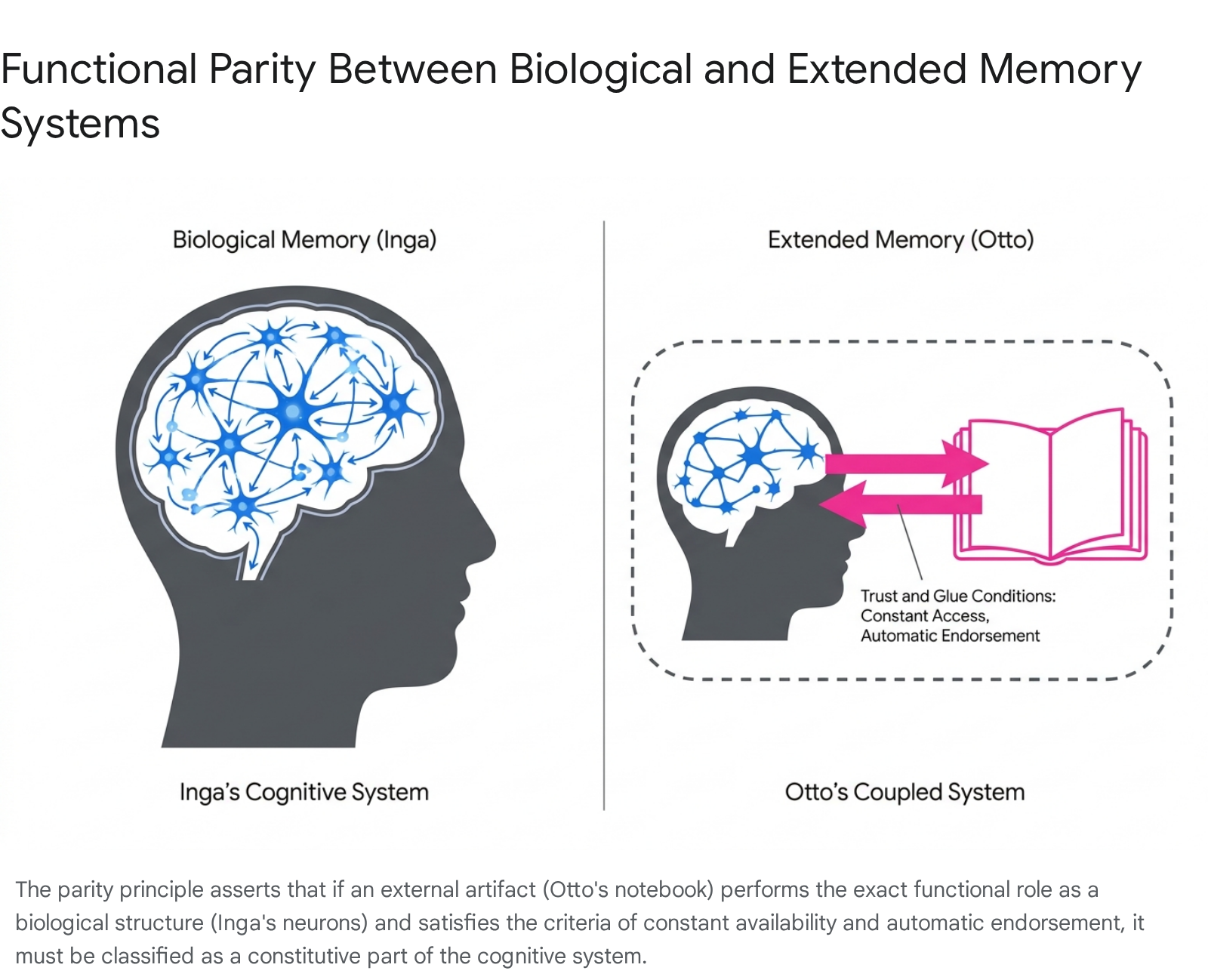
The components of this system jointly govern behavior in the exact same manner that intracranial cognition normally does. If the external component is removed or damaged, the behavioral competence of the system degrades precisely as it would if a biological brain region were lesioned 5. Therefore, interfering with Otto's notebook should, ethically and functionally, be viewed with the same severity as interfering with Inga's biological brain 16.
Internalist Critiques of Cognitive Extension
The extended mind thesis has attracted intense philosophical pushback, primarily from defenders of "contingent intracranialism." This perspective maintains that, while the mind could theoretically extend into the environment in logically possible worlds, in the actual physical world, cognition is contingently restricted to the biological brain 111213. The most prominent and systematic critics of cognitive extension are philosophers Frederick Adams and Kenneth Aizawa, who argue that proponents of the thesis systematically confuse causal dependence with metaphysical constitution 1120.
The Coupling-Constitution Fallacy
Adams and Aizawa argue that arguments for the extended mind rest on a fundamental logical error they term the "coupling-constitution fallacy." The fallacy is defined as the illegitimate slide from the premise that X is causally coupled to Y to the conclusion that X and Y jointly constitute Z 201415.
To illustrate this, they use the example of a thermostat containing a bimetallic strip. The expansion of the strip is causally coupled to the motion of atoms in the surrounding air; it reacts continuously and bidirectionally to temperature changes. However, this dense causal interaction does not mean the thermostat's expansion process literally extends into the air atoms 2015. Similarly, the fact that an organism relies heavily on a smartphone, a pencil, or a notebook to process information does not logically entail that those tools are part of the organism's cognitive apparatus. To claim otherwise, internalist critics argue, is to mistake the environmental scaffolding of cognition for the cognitive process itself 1516. Just because an external object influences a cognitive process does not bestow cognitive status upon the object.
Intrinsic Content and Representational Vehicles
If continuous causal coupling is insufficient to establish that an object constitutes part of the mind, how can researchers objectively distinguish genuine cognitive parts from non-cognitive environmental supports? Internalist critics assert that this debate cannot be resolved without a principled "mark of the cognitive" - a definitive set of necessary and sufficient conditions that establish what makes a physical process mental 111718.
Adams and Aizawa propose a specific mark of the cognitive consisting of two essential conditions. First, cognitive processes must be discriminated on the basis of underlying causal mechanisms that have naturally evolved to process information (which, they argue, only brains contingently possess) 1117. Second, and more critically, they argue that cognitive processes must involve "non-derived" or "intrinsic" representational content 111618.
In the philosophy of mind, non-derived content refers to representations that mean what they mean inherently, independently of outside social conventions or the interpretive gaze of another agent. Neural states in a human brain are posited to possess this original, intrinsic intentionality 71116. By contrast, the ink marks in Otto's notebook only possess derived content. The ink marks only mean "53rd Street" because human social conventions have assigned that specific symbolic meaning to those shapes, and because Otto interprets them as such 1618. Because external artifacts lack intrinsic intentionality and rely on the brain to give them meaning, Adams and Aizawa argue they cannot be genuinely cognitive. Therefore, no matter how tightly coupled Otto is to his notebook, the notebook remains an external tool carrying derived semantic conventions, not a constituent of a mental state 1116.
Proponents of the extended mind have mounted vigorous counterarguments to the intrinsic content objection. Clark argues that Adams and Aizawa are setting an arbitrary, question-begging standard by insisting that every individual component of a cognitive process must independently bear non-derived content 11. If a cognitive process is conceptualized as a hybrid, distributed system spanning the brain and the world, it is entirely acceptable that the neural components handle the intrinsic intentionality while the external components handle the derived representational storage. In this view, the coupled system as a whole possesses the requisite cognitive properties, and demanding that a notebook possess intrinsic intentionality on its own isolates a part from the whole 11.
The Search for the Mark of the Cognitive
Recognizing that the debate hinges almost entirely on definitions, philosophers and cognitive scientists have attempted to propose alternative marks of the cognitive. The goal is to establish criteria that are "location-neutral" and do not inherently beg the question in favor of intracranialism or externalism, allowing empirical observation to determine where cognition occurs 192021.
Competing Definitional Frameworks
Various theorists have proposed frameworks to resolve the boundary problem. Mark Rowlands, a defender of the extended mind, proposed an alternative mark of the cognitive centered on teleology and ownership rather than intrinsic content 1522. According to Rowlands, a process is cognitive if it involves information processing, has the proper evolutionary or designed function of making information available to a subject, and "belongs" to a subject by causally contributing to that subject's intentional states 131522. Because external artifacts can satisfy these conditions by processing and making information available to the biological subject, Rowlands' framework permits cognitive extension.
Conversely, some theorists argue that the quest for a definitive mark of the cognitive is misguided altogether. Drawing parallels to biology, they note that science successfully studies life without a universally agreed-upon definition of "life," and cognitive science can similarly progress without a rigid demarcation criterion 717.
| Proposed Mark of the Cognitive | Principal Advocates | Core Definitional Requirements | Implication for Extended Mind |
|---|---|---|---|
| Intrinsic Content & Specific Mechanisms | Adams & Aizawa (2001, 2008) | Must involve non-derived representational content and specific, naturally evolved underlying causal processes. | Rejects Extension. External artifacts only possess derived content assigned by human convention. |
| Information Processing & Ownership | Mark Rowlands (2009, 2010) | Must process information, make information available to a subject, and belong to a subject contributing to intentional states. | Supports Extension. Allows external artifacts to process and hold information on behalf of the integrated subject. |
| Predictive Error Minimization (PEM) | Kirchhoff & Kiverstein (2019), Kersten (2022) | The system must algorithmically engage in minimizing the difference between its predictions and actual sensory input across a Markov Blanket. | Supports Extension. Self-evidencing and active inference can occur across the brain-body-environment boundary. |
| Teleodynamic Machine Learning | Vieira & Rudolph (2025) | Continuous measurement of systemic coherence against perturbations, resolving semantic and affective stability without localized limits. | Supports Extension. Allows distributed, non-local networks to exhibit geometric learning and emergent interiority. |
Predictive Processing as a Cognitive Mark
In recent years, the rise of Predictive Processing (PP) in cognitive neuroscience has offered a new, mathematically grounded mark of the cognitive. Predictive processing posits that the brain is fundamentally a prediction machine engaged in "prediction error minimization" (PEM) - constantly attempting to match top-down expectations with bottom-up sensory input 919.
Theorists such as Kersten, Kirchhoff, and Kiverstein argue that PEM itself can serve as the mark of the cognitive 19. When construed at an algorithmic level, any system engaged in active inference and error minimization qualifies as a cognitive system. Crucially, the mathematical boundaries of these systems - defined by "Markov blankets" separating internal states from external states - do not necessarily map onto the biological skull 19. An organism can engage in "active inference" by physically altering the environment to match its predictions. Therefore, if a coupled brain-artifact system jointly minimizes prediction errors, the entire extended system is engaging in cognition 19.
Second-Wave Extension and Complementarity
In response to the prolonged philosophical gridlock over the parity principle and the mark of the cognitive, a "second wave" of the extended mind thesis emerged in the mid-2000s. Theorists such as Richard Menary, John Sutton, and Kim Sterelny argued that the original defense of the extended mind relied too heavily on proving that external artifacts function exactly like internal brain processes 2821.
This second-wave perspective emphasizes "complementarity" rather than "parity" 1221. Second-wave theorists readily concede that internal biological memory and external artifactual memory operate via vastly different functional mechanisms. Biological working memory is highly active, associative, exhibits primacy and recency effects, and degrades organically 2123. By contrast, an external artifact like Otto's notebook stores discrete, static, and enduring records in a passive state 2124.
However, second-wave theorists argue that this functional difference does not invalidate the extended mind; rather, it is the primary justification for it. It is precisely because external artifacts possess different material properties that they are recruited into the cognitive system. The brain leverages the stability, durability, and spatial organization of physical media to offset its own biological limitations, creating a hybrid cognitive architecture where internal and external resources complement each other to achieve tasks the naked brain could not perform alone 2132.
Functional Differences and Niche Construction
This complementarity view aligns closely with the biological theory of "cognitive niche construction" 233. Just as beavers build dams to alter their physical ecological niche, humans continuously engineer physical and social environments - through the invention of written language, mathematical notation, spatial layouts, and digital networks - to alter their cognitive niche 233.
From this viewpoint, human intelligence is fundamentally a product of our ability to offload cognitive labor into the environment. The use of cognitive artifacts to perform tasks makes cognitive processes faster, more reliable, and capable of handling exponentially larger data loads 3334. Therefore, the extended mind is not a mere philosophical thought experiment, but a core evolutionary adaptation defining the human species. The brain evolved to be a "leaky" organ, actively seeking out environmental scaffolding to complete its processing loops 3233.
Epistemological Justification and Reliabilism
The debate over the extended mind also intersects deeply with epistemology, particularly concerning how knowledge and justified belief are produced. In traditional epistemology, a major divide exists between epistemic internalism and externalism 2526.
Epistemic internalism (such as accessibilism or mentalism) posits that the justification for a belief must be entirely accessible to the believer's conscious mind; an individual must have internal reflective access to the reasons corroborating their belief 2527. Epistemic externalism, championed by Alvin Goldman's theory of "reliabilism," argues that a belief is justified if it is the product of a reliable cognitive process, regardless of whether the subject has conscious access to the mechanics of that process 2728.
If the extended mind thesis is true, it presents unique challenges and synergies for epistemology. When Otto retrieves the address from his notebook, does he possess a justified belief? If one adheres to epistemic externalism (reliabilism), Otto is justified so long as the notebook retrieval process is reliable and generally produces true beliefs 2739. The coupled system of Otto-and-notebook functions as a reliable truth-tracking mechanism. Therefore, the architectural externalism of the extended mind thesis fits seamlessly with the epistemic externalism of reliabilism, suggesting that knowledge itself is distributed across the agents and artifacts that reliably produce it 527.
The Distributed Self and Personal Identity
If cognition extends beyond the biological body, the boundaries of the self and personal identity must also be re-evaluated. Traditional models of identity locate the "self" firmly within the psychological continuity of the biological brain 4041. However, the extended mind thesis implies the existence of the "distributed self" 4042.
Material Culture and Autobiographical Memory
Autobiographical memory is widely considered the foundational building block of the narrative self 3340. Recent empirical work in human-computer interaction, cognitive archaeology, and psychology demonstrates that humans often remember their personal past through interacting with objects - photos, journals, mementos, and lifelogging technologies 3340.
Philosopher Richard Heersmink argues that because autobiographical memories are frequently distributed across embodied organisms and their environmental resources, the narrative self is similarly distributed 4041. Identity-relevant information is stored in material culture, serving as an external anchor for the self. If a person suffers from severe amnesia but retains access to a highly detailed diary or a wearable lifelogging camera (like a SenseCam), their narrative identity is sustained by the environmental scaffolding 3340.
This view asserts that personal identity cannot be reduced to psychological structures instantiated by the brain, nor to biological structures instantiated by the organism. Instead, the self is an environmentally-distributed, relational construct 40. The complex web of cognitive relations an individual maintains with technological artifacts and other people actively determines their identity 4041.
Non-Western Frameworks of Interconnected Cognition
The intense Western philosophical debate surrounding the extended mind - particularly the internalist resistance to it - is heavily shadowed by a Cartesian dualism that presupposes a strict separation between mind and body, and between the individual and the world 434429. However, when viewed through the lens of non-Western, Indigenous, and Eastern philosophical traditions, the proposition that the mind extends into the environment is neither radical nor novel; it is an epistemological baseline.
Indigenous Epistemology and Holism
Many Indigenous psychologies and philosophies operate on a paradigm of profound interconnectedness, viewing the mind, body, spirit, and the natural environment as a continuous, unified web 464730. For example, the First Nations, Inuit, and Metis worldview, often summarized by the phrase "All My Relations," reflects a mindset where people are inextricably linked to their communities, ancestors, and the land they inhabit 49.
Unlike the analytical and intracranial models of Western cognitive science, which often treat the body as a biologically inert vehicle piloted by a discrete mind 4431, Indigenous theories of embodied and extended cognition view the environment as an active participant in consciousness. The land is not merely a passive container of resources but a living entity and a teacher; cognition is inherently a shared, relational process 473032.
In Aboriginal Australian epistemology, the concept of the "Dreamtime" reflects a reality where consciousness is not an individual possession confined to a skull, but a collective, living connection with the land, ancestors, and cosmos 43. When the extended mind thesis asserts that cognitive states bleed into the physical world, it theoretically approaches the animistic and holistic paradigms that Indigenous cultures have practiced for millennia. In these frameworks, the severance of the self from the environment is not viewed as objective reality, but as a source of psychological distress, alienation, and illness 294647.
Buddhist Philosophy and the Fluid Self
Similarly, Buddhist philosophy provides a robust historical framework for understanding the extended mind through the doctrine of anatta (no-self) 5253. In mainstream Buddhism, the self is not a permanent, intracranial essence but a fluid process generated by the continuous interaction of five aggregates (skandhas): form, sensation, perception, mental formations, and consciousness 4333.
These aggregates are continually changing, arising and passing away based on sensory input and environmental interaction. Contemporary philosophers integrating 4E cognition with Buddhist thought argue that because the "self" is an amalgamated, transient narrative rather than a localized physical object, it naturally extends into the artifacts, diaries, and communities that hold pieces of one's identity 3341. The Buddhist critique of the bounded, masterful ego aligns seamlessly with the extended mind's critique of the isolated, intracranial brain; both assert that consciousness is fundamentally distributed and relational 5233.
Cognitive Extension in the Era of Artificial Intelligence
While Clark and Chalmers originally used a simple paper notebook to illustrate the extended mind, the rapid proliferation of Generative Artificial Intelligence (AI) and Large Language Models (LLMs) in the mid-2020s has forcefully actualized the theory, pushing it from philosophical speculation to daily reality. In a society seamlessly connected to digital knowledge bases, technology has transitioned from being a passive repository of memory to an active, synthetic processing agent.
Large Language Models as External Memory
Recent empirical applications of the extended mind thesis have explicitly tested whether LLMs can function as extended cognitive architecture. A prominent example is "Digital Andy," an LLM built by computer scientist Paul Smart in 2025. Smart applied Retrieval-Augmented Generation (RAG) - a technique that bypasses the fixed internal parameters of an LLM by anchoring it to an external database - to the collective works of philosopher Andy Clark 3435. The resulting system could actively retrieve and generate insights about the extended mind, serving as a non-parametric, externally situated memory bank for philosophical concepts 3435.
Andy Clark himself has argued that human-AI collaboration validates the premise that humans are "natural-born cyborgs," organically disposed to build hybrid thinking systems that fluidly incorporate non-biological resources 355736. From the EMT perspective, when an individual seamlessly queries an LLM to synthesize data, solve a coding problem, or draft a complex argument, the LLM ceases to be a mere tool serving the mind; it becomes a constitutive element of the user's cognitive functional architecture 57.
The Automatic Endorsement Dilemma
However, integrating LLMs into the human cognitive architecture introduces profound philosophical and practical tensions regarding Clark and Chalmers' original criteria - specifically, the automatic endorsement condition 141059. For a notebook to be considered part of Otto's mind, Otto must trust its contents implicitly, just as Inga trusts her biological memory.
LLMs, however, frequently suffer from hallucination and confabulation 10. If an algorithmic system generates synthetic, unverified, or hallucinatory information, the user cannot (or should not) automatically endorse it. A 2026 critique in the Journal of Cultural Cognitive Science proposed the concept of "entangled cognition" to argue that algorithms violate the parity principle because they impose novel, sometimes fabricated content rather than safely storing a user's pre-existing beliefs 60. If an external memory drive requires constant metacognitive monitoring and fact-checking, it acts as a separate conversational agent rather than a transparent cognitive extension 1459.
To resolve this, some researchers argue that specific architectural designs, like strictly siloed RAG systems containing only a user's personal notes (a "local vault"), satisfy the EMT criteria. By ensuring that the generated text is grounded solely in the user's past actions and verifiable data, the system regains the trust necessary for automatic endorsement 10.
Cognitive Atrophy and the Sovereignty Trap
The integration of generative AI as an extended mind also introduces the risk of "Retrieval Collapse" and cognitive atrophy. In the past, cognitive offloading involved shifting passive storage (like memorizing phone numbers or addresses) to artifacts. LLMs, however, allow humans to offload active processing (like synthesis, argumentation, and integrative reasoning) 243762.
A 2025 neurobiological study by Kosmyna et al. demonstrated up to a 55% reduction in cortical activity during AI-assisted writing, accompanied by impairments in subsequent memory integration 37. This phenomenon has led to the conceptualization of the "hollowed mind" - a state of dependency where frictionless access to AI-generated answers causes a breakdown in the internal biological architecture of deep reasoning 37. Researchers term this dynamic the "Sovereignty Trap": the authoritative competence of the AI tempts users to cede their intellectual judgment, mistaking mere access to information for genuine cognitive ability 37.
This dynamic creates an "Expertise Duality."
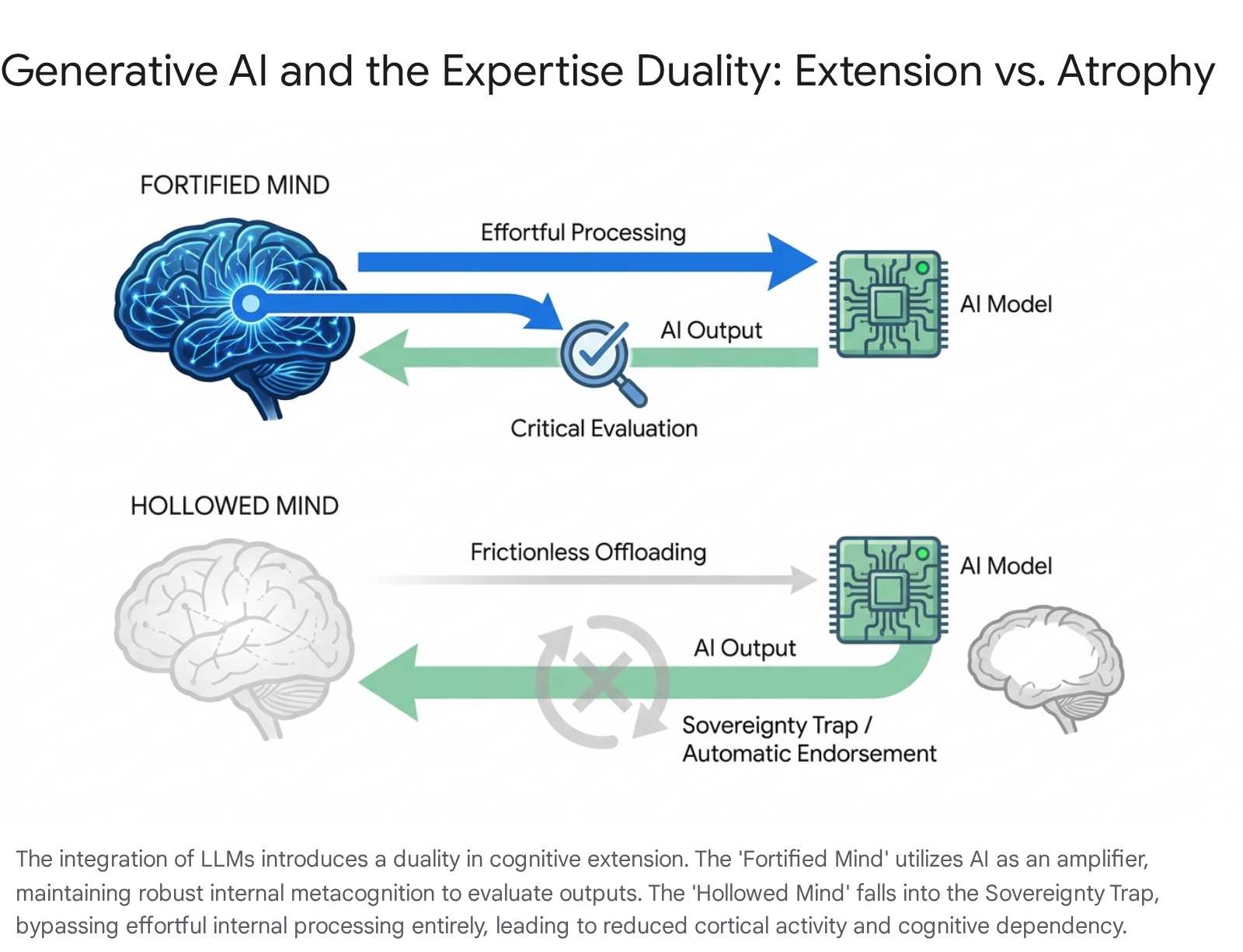
Generative AI acts as a "leveler" for novices, allowing them to perform complex tasks by bypassing effortful internal processing, but it acts as an "amplifier" for experts, who possess the robust internal scaffolding necessary to evaluate, orchestrate, and critically endorse the AI's output 37. The pedagogical and developmental challenge of the AI era is therefore not to reject cognitive extension, but to cultivate a "Fortified Mind" - a resilient internal metacognitive architecture capable of wielding extreme cognitive extension without losing intellectual sovereignty 3763.
Conclusion
The extended mind thesis fundamentally reorganizes the understanding of intelligence, shifting the analytical focus from the isolated biological brain to the dense, dynamic networks formed between organisms and their environments. While the thesis faces rigorous philosophical challenges - most notably the internalist demand for non-derived representational content and the accusation of coupling-constitution fallacies - the paradigm has proven incredibly resilient. By evolving through second-wave complementarity, aligning with theories of cognitive niche construction, and finding deep conceptual resonance in Indigenous and Eastern holistic philosophies, the extended mind offers a robust, inclusive map of human cognition.
As humanity enters an era characterized by continuous, instantaneous interaction with advanced generative AI, the debate over the boundaries of the skull ceases to be a mere academic exercise in the philosophy of mind. Determining whether an artificial agent serves as a benign cognitive tool, a genuinely extended constitutive mind, or an entangled mechanism that hollows out internal sovereignty is one of the premier cognitive, ethical, and technological challenges of the modern era. The prevailing evidence suggests that cognition is not, and perhaps never was, locked strictly inside the head; it is a bio-technological and ecological achievement, dynamically distributed across the tools humans forge and the environments they inhabit.