
Evolutionary psychology and differences between jealousy and envy
The Evolutionary Landscape of Human Affective States
The study of human emotions through the lens of evolutionary psychology has undergone a profound transformation over the past three decades. Historically, emotions such as jealousy and envy were largely relegated to the domain of pathology or moral failing, frequently characterized as maladaptive relics of human nature or socially destructive neuroses. However, foundational shifts in the psychological sciences have increasingly illuminated these affective states as sophisticated, evolved solutions to recurring adaptive problems faced by human ancestors. While early evolutionary psychology - heavily influenced by the seminal works of David Buss, Martin Daly, and Margo Wilson - concentrated predominantly on sexual jealousy as a modular, hardwired adaptation guarding against cuckoldry and resource diversion, contemporary research has vastly broadened this theoretical scope.
The modern evolutionary framework conceptualizes both envy and jealousy not as monolithic reflexes, but as highly facultative, context-dependent mechanisms that are continuously calibrated by environmental, ecological, and social inputs. Recent literature, particularly high-impact peer-reviewed meta-analyses and empirical studies published between 2023 and 2026 in journals such as Evolution and Human Behavior and Emotion, emphasizes the necessity of viewing these emotions as intricate social-cognitive tools. Envy is increasingly understood as an essential mechanism for status monitoring, resource acquisition, and hierarchical navigation, bifurcating into functionally distinct benign and malicious forms that dictate either self-improvement or interpersonal sabotage.
Simultaneously, the foundational dimorphic sex-difference hypothesis in jealousy has faced rigorous methodological and theoretical challenges. Social-cognitive models, most notably advanced by researchers like Christine Harris, alongside the conditional "double-shot" hypothesis proposed by DeSteno and Salovey, offer robust alternative explanations to purely evolutionary determinism. Furthermore, the expansion of research beyond Western, Educated, Industrialized, Rich, and Democratic (WEIRD) populations has illuminated profound cultural variability. Unprecedented cross-cultural investigations suggest that the expression and severity of these emotions are intimately tied to local ecological conditions, culturally dictated paternal investment norms, and shifting socio-economic structures. This report provides an exhaustive analysis of the evolutionary scope of envy and jealousy, detailing their adaptive functions, evaluating the intense academic debate surrounding sex differences, and synthesizing recent cross-cultural and meta-analytic evidence to separate universal human cognitive architecture from culturally mediated manifestation.
Lexical Taxonomy and the Artifacts of Language
A significant and historically underappreciated barrier to the precise study of social emotions is the semantic conflation of the terms "jealousy" and "envy" in everyday language. In colloquial English, individuals frequently state, "I am so jealous," when referring to a peer's new vehicle, professional accolade, or desirable physical trait. However, strict academic, psychological, and evolutionary taxonomies delineate these emotions based on fundamentally different structural, functional, and relational configurations 1. The imprecise use of these terms has, in the past, contaminated self-report psychological instruments, requiring researchers to meticulously design study prompts to isolate the specific affective state under investigation.
Clarifying the Structural Divide: Triadic Versus Dyadic Architectures
In evolutionary and psychological literature, jealousy is fundamentally defined as a triadic emotion 2. It necessitates a minimum of three entities: the self, a valued partner, and a rival. Jealousy occurs when an individual perceives a credible threat to a valued, pre-existing relationship (often, but not exclusively, romantic) from an interloper 43. The core evolutionary function of jealousy is protective and retentive; it motivates mate-guarding behaviors designed to prevent the loss of reproductive exclusivity, paternal investment, or critical shared resources 43. Consequently, jealousy is inextricably linked to the fear of loss, betrayal, anxiety, and the anticipation of abandonment 4.
Conversely, envy is a dyadic emotion, arising from upward social comparison between the self and a single superior other 56. It occurs when an individual lacks a desired attribute, status, or possession that another person currently holds 67. The evolutionary function of envy is acquisitive and hierarchical rather than retentive. It highlights a disparity in fitness-relevant domains and motivates the envier to close that gap 89. Envy is characterized by feelings of inferiority, longing, frustration, and, depending on its specific manifestation, hostility 10.
Cross-Linguistic Evidence and Semantic Drift
The conflation of these terms is largely an artifact of the English language. Recent corpus-based linguistic analyses and prototype approaches from 2023 to 2025 reveal that other languages maintain much stricter lexical boundaries, reflecting the underlying psychological reality of the emotions. For instance, the German language distinguishes clearly between Neid (envy) and Eifersucht (jealousy), while Spanish distinctly delineates envidia (envy) from celos (jealousy) 11.
Linguistic corpus studies comparing English and German data sets (specifically utilizing the iWeb corpus for English and the DWDS Webkorpus for German) demonstrate that the German concept of Neid is perceived as a more purely negative, lacking-based emotional experience with a distinct semantic boundary 1. In contrast, in English-speaking cultures, the emotion concept of envy closely correlates and overlaps with jealousy, making the English conceptualization of envy somewhat more intense and relationally threatening than its German equivalent 1. Understanding this lexical drift is critical for modern researchers, as psychological instruments translated across languages must account for these semantic proximities to ensure valid cross-cultural comparability .
To synthesize and clarify these vital academic distinctions, Table 1 delineates the core parameters separating the two emotions across structural and evolutionary dimensions.
| Dimension | Jealousy | Envy |
|---|---|---|
| Structural Architecture | Triadic (Self, Partner, Rival) | Dyadic (Self, Superior Other) |
| Core Trigger | Threat of losing a valued relationship or resource to a third party. | Lacking a desired possession, trait, or status held by another. |
| Evolutionary Purpose | Mate retention, guarding reproductive exclusivity, preventing resource diversion. | Status monitoring, hierarchy navigation, driving resource acquisition. |
| Primary Target Threat | The interloper (rival) and the defecting partner. | The disparity in status; the superior individual themselves. |
| Dominant Associated Emotions | Fear of loss, anxiety, anger, betrayal, suspicion, disgust. | Inferiority, longing, resentment, frustration, motivation. |
| Action Tendency | Vigilance, mate-guarding, confrontation, relationship severing, violence. | Self-improvement (benign), or sabotage and derogation of the other (malicious). |
The Adaptive Functions and Evolutionary Architecture of Envy
Moving beyond the exclusive historical focus on jealousy, modern evolutionary psychology has recognized envy as a vital adaptation for human survival, resource acquisition, and reproductive success. Because human ancestors lived in highly interdependent, competitive group structures, relative social standing was often a significantly stronger predictor of biological fitness than absolute wealth 1215.
Status Monitoring and the Allocation of Evolutionary Resources
Envy functions as a highly sensitive internal alarm system, alerting an individual to a deficit in fitness-relevant domains relative to their peers. From an evolutionary perspective, both men and women envy same-sex peers who possess qualities that enhance inter-sexual selection and intra-sexual competition 913. Studies indicate that men are more prone to envying rivals who exhibit superior resource acquisition capabilities, financial dominance, physical prowess, and elevated social status 489. Women, governed by different evolutionary selective pressures regarding mate value, frequently report elevated envy toward rivals displaying cues of high reproductive capacity, such as physical attractiveness, youthfulness, and social popularity 48913.
This adaptive alert system drives individuals to engage in compensatory actions. For example, recent empirical work has demonstrated that women experiencing heightened states of envy or romantic jealousy are significantly more willing to engage in risky appearance enhancement behaviors, such as cosmetic surgery, dangerous diet pill consumption, and extreme tanning, in a desperate evolutionary bid to elevate their relative mate value and neutralize the perceived disparity 1415.
In the digital age, this evolved mechanism for status monitoring has been hijacked and hyper-activated by social media platforms. Historically, human status monitoring - often colloquially termed "keeping up with the Joneses" - was naturally constrained by physical geography and Dunbar's number, limiting the pool of upward social comparisons to immediate neighbors and kin 1617. Today, asynchronous, disembodied virtual environments present individuals with a relentless, globally scaled stream of highly curated upward social comparisons 1618. Recent literature emphasizes that this persistent hyper-activation of the status-monitoring system through social media leads to profound psychological distress, exacerbating the "Fear of Missing Out" (FOMO) and contributing directly to disorders of the social brain, including clinical anxiety, depressive phenotypes, and pathological body dysmorphia 161819.
The Pain-Driven Dual Envy Theory: Benign vs. Malicious Pathways
One of the most significant theoretical advancements in the evolutionary understanding of this emotion is the Pain-Driven Dual Envy (PaDE) theory 67. The PaDE framework posits that the psychological pain of inferiority, born from an upward social comparison, branches into two functionally distinct motivational pathways: benign envy and malicious envy 6710. Both forms arise from the identical origin of psychological distress, frustration, and a perceived negative self-other discrepancy; however, their cognitive appraisals and subsequent adaptive behavioral outputs differ drastically.
Benign Envy (The Constructive Pathway): Benign envy occurs when the envier appraises the superior other's advantage as deserved, legitimate, and believes that the situation is ultimately controllable 5617. Evolutionarily, it motivates process-focused goal pursuit and self-enhancement. The envier seeks to "level up" to the superior standard through increased effort and emulation 6. Recent meta-analyses and longitudinal daily diary studies conducted between 2023 and 2025 demonstrate that benign envy fosters positive adaptation, inspires the emulation of consumption or academic effort, and is positively correlated with trait altruism and work engagement 2021. In organizational settings, benign professional envy has been shown to significantly predict employee creativity, learning behaviors, and overall human flourishing, operating as a catalyst for acquiring necessary resources without disrupting critical group cohesion 212223.
Malicious Envy (The Destructive Pathway): Conversely, malicious envy is triggered when the advantage is perceived as unmerited, unfair, or when the envier feels a low sense of personal control over their disadvantage 517. The evolutionary function of malicious envy is to "level down" the competitor. Rather than motivating self-improvement, it motivates hostility, social sabotage, and schadenfreude (the experience of pleasure at a rival's misfortune) 15.
Recent large-scale correlational studies and meta-analyses have linked malicious envy strongly to the Dark Triad of personality traits 1024. Meta-analyzed trait correlations reveal that malicious envy predicts Machiavellian and psychopathic behaviors, facilitating active harm, knowledge hiding, and workplace ostracism 102325. In professional environments, malicious envy often manifests as counterproductive work behaviors, abusive supervision, and the deliberate withholding of critical information to sabotage a peer's performance 252627.
Furthermore, recent research published in the journal Emotion (2024) has revealed fascinating intersections between envy and other complex affective states, such as nostalgia. Studies utilizing cross-sectional and daily diary methods demonstrated that nostalgia - often viewed purely as a positive, sentimental longing - actually increases feelings of envy 28. The mechanism appears to be an upward comparison against one's own past self; individuals feel regret and envy for their past circumstances, which bleeds into generalized state envy in the present 28.
While earlier psychological paradigms dismissed envy entirely as a maladaptive social taboo, the current evolutionary consensus recognizes both forms as highly functional. Benign envy drives resource acquisition and innovation through personal elevation, while malicious envy regulates dominance hierarchies by neutralizing an overbearing or unfair competitor, effectively serving as a brutal but efficient mechanism of social control within ancestral groups 15.
The Evolutionary Psychology of Jealousy: The Foundational Dimorphic Model
While envy regulates broad hierarchical positioning and resource disparities, jealousy specifically polices the reproductive and relational bonds that are most critical to biological fitness. The foundational theory of evolved sex differences in jealousy, pioneered by David Buss, Martin Daly, and Margo Wilson in the early 1990s, remains one of the most widely cited, influential, and hotly contested paradigms in the history of evolutionary psychology 293031.
The Asymmetry of Human Reproductive Biology
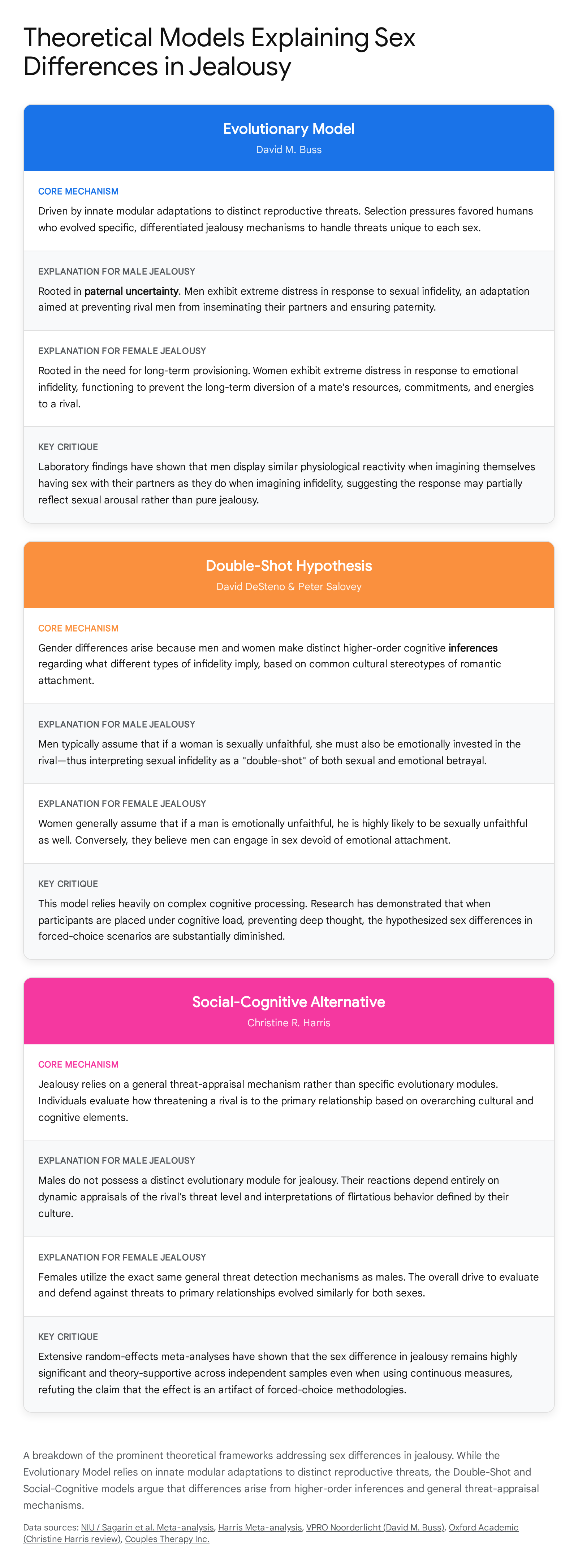
The evolutionary model of jealousy is fundamentally predicated on the physiological asymmetries of human reproduction and the tenets of parental investment theory 42932. Because fertilization and gestation occur internally within human females, human males face a unique and persistent adaptive problem throughout evolutionary history: paternal uncertainty 429. In ancestral environments, a man who failed to fiercely guard his mate against sexual infidelity risked the catastrophic evolutionary outcome of cuckoldry - investing his finite resources, physical protection, and caloric acquisition into the genetic offspring of an intra-sexual rival 433. Consequently, selective evolutionary pressures heavily favored males who exhibited intense psychological distress, physiological arousal, and hyper-vigilance in response specifically to cues of female sexual infidelity.
Conversely, females possess absolute, 100% maternity certainty 433. However, they face a different, equally severe adaptive problem: resource diversion 433. Human infants are exceptionally altricial, requiring extraordinary, prolonged care that historically necessitated sustained paternal investment for optimal survival. A female whose mate became emotionally attached to a rival female risked the devastating diversion of his protection, time, and resources away from her and her children 432. Thus, evolutionary psychology hypothesized that females evolved a heightened jealousy response tuned specifically to cues of emotional infidelity, which signaled impending abandonment and resource loss.
Contemporary Affirmations of the Evolutionary Dimorphism
Recent, highly innovative experimental methodologies continue to explore and affirm this dimorphism, moving beyond traditional self-report questionnaires. A 2024 study utilizing a modified "dictator game" as a behavioral economic proxy for jealousy demonstrated that men and women react predictably to specific types of resource allocation 3334. The study showed that women experienced significantly greater jealousy when their romantic partner allocated monetary resources to a female rival, effectively simulating emotional infidelity and the diversion of resources 3334. Conversely, men exhibited heightened jealousy when their partner received resources from a male rival, tapping into cues of impending sexual access, mate poaching, and eventual cuckoldry 3334.
Furthermore, behavioral genetic studies involving large twin registries (such as a recent study of approximately 7,700 Finnish twins) have indicated that romantic jealousy is roughly 29% heritable, with the remainder of the variance explained by non-shared environmental factors 3. While the magnitude and source of genetic influence do not differ between the sexes, evolutionary variables heavily predict individual variations in jealousy. Factors such as mate-value discrepancy (feeling lower in value than one's partner), restricted sociosexual desire, and a lack of trust heavily predict elevated jealousy, reinforcing the concept of jealousy as a highly calibrated, individually tailored mate-guarding mechanism 3.
The real-world consequences of this evolved module are profound and often destructive. Global systematic reviews and meta-analyses exploring Intimate Partner Violence (IPV) continuously highlight male sexual jealousy as a primary antecedent to physical, sexual, and psychological violence 35. Evolutionary drives to mate-guard frequently manifest as coercive control, economic restriction (to prevent the female from gaining independence and defecting), and outright violence 35. In the modern digital landscape, this same psychological architecture drives cyber-dating abuse, where cognitive and behavioral jealousy strongly predict the psychological surveillance and relational abuse of partners through digital mediums 436.
Critiques and Competing Models: The Fierce Sex-Difference Debate
Despite its prominence and intuitive appeal, Buss's theory has been subjected to decades of fierce methodological and theoretical critique. The core assertion that men and women possess distinct, innate, and sex-specific cognitive modules for jealousy is challenged by researchers advocating for domain-general social-cognitive mechanisms and artifactual explanations of the survey data.
Methodological Critiques: Forced-Choice vs. Continuous Measures
The primary methodological critique of the evolutionary paradigm targets the "forced-choice" measurement format utilized in Buss's original, foundational studies. In these studies, participants were asked to choose which scenario - sexual infidelity or emotional infidelity - was more distressing 2937. Critics argue that forced-choice scenarios artificially manufacture and inflate sex differences by imposing a false dichotomy that does not reflect real-world emotional processing. When researchers utilize continuous Likert scales (asking participants to rate the absolute distress of both scenarios independently on a scale of 1 to 7), both sexes universally rate both sexual infidelity and emotional infidelity as highly distressing, often muting or entirely eliminating the statistical sex difference 2937.
However, defenders of the evolutionary model have pushed back rigorously against this critique. A comprehensive random-effects meta-analysis by Sagarin et al. (2012), analyzing 209 effect sizes derived from 47 independent samples that exclusively used continuous measures, found that a significant, theory-supportive sex difference does emerge even when using continuous scales (g* = 0.258, p < .00001) 2931. This finding strongly suggests that the dimorphism is a genuine psychological phenomenon, not merely an artifact of the forced-choice questionnaire format.
The "Double-Shot" Hypothesis: Inference Over Evolution
A major theoretical alternative to the modular evolutionary view is the "double-shot" hypothesis, proposed by DeSteno and Salovey (1996). This theory argues that sex differences in jealousy are not the result of innate, dimorphic evolutionary modules, but rather arise from logical, gendered inferences about what different types of infidelity imply regarding the overall threat to the relationship 3741.
According to this social-cognitive view, men and women hold different, culturally reinforced empirical stereotypes about how the opposite sex operates. Men generally believe that women only engage in sexual intercourse when they are already emotionally in love. Therefore, if a woman commits sexual infidelity, the man receives a painful "double-shot" - he logically assumes she is both sexually and emotionally involved with the rival 3741. Women, conversely, believe that men can easily have sex without any emotional attachment, but if a man falls in love (emotional infidelity), sexual intimacy is an inevitable consequence. Therefore, women perceive a man's emotional infidelity as the true "double-shot" 3741. When researchers explicitly control for these conditional probabilities - forcing participants to imagine a scenario where only sex or only emotion occurs without the other - the sex differences in jealousy often diminish significantly, suggesting that higher-order cognitive processing and threat appraisal, rather than hardwired evolutionary reflexes, drive the dimorphic response 38.
Christine Harris and the Social-Cognitive Alternative
Dr. Christine Harris has provided some of the most formidable, multi-pronged pushback against the evolutionary jealousy model. Harris posits a domain-general social-cognitive perspective, arguing that jealousy is a general, non-dimorphic threat-detection mechanism aimed at protecting the primary relationship, operating similarly across both sexes 23743.
Harris's empirical work has systematically dismantled several empirical pillars of the evolutionary argument. For instance, she found that individuals' actual experiences with real-life infidelity do not neatly align with the hypothetical scenarios used by evolutionary psychologists. Women who have experienced actual infidelity often focus heavily on the sexual aspects of the betrayal, directly contradicting the evolutionary prediction that they should prioritize the emotional threat 4139.
Furthermore, Harris re-evaluated the physiological data (such as heart rate and electrodermal activity) that Buss originally used to prove men's visceral, hardwired reaction to sexual infidelity. Harris demonstrated that men exhibited the exact same degree of physiological reactivity and arousal when they were instructed to imagine themselves having sex with their girlfriends as they experienced when imagining someone else having sex with their girlfriends 40. This critical finding suggests that the physiological spike men experience during sexual infidelity scenarios may represent generalized sexual arousal or autonomic nervous system activation, rather than the activation of a specific, evolved sexual jealousy module 40. Harris has also conducted novel research demonstrating that non-human animals, specifically dogs, display overt jealous behaviors when their owners display affection to a faux dog, suggesting that the core of jealousy is a basic, hardwired mammalian defense of social bonds that does not require the complex cognitive attributions of sexual versus emotional threat 43.
Methodological Innovations: RoBMA and the Correction of Publication Bias
The academic literature surrounding sex differences in jealousy remains fraught with contradictory meta-analyses, often reflecting the deep theoretical divides of the authors conducting them (e.g., Harris's 2003 meta-analysis failing to find consistent differences versus Sagarin's 2012 meta-analysis confirming them) 293741.
To resolve such entrenched impasses, researchers are increasingly turning to advanced statistical frameworks. A critical recent development (2023) is the application of Robust Bayesian Meta-Analysis (RoBMA), pioneered by Maier, Bartoš, and Wagenmakers 4243. Meta-analyses in psychology have historically been frustrated by profound publication bias - the phenomenon where statistically significant, theory-affirming results are published at far higher rates than null findings. Traditional methods for adjusting this bias (like the trim-and-fill method or p-curve analysis) often force researchers into all-or-nothing choices that can distort the true effect size 4344.
RoBMA circumvents this by utilizing Bayesian model-averaging. It simultaneously applies an ensemble of 12 different meta-analytic models - including models that assume the presence or absence of the effect, varied heterogeneity, and multiple publication bias adjustment methods (such as selection models of p-values and PET-PEESE models adjusting for small-study effects) 424450. The algorithm then weights the estimates based on the support they receive from the actual data 44. When applied to contentious evolutionary psychology datasets, RoBMA frameworks reveal that while evolutionary sex differences in jealousy do hold statistical weight, the literature is saturated with high heterogeneity. Effect sizes are not uniform and are heavily moderated by variables such as relationship status, sexual orientation (e.g., bisexual men with female partners exhibit patterns similar to heterosexual men, reflecting reproductive threat), and cultural environment 384142.
Universality vs. Cultural Variability: Evidence from Non-Western Populations
A fundamental, systemic vulnerability of the evolutionary psychology canon has been its historical reliance on WEIRD samples 4546. For decades, the implicit assumption that WEIRD university undergraduates were perfectly representative of universal human cognitive architecture went largely unchecked, leading to findings that were extrapolated as fixed human universals 4647.
Brooke Scelza's 11-Society Study and the Role of Paternal Investment
To determine definitively if sex differences in jealousy are an inescapable biological human universal or a culturally mediated phenomenon, anthropologist Brooke Scelza and an international consortium of colleagues (2019/2020) conducted an unprecedented, large-scale empirical study across 11 diverse, small-scale societies spanning five continents. The target populations ranged from standard WEIRD settings (urban Los Angeles) to highly unique socio-ecological environments, including matrilineal societies (the Mosuo in China), semi-nomadic pastoralists (the Himba in Namibia), and traditional agriculturalists (the Karo in Indonesia and the Tsimane in Bolivia) 47545548.
Surveying over 1,048 individuals, the results systematically dismantled the rigid, binary dichotomy of "universal versus variable." The data revealed compelling evidence for both perspectives, validating human behavioral ecology 4757.
- Universality of Direction: In almost all populations surveyed, the general directional trend predicted by evolutionary psychology held true: men were relatively more upset by sexual infidelity than women were 4754.
- Extreme Variability in Severity: However, the baseline severity of the jealousy response and the dominant concern varied drastically based on the cultural ecology. For instance, among the Himba pastoralists - a culture where concurrent sexual partnerships are openly acknowledged, culturally normalized, and integrated into marital dynamics - both men and women frequently stated that neither type of infidelity was inherently upsetting. Curiously, when forced to choose, Himba women actually found sexual infidelity more upsetting than emotional infidelity, directly contradicting WEIRD evolutionary predictions 4757. Furthermore, across the entire global sample, in only four of the 11 populations (which included Los Angeles) did the majority of women rate emotional infidelity as worse 474857.
Scelza's comprehensive analysis revealed that cultural variation in jealousy is not random; it is highly predictable based on local socio-ecological constraints, specifically the culturally mandated levels of paternal investment and paternity certainty 5448. In societies where fathers are expected to invest heavily in the direct care, provisioning, and upbringing of their offspring, both men and women exhibit highly severe, retributive reactions to infidelity. For men in these high-investment cultures, the evolutionary cost of cuckoldry is astronomically high. For women, the cost of losing a highly investing mate to a rival is equally devastating 48. Conversely, in cultures characterized by low paternal investment, or where expansive matrilineal kin networks diffuse the burden of child-rearing and resource provision (e.g., the Mosuo), jealous responses from both sexes are significantly muted 544857. Jealousy, therefore, operates as a facultative response, scaling intelligently to the variable risks and costs of male investment across different societies.
The Impact of Colonialism, Modernization, and Cultural Imposition
Recent cross-cultural research also highlights the profound impact of macro-social and historical shifts on the expression of these emotions. Anthropological and sociological studies from 2024 to 2026 suggest that what are often perceived as innate, historical cultural patterns of jealousy in non-Western countries may actually be the lingering legacies of colonialism 58. Western relationship norms, which heavily emphasize strict dyadic monogamy and view romantic love as the sole, exclusionary foundation of the family unit, were frequently imposed upon colonized populations, effectively overwriting historically fluid or concurrent kinship networks 58.
Furthermore, as traditionally collectivist cultures undergo rapid modernization and adopt individualistic, Western-style market economies, their patterns of jealousy reliably shift to align more closely with WEIRD datasets 58. In cultures that prioritize "honor," public reputation, and rigid gender roles, emotional infidelity or even benign interactions can trigger violent jealous outbursts. This is not strictly due to evolutionary paternity uncertainty, but because the behavior threatens the family's social capital, kinship bonds, and public standing within the community 5849.
Synthesis and Future Outlook
The evolutionary psychology of jealousy and envy has matured significantly beyond its early, deterministic origins. The current academic consensus - bolstered by recent methodological innovations like Robust Bayesian Meta-Analysis, sophisticated linguistic mapping, and extensive, non-WEIRD cross-cultural data - paints a picture of highly adaptable, facultative emotional systems.
Envy can no longer be dismissed as a mere social pathology or moral failure. It operates as a critical, evolved metric for continuous status monitoring. Its bifurcation into benign and malicious forms illustrates how evolutionary pressures shaped dual, parallel pathways: one driving social cohesion, resource acquisition, and human flourishing through effortful self-improvement, and the other driving hierarchical regulation and dominance via dark-triad behaviors and social sabotage.
Similarly, the foundational evolutionary claims surrounding sex differences in jealousy have been profoundly nuanced by competing methodologies and theoretical counter-claims. While robust statistical evidence confirms that males and females possess distinct sensitivities to sexual and emotional threats, these differences are neither absolute nor immune to higher-order cognitive processing. As demonstrated by the double-shot hypothesis and the empirical work of researchers advocating for social-cognitive models, human beings utilize complex inferences to appraise relationship threats.
Most importantly, cross-cultural data conclusively demonstrates that evolutionary mechanisms do not operate in a vacuum. Human emotional architecture provides the underlying biological blueprint, but culture, ecology, and the specific demands of paternal investment dictate the ultimate severity, manifestation, and behavioral triggers of these emotions. Ultimately, jealousy and envy are not rigid, inescapable evolutionary artifacts; they are dynamic, environmentally contingent barometers, exquisitely designed to help human beings navigate the complex, ever-shifting landscapes of social hierarchy and reproductive survival.