
Evolution and moral impact of disgust
Disgust is widely considered one of the most complex, multifaceted, and heavily debated constructs in contemporary affective science. Historically classified as a basic biological drive aimed at rejecting noxious tastes and preventing gastrointestinal distress, the emotion has evolved far beyond its original physiological parameters. Modern humans experience disgust not only in response to rotting food and bodily fluids but also in reaction to abstract social phenomena, such as moral transgressions, ideological differences, and the behaviors of outgroups.
The scientific inquiry into disgust bridges evolutionary biology, cognitive neuroscience, and moral psychology, attempting to explain how a rudimentary mechanism designed to protect the physical body from pathogens expanded to protect the social and moral order. Determining whether these varied experiences of disgust represent a single unified emotion or a collection of distinct psychological phenomena sharing a linguistic label remains a central challenge for researchers.
Evolutionary Origins and the Behavioral Immune System
The dominant evolutionary framework for understanding the origin of physical disgust is the "behavioral immune system" theory 123. While the physiological immune system is highly effective at neutralizing pathogens and parasites once they have breached the body's physical barriers, mounting such an immune response is metabolically expensive, causes collateral tissue damage, and is inherently dangerous to the host 45. Evolutionary pressures naturally favored the development of a proactive psychological and behavioral mechanism designed to prevent pathogen exposure in the first place 123.
Disgust operates as the primary affective and behavioral arm of this proactive defense system. It relies on the detection of perceptual cues that were historically correlated with the presence of infectious agents in ancestral environments - such as the smell of decay, the sight of bodily fluids, visible lesions, or the presence of specific disease vectors like maggots, flies, and rodents 2356. Upon detecting these cues, the disgust system activates context-specific behavioral avoidance, motivating the organism to withdraw from the threat, expel contaminated substances from the mouth or stomach, or engage in hygienic cleansing behaviors 12.
The sensitivity of this behavioral immune system is not static; it exhibits significant phenotypic plasticity and calibrates to local environmental pathogen stress 12. However, disgust sensitivity is not without evolutionary costs and trade-offs. Because the emotion heavily motivates withdrawal, avoidance, and rejection, heightened disgust sensitivity can suppress social interaction, restrict caloric intake by limiting acceptable foods, and reduce mating opportunities 147. Consequently, evolutionary behavioral scientists propose that disgust sensitivity is dynamically down-regulated in contexts where the benefits of social integration, extroversion, or caloric acquisition outweigh the immediate risks of pathogen exposure 147. Anthropological studies of the indigenous Shuar people in Ecuador, for instance, demonstrate that individuals regulate their disgust responses across their lifetimes based on their immediate environment, pathogen loads, and the degree of their market integration 8.
Taxonomic Expansion of the Disgust Construct
While the behavioral immune system elegantly explains the origin of physical pathogen avoidance, it struggles to fully account for the vast array of abstract stimuli that elicit disgust in modern humans. The developmental and cultural trajectory of disgust has been extensively mapped, demonstrating a process of evolutionary preadaptation - a well-documented biological process where a structure or system that originally evolved for one specific purpose is co-opted for a new, secondary context 91011.
According to the expansion model pioneered by Paul Rozin and colleagues, disgust originated as an oral defense against toxins and pathogens (distaste) but gradually extended its domain through cultural evolution and socialization 11121314. This historical expansion shifted disgust from a system designed to "protect the body from harm to a system to protect the soul from harm" 11. This trajectory is generally classified into four distinct but overlapping domains.
| Disgust Domain | Primary Elicitors | Evolutionary or Psychological Function |
|---|---|---|
| Core (Pathogen) Disgust | Feces, vomit, rotting food, visible signs of infection, disease vectors. | To protect the body from incorporating pathogens via the oral route or direct physical contact 51113. |
| Animal-Reminder Disgust | Corpses, gore, mutilation, poor hygiene, inappropriate sexual acts. | To suppress awareness of human mortality and biological vulnerability by psychologically distancing humans from their animal nature 5111213. |
| Interpersonal Disgust | Contact with the belongings, bodily fluids, or physical space of strangers. | To protect against novel pathogens carried by outgroups, while simultaneously reinforcing social and tribal boundaries 21314. |
| Socio-Moral Disgust | Betrayal, hypocrisy, taboo violations, systemic unfairness, degradation of sacred symbols. | To protect the social fabric and cultural order from abstract violations of purity, divinity, or fairness 511121315. |
Psychological Principles of Contagion and Similarity
The defining feature that bridges these disparate domains is the cognitive rule of sympathetic magic, specifically the laws of contagion and similarity. In physical disgust, brief contact with a contaminant renders a previously neutral object inherently and permanently disgusting - a phenomenon summarized as "once in contact, always in contact" 51214. For instance, participants in psychological experiments reliably refuse to drink from a glass of juice that was briefly stirred with a sterilized, brand-new comb, or eat chocolate fudge artificially shaped to look like dog feces 91216. The cognitive representation of the contaminant completely overrides rational knowledge of its objective safety.
This same principle of contagion transfers seamlessly to the interpersonal and moral domains. Individuals often exhibit a desire to physically cleanse themselves or their immediate environment after committing or witnessing a moral transgression, indicating an abstract, deeply ingrained psychological link between physical dirt and moral impurity 517.
Neurological Foundations of Disgust
To determine whether the expanding domains of disgust represent a single unified emotion or a collection of distinct phenomena sharing a linguistic label, cognitive neuroscientists have rigorously analyzed the neural and autonomic signatures of the disgust response.
Brain Networks and the Insular Cortex
Historically, the neuroimaging literature heavily implicated the insular cortex (insula) as the primary neural substrate of disgust 18192021. Early functional magnetic resonance imaging (fMRI) studies observed robust insula activation when participants viewed images of contamination, smelled foul odors, or witnessed others expressing facial disgust 182021. Neuropsychological case studies provided converging evidence: patients with bilateral insular lesions or Huntington's disease, which causes significant insular volume loss, frequently display specific and profound deficits in recognizing facial expressions of disgust, while their recognition of other emotions remains largely intact 192021.
However, the assertion that the insula functions as the exclusive "disgust center" of the human brain is highly contested. Extensive fMRI meta-analyses indicate that the insula is broadly recruited across a wide spectrum of arousing stimuli, including fear, anger, sadness, and even happiness or sexual arousal 18192223. Researchers now theorize that the anterior insula plays a much broader role in interoceptive awareness - the ability to monitor internal bodily states - and acts as a central hub for integrating these physiological sensations into subjective emotional feelings 202223. The posterior-to-anterior progression in the human insula suggests that the posterior insula encodes primary sensory feelings, while the anterior insula encodes introspective awareness and complex sociomoral representations 23.
Predictive Modeling and the Visually-Induced Disgust Signature
Recent advancements utilizing machine-learning-based predictive modeling have provided a more nuanced and comprehensive understanding of how the brain processes repugnance. Researchers have developed a whole-brain neurofunctional signature for subjective disgust - termed the Visually-Induced Disgust Signature (VIDS) - that operates across distributed cortical and subcortical networks 222425.
This established neural signature involves the amygdala, periaqueductal gray (PAG), thalamus, and putamen for the early detection of threats and defensive responses, alongside the anterior insula and anterior cingulate cortex (ACC) for explicit interoceptive appraisal 22. Crucially, this distributed signature tracks subjective disgust intensity with remarkable accuracy and generalizes across core disgust, oral distaste, and socio-moral contexts (such as witnessing unfair economic offers) 22242526. This provides strong neurobiological evidence that physical and moral disgust are not entirely separate phenomena, but rather share a fundamental underlying neural architecture 222425.
Autonomic Nervous System Reactivity
The physiological manifestation of disgust further differentiates it from other negative emotions. Autonomic nervous system (ANS) reactivity studies demonstrate that disgust triggers a highly specific peripheral physiological profile that contrasts sharply with classic "fight-or-flight" responses.
When researchers utilize the Directed Facial Action task - instructing participants to move specific facial muscles to simulate emotional expressions without explicitly naming the emotion - they observe distinct autonomic patterns. Forcing the face into an anger or fear expression significantly accelerates heart rate, indicating sympathetic nervous system (SNS) arousal 2728293031. In contrast, adopting a core disgust expression generally produces either no change or a marked deceleration in heart rate, indicating parasympathetic nervous system (PNS) dominance 2728293031.
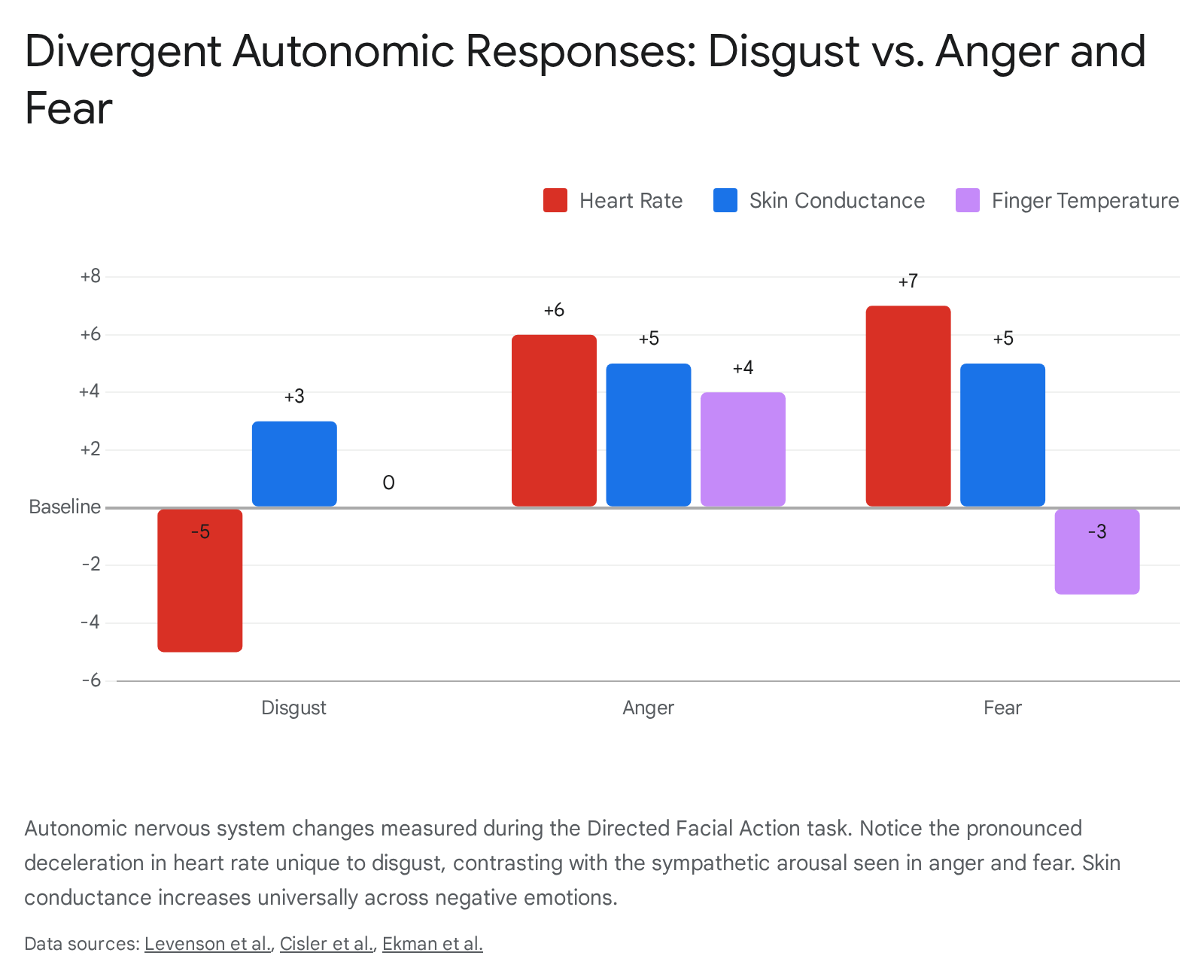
The distinction in autonomic arousal extends to the sub-domains of disgust. Physical, contamination-based disgust predominantly activates parasympathetic pathways, resulting in heart rate deceleration and increased heart-rate variability (HRV) 15273233. This physiological dampening serves an evolutionary purpose: it limits oral ingestion, slows respiration to prevent inhaling noxious odors, and induces behavioral withdrawal.
| Physiological Metric | Fear & Anger Profile | Core Disgust Profile |
|---|---|---|
| Heart Rate (HR) | Significant acceleration (sympathetic arousal) 27283031 | Deceleration or minimal change (parasympathetic dominance) 27283031 |
| Skin Conductance (SCR) | Significant increase 272830 | Moderate increase 272830 |
| Heart Rate Variability (HRV) | Decreases 2734 | Increases 27 |
| Finger/Skin Temperature | Decreases (Fear) / Increases (Anger) 27283134 | Minimal change or slight increase 2728 |
Conversely, stimuli that evoke socio-moral disgust or severe animal-reminder disgust (such as watching a video of an amputation or a severe moral violation) often trigger sympathetic activation, increasing both heart rate and skin conductance 273233. In these abstract domains, the physiological response more closely mirrors anger or fear, serving as a primary point of contention in debates regarding whether moral disgust is a genuine affective state or a linguistic artifact.
Moral Judgment and Emotional Metaphor
The role of disgust in moral judgment is widely documented, yet remains one of the most fiercely debated topics in psychology. The foundational framework for this relationship is the CAD Triad Hypothesis, proposed by Shweder, Rozin, and Haidt. The CAD framework posits that three "other-critical" moral emotions correspond to three distinct clusters of moral ethics: Contempt aligns with violations of Community (hierarchy, duty, and disrespect); Anger aligns with violations of Autonomy (harm, oppression, and individual rights); and Disgust aligns with violations of Divinity (purity, sanctity, and taboo) 3536373839.
Under this model, witnessing acts such as severe hypocrisy, incest, necrophilia, or the degradation of sacred symbols elicits a response that goes beyond rational disapproval, directly triggering the visceral and cognitive architecture of disgust 353739.
The Functional Activation vs. Linguistic Metaphor Debate
A critical debate exists regarding the exact nature of "moral disgust." Is it a functionally distinct emotional state anchored in our biology, or is it merely a linguistic metaphor used to express severe moralistic anger? 3339404142
Proponents of the metaphor hypothesis argue that people use words like "disgusting" or "gross" to describe immoral acts simply to signal the intensity of their anger, without experiencing genuine physiological nausea or pathogen-avoidance mechanisms 3339404142. This perspective is supported by physiological data showing that when participants read moral violation scenarios, their cardiovascular responses often map more closely to anger (sympathetic arousal, elevated heart rate) than to physical disgust (parasympathetic withdrawal, reduced heart rate) 3233. Furthermore, lexical analyses suggest that generic expressions of moral disgust are frequently deployed to convey outrage over harm-based violations (which should theoretically elicit anger) rather than pure divinity violations 404243.
Conversely, the functionalist perspective contends that moral disgust genuinely relies on the same evolutionary hardware as physical distaste. Several compelling lines of empirical evidence support this integration:
- Facial Musculature: Electromyography (EMG) studies demonstrate that unfair economic offers and abstract moral transgressions evoke specific activation of the levator labii (the muscle responsible for the upper-lip raise and nose wrinkle), mirroring the exact facial micro-expressions of gustatory distaste 15273239.
- Pharmacological Disruption: In a groundbreaking experimental design, researchers administered the anti-emetic ginger (Zingiber officinale), which suppresses physiological nausea, to participants prior to a moral judgment task. Participants under the influence of the anti-emetic not only reported reduced physical disgust but also rendered significantly less severe moral judgments regarding purity violations 44. This establishes a causal link, suggesting that the physiological sensation of nausea actively informs moral thinking 44.
- Behavioral Intentions: Anger reliably predicts a motivation for direct confrontation, approach, and proactive punishment 333744. In contrast, moral disgust uniquely predicts an urge for indirect punishment, social distancing, and ostracism - actions perfectly consistent with pathogen avoidance strategies 33374446.
Current synthesis models suggest an integrative approach: moral disgust maintains distinct functional antecedents and behavioral consequences related to purity and social distancing, but the linguistic expression of disgust is highly ambiguous and often co-opted to amplify moralistic anger in everyday communication 40424345.
Political Ideology and Disgust Sensitivity
The behavioral immune system's evolutionary drive to protect the ingroup from contamination has profound implications for political psychology. Over the past two decades, extensive survey research has documented a robust, positive correlation between dispositional disgust sensitivity and political conservatism 4647484950.
This correlation is rarely tied to economic conservatism or foreign policy preferences; rather, it is highly specific to social conservatism and issues related to moral purity 4849. Individuals who score high on self-reported pathogen and contamination disgust scales are significantly more likely to hold traditionalist views, favor strict social hierarchies, oppose gay marriage and abortion, and support protectionist policies that restrict immigration and outgroup integration 46484951. Evolutionary psychologists hypothesize that this ideological divide reflects divergent pathogen management strategies: conservatism operates as a societal-level behavioral immune system, minimizing pathogen entry by enforcing rigid social norms, outgroup avoidance, and strict socio-sexual boundaries 485051.
Methodological Critiques and Replication Failures
While the correlation between self-reported disgust sensitivity and conservative policy preferences is well-established, claims that conservatives possess an inherent, unconscious physiological trait of hyper-reactivity to threat and disgust have recently faced severe methodological challenges 4752535455.
Early influential studies in political physiology suggested that conservatives exhibited significantly higher skin conductance and physiological arousal when exposed to threatening or disgusting images compared to liberals 485255. However, multiple large-scale, pre-registered replication attempts conducted across the United States, Denmark, and the Netherlands have failed to reproduce these physiological findings 52535455. Researchers found no significant ideological differences in electrodermal activity or heart rate when participants viewed aversive stimuli, undermining the narrative that political ideology is fundamentally rooted in disparate autonomic reflexes 52535455. Furthermore, the COVID-19 pandemic highlighted a "conservatism-disgust paradox" - despite scoring higher on trait disgust sensitivity, conservative populations systematically exhibited less concern and behavioral avoidance regarding the novel coronavirus compared to liberals 4753.
Emotion Regulation and Cognitive Reappraisal
The discrepancy between robust self-report data and null physiological data suggests that the link between disgust and ideology resides in higher-order cognitive processing rather than baseline autonomic reflexes 50545556.
Research on emotion regulation indicates that liberals and conservatives may experience the initial, unconscious physiological spike of disgust similarly, but diverge dramatically in how they appraise and regulate that emotion 5057. Liberals exhibit a higher propensity to employ cognitive reappraisal - consciously reinterpreting the emotional stimulus to down-regulate the subjective feeling of disgust, often viewing it as an unreliable or prejudiced heuristic 5057. Conservatives, conversely, are more likely to trust their initial visceral reaction, utilizing the feeling of disgust as a valid, intuitive heuristic for moral significance 5057. When experimental conditions instruct liberals to abandon reappraisal, or force conservatives to utilize it, their respective moral judgments align much more closely, indicating that emotional regulation strategies heavily mediate the ideological divide 5057. Additionally, recent studies emphasize that disgust sensitivity is highly context-dependent, relying heavily on the specific elicitors presented rather than an immutable personality trait 56.
Cross-Cultural Variation and Universality
Disgust is universally recognized as a basic human emotion, complete with shared physiological markers, distinct facial expressions, and a common evolutionary purpose 445859. However, the exact stimuli that trigger the emotion - and how deeply the concept infiltrates the moral domain - are heavily shaped by cultural construction, societal values, and localized ecological pressures 58606162.
Ecological Drivers of Disgust
Populations subjected to different ecological histories exhibit varying baseline levels of pathogen disgust. Studies comparing individuals from the United States with populations in West Africa (e.g., Ghana), a region with historically higher infectious pathogen stress, revealed significant differences in baseline reactivity 59. Ghanaian populations registered substantially higher disgust sensitivity - specifically on contamination scales - compared to American cohorts, supporting the hypothesis that local disease prevalence biologically and culturally upregulates the behavioral immune system 59. Similar within-population effects were observed dynamically during the COVID-19 pandemic, where longitudinal data showed a spike in pathogen disgust sensitivity tracking alongside objective viral mortality rates 237.
Conceptual Boundaries and Regional Distinctions
Cross-cultural psychological research challenges the assumption that the English concept of "disgust" maps perfectly onto translation equivalents in other languages 606162. Extensive cross-linguistic studies analyzing the internal structure of disgust across languages such as Spanish (asco), German (Ekel), Arabic (garaf), and Chinese (yanwu) found significant structural variances in what constitutes the emotion's core features and typical elicitors 6062.
While physical contamination and food rejection remain universally anchored, the threshold for what constitutes socio-moral disgust varies wildly depending on cultural values surrounding honor, collectivism, and autonomy 606364. In the Middle East and Arab cultures, for instance, socio-cultural systems foster a propensity for "allocentric" emotions - emotions centered on interpersonal relationships, community honor, and social conformity 6465. Multinational population-based studies across 16 Arab countries demonstrate that attitudes toward mental illness, stigma, and behavioral avoidance (which are often heavily mediated by interpersonal disgust) are uniquely shaped by regional religious beliefs, high power distance, and strong familial obligations 646667. In these collectivist contexts, moral violations that disrupt group harmony or hierarchical respect may trigger profound disgust and ostracism, whereas individualistic cultures might appraise the same event through the lens of individual harm and anger 6364.
Conclusions
The science of disgust outlines the remarkable trajectory of an emotion that began as a rudimentary safeguard against toxic food and evolved into a primary architect of human morality and social structure. Originating in the behavioral immune system, disgust motivates proactive protective avoidance of pathogens, calibrating its intensity to local environmental threats. Through the process of evolutionary preadaptation, this foundational biological circuitry expanded to regulate complex social behaviors, enforcing boundary maintenance, purity norms, and ideological cohesion.
While fierce debates persist regarding the physiological distinctiveness of moral disgust and its exact causative role in political orientation, neurofunctional evidence increasingly supports a unified underlying architecture. Ultimately, disgust acts as the visceral border guard of the human experience, simultaneously protecting the physical body from infection and the social body from perceived moral decay.