Evidence on Social Media and Political Polarization
The intersection of digital communication networks and democratic stability has become a central focus of contemporary political science, sociology, and computational data analysis. Public discourse frequently attributes rising political division to social media platforms, operating on the assumption of a direct causal relationship between algorithmic content delivery and societal fracturing. However, empirical investigations across multiple disciplines yield a more complex reality. Data spanning several decades and multiple continents indicates that while social media platforms do not unilaterally manufacture ideological divisions from a baseline of consensus, their architectural affordances, algorithmic sorting mechanisms, and network dynamics significantly intensify specific emotional and identity-based manifestations of polarization.
Conceptual Frameworks of Political Polarization
To rigorously evaluate the impact of digital networks on political attitudes, researchers distinguish between distinct dimensions of polarization. The phenomenon is not monolithic; it operates across different psychological, spatial, and structural vectors that must be isolated to understand the specific role of media environments.
Ideological and Issue-Based Polarization
Ideological polarization refers to the divergence of political beliefs along a spatial spectrum, where individuals or groups adopt increasingly extreme policy positions. Issue polarization is a closely related sub-category focusing on the distance between opposing factions regarding specific, discrete policy matters, such as taxation, immigration reform, or healthcare architecture 12.
Historically, academic analyses of political division focused almost exclusively on this spatial divergence. However, longitudinal survey data indicates that true ideological polarization among the mass public has grown at a relatively modest pace in many established democracies. In the United States, data from the Pew Research Center illustrates that the proportion of individuals expressing consistently conservative or liberal opinions increased from 10 percent in 1994 to 21 percent in 2014, reflecting a measurable decline in ideological overlap 2. Despite this increase, a vast majority of citizens continue to hold moderate, mixed, or poorly constrained policy views, suggesting that a rapid, mass-level ideological divergence cannot fully explain the severe societal fracturing observed in contemporary politics.
Affective Polarization and Identity Dynamics
The most pronounced and empirically verifiable shift over the past two decades has been the rise of affective polarization. Rooted deeply in social identity theory, affective polarization - sometimes referred to as emotional polarization or negative partisanship - measures the emotional distance and antagonism between opposing political groups 13. It is characterized by intense ingroup empathy and loyalty coupled with explicit outgroup animosity, hostility, and distrust.
Affective polarization differs fundamentally from issue-based disagreement. It transforms the substance of rational political debate into symbols of identity, wherein political competition is perceived as a zero-sum conflict between incompatible social groups rather than a negotiation over governance or policy 14. In the United States, the affective polarization index - often measured using a standard survey "feeling thermometer" where respondents rate their own party versus the opposing party on a 100-point scale - increased by an estimated 1.08 standard deviations between 1978 and 2020 56.
The Affective Spiral Model
Social media environments are structurally conducive to the amplification of affective polarization through a psychological mechanism identified as the "affective spiral." In digital spaces, an initial expression of outgroup animosity triggers defensive ingroup alignment. This shared aversion to an external "enemy" strengthens ingroup cohesion and identity building, which in turn normalizes and incentivizes further hostility toward the outgroup 17.
Emotional contagion theories, extensively studied in organizational and social psychology, suggest that affect spreads rapidly within network structures. In groups with high ideological interdependence, emotions converge rapidly, leading to a collective, volatile mood state 7. On digital platforms optimized for engagement and prolonged user attention, emotionally charged discourse - particularly expressions of anger, moral outrage, or existential threat - circulates significantly faster than neutral or policy-focused content. This dynamic perpetually fuels the affective spiral, deepening socio-political rifts without necessarily altering underlying ideological policy preferences 17. Furthermore, scholars differentiate between horizontal affective polarization (hostility directed at opposing citizens) and vertical affective polarization (hostility directed at political elites), noting that social media accelerates both dimensions simultaneously 8.
Typology and Measurement Metrics
Evaluating the exact parameters of polarization requires precise operationalization across multiple axes of society. Researchers differentiate between mass-level (the general public) and elite-level (politicians, institutional leaders, and media figures) polarization, cross-referenced with ideological and affective dimensions.
| Dimension | Mass-Level Manifestation | Elite-Level Manifestation | Common Measurement Tools |
|---|---|---|---|
| Ideological | Voters diverging on specific policy stances (e.g., taxation, climate). | Parties adopting extreme, non-overlapping platform manifestos. | Policy preference surveys, spatial distance metrics (e.g., Dip Statistic) 29. |
| Affective | Citizens expressing personal hostility toward out-party voters. | Politicians using hostile, delegitimizing rhetoric against opponents. | Feeling thermometers, social distance scales (e.g., comfort with cross-partisan marriage) 91011. |
Empirical Evaluations of the Echo Chamber Hypothesis
A dominant theoretical narrative regarding social media's impact on democratic discourse is the "echo chamber" or "filter bubble" hypothesis. This model posits that algorithmic curation and individual self-selection insulate users from opposing viewpoints, creating homogenous digital environments that reinforce preexisting beliefs, eliminate cognitive dissonance, and drive individuals toward political extremes 1213. The concept of the filter bubble specifically emphasizes the role of algorithms engaging in passive personalization without active user choice, while the echo chamber encompasses both algorithmic sorting and deliberate user curation 121415.
Network Insulation and Trace Data Evidence
Extensive empirical evaluations, particularly those utilizing large-scale digital trace data rather than self-reported surveys, challenge the prevalence and severity of isolated echo chambers. While social media users exhibit strong homophily - the sociological tendency to cluster with like-minded peers - they are rarely entirely shielded from cross-cutting information. Research assessing online news consumption indicates that individuals who are frequent consumers of digital news from one side of the ideological spectrum generally possess a higher likelihood of consuming news from the opposing side compared to individuals who do not frequently use digital media 1215.
A comprehensive review of the literature demonstrates that while some users actively select attitude-consistent information, complete network insulation is an anomaly rather than the norm. One major observational study analyzing the browsing and sharing habits of 10 million Facebook users found that while the platform's ranking algorithm and individual user choices did marginally restrict exposure to cross-cutting content, the average user still encountered a significant, consistent volume of ideologically discordant information in their daily feed 1316.
The Limits of Cross-Cutting Exposure
The assumption embedded within the echo chamber hypothesis is that exposure to diverse, cross-cutting political information inherently moderates extreme views and fosters constructive democratic deliberation. However, survey data and large-scale field experiments yield highly mixed results regarding the democratizing effects of cross-cutting exposure in digital environments. Meta-analyses of studies encompassing over 70,000 participants show no consistent, uniform correlation between cross-cutting exposure and constructive online or offline political participation 1718.
In certain contexts, encountering differing viewpoints on social media can increase cognitive ambivalence and delay political action. In other scenarios, particularly when the cross-cutting exposure originates from weak ties, automated bots, or algorithmic suggestions rather than trusted personal networks, it entirely fails to induce ideological moderation. Instead, it frequently provokes psychological reactance, where persuasion attempts are perceived as threats to individual freedom or identity, causing individuals to become more entrenched in their original beliefs 192021.
Trench Warfare Dynamics in Digital Spaces
Given the empirical limitations of the echo chamber hypothesis in explaining the undeniable rise in hostility, an alternative framework has gained prominence in communication research. Scholars propose the "trench warfare" model to describe how digital interactions escalate political divides despite - or precisely because of - the presence of ideological diversity.
Mechanisms of the Trench Warfare Model
The trench warfare dynamic suggests that social media users frequently encounter opposing arguments and outgroup individuals, but rather than leading to rational deliberation or perspective-taking, these encounters reinforce original attitudes and exacerbate intergroup hostility 142322. The digital public sphere forces individuals to interact with outgroup members in environments characterized by context collapse, where the nuance of physical interaction is lost, communication is highly performative, and partisan identity is exceptionally salient.
When individuals are exposed to cross-cutting information that challenges their core values on public platforms, they frequently engage in motivated reasoning, confirmation bias, and disconfirmation bias. The presence of opposing views is processed neurologically and psychologically as a threat to their social identity, prompting them to vigorously defend their ingroup and denigrate the outgroup. Consequently, the very interaction intended to burst the filter bubble acts as an accelerant for affective polarization. Users engage in debate, but the engagement serves only to weaponize their identity and solidify the boundaries of their respective political camps 422.
Experimental Evidence of Backfire Effects
Experimental designs have rigorously tested the trench warfare hypothesis by deliberately exposing users to counter-attitudinal content and measuring subsequent attitudinal shifts. A prominent study exposed Twitter users to automated bot accounts that systematically retweeted content from the opposing political spectrum into their feeds over a sustained period. Instead of moderating the users' views, the intervention generated a significant backfire effect: participants exhibited statistically verifiable increases in political polarization 23.
Similar findings emerged from field experiments where users were financially incentivized to subscribe to and consume media from opposing ideological outlets on Facebook. While participants successfully assimilated specific factual knowledge from the opposing media, their underlying affective polarization remained unchanged or marginally worsened, driven by a defensive psychological posture toward the out-party sources 1124. This robust body of evidence indicates that the structural features of digital platforms - which prioritize rapid, public, and often combative exchanges - are ill-suited for the type of empathetic cross-cutting dialogue required to depolarize a fractured public 425.
Algorithmic Feed Ranking and Content Exposure
To move beyond observational data, scholarly attention has shifted toward the specific mechanisms of algorithmic feed curation. Large-scale experiments conducted by independent academics in partnership with major platforms provide critical, causal data on how ranking algorithms influence political attitudes and content consumption behavior.
The Meta 2020 Election Experiments
During the 2020 United States presidential election cycle, a series of unprecedented experiments evaluated the impact of modifying Facebook and Instagram algorithms. Researchers assigned tens of thousands of participants to control groups (experiencing the standard algorithmic feed) and treatment groups featuring significant, platform-level algorithmic alterations. These alterations included removing reshared content entirely, shifting users to a strictly chronological feed, and explicitly deprioritizing content from like-minded sources 526.
The interventions successfully and drastically altered the digital information environment. For instance, the chronological feed significantly increased user exposure to political, untrustworthy, and uncivil content, demonstrating that the standard ranking algorithm generally suppresses low-quality posts in favor of high-engagement, albeit sometimes polarizing, content. Conversely, removing reshared content dramatically decreased the overall volume of political news and partisan material users encountered 26.
Despite these substantial, measurable shifts in content exposure, the interventions produced near-zero effects on individual-level political attitudes. The algorithmic alterations did not significantly impact issue polarization, affective polarization, or off-platform political behavior, such as voting intentions or civic participation 2326. The effect sizes on affective polarization were universally smaller than 0.03 standard deviations 5.
These null findings regarding attitudinal shifts align closely with established theories of minimal mass media effects. Political polarization in mature democratic environments is a deeply entrenched sociological phenomenon shaped by decades of institutional sorting, elite rhetoric, and economic factors. Altering the distribution of digital content for a period of several months during a highly salient election cannot easily override established partisan identities and off-platform environmental reinforcements 523.
Interventions Downranking Hostile Content
While broad algorithmic architectural changes yield minimal attitudinal shifts over short durations, highly targeted interventions focused specifically on toxicity show more promise. A 2024 experimental study conducted by the Stanford Cyber Policy Center during the U.S. election cycle tested a novel browser extension that specifically identified and downranked antidemocratic and highly partisan posts on the platform X. This targeted content included rhetoric explicitly violating democratic norms, severe partisan animosity, and calls for political violence or the jailing of political opponents 27.
Over a 10-day period involving approximately 1,200 participants, the downranking of this specific hostile content produced a measurable reduction in affective polarization. Participants in the treatment group reported attitudes toward the opposing political party that were, on average, two points warmer on a 100-point scale than the control group. This shift is highly notable because it effectively reverses the estimated average degradation in cross-partisan attitudes observed over a three-year period in the general U.S. population 27. Furthermore, the reduction in hostile exposure simultaneously decreased participants' self-reported feelings of anger and sadness, highlighting the severe psychological toll of unmitigated affective spirals.
Asymmetric Amplification on Video-Centric Platforms
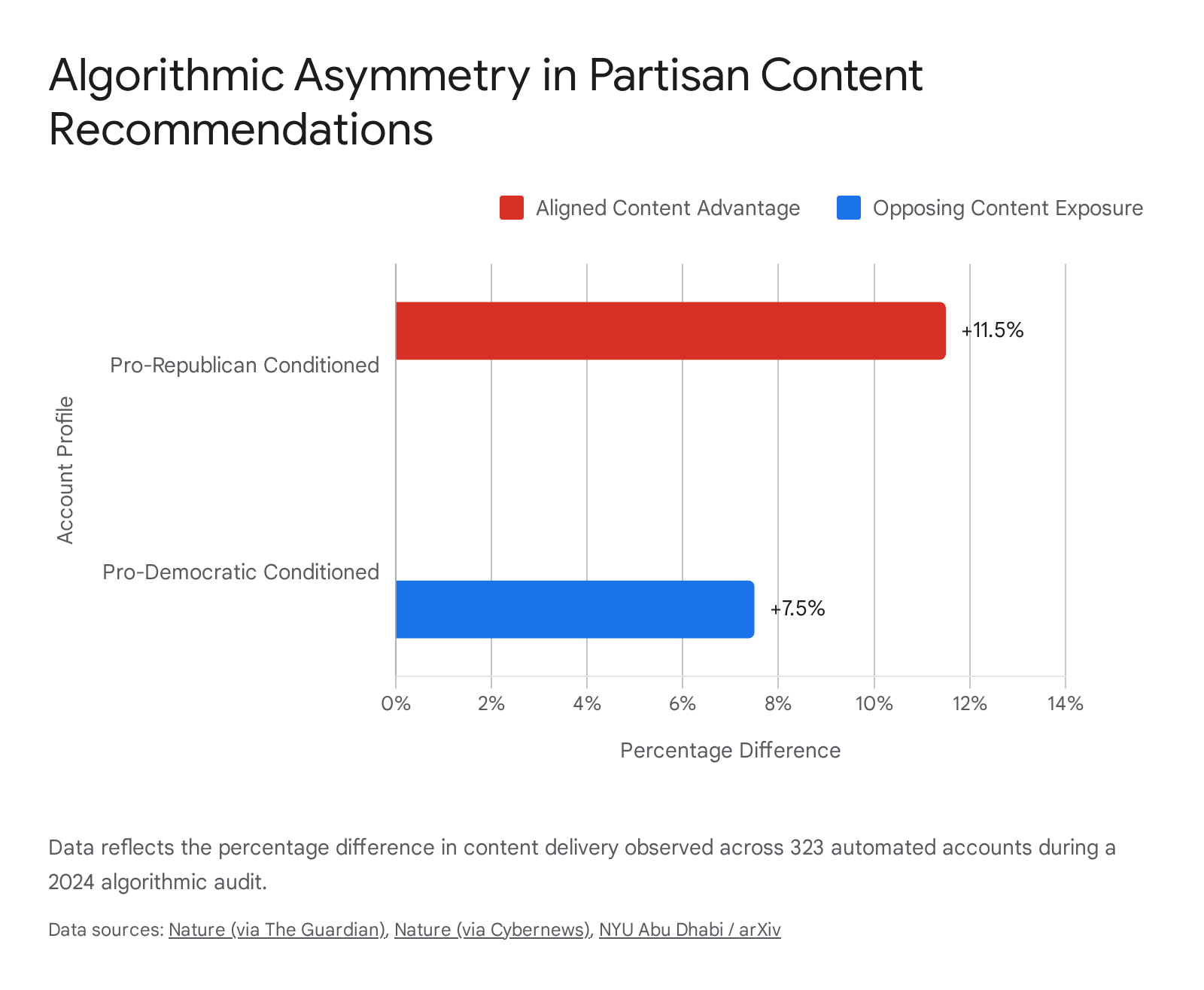
Platform architecture profoundly influences how partisan content is amplified, and newer, video-centric platforms demonstrate distinct behavioral patterns compared to legacy text-based networks. A 2026 algorithmic audit of TikTok during the 2024 U.S. presidential campaign utilized 323 automated sock-puppet accounts to map content delivery pathways and algorithmic biases 283132. The accounts were conditioned to mimic genuine user behavior by engaging with specific partisan content across both battleground states (e.g., Georgia) and solid partisan states (e.g., New York, Texas).
The analysis of nearly 400,000 recommended videos revealed substantial asymmetric algorithmic amplification. Accounts conditioned with pro-Republican viewing behavior were served approximately 11.5 percent more aligned content than their pro-Democratic counterparts. Conversely, Democratic-conditioned accounts experienced significantly higher cross-partisan exposure, receiving 7.5 to 8.0 percent more content from the opposing party. Furthermore, the algorithm systematically targeted perceived partisan vulnerabilities, feeding Democratic accounts disproportionately high volumes of cross-partisan content regarding crime and immigration, while Republican accounts were targeted with cross-partisan content concerning reproductive rights 28313233.
Global Perspectives and Platform Variations
The bulk of highly funded experimental literature focuses heavily on feed-based public platforms like Facebook, X, and TikTok within the United States and Western Europe. However, global data reveals that political polarization and digital communication dynamics vary drastically across different technological environments, regulatory regimes, and socio-political histories.
Encrypted Messaging Networks in the Global South
In many democracies within the Global South, including Brazil, India, Nigeria, and South Africa, the primary digital arena for political communication is not the public, algorithmically sorted feed, but encrypted private messaging applications, predominantly WhatsApp. These platforms differ fundamentally from public social networks; they operate via strong-tie homophily, where content circulates virally within closed groups of family, friends, and trusted community members, shielded from public scrutiny and algorithmic downranking 293031.
The architecture of encrypted messaging limits cross-cutting exposure and facilitates the rapid, unchecked dissemination of hyperpartisan narratives. In Brazil and India, sophisticated political operations have weaponized these networks to orchestrate coordinated disinformation campaigns. Computational analyses of WhatsApp groups during recent Brazilian elections identified tens of thousands of hyperpartisan links, coordinated attacks on democratic institutions, and systemic efforts to delegitimize the mainstream press. This process establishes a parallel, hermetically sealed political communication ecosystem where polarization is driven by elite mobilization and peer-to-peer trust rather than algorithmic manipulation 3132.
Despite the high volume of misinformation circulating in these encrypted networks, targeted interventions yield complex, often muted results. A multimedia deactivation experiment conducted in Brazil during the highly polarized 2022 presidential election disabled the downloading of images and audio files on WhatsApp for a massive test group. While the intervention successfully and significantly reduced participants' recall of circulating false rumors, it did not produce a statistically significant shift in overall belief accuracy, psychological well-being, or affective polarization 303334. This reinforces the conclusion drawn from the Meta experiments: structural platform adjustments alone cannot quickly dismantle entrenched partisan animosity when the underlying political climate is highly charged.
Identity-Driven Affective Polarization in African Democracies
The standard Western paradigm of ideological polarization - often mapped linearly on a left-right economic or social spectrum - frequently fails to capture the realities of political division in Sub-Saharan Africa. Research across Nigeria, Ghana, Kenya, and South Africa identifies a distinct phenomenon termed Identity-Driven Affective Polarization (IDAP). In these contexts, polarization is deeply affective but is rooted in ascriptive identities, such as ethnicity, religion, or regional affiliation, and historical patronage networks, rather than in programmatic or policy-based contestation 35.
Social media acts as a highly volatile accelerant for IDAP. Digital platforms provide political elites with tools to amplify zero-sum political logic, where control of the state is equated with exclusive resource allocation and wealth for specific ethnic or regional groups. During national crises, variations in platform utilization become starkly evident. In Nigeria, the 2020 #EndSARS movement utilized public platforms like X to facilitate decentralized, youth-driven, cross-regional mobilization demanding governance reform, demonstrating a unifying digital potential 36. Conversely, during the July 2021 unrest in South Africa following the imprisonment of former President Jacob Zuma, communication primarily shifted to WhatsApp and Facebook, where closed-group dynamics and algorithmic amplification exacerbated destructive factionalism, spreading xenophobic narratives and organizing coordinated violence and looting 3637.
Disinformation and Algorithmic Enclaves in Southeast Asia
Southeast Asia presents a complex tapestry of political structures ranging from consolidating electoral democracies to established single-party autocracies. Within this region, social media demonstrates a profound dual capability: it simultaneously acts as an engine for grassroots democratization and an instrument for autocratic consolidation 383940.
In tightly controlled environments like Vietnam, digital platforms have occasionally enabled unprecedented civic mobilization, allowing citizens to bypass state media to halt unpopular government initiatives, such as massive environmental disruptions in urban centers 41. However, across the broader region, state and non-state political actors aggressively deploy "algorithmic politics." By exploiting platform engagement metrics and communicative capitalism, these actors fracture populations into isolated algorithmic enclaves. In the Philippines and Indonesia, highly coordinated disinformation networks utilize emotional and binary messaging to secure electoral advantages and marginalize oppositional voices, creating an environment where societal polarization is intentionally sustained as a mechanism of elite political control 384047.
Longitudinal Trends in Democratic Polarization
Evaluating the true macro-level impact of digital communication requires analyzing longitudinal dataset aggregates to track how polarization correlates with global democratic health over time, moving beyond isolated election cycles.
Comparative Cross-Country Trajectories
The Varieties of Democracy (V-Dem) project provides the most comprehensive historical dataset tracking political polarization globally. Relying on evaluations from thousands of country experts, the data measures the extent to which a society is divided into hostile political camps and whether political differences undermine social relationships and discourage interaction across ideological lines 4243.
While affective polarization is recognized as a global trend, its trajectory is highly regionalized and non-linear. Latin America and the Caribbean have experienced the sharpest aggregate increase in political polarization over the last two decades. In the early 2000s, Latin America scored well below the global average for polarization; by 2017, the region surpassed the global average and currently ranks as one of the most highly polarized regions globally, second only to Eastern Europe and Central Asia 42.
| Region / Exemplar Nation | Trend Indicator (2000 - 2025) | Primary Drivers of Digital Polarization |
|---|---|---|
| United States | High and sustained increase | Affective spirals, high-salience partisan identity, algorithmic engagement 644. |
| Latin America (e.g., Brazil) | Steepest global escalation | Encrypted messaging (WhatsApp) coordination, institutional delegitimization 314245. |
| Sub-Saharan Africa (e.g., Kenya, Nigeria) | Fluctuating, crisis-driven | Identity-Driven Affective Polarization (IDAP), digital clientelism 3536. |
| Southeast Asia (e.g., Indonesia, Philippines) | High, state-instrumentalized | Algorithmic enclaves, coordinated electoral disinformation campaigns 3839. |
The V-Dem 2026 Democracy Report illustrates a severe global democratic deficit, noting that 74 percent of the global population now resides in autocracies, effectively returning the average global democratic level to that of 1978. In major regional powers such as Brazil, India, and Türkiye, political polarization has reached what researchers define as "toxic" levels, defined by the erosion of pluralistic norms, the weakening of legislative processes, and the normalization of hostile interactions across all civic spheres 454647.
Demographic Shifts and the Concentration of Partisanship
The demographic composition of the digital public sphere is currently undergoing a structural transformation that further complicates the polarization narrative. Longitudinal survey data from the American National Election Studies (ANES) indicates that overall social media usage for political communication is beginning to decline. Between 2020 and 2024, the youngest and oldest demographics increasingly abstained from digital political engagement, and the average number of platforms utilized by the average citizen measurably dropped 44.
However, this withdrawal is not distributed equally across the ideological spectrum. The users who abandon political discussion tend to be moderates or those with lower baseline political interest. Conversely, individuals who exhibit the highest levels of affective polarization remain the most intensely active posters. On platforms like X, this dynamic has driven a massive demographic reshuffling; between 2020 and 2024, active political posting on the platform flipped by nearly 50 percentage points from a Democratic-leaning user base to a Republican-leaning one, while moderates vanished from the discourse 44.
As casual users disengage and highly polarized partisans monopolize the discourse, the architecture of the digital public sphere shifts. It becomes smaller, sharper, and systematically unrepresentative of the broader public's actual ideological composition. This concentration effect virtually guarantees that the remaining participants are locked in an uninterrupted trench warfare dynamic, projecting an image of extreme societal fracture that algorithms dutifully amplify to maximize remaining user engagement.
Analysis and Implications
The empirical evidence demonstrates conclusively that social media is not the sole progenitor of political polarization. Ideological divisions, historical grievances, and group identities long precede the digital era, and algorithmic changes alone cannot reliably reverse decades of socio-political sorting. Furthermore, the popular notion of the isolated "echo chamber" underestimates the frequency with which digital citizens actively encounter opposing viewpoints.
Instead, the primary risk of social media lies in its capacity to systematically accelerate affective polarization. Through the psychological mechanisms of the affective spiral and trench warfare dynamics, digital platforms transform cross-cutting exposure into acute identity threats, hardening partisan lines and fostering deep-seated outgroup animosity. While systemic algorithmic adjustments show limited short-term efficacy in altering core political beliefs, targeted interventions against overtly hostile and antidemocratic rhetoric hold measurable promise in reducing interpersonal toxicity. Ultimately, navigating the current global democratic deficit requires addressing both the foundational socio-economic and political grievances that drive initial ideological divergence, and the specific digital architectures that reliably convert those grievances into toxic, zero-sum conflicts.