
Equivalence of quantum entanglement and wormholes
Historical and Theoretical Foundations
To critically analyze the ER=EPR conjecture, it is necessary to examine the two distinct physical phenomena it seeks to unify: the quantum mechanical principle of entanglement and the general relativistic concept of topological wormholes. Both phenomena were formally introduced to the theoretical physics community in 1935 through separate papers co-authored by Albert Einstein, though they were conceived to address entirely different problems in fundamental physics.
Quantum Entanglement and the EPR Paradox
In 1935, Albert Einstein, Boris Podolsky, and Nathan Rosen published a thought experiment designed to demonstrate that the prevailing framework of quantum mechanics was an incomplete description of physical reality 12. The paper highlighted a phenomenon - subsequently termed "entanglement" by Erwin Schrödinger - in which two or more particles interact and become interconnected such that their quantum states are fundamentally linked, regardless of the spatial distance separating them 23.
The core of the EPR argument rested on the principle of local realism and a specific criterion of reality: if a physical quantity can be predicted with absolute certainty without disturbing the system, then an "element of reality" corresponds to that quantity 34. The authors noted that measuring the position of one particle in an entangled pair instantly determines the position of the other particle, and the same holds true for momentum 35. Because the operators for position and momentum do not commute, quantum mechanics forbids them from possessing simultaneous, definite values 45. Einstein, Podolsky, and Rosen argued that because the state of the distant particle was determined without direct physical interaction, the particle must have possessed "hidden variables" - pre-existing definite values for these properties prior to measurement 25. They concluded that quantum mechanics, lacking the capacity to describe these variables, was an incomplete theory, as an instantaneous physical influence across space would violate the limitations on information transfer dictated by special relativity 35.
Subsequent theoretical and experimental advancements, notably physicist John Bell's 1964 formulation of Bell's inequalities and decades of subsequent Bell tests, demonstrated that no local hidden variable theory can reproduce the statistical predictions of quantum mechanics 12. Quantum entanglement is now understood as a non-local quantum correlation. Crucially, while this correlation is instantaneous, it obeys the no-signaling theorem; the outcome of a measurement remains fundamentally random, meaning the correlation cannot be utilized to transmit classical information faster than the speed of light, thereby preserving macro-causality while violating classical local realism 566.
Spacetime Geometry and Einstein-Rosen Bridges
In the same year, Einstein and Rosen published a separate paper applying the principles of general relativity to the problem of elementary particles. Attempting to formulate an atomistic theory of matter and electricity free of the geometric discontinuities inherent in the Schwarzschild metric, they proposed a mathematical structure connecting two distinct, asymptotically flat sheets of spacetime 578.
This structure, originally intended as a geometrical representation of a particle, became known as an Einstein-Rosen (ER) bridge, or in modern parlance, a wormhole 810. In its classical formulation, an ER bridge consists of a "throat" connecting two distinct "mouths" located in disparate regions of spacetime 10. However, subsequent mathematical analyses by physicists such as John Archibald Wheeler demonstrated that classical ER bridges constructed in standard vacuum spacetime are highly unstable 9. The geometry of a standard Schwarzschild wormhole is dynamic rather than static; the throat pinches off and collapses into a singularity faster than light - or any physical object - can traverse it 101114. Consequently, standard ER bridges are inherently non-traversable and do not allow for superluminal travel or the transmission of signals across the connected regions of spacetime, a property that intriguingly parallels the no-signaling theorem of quantum entanglement 61011.
| Geometric and Topological Properties (ER Bridges) | Quantum Mechanical Properties (EPR Pairs) |
|---|---|
| Origin: Formulated via General Relativity in 1935 to model singularity-free particles 810. | Origin: Formulated via Quantum Mechanics in 1935 to critique theory completeness 13. |
| Causality Constraint: Non-traversable; the bridge throat collapses before any physical signal can pass through it 610. | Causality Constraint: Obeys the no-signaling theorem; measurement correlations cannot transmit classical information 56. |
| Quantification Metric: Measured geometrically by the maximin cross-sectional area of the wormhole's throat 612. | Quantification Metric: Measured entropically by the Von Neumann entanglement entropy between subsystems 612. |
| Detectability: No local curvature measurement can distinguish a one-sided black hole from a two-sided wormhole geometry 6. | Detectability: Entanglement is not a linear observable; no single local operation can determine if a generic state is entangled 61617. |
| Structural Limitation: Smooth classical vacuum wormhole solutions exhibit nonpositive tripartite information 13. | Structural Limitation: Strict monogamy of entanglement; a quantum system cannot be maximally entangled with two independent systems 61415. |
The AMPS Firewall Paradox
For decades, the concepts of quantum entanglement and topological wormholes were treated as fundamentally separate domains of physics, residing entirely within quantum mechanics and macroscopic general relativity, respectively. The theoretical intersection of these domains was forced by the study of black hole thermodynamics, the preservation of quantum information, and a profound crisis known as the firewall paradox.
Black Hole Thermodynamics and Unitarity
The ER=EPR conjecture emerged primarily as a proposed resolution to the black hole firewall paradox, formalized in 2012 by physicists Ahmed Almheiri, Donald Marolf, Joseph Polchinski, and James Sully (collectively known as AMPS) 142116.
The paradox arises directly from the behavior of Hawking radiation. According to quantum field theory in curved spacetime, the vacuum near the event horizon is characterized by quantum fluctuations. A black hole evaporates through the emission of Hawking radiation, a process involving two mutually entangled particles: one particle escapes to infinity as a quantum of radiation, while its entangled partner falls past the event horizon into the singularity 14.
A central pillar of quantum mechanics is unitarity, the principle that quantum information is strictly conserved over time. If black hole evaporation is a unitary process, the radiation emitted late in the black hole's life must be quantum mechanically entangled with the radiation emitted earlier 17. General arguments from quantum information theory, specifically those formulated by Don Page and Eli Lubkin, dictate that once an old black hole has evaporated past its halfway point - a threshold known as the Page time, occurring on a timescale of $\sim M^3$ - it becomes maximally entangled with its own early radiation 142117.
Monogamy of Entanglement and the Horizon
However, to satisfy Einstein's equivalence principle - which states that a freely falling observer should experience the event horizon as ordinary, empty Minkowski space - the newly emitted outgoing Hawking particle must also be highly entangled with its infalling partner just behind the horizon 1421.
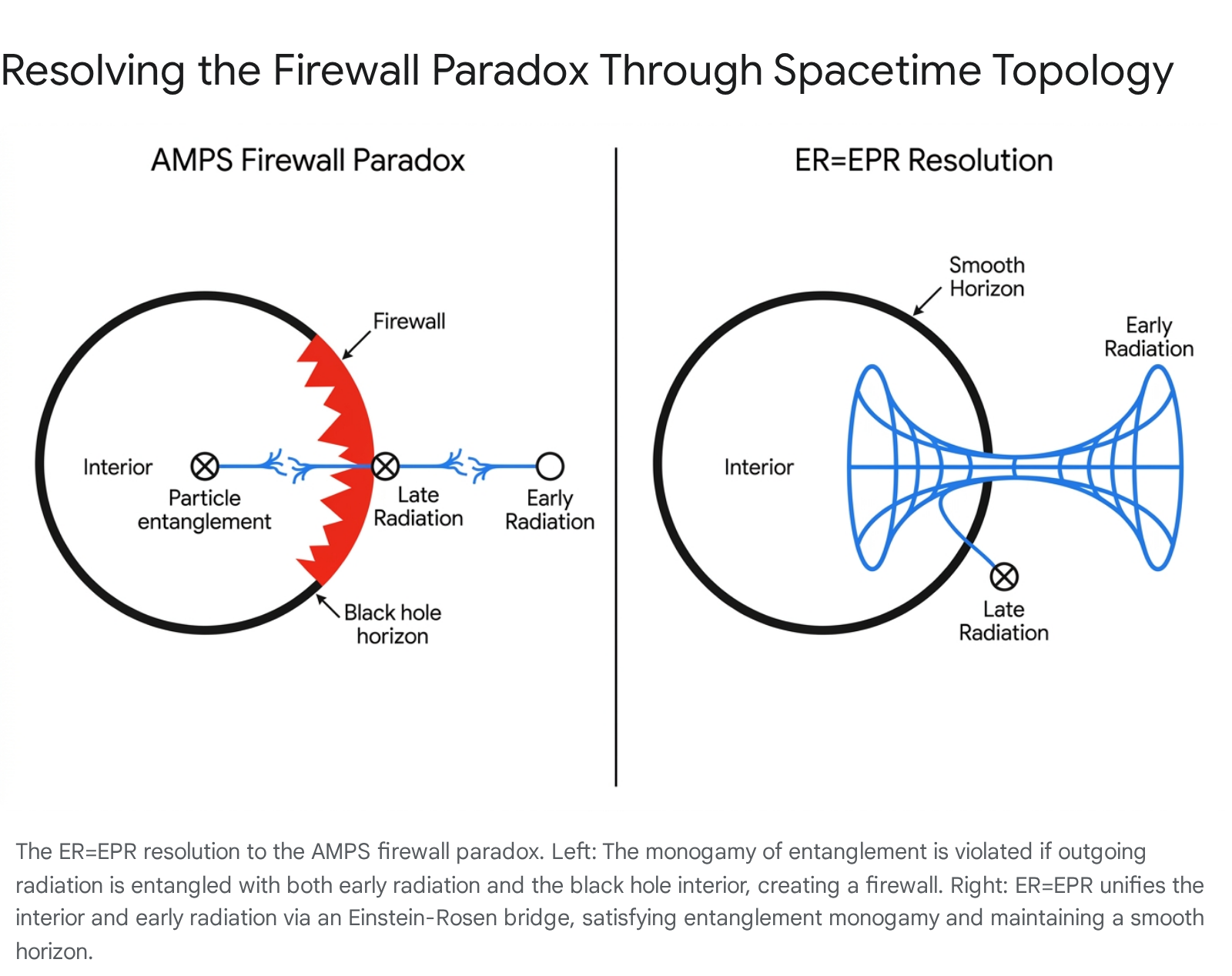
This creates a fundamental conflict with a core mathematical tenet of quantum mechanics: the monogamy of entanglement 141517. A single quantum system cannot be fully entangled with two independent systems simultaneously 1415. The newly emitted outgoing particle cannot be maximally entangled with both the early Hawking radiation (to preserve unitary information conservation) and the infalling partner particle (to preserve the smooth spacetime geometry of the horizon) 1417.
Faced with this contradiction, AMPS concluded that to preserve unitary quantum mechanics, the entanglement between the infalling particle and the outgoing particle must be immediately broken 14. Breaking this entanglement releases a massive amount of energy, fundamentally altering the geometry of the horizon 1416. Instead of empty space, an observer falling into an old black hole would encounter a searing "firewall" of high-energy quanta - an arbitrarily hot maelstrom of particles - precisely at the event horizon, burning them to a crisp 141617. This conclusion forces a painful theoretical sacrifice: physicists must abandon either Einstein's equivalence principle (which theoretical physicist Raphael Bousso equated to a brick wall suddenly appearing in empty space), the principle of quantum unitarity, or local quantum field theory 1416.
Formulation of the ER=EPR Conjecture
In 2013, theoretical physicists Juan Maldacena and Leonard Susskind proposed the ER=EPR conjecture to resolve the AMPS firewall paradox without sacrificing the equivalence principle or the foundations of quantum mechanics 2418.
Susskind and Maldacena's Geometrical Resolution
The conjecture posits a literal, exact equivalence between nontrivial quantum entanglement (EPR) and topological spacetime connectivity (ER) 12. Specifically, Maldacena and Susskind argued that any two maximally entangled particles - or systems of particles - are connected by a microscopic, non-traversable wormhole in the underlying gravitational description 16241826.
Applied to the firewall paradox, the conjecture fundamentally alters the geometric interpretation of the black hole and its early radiation. Susskind and Maldacena envisioned a thought experiment where one gathers all the early Hawking particles emitted by an old black hole, smushes them together, and collapses them into a second, separate black hole 18. Because the early radiation is maximally entangled with the remaining old black hole, this new black hole is, by definition, maximally entangled with the original one 18.
Under the ER=EPR framework, this massive quantum entanglement implies that the two black holes are connected by an Einstein-Rosen bridge 18. Therefore, the early radiation and the interior degrees of freedom of the original black hole are not two separate, independent systems competing for entanglement with the late radiation; rather, they are distinct geometric descriptions of the exact same physical degrees of freedom, connected through the interior wormhole 18. Because the infalling particle and the early radiation represent the same unified topological system, the monogamy of entanglement is not violated. The entanglement overload is averted, and the necessity of a firewall vanishes, preserving a smooth event horizon 18.
Holographic Duality and the Thermofield Double State
The mathematical rigor underlying the ER=EPR conjecture is heavily reliant on the Anti-de Sitter/Conformal Field Theory (AdS/CFT) correspondence, a realization of the holographic principle introduced by Juan Maldacena in 1997 27192021.
AdS/CFT posits that a theory of quantum gravity in a negatively curved, $(d+1)$-dimensional bulk spacetime (Anti-de Sitter space) is mathematically equivalent to a conformal field theory (CFT) without gravity residing on the $d$-dimensional asymptotic boundary of that space 2720. This gauge/gravity duality allows physicists to translate intractable problems in strongly coupled quantum mechanics into solvable geometric problems in classical gravity 20. The classic formulation relates type IIB superstring theory on $AdS_5 \times S^5$ space to $\mathcal{N}=4$ supersymmetric Yang-Mills theory on its boundary 2731.
Within this framework, Mark Van Raamsdonk previously observed that the geometry of a maximally extended AdS-Schwarzschild black hole - a spacetime containing two disconnected asymptotic boundaries connected by a non-traversable Einstein-Rosen bridge - is exactly dual to a pair of isolated, non-interacting conformal field theories residing on the respective boundaries 182022. The specific quantum state corresponding to this two-sided wormhole geometry is known as the thermofield double (TFD) state 12163334. A TFD state is a purification of a thermal state; it consists of two systems that are individually in a mixed thermal state (appearing as thermal radiation to a local observer) but together form a highly entangled, globally pure state 1216. In AdS/CFT, the amount of entanglement between the two CFTs is calculated by the Ryu-Takayanagi formula, demonstrating that the entanglement entropy is precisely proportional to the minimal cross-sectional area of the ER bridge connecting their bulk duals, matching the Bekenstein-Hawking entropy 1220.
Entropy Inequalities and Monogamy Constraints
The ER=EPR conjecture is further bolstered by profound structural similarities between the entropic properties of quantum entanglement and the classical geometries of ER bridges. Theoretical analyses conducted by physicists Hrant Gharibyan and Robert F. Penna demonstrated that geometric definitions of ER bridge entropy satisfy all known quantum entropy inequalities 121323.
The cross-sectional area of classical ER bridges conforms to the strict requirements of subadditivity, strong subadditivity, the triangle inequality, and the Cadney-Linden-Winter (CLW) inequalities 12132324. These are non-trivial constraints that all quantum mechanical entangled systems must obey. Crucially, classical ER bridges are restricted mathematically to monogamous entanglement configurations; they possess nonpositive tripartite mutual information ($I_3(A:B:C) \leq 0$) 12132324. Highly multiparty entangled states, such as the pure four-qubit GHZ state, exhibit positive tripartite information. As a direct consequence, these highly networked states cannot be modeled by smooth, classical wormhole geometries, requiring instead complex and yet-to-be-defined "quantum" wormhole networks or fluctuating string topographies 12132324.
Traversable Wormholes and Quantum Teleportation
Classical general relativity strictly forbids traversable wormholes without the introduction of exotic matter that violates the average null energy condition (ANEC) 1091133. However, the integration of quantum mechanics through the ER=EPR lens has yielded rigorous semi-classical mechanisms to render these bridges traversable.
The Gao-Jafferis-Wall Protocol
In 2016, physicists Ping Gao, Daniel Jafferis, and Aron Wall demonstrated a protocol to theoretically stabilize an Einstein-Rosen bridge, allowing a physical signal to pass from one side to the other 142526. Operating within the semi-classical approximation - treating the background gravitational field classically but the constituent matter fields quantum mechanically - the researchers utilized an eternal BTZ black hole with two asymptotic boundaries 2526.
The wormhole connecting these regions is initially non-traversable. However, by introducing a direct, non-local interaction (a "double-trace deformation") that mathematically couples the quantum fields on the two asymptotic boundaries at a specific time, the geometry of the bulk interior is fundamentally altered 332526.
The coupling of the boundaries induces a quantum mechanical effect that acts as a negative energy flux propagating through the wormhole 111427. In standard general relativity, positive energy density causes light rays to focus, accelerating the collapse of the wormhole throat 1114. The introduction of negative null energy reverses this effect; it causes the light rays traversing the wormhole to defocus, effectively shifting the event horizon and holding the throat of the wormhole open long enough for a signal to pass through 1114.
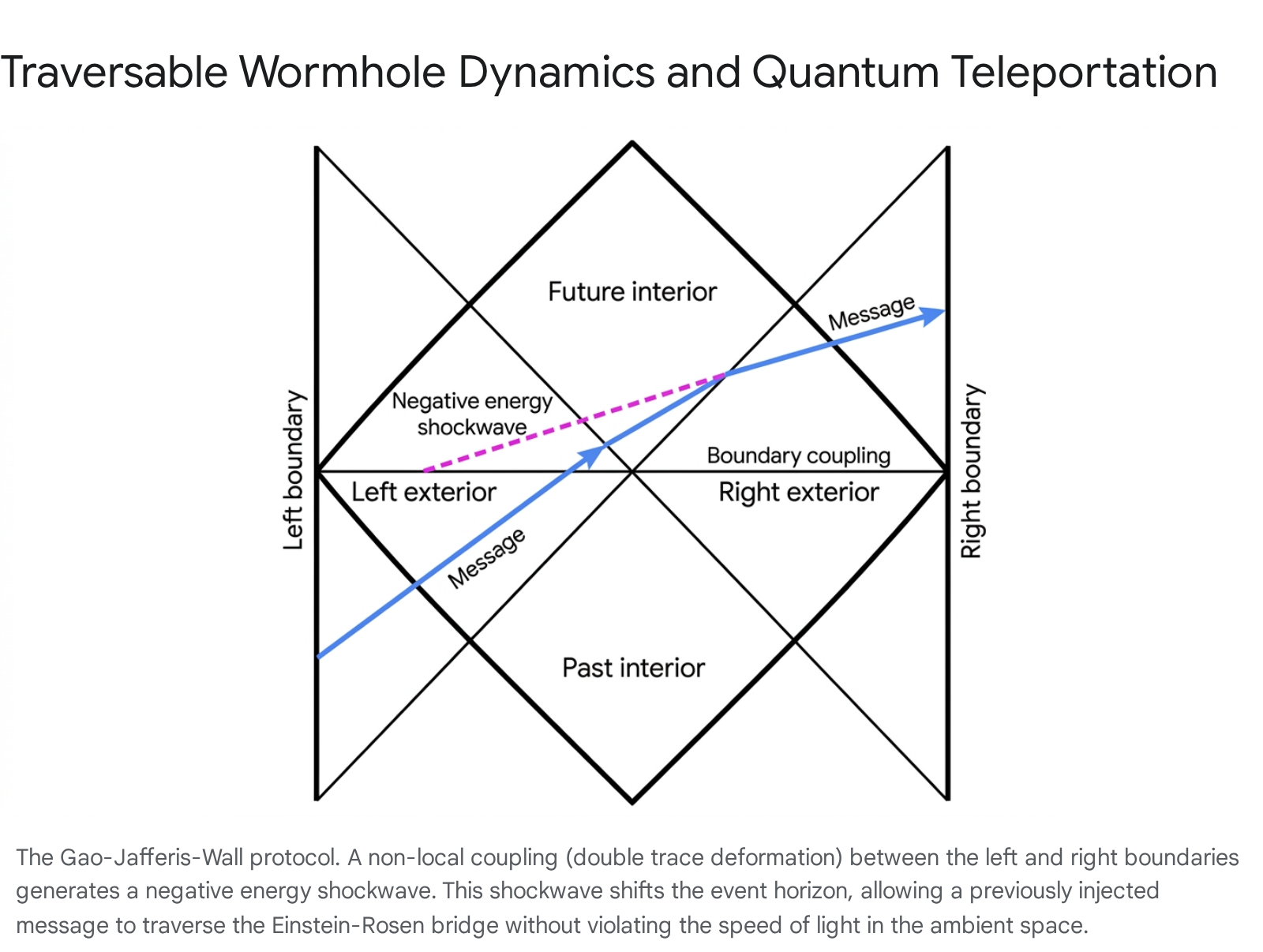
Importantly, this mechanism does not violate bulk causality or permit superluminal signaling in the ambient spacetime. The non-local interaction required between the boundaries effectively acts as a classical communication channel. Because the protocol requires classical coordination to apply the deformation, the overall speed of signal transmission between the two observers remains bounded by the speed of light 264028.
Holographic Teleportation and Operator Size Growth
In the boundary dual CFT, the Gao-Jafferis-Wall traversable wormhole protocol maps directly to the phenomenon of many-body quantum teleportation, specifically resembling the Hayden-Preskill protocol 3325294330.
The process by which information scrambles into the complex degrees of freedom of the left black hole, passes through the bulk geometry, and miraculously unscrambles on the right black hole is holographically identical to sending quantum information via highly entangled pairs augmented by classical communication channels 252831. This boundary phenomenon is driven by an effect known as "teleportation by size" and "size winding" within chaotic many-body systems like the Sachdev-Ye-Kitaev (SYK) model 2831.
The quantum channel capacity of this traversable wormhole is mathematically governed by the time derivative of out-of-time-ordered correlators (OTOCs) 3346. OTOCs measure the rate at which quantum information scrambles and the corresponding growth in the size of operators within the holographic dual system. Because the scrambling of information dictates the formation of the negative energy shockwave in the bulk, the growth rate of operator size in the boundary theory is bounded above by the classical Einstein gravity limit, inextricably linking quantum chaos to gravitational dynamics 3346.
Generalizations and Advanced Geometries
Research into the ER=EPR conjecture has recently expanded beyond highly idealized, symmetric thermal states to encompass typical quantum microstates, yielding new geometric constructs that describe the internal structures of these wormholes.
Complexity and Einstein-Rosen Caterpillars
A significant historical critique of the original ER=EPR proposal was that the thermofield double state is a highly specialized, atypical entangled state, begging the question of whether generic entangled black hole states possess smooth interiors 344732. In recent literature (circa 2024 - 2026), physicists have systematically investigated the holographic duals of typical entangled states - ensembles of states generated via multiplicative Brownian motion and random quantum circuits that densely explore the full black hole Hilbert space 3432.
It has been found that the generic microstates of two entangled black holes do not contain destructive firewalls; rather, they give rise to extremely long, highly irregular wormholes termed "ER caterpillars" 343233. First discussed by H. Lin and L. Susskind in the context of fixed Hamiltonian evolution, an ER caterpillar is a spatial wormhole supported by a large number of matter inhomogeneities, lacking the smooth, featureless symmetry of the standard vacuum ER bridge 343334.
The ER caterpillar provides a direct realization of the "complexity = geometry" postulate 3434. Through the evolution of random quantum circuits acting on the system, the degree of microscopic quantum randomness translates quantitatively into the physical geometric length of the wormhole 343435. As the quantum complexity of the entangled state increases - representing the difficulty of preparing the state from a simple reference state - the ER caterpillar grows progressively longer and more structurally convoluted 3435.
Asymmetric Wormholes and Direct-Sum QFT
The ER=EPR conjecture also robustly extends to the case of non-identical black holes. If two entangled systems differ in mass or electrical charge, the entanglement is still reflected in a geometric connection, but the wormhole is no longer a static, symmetric solution 18. Instead, it becomes a dynamic, asymmetric bridge containing a stress-energy field, often visualized as a domain wall or a shockwave propagating through the interior 18. The presence of this matter inside the bridge generally causes the asymmetric wormhole to collapse even more rapidly than in the vacuum case, strictly preserving causality 18.
Further theoretical expansions have utilized Direct-Sum Quantum Field Theory (DQFT) to interpret ER bridges not as spatial tunnels connecting distant stars, but as connections between opposite arrows of time 73637. In this framework, a quantum system consists of two interdependent components in parity-conjugate regions: one where time flows forward and one where time flows backward 737. Reconciling quantum field theory in extreme gravitational environments, such as inverted harmonic oscillators near a horizon, suggests that the ER bridge acts as a mathematical mirror in spacetime, preserving fully reversible quantum dynamics at the microscopic level 73637.
Experimental Proposals and Quantum Simulations
While the ER=EPR conjecture fundamentally relies on Planck-scale quantum gravity or macroscopic black holes, theoretical proposals have suggested innovative avenues to constrain or simulate the conjecture using atomic systems and quantum processors.
Atomic Constraints and Hydrogen Hyperfine Structure
If all entangled particles are literally connected by microscopic quantum wormholes, it is hypothesized that the classical force fields generated by these particles might interact with the wormhole geometry. Specifically, researchers postulate that the electric field surrounding an entangled charged particle could partially leak into the connecting ER bridge 545556.
For a quantum mechanically entangled system like the hydrogen atom, this leakage would diminish the effective electrostatic interaction between the proton and the electron 5638. Theoretical analyses indicate that such a geometric effect would measurably alter the energy spectrum of the system, particularly shifting the hydrogen atom's hyperfine structure by a factor approximating $1 - 4s/(\pi \alpha^2)$ for large distances 545556. Furthermore, if the quantum wormhole is strictly non-traversable (as is classically assumed for EPR pairs), the leakage of electric flux lines into the wormhole without a corresponding exit would result in a non-zero total effective charge for the previously neutral atom 545639.
Because high-precision spectroscopy of hydrogen hyperfine splitting is incredibly well-documented, this empirical data can be used to place stringent upper bounds on the amplitude of any ER=EPR effect 555638. These high-precision measurements constrain the coupling parameters to regions that completely rule out naive $\mathcal{O}(1)$ expectations, effectively demonstrating that if quantum wormholes exist between atomic particles, their macroscopic electromagnetic footprint is exceptionally constrained 56. Other proposed tabletop tests involve monitoring the positronium annihilation process and measuring effective weights, searching for minuscule variations in the speed of light or gravitational mass influenced by hypothetical microscopic wormholes 59.
The 2022 Sycamore Quantum Computer Controversy
The theoretical difficulty in physically probing ER=EPR led to significant controversy in late 2022 when a team of physicists utilizing Google's Sycamore quantum processor claimed to have simulated a holographic wormhole in the laboratory 214041. The researchers implemented a highly sparsified version of the Sachdev-Ye-Kitaev (SYK) model - a chaotic quantum many-body system known to possess a holographic dual relating to 1D gravity - on nine physical qubits 404162. Upon executing the circuit, they observed a peak in mutual information transfer that successfully mimicked the Gao-Jafferis-Wall traversable wormhole teleportation protocol 212740.
The public claim that the experiment simulated "quantum gravity in the lab" was met with intense and swift criticism from the broader theoretical physics community 214162. Critics, including prominent physicists such as John Preskill and Norman Yao, pointed out that a nine-qubit system represents a state space of merely 512 dimensions 4041. Furthermore, the sparsified Hamiltonian utilized in the simulation was "fully commuting," a massive simplification that removed the chaotic quantum scrambling dynamics necessary to accurately model actual black hole holography 41.
The consensus among critics was that the mathematical operations could be trivially simulated on a classical computer in milliseconds, and the simplified model was insufficient to capture true gravitational phenomena 214041. While the teleportation protocol was successfully executed on hardware, the experiment functioned as an analog of a highly simplified mathematical model rather than a genuine creation of a spacetime wormhole, illustrating the severe conceptual and empirical challenges of verifying the ER=EPR conjecture experimentally 40416263.
Criticisms and Theoretical Limitations
Despite its mathematical elegance and its profound utility in resolving the AMPS paradox within highly symmetric AdS/CFT models, the ER=EPR conjecture faces significant criticism, theoretical hurdles, and ongoing debate regarding its universal physical applicability.
The Problem of Generic States
Physicists Donald Marolf and Joseph Polchinski have challenged the universal scope of the ER=EPR equivalence, arguing that strong quantum entanglement does not universally or generically correspond to a smooth, semiclassical wormhole geometry 476465.
Using the Eigenstate Thermalization Hypothesis (ETH), Marolf and Polchinski analyzed the behavior of random operators on the space of black hole states 47. They demonstrated that local correlations in a typical, generic highly entangled state are exponentially weak 4765. While an eternal black hole prepared in a highly tuned thermofield double state possesses a smooth geometric interior, a state selected uniformly at random from the highly entangled Hilbert space lacks the necessary two-sided correlation structure to support a classical, traversable-like wormhole geometry 476566. Consequently, they argue that while ER=EPR may apply to specific, carefully prepared symmetric states, it fails to geometrize entanglement for typical states, potentially leaving the firewall paradox unresolved for generic black holes undergoing dynamic evaporation 476566.
State Dependence and Linearity Conflicts
The conjecture also sits in profound conceptual tension with the core quantum mechanical principle of linearity 1864. According to ER=EPR, a quantum system in a separable, unentangled state contains no topological wormhole connection. However, standard quantum mechanics dictates that an entangled state is merely a linear superposition of separable states 18. It remains mathematically and conceptually difficult to reconcile how a superposition of entirely disconnected, flat geometries can yield a smoothly connected, curved spacetime topology 18.
This conflict often forces proponents of ER=EPR and the related Papadodimas-Raju (PR) proposal to rely heavily on "state-dependent" operators to describe the black hole interior 6466. In standard quantum mechanics, an observable operator must be independent of the specific state upon which it acts. However, to construct mathematical operators that safely describe the interior of the ER bridge and avoid firewalls, theories relying on ER=EPR frequently define mirror operators whose very formulation depends on the exact microscopic state of the black hole. This methodology is viewed by many theoretical physicists as an uncomfortable violation of standard quantum measurement theory 66.
Topological Field Theory and Fake Entanglement
Further complications arise from rigorous investigations into three-dimensional topological quantum field theories (TQFTs). Work by mathematicians and physicists John Baez and Jamie Vicary has demonstrated that in specific 3D TQFTs, the geometric process of forming a topological wormhole is mathematically identical to the process of creating a particle-antiparticle pair 176742.
However, upon closer examination, Baez and Vicary noted a phenomenon they termed "fake entanglement" 67. In true quantum entanglement, two distinctly independent physical systems become statistically correlated. In their TQFT model of the ER=EPR correspondence, the degrees of freedom across the wormhole are not independent entities that have become correlated; they are literally the exact same topological degrees of freedom accessed from different geometric vantage points 176742. Because the systems are fundamentally not separate entities, this manifestation smoothly circumvents true multiparty entanglement limits, but it raises philosophical and physical questions about whether the ER=EPR duality genuinely describes independent entangled particles (like electrons in a lab) or simply describes self-correlation through complex topological identifications 1742.
The De Sitter Space Constraint
Perhaps the most significant limitation of the ER=EPR conjecture is its near-total mathematical reliance on the AdS/CFT correspondence 27216970. Anti-de Sitter (AdS) space is a theoretical geometric construct characterized by a negative cosmological constant, giving the space a distinct, reflective boundary where a dual conformal field theory can logically reside 272021.
The actual physical universe, however, is a de Sitter space characterized by an accelerating expansion driven by a positive cosmological constant (dark energy) 2170. De Sitter space lacks a timelike asymptotic spatial boundary where a dual CFT could be anchored 2170. While ER=EPR is mathematically robust in specific five-dimensional AdS string theory scenarios, mapping the conjecture directly to the four-dimensional expanding spacetime of standard model cosmology remains highly speculative 1921. Without a rigorous, universally accepted de Sitter equivalent to the AdS/CFT correspondence, the ER=EPR conjecture remains a powerful mathematical tool for quantum gravity research rather than an experimentally verifiable description of the cosmos 242170.
Conclusion
The ER=EPR conjecture represents one of the most provocative and ambitious theoretical frameworks in modern physics, attempting to reconcile the deep foundational incompatibilities between general relativity and quantum mechanics. By proposing an exact equivalence between topological Einstein-Rosen bridges and quantum entanglement, Maldacena and Susskind provided an elegant geometric resolution to the AMPS firewall paradox, preserving the equivalence principle at the cost of radically redefining the nature of spacetime itself.
The theoretical success of the conjecture within the AdS/CFT correspondence is undeniable, particularly regarding the precise alignment of geometric cross-sectional area with entanglement entropy, and the shared prohibitions against superluminal signaling. Theoretical extensions, such as the Gao-Jafferis-Wall traversable wormhole protocol and the conceptualization of ER caterpillars mapping complexity to volume, have further demonstrated the robust, mathematical duality between quantum chaotic evolution and dynamic spacetime geometry.
However, the conjecture remains highly speculative and heavily debated. It faces formidable theoretical challenges regarding its applicability to generic microstates, its uncomfortable reliance on state-dependent operators that stretch the rules of quantum mechanics, and its current confinement to mathematically convenient Anti-de Sitter geometries that do not reflect the accelerating expansion of the physical universe. While atomic tests offer novel theoretical constraints, and quantum computer models offer highly simplified digital analogs, direct physical verification of ER=EPR remains firmly out of reach. Ultimately, the ER=EPR conjecture stands as a profound organizational principle in the ongoing search for quantum gravity - suggesting that the fabric of space and time is not a fundamental background stage upon which particles interact, but rather an emergent, macroscopic property woven entirely by the microscopic threads of quantum entanglement.