
Efficacy of growth hacking in 2026
The discipline of growth hacking emerged in 2010 as a methodology for resource-constrained technology startups to achieve rapid user acquisition by leveraging product mechanics, unconventional distribution channels, and viral loops 123. Coined by Sean Ellis, the term originally described an intersection of marketing, product engineering, and data analytics focused entirely on scalable expansion rather than traditional brand awareness 345. In the early 2010s, practitioners achieved highly publicized successes by exploiting permissive data environments, low competition for digital attention, and open application programming interfaces (APIs). However, as the digital ecosystem has evolved into 2026, the landscape governing user acquisition and retention has fundamentally transformed.
The original playbook of isolated "hacks" has largely degraded due to stringent data privacy regulations (such as the General Data Protection Regulation and App Tracking Transparency), the saturation of digital marketing channels, and the integration of artificial intelligence into core operational workflows 357. The contemporary discipline has transitioned from a collection of tactical shortcuts into a rigorous, structural framework known alternatively as growth engineering or lifecycle marketing 16. In 2026, sustainable expansion requires the architectural alignment of cross-functional data pipelines, hybrid go-to-market motions, and multi-agent artificial intelligence systems 2710. The notion of growth hacking as a sequence of cost-free, easily replicable exploits is widely considered mythology, having been replaced by highly structured, compounding systems that prioritize long-term retention and behavioral analytics over vanity acquisition metrics.
The Role of Survivorship Bias in Startup Narratives
The foundational mythology of growth hacking relies heavily on a select group of highly publicized case studies from the early 2010s. Frequently cited examples include Dropbox's incentivized referral program, Airbnb's automated integration with Craigslist, Hotmail's email signature acquisition loop, and PayPal's initial cash-reward referral system 3458. These narratives are pervasive in business literature and academic curricula, often presented as replicable formulas for exponential growth 91014. However, analyzing these isolated successes without broader market context introduces profound survivorship bias.
Survivorship bias is a logical error that occurs when analysts evaluate only the entities that successfully navigated a selection process while entirely ignoring those that failed 9151617. In the context of early digital startups, for every platform that successfully executed a viral loop or platform arbitrage strategy, an undocumented number of competitors attempted identical strategies and dissolved 9101711. When historical analyses focus solely on surviving "unicorns," they mask the inherent volatility of the startup ecosystem and falsely attribute success entirely to specific marketing tactics rather than a combination of product-market fit, macroeconomic timing, and statistical variance 10111220.
Financial records and retrospective postmortems from the 2010 to 2023 period indicate that many venture-backed startups executing these precise growth methodologies ultimately failed due to high customer churn, unsustainable customer acquisition costs (CAC), or aggressive platform policing. An analysis of 200 venture-backed startups launched during this era revealed that the ability to replicate a competitor's viral mechanism rarely guaranteed sustained engagement 811. High-profile failures, such as the e-commerce platform Fab.com or the subscription service Birchbox (which raised $90 million at a $500 million valuation only to be sold for $15 million in 2018), underscore the limitations of relying on top-of-funnel acquisition tactics without underlying product defensibility 11. The failure to recognize survivorship bias leads to the misallocation of resources, as contemporary founders attempt to recreate the specific growth mechanics of the 2010s in a 2026 digital environment that no longer supports them.
Furthermore, the original growth hacks were heavily dependent on the specific regulatory and technological environments of their time. The digital ecosystem of the 2010s featured minimal data privacy oversight, permissive API access, and low overall competition for consumer attention. In 2026, strict enforcement of privacy frameworks, the deprecation of third-party cookies, and Apple's App Tracking Transparency (ATT) guidelines have neutralized the feasibility of tracking and exploiting user data through unauthorized or undocumented means 357. Consequently, contemporary growth engineering requires obtaining explicit user consent and delivering immediate, recognizable value to justify data collection.
Structural Paradigms: The Shift from Funnels to Growth Loops
A defining characteristic of modern growth methodology is the transition away from traditional marketing funnels in favor of compounding growth loops 13142315.
Traditional go-to-market funnels operate on a linear, one-directional framework. Capital is deployed at the top of the funnel to generate awareness, which subsequently filters down through acquisition, activation, retention, and eventual revenue 131416. While the AARRR funnel (Acquisition, Activation, Retention, Referral, Revenue) remains a foundational concept for tracking user milestones, treating it as the primary operating model is inherently capital-intensive 1226. The funnel model is characterized by continuous leakage; users drop off at each stage, requiring organizations to continuously inject financial resources into top-of-funnel advertising to maintain growth velocity 131415.
By contrast, growth loops are closed, self-reinforcing systems where the outputs of one cycle serve as the direct inputs for the next 13141627. When a new user is acquired, their natural engagement with the product generates conditions that organically attract additional users, thereby decentralizing the acquisition effort from the marketing department to the user base itself.
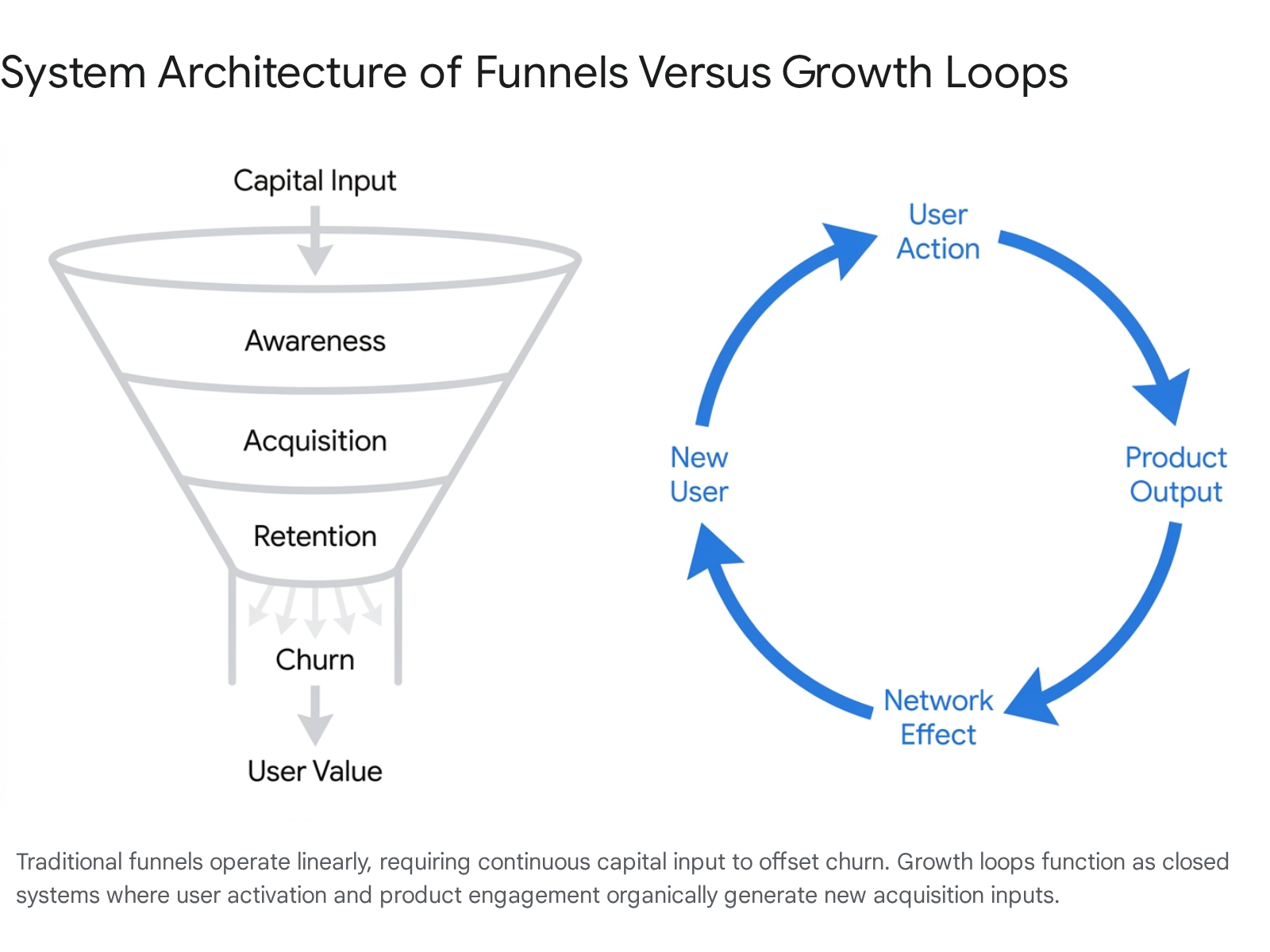
The architecture of these loops generally falls into three categories: 1. Viral Loops: Existing users directly invite colleagues or peers (e.g., Slack users inviting external vendors, Calendly users sending scheduling links to non-users) 41417. 2. Content Loops: User activity generates publicly accessible content that attracts new users via search engines or social algorithms (e.g., Notion templates shared via public URLs, Pinterest boards indexed by Google) 14. 3. Paid Loops: Revenue generated by highly engaged users is algorithmically reinvested into highly targeted acquisition channels, creating a continuous cycle of compounding returns 14.
The mathematical efficacy of a growth loop is evaluated through its viral coefficient, commonly referred to as the K-factor. The K-factor is calculated by multiplying the average number of invitations or outputs generated per user by the conversion rate of those outputs into new active users 813. If the K-factor exceeds 1.0, the user base exhibits exponential organic growth, expanding without additional top-of-funnel capital. While sustaining a K-factor above 1.0 is rare over long horizons due to market saturation, achieving a fractional K-factor (e.g., 0.3 or 0.4) significantly subsidizes the blended customer acquisition cost 13.
The transition toward loop-based architecture has fundamentally altered the composition and skill requirements of modern growth teams. Optimization is no longer the sole domain of marketing managers executing A/B tests on landing pages. In 2026, growth engineering requires cross-functional collaboration among data scientists, full-stack developers, and product managers 467. These teams focus on cycle time - the velocity at which a user completes a loop - and cohort analysis, grouping users by their acquisition date to track long-term retention dynamics 1314. Identifying and alleviating exact points of friction within a loop requires front-end event streaming architecture to capture granular user behavioral data 6.
Product-Led Growth and Go-to-Market Integration
The concept of product-led growth (PLG) serves as the primary distribution vehicle for modern digital services, fundamentally altering the unit economics of software delivery. In a PLG framework, the product itself acts as the primary mechanism for customer acquisition, activation, and expansion, typically utilizing freemium tiers or self-serve free trials to eliminate initial purchasing friction 291819. Users discover the product, experience its core utility without interacting with a sales representative, and voluntarily upgrade to premium tiers as their usage expands 291920.
While pure PLG models dominated the SaaS narrative between 2018 and 2023, data from the 2026 market indicates a mature evolution toward hybrid go-to-market architectures 1821. Currently, an estimated 58% of business-to-business (B2B) software companies operate a product-led motion 1821. However, the most successful entities deploy a hybrid model that combines PLG mechanics with a targeted Sales-Led Growth (SLG) overlay 181921.
This hybrid approach leverages the product's self-serve capabilities to autonomously capture individual users and small-to-medium businesses. Simultaneously, dedicated sales teams monitor product usage data to identify Product Qualified Leads (PQLs) - accounts exhibiting high engagement, specific feature adoption, or rapid internal seat expansion 181934. Sales representatives then execute targeted outreach to these high-intent accounts to negotiate complex, multi-year enterprise contracts.
| Go-To-Market Dimension | Pure Sales-Led Growth (SLG) | Pure Product-Led Growth (PLG) | 2026 Hybrid Architecture (PLG + SLG) |
|---|---|---|---|
| Primary Driver of Acquisition | Sales representatives and outbound marketing efforts | Autonomous user discovery and self-serve product utility | Product adoption generating high-intent behavioral signals (PQLs) |
| Average Contract Value (ACV) | High ($25,000 to $100,000+) | Low to Medium ($100 to $5,000) | Blended (Self-serve volume plus six-figure enterprise contracts) |
| Sales Cycle Duration | Extended (Months to quarters) | Accelerated (Immediate to days) | Rapid initial entry with protracted, strategic enterprise expansion |
| Customer Acquisition Cost | High (Driven by salaries, commissions, and travel) | Low (Leverages scalable product infrastructure) | Optimized (Sales resources deployed exclusively on high-probability accounts) |
| Free-to-Paid Conversion Benchmark | Not Applicable | Industry median of approximately 9% | 10% to 15% (with Sales Assist interventions), scaling higher with agentic integration |
| Net Revenue Retention (NRR) Success | Reliant on active account management | 58% of organizations achieve target NRR | 67% of organizations achieve target NRR |
Table 1: Comparative operational metrics distinguishing traditional, product-led, and hybrid go-to-market strategies based on 2026 SaaS benchmarking data 18192021.
The empirical data supporting the hybrid model is definitive. In 2026, companies employing a hybrid PLG and SLG motion achieve their net revenue retention targets at a rate of 67%, compared to just 58% for pure PLG companies 21. Pure PLG frameworks frequently encounter scaling ceilings, as the self-serve model struggles to navigate the complex procurement, security, and compliance requirements inherent to enterprise-level transactions 35. By deploying sales-assist motions specifically for accounts exhibiting strong product signals, organizations bridge the gap between rapid user activation and substantial commercial monetization.
The Emergence of Agentic AI and Headless Growth
The most disruptive force altering the trajectory of product-led growth in 2026 is the integration of agentic artificial intelligence. Traditional growth frameworks (frequently categorized in 2026 as "PLG 1.0") relied entirely on human operators navigating software interfaces to achieve value 17. The emerging paradigm of "Agentic PLG" involves software platforms specifically designed to be operated, queried, and in some cases purchased, by autonomous AI agents acting on behalf of human users 1721.
This shift fundamentally alters the metrics governing user activation. Historically, activation was defined as the moment a human user successfully executed a core task within a graphical user interface (GUI) 173436. In 2026, activation increasingly occurs through a Language User Interface (LUI), where users submit natural language commands and an integrated AI agent executes complex, multi-step workflows across the software's backend 37. Products are increasingly evaluated not by the aesthetic polish of their interfaces, but by the efficiency with which language models and autonomous agents can execute tasks via API endpoints 17.
The impact of agentic architecture on unit economics is severe. Traditional PLG models experience a median free-to-paid conversion rate of approximately 9% 1819. However, platforms that have successfully integrated agentic onboarding - where an embedded AI agent guides the user through complex setup processes or resolves configuration errors autonomously without engineering intervention - are recording free-to-paid conversion rates between 25% and 30% 19.
Notable case studies from 2025 and 2026 highlight the unprecedented velocity of agent-native companies. For instance, the AI code editor Cursor reportedly scaled from zero to $500 million in annual recurring revenue (ARR) in less than 24 months, eventually crossing the $2 billion ARR threshold by early 2026 without hiring a single enterprise sales representative until surpassing $200 million 182138. Similarly, platforms like Lovable achieved $100 million ARR within eight months of launch 2138. These metrics suggest that when software activation becomes virtually frictionless through AI orchestration, traditional sales and marketing coordination becomes a secondary function rather than the primary driver of growth.
Search Ecosystem Shifts: Answer Engine Optimization (AEO)
The infrastructure governing digital discovery and top-of-funnel acquisition has migrated away from traditional search engine result pages (SERPs). Consumers and enterprise buyers increasingly utilize generative AI models - such as ChatGPT, Perplexity, Anthropic's Claude, and Google's AI Overviews - to bypass the friction of browsing disparate websites 22232425. This behavioral shift has necessitated the development of Answer Engine Optimization (AEO), a discipline distinct from traditional Search Engine Optimization (SEO).
Traditional SEO is engineered around visibility and ranking; the objective is to secure the highest possible position on a results page to drive direct traffic to a proprietary domain 2526. It relies heavily on long-form narrative content designed to increase user "dwell time" and compound organic traffic over time 2526. AEO, by contrast, optimizes for citation and inclusion 2226. The objective is to structure a brand's digital assets so that autonomous AI systems can easily parse, extract, and synthesize the information directly into a generated response 2223.
To achieve inclusion in AI models, growth engineers must prioritize "fact density." AI models deprioritize unstructured narrative formatting in favor of verifiable data points, concise semantic clarity, and extensive schema markup 2326.
| Strategic Dimension | Traditional Search Engine Optimization (SEO) | Answer Engine Optimization (AEO) |
|---|---|---|
| Primary Objective | Secure top page rankings to drive direct website traffic | Ensure content is cited, extracted, and synthesized by AI models |
| Core Metric of Success | Organic sessions, click-through rates (CTR), and bounce rates | Citation frequency, brand imprinting, and "share of model" |
| Content Formatting | Long-form, narrative-driven content optimized for human dwell time | High fact density, structured schema markup, and direct conversational answers |
| User Journey Impact | Full-funnel coverage, heavy emphasis on top-of-funnel browsing | Mid-to-bottom funnel impact, providing immediate validation and direct answers |
| Technological Target | Indexing algorithms (e.g., traditional Google crawlers) | Large Language Models (LLMs) and conversational agents (e.g., ChatGPT, Perplexity) |
Table 2: Strategic divergence between traditional web visibility optimization and emerging AI citation optimization 222326.
The metrics governing digital discovery have subsequently transformed. Because AI interfaces often deliver comprehensive answers directly on the interface without requiring the user to click through to the source website, the industry has transitioned into a "zero-click economy" 2526. For e-commerce and B2B SaaS sectors, traditional web traffic is declining as a reliable indicator of brand reach 26. Consequently, modern growth teams utilize AI-native tracking tools to monitor their "share of model" - a metric defining how frequently their brand is recommended by primary LLMs for specific commercial queries 2627.
Crucially, AEO does not replace SEO. AI agents still require the foundational crawlability, site speed, and structured technical infrastructure of the open web to retrieve reliable information 222326. Organizations executing leading growth strategies in 2026 build hybrid architectures that maintain traditional SEO elements to capture human navigators while deploying dense, AEO-compliant data structures to feed AI engines 2225.
Geographic Divergence: The Asian Superapp Paradigm
Growth hacking and digital strategy exhibit significant structural variations based on regional regulatory environments, consumer behavior, and technological infrastructure. In the Asia-Pacific (APAC) region, the prevalence of "superapps" - such as WeChat in China, Grab in Southeast Asia, and Gojek in Indonesia - has established a growth paradigm fundamentally distinct from Western models 45464728.
A superapp consolidates disparate consumer services - including messaging, ride-hailing, food delivery, e-commerce, and digital banking - into a singular, enclosed ecosystem 462849. The origin of these platforms is deeply tied to regional technological adoption patterns; because mobile internet adoption in many Asian markets bypassed the desktop era entirely, populations gravitated toward all-in-one mobile utilities that bridged infrastructure gaps in traditional retail and financial inclusion 47.
For growth professionals operating within these environments, user acquisition strategies diverge sharply from the open-web methodologies used in North America or Europe. Instead of executing SEO campaigns or attempting to pull traffic from fragmented search engines, growth teams must engineer integration into the superapp's proprietary infrastructure, often developing "mini-programs" that live natively within the host application 2849.
Furthermore, superapps act as centralized digital trust layers 47. By holding vast concentrations of biometric data, persistent transaction histories, and behavioral profiles, these platforms establish continuous authentication protocols 47. This centralization drastically accelerates user activation rates for new services. When an individual attempts to utilize a new financial tool or retail mini-program within the superapp, the host platform's pre-established biometric verification removes the friction of account creation and identity verification 47. This allows businesses integrating with the superapp to bypass the heavy customer acquisition costs typically associated with establishing independent brand trust and secure onboarding 4728.
While Western technology conglomerates have consistently signaled intentions to replicate the superapp model, highly fragmented regulatory environments, stringent antitrust scrutiny, and the deep entrenchment of single-purpose legacy applications have largely stymied the development of true multi-service ecosystems outside of Asia 462849.
Modern Growth Technology Stacks and the "Vibe Marketing" Risk
The technological infrastructure utilized by growth engineers in 2026 is highly complex, moving far beyond the isolated email marketing software and standalone analytics dashboards of the previous decade. A contemporary growth stack integrates robust data warehouses, real-time event streaming pipelines, and strategic intelligence orchestration layers powered by AI 10.
Data is continuously ingested from product interfaces, customer relationship management (CRM) platforms, and third-party sources. Analytics platforms such as Mixpanel, Amplitude, and Google Analytics 4 (GA4) process this behavioral data to map exact user pathways and identify cohort retention trends 34272951. Execution is increasingly handled by workflow automation tools like Zapier or enterprise-grade platforms like n8n, which chain Large Language Models together to trigger highly personalized interventions based on predictive behavioral models 2752.
However, the automation of growth tactics has generated acute operational risks. The democratization of generative AI has led to a phenomenon colloquially termed "vibe marketing" or "vibe coding" 5354. This occurs when small teams deploy autonomous agents to instantly generate thousands of ad variations, landing pages, and automated outbound email sequences using natural language prompts, bypassing rigorous human oversight and data validation 53. While this methodology produces massive operational volume, it frequently results in generic, tone-deaf messaging that prioritizes scale over signal. As AI-generated content saturates digital channels, consumer trust and attention have become the ultimate premium constraints 53.
In response to this systemic noise, elite growth operations are deliberately moving away from hyper-automated outbound volume. The most sophisticated teams utilize AI not to spam channels with generated content, but to conduct predictive behavioral cohort analysis 229. By using machine learning to identify the precise friction points that statistically precede user churn, growth engineers can deploy targeted, contextually relevant interventions before the user actively disengages 234.
Evolving Team Structures and Unit Economics
The structural shift toward compounding growth engines and autonomous execution has profound implications for team composition and enterprise economics. The traditional siloed structure - where marketing handles acquisition, sales handles revenue, and engineering handles the product - is increasingly obsolete. Modern growth teams operate cross-functionally, reporting directly to the Chief Executive Officer or a dedicated Chief Revenue Officer, and integrate full-stack developers, product managers, and data scientists 347.
The capital efficiency of these models is accelerating due to AI-native workflows. The venture capital ecosystem, as indicated by standard frameworks like Y Combinator's 2026 Requests for Startups, is explicitly prioritizing AI-native organizations designed to replace human coordination costs rather than augment them 55305758. The thesis posits that small, highly leveraged teams of founders can deploy multi-agent orchestration platforms to execute go-to-market strategies that previously required dozens of specialized employees, allowing companies to scale to multi-million dollar valuations with fractions of historical seed funding 5859.
Furthermore, the agency and consultancy ecosystem supporting growth engineering is evolving. Pricing models are shifting away from billable hourly rates toward outcome-based billing tied to specific metrics (e.g., pipeline generation or K-factor improvement). Analysis of agency unit economics in 2026 suggests that outcome-based billing produces significantly higher gross margins (reportedly up to 41% higher) for repeatable, high-context execution, aligning the financial incentives of external consultants directly with the compounding growth of their clients 60.
Conclusion
The original conception of "growth hacking" as a series of clever, zero-cost marketing exploits is overwhelmingly a mythology in 2026. The technical loopholes, permissive API architectures, and unregulated digital environments that enabled the foundational case studies of the 2010s have been systematically dismantled by stringent privacy frameworks and platform consolidation. Furthermore, historical reliance on survivor-biased narratives has led many organizations to pursue unsustainable top-of-funnel tactics without establishing necessary product-market fit.
However, while the isolated tactics of the past have expired, the underlying scientific philosophy - rapid, cross-functional, and data-driven experimentation across the entire customer lifecycle - has permanently restructured digital business strategy. Maturing into the discipline of growth engineering, this approach now requires profound architectural alignment. Organizations must transition from linear marketing funnels to compounding growth loops, adopt hybrid product-led and sales-led go-to-market motions, and continuously optimize their digital presence for both human users and autonomous AI agents. The entities that successfully integrate these systems achieve mathematical advantages in customer acquisition cost and net revenue retention that traditional marketing approaches are no longer equipped to match.