Effects of gratitude practices on wellbeing
Gratitude has long been conceptualized across multiple dimensions, serving as a transient emotional state, a stable personality trait, a moral virtue, and an adaptive coping response. Over the past two decades, the academic study of positive psychology has sought to quantify the effects of gratitude on human functioning, aiming to determine whether intentional gratitude practices yield measurable benefits for psychological and physical health. Through hundreds of randomized controlled trials, longitudinal observations, and neurophysiological assessments, researchers have investigated the efficacy of various gratitude interventions. The aggregated scientific consensus indicates that gratitude practices produce modest, reliable improvements in subjective wellbeing and moderate physiological benefits. However, the literature also reveals critical nuances regarding intervention methodologies, the underlying mechanisms of autonomic regulation, cross-cultural differences, and the psychological risks of emotional invalidation, frequently termed "toxic positivity."
Theoretical Frameworks and Definitions
To understand how gratitude influences psychological and physiological states, researchers distinguish between two primary constructs: trait gratitude and state gratitude. Trait gratitude corresponds to a wider life orientation characterized by a natural, enduring inclination to notice and appreciate the positive aspects of the world 112. State gratitude, conversely, is the acute emotional experience that arises when an individual perceives themselves as the recipient of a positive outcome, often triggering a subsequent desire to reciprocate or engage in prosocial behavior 123.
Researchers have proposed several foundational hypotheses to explain the pathways through which these constructs translate into improved health outcomes. The "schematic hypothesis" suggests that individuals with high trait gratitude possess cognitive schemas that fundamentally bias their interpretation of daily situations toward positive recognition 2. By consistently noticing the positive elements of their environment, these individuals experience an accumulation of positive affect. Closely related is the "coping hypothesis," which posits that grateful individuals utilize more adaptive coping appraisals during times of stress. Rather than behaviorally disengaging, denying the existence of a problem, or resorting to substance use, grateful people are more likely to re-evaluate negative events, seek social support, and engage in active problem-solving and planning 12.
From an emotional regulation standpoint, the "broaden-and-build hypothesis" argues that positive affective states, including gratitude, broaden an individual's momentary thought-action repertoires 2. This broadening allows for the development of durable personal and social resources, which function as a protective buffer against psychopathology and enhance long-term resilience. Furthermore, the "positive effect hypothesis" simply asserts that positive emotions have a direct protective effect on various mental disorders, leading to improved subjective wellbeing 2.
Meta-Analytic Evidence on Subjective Wellbeing
The question of whether practicing gratitude directly causes improvements in wellbeing has been the subject of numerous systematic reviews and meta-analyses. The findings consistently point to statistically significant, yet highly calibrated, effect sizes.
The Cross-Cultural Efficacy of Gratitude
The trajectory of gratitude intervention research began in earnest with seminal studies in the early 2000s demonstrating that weekly gratitude journaling could lift positive affect. Subsequent replication attempts and comprehensive meta-analyses have refined these initial estimates. The most expansive meta-analysis to date, published in the Proceedings of the National Academy of Sciences (PNAS) in 2025 by Choi and colleagues, synthesized data from 145 studies covering 28 countries and 24,804 participants 4567. The study addressed the fundamental question of whether gratitude interventions increase wellbeing across diverse global populations.
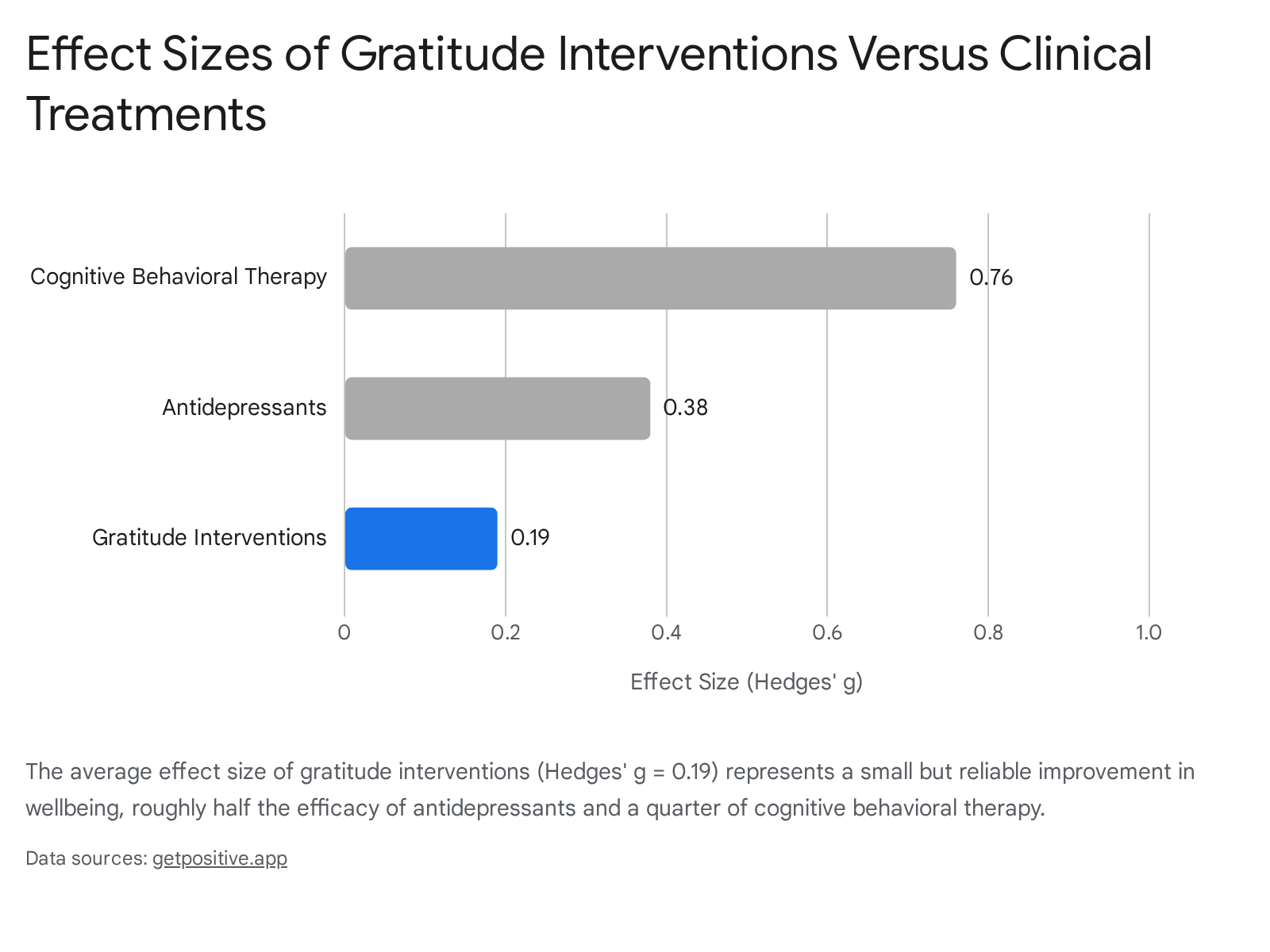
The overall effect size for the difference in wellbeing between gratitude and control conditions was calculated at Hedges' g = 0.19 (95% CI [0.15, 0.22], P < 0.001) 57. This effect size indicates that gratitude interventions have a small positive overall effect on wellbeing compared to control conditions. The researchers noted significant heterogeneity within the data (I2 at Level 2 = 21.9%, I2 at Level 3 = 35.4%), indicating considerable variance within and between samples 78. Subsequent moderation analyses revealed that methodological factors influenced effectiveness: interventions were significantly more effective when wellbeing outcomes were measured specifically as positive affect, when multiple types of gratitude interventions were combined, and when rigorous randomized controlled trials were employed 5678.
This effect size of 0.19 is categorized as small but robust. For clinical context, a Hedges' g of 0.19 is approximately half the effect size typically observed for antidepressant medications in large clinical trials, and roughly a quarter of the effect size associated with cognitive behavioral therapy for depression 4. The data suggests that gratitude is not a transformative panacea or a replacement for clinical care, but rather a low-cost, habit-based behavioral practice with a modest and reliable return on investment 4.
Publication Bias and Statistical Adjustments
The field of psychology frequently suffers from a file-drawer problem, wherein studies with null results go unpublished, artificially inflating meta-analytic effect sizes. Interestingly, the 2025 PNAS meta-analysis examined publication bias using precision-effect tests and standard error models (PET-PEESE) and discovered a reversed selection bias in the recent gratitude literature 58.
Studies reporting nonsignificant or negative results were found to be 1.75 times more likely to be published than those reporting significant positive results 57. This likely reflects a recent academic movement aimed at publishing null replications to correct early, overly optimistic claims in positive psychology. After adjusting for this reversed selection bias, the overall effect size of gratitude interventions actually increased slightly, from an unadjusted 0.15 in baseline models to an adjusted 0.20, demonstrating a better statistical fit 57. Furthermore, removing 13 identified influential outlier effect sizes yielded a similar overall effect of Hedges' g = 0.17, confirming that the benefits of gratitude interventions are robust against the presence of extreme data points 5.
Clinical Applications and Psychopathological Limitations
While gratitude interventions reliably increase general subjective wellbeing, their efficacy as a primary treatment for clinical psychopathology is heavily contested. Several meta-analyses have focused specifically on the utility of gratitude interventions for reducing clinical symptoms of depression and anxiety, yielding mixed interpretations.
A rigorous meta-analysis by Cregg and Cheavens (2021) analyzed 27 studies with 3,675 participants to examine the efficacy of gratitude interventions on psychological distress 1011. The researchers found that gratitude interventions produced small effects on depression and anxiety symptoms at post-test (g = -0.29) and at follow-up periods (g = -0.23) 1011. Similarly, Dickens (2017) observed a small effect (d = 0.13) on depression when comparing gratitude interventions to waitlist or active control tasks 10.
In a review of 64 randomized clinical trials, Diniz et al. (2023) demonstrated that patients who underwent gratitude interventions had 6.89% fewer symptoms of depression and 7.76% fewer symptoms of anxiety, concluding that acts of gratitude can be used as a therapeutic complement 910. However, leading researchers caution that these modest effects temper enthusiasm for gratitude as a standalone clinical protocol. Experts recommend that individuals seeking to reduce severe symptoms of depression and anxiety should engage in treatments with stronger evidence of efficacy, such as cognitive behavioral therapy, viewing gratitude exclusively as an adjunctive daily habit rather than a medical intervention 141111.
Methodological Considerations in Control Group Design
The interpretation of gratitude research is heavily dependent on methodological rigor, particularly regarding the design of experimental control groups. In psychological intervention research, the choice of the control condition dictates the validity and magnitude of the effect size observed.
Active Controls Versus Passive Controls
Early gratitude studies frequently compared gratitude journaling to "hassles" conditions, wherein participants were instructed to list daily annoyances, or to passive "measurement-only" waitlists. Meta-analyses, including those by Davis et al. (2016) and Wood et al. (2010), have cautioned that comparing gratitude to a negative reflection task artificially inflates the apparent efficacy of gratitude 101216. Differences observed in these comparisons may stem from the negative psychological impact of ruminating on stressful events in the hassles condition, rather than the intrinsic positive impact of the gratitude task 1216.
When gratitude interventions are tested against "active" or "neutral" control groups - such as instructing participants to write an objective account of their daily schedule, track daily activities, or document interesting events without an explicit emotional valence - the superiority of the gratitude intervention frequently diminishes 101314.
The Demand Characteristics Debate
Extensive reviews indicate that while gratitude interventions outperform passive controls, they do not consistently outperform other positively valenced or psychologically active control activities that require a similar degree of cognitive processing 13. For instance, one robust study found that while participants instructed to write unconstrained gratitude lists reported greater positive affect than waitlisted controls, they did not differ significantly on subjective wellbeing outcomes from an active control group instructed to merely keep track of daily activities 1516.
This methodological nuance has led to debates regarding how much of the gratitude effect is driven by specific neurocognitive pathways associated with appreciation, and how much is attributable to general placebo effects, demand characteristics, or the simple therapeutic benefit of taking time for structured daily writing and reflection 1314. Consequently, researchers emphasize the necessity of dismantling studies that employ well-matched active placebo controls to isolate the specific active ingredients of gratitude 1417.
Comparison of Gratitude Intervention Modalities
The manner in which gratitude is practiced significantly dictates the magnitude and duration of the psychological outcome. The scientific literature categorizes gratitude interventions into several distinct modalities, ranging from intrapersonal cognitive exercises to interpersonal behavioral communication. Efficacy varies widely depending on the structure, dosage, and social nature of the task.
Journaling and the Gratitude List
The most ubiquitous intervention is the gratitude list or journal, where participants enumerate several things they are thankful for on a daily or weekly basis. While this approach produces reliable baseline effects, evidence suggests that unconstrained, generic lists performed automatically yield minimal long-term benefits 416. Routine journaling is highly susceptible to hedonic adaptation if the participant does not actively cultivate emotional engagement.
However, reflective journaling that requires deeper cognitive processing - such as savoring a single positive moment for thirty seconds, elaborating on the causal factors of a positive event, or focusing on specific, novel domains - consistently outperforms the repetitive listing of general life circumstances 41418. A 2025 study evaluating instructional strategies highlighted that structured reflective journaling significantly improves cognitive integration and emotional reporting, outperforming standard, unstructured writing tasks 1920.
Interpersonal Expressions: Letters and Text Messages
Interventions that incorporate an interpersonal element consistently exhibit superior effect sizes compared to solitary journaling. The "gratitude letter," in which an individual writes a detailed narrative of appreciation to a specific benefactor, has been shown to produce profound, albeit sometimes temporary, spikes in positive affect, happiness, and elevation 41621.
Recent research into scalable digital interventions reveals that even short-form interpersonal communication, such as sending a text message expressing thanks, can match or exceed the benefits of a formal letter 81522. In large-scale comparative experiments (such as a multi-condition study involving 1,573 participants designed to detect an effect size of 0.40), gratitude text messages yielded the highest increases in feelings of social connectedness and perceived social support among participants, outperforming long-form letters and all solitary list conditions 822.
Interpersonally focused interventions require deeper psychological effort, thereby enhancing cognitive processing and generating stronger feelings of meaning 1216. However, studies also note that gratitude letters and text messages generate significantly higher levels of indebtedness compared to control tasks, introducing a complex emotional variable to the intervention 1622.
Mental Subtraction and Counterfactual Reasoning
A highly potent, yet less conventional, gratitude intervention is "mental subtraction." Grounded in counterfactual reasoning, this task requires individuals to reflect on a positive life event (e.g., meeting a romantic partner, securing a specific job, or recovering from an illness) and actively imagine the ways in which that event might never have occurred 2223.
By conceptually removing a positive element from their life narrative, individuals experience a stark cognitive contrast that disrupts hedonic adaptation. Studies have found that thinking about the absence of a positive event improves affective states more than simply thinking about its presence 23. In recent pairwise analyses, the mental subtraction task emerged as one of the most potent interventions for increasing state positive affect, reducing negative affect, and lowering feelings of envy, often outperforming standard gratitude lists and even rivaling interpersonal letters 2224.
Summary of Intervention Modalities
| Intervention Modality | Primary Mechanism of Action | Observed Efficacy and Common Effects |
|---|---|---|
| Generic Gratitude Lists | Intrapersonal reflection on the presence of positive events. | Small baseline effects on subjective wellbeing. Highly subject to rapid hedonic adaptation if performed without deep cognitive engagement 416. |
| Gratitude Letters | Interpersonal expression and deep narrative emotional processing. | Moderate to large acute spikes in positive affect, elevation, and happiness. Strongly associated with concurrent increases in feelings of indebtedness 162122. |
| Gratitude Text Messages | Low-barrier, immediate interpersonal connection and social exchange. | Highest measured efficacy for boosting social connectedness and perceived social support. May be as impactful as in-person delivery but carries less social risk 81522. |
| Mental Subtraction | Counterfactual reasoning; disrupting hedonic adaptation through contrast. | High potency for increasing positive affect and reducing envy by visualizing the hypothetical absence of a cherished life circumstance 2223. |
| Savoring Exercises | Prolonged sensory and cognitive attention to a specific positive moment. | Outperforms speed-writing. Associated with enhanced emotion regulation, chronic pain relief, and reductions in anxiety symptoms 425. |
Trait Gratitude Moderation and State Dynamics
Research clearly distinguishes between gratitude as a stable personality characteristic ("trait gratitude") and gratitude as a transient emotional reaction ("state gratitude"). The interaction between these two variables heavily influences the success of wellbeing interventions.
Individuals with high trait gratitude exhibit elevated baseline life satisfaction, greater empathy, and a lower incidence of anxiety and depression symptoms 1126. They also display a wider "span" and greater "density" of gratitude, meaning they feel grateful for a wider array of circumstances and toward more people simultaneously 13. High trait gratitude serves as a robust psychological buffer, reducing the physiological impact of chronic stress and promoting prosocial behavior through upstream reciprocity 131.
Interestingly, the efficacy of state gratitude interventions appears to be moderated inversely by an individual's baseline trait gratitude. The 2025 cross-cultural meta-analysis by Choi et al., alongside studies by Heekerens and others, noted that gratitude interventions are often most effective at inducing wellbeing benefits for individuals who possess low levels of baseline trait gratitude 821. Individuals already high in trait gratitude may experience a ceiling effect, wherein standard interventions such as daily journaling provide minimal additional subjective benefit because these individuals already spontaneously engage in grateful cognitive framing throughout their day 2131.
Physiological and Neurobiological Correlates
The benefits of gratitude extend substantially beyond subjective psychological self-reporting. Contemporary psychophysiology and neuroscience have mapped the biological mechanisms through which gratitude influences somatic health, focusing heavily on autonomic regulation, endocrine pathways, and immune system inflammation.
Autonomic Nervous System and Heart Rate Variability
The autonomic nervous system provides homeostatic regulation through two antagonistic branches: the sympathetic system (responsible for "fight-or-flight" stress responses) and the parasympathetic system (responsible for "rest-and-digest" restorative functions) 32. Gratitude acts as a powerful mediator of parasympathetic tone, primarily via the vagus nerve.
Heart rate variability (HRV), and specifically high-frequency HRV (HF-HRV), serves as a direct, quantifiable biomarker of cardiac vagal tone. High HRV coherence indicates a smooth, ordered, sine-wave heart rhythm that reflects strong vagal regulation, emotional adaptability, and heightened stress tolerance 3233. In a massive 2025 observational study analyzing 1.8 million real-world HRV sessions, Rivera and colleagues found a robust, reproducible correlation between the subjective experience of gratitude or appreciation and states of high HRV coherence across diverse age groups and locations 33.
This physiological shift toward parasympathetic dominance lowers blood pressure, stabilizes metabolic function, and facilitates rapid recovery following acute sympathetic arousal - a phenomenon known as "vagal rebound" 333427. Conversely, individuals exhibiting low vagal tone generally experience prolonged sympathetic dominance, higher inflammation, and reduced cognitive flexibility 3233.
Endocrine Responses and Cortisol Trajectories
Cortisol, a primary glucocorticoid hormone released by the adrenal glands during psychological and physiological stress, has been investigated as a key neuroendocrine target for gratitude interventions. Chronic dysregulation of the Hypothalamic-Pituitary-Adrenal (HPA) axis and sustained elevation of cortisol are implicated in numerous pathologies, including immunosuppression, metabolic disorders, and cardiovascular disease 2829.
While traditional literature often posits a direct linear relationship between gratitude and cortisol reduction, advanced data-driven trajectory modeling reveals a more complex picture. A 2024 study utilizing latent growth mixture modeling in 386 adults identified distinct subgroups of cortisol responders to stress: a "prototypical" subgroup (n = 309) exhibiting an expected rise and fall, a "rise" subgroup (n = 49), and a "decline" subgroup (n = 28) 29. The study found that among the prototypical responders, greater HRV during stress was significantly associated with a steeper decline in cortisol during the recovery phase (r = 0.19, p < 0.001) 29. Gratitude interventions appear to condition the nervous system to achieve this prototypical, adaptable response, thereby preventing the blunted cortisol reactivity that signifies an exhausted HPA axis 342829. Furthermore, gratitude likely exerts secondary effects on cortisol by enhancing sleep architecture - improving sleep latency and reducing daytime dysfunction - which naturally restores endocrine balance 3328.
Inflammatory Biomarkers and Cardiovascular Health
Through the moderation of autonomic and endocrine pathways, gratitude ultimately exerts a downstream effect on systemic inflammation, a primary driver of biological aging and cardiovascular morbidity. Within preventive cardiology, positive psychological factors are increasingly targeted to reduce the risk of adverse cardiac remodeling 3031.
Intervention studies targeting patients with asymptomatic heart failure (Stage B) have yielded promising biomarker data. Following an eight-week gratitude journaling intervention, patients exhibited a significant reduction in a circulating inflammatory biomarker index score compared to those receiving treatment as usual 30313233. Specific reductions have been observed in C-reactive protein (CRP), tumor necrosis factor-alpha (TNF-α), interleukin-6 (IL-6), and interferon-gamma (IFN-γ) 333132. By increasing parasympathetic tone and downregulating threat responses generated by the amygdala, gratitude appears to decrease cellular inflammatory cascades, directly counteracting "inflammaging" and improving overall baroreflex function 333142.
Neurobiological Signatures
Neuroimaging studies have identified specific cortical changes associated with the practice and trait of gratitude. Functional MRI research indicates that focusing on gratitude increases blood flow to the hypothalamus and activates the medial prefrontal cortex - the brain's executive control center 34324234. This prefrontal activation is accompanied by a concurrent dampening of amygdala reactivity, shifting the brain from reactive threat-detection to thoughtful emotional regulation 4234.
Furthermore, individuals demonstrating high trait gratitude exhibit structural neurological differences, including increased gray matter volume in regions associated with moral cognition, social interaction, and reward processing, such as the posteromedial cortex, insular cortex, and nucleus accumbens 42. These structural changes suggest that persistent gratitude practice may leverage neuroplasticity to rewire brain circuitry for enhanced affective stability over time 4244.
Cross-Cultural Nuances in Gratitude Experience
Psychological research has historically been constrained by a reliance on Western, Educated, Industrialized, Rich, and Democratic (WEIRD) samples. Because gratitude fundamentally involves social exchange, reciprocity, and interpersonal dynamics, cultural variables significantly influence how the emotion is experienced, expressed, and internalized.
The 2025 PNAS meta-analysis spanning 28 countries confirmed that gratitude interventions generally yield positive wellbeing effects globally, proving robust across both individualist and collectivist societies 456. However, the analysis also revealed statistically significant between-country differences in intervention efficacy, underscoring the need to adapt interventions to specific cultural paradigms 5678.
In highly individualistic cultures (predominantly in North America and Western Europe), gratitude is largely construed as a personal emotional benefit and a straightforward, positive exchange that boosts self-esteem 1335. Conversely, in many collectivist cultures, gratitude is inextricably linked to social harmony, hierarchy, and communal obligation 435. Consequently, interpersonal gratitude interventions, such as writing a letter to a benefactor, frequently evoke feelings of "indebtedness" alongside positive affect 162235.
In certain cultural frameworks, recognizing a benefit conferred by another highlights a social debt that must be reciprocated. This sense of obligation can introduce mixed emotional valence - blending appreciation with guilt or a burden of repayment - which may attenuate the pure positive affect typically measured in Western studies 3536. Culturally specific interventions, such as the Japanese Naikan reflection practice (which balances reflecting on what one has received, what one has given, and the troubles one has caused others), often produce distinct psychological profiles compared to standard Western gratitude lists, highlighting the necessity of culturally tailored psychological interventions 22.
Psychological Risks: Toxic Positivity and Emotional Invalidity
Despite the extensive physiological and psychological benefits documented in the literature, the indiscriminate application of gratitude as a self-help mandate carries well-documented clinical risks. Psychologists and researchers increasingly warn against the phenomenon of "toxic positivity" or "toxic gratitude" - the rigid, excessive enforcement of a positive outlook that deliberately invalidates, suppresses, or avoids the processing of negative emotions 36373839.
Emotional Suppression and Cognitive Consequences
In clinical, workplace, and interpersonal settings, prematurely deploying gratitude to mask emotional pain functions as emotional invalidation. When individuals suppress genuine feelings of grief, anger, or systemic distress by forcing themselves to "count their blessings" or adhere to "good vibes only" scripts, they risk severe psychological repercussions 363738.
Research strictly correlates the chronic suppression of negative emotions with higher long-term risks of clinical depression, anxiety, emotional dissonance, and alexithymia (the inability to identify and describe emotions) 3738. Furthermore, avoiding negative emotion compromises psychological flexibility and can lead to delayed or complicated grief reactions 3638.
Toxic gratitude often manifests as cognitive distortion, where individuals utilize forced appreciation to justify remaining in abusive relationships, unsafe situations, or toxic work environments out of an artificial sense of obligation 3640. By filtering reality strictly through a lens of what one "should" be thankful for, individuals lose access to the vital information that negative emotions provide - such as recognizing boundary violations or acknowledging systemic injustices 363739.
Trauma-Informed Approaches and Post-Traumatic Growth
Within the context of psychological trauma and extreme adversity - such as that experienced by frontline healthcare workers during the COVID-19 pandemic or survivors of abuse - enforcing gratitude without acknowledging profound suffering can severely rupture therapeutic trust, exacerbate moral injury, and drive emotional disconnection 365141.
A trauma-informed approach to gratitude and positive psychology recognizes that human beings are capable of holding dual, seemingly contradictory realities: one can mourn a devastating loss or endure severe stress while simultaneously holding genuine appreciation for the social support received during that hardship 355142.
The scientific consensus on resilience emphasizes that the authentic processing of sadness and anger is an evolutionary necessity and a critical prerequisite for Post-Traumatic Growth (PTG) 394142. PTG involves a positive reevaluation of life and an appreciation of new possibilities that emerges through the struggle with trauma, not by avoiding it 4142. Therefore, gratitude is most clinically effective when integrated as a natural complement to processing reality in its entirety, rather than utilized as an avoidance mechanism to bypass the inevitable discomfort of the human condition.
Conclusion
The scientific inquiry into gratitude reveals a highly accessible, low-risk psychological intervention that yields a small but highly reliable enhancement to subjective wellbeing. By shifting autonomic nervous system activity toward parasympathetic dominance, the practice of gratitude increases heart rate variability, modulates endocrine stress trajectories, and reduces systemic inflammatory biomarkers. The efficacy of gratitude is heavily dependent on the intervention modality employed; deep, specific, and contrast-oriented practices - such as mental subtraction or direct interpersonal expressions of thanks via letters or text messages - generate far more robust psychological effects than generic, unconstrained journaling.
However, the empirical evidence dictates that enthusiasm for gratitude must remain calibrated. It is not a standalone substitute for psychiatric treatments or psychotherapy in cases of severe clinical depression and anxiety. Furthermore, its application must be both culturally sensitive and trauma-informed, ensuring that the pursuit of positive affect does not devolve into toxic positivity or the harmful suppression of legitimate negative emotions. When practiced with intention, deep cognitive engagement, and emotional authenticity, gratitude serves as a vital, evidence-based component of emotional resilience and long-term physiological health.