
Effect of Birth Order on Personality Traits
Historical Foundations of Birth Order Theory
The hypothesis that a child's ordinal position within their family systematically shapes their personality has permeated psychological discourse for over a century. The foundational framework for this construct was introduced in the late 1920s by Austrian psychiatrist Alfred Adler. Within his broader approach to individual psychology, Adler posited that a child's birth rank dictates a unique psychosocial environment, resulting in predictable developmental trajectories and distinct behavioral phenotypes 123.
Under this classical psychoanalytic model, firstborn children were characterized as conscientious, high-achieving, and oriented toward authority. Adler argued that because firstborns initially receive the exclusive attention of their parents, they internalize adult values more readily. However, the arrival of subsequent siblings inevitably leads to a perceived "dethronement," prompting the firstborn to adopt responsible, surrogate-parenting roles to regain parental favor 145. Middle children, sandwiched between older and younger siblings, were theorized to develop strong diplomatic and social skills as a coping mechanism for feeling overlooked - a concept frequently referred to as middle child syndrome 12. Finally, youngest children were viewed as pampered, socially adept, and highly outgoing, relying on charm and risk-taking to command attention in an established family hierarchy 145.
This theoretical foundation experienced a massive resurgence and expansion in 1996 with Frank Sulloway's introduction of the evolutionary niche-finding model. Sulloway argued that sibling dynamics mirror Darwinian competition for scarce parental resources, including time, affection, and financial investment. In this framework, firstborns align with the familial status quo to secure continued parental investment, naturally developing higher levels of conscientiousness 6789. Conversely, later-borns find the conventional niches already occupied. To differentiate themselves and extract parental investment, they must cultivate alternative strategies. Sulloway proposed that later-borns develop higher degrees of openness to experience, agreeableness, and rebelliousness to carve out an unoccupied niche within the family system 6789. For decades, these compelling profiles were broadly accepted by the public and academia alike, seemingly bolstered by smaller-scale observational studies 1011.
Methodological Challenges in Early Research
Despite the enduring popularity of birth order theories, early empirical research suffered from severe methodological flaws that routinely produced spurious correlations. When researchers began analyzing larger datasets in the late 20th and early 21st centuries, it became evident that earlier findings were heavily distorted by confounding variables. The most significant methodological divide exists between "between-family" and "within-family" study designs.
Between-Family Designs and Sibship Size
A between-family study design compares the personality traits of individuals of varying birth ranks across entirely different families - for example, comparing a firstborn from one household to a third-born from another 1213. This approach contains a fatal structural flaw: it inherently conflates birth order with sibship size (total family size). A firstborn child can belong to a family of any size, whereas a fourth-born child exclusively originates from a family with at least four children 21415.
This distinction is critical because family size is heavily correlated with overarching socioeconomic status, parental resource availability, educational attainment, and cultural background 21617. Wealthier, highly educated parents statistically tend to have fewer children 1217. Consequently, firstborns are disproportionately overrepresented in high-socioeconomic-status households. When early researchers observed that firstborns were more academically driven or responsible than later-borns, they were frequently measuring the downstream effects of parental wealth and smaller family sizes rather than the isolated impact of birth order itself 21315. Once socioeconomic status and family size are statistically controlled, the purported personality differences in between-family designs vanish almost entirely 1415.
Within-Family Designs and Age Confounds
To correct for the discrepancies across different households, researchers shifted toward "within-family" designs, analyzing siblings raised by the same parents in the same environment. While this approach effectively neutralizes socioeconomic and genetic confounds, it introduces a perfect age confound 1112.
Because siblings in within-family studies are generally tested simultaneously, the firstborn is always biologically older, more mature, and further along in cognitive and emotional development than the later-born sibling at the time of assessment 1112. Standard personality traits, particularly conscientiousness and emotional stability, naturally increase as individuals age from childhood into early adulthood. Without rigorous age-adjustment algorithms, older siblings naturally appeared more conscientious, responsible, and less neurotic simply by virtue of being older, artificially validating the classical birth order stereotypes 1112. Furthermore, early within-family studies frequently relied on a single rater - asking one sibling to evaluate the personality of the others. This methodology exacerbates contrast effects, as individuals tend to exaggerate minor behavioral differences when comparing themselves directly to their family members 1218.
Findings from Large-Sample Big Five Studies
The 2015 Paradigm Shift
A definitive paradigm shift occurred between 2015 and 2019, driven by the availability of massive, nationally representative panel datasets that allowed researchers to control for sibship size, socioeconomic status, and age simultaneously. Two landmark studies fundamentally dismantled the classical birth order theory regarding broad personality traits.
Damian and Roberts (2015) analyzed data from over 370,000 United States high school students who participated in the Project Talent sample, representing a dataset large enough to reliably detect even the most minute statistical effects 610121920. Concurrently, Rohrer, Egloff, and Schmukle (2015) examined datasets comprising approximately 20,000 individuals across the United States, Great Britain, and Germany 610121920. By utilizing both between-family and within-family designs with independent self-reports, these studies achieved unprecedented methodological rigor.
The Negligible Impact on Core Personality Dimensions
The results from these massive cohorts were definitive: the association between birth order and the Big Five personality traits (Extraversion, Emotional Stability, Agreeableness, Conscientiousness, and Openness to Experience) is statistically negligible 6122021. Across all models, the average absolute association between birth order and these traits yielded a correlation coefficient (r) of roughly 0.02 1222.
In psychometric terms, an effect size of 0.02 means that birth order explains less than 1% of the total variance in human personality 2610. The remaining 99% of personality variation is attributable to genetics, peer socialization, specific parenting practices, and broader environmental factors. The effect is so minuscule that it is imperceptible at the individual level; if an observer were to line up individuals by personality traits, they could not reliably identify the firstborns from the later-borns better than random chance 2612.
| Classical Theory Expectation | Modern Empirical Finding (Large-Sample Data) | Estimated Effect Size / Variance |
|---|---|---|
| Firstborns are highly conscientious and responsible. | No meaningful difference in conscientiousness across sibling ranks. | r ≈ 0.02 (Explains <1% of variance) 61221 |
| Later-borns are more extraverted and sociable. | No meaningful difference in extraversion or sociability. | r ≈ 0.02 (Explains <1% of variance) 61221 |
| Middle children suffer from "Middle Child Syndrome" (insecure, agreeable out of necessity). | No consistent deviations in self-esteem, security, or agreeableness. | r ≈ 0.02 (Explains <1% of variance) 22023 |
| Later-borns are highly open to experience and rebellious. | Marginally higher openness, but practically insignificant. | r ≈ 0.02 (Explains <1% of variance) 62124 |
| Firstborns exhibit higher intelligence and academic aptitude. | Consistent, measurable advantage in IQ and objective intellect for firstborns. | d ≈ 0.1 to 0.2 (1.5 to 3 IQ points) 2620 |
Cognitive Ability and Intellectual Development
The Firstborn Intelligence Advantage
While broad personality traits show no meaningful link to birth order, large-scale studies consistently confirm a slight, robust effect on cognitive ability and objective intelligence. Within-family analyses demonstrate that firstborns score approximately 1.5 to 3 IQ points higher than their later-born siblings, representing a standardized difference of roughly 0.1 to 0.2 standard deviations 2620. The Rohrer et al. study, for instance, found that in a sibship of two, the older sibling has a higher IQ than the younger sibling in about 60% of cases 20.
This intellectual advantage translates into tangible real-world outcomes. Registry data from Norway covering the entire population over extended periods shows that firstborns have systematically higher educational attainment and slightly higher long-term earnings than their younger siblings 1725. Notably, when researchers use twin births as an instrumental variable to control for family size, the negative correlation between family size and education diminishes, but the negative effect of higher birth order remains robust 1625.
Theoretical Mechanisms: Confluence Model and Teacher Effect
Researchers attribute this cognitive gap entirely to environmental and family dynamics rather than biological or gestational advantages. Two prominent theories explain the disparity. The confluence model, introduced by Robert Zajonc in the 1970s, posits that the intellectual environment of a family is an average of the intellectual levels of its members. A firstborn child interacts exclusively with adults early in life, enjoying a highly stimulating linguistic and cognitive environment 242627. When a second child is born, the average intellectual age of the household drops. The parental resources - including time, financial investment, and direct interaction - are suddenly diluted, suppressing the early cognitive environment for later-borns 1627.
Furthermore, the "teacher effect" hypothesis suggests that firstborns reinforce their own learning and cognitive development by tutoring their younger siblings 16. The act of organizing information and transmitting it to a younger sibling solidifies the older child's intellectual foundation, a dynamic that the youngest child in a family never has the opportunity to experience.
Insights from the HEXACO Personality Framework
The 2024 - 2025 Ashton and Lee Meta-Analysis
While research using the Big Five taxonomy yielded null results, recent investigations utilizing the HEXACO Personality Inventory have detected subtle but meaningful variations related to family structure. The HEXACO model is a six-dimensional framework that measures Emotionality, Extraversion, Agreeableness, Conscientiousness, Openness to Experience, and crucially, Honesty-Humility 28293031.
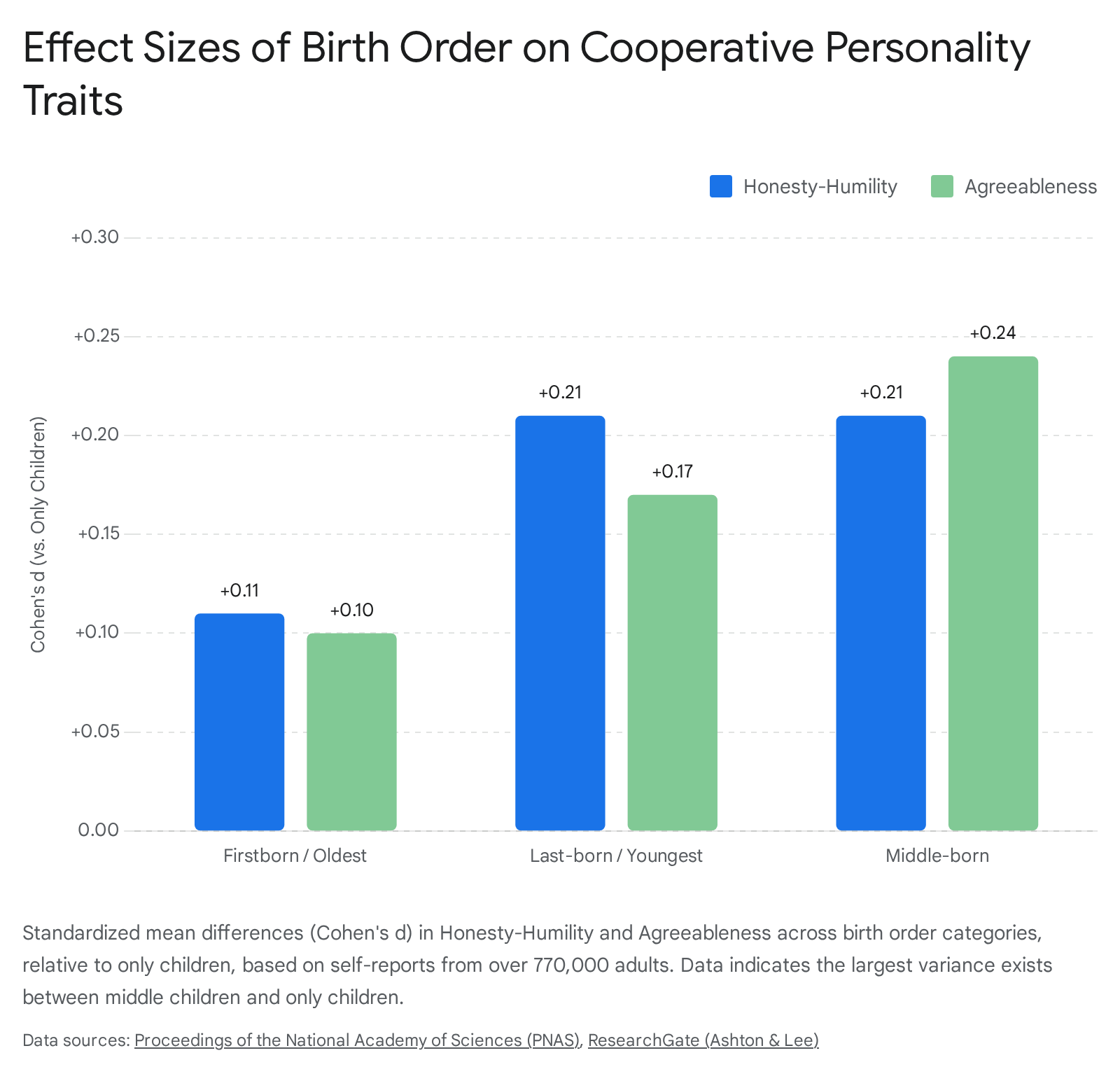
A landmark 2024/2025 study by Michael Ashton and Kibeom Lee analyzed self-reports from over 770,000 adults primarily from English-speaking countries, representing the largest single dataset applied to the birth order question to date 192829. Their initial findings seemingly contradicted the 2015 Big Five consensus. They found that middle-borns and last-borns scored higher on Honesty-Humility and Agreeableness than firstborns and only children, yielding a small effect size (Cohen's d) between 0.20 and 0.27 192832. Specifically, only children averaged lowest on these traits, followed by firstborns, then last-borns, with middle children scoring highest 1928.
The Cooperativeness Hypothesis and Sibship Size
However, Ashton and Lee pursued a deeper statistical deconstruction of their data. They noted an inherent confound in their initial analysis: "only children" by definition come from a sibship size of one, and "middle children" by definition come from a sibship size of at least three. When the researchers explicitly controlled for sibship size across a secondary sample of 70,000 adults, the differences associated strictly with birth order narrowed drastically 192833.
The HEXACO data reveals that the phenomenon previously misattributed to birth order is actually a function of family scale. Individuals from massive families (six or more siblings) demonstrated scores up to d = 0.36 higher in Agreeableness and d = 0.30 higher in Honesty-Humility compared to only children 1928. Even within families of the same size, the gap between firstborns and later-borns was negligible (d ≈ 0.10) 192829.
This points to a "cooperativeness hypothesis." The density of a large sibling environment - which inherently requires resource sharing, frequent conflict resolution, lack of privacy, and communal living - fosters slightly higher baseline levels of humility and agreeableness 2933. Ultimately, a child's precise chronological position in the family hierarchy matters far less than the sheer number of siblings they interact with during critical periods of cognitive and emotional development.
| Psychometric Framework | Core Findings on Birth Order | Role of Sibship Size |
|---|---|---|
| Big Five Model (Damian & Roberts, 2015; Rohrer et al., 2015) | Birth order explains <1% of variance in Extraversion, Neuroticism, Openness, Agreeableness, and Conscientiousness. | No direct causation; family size differences historically confounded between-family results. |
| HEXACO Model (Ashton & Lee, 2024/2025) | Subtle differences initially detected. Only children show lowest humility; middle children show highest. | Primary Driver: Large sibships (6+) produce higher Honesty-Humility and Agreeableness than small sibships (1-2), regardless of birth rank. |
Moderators of Sibling Dynamics
Functional Birth Order and Age Gaps
Even if birth order effects were prominent, biological birth order does not always align with a child's lived psychological experience, a divergence captured by the concept of "functional birth order" 81334. Family dynamics research identifies sibling age spacing as a critical moderator of the sibling environment. When the age gap between consecutive children is small, competition for parental resources is fierce, and children are more likely to exhibit standard sibling rivalry 134.
However, when the age gap between children exceeds five to six years, the familial dynamic effectively resets. The younger child experiences an upbringing similar to that of a functional firstborn or an only child, receiving undivided parental attention during critical early development stages, effectively negating any anticipated later-born traits 2734. Similar disruptions to classical biological birth order effects occur in blended families, instances of child mortality, or with the birth of twins, where shared attention and complex household structures override sequential biological hierarchy 11335.
Gender Composition and Parental Investment
The gender composition of a sibship also modulates how roles are assigned and enacted. If a middle child is the only female among a group of brothers, or the only male among sisters, their unique gender status often grants them a psychological niche that overrides their middle-born status, providing them with levels of parental attention typically reserved for firstborns 1. Furthermore, evolutionary perspectives note that parents historically allocate resources based on the sex of the child relative to the cultural norms, rather than strictly by birth order. For example, a firstborn female in a highly patriarchal society may be overlooked in favor of a later-born male heir, upending the traditional assumption that the firstborn inherently receives maximum parental investment 49.
Cross-Cultural Analyses of Birth Order Effects
The WEIRD Data Limitation
A historical critique of birth order research is its heavy reliance on Western, Educated, Industrialized, Rich, and Democratic (WEIRD) datasets. Researchers have repeatedly raised concerns that individualistic cultural values might exacerbate or artificially create birth order traits. Individualistic societies reward autonomy, personal achievement, and self-reliance. It is theoretically plausible that these cultural values amplify the assertive characteristics typically associated with firstborns, or encourage the differentiation and rebelliousness of later-borns seeking to stand out 336. Conversely, in collectivist cultures that prioritize family cohesion, filial piety, and group harmony, the pressure to differentiate oneself from siblings might be muted.
Evidence from Asian and Collectivist Cohorts
Recent evaluations of non-Western demographics support the null hypothesis regarding broad personality, demonstrating that the lack of birth order effects is a universal human phenomenon rather than a Western artifact. A 2023 within-family study targeting a representative Chinese cohort (Mu et al.) confirmed that birth order has no lasting, systematic impact on Big Five personality traits within a collectivist cultural framework 183637. The researchers utilized independent peer and parent ratings alongside self-reports, finding no statistically significant deviations between firstborns and later-borns in Conscientiousness, Openness, or Extraversion 1837.
While hierarchical norms in traditional Asian, African, and Latin American societies may impose starkly disparate familial responsibilities - such as elder female siblings acting as maternal surrogates, or elder males receiving preferential educational investments - these cultural expectations alter immediate socioeconomic behaviors and educational opportunities rather than fundamentally rewriting baseline personality traits 3438. The social role a firstborn plays in an agrarian collectivist society dictates their daily labor, but it does not shift their innate levels of neuroticism or extraversion compared to their siblings.
Applied Outcomes in Adulthood
Occupational Sorting and Executive Leadership
Though core personality traits remain largely unaffected by sibling rank, birth order does exert a statistically observable influence on occupational sorting and executive behavior. Because firstborns tend to have slight advantages in educational attainment and objective intelligence, they are statistically overrepresented in managerial roles, academic institutions, and high-status professions 11739. Later-born children, facing slightly lower educational attainment rates across large populations, are proportionally more likely to pursue self-employment or solo entrepreneurship 1726.
Interestingly, when later-borns do ascend to executive leadership positions, the echoes of sibling rivalry appear to manifest in corporate strategy. Empirical research on corporate leadership reveals that later-born Chief Executive Officers (CEOs) engage in systematically higher degrees of strategic risk-taking. Studies tracking capital expenditures, research and development spending, and merger and acquisition activity in major corporations show that later-born CEOs take 19% to 38% more strategic financial risks than their firstborn counterparts 4041. Evolutionary theorists and management researchers posit that this reflects engrained childhood behaviors; later-borns historically utilized risk-taking and bold behavior to command parental attention, a behavioral tendency that remains dormant until activated by executive power in adulthood 4041.
Middle Child Dynamics and Psychosocial Outcomes
Popular psychology frequently references the concept of the "middle child," suggesting that children sandwiched between the eldest and youngest develop pronounced insecurities, people-pleasing tendencies, or feelings of profound neglect 12. Contemporary clinical and empirical research provides virtually no validation for a distinct, pathological, or personality-driven syndrome affecting middle children. Large-scale cohort analyses consistently fail to find elevated levels of neuroticism, reduced self-esteem, or unique extraversion deficits among middle children when family size is properly controlled 223.
While middle children may self-report feeling slightly less emotionally tethered to parents during early adolescence compared to the eldest or the youngest, they frequently compensate adaptively by establishing robust social networks, strong friendships, and extra-familial relationships 142. Furthermore, research evaluating mental health outcomes - such as self-harming behaviors or Disruptive Behavior Disorders (DBDs) - indicates that birth order is irrelevant. A massive meta-analysis of quasi-experimental evidence regarding DBDs found that negative parenting practices (e.g., harsh discipline, emotional neglect) are highly predictive of disruptive behavior, whereas birth order demonstrated an effect size of zero 4344. Ultimately, the emotional climate of the home and the quality of parent-child attachment override any marginal effects generated by sibling position.
Conclusion
The scientific consensus on birth order has undergone a profound empirical correction. For nearly a century, the assumption that sibling position acts as a primary architect of personality survived largely on confirmation bias, cultural lore, and flawed early methodologies that failed to disentangle birth order from family size and socioeconomic status 610111415.
Modern, massive-sample psychometric research has conclusively demonstrated that birth order does not determine core personality traits 6101220. While a child's rank within the family slightly impacts cognitive test scores due to shifting intellectual environments, and may gently steer occupational trajectories or risk propensities in corporate settings, the vast majority of human personality variance is shaped by genetics, peer socialization, and broad family environment 6104144. Subtle variances in cooperative traits like honesty and agreeableness are driven not by the sequential rank of birth, but by the social demands of growing up in larger families 2833. A child's position in the family is merely a demographic circumstance that defines their early environment; it does not represent a psychological destiny.