
Economic Anxiety and Political Behavior
Economic anxiety functions as a primary catalyst for political realignment across advanced and emerging democracies. Defined by the interplay of material insecurity, structural labor market shifts, and the subjective fear of downward mobility, this phenomenon consistently disrupts established political hierarchies. Over the past decade, and particularly culminating in the global electoral cycles between 2023 and 2025, incumbent governments have demonstrated profound vulnerability amid periods of high inflation, housing unaffordability, and real wage stagnation 12.
However, the relationship between economic hardship and political behavior is not strictly linear or isolated to immediate financial loss. Contemporary research indicates that objective economic indicators frequently serve as an activating mechanism for deeper sociological phenomena, including status anxiety, cultural resentment, and anti-establishment mobilization 345. Understanding this dynamic requires evaluating leading theoretical models alongside empirical data from recent elections to delineate the exact pathways through which financial insecurity translates into systemic political disruption.
Theoretical Models of Electoral Realignment
The academic consensus regarding the rise of populist, anti-establishment, and radical voting patterns is distributed among several primary, though increasingly intersecting, theoretical frameworks. These include the economic grievance model, the cultural backlash hypothesis, the national populism paradigm, and theories of nostalgic deprivation.
Material Decline and the Economic Grievance Thesis
The economic grievance model posits that structural transformations in the global economy - specifically deindustrialization, trade liberalization, and automation - have generated a disenfranchised demographic that channels its material frustration into anti-systemic voting 567.
Economist David Autor and his colleagues have extensively documented the localized impacts of trade exposure, frequently termed the "China Shock," on regional labor markets. Their research indicates a distinct geographic correlation between regions suffering from manufacturing decline and an increase in support for populist and ideologically extreme candidates 789. In the United States context, this phenomenon is heavily concentrated in the industrial Rust Belt. Between 2000 and 2016, trade-exposed counties with predominantly white populations exhibited significant swings toward right-wing candidates, while similar economic shocks in demographically diverse counties often increased left-wing vote shares 91011.
The structural foundations of this grievance extend beyond immediate job losses in manufacturing sectors. Research highlights that approximately two-thirds of the rise in income inequality between 1980 and 2005 was driven by an increased educational premium, which systematically disadvantaged workers without tertiary degrees 6. This disparity has been compounded by the steady decline in labor union density. Historically, unions served as vital civic intermediaries that channeled working-class economic interests into reformist political structures. The erosion of these institutions has left a vacuum frequently filled by reactionary or nationalist political narratives 67.
Furthermore, the economic trajectory of males without college degrees has declined across multiple dimensions, including skills acquisition, employment rates, occupational stature, and real wages. This absolute and relative loss of status creates a highly fertile environment for populist mobilization, as voters seek candidates who promise a return to previous industrial economies 312.
The Cultural Backlash Hypothesis
Contrasting the strictly materialist approach, the cultural backlash thesis, most prominently advanced by political scientists Pippa Norris and Ronald Inglehart, argues that contemporary political volatility is primarily a reactionary response to long-term progressive value shifts 51314.
According to this framework, the transition toward post-materialist values - such as cosmopolitanism, environmentalism, and evolving gender norms - has provoked an authoritarian reflex among traditionally dominant demographic groups 513. Norris and Inglehart hypothesize that as older, socially conservative cohorts perceive themselves transitioning from a cultural majority to a minority status, they experience a "tipping point" of cultural threat. This perceived threat drives them to support radical-right parties that promise to restore traditional social hierarchies and halt the perceived erosion of national identity 1314.
However, the cultural backlash thesis has faced substantial empirical critique within the political science community. Re-evaluating European Social Survey (ESS) data, researchers such as Armin Schäfer demonstrate a lack of significant polarization between older and younger cohorts regarding core cultural liberalism metrics, challenging the assertion that populism is purely a generational phenomenon driven by older voters resisting a libertarian tide 51516. Furthermore, recent electoral data from Western Europe reveals that segments of the highly educated "young elite," as well as working-class millennials, are increasingly drawn to radical-right platforms, suggesting that the cultural backlash model's demographic assumptions may be overly reductive and ignore pervasive youth discontent 516.
Relative Deprivation and National Populism
Attempting to bridge the gap between pure economic determinism and purely cultural explanations, scholars Roger Eatwell and Matthew Goodwin conceptualize the contemporary phenomenon as "national populism." They argue that the movement is rooted in four cumulative structural shifts, termed the "Four Ds": Distrust of political elites, Destruction of national culture via rapid demographic change, Deprivation of economic opportunity, and Dealignment from traditional two-party systems 17181819.
Central to their framework is the concept of relative deprivation - the subjective perception that one's social group is losing status and resources compared to other groups, regardless of objective, absolute material wealth 41820. This explains why support for populist platforms is not confined to the absolute poorest citizens, who frequently abstain from voting altogether, but is highly prevalent among the middle and lower-middle classes who feel their upward mobility has stalled 518. Under this paradigm, voters react not strictly to absolute poverty, but to the sensation that the broader system prioritizes the needs of urban elites, ethnic minorities, or immigrants over the native working class 2021.
Status Anxiety and Nostalgic Deprivation
Expanding upon relative deprivation, research by Noam Gidron and Peter A. Hall demonstrates that subjective social status anxiety predicts populist voting across multiple advanced democracies 232223. Because socioeconomic status is fundamentally structured as a zero-sum game, individuals experiencing a decline in positional income view the advancement of other groups as a direct threat to their own standing 4.
Data across 23 Western European elections confirms that social classes facing economic status loss are significantly more likely to vote for populist radical-right parties. Specifically, a one-unit increase in positional status corresponds to a 14-percentage point decrease in the probability of supporting such platforms 4. This phenomenon is heavily associated with "nostalgic deprivation," where voters benchmark their current economic stagnation against the perceived prosperity of their parents' generation or childhood expectations 2322.
| Theoretical Framework | Primary Drivers | Key Mechanisms | Major Academic Proponents | Common Critiques |
|---|---|---|---|---|
| Economic Grievance | Globalization, automation, deindustrialization, union decline. | Absolute material loss, wage stagnation, geographic spatial inequality. | David Autor, Dani Rodrik | Fails to explain why some relatively affluent demographic groups support populism; ignores cultural animus. |
| Cultural Backlash | Post-materialism, progressive social shifts, cosmopolitanism. | Reactionary authoritarianism, fear of lost cultural dominance by older cohorts. | Pippa Norris, Ronald Inglehart | Empirical data shows high populist support among youth; artificial separation of economic and cultural variables. |
| National Populism / Relative Deprivation | Distrust, rapid demographic change, subjective status threat. | Subjective perception of status loss; zero-sum view of the social hierarchy. | Roger Eatwell, Matthew Goodwin | Accused by some critics of normalizing radical-right rhetoric by over-emphasizing "rational" anxiety over explicit nativism. |
| Status Anxiety | Positional income decline, nostalgic deprivation. | Psychological resentment toward downward mobility compared to previous generations. | Noam Gidron, Peter A. Hall | Difficult to isolate subjective feelings of status loss from broader macro-economic realities. |
Macroeconomic Catalysts for Incumbent Vulnerability
While overarching theories explain the structural preconditions for political realignment, specific macroeconomic shocks act as the immediate triggers that shift voter behavior away from established political parties. Recent empirical data highlights inflation, real wage stagnation, and housing unaffordability as the most potent catalysts for sudden electoral disruption.
The Intersection of Inflation and Real Wage Stagnation
The surge in global inflation following the COVID-19 pandemic and the geopolitical destabilization of global supply chains has profoundly impacted incumbent stability worldwide 124. A comprehensive study by the Kiel Institute for the World Economy, analyzing 365 elections in 18 advanced economies since 1948, quantifies the severe political impact of macroeconomic shocks. The study finds that a 10-percentage point surprise in inflation typically results in an approximate 1.7 percentage point increase in the vote share for extremist, anti-system, or populist parties 25.
Crucially, the political penalty of inflation is highly dependent on its interaction with real wages. The Kiel Institute data demonstrates that when inflation surprises coincide with a measurable decline in real wages, the increase in vote shares for extremist parties essentially doubles 25.
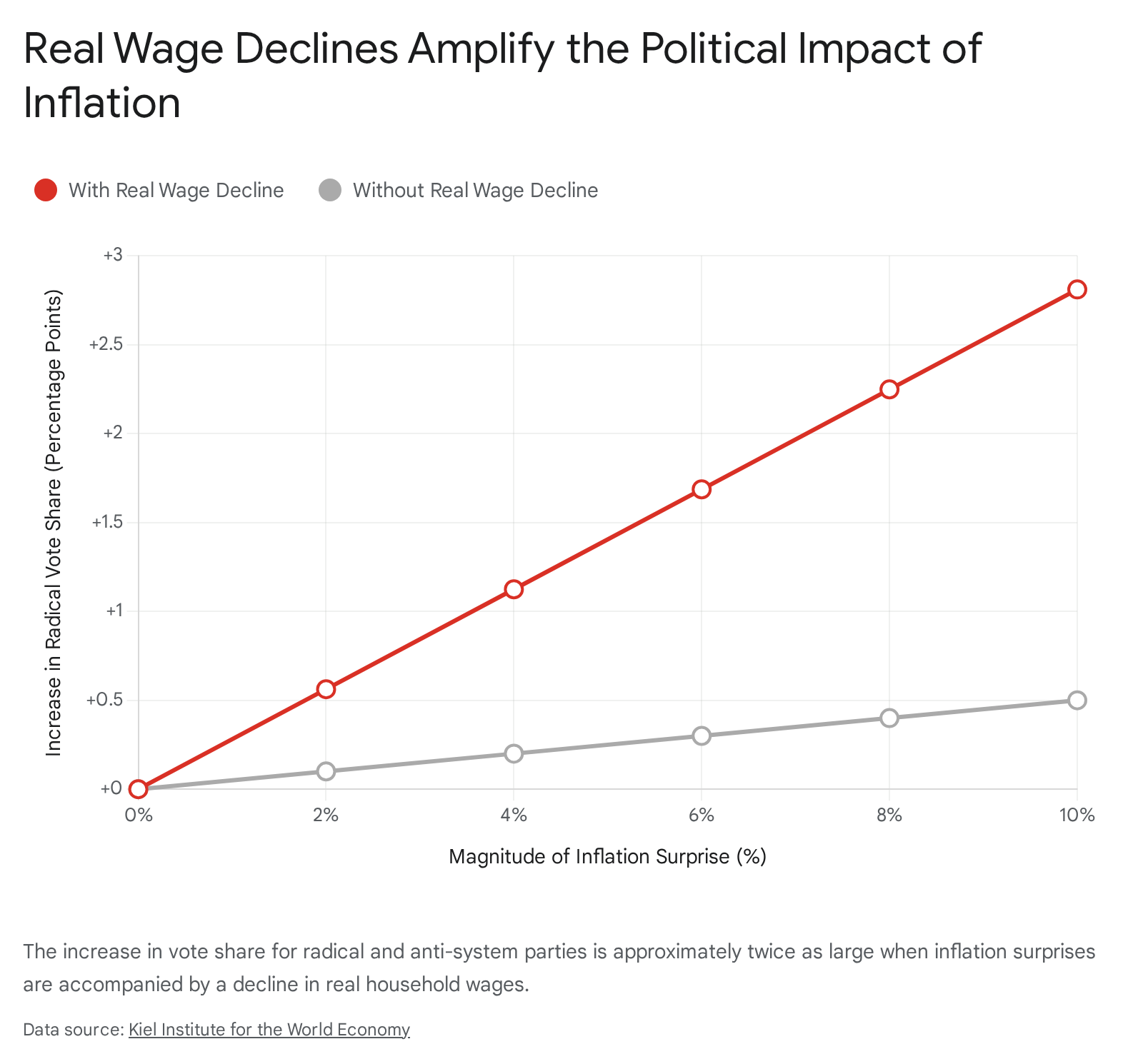
Conversely, if real wages hold steady or outpace inflation, the political backlash is statistically mitigated and often becomes insignificant 25. This proves that voters are not reacting merely to the abstract concept of inflation, but to the tangible erosion of their household purchasing power and living standards.
Pocketbook Versus Sociotropic Voting Mechanisms
The mechanisms of this macroeconomic phenomenon are further illuminated by preliminary data from the American National Election Studies (ANES) 2024 Pilot Study. Analyzing the U.S. presidential election landscape, researchers utilized a novel "Inflation Behavior Index" (IBR) to distinguish between pocketbook voting (decisions based on personal financial struggles) and sociotropic voting (decisions based on broad perceptions of the national economy) 2627.
The ANES data reveals that severe personal economic struggles caused by inflation significantly increase the likelihood that a voter will defect from their preferred political party to vote against the incumbent 2630. By contrast, negative perceptions of the broader national economy alone are substantially less likely to break established partisan loyalty 2630. This underscores that deeply internalized, localized economic anxiety - the struggle to afford daily necessities - is a primary vector for voter realignment, superseding general ideological pessimism.
Spatial Inequality and the Housing Affordability Crisis
Alongside inflation, housing affordability has surfaced globally as a dominant driver of economic anxiety. This crisis heavily influences youth cohorts and drives political instability in metropolitan centers through severe spatial inequality: ample, affordable housing exists in economically stagnant regions with few job opportunities, while urban cores offering robust employment suffer from severe housing shortages and prohibitive costs 2832.
In Central and Eastern Europe (CEE), this dynamic has contributed to the rise of populist movements despite high overall national homeownership rates. While countries like Romania, Poland, and Slovakia boast ownership rates exceeding 85%, these averages obscure the reality that younger generations migrating to high-growth urban hubs are entirely priced out 28. For example, in Cluj-Napoca, Romania - a burgeoning IT sector hub - the price per square meter of city-center housing exceeds that of major Western European cities like Genoa and Belfast 28. This friction limits internal labor mobility, forcing workers into suboptimal housing arrangements or lengthy commutes, and generates intense frustration that makes them highly receptive to anti-establishment narratives 28.
According to EU post-electoral survey data following the June 2024 European Parliament elections, 42% of EU citizens cited rising prices and the cost of living (of which housing is the largest single component) as their primary voting concern, followed closely by the overall economic situation at 41% 29. Between 2015 and 2023, housing costs in major EU cities surged by roughly 50%, vastly outpacing wage growth 30. This reality directly correlates with increased support for far-right parties that have successfully framed the housing crisis not as a complex zoning or supply chain issue, but as a failure of liberal governance, often linking scarcity directly to immigration policy and the allocation of state resources 30.
Regional Case Studies in Economic Voting
The theoretical models of economic grievance and relative deprivation manifest uniquely across different geopolitical landscapes. An analysis of recent elections in Argentina, South Korea, Taiwan, Japan, and Poland demonstrates how varying forms of acute economic anxiety dictate political outcomes.
Argentina and the Politics of Hyperinflation
The victory of Javier Milei in the November 2023 Argentine presidential election represents an extreme manifestation of pocketbook voting in the face of macroeconomic collapse. Milei inherited an economy devastated by the policies of successive Peronist and center-right administrations, characterized by an overvalued exchange rate, depleted sovereign reserves, and a fiscal deficit funded by uncontrolled money printing 3132.
At the time of the election, Argentina faced an annual inflation rate of 211.4% and a poverty rate exceeding 41%, leaving over 19 million people living below the poverty line 323334. Conventional political science might assume that a far-right libertarian candidate proposing the destruction of the central bank, the dollarization of the economy, and sweeping austerity would alienate low-income voters. However, the depth of the economic crisis triggered a total dealignment from traditional party structures 183135. Milei successfully captured the youth vote and secured unexpected victories in working-class districts historically loyal to the state-interventionist Peronist party 36.
Upon taking office in December 2023, Milei implemented a severe shock therapy program. This included an immediate 54% currency devaluation to close the gap between the official and black-market exchange rates, sweeping cuts to public spending, and a "crawling peg" exchange rate management system initially set at 2% monthly depreciation 3738. This brutal austerity initially deepened the recession, pushing poverty rates to a two-decade high of 52.9% and resulting in significant job losses in construction and public sectors 37.
However, by late 2024 and early 2025, the strategy yielded a dramatic disinflationary trend. The monthly inflation rate plummeted from 25.5% in December 2023 to 2.7% by October 2024, and further down to 1.5% by mid-2025 323437. Milei's sustained approval ratings - holding near 50% despite the austerity - indicate that for the Argentine electorate, the acute pain of fiscal adjustment is currently viewed as vastly preferable to the chronic anxiety of hyperinflation 3738.
South Korea and Demographic Economic Fracturing
The South Korean political landscape illustrates how economic anxiety can fracture demographics along severe gender lines, overriding traditional class-based voting. South Korea faces a unique combination of structural economic pressures: an intensely competitive educational system that yields a highly skilled workforce (with a university entry rate over 76%), but a polarized labor market failing to produce sufficient high-quality corporate positions 39.
In early 2025, data indicated that over 500,000 young Koreans were entirely removed from economic activity, categorized as "just resting" 40. Many cite burnout, career anxiety, and the impossibility of securing long-term financial stability in an environment of exorbitant housing costs 40. This economic pessimism is intrinsically linked to the country's demographic crisis, featuring the world's lowest fertility rate at 0.72, as young adults delay or abandon marriage due to financial constraints 4041.
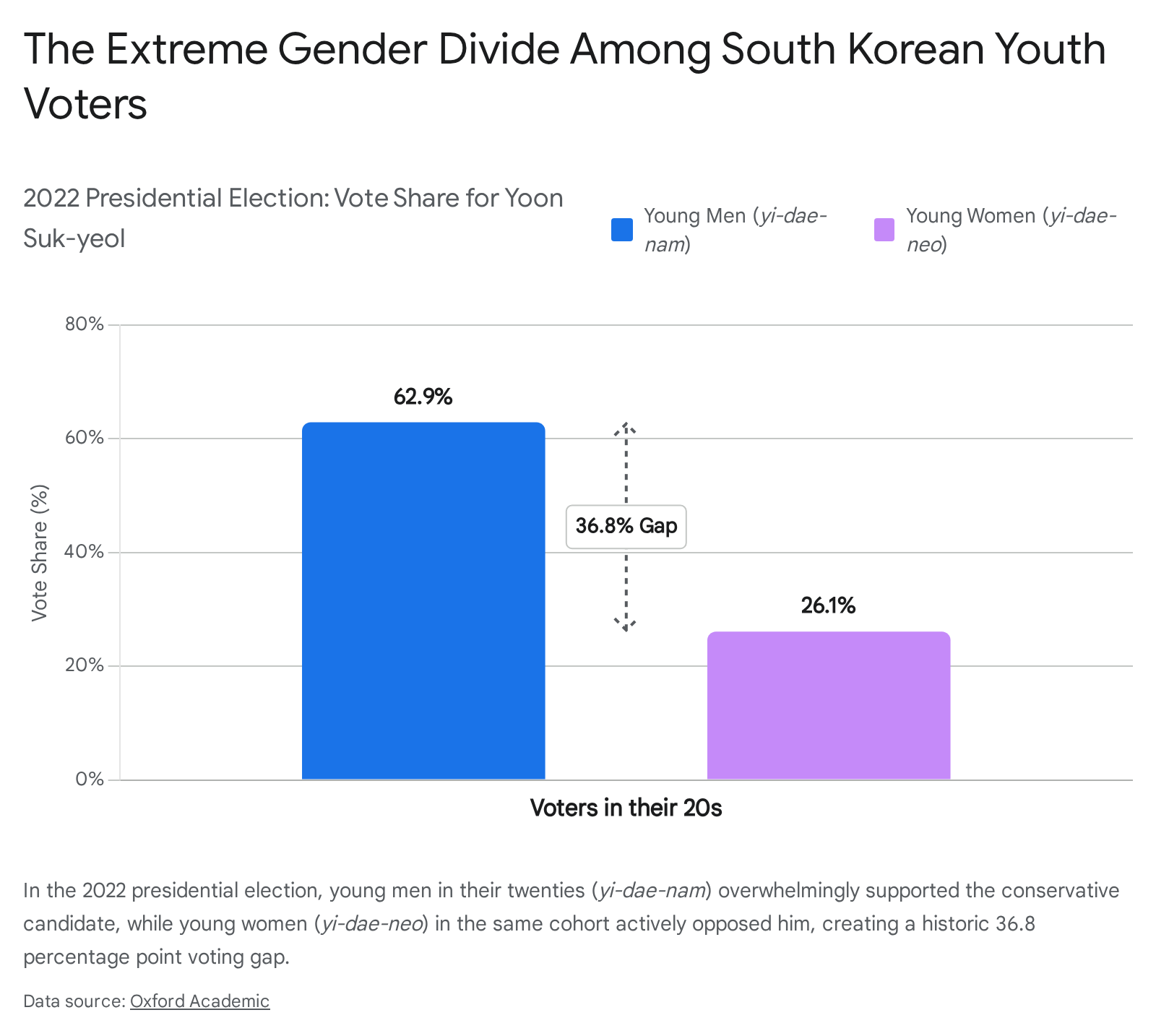
In this high-pressure environment, economic deprivation has merged seamlessly with status anxiety. Young South Korean men (yi-dae-nam) have expressed immense frustration over perceived systemic disadvantages, mandatory military service, and feminist policy initiatives, viewing the advancement of women as a threat to their own dwindling economic prospects in a zero-sum labor market 4142. This resulted in a historic 36.8 percentage point gender voting gap in the 2022 presidential election, where 62.9% of yi-dae-nam voted for conservative candidate Yoon Suk-yeol, compared to only 26.1% of young women (yi-dae-neo) 42.
However, the endurance of economic hardship rapidly erodes ideological loyalty. By the April 2024 legislative elections, the ruling People Power Party (PPP) suffered a severe defeat. The main opposition Democratic Party (DP) secured a majority with 175 seats, leaving the PPP with only 108 43. The electorate, suffering from persistent inflation, soaring agricultural costs, and housing market volatility, used the election to express profound dissatisfaction with the incumbent's handling of the economy 4344. This shift demonstrates that culturally-driven status voting can be quickly superseded by immediate, universal pocketbook concerns.
Taiwan and the Third-Party Realignment
Taiwan's January 2024 elections signaled a marked departure from historical voting patterns. While cross-strait relations and national identity have traditionally dominated Taiwanese presidential politics, the 2024 cycle was overwhelmingly dictated by domestic economic anxiety 4546.
Despite Taiwan's robust macroeconomic growth and unassailable dominance in global semiconductor supply chains, the domestic population suffers from a severe "high-income trap" characterized by stagnant real wages and extraordinary housing costs 4647. According to the Numbeo Global Property Price to Income Ratio, Taiwan ranks 16th globally with a ratio of 20.1, meaning it would theoretically take an individual 20 years of entirely saved income to afford an average home 53. Rents are similarly burdensome, with a vast majority of renters operating in an opaque, unregulated market where landlords frequently forbid tenants from claiming government subsidies to avoid taxation 48.
This economic bottleneck catalyzed the rise of the Taiwan People's Party (TPP), led by former Taipei Mayor Ko Wen-je. Framing the two establishment parties (the ruling DPP and the opposition KMT) as complicit in protecting wealthy property developers, the TPP successfully mobilized young voters concerned with upward mobility, stagnant wages, and housing justice 4649. The TPP pledged aggressive interventions, including building social housing equivalent to 5% of Taiwan's total housing stock and penalizing unoccupied properties 48.
Ultimately, while the incumbent DPP won an unprecedented third consecutive presidential term under Lai Ching-te with 40% of the vote, they lost their absolute majority in the Legislative Yuan 5051. The DPP retained only 51 seats against the KMT's 52, while the TPP secured a critical eight seats 5051. By breaking the traditional two-party duopoly, the TPP positioned themselves as the necessary swing vote for future legislative action, proving the potency of housing affordability as an electoral weapon.
Japan and the Collapse of Incumbent Stability
In Japan, the long-ruling Liberal Democratic Party (LDP) experienced a stunning collapse in support across the 2024 and 2025 election cycles. The LDP lost its lower house majority in an October 2024 snap election under Prime Minister Shigeru Ishiba, and subsequently lost its upper house majority in July 2025, marking the first time the party lacked control of both legislative chambers since its founding in 1955 525354.
While the LDP was hampered by a high-profile political funding scandal regarding unrecorded donations, the primary mechanism of their defeat was profound public frustration over the macroeconomic environment 5253. Japan, historically characterized by decades of deflation, experienced a painful inflationary spike compounded by a historically weak yen, which drastically drove up the cost of essential imports, food, and energy 5253. Crucially, nominal wage increases failed to keep pace with this inflation, resulting in an extended period of real wage decline for the average Japanese household 55.
The Ishiba government's response - primarily modest cash handouts - failed to resonate with an electorate suffering from systemic purchasing power erosion 53. In contrast, opposition parties successfully campaigned on tangible cost-of-living relief, notably proposing the suspension of the consumption tax 5356. The subsequent election of Sanae Takaichi as Prime Minister and her pivot toward aggressive fiscal expansion (including the promised two-year suspension of the 8% consumption tax on food) highlights the intense pressure democratic leaders face to alleviate localized economic pain, even in nations possessing debt-to-GDP ratios exceeding 235% 5556.
Poland and the Limits of Populist Economics
The trajectory of Poland's Law and Justice (PiS) party provides critical insight into the limits of using state economics to sustain populist governance. Following their 2015 victory, PiS operated under highly favorable macroeconomic conditions, allowing them to implement "PiSonomics" - a blend of nationalist rhetoric supported by massive social welfare expansion, including generous child-support schemes and the lowering of the female retirement age 2457.
While this strategy effectively mobilized working-class and rural voters for years, the macroeconomic environment eventually deteriorated. By 2022, inflation surged to 14.4%, driven by the energy crisis resulting from the war in Ukraine and domestic wage-price spirals 5859. Despite implementing anti-inflationary measures, including temporary VAT cuts on food and fuel, the PiS government struggled to maintain economic optimism 2458.
In the October 2023 parliamentary elections, high inflation, combined with democratic backsliding and a freeze on vital EU recovery funds, drove record voter turnout (74.4%) 5758. While PiS secured the largest single share of votes (35.4%), they failed to assemble a governing majority 58. Donald Tusk's Civic Platform (PO) successfully formed a coalition government, ending eight years of PiS rule 58. Notably, the incoming liberal government promised to retain the popular cash transfers and retirement age policies instituted by PiS, demonstrating how deeply economic populism has become entrenched in the Polish social fabric, forcing mainstream parties to adopt these mechanisms to remain electorally viable 57.
| Country | Election Cycle | Primary Economic Stressors | Key Electoral Outcome | Structural Shifts |
|---|---|---|---|---|
| Argentina | 2023 Presidential | Hyperinflation (211%), currency collapse, high poverty. | Victory of libertarian outsider Javier Milei (55.6% in run-off). | Total rejection of established Peronist machine; youth realignment toward radical free-market policies. |
| South Korea | 2024 Legislative | Youth unemployment, housing unaffordability, inflation. | Main opposition DP wins 175 seats; ruling PPP reduced to 108 seats. | Severe gender polarization intersecting with labor market stagnation; rejection of incumbent economic policy. |
| Taiwan | 2024 Presidential & Legislative | Stagnant real wages, extreme housing price-to-income ratio (20.1). | DPP retains presidency (40%); loses legislative majority. | Rise of the TPP driven by youth anger over housing and domestic inequality; end of two-party dominance. |
| Japan | 2024 - 25 Parliamentary | Import-driven inflation, persistent real wage decline, weak Yen. | LDP loses majorities in both chambers for the first time since 1955. | Shift from long-term political stability to fragmentation; populist demands for consumption tax relief. |
| Poland | 2023 Parliamentary | High inflation (14.4%), frozen EU funds, democratic backsliding. | PiS loses governing majority to Donald Tusk's PO coalition. | Liberal opposition adopts populist social welfare policies to secure working-class votes. |
Methodological Advances in Measuring Economic Discontent
As economic anxiety increasingly dictates political outcomes, the methodologies utilized by political scientists to measure these phenomena have evolved. Standard economic indicators like GDP growth and baseline unemployment rates frequently fail to capture the subjective financial distress driving voter behavior, necessitating more granular tools.
Polling Infrastructure and the Assessment of Representative Democracy
Major international research consortiums have reoriented their data collection to better understand the intersection of economics and populism. The Comparative Study of Electoral Systems (CSES), an international collaborative research program, launched Module 6 (spanning 2021 to 2026) under the explicit theme of "Representative Democracy Under Pressure" 606162. By integrating micro-level demographic data with macro-level district results, CSES tracks how subjective perceptions of system outputs and economic fairness directly correlate with vote switching toward populist candidates across dozens of nations 6263.
Similarly, the American National Election Studies (ANES) 2024 Time Series Study introduced highly specialized metrics to measure modern anxiety 646566. The ANES 2024 pilot studies tested new indices focusing on employment satisfaction, economic vulnerability, student loan stress, and the perceived inability to access healthcare due to cost 2765. By utilizing machine learning algorithms like k-means clustering on ANES data, researchers have been able to map issue polarization from the bottom up, proving that subjective economic anxiety is creating distinct, cohesive, and increasingly separated voter clusters that align against incumbent systems regardless of their objective employment status 6768.
Policy Implications and Democratic Resilience
Economic anxiety is not merely a metric of financial distress; it is a profound psychological mechanism that alters how citizens interact with the state and with each other. The synthesis of contemporary political science frameworks and global electoral data reveals that economic shocks rarely operate in a vacuum. Instead, they serve as potent accelerants for existing cultural, demographic, and spatial fissures.
The evidence confirms a hierarchical relationship between different forms of economic distress. While general inequality and absolute poverty are chronic conditions, they do not consistently generate immediate electoral volatility. It is the acute, subjective experience of relative loss - specifically the sudden erosion of purchasing power via inflation combined with wage stagnation, or the realization of permanent spatial inequality via housing unaffordability - that breaks partisan loyalty and drives voters toward radical alternatives 252632. Furthermore, the assumption that populism is primarily driven by older, culturally conservative cohorts resisting progressive values is demonstrably incomplete; in economies where youth are priced out of asset accumulation, millennial and Gen Z voters are frequently the primary engines of anti-establishment disruption 546.
As seen in the decisive electoral shifts across Argentina, South Korea, Taiwan, Japan, and Poland, incumbent governments that fail to protect real wages and address the structural barriers to housing and upward mobility will inevitably face severe electoral consequences. Mitigating this volatility requires democratic institutions to address not only absolute macroeconomic growth, but the equitable distribution of economic security and the preservation of social dignity across all geographic and demographic divides.