
Early-stage startup hiring and candidate assessment signals
The Financial and Operational Impact of Mis-Hires
In early-stage enterprises, the structural fragility of a small organizational framework magnifies the impact of every individual contributor. Unlike large corporations where underperformance is absorbed by a broad operational apparatus, a startup operates with minimal redundancy. A single misaligned hire at the founding stage carries disproportionate weight, distorting execution momentum, capital allocation, and cultural alignment 12. Evaluating the cost of a mis-hire relies on distinguishing between visible direct expenses and the latent, often unmeasured, operational losses that constitute the bulk of the financial damage.
Direct Financial Penalties and Replacement Costs
Baseline estimates from the U.S. Department of Labor indicate that a mis-hire costs an organization a minimum of 30% of the employee's first-year expected earnings 344. However, in specialized technology sectors and executive leadership contexts, this figure dramatically underestimates the true financial exposure. The Society for Human Resource Management (SHRM) estimates the total replacement cost ranges from 50% to 200% of the individual's annual salary, compounding significantly for senior roles 135.
The direct financial outlay encompasses recruiter fees, onboarding logistics, equipment allocation, and the raw compensation paid during the individual's tenure. For instance, an underperforming software engineer compensated at an $80,000 baseline implies a minimum direct loss of $24,000, while senior engineering or executive mis-hires carry financial damages routinely cited between $150,000 and $300,000 367. In extreme scenarios involving highly compensated technical leadership or enterprise sales roles, cumulative opportunity costs and direct outflows can reach an estimated 5 to 27 times the individual's base salary 59. One widely cited case study involves Zappos, where the chief executive estimated that cumulative mis-hires early in the company's lifecycle cost the enterprise well over $100 million 58.
| Role Level and Complexity | Estimated Financial Impact (Multiplier of Salary) | Core Drivers of Expense |
|---|---|---|
| Entry-Level / Hourly | 30% to 75% 3 | Recruitment advertising, basic training, administrative onboarding, short-term productivity loss. |
| Mid-Level Technical | 100% to 150% 311 | Specialized agency fees, prolonged onboarding cycles, software licensing, peer disruption. |
| Senior Technical / Management | 150% to 200% 35 | Executive search retainers, relocation costs, extensive supervision tax, architectural rework. |
| Executive Leadership | 200% to 213%+ 3 | Strategic misalignment, lost enterprise value, damaged investor confidence, high severance liabilities. |
Operational Drag and the Supervision Tax
The financial burden of a failed hire is frequently secondary to the operational disruption imposed on the existing team. A critical dynamic in small organizations is the "supervision tax" - the phenomenon where management and peer resources are diverted from strategic execution to performance remediation. Managers spend an estimated 17% of their operational bandwidth attempting to correct, document, or coach underperforming early hires 34. This diversion of resources stunts organizational growth, delaying product releases and eroding execution momentum 112.
Furthermore, low-performing employees force high-potential peers to compensate for productivity deficits. Approximately 85% of human resources professionals observe that a single bad hire negatively impacts the broader morale and output of the surrounding team 3. In a 10-person startup, introducing one misaligned individual effectively degrades the productivity of the entire organizational unit. This phenomenon frequently prompts high-performing employees to reconsider their commitment to the venture, sparking secondary turnover that exacerbates the initial error 1211. Globally, macroeconomic estimates from entities like McKinsey and Gallup suggest that talent misallocation and disengagement cost the global economy over $8.9 trillion annually, representing a systemic structural failure in workforce planning 13.
The Opportunity Cost of Role Vacancies
In attempts to avoid a mis-hire, founders frequently swing toward excessive caution, resulting in prolonged role vacancies. However, chronic vacancy introduces an equivalent, albeit different, operational penalty. Maintaining an open critical position creates immense internal strain. Existing employees assume dual roles, escalating the risk of burnout and context-switching fatigue 6.
The hidden cost of an open executive or senior technical role is typically assessed between $30,000 and $50,000 per month in lost productivity alone 6. For early-stage companies constrained by venture runway - often burning $150,000 monthly - a three-month delay in securing technical leadership directly threatens milestone achievement for subsequent funding rounds 6. Consequently, founders are trapped in a tight optimization problem: acting too quickly risks a 200% salary penalty and cultural degradation, while acting too slowly burns runway through unrecouped productivity losses.
Common Hiring Errors in the Entrepreneurial Context
Early-stage founders frequently commit systematic errors during the talent acquisition process, driven by intense resource constraints, lack of formal human resources infrastructure, and the immense pressure to achieve product-market fit. Analysis of early-stage failures reveals consistent patterns in how founders mismanage the assessment and onboarding of early personnel 19.
Premature Scaling and Role Inflation
A primary error among novice founders is chasing the "unicorn" candidate. Under immense pressure to conserve capital, founders frequently craft impossible job descriptions demanding a single individual possess full-stack engineering, outbound sales, and financial modeling capabilities 26. These candidates rarely exist, and when they do, the resulting workload leads to rapid burnout and systemic failure 2. The recommended corrective action is to identify the single most critical operational bottleneck - such as coding backlog or customer onboarding - and hire explicitly to resolve that narrow pain point 2.
Founders also frequently engage in title inflation, handing out arbitrary "C-level" designations to lure talent without providing competitive market salaries 9. This strategy creates severe downstream friction. As the company scales, the organizational chart becomes top-heavy with personnel who possess executive titles but lack the requisite experience to manage large divisions. This alienates internal high-performers, complicates future executive hiring, and forces difficult demotions or terminations when specialized senior leadership is eventually required 9.
The Fallacy of Corporate Pedigree and Procedural Failures
A persistent bias in startup hiring is the overvaluation of specific corporate pedigrees, particularly prior tenure at dominant technology firms (e.g., FAANG companies). While these candidates possess verified technical capabilities, overemphasizing corporate pedigree introduces structural risk 9. An individual accustomed to vast corporate resources, rigid administrative hierarchies, and highly specialized, narrow role scopes may struggle severely to adapt to the ambiguity, resource scarcity, and generalist demands intrinsic to an early-stage startup 9.
Additionally, founders routinely fail to formalize the vetting and onboarding processes. Racing through the evaluation phase to ease immediate workloads often results in skipping essential reference checks or work trials, directly leading to mis-hires 19. Furthermore, founders frequently begin interviews with generic, rehearsed sales pitches about the company rather than asking diagnostic questions to uncover the candidate's motivations 9. Finally, post-hire integration is often neglected. Assuming that experienced hires do not require formal onboarding is a critical failure; without established cultural values, clear expectations, and regular feedback loops, even highly competent individuals will fail to integrate into the startup's fragile ecosystem 9.
Decision-Making Under Uncertainty and Effectual Logic
The mechanics of hiring within a mature, capitalized corporation fundamentally differ from early-stage venture hiring. Corporate entities function in environments of calculable risk and causal logic, utilizing predictive modeling to forecast required headcount, allocate predefined budgets, and fill narrowly defined roles. Startups, conversely, operate in environments characterized by profound uncertainty, where traditional predictive techniques and long-term planning routinely fail 1011.
Causal Versus Effectual Reasoning
Research by Sarasvathy (2001) on entrepreneurial expertise identifies "Effectuation" as the dominant cognitive logic utilized by successful founders in highly uncertain environments 1012. Causal logic assumes that the future can be predicted, allowing an organization to start with a predetermined goal and optimize the means to achieve it. Effectual logic assumes the future is unknowable but controllable 1018. Expert entrepreneurs begin with a set of available means - specifically, "who they are, what they know, and whom they know" - and allow the organizational goals and product trajectory to emerge and pivot based on the resources and personnel they successfully gather 101813.
In the context of early-stage hiring, effectual logic explains why founders lean heavily on personal networks and serendipitous encounters for their initial hires. These early stakeholders do not merely execute predefined job descriptions; their specific, idiosyncratic capabilities actively dictate the ultimate direction of the venture 1018. A highly effectual entrepreneurship model leverages the existing social capital and specialized knowledge of the founding team to co-create the business model with early hires, rather than attempting to slot individuals into a rigid, pre-planned corporate structure 1813.
The Principle of Affordable Loss in Talent Acquisition
A cornerstone of effectuation theory is the "Affordable Loss" principle 1011. Traditional financial models dictate evaluating opportunities based on maximum expected returns. In environments of extreme uncertainty, however, expert entrepreneurs assess decisions based on what they are financially and operationally willing to lose if the decision fails 1011.
Applied to talent acquisition, the affordable loss principle fundamentally alters how a founder views hiring risk. Rather than committing to a highly compensated, permanent executive hire based on a speculative financial forecast, an effectual founder will minimize downside exposure. This manifests as utilizing short-term consulting contracts, offering equity-heavy compensation packages to preserve cash reserves, or hiring for immediate, specific deliverables rather than long-term strategic potential 11. By controlling the downside risk of a mis-hire, the startup preserves sufficient capital and optionality to survive early-stage volatility 1011.
Structuring Compensation as a Sorting Mechanism
In environments characterized by high information asymmetry, compensation structures act as critical signaling mechanisms between the employer and the prospective employee. A startup founder lacks full knowledge of a candidate's true productivity and intrinsic motivation, while the candidate lacks certainty regarding the startup's survival trajectory, financial stability, and future valuation 2014. Consequently, the composition of the compensation package - specifically the ratio of base salary to equity - serves to filter the applicant pool.
Equity and Salary as Bilateral Signals
Equity distribution operates far beyond simple financial remuneration; it serves as an endogenous mechanism aligning risk, control, and long-term incentives. From a game-theoretic perspective, startups balance scarce internal liquidity against the dilution of founder ownership 2015. A compensation package heavily weighted toward equity rather than cash salary requires the candidate to assume a portion of the venture's inherent risk. Candidates who willingly accept reduced baseline salaries in exchange for elevated equity stakes inadvertently signal high risk-tolerance, a preference for long-term alignment, and a strong intrinsic belief in the company's market viability 1423.
Conversely, candidates demanding market-rate or premium cash compensation signal a preference for immediate liquidity and lower risk absorption. For well-funded startups, prioritizing stronger salaries while moderating equity grants signals a strategic desire to preserve long-term founder control and signals to the market that the company possesses robust financial footing 14. However, for pre-seed or cash-constrained ventures, excessive cash demands from candidates can drain runway.
Research demonstrates that variations in employee equity actively reshape workforce dynamics and retention. An empirical study analyzing population-wide administrative data of Finnish startups (2006 - 2022) found that a 10% increase in employee equity allocation reduces one-year exit probabilities by 2.5% to 3% and significantly increases the likelihood of internal organizational advancement by 10% to 12% 15.
| Compensation Structure Focus | Employer Signal | Candidate Signal | Primary Risk |
|---|---|---|---|
| High Equity / Low Salary | Cash constraint; requirement for true partners and risk-sharing 14. | High risk tolerance; strong belief in mission; low immediate liquidity needs 23. | Candidate burnout; inability to attract top-tier talent with high financial obligations 224. |
| High Salary / Low Equity | Strong financial footing; desire to preserve founder control and ownership 14. | Preference for stability; lower risk tolerance; immediate liquidity requirements 20. | Misalignment of long-term incentives; rapid cash burn; attracting mercenary talent 1424. |
The Impact of Regulatory Wage Constraints
External regulatory pressures, such as binding wage floors or mandatory minimum salaries, disrupt the organic signaling mechanism of startup compensation. The aforementioned Finnish startup study utilized the staggered introduction of collective bargaining agreement extensions that imposed binding wage floors on previously uncovered firms. The data indicated that when regulatory constraints forcefully raised the required cash compensation threshold, liquidity-constrained startups reduced individual employee equity stakes by an estimated 10% to 11% 15.
This dynamic limits the founder's ability to utilize equity as a filtering mechanism for mission alignment. When baseline cash compensation is artificially elevated by regulation, the venture risks attracting candidates motivated by the secure base compensation rather than the asymmetric upside of the venture's success. Furthermore, founders who attempt to circumvent cash constraints by bargain-hunting - hiring underqualified talent willing to accept minimum salary for ambiguous equity - frequently trigger a secondary penalty. The candidate inevitably flounders, requiring expensive rework, or eventually realizes market-rate peers earn significantly more, leading to immediate disengagement and resentment 224.
Evolution of Predictive Validity in Personnel Selection
Assuming a candidate pool has been successfully aggregated, the mechanisms used to evaluate those candidates dictate the probability of selection success. For decades, personnel selection was governed by meta-analytic benchmarks established in the late twentieth century. Recent rigorous corrections to these statistical models have fundamentally shifted the industrial-organizational psychology consensus on which assessment methods accurately predict future job performance.
Revising Twentieth-Century Meta-Analytic Benchmarks
The foundational benchmark in personnel selection was established by Schmidt and Hunter in their landmark 1998 meta-analysis, which concluded that General Mental Ability (GMA), or cognitive ability testing, was the single strongest predictor of job performance, yielding a corrected validity coefficient of 0.51 251617. Based on this premise, generations of corporate and startup hiring processes heavily prioritized intelligence testing, abstract problem-solving assessments, and logic puzzles.
However, a comprehensive 2022 meta-analysis by Sackett, Zhang, Berry, and Lievens exposed systematic flaws in how prior statistical corrections were applied, specifically regarding the phenomenon of range restriction 251618. Range restriction occurs because validation studies typically measure incumbent employees who have already passed a rigorous selection filter, inherently limiting the statistical variance of their scores compared to the broader, unselected general applicant pool. To estimate the true operational validity, statisticians apply a correction factor.
Schmidt and Hunter applied a uniform predictive range restriction correction across all study types in their database. Sackett et al. demonstrated that this was a mathematical error. Applying massive range restriction corrections derived from predictive validation studies to concurrent validation studies - which make up the vast majority of the historical data and suffer from minimal range restriction - resulted in substantial overcorrection and extreme artificial inflation of validity estimates 1619. Under the revised, highly conservative methodology, the predictive validity of cognitive ability tests was adjusted sharply downward to a coefficient of 0.31 251920. This revision dismantled the long-held assumption of cognitive ability's absolute supremacy in candidate evaluation 16.
The Superiority of Structured Interviewing
The unstructured interview - a conversational format lacking standardized questions, defined behavioral anchors, or systematic scoring rubrics - remains the default selection mechanism for most early-stage founders 1821. Unstructured interviews rely heavily on intuitive judgments regarding "culture fit," making them highly susceptible to cognitive biases, demographic preferences, and heuristic errors 1721. Under the updated 2022 meta-analytic models, unstructured interviews demonstrate a predictive validity coefficient of merely 0.19, indicating they explain less than 4% of the variance in actual job performance 171821.
In stark contrast, structured interviews require absolute consistency: every candidate is asked the identical questions in the exact same sequence, targeting specific competencies, with responses evaluated against a predetermined, objective scoring rubric 1721. Sackett et al. (2022) identified structured interviews as the most effective single predictor of job performance, yielding a revised validity coefficient of 0.42 161820.
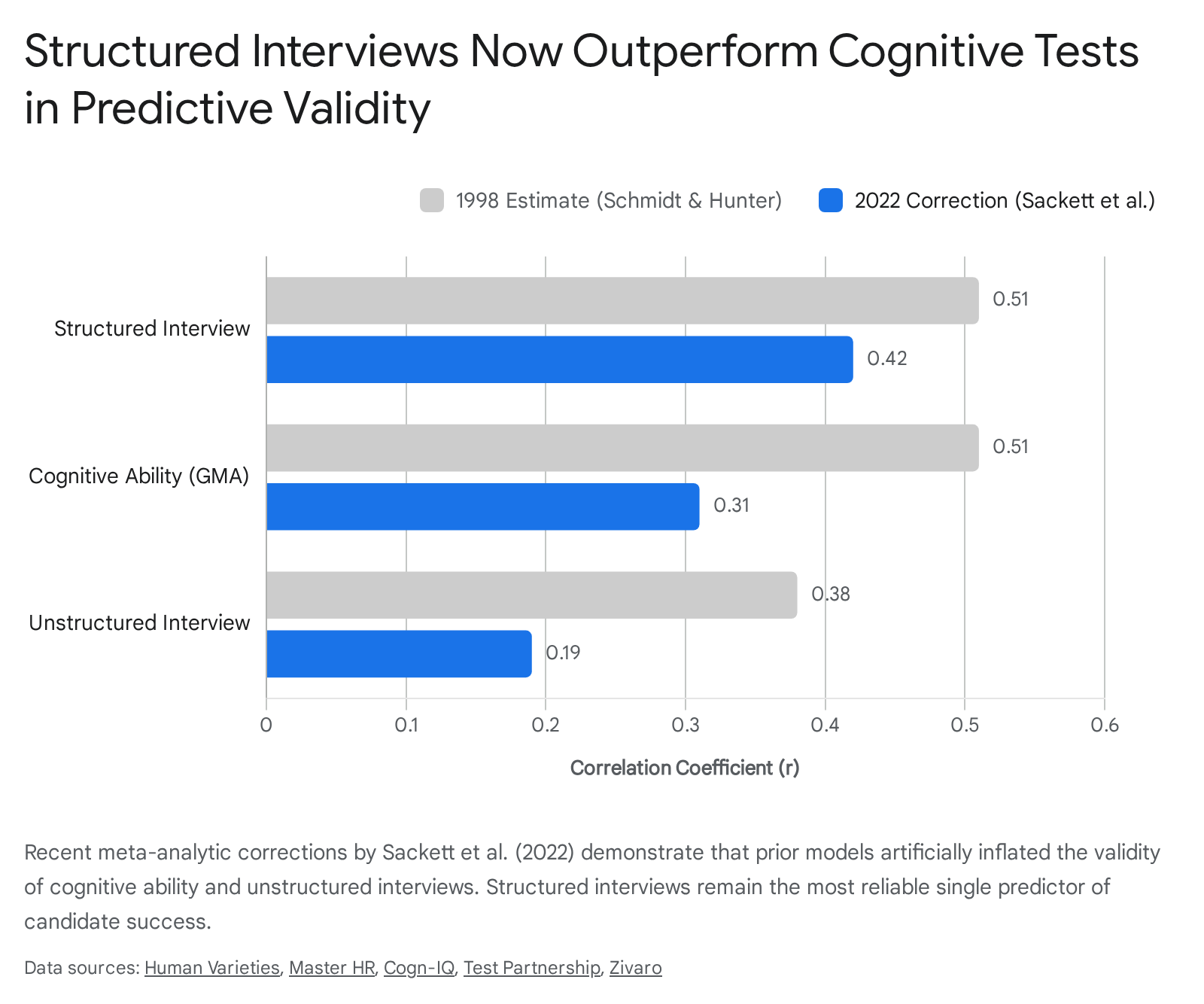
This indicates that structured formats are more than twice as effective at predicting capability than free-flowing conversations 171821.
Work Sample Tests and Contextual Assessments
Beyond structured interviewing, empirical data favors assessments that closely mirror the operational reality of the role. Work sample tests - which require candidates to perform actual components of the job - and job knowledge tests remain among the highest predictors of success, as they directly sample the behavior the employer intends to purchase 2022.
However, these modalities are highly context-dependent. While they are exceptionally effective for experienced candidates stepping into well-defined technical roles, they fail to assess entry-level applicants or roles where specialized skills must be acquired organically post-hire 20. Conversely, heuristic proxies frequently relied upon by resume screeners, such as years of prior experience, exhibit exceptionally poor predictive validity (r = 0.18). Performance improvements linked to raw tenure tend to plateau rapidly after the initial years of employment, meaning a candidate with ten years of experience is not inherently more capable than a candidate with three years of targeted, high-density experience 18.
| Selection Method | 1998 Validity Estimate (Schmidt & Hunter) | 2022 Validity Estimate (Sackett et al.) |
|---|---|---|
| Structured Interviews | 0.51 | 0.42 1821 |
| Cognitive Ability (GMA) | 0.51 | 0.31 2519 |
| Unstructured Interviews | 0.38 | 0.19 1718 |
| Years of Job Experience | 0.18 | Not significantly updated 18 |
Artificial Intelligence and the Degradation of Applicant Signals
The efficacy of traditional talent sourcing has been systematically undermined by the recent proliferation of generative artificial intelligence. The fundamental dynamic currently distorting applicant pipelines can be explained through Goodhart's Law, a principle originally coined by British economist Charles Goodhart, which states: "When a measure becomes a target, it ceases to be a good measure" 23243525.
Goodhart's Law and Resume Optimization
Historically, resumes and cover letters served as functional proxies for a candidate's written communication ability, professional diligence, organizational skills, and specific domain expertise. Applicant Tracking Systems (ATS) further formalized this proxy by measuring keyword density and formatting exactness as targets to automatically filter candidates 37. Consequently, candidates have leveraged generative AI to perfectly optimize their applications against these algorithmic targets. Tools are utilized to rewrite resumes, stuff applications with required keywords, fabricate professional summaries, and even generate deepfake video screening communications 3738.
This is a classic manifestation of Regressive Goodhart's Law 39. Because AI allows any applicant to effortlessly achieve the algorithmic target (a flawless, keyword-dense resume), the measure itself loses all correlation with the underlying trait it was originally intended to assess (actual human competence and diligence) 3539. By 2026, 67% of hiring managers reported that the influx of AI-tailored resumes directly slows down the hiring process, forcing recruitment cycles to delay up to two weeks as organizations struggle to verify fabricated or heavily embellished experiences 26. Furthermore, 92% of candidates acknowledge that AI screening overlooks qualified individuals who simply lack optimized keywords, resulting in a fractured talent pool where 65% of applicants actively revise resumes solely for algorithmic compatibility rather than factual accuracy 38.
Algorithmic Bias and Litigation Exposure
As startups and corporations rapidly deploy automated AI screeners to manage the flood of optimized applications - with over 79% of employers relying on AI for resume screening by 2025 - they incur massive compliance and bias risks 38. AI hiring tools frequently replicate, or even amplify, the historical biases present in their underlying training data 27.
A landmark audit by the University of Washington Information School evaluated leading open-source AI resume-screening models using over three million combinations of resumes and job descriptions. When evaluating substantively identical AI-generated resumes differing only by the demographic association of the candidate's name, the models demonstrated profound discriminatory skewing. The systems selected resumes associated with White names 85% of the time, while selecting Black-associated names only 9% of the time. Furthermore, male-associated names were preferred 52% of the time, even in historically female-dominated professions such as human resources and secondary education 2742.
For a startup founder, adopting opaque AI screening technology to save capital transforms a talent-acquisition problem into an acute litigation and reputational liability. If an AI agent penalizes an applicant based on gendered pronouns or inferred racial demographics, the startup remains legally responsible for the discriminatory outcome, regardless of vendor assurances 2742. Reputational damage among candidate pools can be devastating, as applicants frequently audit systems and share rejection patterns on public forums 42. Relying heavily on artificial intelligence to filter the top of the funnel demands aggressive human auditing, the integration of verified skills assessments, and mandatory interactive, non-digital interviewing steps to re-establish verified candidate signals 2643.
Cross-Border Regulatory Friction in Talent Acquisition
The normalization of remote work infrastructure has theoretically allowed startups to source talent globally, circumventing local talent shortages and expanding the means available to effectual entrepreneurs. However, international employment law introduces massive, fixed downside risks that severely disrupt the "affordable loss" principle if a hire fails 4428. Navigating these regulations requires precise capital modeling to avoid devastating financial surprises.
Global Discrepancies in Statutory Severance
In the United States, the doctrine of at-will employment heavily favors the employer, generally allowing termination of the relationship at any time, without cause, and without mandatory statutory severance pay (absent specific contractual obligations or mass layoffs triggering the WARN Act) 462930.
Globally, this legal framework is an extreme outlier. The vast majority of international jurisdictions treat employment as an indefinite contract requiring substantial, documented justification for termination, extended mandatory notice periods, and severe statutory financial indemnification upon dismissal 2829. These international labor codes are strictly enforced by local labor courts that inherently lean toward employee protection 44.
Comparative Analysis of Termination Liabilities
The asymmetric financial burden of global labor law is severe and frequently catches early-stage teams off guard. Terminating an underperforming software engineer in Texas requires zero severance; terminating the exact same role in Brazil mandates payouts approaching 80% of the individual's annual salary 44. A failure to accurately model statutory severance turns global talent acquisition from a theoretical cost-saving measure into a catastrophic drain on venture capital reserves 44.
| Jurisdiction | Mandatory Notice Period | Statutory Severance and Termination Liabilities |
|---|---|---|
| United States | None required (at-will doctrine) 4629. | No statutory severance. WARN Act applies only to mass layoffs (>100 employees) 30. |
| Mexico | 30 days general practice; strict requirements for proving just cause 2846. | 3 months base salary + 20 days per year of service + 12 days seniority premium + proportional bonuses 443049. |
| Brazil | 30 days minimum + 3 days per year of service (capped at 90 days) 44. | 40% fine on total accumulated FGTS balance + 13th-month salary + accrued vacation bonus (1/3 addition) 4430. |
| India | 1 month notice or pay in lieu specifically for retrenchment 4446. | "Retrenchment compensation" of 15 days average pay per year of continuous service; requires government approval for larger firms 30. |
| United Kingdom | 1 week per year of service (capped at 12 weeks) 2831. | Statutory redundancy based on age and service; unfair dismissal claims can result in exceedingly high tribunal compensation 30. |
Terminations for cause (e.g., gross misconduct) can sometimes bypass these severance requirements, but proving "cause" internationally is a complex, heavily scrutinized legal process requiring extensive documentation, formal hearings, and adherence to strict disciplinary timelines. Poor performance is rarely accepted by international courts as a valid justification for immediate, penalty-free dismissal 29. Additionally, numerous jurisdictions require the payout of accrued but unused vacation and pro-rated 13th-month mandatory bonuses upon termination, further escalating the total cash required to exit a mis-hire 2949.
Conclusion
Building a high-performing team at the genesis of a startup requires founders to navigate an environment characterized by asymmetric financial risks, shifting statistical paradigms, and adversarial candidate signaling. The data clearly illustrates that relying on heuristic intuition, unstructured interviews, or automated artificial intelligence introduces profound organizational vulnerability.
Founders must recognize that the true cost of a mis-hire is not contained within a basic salary line item, but cascades destructively through the organization via supervision taxes, cultural drag, and delayed product roadmaps. Mitigating this risk demands abandoning the pursuit of mythical generalists and prestigious corporate pedigrees. Instead, success hinges on deploying highly structured assessment rubrics to accurately measure competence, utilizing equity strategically to enforce mutual risk absorption, and aggressively calculating global regulatory exposure to adhere to the principle of affordable loss. Ultimately, in the early stages of enterprise formation, operational viability is preserved not merely by who the founder manages to attract, but by the rigor and discipline applied to verifying their capability.