
Do College Rankings Actually Matter
Every year, millions of families around the globe engage in a high-stakes, anxiety-inducing ritual. They spend thousands of dollars on test preparation, agonize over the meticulous curation of extracurricular profiles, and routinely sacrifice adolescent well-being, all in the desperate pursuit of an acceptance letter from a highly ranked college. The underlying assumption driving this psychological and financial frenzy is that securing a spot at an elite, top-tier institution is the ultimate guarantor of lifelong prosperity, superior intellectual development, and insulated career success. The higher the rank, the societal logic dictates, the better the human being that emerges.
To provide a direct answer to the core question: Do college rankings actually matter? The empirical evidence decisively indicates that for the vast majority of students, the overall published rank of a university matters far less than the intrinsic characteristics of the student attending it and the specific academic field they choose to pursue. Elite college rankings do not correlate with superior undergraduate teaching quality, nor do they guarantee a higher median salary for the average graduate after adjusting for pre-existing selection bias. However, rankings do matter significantly for a highly specific subset of outcomes - namely, accessing the top 1% of the national income distribution, gaining admission to elite graduate programs, and securing employment at prestigious firms in gatekept industries like high finance and corporate law. Furthermore, for marginalized, low-income, and first-generation students, attending a highly ranked institution provides a profound socio-economic premium and network access that is not observed for their wealthier peers.
This report systematically dissects the mechanics, empirical validities, and socio-economic consequences of global university rankings. By evaluating comprehensive research from leading labor economists, analyzing the recent methodological upheavals in the ranking industry, and observing international prestige premiums across varying labor markets, the subsequent analysis demystifies the actual value of institutional prestige.
How Do College Rankings Actually Work in Practice?
To understand why college rankings dictate consumer behavior and institutional strategy so profoundly, it is necessary to demystify how they are constructed. The methodologies behind these annual lists are often opaque to the general public, leading to critical misinterpretations of what a "Number One" ranking actually signifies.
A highly effective way to understand ranking methodologies is to look at real-world analogies from other industries. In the culinary world, the Michelin Guide awards stars based on highly subjective, experiential criteria - the artistry of the chef, the exclusivity of the ingredients, and the overall ambiance of the dining experience 1. Michelin stars gatekeep prestige and signal luxury. Conversely, Consumer Reports or the National Highway Traffic Safety Administration (NHTSA) evaluates vehicles based on utilitarian, objective metrics: crash test safety ratings, long-term reliability surveys, and fuel efficiency 2. The former measures elite status; the latter measures functional utility and return on investment.
For decades, the dominant college ranking systems, particularly the U.S. News & World Report, operated much like the Michelin Guide while presenting themselves to the public as Consumer Reports 32. They rewarded institutions for their accumulated wealth, their exclusivity, and their subjective peer reputation, rather than evaluating the objective "safety" or "reliability" of the educational product - meaning how much a student actually learns or how successfully they transition into the middle class.

Research indicates that even minor, mathematically arbitrary changes in these rankings have outsized impacts on consumer behavior. A study published in the Journal of Consumer Research analyzed data from the Graduate Management Admissions Council and found that moving just two spots up or down across a "category border" on a published list (for example, moving from number 12 to number 10) significantly impacts the volume of applications a school receives 3. Because consumers treat these lists as authoritative guides to absolute quality, universities are heavily incentivized to optimize their internal operations solely to satisfy the specific algorithms of ranking publications, regardless of whether those optimizations benefit the student body 45.
Why Did Top Universities Boycott the Rankings in 2023?
The tension between what legacy rankings measure and what modern higher education is fundamentally supposed to achieve reached a critical breaking point in late 2022 and early 2023. A historic exodus occurred when elite professional programs - initiated by the Yale Law School and followed swiftly by Harvard Medical School and dozens of others - announced they would permanently boycott the U.S. News & World Report rankings, refusing to submit their proprietary institutional data 8678.
The deans of these boycotting institutions argued that the traditional ranking methodology actively penalized universities for pursuing social equity and public service. For instance, the traditional formula discouraged schools from admitting highly promising graduates from lower-income backgrounds if those applicants had slightly lower standardized test scores, as admitting them would marginally harm the institution's critical "selectivity" metric 78. Furthermore, law schools noted they were mathematically penalized when their graduates accepted vital but low-paying public interest roles, public defender positions, or school-funded fellowships, because the algorithm blindly favored high initial corporate salaries as the sole proxy for post-graduate success 78.
In response to the institutional boycotts, mounting public criticism, and the shifting cultural landscape regarding college affordability, U.S. News & World Report executed the most significant methodological overhaul in its operational history for the 2024 and 2025 undergraduate rankings. To address the backlash, the publication abruptly abandoned five long-standing metrics that historically favored wealthy, elite institutions 86910:
- Alumni Giving Rate (Previously 5%): Historically, schools could game this metric by aggressively soliciting one-dollar donations from alumni simply to artificially inflate their engagement percentages, rather than demonstrating actual alumni satisfaction 14.
- Class Size (Previously 8%): This metric previously penalized highly rigorous institutions (such as the California Institute of Technology) where demanding curricula naturally led to smaller, self-selected upper-level courses or slight attrition, punishing them for academic rigor 14.
- High School Class Standing: Removed due to the diminishing number of American high schools that continue to rank their students, rendering the data incomplete.
- Proportion of Faculty with Terminal Degrees (Previously 3%)
- Proportion of Graduates Borrowing Federal Loans
Taking their place, the publication dramatically increased the weight of social mobility indicators. The graduation rates of Pell Grant recipients (targeting low- and moderate-income populations) were weighted more heavily, increasing from 5% to up to 11% depending on the specific ranking list 10. A new metric rewarding the successful graduation of first-generation college students was introduced, accounting for 2.5% of the score 1015. Additionally, U.S. News began measuring whether graduates earn more than a typical high school graduate, utilizing federal College Scorecard data 910.
However, despite these sweeping methodological changes, the top of the hierarchy remained virtually frozen. Princeton, the Massachusetts Institute of Technology (MIT), Harvard, and Stanford maintained their iron grip on the top spots 10. This stasis suggests that while the peripheral metrics shifted, the underlying mathematical architecture of prestige remains inherently tied to massive institutional wealth, faculty resources, and historical reputation, variables which elite universities possess in such abundance that minor algorithmic tweaks cannot dethrone them 10.
As U.S. News faced intense scrutiny, alternative ranking systems utilizing entirely different philosophical approaches gained massive traction. The Wall Street Journal (WSJ), in partnership with College Pulse and Statista, utilizes a highly divergent methodology that heavily prioritizes student outcomes over institutional inputs 216. In the WSJ algorithm, a massive 70% of the total weight is dedicated to student outcomes - specifically analyzing graduates' salaries, the time required to pay off the net price of the degree, and the institution's ability to help students graduate 17.
By entirely ignoring traditional metrics like standardized test scores, acceptance rates, and the highly subjective peer reputation surveys, the WSJ rankings yield drastically different results. In recent iterations, institutions like the University of Pennsylvania and Columbia surged to the top, while traditional elites like Brown and Johns Hopkins saw high volatility, plunging down the list based on shifting salary data and regional cost-of-living variables 218. This divergence proves a critical empirical point: a university's "rank" is not an objective scientific truth; it is merely a reflection of the specific mathematical weights and philosophical biases chosen by a publishing company 91811.
| Metric Category | U.S. News & World Report (Post-2023 Methodology) | Wall Street Journal / College Pulse |
|---|---|---|
| Primary Focus | Academic reputation, graduation rates, faculty resources, research citations 91014. | Tangible student outcomes, salary impact, social mobility, and time-to-payoff 217. |
| Peer Assessment | Heavy reliance (20%) on subjective surveys from university presidents and deans 1520. | Completely eliminated. Focuses solely on empirical financial data and student/alumni surveys 2. |
| Input Selectivity | Still considers standardized test scores (SAT/ACT) for admitted cohorts 20. | Completely eliminated. Acceptance rates and incoming test scores are ignored to prevent selection bias 17. |
| Financial Resources | Rewards schools with high per-student spending and large endowments 1420. | Evaluates how long it takes graduates to pay off the net price of attendance based on salary 17. |
Do Elite Colleges Guarantee Higher Salaries?
The most common and deeply ingrained justification for agonizing over college admissions is the assumption that an elite degree acts as an infallible guarantee of a higher lifetime salary. Economic research spanning the last two decades has heavily scrutinized this assumption, revealing a far more nuanced, complex, and conditional reality.
The Dale-Krueger Findings: The Power of Unobserved Motivation
In the early 2000s, economists Stacy Dale and Alan B. Krueger published a landmark study that fundamentally challenged the concept of the prestige premium. They acknowledged that, at a surface statistical level, graduates of highly selective elite colleges earned significantly more than graduates of less selective schools 121314. However, they identified a massive confounding variable that skewed this data: selection bias 1215.
Students accepted into Ivy League universities already possess intrinsic characteristics - high raw intelligence, intense internal motivation, strong family resources, and resilience - that predict future financial success regardless of where they actually attend college 1225. To isolate the actual "value-add" of the institution itself, Dale and Krueger utilized a brilliant methodological control known as the "self-revelation model." They measured a student's unobserved "motivation" and ambition by looking at the average SAT scores of the colleges that the students applied to, regardless of where they were accepted or ultimately enrolled 141516.
The findings, derived from the College and Beyond Survey and linked directly to detailed administrative earnings records from the Social Security Administration, were revolutionary. When adjusting for this unobserved student ability and ambition, the earnings premium for attending a highly selective college dropped substantially and became statistically indistinguishable from zero for the average student across the 1976 and 1989 cohorts 121427. In other words, a highly motivated student who applies to Harvard and the University of Pennsylvania, gets accepted to both, but chooses to attend a less-selective state university, will earn roughly the same median salary over their career as if they had attended Harvard 1225. The ambition of the student, not the name printed on the diploma, drives the median economic outcome.
There were, however, vital and persistent exceptions in the Dale-Krueger data. For Black and Hispanic students, and for students from less-educated or lower-income families, the estimates of the return to college selectivity remained exceptionally high, even in models that controlled for unobserved characteristics 1427. For these marginalized populations, the elite institution provides something they do not already possess inherently: access to high-powered alumni networks, elite social capital, and immediate reputational credibility in a labor market that might otherwise exhibit bias against them. Interestingly, the research also noted historical gender disparities; in older cohorts, attending a highly selective college actually showed a negative wage effect for women, largely attributed to assortative mating where women at elite colleges often married high-earning peers and subsequently reduced their own labor market participation 1327.
Raj Chetty and Opportunity Insights: The Top 1% Gatekeepers
While Dale and Krueger demonstrated that median earnings are largely unaffected by college selectivity, more recent and exhaustive research by Harvard economist Raj Chetty and the Opportunity Insights team provides a crucial addendum to the prestige narrative. Chetty's 2023 research utilized anonymized admissions data from a diverse array of colleges linked securely to federal income tax records, focusing heavily on the "Ivy-Plus" colleges (the eight Ivy League institutions, plus Stanford, MIT, Duke, and Chicago) 171819.
Chetty's team isolated the causal effect of attending an elite college by studying natural experiments within the admissions process. They specifically analyzed students who were waitlisted at Ivy-Plus institutions and were either idiosyncratically accepted or rejected to fill specific, random institutional needs (e.g., needing a bassoon player for the orchestra or a specific geographic demographic) 121720.
The findings perfectly reconciled with Dale and Krueger regarding average earnings - Ivy-Plus colleges have much smaller causal effects on average earnings than the public assumes 17. However, the data revealed a stark, structural disparity at the absolute extremes of wealth. Attending an Ivy-Plus college instead of a highly selective flagship public institution increases a student's chances of reaching the top 1% of the national earnings distribution by a staggering 60% 1720.

Furthermore, the research found that attending an Ivy-Plus college nearly doubles a student's chances of attending an elite graduate school and triples their chances of working at a prestigious firm 171820. These specific industries - such as elite management consulting, bulge-bracket investment banking, and top-tier corporate law - utilize elite universities as outsourced human resources filters; they routinely refuse to recruit outside of these top-ranked campuses, essentially reserving leadership positions for Ivy-Plus alumni.
Chetty's research also exposed the severe, systemic socioeconomic disparities baked into elite admissions. Children from families in the top 1% of the income distribution are more than twice as likely to attend an Ivy-Plus college as students from middle-class families who possess identical SAT or ACT scores 1832. This massive high-income advantage is driven mathematically by three distinct factors: heavy preferences for legacy applicants (children of alumni), the weighting of non-academic ratings (which heavily favor students applying from affluent private high schools with vast extracurricular resources), and the targeted recruitment of elite athletes (in niche, expensive sports like fencing or rowing) 17193221. Strikingly, Chetty noted that these three specific factors are either uncorrelated or actively negatively correlated with post-college success, whereas raw academic credentials remain highly predictive 171821.
Does a Higher Rank Mean Better Teaching Quality?
A pervasive and deeply flawed misconception among prospective students and parents is that a highly ranked university automatically provides a superior, transformational classroom experience. The logic seems intuitively sound: if a university possesses billions in endowment funds, boasts state-of-the-art facilities, and attracts the most brilliant academic minds in the world, the undergraduate teaching must be unparalleled. Empirical evidence, however, thoroughly debunks this "instruction myth."
The fundamental flaw in this assumption lies in how modern research universities evaluate and reward their faculty, and conversely, how ranking systems evaluate those universities. The major global and national ranking systems - including U.S. News, Times Higher Education (THE), and Quacquarelli Symonds (QS) - heavily favor research output and bibliometric indicators 53435. For example, QS assigns a massive 50% of its overall score to research volume and academic reputation, while THE similarly allocates roughly 60% to research environment and citation impact 34. Consequently, university faculty are hired, tenured, and promoted based almost entirely on their research output, the prestige of the journals they publish in, and the volume of grant money they secure 522.
Conversely, institutions invest relatively little time, effort, or financial incentive into evaluating or improving undergraduate pedagogy. Educational researchers note a profound disconnect: universities compete for students by imitating high-prestige research models, yet there is scant evidence that this research prowess has any bearing on their aptitude as educators 22. A comprehensive study conducted at Northwestern University analyzed matched student-faculty data for over 15,000 undergraduates to investigate the relationship between teaching quality and scholarly quality. The results were conclusive: there is no apparent relationship between a professor's research quality (measured by field prominence and major awards) and their teaching quality (measured by deep learning outcomes and their ability to inspire students to major in the subject) 23. A Nobel laureate may be a pioneer in theoretical physics but highly ineffective at communicating fundamental concepts to an auditorium of 18-year-old freshmen.
Furthermore, traditional rankings use proxy metrics that fail entirely to capture classroom effectiveness. U.S. News utilizes factors like "faculty salaries" and "student-faculty ratio" under the assumption that well-paid professors in smaller classes equate to better learning 1420. However, an institution might boast a low student-faculty ratio simply because its star researchers are granted total immunity from teaching duties to focus on their labs, leaving undergraduate instruction to adjuncts and teaching assistants 2223.
Educational journalists and researchers note that active learning, rigorous debate, and hands-on exercises are the true drivers of student knowledge and retention . These demanding pedagogical practices are often found in abundance at regional state universities and dedicated liberal arts colleges, which may rank much lower on national lists precisely because they lack the massive research endowments of flagship R1 institutions . High expenditures per student often fund what critics call the "Edifice Complex" - fancy new gyms, luxurious dormitories, and administrative bloat - rather than meaningful investments in classroom instruction . In short, rankings assess the prestige of the faculty's research portfolio and the wealth of the institution, not the caliber of the education delivered to the student.
How Does the "Prestige Premium" Translate Internationally?
The obsession with university rankings is not an exclusively American phenomenon; it is a highly globalized mechanism that influences domestic labor markets, dictates immigration policies, and directs international student flows. However, the economic return on prestige - the "prestige premium" - varies wildly depending on the structural realities of the geographic context and local labor markets.
The United Kingdom and Europe: A Shrinking Premium
In the United Kingdom, the higher education landscape has expanded significantly since the 1990s, with the proportion of the population attending university doubling over a short period 24. As the supply of degrees has surged, the overall "graduate premium" - the excess income earned by a graduate compared to a non-graduate - has begun to shrink or stagnate in certain sectors 244041. Data from the UK Department for Education shows that for graduates aged 21 to 30, the premium over non-graduate pay fell by one-third between 2007 and 2024, driven by increased competition for graduate jobs and sharp real-terms increases in the minimum wage 41. Currently, the graduate premium in the UK sits at roughly 20%, compared to a massive 130% premium in the United States, where general income inequality is vastly more pronounced and the social safety net is weaker 412543.
In the UK, institutional prestige - specifically membership in the Russell Group (which includes Oxford, Cambridge, and Imperial College London) - does still carry immense weight. Male graduates of the 34 Russell Group universities earn, over their lifetime, significantly more than graduates of the least selective UK institutions 41. However, structural differences in the UK labor market mean that practical experience, highly specific skill sets, and subject choice can often compensate for a lack of institutional prestige faster than in the US 44. For instance, UK data reveals that one in five graduates will see a negative return from going to university, particularly in fields like the creative arts, regardless of institutional branding 41.
In a broader context, researchers at UC Berkeley note that the European higher education sector is emerging as an "alternative business model" to the US system. While the US system relies heavily on high tuition, cross-subsidization from international students, and the symbolic prestige of a few elite institutions, the European model offers a broadly high quality of education at substantially lower costs 26. Experts warn that the US higher education system is experiencing a decline similar to the American car industry in the 20th century - resting on legacy prestige while international competitors improve their core product value 26.
Asia: Education as Social Destiny
In stark contrast to the shifting dynamics in the West, across much of Asia, the prestige of a university is inextricably linked to social status, marriage prospects, and long-term career viability. In countries like China, South Korea, and Singapore, the institutional name on a diploma is the single most critical factor in applying for jobs, often functioning as a rigid, impenetrable societal filter 2544.
China's top institutions, specifically Tsinghua University and Peking University (Beida), have executed aggressive, heavily funded strategies to climb global rankings, recognizing that international prestige attracts both capital and elite talent 27. Their strategy has been remarkably successful; in recent Times Higher Education subject rankings, Tsinghua surpassed both Oxford and Cambridge in Business and Economics, driven by massive investments in research output and international academic reputation 48. For a Chinese graduate, the employment prospects and salary trajectories from Tsinghua or Beida are considered functionally equivalent to those of a British graduate from Oxbridge or an American from the Ivy League .
Interestingly, empirical studies of the Chinese labor market reveal the persistence of the prestige signal. A master's graduate who holds a bachelor's degree from an elite Chinese university will command a 12% salary premium over a peer holding the exact same master's degree but whose bachelor's degree is from a non-elite institution 28. This demonstrates that in highly competitive Asian labor markets, the initial prestige signal established at the undergraduate level persists as a powerful determinant of income inequality long into a professional career 28.
| Geographic Region | Earnings Premium for Graduates (vs. High School) | Impact of Institutional Prestige on Hiring and Salary |
|---|---|---|
| United States | Extremely High (~130% premium) 25. | High. Massive advantage for reaching the top 1% and accessing elite industries (finance, law) 1725. |
| United Kingdom | Moderate (~20% to 30% premium) 412543. | Moderate. Russell Group status matters heavily, but skills and specific subject choice are becoming the dominant drivers 414350. |
| Asia (e.g., China, South Korea) | High (Roughly double the earnings of non-graduates) 25. | Extreme. Elite university status (e.g., Tsinghua, Peking) dictates corporate hiring, network access, and social standing 254428. |
What Do Students Actually Care About Versus What Rankings Measure?
There is a rapidly widening chasm between the criteria used by publications to construct college rankings and the actual, lived priorities of modern prospective students. As the cost of tuition escalates to historic highs and the burden of student debt grows, the current generation of students - Generation Z - approaches higher education with a highly pragmatic, outcome-oriented mindset 51.
Recent sentiment surveys involving hundreds of thousands of high school and college students reveal that traditional prestige metrics rank remarkably low on their list of core concerns 2953. According to Eduventures' Student Sentiment Research, only about 19% of college-bound high school students consider rankings a top trusted information source for their college search 54. While parents of these students often rely on rankings heavily as a perceived beacon of hard metrics in a confusing landscape, the students themselves are highly skeptical of institutional narratives and prestige signaling 54.
When surveyed about what genuinely drives their enrollment decisions and post-graduation satisfaction, students prioritize factors that directly impact their daily lives, mental well-being, and future financial solvency: * Affordability and Net Cost: Nearly half of students (47%) cite affordability as their absolute top concern when choosing a college. The tangible value of the degree versus the ever-rising cost is the primary filter for Gen Z 55. * Career Readiness and Outcomes: Students demand robust internship pipelines, active career counseling, and high, proven job placement rates. The degree is viewed as a direct pathway to a successful career, not merely a symbol of intellectual prestige 5156. * Academic Program Variety: A comprehensive study by EAB found that the availability of specific majors and the flexibility to change fields is a primary driver of student attraction, with schools offering a wider range of programs seeing significantly higher application rates 57. * Campus Culture, Safety, and Well-being: A sense of belonging, physical campus safety, and the availability of mental health resources are critical 5557. In job searches post-graduation, a staggering 76% of students prioritize work-life balance, outranking even salary (60%) 58.
Traditional ranking algorithms fundamentally ignore these human elements. A university cannot be algorithmicized for its "sense of belonging," nor can a national ranking accurately reflect the localized strength of a specific, niche department at a regional university 2557. Consequently, rankings misalign entirely with the practical realities and anxieties of the modern educational consumer.
How Should Students Weigh Prestige Against Cost? (Practical Takeaways)
Given the extensive empirical evidence exposing the flaws and limitations of college rankings, how should students and families navigate the high-stakes, highly emotional college decision process? The data points to a clear, actionable set of practical takeaways that prioritize long-term financial health, pedagogical quality, and career satisfaction over arbitrary institutional prestige.
1. Subject Choice Trumps Institutional Selectivity
The single most crucial takeaway from contemporary labor economics is that what a student studies has a vastly greater, more persistent impact on their lifetime earnings than where they study. Extensive analysis linking education and employment records across millions of graduates reveals that the earnings gap driven by subject choice is significantly larger than the gap driven by institutional selectivity 2550.
For example, data from Revelio Labs indicates that in the first year after graduation, choosing a high-paying major (such as Computer Science or Engineering) generates an earnings premium of roughly $33,000 50. In contrast, the earnings premium linked strictly to attending a highly selective university is roughly $19,000 50. This gap only widens over time. Five years after graduation, students who major in mathematics, engineering, or computer science at less selective state universities (e.g., Virginia Tech) routinely and significantly out-earn their peers who studied humanities, psychology, or history at elite Ivy League institutions like Harvard 2550. Students seeking financial security should focus on the specific strength of the academic department, not the overall brand name on the campus gates.
2. The Debt-to-Income Calculation is Paramount
Because median salaries are dictated far more by personal ambition, pre-existing family wealth, and major selection than by institutional brand, taking on catastrophic, non-dischargeable student loan debt to attend a highly ranked private university is rarely a mathematically sound decision for the average student 142550.
Students and families must evaluate the true "net price" of attendance (the actual out-of-pocket cost after institutional grants and scholarships are applied) against the median starting salary for their specific intended major. Families should abandon subjective ranking lists and instead utilize federal tools like the Department of Education's College Scorecard, which provides direct, anonymized IRS data on what graduates of specific programs at specific colleges actually earn 825. If a lower-ranked regional university offers a robust financial aid package or lower in-state tuition, the long-term return on investment will almost certainly surpass that of a prestigious university that requires six figures of debt.
3. Recognize When Prestige Actually Matters
Families must honestly assess the student's specific career goals. If a student is absolutely determined to become a Supreme Court Justice, an investment banker at a bulge-bracket firm like Goldman Sachs, a management consultant at McKinsey, or a tenure-track professor at a top-tier research university, institutional prestige is functionally mandatory 1718. These elite, highly insular sectors use Ivy-Plus credentials as minimum barriers to entry; they rely on the university admissions office to do their initial talent filtering 17.
However, if a student wishes to become a software engineer, a registered nurse, a regional business manager, an accountant, or a public school teacher, the prestige premium effectively evaporates 2559. In these vast sectors of the economy, licensure, technical skill, and practical experience are the only metrics employers value. In these cases, the focus should shift entirely to minimizing student loan debt, maximizing experiential learning opportunities, and finding a campus environment where the student can thrive personally and academically.
Bottom Line
The anxiety that consumes families during the college admissions process is largely based on a flawed, outdated premise: the belief that a university's published rank is an objective, flawless scientific measure of its educational quality and a guaranteed, risk-free ticket to lifelong financial prosperity.
Extensive economic research, notably from Dale, Krueger, and Chetty, proves conclusively that for the vast majority of students, personal motivation, individual ambition, and the specific choice of academic major play a vastly more significant role in determining lifetime earnings than institutional prestige 12142550.
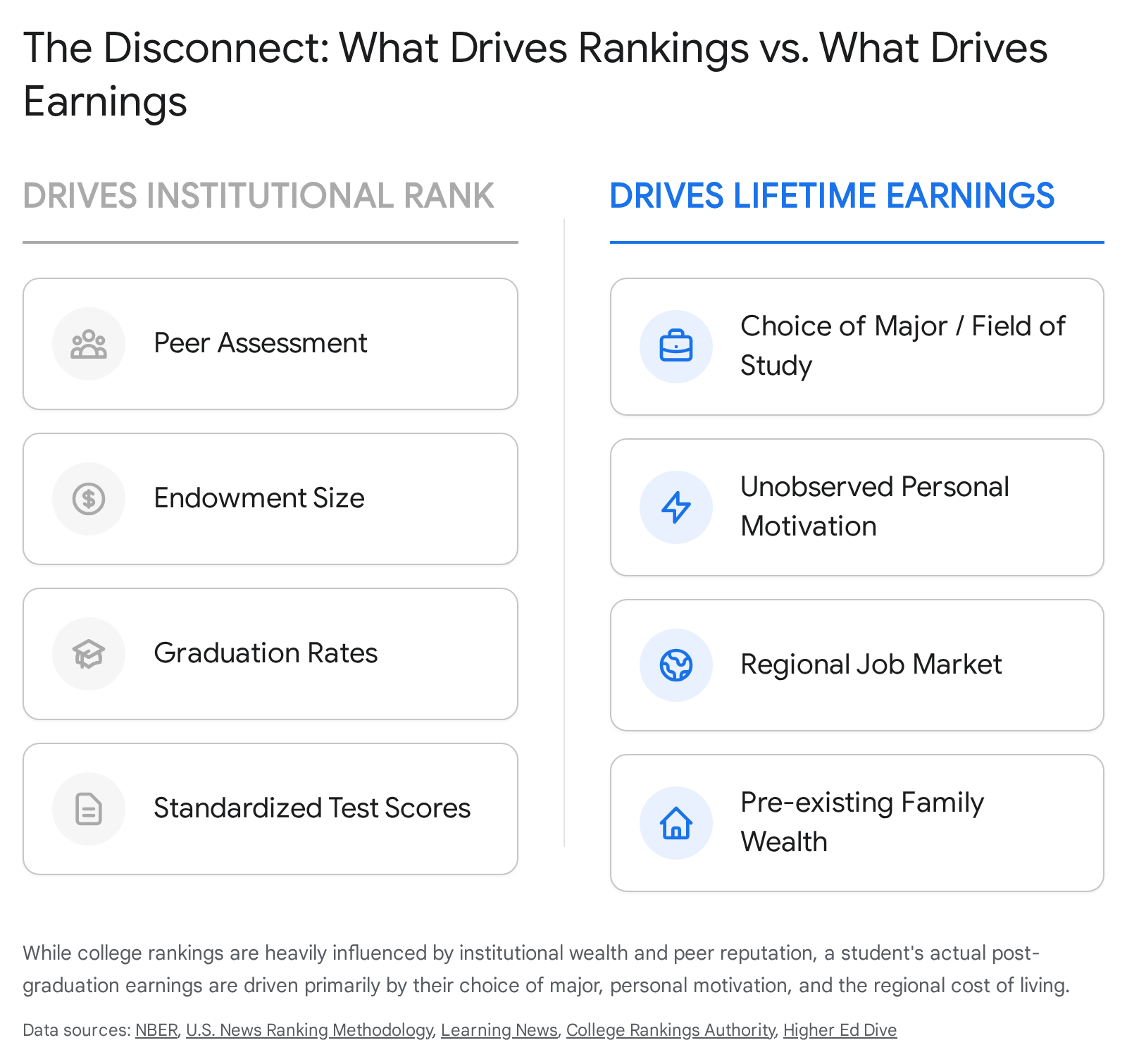
The "prestige premium" is a real economic phenomenon, but it is highly concentrated; it predominantly benefits marginalized students seeking access to elite networks, and it serves as a rigid gatekeeper for those aiming specifically for the top 1% of the income distribution or highly exclusive corporate and academic sectors 141718.
Rankings themselves are inherently subjective, built on volatile algorithms that historically reward institutional wealth, research volume, and peer popularity while failing utterly to measure actual classroom teaching quality or student well-being 452230. As the recent historic boycotts by top law and medical schools demonstrate, these arbitrary metrics often force universities to prioritize their algorithmic standing over their core educational missions and commitments to social equity 878.
Ultimately, higher education is an immense financial and personal investment, not a luxury brand acquisition. Students weighing prestige against cost must recognize that taking on crippling debt for a highly ranked name rarely yields a positive financial return compared to studying a high-demand, high-skill field at a well-regarded, affordable public university 2550. By ignoring the noise of arbitrary publishing rankings and focusing instead on specific program strength, true affordability, and tangible career readiness, students can make data-driven decisions that secure their financial and professional futures.