
Discord Community Growth and Monetization Trends 2026
Evolution of the Platform Infrastructure
The digital communication ecosystem in 2026 reflects a structural transformation in how online audiences organize, interact, and generate commercial value. Originally conceptualized as a low-latency voice-over-IP service for online multiplayer gaming, Discord has systematically evolved into a comprehensive infrastructure platform for digital communities. As of late 2025 and into 2026, the platform architecture supports a registered user base of 656 million individuals globally, with 259 million engaging as monthly active users (MAUs) 12. The interaction volume across the network is substantial, processing over 1.1 billion messages and facilitating 4 billion minutes of synchronous voice conversations on a daily basis 345.
This unprecedented scale is accompanied by a critical demographic and behavioral realignment. While gaming remains the platform's historical foundation, 54% of Discord's user base now actively identifies with non-gaming communities 36. The platform is heavily utilized for educational cohorts, where it ranks as the second most preferred platform globally behind Google Meet, alongside expansive adoption by creator ecosystems, professional networking collectives, and decentralized finance networks 35. Productivity-focused server usage has experienced a 40% year-over-year growth trajectory, placing Discord in direct competition with traditional enterprise communication tools 5.
The financial metrics of the platform underscore this maturation. Discord's direct total revenue reached $561 million in 2025, representing a robust 29.2% year-over-year increase 123. A significant portion of this capital generation - $304 million, or approximately 54% of total revenue - is driven by the platform's native Nitro subscription service, which currently serves 7.3 million active subscribers globally 3. The average revenue per user (ARPU) sits at $3.47, highlighting a deliberate corporate focus on freemium accessibility over aggressive, extractive pricing strategies 36. These fundamentals have sustained the company's private market valuation between $10 billion and $15.2 billion as it prepares for a potential initial public offering coordinated by major financial institutions, including Goldman Sachs and JPMorgan Chase 267.
Unlike algorithmic social media environments that are optimized for passive content consumption, Discord's architecture requires intentional, active participation. The average user spends 94 minutes daily on the platform, exhibiting an industry-leading 73% daily active user (DAU) to monthly active user (MAU) ratio among heavy users 5. This distinct structural reality demands highly specialized growth and retention strategies. Community operators can no longer rely on traditional audience broadcasting; they must engineer participatory environments that optimize for early user activation, peer-to-peer connection, and long-term retention.
Demographic Composition and Regional Market Dynamics
Global User Demographics
Executing an effective community growth strategy requires a granular understanding of the platform's audience composition. Discord's user base heavily indexes toward younger demographics entering their prime professional and spending years. Globally, the most significant percentage share of users (53.4%) falls into the 25-34 age bracket, while 20.6% belong to the 16-24 cohort 58. The gender distribution remains predominantly male at 66.3%, though female representation (32.6%) is steadily increasing, particularly within educational, artistic, and creator-focused communities, with industry projections suggesting a convergence toward a 1:1 gender ratio by 2030 458.
From a geographical standpoint, North America and Europe currently dominate aggregate platform usage, accounting for nearly 60% of the total user base 9. The United States represents the largest single market, maintaining over 70 million MAUs, which accounts for approximately 22.27% of global traffic 34. Europe contributes 25% of the platform's user traffic, heavily concentrated in Germany and the United Kingdom, where Discord contributes 6% of the company's global in-app purchase revenue 34.
Asia-Pacific and Latin America Expansion
The most aggressive vectors for community growth and mobile adoption are situated in the Asia-Pacific (APAC) and Latin America (LATAM) regions. APAC has emerged as the fastest-growing geographical segment, now representing 34% of Discord's active user base 3. This growth is propelled by mobile-first adoption in markets such as Japan, South Korea, Indonesia, and the Philippines, alongside India, which ranks globally as the second-largest user base with approximately 39 million active users in 2025 349.
To support this expansion and reduce communication latency, Discord launched localized data centers in Singapore and Sydney in 2024, alongside targeted localization tactics such as strategic partnerships with regional VTubers and creators 9. Similarly, LATAM represents a critical growth frontier, anchored by Brazil, which boasts 56.4 million users (5.84% of all global traffic) 4. The expansion across these regions is heavily intertwined with burgeoning mobile gaming and local creator economies.
The distinction in device preference across these regions is stark and dictates how community architects must design their onboarding user experiences. While the United States remains a desktop-centric environment, emerging markets are overwhelmingly mobile-dependent.
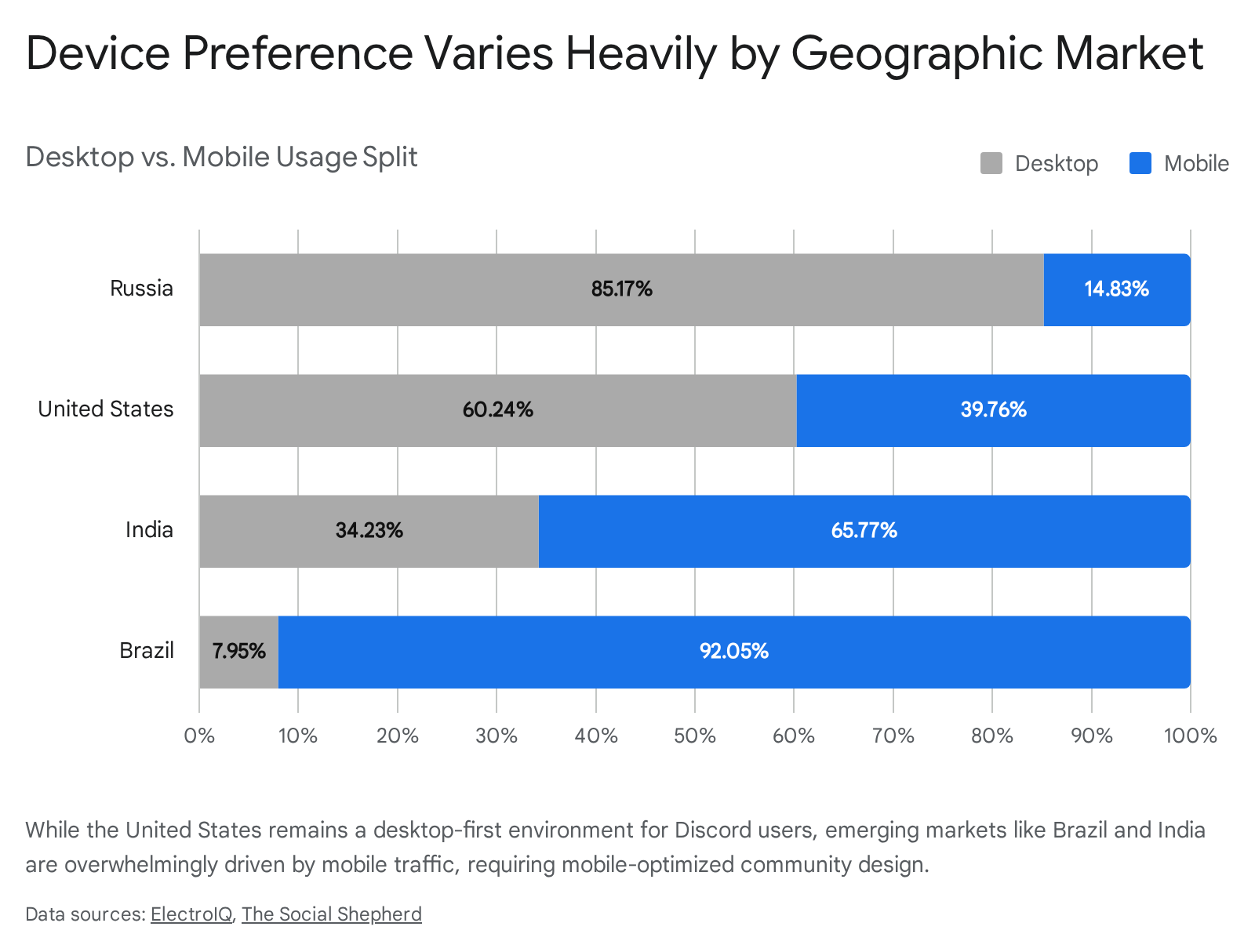
To capture these cohorts, Discord introduced localized pricing tiers for Nitro in late 2024, a strategic adjustment that resulted in international markets driving over 45% of subsequent subscription growth 9.
Regulatory and Infrastructure Challenges
Operating global communities across these disparate regions requires navigating complex regulatory environments. Discord faces stringent data localization mandates in India and Southeast Asia, forcing the storage of user data on local servers. Compliance with these geopolitical directives raised estimated regional infrastructure costs by $45 million to $60 million in 2025, adding 12% to 18% to operating expenses for APAC services 10.
Furthermore, global supply chain shifts, nearshoring, and free trade agreements (FTAs) have deeply interconnected the LATAM and APAC digital economies. Mexico recorded $36.06 billion in foreign direct investment in 2023, largely driven by nearshoring efforts, while the number of signed FTAs between the two regions reached 261 by 2024 11. For community operators, particularly those in Web3, enterprise software, or international trade facilitation, understanding that a user base may simultaneously span these intertwined regions is critical for scheduling live audio events, setting moderation hours, and building localized engagement strategies 311.
Community Onboarding and Retention Mechanics
The Three Phases of Community Scaling
The architectural trajectory of a successful Discord community typically follows three distinct operational phases. Growth relies heavily on genuine value delivery and systematic engagement rather than algorithmic visibility. Market data indicates that a staggering 83% of newly created Discord servers never surpass 100 members, primarily because operators optimize for channel creation and invite links before establishing a sustainable retention mechanic 1213.
To overcome this plateau, community managers must progress systematically through established growth tiers. The focus shifts from high-touch human connection in the early stages to automated systems and scalable moderation in the later stages 13.
| Scaling Phase | Member Count | Primary Objectives | Operational Focus |
|---|---|---|---|
| Foundation | 0 - 100 | Establish core value proposition and cultural norms. | High-touch, 1-on-1 welcome messages; defining the server's unique utility against competitors. |
| Growth | 100 - 1,000 | Systematize engagement and scale peer-to-peer interaction. | Implementation of onboarding funnels, leveling systems, and basic automated moderation. |
| Scaling | 1,000 - 10,000+ | Automate logistics while maintaining quality control. | Advanced API integrations, premium LLM support bots, and tiered monetization structures. |
Friction Points for Professional Cohorts
As Discord aggressively expands into the 25-45 age demographic - capturing digital hobbyists, educational cohorts, and software-as-a-service (SaaS) communities - it encounters unique onboarding friction points not seen in its legacy user base. Product teardowns and platform diagnostics identify several systemic barriers that halt professional adoption at the top of the funnel 14.
The primary barrier is "Gamer Branding." For users native to enterprise software like Slack and Notion, Discord's casual visual identity and terminology create a perception mismatch, leading them to view the platform as a chaotic recreational space rather than a structured organizational tool 14. This branding misalignment is exacerbated by the platform's engineering logic.
Furthermore, Discord's prioritization of instantaneous live voice connection induces "Joiner Anxiety" (or mic-on anxiety) among adult professionals. While the underlying architecture reduces connection latency by 5% to 15%, the potential for social embarrassment upon unexpectedly broadcasting audio results in a documented 5% instant churn rate, effectively negating the engineering speed gains 14.
Text-based friction is equally prevalent. Discord handles real-time message scaling efficiently, but large servers generating upwards of 50 messages per minute induce extreme "Information Fatigue" for new users attempting to orient themselves. This continuous cascade, known as the Waterfall Effect, causes massive servers (those exceeding 1 million members) to suffer dismal active engagement rates ranging from only 1% to 15% 14. Finally, stringent security protocols meant to combat automated spam - such as forcing users to complete third-party identity or age-assurance verifications within the first 60 seconds of joining - cannibalize professional onboarding, doubling the risk of user drop-off before any community value can be demonstrated 14.
Optimizing the First-Week Experience
The most critical phase of Discord community growth occurs within a user's first week. First-week retention is highly correlated with first-hour activation, defined as a user making an initial interaction, such as sending a message, claiming a role, or introducing themselves 1215. Unstructured communities that simply deposit new users into a busy general chat channel suffer from immediate day-one churn.
To combat early drop-off, operators deploy the "Digital Clubhouse Philosophy," structuring the server with dedicated onboarding funnels and progressive channel disclosure 12. A highly effective onboarding architecture utilizes a read-only "Start Here" channel, restricting new users to a view of only three or four essential orientation channels. Users must read the guidelines and actively click role-assignment buttons to gradually unlock the rest of the community 16. Data demonstrates the efficacy of this approach: standard, unoptimized invite links yield a mere 12-18% conversion rate for active retention, whereas optimized onboarding flows achieve a 43-67% retention rate in the first week 14. Additionally, operators utilize the "Icebreaker Method" - automated daily prompts or introductory incentives involving experience points (XP) - to nudge new users into making their vital first contribution 1215.
Server Analytics and Key Performance Indicators
Native Metrics and Server Insights
Sustainable growth relies on tracking behavioral data rather than vanity metrics. A community with 10,000 total members but only a 5% activity rate generates significantly less commercial and social value than a server with 2,000 members maintaining a 40% activity rate 13. Community operators rely heavily on Discord's native Server Insights dashboard to diagnose health and optimize content scheduling 16.
Server Insights categorizes user behavior into specific quantitative states. "Visitors" are members who click into the server to view channels, regardless of whether they post, while "Communicators" are members who actively generate text or voice data 16. The dashboard measures "New Member Retention" by tracking the exact percentage of newly joined users who return to the server after a seven-day interval 16.
A healthy community benchmark explicitly targets a 50/50 ratio: approximately 50% of the total member base should register as Visitors in a given period, and 50% of those Visitors should convert into active Communicators 16. Discord's internal guidelines suggest that achieving a 30% baseline ratio of Communicators across the total population indicates strong fundamental health 16.
Engagement Measurement Frameworks
Beyond the native dashboard, professional community managers construct holistic measurement frameworks to track conversion pathways and engagement velocity. Significant deviations in the Join vs. Leave ratio or declines in Daily Active Chatters often signal "Ping Fatigue" - a phenomenon where over-notification causes user burnout - or a lack of structured, recurring programming to maintain momentum 1218.
| Key Performance Indicator | Definition | Managerial Implication |
|---|---|---|
| Active Member Ratio | The percentage of members who participated (text or voice) in the past 7 to 30 days versus total membership. | Quality over quantity; a high ratio indicates strong content relevance and low user churn. |
| Message Velocity | The average number of messages sent per day across all text channels. | Indicates conversation health; sudden drops suggest community stagnation or ping fatigue. |
| Retention Rate Cohorts | The percentage of new members still actively visiting after 7, 30, and 90 days. | Crucial for diagnosing "Leaky Bucket" issues where onboarding fails to convert visitors to long-term citizens. |
| Voice Participation | The aggregate number of members joining voice channels and their average session duration. | Highly correlated with long-term platform stickiness and deep interpersonal community bonding. |
| Join vs. Leave Ratio | A comparative metric of daily inbound users versus outbound server departures. | A declining ratio demands immediate refinement of welcome channels, value propositions, or moderation standards. |
The Impact of Voice Channel Participation
Synchronous voice interaction fundamentally alters user engagement trajectories and serves as a primary driver of retention. Empirical data demonstrates that when users engage in voice channels with at least one friend, their total platform session duration increases by six times 17. When interacting with three friends, session lengths extend to eight times longer compared to solo platform usage 17.
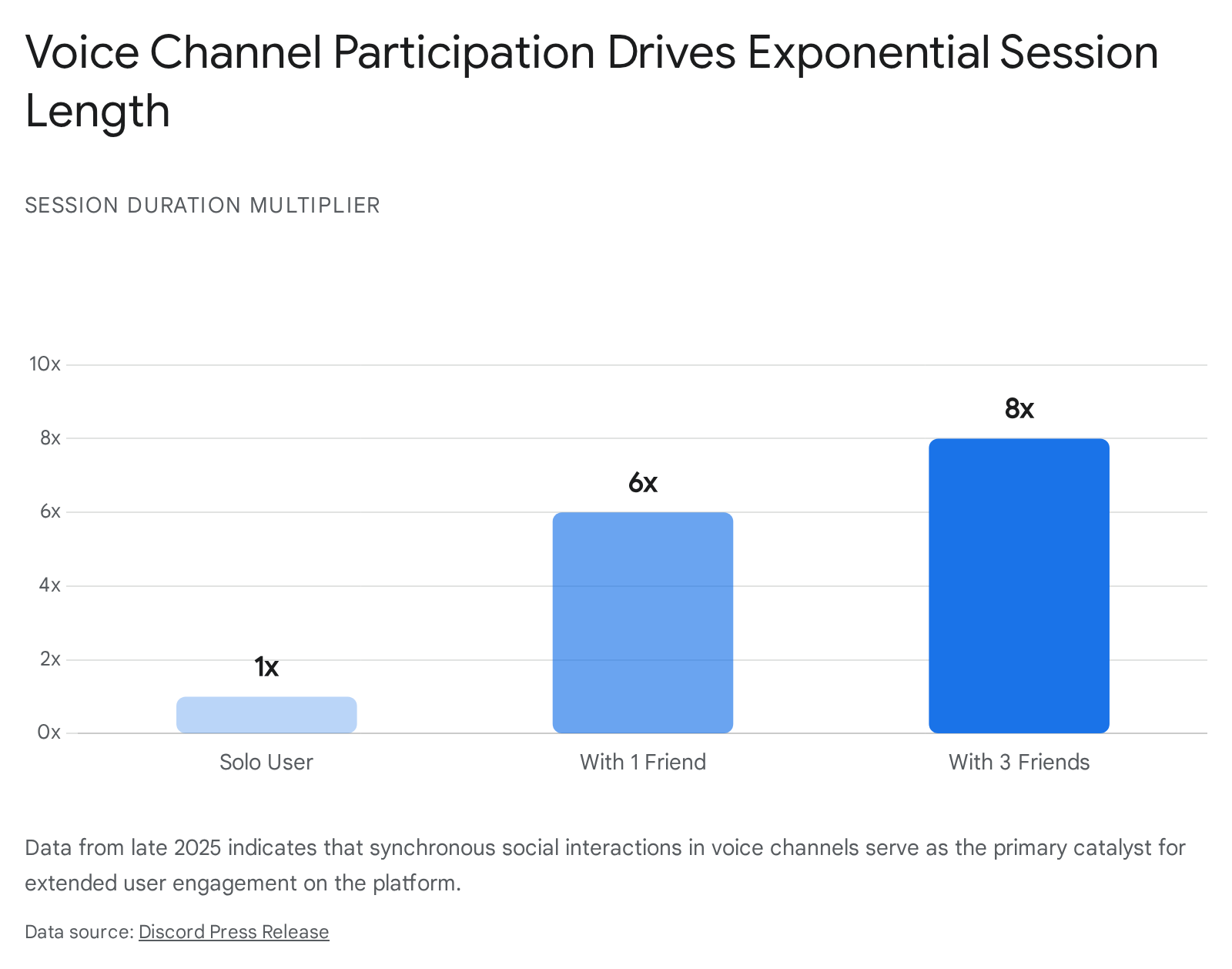
Furthermore, post-gameplay or post-event social behavior persists strongly within these audio channels; 66% of users remain in channels to watch videos together via screen share, 59% listen to music collectively, and 49% participate in group movie viewings 2. These statistics indicate that Discord functions as a comprehensive, persistent social infrastructure.
Content Moderation and Platform Security
Automated Moderation Tools and Limitations
As communities scale from hundreds to tens of thousands of members, manual moderation becomes mathematically impossible and financially unsustainable. Servers with public discoverability are subjected to sophisticated spam, malicious phishing links (IP grabbers), and coordinated raid attempts - where large numbers of automated bot accounts join simultaneously to disrupt the environment 181920. Consequently, automated moderation is categorized as an operational necessity rather than a luxury.
Operators utilize a layered security architecture. The foundation relies on Discord's native AutoMod, an integrated tool that scans messages for commonly flagged words, blocks severe profanity, and prevents mention spam 181921. Beyond these native capabilities, third-party moderation bots - such as Dyno or MEE6 - execute complex programmatic rulesets. They monitor for invite link spam, assign progressive warnings, and automatically execute mutes or bans based on strict infraction thresholds 192022. At the enterprise level, massive communities exceeding 100,000 members frequently deploy premium, self-hosted, or custom bot architectures (such as Beemo, Fish, or Crosslink) to defend against highly aggressive platform manipulation and targeted raids 18.
Artificial Intelligence Versus Human Support Dynamics
The deployment of Large Language Models (LLMs) for complex community support and moderation presents a highly nuanced trade-off. A comprehensive 2025 study analyzing the VRChat Discord community provided empirical data on how users interact with AI chatbots versus human community managers 23.
The study revealed distinct interaction and network patterns. AI-driven support excels at 24/7 availability and the rapid, highly structured resolution of routine technical issues 23. However, the communication network around an AI agent remains strictly centralized and transactional; users pose simple, localized questions and do not engage with other community members in the channel 23. Current AI models also struggle to process complex multimodal inputs (such as users uploading diagnostic screenshots) and lack genuine emotional sensitivity, leading to user frustration when nuanced context is misinterpreted 23.
Conversely, human-powered moderation networks foster deep collaboration. Interactions managed by human experts feature long, descriptive query formulation and extensive media sharing. Most importantly, human support provides "non-technical solidarity" - instances where users simply reply with validating statements to acknowledge a peer's frustration. This empathetic exchange generates a sense of community belonging that algorithmic agents cannot replicate 23. The VRChat study noted that community-led support threads can generate upwards of 1,700 collaborative replies, whereas AI-support threads rarely exceed 200 interactions before stagnation 23.
Financially and operationally, the disparity is stark. Research into multimodal LLMs utilized for brand safety and content moderation indicates that human reviewers are vastly superior at identifying nuanced, context-heavy policy violations 24. However, this accuracy carries an extreme premium: human moderation costs approximately 40 times more than the most cost-efficient machine learning labor 24. Furthermore, studies indicate that LLMs can actually be highly persuasive in community debates; when provided with basic demographic data about an opponent, AI models were able to adapt arguments and out-persuade humans 64% of the time .
Because of these dynamics, the prevailing industry standard relies on a hybrid architecture.
| Moderation Approach | Core Strengths | Primary Weaknesses | Optimal Use Case |
|---|---|---|---|
| Native AutoMod & Basic Bots | Free, instantaneous, 24/7 continuous uptime, capable of handling infinite volume without fatigue. | Relies on rigid rulesets, lacks contextual understanding, easily bypassed by creative spelling or spacing. | Blocking explicit slurs, stopping mass-mentions, preventing new-account raids, filtering known malicious URLs. |
| AI Support Agents (LLMs) | Highly scalable, cost-efficient (up to 40x cheaper than human labor), provides structured and immediate responses. | Cannot replicate emotional solidarity, struggles with complex multimodal context, fosters isolated transactional behavior. | Routine technical troubleshooting, FAQ deployment, automated onboarding guidance, and initial triage of support tickets. |
| Human Moderators | High emotional intelligence, nuanced context evaluation, builds trust, capable of interpreting non-verbal cues and media. | Prohibitively expensive at scale, prone to fatigue and burnout, limited concurrent processing capacity. | Subjective conflict resolution, nuanced policy enforcement, community culture building, and managing complex edge cases. |
Monetization Ecosystem and Revenue Models
Discord's evolution into a trillion-dollar creator economy ecosystem relies heavily on its ability to help operators generate sustainable revenue without relying on volatile advertising algorithms 2825. The platform's direct-to-audience monetization tools enabled it to process over $200 million in creator payments by 2025, complementing broader industry shifts where platforms like Patreon and Substack process hundreds of millions in subscription revenue 1025. In 2026, successful Discord communities routinely generate between $500 and $50,000 per month by deploying sophisticated access models 52826.
Because Discord communities consist of high-intent users who have already opted into a persistent digital space, conversion rates for paid products significantly outpace those of traditional cold-traffic landing pages.
Native and Third-Party Subscription Models
To maximize yield, the highest-earning servers implement a "value ladder" tier structure. Offering three distinct tiers (for example, a $10 Basic tier, a $30 Core tier, and a $100 Premium tier) typically generates 40% to 60% more total revenue than offering a single unified subscription price, as it successfully captures both casual supporters and high-ticket purchasers seeking direct access to creators 28.
Platform fees are a critical consideration for operators. Discord's native subscription tools impose a revenue share that takes between 10% and 30% of earnings 52627. In response, many community managers utilize third-party platforms for payment processing and role assignment. Specialized crypto-native or creator-focused gateways like XOE charge a 0% platform fee on premium tiers, while competitors like Whop require a 3% to 5% transaction fee, and LaunchPass charges 3.5% 2826.
| Revenue Model | Financial Mechanism | Average Conversion & Retention Benchmarks | Optimal Community Alignment |
|---|---|---|---|
| Recurring Subscriptions | Monthly or annual fees processed via Discord Native, Whop, or LaunchPass for ongoing access to premium channels. | Converts 3% to 8% of free members. Average retention is 3 to 6 months (requires managing a 5-10% monthly churn). Average LTV is $60 - $300. | Communities requiring ongoing updates: Trading signals, regular coaching, weekly content drops, and SaaS support. |
| One-Time Paid Roles | A single upfront payment granting permanent, lifetime access to exclusive server channels or role badges. | Converts 5% to 15% of engaged free members. Yields 100% retention (zero churn) as access is never revoked. | Evergreen content delivery: Resource libraries, digital courses, one-off software tools, and alumni networks. |
| Server Shops (Transactions) | Selling one-off digital items directly within the server interface without requiring recurring commitment. | Transaction sizes vary widely, typically ranging from $10 to $500 per item purchased. Conversion relies heavily on product relevance. | Digital merchandise: Specialized role badges, eBooks, early access passes, and individual masterclasses. |
| Sponsorship and Advertising | Monetizing audience attention through brand partnerships, native announcements, and sponsored quests. | Yields a CPM equivalent of $5 to $50 per 1,000 active members. Mid-size servers negotiate $500 to $5,000 monthly deals. | Free-to-access communities with massive scale: General gaming hubs, public art collectives, and open-source developer spaces. |
Web3 Integration and Token-Gated Architectures
For decentralized autonomous organizations (DAOs) and Web3 projects, Discord serves as the unquestioned operational headquarters 28. Token-gating represents a fundamental shift in the paradigm of community membership, transitioning users from rented subscriptions to owned digital assets. Rather than paying a recurring fiat fee, members connect their cryptocurrency wallets using specialized middleware bots (such as Collab.Land or Guild.xyz), and the server grants privileged access roles based on the cryptographic verification of specific ERC-20 tokens or NFTs held on the blockchain 333435.
The psychological impact of token gating is profound. Blockchain behavioral research indicates that users who hold a financial asset linked to a specific community demonstrate significantly higher emotional and financial investment 3334. These verified holders participate more actively in governance polls, Q&A threads, and product feedback 3334. Furthermore, the strict technical barrier to entry naturally eliminates low-effort spam, yielding an exceptionally high signal-to-noise ratio within gated channels 34.
Conversion Funnels and Drop-Off Risks
Despite the benefits of exclusivity, the user experience (UX) of Web3 onboarding is notoriously fragile. The conversion funnel requires multiple high-friction steps: joining the server, engaging with a verification bot, clicking an external link to connect a cryptocurrency wallet, signing a cryptographic message to prove ownership, and returning to Discord to receive the automated role 333436.
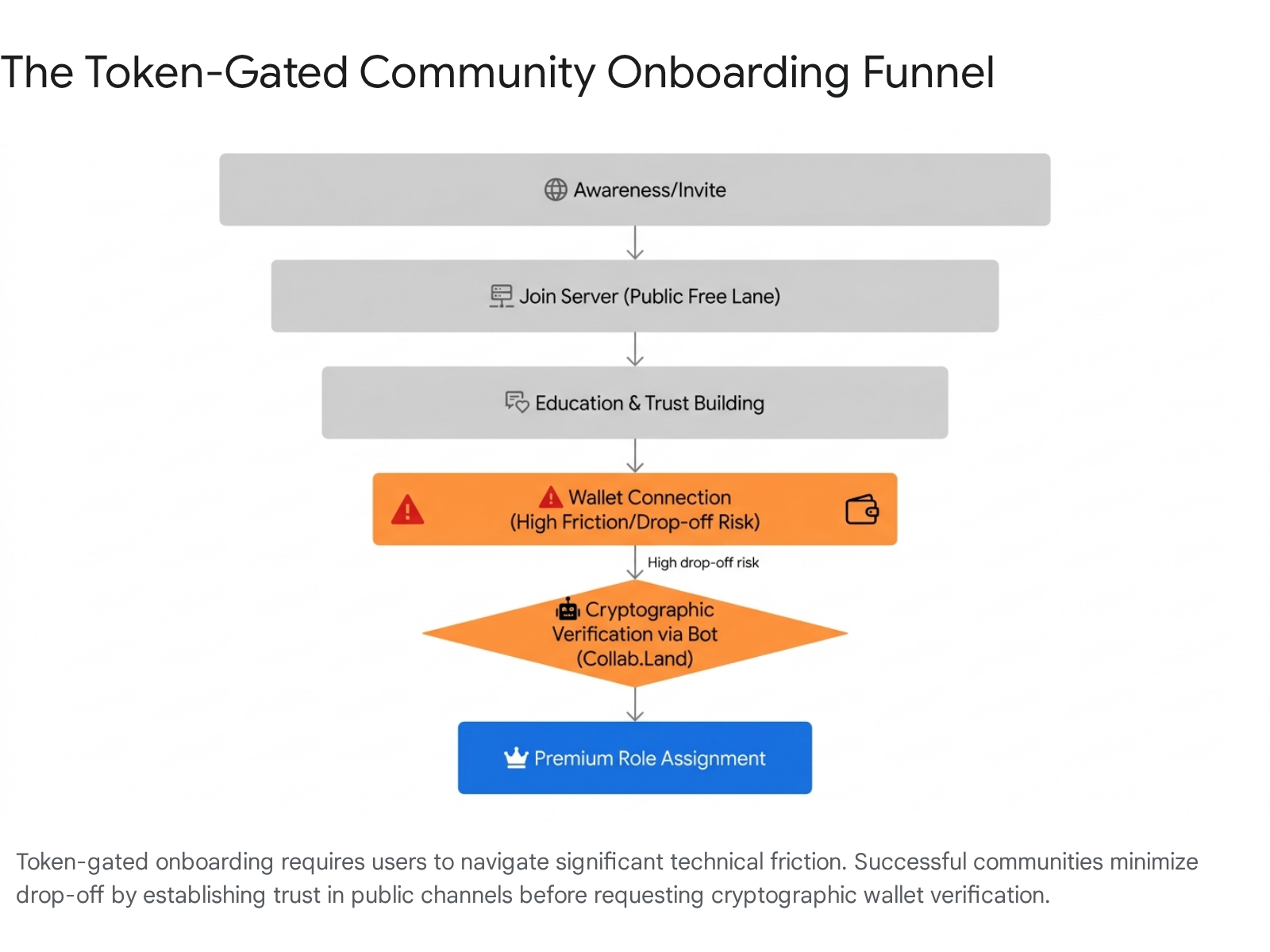
Security concerns regarding wallet connection, complex multi-step verifications, and fluctuating blockchain network fees directly cause severe funnel drop-offs 3336. To optimize this conversion flow, successful operators in 2026 are shifting toward sophisticated hybrid architectures. A server maintains a robust, easily accessible "free lane" for public discovery, brand building, and basic onboarding education. The complex, token-gated "premium lane" is reserved strictly for deep utility, alpha information, and governance voting 33. This structural bifurcation ensures that technical friction does not artificially stunt top-of-funnel audience acquisition.
Community Management Industry Trends
Professionalization and Resource Allocation
The operational reality for professionals tasked with managing these complex ecosystems is shifting. The 2025 CMX Community Industry Trends Report highlights a rapidly tightening resource environment. Full-time community roles have declined markedly, dropping from 69% of the surveyed workforce in 2021 to 59% in 2025 29. Concurrently, 17% of surveyed organizations reported that they possess no dedicated full-time community staff, the highest absence rate recorded in the report's history 2938.
To compensate for leaner internal structures, organizations are increasingly reliant on external freelancers, specialized consultants, and cross-departmental task sharing to manage Discord communities. The responsibility for community engagement is increasingly dispersed across Customer Success, Marketing, and Product teams. Notably, involvement from traditional Public Relations and Communications departments has surged, with communications staff involvement jumping from 41% to 49% between 2024 and 2025, suggesting that corporate entities increasingly view Discord servers as critical components of brand voice and crisis management rather than mere user engagement hubs 2938.
The Impact of Customer Relationship Management Integration
Despite operating with leaner staffing and constrained budgets, the corporate expectation to prove Return on Investment (ROI) has intensified. Community leaders are under immense pressure to quantify their direct impact on overarching business objectives. Data indicates significant maturation in this area: a record 24% of community teams report they can now confidently quantify the exact financial value of their communities 2938. Of the cohort capable of financial quantification, nearly half report that their community initiatives generated over $1 million in tangible business value over a 12-month period 2938.
A critical differentiator between highly successful and struggling community operations is the integration of community platform data into enterprise systems. Teams that successfully connect their Discord behavioral data to their corporate Customer Relationship Management (CRM) software are twice as likely to rate their overall impact as "extremely successful" (24%) compared to teams operating with siloed, unconnected data systems (11.5%) 38. Conversely, only 3.5% of integrated teams described their business success as minimal, compared to over 9% in the unconnected group 38. This integration enables organizations to map a user's Discord engagement - such as event attendance or support queries - directly to their external purchasing behavior, software adoption rates, and long-term customer lifetime value, transforming community management from a qualitative art into a rigorously quantifiable revenue engine.