
Decline of Traditional Rituals and Its Societal Impact
Human civilization has historically relied upon shared rituals to navigate transitional life phases, foster social cohesion, and mitigate the psychological distress associated with uncertainty and mortality. From an anthropological and sociological perspective, ceremonies such as weddings, funerals, and civic gatherings have long provided a structural scaffolding that defines individual identity within a broader communal context. Classical sociological theory, particularly the frameworks established by Émile Durkheim, posits that rituals are essential mechanisms that reinforce community ideas and generate collective effervescence, thereby sustaining social order and solidarity during periods of disruption 12. Similarly, microsociological perspectives formulated by Erving Goffman emphasize that "interaction rituals" form the bedrock of socioemotional connections, allowing individuals to share an "image of self" through highly structured, syntactical relations 34.
However, contemporary sociological, economic, and demographic data indicates a systemic, global contraction in the frequency, scale, and traditional execution of these practices. Driven by economic pressures, shifting demographic realities, rapid secularization, and technological integration, the decline of institutionalized rituals presents profound implications for human psychology and social capital. The erosion of these frameworks leaves individuals to navigate major life transitions - such as grief, familial commitment, and community integration - without established cognitive scripts or the robust communal support networks that defined pre-modern and early-modern societies.
This exhaustive analysis examines the empirical evidence surrounding the decline of traditional rituals, the socioeconomic and regional factors driving these structural shifts, the emergence of secular and digital alternatives, the underlying cognitive science of ritual efficacy, and the psychological and existential consequences of a society increasingly devoid of standardized ceremonial practices.
The Macro-Decline of Civic and Communal Rituals
The deterioration of formal ceremonial events is intrinsically linked to a broader structural decline in civic engagement and social capital. Rituals do not exist in a vacuum; they are sustained by the daily, weekly, or seasonal habits of communal association that build interpersonal trust and reciprocal obligation.
Longitudinal Trends in Social Capital
Longitudinal data from the General Social Survey (GSS), an initiative conducted by the National Opinion Research Center (NORC) at the University of Chicago that has tracked American social attitudes and behaviors since 1972, demonstrates a sustained downward trajectory in community attachment, institutional trust, and civic participation 567. Over the past half-century, the social fabric has transitioned from being dominated by grassroots, localized group memberships to being defined by either atomization or participation in distant, national organizations that offer few opportunities for local leadership or deliberation 8.
The past several decades have witnessed a marked reduction in the share of individuals who serve as officers of local groups, attend public school board meetings, or participate actively in political parties 8. While religious organizations historically served as the primary nexus for communal rituals, overall religious affiliation has declined significantly. Although religious membership remains the most common form of associational life, it has dropped precipitously, particularly among younger demographics 9.
| Organization Type | Overall US Adult Membership Rate | Young Adult (18-34) Membership Rate | Senior Membership Rate |
|---|---|---|---|
| Religious Organizations | 33% | 28% | 43% |
| Hobby / Activity Groups | 17% | Data Unavailable | Data Unavailable |
| Parent / Youth Groups | 16% | Data Unavailable | Data Unavailable |
| Neighborhood Associations | 15% | Data Unavailable | Data Unavailable |
| Sports / Workout Leagues | 10% | Data Unavailable | Data Unavailable |
| Labor Unions | 7% | Data Unavailable | Data Unavailable |
Data compiled from the American Social Capital Survey representing modern civic engagement levels 9.
The consequences of this withdrawal are severe. Societal structures that historically provided a consistent rhythm of micro-rituals are fracturing. Among young adults (ages 18 to 34), exactly 50 percent report that they rarely or never spend time in person with others in their community, reflecting a critical lack of accessible, welcoming "third spaces" outside of the home and workplace 10. This absence of physical interaction correlates strongly with lower broader civic engagement. For instance, youth who did not vote in recent elections reported substantially lower rates of in-person community interaction (61 percent rarely or never interacted) compared to those who did vote 10.
Socioeconomic and Educational Stratification
The decline in civic ritual participation is not distributed evenly across populations; it is heavily stratified by socioeconomic status (SES) and educational attainment. Sociologists note that college-educated individuals generally reside in communities that maintain robust civic cultures, allowing them to participate in associational life, attend community events, and maintain extensive social networks 9. In stark contrast, individuals without a college degree have experienced a dramatic contraction in their relational lives. Nearly eight in ten Americans (79 percent) with a high school diploma or less report that they seldom or never volunteer in their community, and only 33 percent attend community social events, compared to 55 percent of college graduates 9.
This participation gap presents a documented psychological paradox, which researchers term the "mismatch paradigm." Recent research utilizing the Canadian World Values Survey indicates that while individuals of higher socioeconomic status are substantially more likely to belong to voluntary associations, the psychological returns of membership are vastly unequal 11. Working-class respondents experience significantly larger gains in happiness and life satisfaction from acquiring additional organizational memberships than their service-class counterparts 11. Furthermore, individuals with less formal education gain more psychological happiness from joining associations than highly educated individuals 11.
This data reveals a critical systemic failure: the demographic groups that stand to gain the most psychological benefit from the social capital generated by communal rituals are precisely those structurally excluded from them. The stratification of civic opportunities means that less-educated individuals are increasingly living in "civic deserts," lacking the commercial and public physical spaces required to facilitate organic community rituals and meaning-making 9.
Economic and Demographic Transformations in Nuptial Rites
The contraction of traditional rituals is driven extensively by escalating economic costs and shifting demographic priorities. As the financial burden of hosting large-scale events increases and the perceived necessity of institutional validation wanes, consumers are forced to modify, truncate, or entirely abandon traditional nuptial formats.
The Commodification and Contraction of the American Wedding
The traditional Western wedding - which frequently involves 100 to 350+ guests and requires substantial capital for venue rentals, elaborate catering, floral arrangements, and entertainment - is increasingly being supplemented or replaced by "micro-weddings" and luxury elopements 121314.
A traditional wedding shifts the focus heavily toward guest experience and formal, sequential programming (e.g., ceremony, cocktail hour, formal dinner, dancing) 1314. As the per-capita cost of hosting guests has surged, the financial viability of this model has deteriorated. In response, the wedding industry has seen a massive influx of micro-weddings. Typically capped at roughly 50 guests, a micro-wedding allows couples to retain the core elements of a traditional ceremony (decor, photography, abbreviated reception) while reallocating their budget to enhance the specific per-capita experience or to save capital entirely 1314. Couples opting for a micro-wedding generally spend roughly 40 percent less than those hosting traditional weddings; for example, catering bills for 124 guests averaging $8,680 can be reduced to approximately $3,500 for a micro-wedding of 50 guests 15.
Elopements have also undergone a conceptual rebranding. Historically carrying a stigma of secrecy, spontaneity, or familial disapproval, modern elopements are highly intentional, luxury experiences focusing entirely on the couple, often involving zero to ten guests 1214. This severe contraction in guest counts fundamentally alters the sociological function of the event. It curtails the role of the wedding as a broad community gathering and an integration of extended family networks, converting a public civic declaration into a highly private, insulated, and aesthetically driven event 1216.
| Nuptial Model | Typical Guest Count | Financial Profile | Core Structural Elements | Sociological Focus |
|---|---|---|---|---|
| Traditional Wedding | 100 - 350+ | Highest Overall Cost | High logistics, formal timeline, large dedicated venue, extensive catering | Broad community celebration, extended family integration, guest experience |
| Micro-Wedding | 15 - 50 | Moderate Cost (High per-capita) | Flexible timeline, smaller venues (restaurants, estates), retained key traditions | Curated intimacy, high-quality aesthetic investment, reduced planning stress |
| Modern Elopement | 0 - 10 | Lowest Overall Cost | Minimal logistics, high mobility (e.g., national parks), no formal reception | Absolute privacy, individual couple experience, isolation from community observation |
Nuptial Decline and Demographic Crises in East Asia
While economic rationalization alters the format of weddings in the West, parts of East Asia are experiencing a severe decline in the occurrence of the ritual itself. South Korea, Japan, and China have all registered protracted declines in marriage rates over the last decade, driven by the escalating costs of housing, the financial burden of child-rearing, and shifting societal attitudes toward traditional gender roles and institutional expectations 1617.
Although 2023 and 2024 data revealed slight statistical bumps in marriage rates in China and South Korea, demographic analysts attribute this to a temporary "base effect" of pent-up demand from weddings postponed during the COVID-19 pandemic, rather than a reversal of the macro-trend 161819. In South Korea, for instance, marriages rose 8.1 percent in 2025 to 240,000, but this followed a devastating 11-year consecutive decline 1819.
Furthermore, the structure of the marrying population is shifting. In South Korea, the average age of first marriage has risen sharply to 33.9 years for men and 31.6 years for women, up more than a full year from the previous decade 1819. China's historical census data mirrors this delay, with the average age at first marriage rising from 25.75 (men) and 24.00 (women) in 2010 to 29.38 and 27.95, respectively, by 2020 16. Additionally, South Korean demographics show an increasing trend of non-traditional age gaps, with "older woman - younger man" marriages exceeding 20 percent of the total for the first time 1819.
Because cultural norms in these nations tightly link marriage to childbearing (non-marital childbearing is historically statistically negligible in East Asia compared to the West), the delay or abandonment of the marriage ritual directly fuels the region's severe demographic crisis and plummeting birth rates 1617. The ritual's decline is not merely a cultural shift; it is a catalyst for population collapse.
The Restructuring of Funerary and Death Rituals
Perhaps no ritual is more universally necessary than the disposition of the dead and the accompanying mourning practices. Yet, funerary rites are undergoing a rapid, structural transformation globally. The shift moves away from highly structured, formal, and religiously mandated mourning rituals toward highly personalized, cost-conscious, and secular events.
The Financial Impetus for Cremation in North America
In the United States and Canada, the traditional burial service - characterized by chemical embalming, a formal public viewing, a religious ceremony, a casket, and interment in a cemetery plot - has become financially prohibitive for a significant segment of the population. The national median cost of a traditional funeral with a viewing and burial reached $8,300 in 2023, and routinely exceeds $10,000 to $15,000 when accounting for cemetery fees, headstones, and localized real estate costs 202122.
Consequently, cremation has rapidly overtaken traditional burial as the primary method of disposition. Since the 1960s, cremation rates have steadily climbed, and the National Funeral Directors Association (NFDA) projects continued, aggressive expansion of this trend 212326.
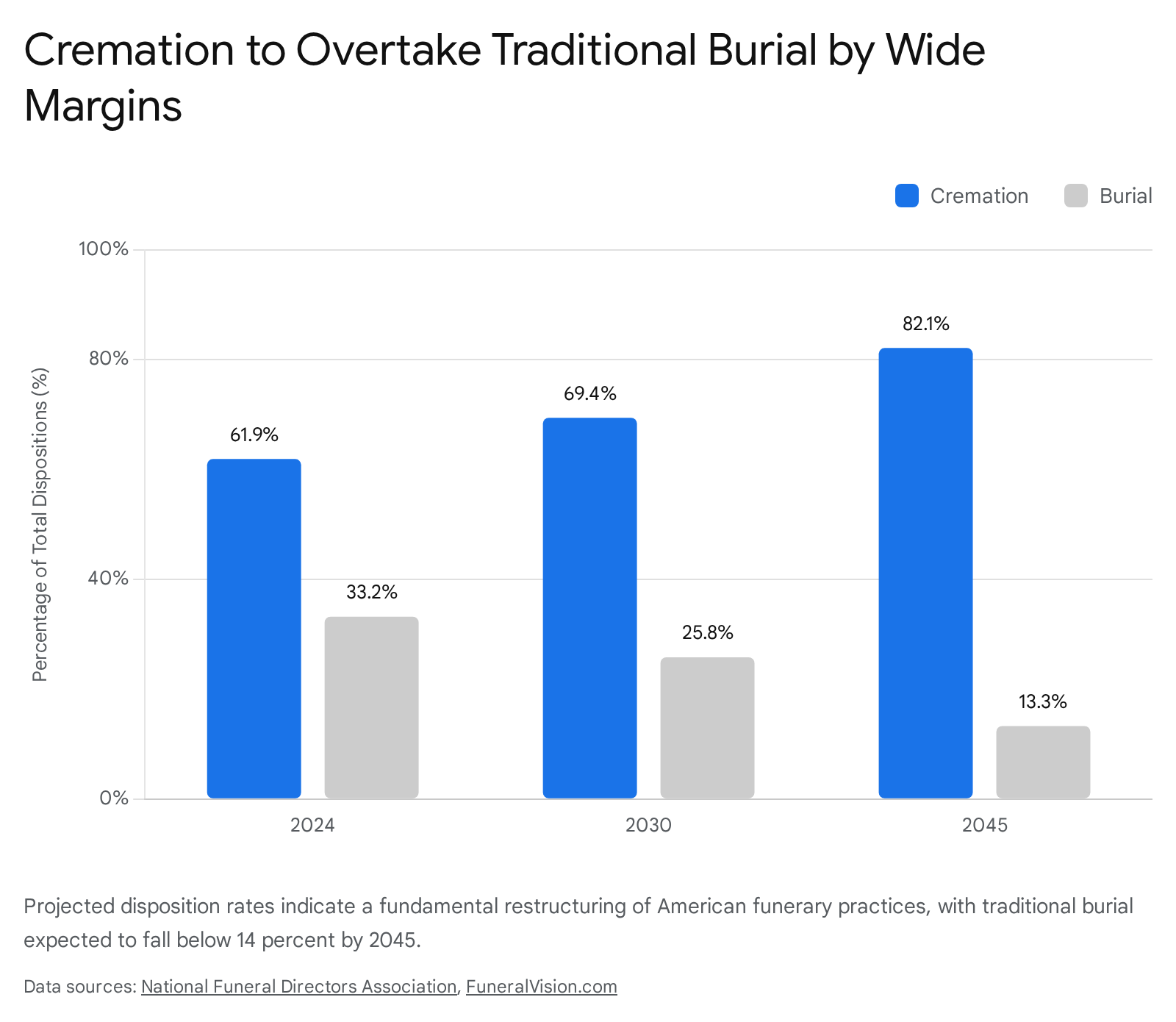
Direct cremation, which completely bypasses embalming, viewing, and formal ceremonies, averages approximately $1,500 to $2,200, offering families savings of over 70 percent compared to a full-service burial 2124.
The shift in disposition method is accompanied by a fundamental shift in the psychological tone and structure of the gathering. Families are increasingly favoring secular "celebrations of life" over traditional mourning services 2529. These modern rituals often take place in non-traditional venues - such as parks, private homes, or community centers - and focus on personalization, storytelling, and uplifting multimedia presentations rather than formal religious rites or focused mourning 222529. While these events provide valuable scheduling flexibility and reduce financial strain, they alter the psychological architecture of the funeral, moving away from a collective, structured processing of immediate grief toward a highly individualized celebration of legacy.
Global Projections of Religious Affiliation at Death
The decline in traditional burial is also a symptom of global secularization. A landmark demographic study from Columbia University's Mailman School of Public Health projected the religious affiliation of individuals at the time of death globally between 2010 and 2060 26.
The projections indicate that while Christianity will remain the most common stated religion globally, its share of total deaths will decline from 37 percent in 2010 to 31 percent by 2060 26. In North America specifically, the share of individuals identifying as Christian at the time of death is projected to fall from 85 percent to 74 percent, while those with no religious affiliation will double from 10 percent to 20 percent of all deaths 26. Because religious affiliation dictates acceptable end-of-life practices (such as the prohibition of cremation in certain orthodox traditions), this demographic shift paves the way for the continued abandonment of historical burial rites in favor of secular alternatives 26.
Preservation of Ritual Complexity in the Global South
While economic rationalization and secularization dominate Western trends, the preservation and adaptation of death rituals vary significantly across different cultural landscapes, particularly in the Global South, where the cosmological stakes of the ritual remain high.
In Brazil, funerary customs embody a complex tapestry of Catholic, Indigenous, and Afro-Brazilian traditions 27. The rituals dictate a highly compressed but emotionally intense mourning period. Funerals typically occur within 24 to 48 hours of death - a timeline historically necessitated by the tropical climate but strictly maintained as a cultural norm 272833. Unlike the emerging Western preference for upbeat "celebrations of life," Brazilian rituals lean into the acute pain of loss. Wailing, physical contact with the deceased, and outward expressions of devastation are socially expected and culturally supported 2833. The ritual is explicitly structured to process saudade - a profound, melancholic longing 27. Furthermore, 72 percent of the deceased are still buried rather than cremated, and long-term memorialization is sustained through subsequent communal rituals, such as the Missa de Sétimo Dia (Seventh Day Mass) and Dia de Finados (All Souls' Day) 2728.
Conversely, in Nigeria, many ethnic groups (such as the Igbo, Yoruba, and Tiv) view death not as an end, but as a critical transition to the ancestral realm 29. Consequently, burial ceremonies are elaborate, multi-staged, and highly resource-intensive. The Igbo people, for example, perform specific rituals meant to sever ties with the physical world and integrate the deceased into the spirit world; failure to execute these rites properly is believed to result in malevolent spiritual consequences 29. These ceremonies require extensive community participation, the slaughtering of livestock, and complex symbolic acts. They serve not only to honor the dead but to aggressively reinforce communal hierarchies and familial bonds 29. Despite the financial burden, these rituals resist the streamlining seen in the West because their perceived metaphysical efficacy is viewed as socially and spiritually non-negotiable.
| Region / Culture | Primary Disposition | Timing of Ritual | Psychological & Cultural Focus | Key Ceremonial Features |
|---|---|---|---|---|
| North America | Cremation (>60%) | Flexible (Days to Months) | Celebration of individual life, cost reduction, convenience | Personalized multimedia, non-traditional venues, secular tones |
| Brazil | Burial (~72%) | Rapid (24-48 hours) | Intense emotional expression, processing of saudade, Catholic/Syncretic duty | Wailing, physical proximity to the body, Seventh Day Masses |
| Nigeria (Igbo/Yoruba) | Burial (Near 100%) | Extended/Multi-phase | Ancestral integration, social status, severing earthly ties | Livestock sacrifices, strict procedural adherence, high community cost |
The Emergence of Secular and Digital Ritual Ecosystems
As traditional, institutionally backed rituals decline, populations do not simply cease ritualistic behavior; rather, they migrate toward digital and secular alternatives to fulfill the inherent human need for ceremony, transition, and meaning-making.
Post-Secular Funerals and Hybrid Mourning
The binary distinction between "religious" and "secular" ceremonies is increasingly inadequate to describe modern rituals. Research conducted in the UK indicates the rise of "post-secular" funerals, heavily mediated by independent celebrants 30. A vast segment of the population desires ceremonies that are neither entirely religious nor entirely secular, but a customized blend of both 30. Independent celebrants craft meaning using both secular poetry and traditional religious resources, catering to a population that has rejected institutional dogma but still craves the gravity and structure of spiritual ritual 30.
Digital Memorialization and the Technological Divide
The COVID-19 pandemic acted as a massive catalyst for the digitization of grief, accelerating a "digital turn" in mourning 1. With physical funerals banned or heavily restricted, the bereaved turned to social media to construct digital rituals. Initiatives like the Twitter account FacesOfCOVID provided compact, curated digital portraits of the deceased, allowing strangers to participate in collective mourning through likes, retweets, and comments 31. These digital artifacts purposely eschewed politicized language, focusing entirely on a minimalist snippet of biographical data and a photograph, serving to validate individual losses that were otherwise subsumed by aggregate statistics 31.
This shift toward "thanatechnology" extends beyond social media feeds. Virtual reality platforms (such as VRChat) are now hosting immersive memorial ceremonies. Unlike static webpages, these platforms allow participants to interact through personalized 3D avatars, fostering emotional engagement and communal support across vast physical distances 32. Online spaces effectively reconstruct the functions of a physical cemetery, providing locations for continuous, asynchronous remembrance 3233.
However, the transition to digital mourning is complicated by the digital divide. Anthropological research conducted in Varanasi, India, demonstrates the emergence of "hybrid mourning," where ancient Hindu offline traditions intermingle with online memorials 1. Yet, this adaptation is heavily stratified by class and resource access.
| Income Group in Varanasi | Participation Rate in Digital Mourning |
|---|---|
| High-Income | 85% |
| Middle-Income | 50% |
| Low-Income | 20% |
Data Source: Study on socioeconomic disparity in Varanasi death rituals, illustrating the technological barriers to modern ritual access 1.
This participation gap highlights a critical vulnerability: as rituals move into digital spaces, populations lacking technological access or literacy are disenfranchised from contemporary mechanisms of social support and collective memory 1.
Wellness Culture as a Secular Religion
With the decline of organized religion - particularly in Western democracies - the modern wellness industry has stepped in to fill the ritualistic void, emerging as a $3.7 trillion global economy 2. The wellness movement has adopted many of the codes, aesthetics, and structural cues of traditional faiths, offering consumers a sense of belonging and promises of spiritual transcendence 2.
Sociological analysis utilizing Durkheimian frameworks suggests that wellness practices serve to organize modern social life into the "sacred" and the "profane" 2. Strict dietary regimens (such as fasting or juice cleanses) function as forms of ascetic self-mortification, replacing historical religious fasting 2. Group exercise classes (such as yoga retreats or highly structured bootcamp classes) act as synchronized interaction rituals that generate collective effervescence, mirroring the communal experience of a religious congregation 23. In this secular paradigm, the pursuit of health transcends physical maintenance and enters the realm of moral discourse; engaging in wellness behaviors becomes a marker of personal virtue, discipline, and moral purity .
The Cognitive Science of Ritual Efficacy
To fully comprehend what humanity loses when formal rituals decline, it is necessary to analyze the precise cognitive and psychological mechanisms that make rituals effective. Rituals are not merely symbolic window dressing or cultural artifacts; they are highly evolved behavioral technologies designed to regulate the human nervous system, alleviate anxiety, and enforce social cohesion.
Causal Opacity and Supernatural Reasoning
A defining feature of a ritual, as opposed to a routine or a habit, is "causal opacity." Unlike instrumental actions (e.g., turning a key to start a car, which has a transparent mechanical cause and effect), rituals lack a logical, physical-causal connection between the action performed and the desired outcome 343536. There is no direct physical mechanism by which wearing a specific colored garment ensures a prosperous marriage, or burying a body facing a certain direction guarantees safe passage to the afterlife.
Counterintuitively, it is exactly this lack of logical causality that gives rituals their psychological power. Experimental cognitive research conducted in Brazil analyzed simpatias - formulaic, culturally prevalent rituals used to treat everything from asthma to infidelity 3537. Psychologists manipulated the descriptions of these rituals, altering characteristics such as the number of steps, the frequency of repetition, and the presence of religious icons. The respondents were then asked to rate the perceived effectiveness of each ritual 3537.
The results demonstrated that individuals intuitively associate a high degree of time, effort, and repetition with higher efficacy. Because the action has no obvious physical mechanism, the human brain assumes the procedural complexity itself holds the power 353738. This finding was subsequently replicated in U.S. populations, demonstrating that the intuitive cognitive bias toward complex, redundant rituals is a universal feature of human psychology, irrespective of cultural background or religious belief 3537.
Working Memory Swamping and Anxiety Reduction
During periods of high stress, ambiguity, or grief (such as the death of a family member or a major life transition), the human brain aggressively seeks control. If actual control over the environment is impossible, the brain relies on ritual to create a "bottom-up" perception of order 39. Because rituals are rigidly structured and predictable, executing them signals to the brain that the environment is ordered, thereby reducing the neurological markers of anxiety 39.
Experimental psychology has consistently demonstrated that executing a ritual reduces physiological markers of anxiety, such as heart rate, and improves subsequent performance 3640. In a prominent study by researchers at Harvard Business School, participants were asked to sing a popular song in front of strangers - a task known to induce high levels of performance anxiety. Half the group was instructed to perform a novel, causally opaque ritual (sprinkling salt on drawings in a highly specific sequence) before singing, while the control group sat quietly 3641. The group that performed the salt ritual reported significantly lower anxiety and performed better objectively 3641. The effect holds true even when participants are explicitly told that the actions are merely "random behaviors"; however, when the exact same actions are labeled a "ritual," the anxiety-reducing effects and feelings of self-discipline are magnified 363942.
Cognitive scientists propose that rituals achieve this anxiolytic effect through a process called "working memory swamping" 43. Because rituals require the execution of precise, sequential, and highly scripted physical actions, they demand high cognitive control. This mental load effectively monopolizes the brain's working memory capacity, leaving no cognitive bandwidth available for intrusive, anxiety-producing thoughts or existential dread 43.
The Dual-Pathway Mechanism of Perceived Control
Further research into traditional practices, such as the Guozhuang worship rituals of the Pumi people in China, reveals that rituals operate on a dual-pathway mechanism to restore a sense of control to the practitioner 44.
The physical actions of the ritual directly enhance perceived control through the bottom-up ordering of behavior (as seen in the working memory swamping model). Simultaneously, the symbolic meaning of the ritual enhances perceived control indirectly, fully mediated by the generation of positive emotions (such as gratitude or a sense of blessing) 44. Therefore, when a ritual is stripped of its physical complexity (e.g., transitioning from a multi-day burial rite to a rapid direct cremation), it loses the first pathway of efficacy. When it is stripped of its symbolic or religious meaning, it loses the second pathway, severely blunting the psychological benefits of the practice.
Psychological and Existential Consequences of Ritual Loss
The systematic dismantling of traditional rituals - whether due to prohibitive costs, rapid secularization, or geographic isolation - removes critical psychological buffers that have historically protected human populations. The loss of these structured, communal frameworks is directly implicated in the contemporary crisis of mental health, characterized by rising rates of loneliness, depression, and profound existential anxiety 5253.
The Proliferation of Existential Anxiety
Existential dread, or existential anxiety, is a profound psychological state triggered by confronting life's fundamental and unavoidable uncertainties: mortality, isolation, freedom, and the search for ultimate meaning 5445. Historically, religious institutions and their accompanying communal rituals provided a pre-packaged cosmological framework to answer these questions. Funerals provided an established script for understanding death and processing grief; weddings provided a template for lifelong companionship and societal duty.
As traditional belief systems and their accompanying rituals fade from the public sphere, individuals are forced to construct their own frameworks for meaning entirely from scratch 4546. For many, this individualization of meaning-making leads to psychological paralysis. Existential anxiety often manifests not as acute panic, but as a chronic, low-level dread - a persistent feeling that life is hollow, that daily routines are meaningless, or that personal achievements are ultimately pointless in an indifferent universe 5445. This dread is particularly prevalent during major life transitions (such as a career change, divorce, or the death of a peer), which were historically managed and validated through communal rites of passage, but are now frequently endured in isolation 544546.
The Erosion of Social Mattering and Bridging Capital
One of the most robust findings in positive psychology is that human mental well-being relies heavily on a "sense of mattering" - the deep conviction that one's existence is significant to others and that one's absence would be actively noticed and felt 53. Rituals are the primary sociological mechanism through which communities confer this sense of mattering upon the individual.
When individuals gather for a funeral, a weekly religious service, or a civic meeting, they reinforce weak social ties, synchronize their emotional states, and validate each other's existence 3453. The structural decline of these participatory events means that social capital is eroding at an unprecedented rate. Robert Putnam's foundational sociological research warned of the loss of "bridging capital" - the connections between people of differing backgrounds and viewpoints that occur organically in shared civic spaces 853.
Without the grounding practices that shared rituals provide, society fractures into atomized individuals. People increasingly retreat into digital algorithmic echo chambers, where they are sorted away from those who are different 53. This isolation results in increased affective polarization, creating a worldview where strangers are increasingly perceived as societal threats rather than fellow community members 53. A society where the stranger is an enemy is an inherently anxious society; the loss of interaction rituals removes the socioemotional bedrock of daily life, leaving individuals without a shared script to process grief, celebrate milestones, or forge enduring social solidarity 353.
Conclusion
The decline of weddings, funerals, and civic rituals is not merely a superficial shift in event-planning logistics or consumer preferences; it represents a fundamental restructuring of human social and cognitive behavior. As economic constraints make traditional, large-scale ceremonies inaccessible, and as secularization dilutes the authority of ancient cosmological scripts, society is rapidly pivoting toward highly individualized, private, and digital alternatives.
While these modern adaptations - such as micro-weddings, direct cremations, digital memorialization, and wellness regimens - offer practical benefits in terms of cost reduction, personalization, and convenience, they frequently fail to replicate the deep psychological and communal benefits of traditional rituals. The human brain is evolutionarily primed to respond to complex, shared, causally opaque actions. These ritualistic behaviors swamp working memory to alleviate anxiety, bind communities together through synchronized movement, and provide a vital psychological defense against existential dread. Without a concerted societal effort to invent, fund, and sustain new, inclusive rituals that fulfill these inherent cognitive and social needs, the continued erosion of ceremonial life risks exacerbating the current epidemics of isolation, anxiety, and social fragmentation.