
Debate on smartphone impact on adolescent mental health
Over the past decade, a pronounced demographic inflection point has been observed in global adolescent well-being. Epidemiological data indicates that one in seven individuals aged 10 to 19 now experiences a mental health disorder, with depression, anxiety, and behavioral disorders acting as leading causes of illness and disability within this cohort 1. The proliferation of digital technologies, specifically smartphones and social media platforms, occurred almost concurrently with these rising rates of psychological distress. Up to 95% of youth in the United States report using a social media platform, with over a third describing their usage as "almost constant" 2.
This temporal alignment has catalyzed intense scientific and public debate regarding causality. On one side of the academic divide are researchers who posit that the ubiquitous adoption of smartphones fundamentally rewired childhood, directly causing a population-level epidemic of mental illness. On the other side are quantitative and developmental psychologists who argue that the evidence linking digital technology to psychological harm is predominantly correlational, characterized by small effect sizes, and severely confounded by reverse causation and preexisting vulnerabilities. This report systematically examines the evidence surrounding the impact of smartphones on adolescent mental health, utilizing the prominent academic debate between social psychologist Jonathan Haidt and developmental psychologist Candice Odgers to explore the nuances of methodological design, causal inference, and global health trends.
Global Trends in Adolescent Mental Health
The empirical foundation of the smartphone debate rests on establishing whether a genuine, unprecedented crisis in adolescent mental health exists, and identifying where geographically and demographically this crisis is concentrated. The consensus across multiple institutional datasets confirms a marked deterioration in youth psychological well-being, though the trajectory is not uniform across all demographics or regions.
Epidemiological Data on Psychological Distress
Within the United States, recent data illustrates a profound escalation in clinical diagnoses among youth. In 2023, more than 5.3 million adolescents aged 12 to 17 - representing 20.3% of that demographic cohort - had a current, diagnosed mental or behavioral health condition 3. Between 2016 and 2023 alone, the prevalence of diagnosed mental health conditions increased by 35% 3. Specifically, diagnosed anxiety surged by 61% (reaching 16.1%), and depression increased by 45% (reaching 8.4%), while behavioral and conduct problems remained relatively stable 3. This clinical burden disproportionately affects adolescent girls, who report diagnosed anxiety at a rate of 20.1% compared to 12.3% for boys, and depression at 10.9% versus 6.0% 3. Conversely, boys exhibit higher rates of diagnosed behavioral and conduct issues 3.
These localized national trends are echoed in broader cross-national analyses. An examination of the Health Behaviour in School-aged Children (HBSC) dataset, which covers 15-year-old adolescents across 41 countries from 1994 to 2022, revealed that psychological and somatic complaints have increased in over 82% of cases 4. The data indicates complex polynomial trajectories rather than simple linear growth. For instance, while boys generally demonstrated linear increases or no clear trend over time, girls predominantly exhibited cubic or U-shaped trends, indicating sharper, more dynamic fluctuations in mental health over the past three decades 4. Somatic complaints generally followed linear upward trajectories, whereas psychological distress metrics showed sharper accelerations in recent years, peaking globally around 2022 4.
The consequences of this deterioration are severe. The World Health Organization (WHO) reports that suicide is the third leading cause of death among individuals aged 15 to 29 1. The consequences of failing to address these adolescent mental health conditions extend deep into adulthood, permanently impairing long-term physical and mental health trajectories, and limiting overall life outcomes 1.
Regional Divergences and Non-Western Populations
A critical test of the hypothesis that smartphones are the primary biological and psychological trigger for adolescent mental illness is its global applicability. If digital technology acts as a uniform vector of harm, the introduction of this technology should theoretically yield consistent declines in mental health across diverse international borders. However, expansive global datasets reveal substantial heterogeneity, suggesting that sociocultural and economic contexts heavily mediate the impact of digital proliferation.
Data compiled by Sapien Labs for their Global Mind Health in 2025 report synthesizes over one million responses across 84 countries, utilizing the Mind Health Quotient (MHQ) to measure cognitive, emotional, and social capacities 567. The report identified a striking paradox: an inverse relationship exists between national economic wealth and youth mental health outcomes 8. Globally, 41% of internet-enabled young adults (ages 18 - 34) face a "mind health crisis," functioning significantly below their older generational counterparts 78. Yet geographically, young adults in Sub-Saharan African countries - specifically Ghana, Nigeria, Kenya, Tanzania, and Zimbabwe - consistently achieved the highest mental well-being scores globally 78.
In sharp contrast, youth in the highly developed Anglosphere nations (such as the United Kingdom, New Zealand, and Australia) ranked near the absolute bottom of the 84 surveyed nations 68. While the delayed adoption of smartphones in childhood within African nations correlates with these better outcomes, the data also highlights the robust protective effects of strong family structures and cultural spirituality, implying that the surrounding offline environment can buffer the potential harms of digitalization 8.
Cross-national suicide data further complicates the narrative of a monolithic, tech-driven global crisis. A comprehensive 2025 analysis spanning the United States, Canada, and South Korea demonstrated that youth suicide rates are moving in fundamentally divergent directions 9. While suicide rates for Canadian teenage girls continue to increase, the data shows that youth suicide rates for most demographics in the United States have recently begun to level off or even decline, indicating a potential stabilization perhaps resulting from widespread prevention programs 9. Conversely, the Western Pacific Region, particularly South Korea, has experienced sharp, ongoing escalations in suicide rates among both young men and young women 910.
Furthermore, an epidemiological survey assessing adolescent mental health in Kenya, Indonesia, and Vietnam found vastly different prevalence rates of mental disorders among 10- to 17-year-olds in each nation 11. The prevalence in Kenya (nearly 1 in 8 adolescents) mirrored rates in Western nations like Australia, whereas rates in Indonesia (1 in 18) and Vietnam (1 in 30) were substantially lower 11. These disparities emphasize that while digital technology is increasingly universal, local cultural frameworks, socioeconomic pressures, and geographic factors remain the primary determinants of psychological health in low- and middle-income countries (LMICs) 11.
| Metric / Finding | Anglosphere / Western Nations | Non-Western / LMIC Nations |
|---|---|---|
| Overall MHQ Ranking (Sapien Labs) | Bottom quartile globally (e.g., UK, New Zealand, Australia) 68. | Top quartile globally (e.g., Ghana, Nigeria, Kenya) 78. |
| Suicide Trajectories | Leveling off in the US; increasing for Canadian females 9. | Sharp escalations in the Western Pacific (e.g., South Korea) 910. |
| Diagnostic Prevalence | High (e.g., ~20% of US adolescents diagnosed with conditions) 3. | Highly variable (e.g., Kenya 1 in 8; Vietnam 1 in 30) 11. |
| Digital Saturation Context | Early adoption, near-universal constant connectivity 2. | Later childhood adoption; moderated by stronger offline community ties 8. |
The Causal Harm Framework
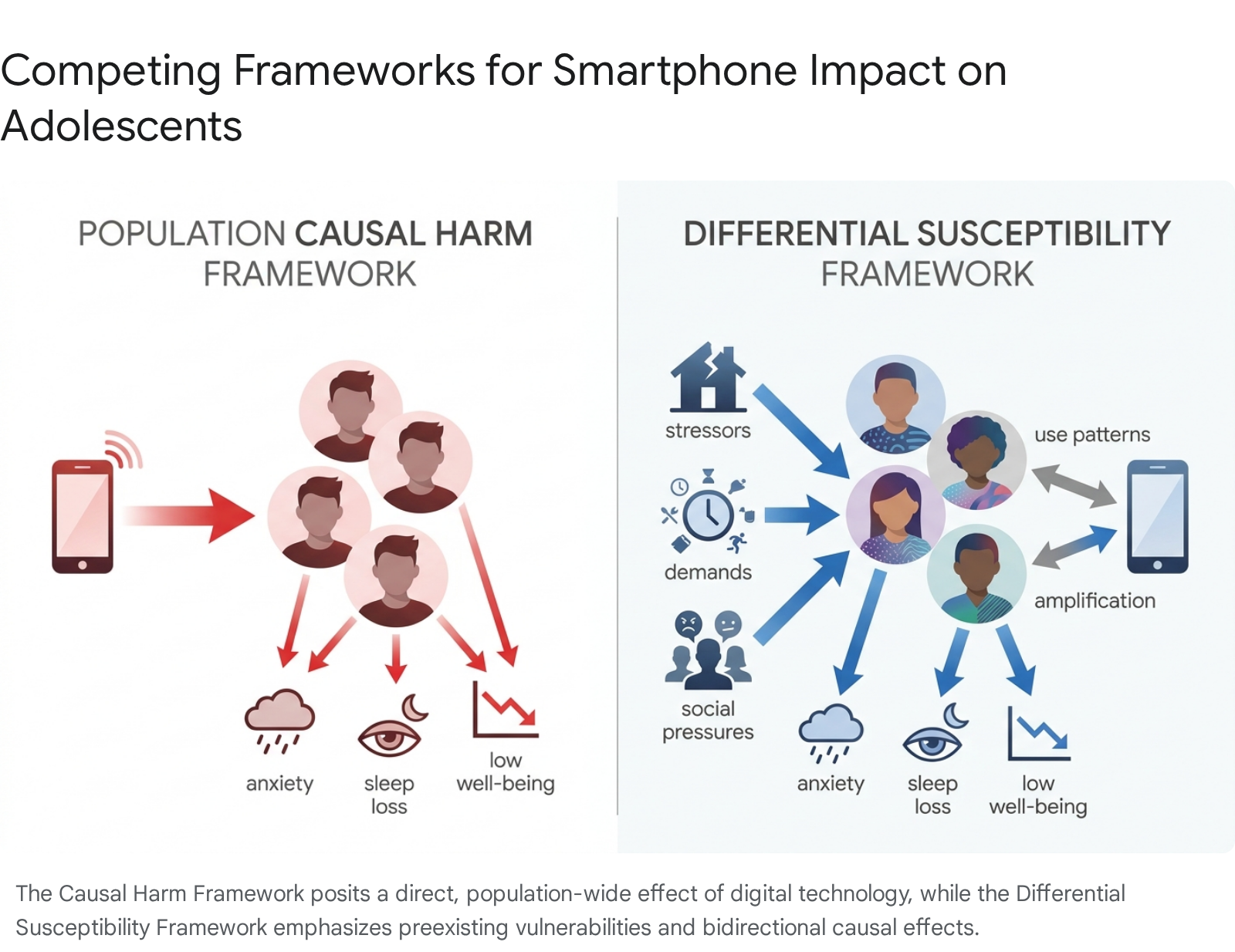
The most prominent articulation of the causal harm model is advanced by social psychologist Jonathan Haidt, along with collaborators such as Jean Twenge and Zach Rausch. Their framework posits that the precipitous decline in adolescent mental health is not merely correlated with the rise of digital technology, but directly caused by it.
The Phone-Based Childhood Hypothesis
In his 2024 publication, The Anxious Generation, Haidt hypothesizes that a fundamental "rewiring" of human development occurred between 2010 and 2015 121313. During this narrow temporal window, the traditional "play-based childhood" - characterized by unsupervised outdoor exploration, synchronous peer interaction, and manageable physical risk - was rapidly displaced by a "phone-based childhood" 1213. Haidt argues that this transition occurred just as the global financial crisis was receding, rendering economic explanations for the mental health collapse insufficient, particularly given the simultaneous deterioration of youth well-being across economically diverse Western nations like the US, Canada, the UK, and the Nordic countries 1214.
Proponents of this framework argue that modern smartphones and algorithmic social media platforms inflict damage through four foundational mechanisms 131516: 1. Social Deprivation: The displacement of in-person, synchronous social interactions with asynchronous, digitally mediated communication. This deprives adolescents of the complex physical cues required to develop empathy, conflict resolution, and robust real-world social skills, fostering deep isolation. 2. Sleep Deprivation: The chronic disruption of healthy sleep patterns. This is driven by the physiological impact of blue light emitted from screens inhibiting melatonin production, combined with the psychological compulsion to remain connected to peer networks late into the night 1817. 3. Attention Fragmentation: The degradation of sustained cognitive focus. The constant interruption of notifications, combined with the rapid context-switching necessitated by short-form video algorithms, severely impairs an adolescent's ability to engage in deep learning or sustained reflection. 4. Behavioral Addiction: The deliberate exploitation of neurological reward systems. Technology companies utilize variable reinforcement schedules, infinite scroll interfaces, and quantifiable social metrics (likes, followers, and read receipts) to trap adolescents in dopamine-driven feedback loops, mimicking the mechanics of slot machines 1818.
Divergent Pathways of Harm by Gender
The phone-based childhood hypothesis explicitly identifies diverging pathways of harm for male and female adolescents, acknowledging that the architecture of digital platforms interacts differently with male and female socialization processes.
For adolescent girls, the hypothesis suggests that social media platforms - particularly highly visual, image-centric networks like Instagram and TikTok - weaponize female peer dynamics. These platforms exacerbate relational aggression, foster intense visual social comparison, drive body dissatisfaction, and amplify perfectionism 131819. A widely cited 2019 study utilizing data from the UK Millennium Cohort Study provides foundational support for this claim, demonstrating that 14-year-old girls who spend five or more hours per day on social media are roughly twice as likely to meet the criteria for clinical depression compared to those using it for less than an hour per day 16. Furthermore, internal corporate research leaked from Meta in 2021 indicated that the company was aware that platforms like Instagram worsened body image issues for a significant percentage of teen girls, and that 13% of users aged 13 to 15 reported receiving unwanted sexual advances weekly 1318.
Conversely, for adolescent boys, the harm is hypothesized to stem primarily from a systematic retreat into the virtual world via immersive multiplayer video games and easily accessible pornography. This retreat is theorized to replace the physical, risky play and competitive real-world interactions historically necessary for developing resilience, independence, and social confidence, leading to isolation, failure to launch into adulthood, and different manifestations of psychological distress, including rising male suicide rates 122021.
Experimental Evidence and Mechanisms of Harm
To counter methodological critiques asserting that the smartphone-distress link is merely an observational correlation, proponents of the causal harm framework point to specific subsets of experimental and quasi-experimental data. Curated literature reviews managed by Haidt and Rausch aggregate dozens of studies, claiming that among available experimental research, a clear majority demonstrate significant evidence of causality 1422.
Within their published collaborative review documents, Haidt cites 22 experimental studies, arguing that 16 of them explicitly found significant evidence of harm caused by social media use, or conversely, demonstrated measurable psychological benefits when individuals ceased using the platforms 1422. For example, studies in which college-aged individuals were randomly assigned to restrict or entirely eliminate their social media use for several weeks often reported significant reductions in clinical depression, anxiety symptoms, and feelings of loneliness relative to control groups who maintained their standard digital habits 1823.
Furthermore, proponents argue that cross-sectional data, when properly segmented, reveals massive risk vectors. A 2022 meta-analysis frequently cited within the causal framework found that the odds of depression increased by approximately 13% for every additional hour per day an adolescent spent on social media 16. Given that the average US adolescent reportedly spends nearly five hours per day on these platforms, researchers extrapolate this to represent a severe, compounding cumulative risk that easily explains population-level shifts in mental health 1618.
Methodological Critiques and Effect Sizes
While the narrative of a phone-induced mental health epidemic is intuitive and aligns with widespread societal anxiety, a substantial contingent of leading researchers - most notably Candice Odgers, Amy Orben, and Andrew Przybylski - argue that the scientific foundation supporting these sweeping claims is statistically fragile and conceptually flawed. These skeptics maintain that the prevailing panic relies on the misinterpretation of correlational data, the overstatement of trivial effect sizes, and a failure to account for complex bidirectional relationships 262425.
Cross-Sectional Limitations and Specification Curve Analysis
A primary critique leveled against the phone-based childhood hypothesis is its heavy reliance on weak, cross-sectional associations extrapolated to represent population-wide harm. Odgers notes that rigorous, large-scale preregistered cohort studies consistently report only "small associations" between the daily amount of digital technology usage and adolescent well-being 25. The National Academies of Sciences, after a comprehensive year-long review of the evidence, similarly concluded that the available research demonstrates only "small effects and weak associations," lacking the robust causal connection required to label smartphones as the primary engine of the youth mental health crisis 2627.
The fragility of these associations was rigorously demonstrated in a seminal 2019 study by Amy Orben and Andrew Przybylski, published in the Proceedings of the National Academy of Sciences (PNAS). Utilizing large-scale representative panel data comprising over 84,000 individuals, the researchers sought to control for the immense analytical flexibility that often leads to "cherry-picking" in social science research 283229. Through Specification Curve Analysis, they tested thousands of different statistical models to see how the data behaved under various assumptions.
The results indicated that the median cross-sectional correlation between social media use and well-being was profoundly small (r = -0.13), an effect size judged as practically trivial by behavioral science standards 28. Orben and Przybylski emphasized a critical epidemiological error pervasive in the literature: conflating between-person effects with within-person effects. Observing that a heavy social media user is more depressed than a light user (a between-person association) does not prove that an individual's mental health will decline if their personal screen time increases (a within-person effect) 28. Drawing causal inferences from between-person data, they argue, risks misinforming the public and driving reactionary policy based on unsuitable evidence 28.
Person-Specific Effects and Heterogeneity
Rather than viewing smartphones as a uniform toxin affecting the entire population, developmental psychologists advocate for understanding technology effects through the lens of extreme heterogeneity. Moving beyond nomothetic methods (which seek to establish broad group averages), researchers have increasingly employed idiographic, Experience Sampling Methods (ESM) to track real-time, person-specific fluctuations in well-being.
A 2021 ESM study by Beyens et al. tracked hundreds of adolescents using intensive longitudinal assessments to evaluate how social media scrolling impacted them individually 30. The findings fundamentally challenged the uniform harm narrative. For 60% of the adolescents, social media scrolling had a statistically neutral effect on their well-being 30. Furthermore, while a subset of participants experienced measurable negative effects, an equal or sometimes larger subset (roughly 20%) experienced measurable positive effects on their well-being following social media use 30. This extreme variability suggests that establishing a single, universal "effect size" for social media is a flawed endeavor; the technology acts as a highly personalized amplifier, yielding vastly different psychological outcomes depending on the user's immediate context, emotional state, and digital literacy.
Differential Susceptibility and Bidirectionality
To explain why some adolescents suffer severe psychological distress online while the majority do not, methodological skeptics rely on the "differential susceptibility" framework. This approach posits that offline vulnerabilities actively mirror, shape, and amplify online risks, meaning that social media acts primarily as an accelerator of existing inequalities rather than the root cause of them 31.
Vulnerable Subgroups and Clinical Profiles
Odgers argues that young people who are already struggling offline - due to poverty, family instability, trauma, or preexisting psychiatric conditions - navigate the digital world in fundamentally different ways than their neurotypical, secure peers 2536. This hypothesis is supported by granular clinical research. A 2025 registered report by Fassi et al. analyzed a nationally representative sample of UK adolescents specifically focusing on youth with clinical-level mental health symptoms 32.
The researchers found that adolescents with internalizing conditions (such as severe depression and anxiety) exhibited distinct digital behavioral profiles. They not only spent more time on social media, but they also engaged in significantly more toxic social comparison, experienced a greater negative impact on their mood from online feedback, engaged in lower levels of honest self-disclosure, and were generally less happy about the nature of their online friendships 32.
Furthermore, experimental research highlights how identical online events impact youth differently based on trauma history. A study utilizing the Environmental Risk Longitudinal Twin Study found that insufficient social validation (e.g., receiving few "likes" on a post) caused brief but powerful feelings of rejection across the board 33. However, for adolescents with a history of prior peer victimization or poly-victimization, these minor online rejections correlated with ecologically valid risk factors for depression, indicating that trauma primes the adolescent brain to interpret ambiguous digital feedback as highly threatening 3334.
Crucially, the differential susceptibility framework also recognizes the profound protective benefits of digital platforms for specific marginalized subgroups. For LGBTQ+ youth, racial minorities, and adolescents with niche neurodivergent conditions, social media frequently serves as an indispensable lifeline 3541. It provides access to identity-affirming content, vital peer support, and communities of belonging that may be entirely absent in their immediate physical geographies. Broad, population-level bans on technology threaten to sever these critical support networks, inadvertently inflicting harm on the most vulnerable adolescents 3136.
Systemic Confounders and Alternative Hypotheses
A central pillar of the skeptical argument is that correlations between digital technology and mental illness are heavily confounded by reverse causation - a phenomenon where deteriorating mental health drives increased screen time, rather than the reverse. Orben and Przybylski's longitudinal analysis found robust evidence supporting this bidirectional dynamic: while social media use predicted small decreases in life satisfaction, lower-than-average life satisfaction in one year consistently predicted subsequent increases in estimated social media use the following year 322937. Therefore, identifying heavy smartphone usage in an anxious adolescent does not constitute proof that the device caused the anxiety; the device may serve as a coping mechanism or a digital refuge for an adolescent already in distress 26.
Furthermore, skeptics argue that focusing exclusively on technology obscures the massive macroeconomic and systemic stressors that defined the 2010s and 2020s. Odgers points out that the timeline of declining youth mental health perfectly overlaps with the lingering devastation of the 2008 Global Financial Crisis, which disproportionately pushed millions of families into precarious economic circumstances 2238. Other researchers cite the existential dread associated with unchecked climate change, rising intergenerational inequality, the normalization of school lockdown drills in the United States, and the profound social and educational disruption caused by the COVID-19 pandemic as primary drivers of the crisis 154539.
A comparative study of adolescent depression in China and the US highlighted that academic pressure, family structural changes, and stringent lockdown policies were massive, independent variables driving mental health outcomes, demonstrating that social media is only one component of a highly complex ecological system 45. To distill this multifaceted crisis into a single technological culprit, critics argue, is scientifically inaccurate and diverts vital resources away from addressing the root causes of child poverty, trauma, and systemic inequality.
Institutional Advisories and Consensus Statements
Amidst the fierce academic debate over exact causal mechanisms and effect sizes, public health institutions have been forced to synthesize the available, imperfect data to provide actionable guidance to policymakers, educators, and parents. These advisories attempt to bridge the gap between Haidt's urgent precautionary principle and Odgers' demand for rigorous empirical precision.
The Surgeon General and American Psychological Association
In May 2023, U.S. Surgeon General Dr. Vivek Murthy issued a landmark advisory on social media and youth mental health 24740. Acknowledging the lack of robust, independent safety analyses and the presence of critical data gaps, the advisory explicitly stated that there is currently insufficient evidence to declare social media safe for children and adolescents 235. The Surgeon General highlighted correlational data showing that adolescents spending more than three hours a day on social media face double the risk of experiencing poor mental health outcomes, including symptoms of depression and anxiety 3541. The advisory called for a multifaceted societal approach, urging tech companies to prioritize safety by design and algorithmic transparency, while encouraging parents to establish tech-free zones to protect sleep and foster in-person relationships 3540.
Concurrently, the American Psychological Association (APA) released a comprehensive health advisory reflecting a highly nuanced, developmentally informed stance 4142. The APA deliberately avoided technological determinism, opening with the foundational declaration that "using social media is not inherently beneficial or harmful" 41. The association stressed that psychological effects depend heavily on a teen's individual characteristics, preexisting vulnerabilities, and the specific nature of their online activities 43.
The APA's recommendations focused heavily on digital literacy and harm reduction rather than abstinence. They advised that adolescents should receive explicit training in social media literacy prior to use, be routinely screened by clinicians for signs of "problematic social media use," and be shielded from content promoting self-harm, extreme restricted eating, or discrimination 4142. Furthermore, the APA emphasized that digital engagement must not be allowed to restrict opportunities for reciprocal in-person interactions or disrupt the minimum 8 hours of sleep required for neurological development 41.
| Issuing Body | Primary Stance on Social Media | Key Recommendations for Action |
|---|---|---|
| U.S. Surgeon General (2023) | Insufficient evidence to declare platforms safe; significant risk of harm identified for heavy users (>3 hrs/day) 35. | Establish tech-free zones; demand data transparency from tech companies; implement stronger platform safety standards 3541. |
| American Psychological Assoc. (2023) | Not inherently beneficial or harmful; effects are highly contingent on individual psychology and content 41. | Mandate social media literacy training; monitor for problematic use; tailor platform functionality to developmental age 4143. |
The 2025 Expert Consensus on Technology Use
To further clarify the fractured scientific landscape and move beyond individual studies, a major 2025 initiative utilized the Delphi method to convene over 120 international researchers from 11 disciplines - including behavioral economics, cognitive psychology, and adolescence studies - to systematically evaluate claims regarding technology and youth 19. The resulting consensus statement provided a carefully calibrated view of what is currently supported by the weight of scientific evidence.
The panel achieved a remarkably high consensus (92 - 97% agreement) on several foundational points. First, the experts universally agreed that adolescent mental health has indeed declined in several Western countries over the past 20 years 1819. Second, they affirmed the physiological impacts of technology, agreeing that heavy smartphone and social media use can directly cause sleep problems 1819. Third, they established that usage correlates with attention problems and behavioral addiction 19. Finally, they agreed that among girls specifically, social media use may be associated with body dissatisfaction, perfectionism, exposure to mental disorders, and the risk of sexual harassment 1819.
However, the consensus panel also validated several of the cautions raised by methodological skeptics. The experts explicitly noted that the evidence linking technology use to broad social deprivation and relational aggression remains "limited" 1819. Most notably for policymakers, the panel concluded that the evidence supporting sweeping legislative interventions - such as strict age restrictions for social media access and comprehensive school phone bans - is currently only "preliminary," indicating that the efficacy and potential unintended consequences of such policies require further rigorous evaluation 1819.
Policy Interventions and Societal Recommendations
The debate regarding causality directly informs the interventions proposed by researchers, educators, and lawmakers. The solutions advocated by those subscribing to the causal harm framework differ fundamentally from those emphasizing differential susceptibility.
Restrictive Measures and Phone-Free Environments
Driven by the conviction that smartphones are a primary vector of psychological harm, proponents like Jonathan Haidt advocate for aggressive, population-level interventions designed to structurally delay an adolescent's entry into the digital ecosystem. Haidt proposes four foundational "norms" for societal adoption: 1. No Smartphones Before High School: Parents should provide communication-only devices (such as basic flip phones or specialized watches) rather than internet-enabled smartphones to children under 14 1236. 2. No Social Media Before 16: Delaying the opening of accounts on algorithmically driven platforms until the adolescent brain is more neurologically mature and capable of self-regulation 1236. 3. Phone-Free Schools: Implementing strict policies (such as the use of locking Yondr pouches) to ensure students do not have access to their devices during the instructional day, thereby eliminating digital distraction and forcing a return to synchronous, face-to-face peer interaction during free periods 363644. 4. More Independence and Free Play: Systematically rolling back overprotective parenting norms to allow children the unsupervised physical exploration necessary to build real-world resilience and anti-fragility 1236.
Haidt argues that these measures must be adopted collectively. If an individual parent attempts to restrict access unilaterally, they risk socially isolating their child; however, if communities adopt these norms together, the social penalty is eliminated, resolving the "collective action trap" 1318.
Harm Reduction and Digital Literacy
Researchers aligned with the differential susceptibility framework strongly push back against broad bans and restrictive legislation. Odgers argues that prohibitive policies are historically ineffective, often driving adolescent behavior underground and resulting in unregulated, illicit use of platforms where youth cannot safely seek adult guidance if they encounter harm 3636. Furthermore, skeptics highlight the equity concerns inherent in bans; for example, strict school phone policies may disproportionately result in disciplinary action against minority students, or cut off essential communication for students managing family logistics in lower-income communities 36.
Instead of bans, this camp advocates for a harm reduction model. This includes integrating comprehensive digital literacy curricula into educational systems to teach adolescents how to critically evaluate algorithms, manage their attention economies, and recognize digital manipulation 4142. Furthermore, they argue that policy efforts should focus on compelling technology companies to share internal data with independent researchers, ensuring that future regulations are targeted, evidence-based, and specifically designed to protect the most vulnerable subgroups without alienating the broader adolescent population 3537.
Conclusion
The intersection of smartphone adoption and adolescent mental health represents one of the most complex, rapidly evolving public health challenges of the modern era. The academic debate between researchers like Jonathan Haidt and Candice Odgers reveals that the scientific community continues to grapple with profound uncertainty regarding precise causality, effect sizes, and the directionality of harm.
The causal harm framework correctly identifies a population-level temporal shift, articulating widespread clinical and parental observations that the sudden displacement of real-world, synchronous interaction by hyper-stimulating, algorithmically driven digital platforms has introduced novel, pervasive stressors into adolescent development. The documentation of specific, direct harms - such as severe sleep deprivation, the exacerbation of body dysmorphia among young women, and exposure to predatory content - provides a compelling mandate for enhanced platform safety standards and immediate precautionary action.
Conversely, methodological skeptics provide a necessary corrective to simplistic, monolithic narratives that threaten to spark moral panics. By demonstrating that cross-sectional effect sizes are remarkably small, and that offline vulnerabilities heavily dictate online outcomes, they force the scientific community to maintain empirical rigor. Their research ensures that the focus remains on the specific, marginalized subgroups most at risk of harm, and warns that broad, prohibitive bans may unintentionally sever vital digital lifelines for isolated or minority youth. Furthermore, they rightfully caution that an exclusive focus on technology companies risks obscuring the massive, systemic macroeconomic and ecological stressors that defined the past decade.
Ultimately, public health advisories reflect a necessary synthesis of both frameworks. While definitive, irrefutable proof of population-wide, tech-induced neurological "rewiring" remains methodologically elusive, there is sufficient, varied evidence of targeted harms to justify robust regulatory guardrails. The path forward requires abandoning the binary question of whether smartphones are unilaterally "good" or "bad." Instead, society must focus on compelling transparency from technology corporations, funding granular, longitudinal research across diverse global populations, and intentionally designing digital ecosystems that actively mitigate risk for the vulnerable while preserving the utility, education, and connection that the technology offers to the broader adolescent population.