
De Broglie-Bohm pilot wave theory
Introduction to Causal Quantum Mechanics
The de Broglie-Bohm pilot wave theory, frequently referred to as Bohmian mechanics or the causal interpretation, is a deterministic and explicitly nonlocal formulation of non-relativistic quantum mechanics 12. Initially conceived by Louis de Broglie in 1927 and subsequently independently rediscovered, formalized, and expanded by David Bohm in 1952, the theory offers a radical departure from the orthodox epistemological frameworks that have dominated physics since the Solvay Conference 234. In the standard Copenhagen interpretation, the wavefunction is typically understood as a complete description of a physical system, representing a superposition of potential states that indeterministically "collapses" into a single definite actuality only upon the act of macroscopic measurement or observation 55. The de Broglie-Bohm theory rejects this premise, postulating instead that quantum systems are fundamentally composed of two distinct, co-existing objective entities: a localized, point-like particle and an objective guiding wave 46.
In this framework, the physical universe consists of actual particles that possess well-defined, continuous trajectories in space and time, regardless of whether they are being observed 146. These trajectories are deterministically choreographed by a universal wavefunction that evolves continuously according to the Schrödinger equation 24. By decoupling the evolution of the wave from the independent existence of the particle, the theory entirely bypasses the notorious quantum measurement problem - the conceptual difficulty of defining when, why, and how a continuous wave collapses into a discrete particle 15. In Bohmian mechanics, the wave never collapses 56. Instead, the act of measurement is treated merely as another physical interaction governed by the same deterministic laws as any other dynamic process 12. The apparent randomness and probabilistic nature of quantum experiments are attributed not to a fundamental indeterminism at the heart of nature, but strictly to the epistemic limitations of the observer - specifically, our fundamental inability to know or control the precise initial positions of the particles 18. This approach preserves the empirical, statistical predictions of standard quantum mechanics while restoring a realist, causal ontology to the microscopic realm 1.
Foundational Principles and Mathematical Framework
The Dual Ontology of Wave and Particle
The mathematical architecture of the de Broglie-Bohm theory relies on a dual ontological structure that formalizes both the particle configuration and the continuous wavefunction. For a non-relativistic system consisting of $N$ particles moving in three-dimensional physical space, the instantaneous configuration of the entire system is denoted by $Q(t) = (\mathbf{q}_1(t), \mathbf{q}_2(t), ..., \mathbf{q}_N(t))$, and the wavefunction is expressed as $\psi(q, t)$ 248. The theory asserts that both $Q(t)$ and $\psi(q, t)$ are objectively real physical entities.
The temporal evolution of the system is governed by two coupled fundamental differential equations. The first is the standard time-dependent Schrödinger equation, which dictates the deterministic, unitary evolution of the complex-valued wavefunction over time:
$$i\hbar \frac{\partial \psi}{\partial t} = \hat{H}\psi$$
where $\hat{H}$ represents the Hamiltonian operator of the system. The second equation, which is unique to the de Broglie-Bohm interpretation and provides the theory with its causal mechanism, is the guiding equation (sometimes referred to as the pilot-wave equation). To derive this equation conceptually, the wavefunction is typically written in polar form, $\psi(q, t) = R(q, t) \exp(i S(q, t) / \hbar)$, where $R$ represents the real amplitude and $S$ represents the phase of the wave 87. The velocity of the $k$-th particle in the system is defined as being proportional to the spatial gradient of the phase:
$$\frac{d\mathbf{q}_k}{dt} = \frac{\nabla_k S}{m_k} = \frac{\hbar}{m_k} \text{Im} \left( \frac{\nabla_k \psi}{\psi} \right)$$
This first-order differential equation dictates that the trajectory of any given particle is entirely determined by the local spatial gradient of the wavefunction's phase at the exact location of the particle 810.
Configuration Space and Explicit Nonlocality
A critical mathematical feature of the guiding equation is its reliance on the full wavefunction $\psi$, which is defined not in standard three-dimensional physical space, but on the $3N$-dimensional configuration space of the entire multi-particle system 12. Consequently, the velocity equation for the $k$-th particle, $d\mathbf{q}k/dt$, instantaneously depends on the coordinates of all other particles in the system, $\mathbf{q}_1, \mathbf{q}_2, ..., \mathbf{q}{k-1}, \mathbf{q}_{k+1}, ..., \mathbf{q}_N$, regardless of the physical distance separating them 12.
This explicit dependence is the mathematical origin of the theory's nonlocality. If an experimenter alters the physical setup or measures a particle at one location, the structure of the universal wavefunction in configuration space is instantly altered, which in turn instantaneously alters the guiding velocity field of a distant, entangled particle 28. This mechanism allows Bohmian mechanics to perfectly describe the phenomenon of quantum entanglement and violate Bell's inequalities without introducing any internal contradictions, acknowledging that nature at its fundamental level is profoundly interconnected 28.
The Quantum Equilibrium Hypothesis
For any hidden variable theory to be scientifically viable, it must recover the extraordinarily successful empirical predictions of orthodox quantum mechanics. The de Broglie-Bohm theory achieves this through the quantum equilibrium hypothesis. This postulate states that the probability density $\rho(q, t)$ of the actual particle configuration in an ensemble of identically prepared systems is given by the square modulus of the wavefunction:
$$\rho(q, t) = |\psi(q, t)|^2$$
Due to the continuity equation, which is a direct mathematical consequence of the Schrödinger equation, if this density relation holds at any initial time $t_0$, the deterministic motion prescribed by the guiding equation guarantees that it will hold for all subsequent times $t$ 149. Because the initial positions of the particles are fundamentally unknowable to an observer (a limitation deeply tied to the thermodynamic and informational structure of the universe), the theory appears stochastic and yields statistical predictions that are strictly indistinguishable from the Born rule in standard quantum mechanics 1. Some researchers in the field argue that this equilibrium distribution is not merely a postulate but can be derived dynamically, akin to the H-theorem in classical statistical mechanics, where systems naturally relax into a state of quantum equilibrium over time 9.
The Quantum Potential and the Hamilton-Jacobi Formulation
In his foundational 1952 papers, David Bohm demonstrated that the pilot-wave theory could be recast into a mathematical form closely resembling classical Newtonian mechanics by separating the Schrödinger equation into its real and imaginary parts 18. This operation yields a generalized continuity equation and a modified Hamilton-Jacobi equation governing the action $S$:
$$\frac{\partial S}{\partial t} + \sum_{k=1}^N \frac{(\nabla_k S)^2}{2m_k} + V + Q = 0$$
Here, $V$ represents the classical potential energy of the system, and $Q$ represents a highly novel term termed the "quantum potential," defined mathematically as:
$$Q = - \sum_{k=1}^N \frac{\hbar^2}{2m_k} \frac{\nabla_k^2 R}{R}$$
The quantum potential $Q$ is responsible for all distinctly quantum mechanical phenomena, including interference, diffraction, and probabilistic tunneling 110. Unlike classical potentials (such as gravity or electromagnetism), the quantum potential does not generally attenuate with physical distance; its strength and influence depend entirely on the mathematical form or curvature of the wavefunction amplitude ($\nabla_k^2 R$), divided by the amplitude itself ($R$) 101112. This scaling property means that a localized particle can be subjected to powerful physical forces from the pilot wave regardless of how weak the overall amplitude of the wave might be in that region 2. This feature ensures that the pilot wave exerts a profound, non-classical influence on the particle, further cementing the theory's intrinsic nonlocality and providing a causal mechanism for effects that appear "spooky" in orthodox frameworks 28.
The Double-Slit Experiment and Quantum Interference
The double-slit experiment is universally recognized as the paradigmatic illustration of wave-particle duality and the conceptual difficulties inherent in quantum mechanics. In orthodox interpretations, the experiment presents a profound paradox: an unobserved single particle, such as an electron or photon, appears to pass through an impermeable barrier via two separate slits simultaneously as a delocalized wave, interfering with itself, before discontinuously collapsing into a localized point-like dot upon striking the detector screen 1. The standard framework provides no mechanism for how this collapse occurs, only a statistical rule for where the particle is likely to be found.
Deterministic Trajectory Analysis
In the de Broglie-Bohm formulation, the dualistic paradox is resolved by abandoning duality altogether: the physical system consists of both a wave and a particle concurrently 46. When an electron approaches the barrier, the guiding wavefunction passes through both slits, diffracts, and creates a complex interference pattern in the space beyond the barrier. However, the actual point particle travels along a continuous trajectory and passes through exactly one slit 14.
The interfering wavefunction generates a highly structured, oscillating quantum potential that actively channels the particle's trajectory in the vacuum 12. Simulated de Broglie-Bohm trajectories for particles passing through a double-slit apparatus show that the underlying pilot wave passes through both slits and interferes with itself, creating a complex quantum potential. This potential guides the individual particles along continuous, deterministic paths that avoid areas of destructive interference and accumulate in areas of constructive interference, producing the characteristic banded pattern on the detector screen 12469.
The resulting distribution of particle arrival points precisely matches the standard $|\psi|^2$ interference pattern, creating the appearance of randomness strictly due to the experimenter's inherent inability to know or control the exact initial transverse position of the particle before it enters the slit 19. If the initial position were known with absolute precision, the exact final location on the screen could be calculated with classical certainty 12.
The Non-Crossing Rule and Experimental Reconstructions
A rigorous mathematical consequence of the guiding equation being a first-order differential equation in configuration space is that Bohmian trajectories can never intersect one another in configuration space 89. Because the velocity field is single-valued at any given point, two particles arriving at the same point in space at the same time must possess the same velocity and thus must have traveled identical past trajectories. In the context of the symmetric double-slit experiment, this non-crossing rule dictates that the ensemble of trajectories passing through the upper slit never crosses the horizontal axis of symmetry into the lower half of the apparatus, and vice versa 9. It is therefore conceptually possible to deduce exactly which slit a particle passed through a priori merely by observing where it lands on the upper or lower half of the screen 9.
Orthodox physicists often object that determining the "which-path" information via a detector placed at the slits destroys the interference pattern, supposedly proving that the particle could not have had a definite trajectory. In Bohmian mechanics, this is effortlessly explained: introducing a macroscopic measuring device at the slits physically entangles the particle with the countless degrees of freedom of the detector 26. This entanglement effectively destroys the coherent superposition of the guiding wave in configuration space, profoundly altering the quantum potential and thereby destroying the interference pattern on the screen - a process fully explained by deterministic, continuous dynamics rather than ad hoc wave collapse 26.
Recently, the concept of Bohmian trajectories has moved from pure philosophy to empirical science. Experiments utilizing the protocol of "weak measurements" on ensembles of single photons have successfully reconstructed average trajectories that visually correspond identically to those predicted by de Broglie-Bohm mechanics 1213. Furthermore, weak measurement experiments involving entangled photons have demonstrated the existence of "surreal Bohmian trajectories," visually validating the non-local influence one particle's measurement exerts on the trajectory of its entangled partner 2.
Ontological Status of the Wavefunction: The PBR Theorem
The precise physical and philosophical status of the wavefunction is one of the most vigorously debated topics within the de Broglie-Bohm community, a debate that has been significantly sharpened by modern theorems in quantum foundations.
Epistemic Versus Ontic Classifications
In the modern ontological models framework advanced by Harrigan and Spekkens, hidden variable theories are classified based on how they interpret the wavefunction. An "epistemic" ($\psi$-epistemic) wavefunction represents merely an observer's statistical knowledge or information about the underlying reality, akin to a probability distribution in classical statistical mechanics 1714. Conversely, an "ontic" ($\psi$-ontic) wavefunction represents an actual, concrete physical entity or state of reality 31415. The de Broglie-Bohm interpretation is inherently $\psi$-ontic (often specifically termed "$\psi$-supplemented"), meaning the wavefunction is a real element of the universe, supplemented by additional hidden variables (the particle positions $\lambda$) that complete the description of reality 171416.
The Nomological View of the Universal Wavefunction
However, within Bohmian mechanics, there is a subtle but profound internal division regarding the universal wavefunction. A highly prominent view - advocated by foundational figures such as Detlef Dürr, Sheldon Goldstein, and Nino Zanghì - argues that the universal wavefunction should not be considered a concrete physical field (like an electromagnetic field) but is instead nomological; it acts as a fundamental law of nature that dictates the motion of matter, functioning much like a classical Hamiltonian 31718. In this view, the sole physical ontology (the tangible "stuff" that exists) of the theory consists of particles moving in three-dimensional space and time 319.
Implications of the Pusey-Barrett-Rudolph (PBR) Theorem
The debate over the nomological view was profoundly impacted by the publication of the Pusey-Barrett-Rudolph (PBR) theorem in 2012 1619. The PBR theorem operates within the framework of ontological models, demonstrating mathematically that distinct pure quantum states must correspond to disjoint (non-overlapping) probability distributions over the underlying ontic states 141619. Relying on the "preparation independence assumption" - which posits that independently prepared macroscopic systems have independent ontic states - the theorem proves that local measurement outcomes depend solely on the ontic state, and therefore, the wavefunction itself must be an ontic property of the system 1716.
While the de Broglie-Bohm theory effortlessly circumvents the PBR ruling against $\psi$-epistemic models (because it already relies on the wavefunction to dynamically guide the particles), contemporary researchers, such as Shan Gao, have highlighted deep theoretical tensions between the PBR theorem and the nomological view of the universal wavefunction 315. Gao notes that the PBR theorem mathematically forces the "effective wavefunction" of any localized subsystem in the universe to be an ontic property - representing a concrete physical state 31819. If the effective wavefunction of a subsystem is a real, physical entity, then the universal wavefunction from which it is derived cannot merely be a law of nature 315.
Consequently, if the PBR theorem holds true for the universe, the ontology of Bohmian mechanics cannot consist solely of particles. The wavefunction itself must be granted the status of a concrete physical entity (such as a multi-field in configuration space or a primitive physical property), directly challenging the minimalist, particle-only ontology favored by the nomological camp 3151920. Rejecting the preparation independence assumption to save the nomological view leads to serious interpretational problems, such as an inability to explain local measurement results and their probabilities dynamically 318.
Hydrodynamic Quantum Analogs (Pilot-Wave Hydrodynamics)
Because the explicit nonlocality and multi-dimensional reality of the de Broglie-Bohm theory are highly counterintuitive, considerable theoretical and experimental interest has been directed toward macroscopic classical systems that exhibit analogous pilot-wave dynamics. The most successful and prominent of these are "walking droplet" systems, forming a burgeoning field known as hydrodynamic quantum analogs (HQAs) 2122.
The Walking Droplet System
Pioneered in 2005 by French physicists Yves Couder and Emmanuel Fort, and subsequently advanced extensively by researchers such as John W. M. Bush at the Massachusetts Institute of Technology, the walking droplet system involves a millimetric silicone oil droplet repeatedly bouncing on the surface of a vertically vibrating fluid bath 2123.
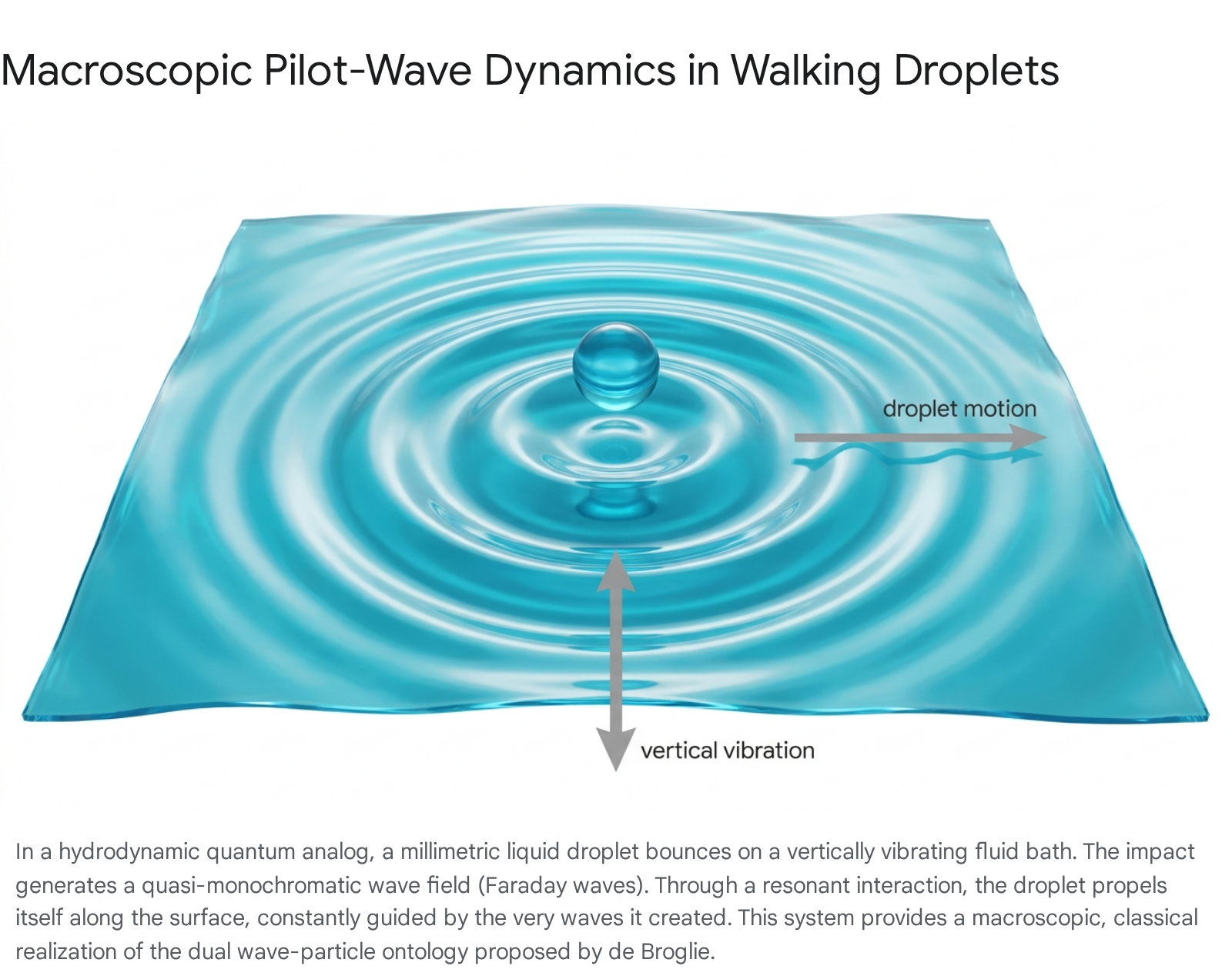
The bath is vibrated at an acceleration just below the Faraday instability threshold, preventing spontaneous surface waves but allowing localized perturbations to persist 2228.
When the droplet bounces, its impact generates a localized, quasi-monochromatic wave field composed of Faraday waves. Under specific resonant conditions between the droplet's impact phase and the wave oscillation, a dynamic symmetry breaking occurs, causing the droplet to propel itself laterally across the fluid bath 2324. The droplet effectively acts as an active, self-propelling wave source, navigating a complex physical landscape of its own creation 2325.
The dynamics of this system are highly non-Markovian; due to the slow viscous decay of the surface waves near the Faraday threshold, the droplet possesses a "path memory." Its current motion is heavily influenced by the wave field generated from its past positions 212632.
Emergent Quantum-Like Statistics
Remarkably, these classical walking droplets replicate an extensive array of phenomena previously thought to be exclusive to the microscopic, quantum domain 21. The mapping between the hydrodynamic system and de Broglie's original double-solution theory is remarkably direct: the bouncing of the droplet at the Faraday frequency serves as an analog to de Broglie's hypothesized particle vibration at the Compton frequency, and the Faraday wavelength maps to the de Broglie wavelength 212827. The hydrodynamic system operates on three distinct timescales - rapid particle vibration, particle translation, and long-term statistical convergence - which advocates argue helps clarify the timescale disparities inherent in quantum theory 2128.
HQAs have successfully demonstrated single-particle diffraction, interference, probabilistic quantum tunneling, quantized orbital states, Zeeman splitting, and interaction-free measurement 2122. Furthermore, when confined within circular or elliptical boundaries, droplets exhibit statistical projection effects identical to those seen in a quantum corral, and display localized statistics analogous to Friedel oscillations and Anderson localization in electronic systems 21222826. The average spatial distribution of the droplets over long observation periods recovers probability density functions akin to the Born rule, demonstrating empirically that localized particles guided by a persistent wave field can indeed generate wave-like emergent statistics 2632.
Boundaries and Limitations of the Analogy
Despite these profound phenomenological parallels, HQAs suffer from strict theoretical boundaries and cannot perfectly replicate standard quantum mechanics. Because the wave field propagates on a two-dimensional macroscopic fluid surface, the wave-particle coupling is always strictly local (or, at most, memory-nonlocal in the temporal domain) 2332. The system inherently lacks the multidimensional configuration space required to exhibit true quantum nonlocality, state collapse, or the genuine multiparticle entanglement described by Bell's theorem, although researchers are actively searching for classical analogs to static Bell violations 212632.
Furthermore, the hydrodynamic system is fundamentally dissipative, requiring continuous energy input via the vibrating bath to sustain the pilot wave, whereas quantum wavefunctions evolve unitarily 32. Nevertheless, HQAs provide critical conceptual insights into how the incompleteness of observational parameters in a complex, non-Markovian system with hidden variables can lead to the misinference of fundamental indeterminism and spontaneous wavefunction collapse 2126.
Clarification of Common Misconceptions
The mathematical elegance and conceptual simplicity of the de Broglie-Bohm theory are frequently obscured by persistent misconceptions regarding its handling of physical observables.
Momentum and the Uncertainty Principle
A recurring critique leveled against the theory is that if it assigns definite, continuous positions and trajectories to particles at all times, it must inherently assign definite classical momenta ($p=mv$), thereby violating Heisenberg's uncertainty principle 878. This objection reflects a fundamental misunderstanding of the theory's ontological construction.
In Bohmian mechanics, spatial position is the fundamental "beable" - the sole intrinsic, persistent property of the physical particle 687. The instantaneous velocity of the particle is not an independent parameter but is dynamically derived at each moment from the spatial gradient of the universal wavefunction 8. Consequently, classical momentum ($p = m \dot{q}$) has no fundamental ontological status in the theory; it is merely an emergent property of the trajectory, not a "hidden variable" in its own right 7.
The uncertainty principle remains entirely intact 834. Because the initial particle positions are distributed according to the square modulus of the initial wavefunction (per the quantum equilibrium hypothesis), any macroscopic measurement designed to ascertain the system's position and momentum yields probability distributions that are mathematically identical to those of orthodox quantum mechanics 934. The "uncertainty" arises not because the particle lacks a definite position, but because any measurement interaction inextricably alters the guiding wavefunction, thereby disturbing the particle's trajectory in a fundamentally uncontrollable and unpredictable manner 934.
This misunderstanding extends to historic critiques, such as Einstein's objection regarding the ground state of the hydrogen atom or a particle in a box. In these stationary states, the wavefunction is purely real, meaning the phase gradient is zero, and the Bohmian particle is completely motionless 8. Critics argued this contradicted the classical requirement that macroscopic motion should emerge from microscopic motion 8. However, any attempt to measure the velocity of the "motionless" electron fundamentally alters the stationary wavefunction, initiating movement and yielding the standard, non-zero momentum distribution predicted by orthodox theory 88.
The Contextuality of Spin
Another pervasive misconception is that the pilot-wave theory is exclusively a theory of position and fails to account for intrinsic internal properties such as particle spin. In orthodox quantum mechanics, spin is considered a fundamental, intrinsic form of angular momentum possessed by the particle. In the minimalist version of the de Broglie-Bohm theory, spin is not an inherent property of the physical particle at all 87. Instead, it is treated entirely as a property of the wavefunction (e.g., formalized as a multi-component spinor field).
When a "spin measurement" is performed - for example, passing a silver atom through the inhomogeneous magnetic field of a Stern-Gerlach apparatus - the magnetic field splits the spatial parts of the wave packet into distinct, spatially separated channels 8. The particle is deterministically guided into one of these channels depending solely on its exact initial entry position relative to the guiding field 8. Therefore, spin in Bohmian mechanics is purely contextual. The measurement outcome does not reveal a pre-existing intrinsic property of the particle, but rather records a complex dynamical interaction between the initial hidden position of the particle, the guiding spinor field, and the exact spatial configuration of the macroscopic measuring device 834.
Comparative Analysis of Quantum Interpretations
To fully grasp the epistemological standing of the de Broglie-Bohm theory, it is highly instructive to compare its core theoretical commitments with the two other dominant interpretative frameworks in modern physics: the Copenhagen interpretation and the Many-Worlds Interpretation (MWI) 5528.
| Feature | Copenhagen Interpretation | Many-Worlds Interpretation (MWI) | de Broglie-Bohm Theory |
|---|---|---|---|
| Determinism | No (Fundamental indeterminism) | Yes (Universal wavefunction evolves unitarily) | Yes (Determined by initial positions and guiding equation) |
| Locality | Nonlocal (Instantaneous wave collapse) | Local (Apparent nonlocality due to branching) | Explicitly Nonlocal (Particles interact instantaneously via wavefunction) |
| Status of Wavefunction | Often Epistemic (Represents statistical knowledge or potential) | Ontic (The only reality, universe exists as a single wave) | Ontic ($\psi$-supplemented; wave guides actual particles) |
| Measurement Problem | Unresolved (Requires ad hoc boundary between quantum/classical) | Solved (Decoherence causes branching, observer is entangled) | Solved (Particles always have positions; measurement merely reveals them) |
| Hidden Variables | None | None | Yes (Particle positions) |
| Ontology | Indefinite until measured | Branching realities/superpositions | Particles and Pilot Wave |
Copenhagen Interpretation
The Copenhagen interpretation, primarily championed by Niels Bohr and Werner Heisenberg, is characterized by instrumentalism. It asserts that physical systems fundamentally lack definite properties prior to measurement 529. The wavefunction provides a complete description of the system, but its absolute square represents only the probability of obtaining various outcomes 29. Upon measurement, the wavefunction spontaneously and indeterministically "collapses" into a single state 55.
Proponents of Bohmian mechanics heavily critique the Copenhagen interpretation by arguing that its probabilistic nature merely codifies human ignorance of the underlying deterministic particle paths 1. While Copenhagen is pragmatically sufficient for calculating laboratory probabilities, it suffers fatally from the measurement problem: it forces physicists to accept an arbitrary, undefined boundary (the "Heisenberg cut") where the deterministic, continuous Schrödinger equation magically ceases to apply and probabilistic, discontinuous collapse takes over 25528.
Many-Worlds Interpretation
The Many-Worlds Interpretation (MWI), originally proposed by Hugh Everett III, takes the Schrödinger equation as universally and exclusively true, denying wavefunction collapse entirely 528. When a quantum measurement occurs, the universe branches into mutually unobservable, non-interacting realities, physically accommodating all possible outcomes of the superposition 529. Like Bohmian mechanics, MWI is strictly deterministic 528.
However, MWI resolves the measurement problem by continually multiplying the number of unobservable universes 530. The de Broglie-Bohm theory, in stark contrast, maintains a single, unique macroscopic reality by breaking the symmetry of the superposition via the actual, hidden position of the particle 5. The pilot wave acts much like the branching universes in MWI, but the actual physical particle dictates which single branch represents observed physical reality, effectively rendering the other branches as conceptually necessary but physically inert "empty waves" 2.
Contemporary Research and Theoretical Extensions
The de Broglie-Bohm theory is not merely a historical curiosity but the subject of active, contemporary research. A dedicated international research network, originally spearheaded by Detlef Dürr, Sheldon Goldstein, and Nino Zanghì, continues to formalize the theory's mathematical foundations, exploring topics ranging from global existence proofs for Bohmian trajectories to scattering theory and the foundations of statistical mechanics 3132. Contemporary research groups across institutions in Asia, India, and the West continue to explore the boundaries of foundational quantum mechanics, touching upon aspects of causality, time in quantum theory, and the fundamental limits of the orthodox framework 40414233.
One of the most significant theoretical challenges facing the de Broglie-Bohm interpretation is its extension into the relativistic domain and quantum field theory (QFT). Because the theory relies on a universal configuration space and explicit instantaneous nonlocality to guide the particles, it inherently requires a preferred frame of reference, which conflicts with the fundamental tenets of Lorentz invariance in special relativity 3031. Researchers have developed several approaches to reconcile this, including Dirac-based pilot-wave models that utilize the probability current 4-vector field to determine relativistic world-lines, as well as stochastic jump models that adapt the causal interpretation to the creation and annihilation operators of quantum field theory 431. Theoretical variants, such as exploring modifications to the Schrödinger equation utilizing local time variables to enforce finite speeds of perturbation propagation, are also heavily studied in the context of bridging pilot-wave dynamics with relativistic constraints 10.
Conclusion
The de Broglie-Bohm pilot wave theory stands as a mathematically rigorous, internally consistent framework that resolves the core conceptual paradoxes of quantum mechanics without requiring observer-induced wave collapse, subjective epistemology, or infinite parallel universes. By introducing explicit nonlocality and maintaining that point particles possess continuous, deterministic trajectories choreographed by an objective guiding wave, the theory recovers all statistical predictions of standard quantum mechanics while establishing a clear, causal ontology.
While profound philosophical and theoretical debates continue - particularly regarding the precise ontological status of the universal wavefunction in light of the PBR theorem, and the mathematical hurdles of establishing a fully Lorentz-invariant quantum field theory - the interpretation remains highly influential. Furthermore, its macroscopic realization in hydrodynamic quantum analogs has revitalized global interest in causal interpretations, empirically proving that classical, path-memory systems can organically reproduce complex quantum statistics. Ultimately, Bohmian mechanics serves as a vital conceptual tool, proving unequivocally that realism, determinism, and exact trajectories are not incompatible with the phenomena of the quantum realm.