
Data-driven marketing practices in 2026
The concept of data-driven marketing has transitioned from a theoretical objective to a rigorous, highly regulated operational standard. By 2026, the definition of data-driven marketing no longer centers merely on the accumulation of customer metrics or the deployment of standalone analytics dashboards. Instead, it encompasses the engineering of centralized data architectures, the deployment of autonomous artificial intelligence agents, and strict adherence to a complex global matrix of data privacy regulations. This operational shift requires organizations to manage the entire data lifecycle - from ingestion and identity resolution to secure activation and compliance auditing. The fundamental practice now relies on prescriptive analytics, where unified data models autonomously dictate and execute multi-channel engagement strategies in real time.
Theoretical Foundations of Data-Driven Decision-Making
To understand the practical application of data-driven marketing, it is necessary to examine the theoretical frameworks that govern it. Historically, the marketing discipline operated on intuition-based strategies and broad demographic research, but the exponential growth of digital touchpoints has forced a profound metamorphosis 1. The modern paradigm is rooted in the philosophy of market orientation, which emphasizes the critical importance of understanding and responding dynamically to customer needs 1.
Peer-reviewed analyses of Data-Driven Decision-Making (DDDM) within marketing contexts reveal a systemic influence across multiple organizational levels. Systematic reviews of current literature indicate that DDDM manifests through four primary thematic pillars: the enhancement of the customer experience via granular personalization; the acceleration of innovation through machine learning and artificial intelligence; the maximization of performance through optimized resource allocation; and the establishment of strict data governance and ethical usage frameworks 2. The consensus among academic researchers defines DDDM as the systematic application of data science methodologies to manage complexity at scale, bridging the gap between raw data signals and actionable business intelligence 3. In increasingly saturated markets, the ability to extract value from digital data is no longer an optional capability but a profound necessity for customer acquisition, retention, and operational efficacy 2. Big Data Analytics (BDA) serves as the analytical bridge, enabling organizations to map customer journeys with unprecedented granularity, detect latent behavioral patterns, and move decisively beyond intuition toward evidence-based strategy 3.
Marketing Data Architecture and Technology Stacks
The structural foundation of marketing technology has shifted away from fragmented, specialized applications toward integrated ecosystems built around centralized data warehouses. This centralization is driven by "data gravity," the principle that data management is most effective when executed within a single, unified environment rather than distributed across a cascade of tooling silos 4. The average enterprise marketing team utilizes over 100 disparate platforms on a daily basis, a volume that historically generated crippling data chaos and fragmented organizational silos 5. To resolve this, modern organizations approach their marketing technology stack through a layered architecture designed to firmly separate data storage from downstream activation capabilities 56.
The Composable Versus Packaged Dilemma
The foundation layer serves as the absolute system of record for all customer interactions. Customer Data Platforms (CDPs) and cloud data warehouses - such as Snowflake, Databricks, and Google BigQuery - constitute this critical base 67. In this architecture, raw behavioral data, transaction histories, and engagement metrics from websites, applications, and customer relationship management (CRM) systems are continuously ingested 68.
The industry demonstrates a clear division between packaged CDPs and composable CDPs. Packaged solutions, including Segment, mParticle, and Lytics, offer end-to-end event collection, identity resolution, and activation interfaces suitable for teams prioritizing out-of-the-box functionality and rapid deployment 8. Conversely, composable CDPs treat the cloud data warehouse as the primary core, utilizing specific, highly specialized tools for data transformation and activation 57. Organizations adopting the composable approach gain the ability to maintain zero-copy data architectures, meaning data is not duplicated into a secondary vendor platform but remains governed entirely within the primary warehouse, thereby lowering costs and improving regulatory compliance 9.
The Centralization of Customer Identity
Raw data ingested into the warehouse holds limited immediate utility without extensive refinement. The transformation layer is responsible for standardizing formatting, resolving identities across multiple devices, and computing complex operational metrics such as churn probability, lifetime value, and product-qualified lead scoring 510. Data engineers utilize SQL and transformation platforms like dbt to model this data, creating unified customer tables that provide a comprehensive 360-degree view of individual users 711.
This modeling process is critical for resolving persistent data silos. Historically, disparate systems resulted in conflicting definitions of standard metrics; for example, a marketing team might define a "qualified lead" entirely differently than the sales team operating out of a separate CRM 11. By establishing the data warehouse as the single source of truth, organizations ensure that downstream marketing automation platforms, sales tools, and customer service dashboards operate from identical, computationally validated datasets, thereby building universal trust in the underlying metrics 911.
Activation Through Reverse ETL Protocols
To address the latency and operational limitations of traditional data workflows, Reverse Extract, Transform, Load (Reverse ETL) protocols have become the absolute standard activation mechanism in warehouse-centric architectures 711. While traditional ETL pipelines move operational data from source systems into a warehouse for passive analysis, Reverse ETL executes the exact opposite function.
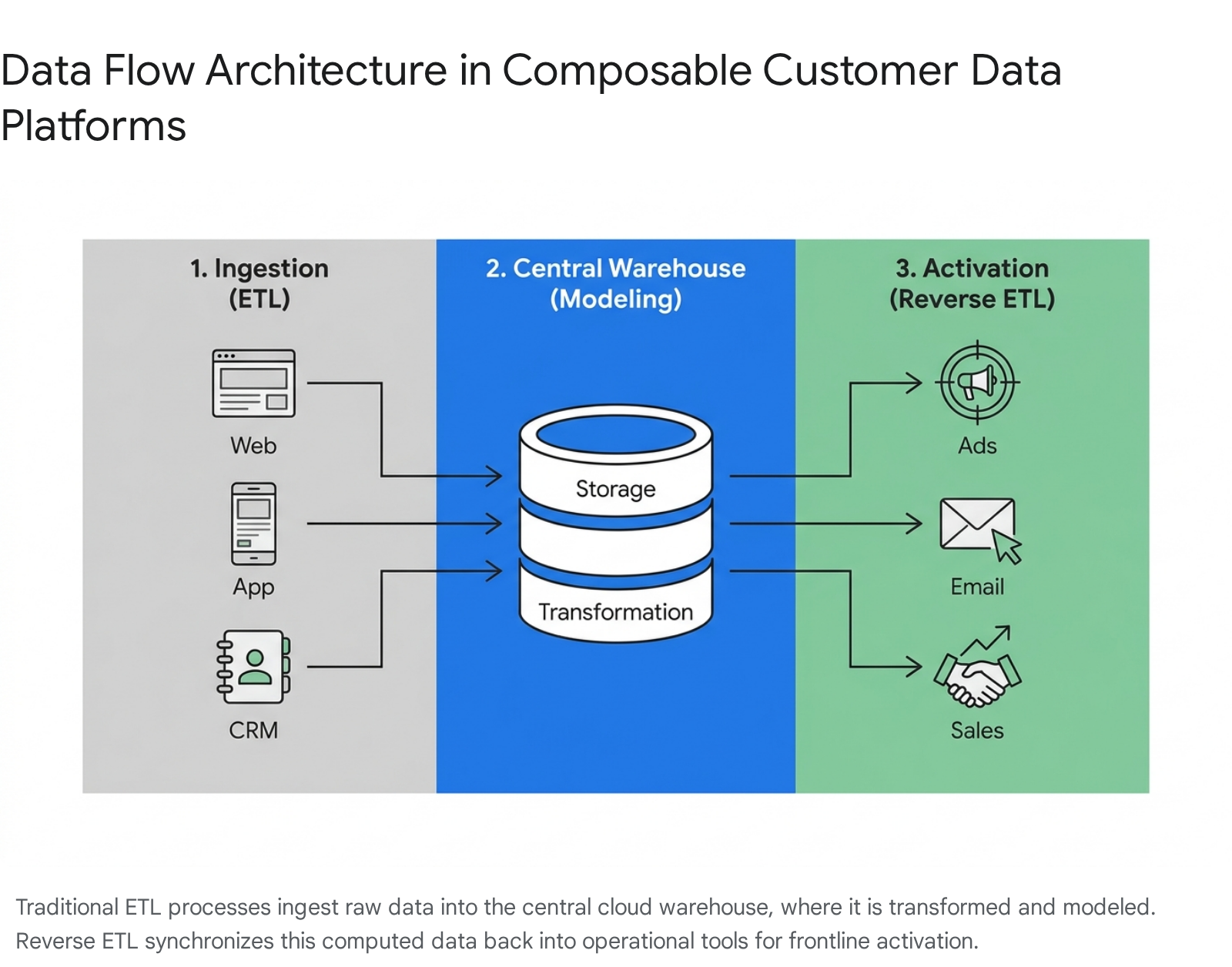
It extracts the curated, transformed data from the warehouse and synchronizes it directly into the frontline business applications where marketing and sales teams actually execute their strategies, such as Salesforce, HubSpot, Zendesk, and programmatic advertising networks 71011.
Platforms such as Hightouch, Census, and Polytomic strictly govern this process 78. The synchronization occurs on defined schedules or in near-real-time, automatically mapping specific warehouse columns (e.g., a "high-value segment" flag calculated via machine learning) directly to custom fields in destination systems 7. This ensures that marketing teams can trigger behavioral campaigns - such as initiating a retention protocol the moment a customer's health score drops below a specific threshold - without requiring manual CSV exports, custom point-to-point API development, or constant engineering support 710.
Convergence and the End of Tool Sprawl
The upper layers of the technology stack facilitate direct customer interaction and performance measurement. The engagement layer comprises marketing automation platforms, email service providers, content management systems, and social media scheduling tools 6. These systems utilize the data fed by the foundation layer to execute highly targeted campaigns. In practice, building a stack in 2026 demands a careful audit to identify and eliminate overlapping tools that perform identical tasks, a common byproduct of years of unchecked software procurement 11.
The industry is experiencing a massive wave of platform convergence. Leading providers such as HubSpot, Adobe, and Salesforce are expanding their portfolios to offer fully converged platforms that cover all steps from customer journey mapping to content activation 13. Furthermore, organizations are increasingly utilizing Integration Platform as a Service (iPaaS) solutions, such as Zapier, Make, and Integromat, to manage simpler operational connections between peripheral tools outside the core warehouse architecture 612. The true innovation lever in 2026 lies not in adding more standalone tools to the stack, but in the intelligent orchestration of existing technologies utilizing open standards and clear data governance 13.
Artificial Intelligence and Automation Integration
The deployment of artificial intelligence in marketing has moved past isolated experimental phases into universal enterprise integration. By the first quarter of 2026, 87% of marketing professionals report utilizing generative AI within at least one recurring operational workflow, representing a striking 36-percentage-point increase from early 2024 13. This rapid adoption permeates all organizational sizes, with 94% adoption reported at the enterprise level and 73% among solo or micro-teams 13.
Generative AI Adoption and the Autonomy Spectrum
Marketing AI functionality is categorized across a precise autonomy spectrum. Level 1 involves basic rules-based automation workflows. Level 2 introduces task agents that perform limited functions, such as summarizing customer interactions. Level 3 features decision agents capable of determining next actions, including autonomously segmenting prospect data. Level 4 introduces adaptive agents that continuously optimize themselves based on live performance feedback. Ultimately, the industry is migrating toward Level 5 orchestrator agents, which possess the capability to plan, execute, and monitor complete, multi-step marketing campaigns entirely autonomously 12.
While 81% of marketing technology leaders report either piloting or fully implementing AI agents, the operational reality dictates that most systems in 2026 remain AI-assisted rather than fully autonomous 1214. Organizations leverage these tools predominantly for content production, with 68.9% of organizations utilizing agents for drafting, followed closely by audience segmentation (40.8%) and competitive analysis (35.9%) 12.
Context Engineering and Model Context Protocols
As foundational AI models rapidly commoditize basic content generation, competitive advantage relies entirely on "context engineering" 12. This discipline involves providing an AI agent with the exact right information, in the correct format, at the precise moment a decision is required. If an agent receives inadequate context, it hallucinates or executes poorly; if overwhelmed with irrelevant data, processing latency increases and accuracy degrades 12.
In 2026, an organization's primary competitive moat is the contextual richness it can provide to its AI models. This requires synthesizing customer data, dense product information, brand guidelines, historical campaign performance, and real-time behavioral signals 12. Because this information is historically scattered across dozens of systems, the Model Context Protocol (MCP) - a standard introduced by Anthropic and broadly embraced by major vendors - has emerged as a critical integration layer 12. MCP enables AI systems to securely and rapidly interface with enterprise data warehouses, ensuring that generative outputs and automated decisions are strictly anchored in factual operational realities rather than generic training data 12.
Hyper-Personalization and Predictive Analytics
Data-driven personalization represents a non-negotiable consumer mandate. Approximately 71% of consumers prefer brands that adapt to their shopping habits over time, and 76% express active frustration with generic, impersonal interactions 1518. The financial impact of personalization is heavily documented; tailored promotions demonstrate the capacity to increase total sales by 1% to 2% and expand gross profit margins by 1% to 3% 16.
Predictive analytics models analyze historical transaction data to calculate churn risks and purchase propensities, answering the question of "what will happen next" 16. However, the discipline has progressed to prescriptive analytics, wherein machine learning systems not only forecast future behaviors but also automatically recommend and deploy the optimal intervention strategy 16. Consequently, automated, behaviorally triggered email sequences yield conversion rates roughly 2.5 times higher than standard promotional broadcasts, while personalized calls-to-action convert 202% more effectively than default messaging 20. The integration of advanced product recommender systems ensures that 73% of consumers are more likely to purchase when presented with suggestions that feel highly relevant to their immediate context 17.
The Operational Risks of Premature AI Deployment
Despite the measurable benefits, AI integration carries substantial operational risks, particularly concerning customer trust and brand safety. The deployment of generative AI chatbots and automated support agents lacking adequate context or refinement results in severe customer friction. Industry analysts predict that throughout 2026, premature deployment of AI self-service tools - driven solely by cost-cutting objectives rather than experiential enhancement - will actively damage brand reputation and increase churn for approximately one-third of adopting companies .
Furthermore, over-personalization generates consumer discomfort. Research indicates that 21% of consumers feel actively uneasy when AI sounds too human or "pretends" to possess deep personal knowledge about them 18. Poor or inaccurate personalization carries tangible consequences; when consumers receive sloppily targeted messages, approximately 20% immediately cease opening future communications from that brand, fundamentally eroding trust in the company's ability to manage their data responsibly 18. Therefore, organizations are strictly advised to personalize marketing solely using first-party data gathered with explicit, verifiable consent 18.
Performance Measurement and Return on Investment
The financial justification for expansive marketing technology and AI investments relies entirely on the precise measurement of Return on Investment (ROI). Despite the prevalence of advanced analytics tools, calculating accurate ROI remains intensely challenging due to complex attribution chains, extended B2B sales cycles, and the fragmentation of user identities across multiple devices 1920. Currently, only 36% of marketing professionals report the ability to accurately measure cross-channel ROI 19.
The Complexity of Attribution and Signal Loss
Enterprise adoption of multi-touch attribution models reached 41% in 2026, yet accuracy remains highly elusive. Only 18% of organizations utilizing these models rate their implementations as highly accurate 21. This confidence gap represents the defining challenge of marketing analytics. A massive 87% of practitioners view data-driven decision-making as critical, but only 32% inherently trust the data feeding their dashboards 21.
This crisis in measurement is exacerbated by severe privacy-driven signal loss. The cumulative impact of aggressive GDPR enforcement, stringent state-level US privacy laws, browser tracking prevention mechanisms, and mobile OS consent requirements has eliminated approximately 30% to 40% of the conversion signals marketers historically relied upon 21. Organizations that have proactively shifted their architectures to server-side tracking and robust first-party data strategies are managing to recover 60% to 75% of this lost signal, creating a measurable and highly lucrative competitive advantage over peers still reliant on deprecating third-party cookies 21.
Channel-Specific ROI Benchmarks
Marketing ROI varies significantly depending on the specific channel deployed, the measurement window evaluated, and the underlying industry context. Organizations employing mature, data-driven analytics report overall marketing ROI figures 5% to 8% higher than competitors relying on traditional, intuition-based methods 19.
| Marketing Channel | Average ROI / Return | Break-Even Timeline | Key Characteristics and Applications |
|---|---|---|---|
| Search Engine Optimization (SEO) | 702% - 748% ($22.24 per $1) | 9 months | High long-term value; compounding returns over three years; critical for top-of-funnel B2B awareness 192022. |
| Email Marketing | 3,600% - 4,200% ($36 - $42 per $1) | Immediate to 7 months | Heavily reliant on personalization; highly effective for retail/e-commerce; automated sequences wildly outperform standard mass campaigns 20192022. |
| Webinars & Virtual Events | 213% - 430% | Variable | Strong performance in B2B SaaS sectors; requires high-quality, frictionless lead capture mechanisms 22. |
| Paid Search (PPC) | 36% - 200% ($1.55 - $2.00 per $1) | 4 months | Rapid returns and easily measurable attribution; lower total ROI multiplier than organic channels but highly predictable 1922. |
| Paid Social (LinkedIn) | 192% ($2.30 ROAS) | Campaign-dependent | Superior lead quality for B2B applications compared to broader consumer networks; 40% of B2B marketers rank it as their top lead generation channel 2022. |
The timeline for realizing returns dictates overall budget strategy. While paid media offers short-term liquidity and rapid break-even points, organic content and SEO demand extended, disciplined investment horizons - often 24 to 36 months - before generating their highest, compounding returns 20.
Artificial Intelligence ROI and Efficiency Gains
The financial returns on generative AI investments are becoming highly quantifiable. AI-driven content drafting tools deliver a 3.2x average ROI, while personalization engines return 2.7x, with audience research (2.4x) and ad copy generation (2.3x) trailing closely behind 13. At the workflow level, marketers report recovering an average of 6.1 hours per week through AI assistance, with senior practitioners saving up to 10 hours by automating complex data synthesis tasks 13.
The median payback period for enterprise AI tooling investments has compressed to just 4.2 months in 2026, down from 7.8 months in 2024, demonstrating the rapid maturation of the technology 13. Furthermore, organizations deploying advanced agentic AI - systems capable of autonomous task execution - report projected ROIs ranging from 171% to 192%, fundamentally altering the economic models of traditional marketing operations 28.
Budget Allocation and Financial Constraints
The macroeconomic environment of 2026 has forced strict fiscal discipline upon marketing leadership. Enterprise marketing budgets have plateaued, sitting at an average of 7.8% of total company revenue, representing a statistically insignificant rise from 7.7% in 2025 2324. Consequently, Chief Marketing Officers (CMOs) operate under intense financial pressure; 56% explicitly state they lack the budget required to fully execute their organizational strategies, and 54% report possessing insufficient internal resources 2425.
Resource Reallocation and Technology Expenditures
To survive in an environment where customer acquisition costs have doubled year-over-year, marketing leaders are ruthlessly reallocating capital away from legacy operations and underperforming vendor contracts toward automated, highly measurable channels 26. The modern marketing budget reflects a structural shift prioritizing direct technological intervention over external service providers.
| Budget Category | Percentage of Total 2026 Marketing Budget | Strategic Implications and Industry Trends |
|---|---|---|
| Paid Media | 31.4% | Remains the largest expenditure; heavily shifted toward digital search, social advertising, and retail media networks offering closed-loop attribution 2728. |
| Labor (In-House) | 24.5% | Reflects the high cost of specialized data engineering and technical marketing talent required to operate modern stacks 28. |
| Marketing Technology (MarTech) | 19.4% | Capital deployed for CDPs, cloud warehouses, and reverse ETL infrastructure. Consolidation is actively occurring to reduce vendor bloat 2628. |
| Agencies & External Services | 19.2% | Decreasing share as automation internalizes capabilities; 85% of US B2C executives plan to aggressively review and renegotiate agency MSAs 2829. |
| Artificial Intelligence Initiatives | 15.3% | Represents a distinct, rapidly growing sub-allocation. Highly mature "AI-Ready" organizations allocate significantly higher percentages (21.3%) to maintain competitive advantage 242528. |
This reallocation underscores a profound reality: CMOs are utilizing artificial intelligence not merely as a supplementary tool, but as a mandatory mechanism to offset budget stagnation 2528. By automating repetitive tasks and optimizing media spend algorithmically, marketing organizations attempt to generate net-new growth without corresponding increases in top-line budget allocations.
The Cost of Poor Data Quality
The efficacy of these massive technology investments is strictly bound by underlying data integrity. Enterprise marketing stacks produce an average of 47 terabytes of data monthly, and managing this volume creates immense vulnerability 21. The financial penalty for poor data quality is severe, costing enterprise marketing organizations an average of $12.9 million annually 21.
Currently, 42% of CRM records contain at least one critical data quality issue, manifesting as missing fields, outdated contact information, or duplicated entries 21. When activation layers process compromised or decayed data, the results are immediate: inaccurate audience segmentation, wasted programmatic ad spend, triggered privacy violations, and damaged customer trust. Organizations utilizing stringent reverse ETL protocols and strict data governance frameworks within their cloud warehouses actively mitigate this financial risk by maintaining a tightly controlled, continuously updated single source of truth 11.
Global Data Privacy and Compliance Regulations
The acquisition, storage, and activation of consumer data in 2026 are heavily restricted by a rapidly maturing web of global privacy statutes. Regulatory frameworks have completely transitioned from issuing general data processing principles to enforcing strict, operational mandates supported by severe financial penalties and executive liability 3031. The era of treating consumer data as an infinite resource to be mined without friction is over; data is now legally recognized as a borrowed asset, requiring marketers to build "trust-first" architectures centered on explicit consent and first-party data ownership 3233.
The Maturation of Asia-Pacific Regulatory Frameworks
The Asia-Pacific region has instituted highly aggressive data protection regimes in 2026, fundamentally altering cross-border data transfers, tracking methodologies, and automated marketing consent protocols. These laws force multinational corporations to completely re-engineer their localized technology stacks.
| Jurisdiction | Primary Legislation | 2026 Implementation Status & Core Marketing Impact | Maximum Enforcement Penalties |
|---|---|---|---|
| South Korea | Personal Information Protection Act (PIPA) Amendments | Effective Sept 11, 2026. Introduces personal supervisory liability for CEOs. Strictly regulates tracking cookies via explicit opt-in consent. Requires mandatory ISMS-P certification by July 2027 30313435. | Up to 10% of total global revenue; potential criminal liability (imprisonment) for egregious breaches 313435. |
| India | Digital Personal Data Protection Act (DPDPA) | Transitioning to active enforcement in 2026. Forces marketers to abandon bulk, non-consensual SMS outreach. Requires architecture compatible with government Consent Manager APIs by mid-2026 32333637. | Up to INR 250 crore (approx. $30 million USD) per distinct violation 3638. |
| Japan | Act on the Protection of Personal Information (APPI) | Cabinet-approved April 2026. Introduces exceptions allowing personal data use for "statistical processing" (e.g., AI training) without consent, provided the data is pseudonymized and strictly safeguarded 394041. | Introduces a new administrative surcharge regime focused specifically on economic deterrence 3941. |
| Vietnam | Personal Data Protection Law (PDPL) & Decree 356 | Effective Jan 1, 2026. Expanded extraterritorial reach to foreign entities. Strict prohibitions on pre-ticked consent boxes. Requires Data Protection Impact Assessments (DPIA) within 60 days 424350. | Up to VND 3 billion (approx. $115,000 USD) for standard violations 42. |
The Implementation of Consent Architectures
These regulations explicitly alter the utility and design of marketing data architectures. In India, the operationalization of the Consent Manager framework requires that marketing technology stacks integrate via APIs to instantly recognize and honor user-initiated consent withdrawals across all platforms simultaneously 3637. Organizations failing to build this real-time suppression logic face massive financial exposure 33.
In Japan, the legislative amendments provide a careful, highly structured carve-out for "statistical processing." This allows organizations to legally utilize vast datasets for the training of localized artificial intelligence models without obtaining individual user consent, provided the data is strictly pseudonymized and cannot be used to contact or target the individual 4051. However, the law explicitly prohibits the use of that same model output for individualized marketing without acquiring secondary, explicit consent, forcing data engineers to build strict firewalls between AI training environments and marketing activation layers 40.
South Korea's stringent updates to PIPA represent the highest tier of global regulatory risk. By formally imposing personal supervisory liability on Chief Executive Officers and raising maximum fines to 10% of global turnover, South Korea elevates data compliance from an IT operational nuisance to a primary board-level governance mandate 3031. Marketers operating in Korea can no longer rely on ambiguous cookie banners; the PIPC enforcement requires verifiable, granular opt-in mechanisms before any tracking pixel can legally execute 34.
United States State-Level Legislation and Enforcement
In the absence of a unified federal privacy statute, the United States operates under a deeply fragmented system of state-level comprehensive privacy laws. By the end of 2026, 20 individual states actively enforce comprehensive digital privacy regulations, creating a highly complex compliance matrix for domestic marketers 4445.
Three new state laws took effect on January 1, 2026: the Indiana Consumer Data Protection Act, the Kentucky Consumer Data Protection Act, and the Rhode Island Data Transparency and Privacy Protection Act 4446. Both Indiana and Kentucky mandate that applicable businesses conduct formal Data Protection Impact Assessments (DPIAs) before engaging in any targeted advertising, selling of personal data, or processing of sensitive data 4647. The definition of sensitive data has expanded significantly across state lines, now explicitly including precise geolocation tracking and biometric indicators 4647.
Furthermore, existing frameworks underwent stringent, operational amendments in 2026. California launched the Delete Request and Opt-out Platform (DROP), implementing the California Delete Act by allowing residents to submit a single, universal data deletion request to all registered data brokers simultaneously, with mandatory compliance effective August 2026 4548. States including Oregon and Connecticut enacted strict categorical prohibitions against the selling of minors' personal data and the deployment of targeted advertising to users under age 16, regardless of prior consent 4748. Consequently, marketers rely heavily on localized, server-side compliance mechanisms that dynamically suppress data tracking tags based on the user's geographic IP address. The legal exposure for data mismanagement extends far beyond regulatory fines; industry analysts predict a 20% surge in consumer class-action lawsuits directly targeting AI-driven privacy breaches throughout 2026 49.
Talent Acquisition and Marketing Operations
The technological and regulatory transformations of 2026 require a fundamental, structural reshaping of marketing personnel. The widespread adoption of automation has precipitously diminished the demand for traditional, generalist marketing roles while heavily amplifying the need for specialized data engineering and strategic planning capabilities 27.
The Critical Data Engineering Talent Gap
Data engineering currently represents one of the fastest-growing technology occupations globally. The sector is experiencing a 35% increase in demand through 2025 and 2026, with the United States alone projecting 260,000 job openings 50. While the industry employs over 150,000 professionals, the supply of highly qualified talent remains vastly insufficient to meet the needs of organizations migrating to complex cloud architectures and building advanced reverse ETL pipelines, creating a global talent gap approaching 2.9 million related roles 5051.
Data engineers are tasked with resolving the primary bottlenecks in modern marketing operations: managing crippling legacy technical debt, ensuring absolute data quality, and maintaining flawless compliance across distributed, cloud-native systems 5152. As real-time analytics and generative AI move from isolated experiments into core production environments, the data engineer's role has expanded to encompass AI infrastructure and strict data governance 5153. Employers heavily prioritize candidates possessing deep, hands-on expertise in cloud data warehouses (Snowflake, Databricks), semantic modeling (dbt), and distributed orchestration (Airflow, Kafka), alongside a thorough understanding of global privacy compliance 5362.
The Contraction of Traditional Marketing Roles
Within the core marketing function, generative AI has successfully absorbed vast amounts of routine execution work, particularly in basic copywriting and code generation. Consequently, the labor market is experiencing a severe contraction in entry-level positions. Data indicates that 23% of marketing agencies actively reduced junior copywriting headcount in 2025, with an additional 31% planning further cuts throughout 2026 13. Because AI handles lower-value execution with high efficiency, organizations are becoming entirely reliant on mid-level and senior talent, fundamentally fracturing traditional career pathways and increasing demands on human resources to aggressively redeploy internal staff 54.
Content marketing roles, historically focused solely on written asset production, are splitting into two highly distinct paths: high-volume, multi-format technical producers, and senior strategic growth operators who manage SEO, analytics, and algorithmic discovery as a unified commercial ecosystem 55. A comprehensive 2026 survey of hiring managers revealed that 57% consider creative thinking, clear communication, and strategic storytelling to be vastly more valuable than hard technical coding skills, primarily because AI platforms now execute routine technical tasks at scale 56. Marketing professionals are expected to transition from tactical executors to "AI-augmented specialists" or "business value engineers" whose primary mandate is translating deep technological capabilities into measurable commercial revenue 1227.
The Transformation of the Agency Ecosystem
The external service provider ecosystem is undergoing an equally violent disruption. Marketing agencies, facing consistent procurement pressure and the commoditization of creative execution via AI, are rapidly moving away from traditional labor-based economic models 29. Automation and AI efficiencies are accelerating workforce reductions across the agency landscape, with analysts forecasting a massive 15% headcount reduction across major agencies in 2026 29.
To survive, agencies are shifting from acting purely as client agents to operating as principals in media trading. In 2026, principal media - where agencies utilize advanced algorithms to purchase inventory and resell it to clients with distinct margins and performance guarantees - is projected to account for nearly 33% of total agency billings 29. This operational pivot, combined with extreme market pressure, is driving a wave of major industry consolidation, with analysts predicting significant mergers and acquisitions among major holding companies such as WPP, Havas, and Dentsu 29.
The AI Literacy Gap Among Marketing Executives
Despite the rapid deployment of technology across the operational floor, organizational readiness at the leadership level remains a critical, systemic vulnerability. A 2026 survey indicates that while 65% of CMOs fully acknowledge that AI will dramatically alter their role and function within two years, only 32% recognize the need to significantly update their personal skill sets and profiles 57.
This glaring AI literacy gap poses a substantial risk to enterprise execution. Organizations can no longer treat artificial intelligence merely as an operational efficiency tool delegated to junior staff or external IT departments; it must be integrated as a core strategic capability managed directly by marketing executives who fundamentally understand data provenance, algorithmic bias, and the economics of automated optimization 5457. Analysts predict that by 2027, a fundamental lack of AI literacy will rank among the top three reasons CMOs are actively replaced at large enterprises, elevating AI fluency to a strict board-level leadership expectation 57. The ultimate success of data-driven marketing in 2026 relies entirely on human expertise to design the architecture, engineer the vital contextual guardrails, and enforce the strategic discipline within which these powerful autonomous systems operate.