
Dark Social and Marketing Attribution in 2026
Fundamentals of Marketing Attribution Loss
The digital marketing landscape of 2026 is defined by a paradox: enterprise organizations possess more sophisticated analytical infrastructure than ever before, yet their visibility into the actual drivers of customer acquisition is steadily eroding. This erosion is primarily driven by the systemic expansion of dark social - the sharing of content, links, and recommendations through private, untrackable communication channels rather than public, measurable platforms. When network traffic originates from the dark social ecosystem, the referring metadata is systematically stripped or obfuscated, causing analytics platforms to miscategorize the visits as direct traffic or organic search 1.
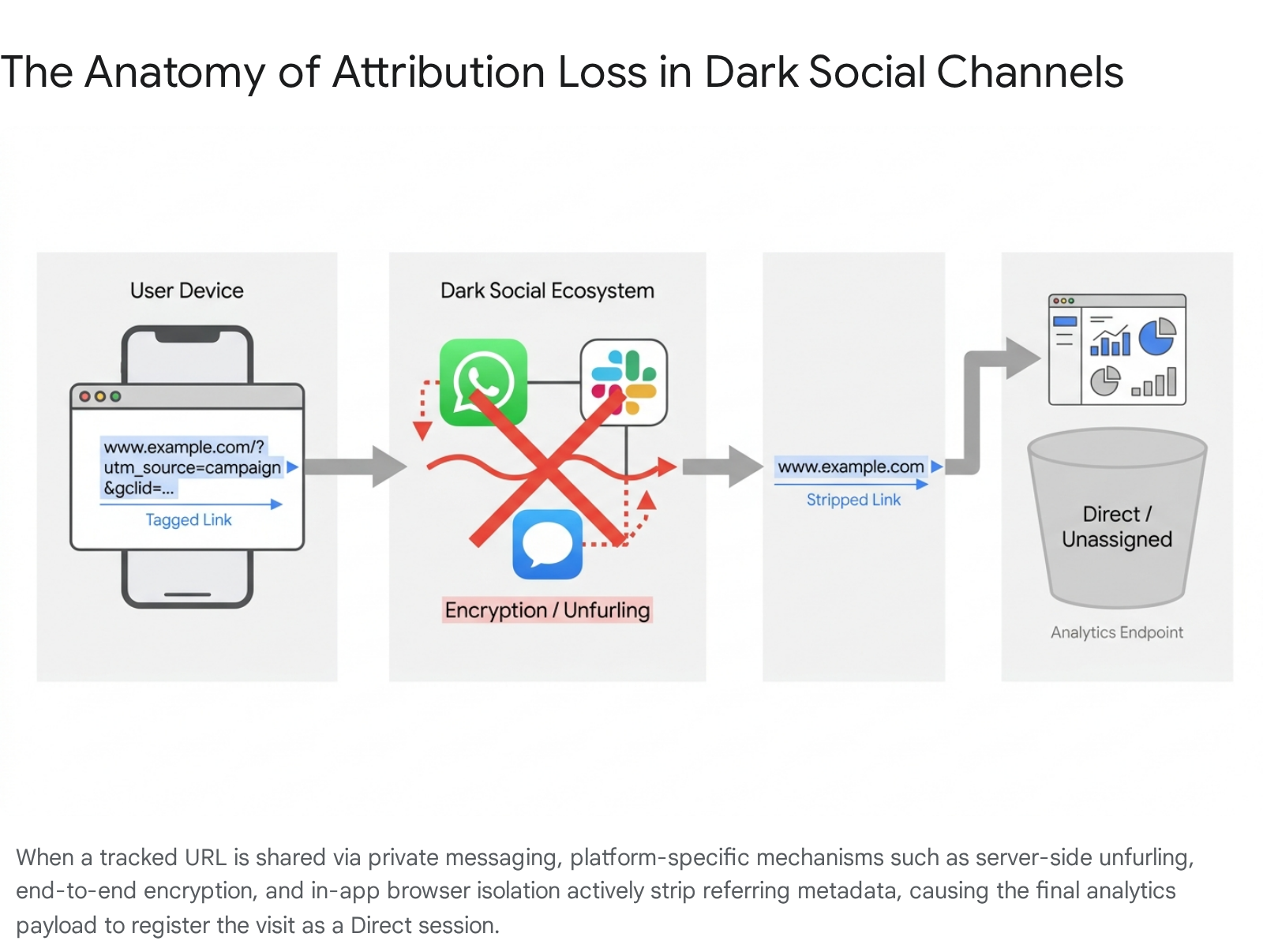
Dark social is no longer an edge case or an anomaly in data tracking; it has become the default architecture for modern digital communication and business procurement. According to 2026 behavioral research, 70% to 73% of the business-to-business (B2B) buying journey now occurs in the dark funnel before a prospective buyer ever completes a form fill or directly contacts a vendor 23. The average B2B purchasing path has expanded to encompass 211 days and approximately 76 tracked touchpoints, yet standard form-based attribution models capture less than 30% of this actual journey 2. The buying committees navigating this prolonged cycle have also grown, averaging 6.8 stakeholders for B2B software-as-a-service (SaaS) procurement and between 8 to 12 stakeholders for B2B manufacturing 2. Consequently, an average of 38% of all B2B sales pipeline is entirely unattributable through conventional deterministic tracking methodologies 4.
The opacity of the dark funnel represents a significant financial liability, largely because standard attribution software is designed to measure demand capture rather than demand creation. Buyers frequently consume between 20 and 30 pieces of content anonymously - ranging from review site comparisons to podcast discussions and peer community threads - before initiating contact 2. Approximately 83% of buyers fully define their purchase requirements before engaging with sales representatives, and 61% report a preference for a completely rep-free buying experience 3. By relying on analytics platforms that only measure the final, trackable interactions, organizations systematically over-invest in bottom-of-funnel demand capture channels while starving the upper-funnel demand creation activities that actually initiate the buying cycle 15.
The Role of Generative Artificial Intelligence in the Dark Funnel
While encrypted messaging applications represent the current foundation of dark social, Generative Artificial Intelligence (AI) and Large Language Models (LLMs) represent the most rapidly expanding sector of the dark funnel. In 2026, 94% of B2B buyers utilize LLMs - such as OpenAI's ChatGPT, Anthropic's Claude, and Google's Gemini - during their procurement and research processes 34. Furthermore, 72% of buyers encounter AI-generated overviews during their research, significantly altering traditional search engine behavior 3.
LLMs function as an impenetrable layer of the dark funnel. Buyers utilize these conversational interfaces to conduct competitive comparisons, vet software vendors, and synthesize product reviews entirely outside of traditional, trackable search engines 34. This behavior accelerates buyer education and shapes procurement shortlists while remaining completely invisible to marketing analytics platforms 4. Because an AI interface synthesizes answers directly within the chat window, the buyer rarely clicks through to the vendor's actual website during the initial consideration phase. When the buyer finally navigates to the site to request a demonstration, they typically do so via a direct URL entry or a branded search. Analytics platforms record this as a direct visit with zero prior touchpoints, entirely masking the fact that the primary consideration phase occurred inside a private LLM instance 14.
The financial implications of this ungoverned AI research phase are severe. Forrester analysis predicts that in 2026, B2B companies risk losing over $10 billion in enterprise value due to incidents resulting from inaccurate, unverified, or hallucinatory information provided by generative AI tools during the buyer journey 5. Because marketers cannot track interactions or directly inject messaging into closed LLM environments, traditional search engine optimization strategies are rapidly pivoting toward Answer Engine Optimization (AEO), which focuses on structuring proprietary data to be easily ingested and accurately represented by foundational models 6. The inability to track LLM referrals definitively reinforces the reality that traditional attribution models are no longer sufficient for mapping the modern customer journey.
Technical Mechanisms of Referral Obfuscation
The loss of marketing attribution is not a passive failure of analytics software; it is the active result of network architectures, platform configurations, and browser-level privacy interventions. When users copy and paste links into private spaces, the underlying technology stack systematically degrades the tracking signals that digital marketers have historically relied upon.
Operating System Interventions and Link Tracking Protection
A primary catalyst for the degradation of deterministic tracking is the maturation of Apple's Link Tracking Protection (LTP), an operating system-level privacy feature initially introduced in iOS 17 and significantly expanded across Apple's device ecosystem by 2026 7812. LTP automatically removes user-identifiable tracking information from URLs accessed within Apple Mail, Apple Messages, and Safari Private Browsing 789.
Historically, marketing platforms generated unique click identifiers and appended them to the query string of a URL. For example, Google utilizes the gclid (Google Click Identifier), which is automatically applied to URLs via auto-tagging whenever a user clicks a Google Ad 814. The gclid contains encrypted data that only Google Analytics can decipher, allowing the platform to match a specific site visit to an exact ad impression, user profile, and bidding strategy 14. Meta utilizes a similar proprietary parameter known as the fbclid 810. Under Apple's LTP framework, the iOS system intercepts the URL resolution process. When a user clicks a shared link within a protected application, the system executes a pattern-matching algorithm that sanitizes the URL query string, surgically stripping out these vendor-specific identifiers while leaving the core, non-identifiable base URL intact 8910.
Current implementations of LTP generally permit broader, non-personal Urchin Tracking Module (UTM) parameters to pass through, such as standard utm_source and utm_medium tags, provided they do not uniquely fingerprint an individual user 8. However, the eradication of click-level IDs fundamentally breaks the feedback loop required for algorithmic ad optimization 10. Marketers can observe that a user arrived via a generic campaign source, but they lose the deterministic link between a specific user, the specific ad creative they clicked, and the subsequent conversion event 10. This intervention creates a persistent attribution gap, artificially deflating the measurable return on investment (ROI) for email marketing and social sharing among the massive demographic of iOS users 712.
Server-Side Fetching in Enterprise Collaboration Tools
A secondary, highly pervasive mechanism of dark social attribution loss occurs within enterprise collaboration and community tools like Slack, Microsoft Teams, and Discord. When a user pastes a URL into these platforms, the application automatically generates a rich card displaying the webpage title, meta description, and preview image. This process, known as URL unfurling, is a primary technical driver of attribution distortion 11.
The unfurling process relies entirely on server-side fetching. When a link is detected via regular expression pattern matching (e.g., https?://[^\s]+), the platform's proprietary server - such as Slackbot 1.0 or Discordbot - makes an HTTP GET request to the target URL 1117. This automated action introduces multiple critical breaks in the tracking chain. First, the network request originates from the chat platform's corporate IP address, completely masking the end-user's actual location and device information 11. Second, server-side bots parse the HTML response solely to extract Open Graph or Twitter Card meta tags and do not execute client-side JavaScript 11. Because pixels from measurement platforms rely heavily on JavaScript execution to record a valid session, the bot's visit is entirely invisible to standard analytics.
When the end-user subsequently clicks the generated rich card, the traffic is routed out of the desktop or mobile application. Native desktop applications generally do not pass standard HTTP_REFERER headers to external web browsers. Consequently, the receiving web server registers a visit with no referring domain, which the analytics platform categorizes by default as unassigned or direct traffic 15.
In-App Browser Isolation and Protocol Disconnects
The third major technical mechanism involves the proliferation of in-app browsers utilized by high-volume platforms such as TikTok, Instagram, and LinkedIn. When a user clicks an outbound link within a direct message or a public post on these platforms, the destination URL rarely opens in the device's native browser. Instead, the link is forcefully opened within an embedded WebView maintained entirely by the social application 1.
In-app browsers frequently drop, modify, or aggressively block referrer information to prevent data leakage outside of their respective walled gardens. Furthermore, these enclosed environments isolate the user's session data. A user who is authenticated and logged into a brand's website on their native mobile Chrome browser will appear as a completely new, unrecognized, and unauthenticated visitor when opening the exact same website via an Instagram in-app browser. This architectural disconnect severs cross-device identity resolution, resulting in highly fragmented user journeys and the artificial over-reporting of unique site visitors.
The degree to which referral data is obfuscated varies significantly based on the specific architecture of the platform. Technical research measuring the loss of attribution data highlights the severity of this issue across different dark social vectors.
| Platform / Channel | Percentage of Referral Data Obfuscated (Categorized as Direct) | Primary Mechanism of Tracking Loss |
|---|---|---|
| TikTok | 100% | In-app browser isolation and aggressive stripping of outbound HTTP headers 112. |
| Slack | 100% | Desktop application routing, HTTP_REFERER blocking, and server-side bot unfurling 1112. |
| 100% | End-to-end encryption protocols and closed-network private routing 112. | |
| Discord | 100% | Desktop client routing and privacy-focused bot unfurling 1712. |
| Facebook Messenger | 75% | Mixed routing behavior between mobile applications and desktop web environments 12. |
| Instagram Direct Messages | 30% | Partial passage of referrers depending on the device operating system and app version 12. |
| LinkedIn (Public Posts) | 14% | Link shortening intermediaries and redirects stripping URL parameters 12. |
Geographic and Platform Penetration of Dark Social
The impact of dark social attribution loss is not distributed evenly across the global market. Because the technical mechanisms of obfuscation are inherently tied to the architecture of specific software platforms, a region's demographic preference for certain messaging applications directly dictates the severity of its marketing attribution blind spots.
Global Social Media Penetration and Platform Adoption
In 2026, global social media users reached approximately 5.66 billion, representing nearly 69.9% of the world's population 1314. The global internet penetration figure stands at 73.2%, indicating that the vast majority of connected individuals are active participants in social ecosystems 13. Social media usage continues to exhibit strong annual growth, adding over 259 million new user identities year-over-year 1321. Users currently spend an average of 2 hours and 21 minutes per day consuming content across an average of 6.8 to 7.4 different platforms per month, highlighting extreme user fragmentation 1421.
Regional growth rates reveal distinct patterns. The Asian market remains the fastest-growing region with a 14.1% increase, housing nearly 60% of all global social media users 15. Europe accounts for roughly 12% of the global user base but exhibits the slowest growth at 3.8% 15. Africa follows with 11.5% of users, while South America and North America represent 8.6% and 6.5%, respectively 15.
| Country / Region | Total Social Media Users (2026 Estimate) | Notable Growth and Platform Dynamics |
|---|---|---|
| China | 1.3 Billion | Heavily isolated digital ecosystem dominated by WeChat (1.3B MAU) and Douyin (750M DAU) 1516. |
| India | 500 Million+ | Largest market for YouTube and WhatsApp; rapid adoption of LinkedIn (nearly 200M members) 1516. |
| United States | 310 Million | Highly saturated market (93% penetration); deeply fragmented messaging landscape across iMessage, SMS, and varied social DMs 1415. |
| Indonesia | 180 Million | High mobile penetration; serves as WhatsApp's third-largest global market with 112M users 1517. |
| Brazil | 150 Million | Exceptional WhatsApp penetration reaching 98.9% among internet users; massive dark social sharing volumes 1517. |
The Dominance of Encrypted Messaging in Emerging Markets
While the United States exhibits a highly fragmented messaging market that frequently utilizes non-encrypted SMS protocols alongside Apple's iMessage 14, emerging markets in Latin America and the Asia-Pacific regions operate as near-monopolies dominated by Meta's WhatsApp. WhatsApp's global user base exceeds 3 billion monthly active users, processing immense volumes of peer-to-peer communication 1617.
WhatsApp's largest global market is India, boasting an estimated 535.8 million active users, with projections indicating the user base will surpass one billion by the end of 2026 17. Brazil represents the second-largest market with approximately 148 million users, achieving a staggering 98.9% penetration rate among connected citizens 17.
For marketing analysts and data scientists, this geographic disparity means that consumer brands operating primarily in India, Brazil, and Indonesia suffer from structurally higher rates of dark social traffic compared to those operating in North America or Western Europe. When 98.9% of a country's connected population utilizes an end-to-end encrypted application as their primary vector for sharing product links, news articles, and brand recommendations, the volume of traffic defaulting to the direct attribution bucket becomes overwhelmingly large 11718. Traditional ecommerce metrics fail entirely to capture the true drivers of sales in these regions, artificially deflating the perceived ROI of social marketing efforts and obscuring the measurable impact of word-of-mouth vitality 18.
Cryptographic Protocols and Metadata Retention
Even within the dark social ecosystem, the specific messaging application chosen by a consumer dictates the level of potential tracking loss. This variation is driven by the underlying cryptographic standards and data-retention policies engineered into the platforms.
- Signal Protocol (High Obfuscation): Signal is widely recognized as the cryptographic gold standard for secure communication. It operates on the open-source Signal Protocol, applying robust End-to-End Encryption (E2EE) to all messages, voice calls, and media transfers by default 1920. Crucially, Signal utilizes advanced "Sealed Sender" technology, ensuring that even Signal's own corporate servers cannot read the origin, destination, or metadata of a transmitted message 1921. Because the platform collects virtually zero user metadata, any referral links shared within the application are completely shielded from external tracking, resulting in absolute attribution loss for digital marketers 192021.
- WhatsApp Protocol (Mixed Obfuscation): WhatsApp also utilizes the Signal Protocol to provide foundational E2EE 1922. From a strict content perspective, the URLs and text shared in WhatsApp are entirely unreadable by Meta. However, unlike the non-profit Signal Foundation, Meta operates WhatsApp as a commercial data asset. WhatsApp collects vast amounts of operational metadata, including device IP addresses, connection timestamps, geographic location data, and address book graph networks 2023. Therefore, while the specific link click registers as a direct visit on an external brand's website, Meta's internal systems may still probabilistically connect the user's activity back to their larger consumer profiling matrix, even if independent marketers cannot access this granular data 23.
- Telegram MTProto (Broadcast Obfuscation): Telegram is fundamentally architected differently than Signal and WhatsApp. By default, standard Telegram chats and large broadcast channels are not end-to-end encrypted; message data is stored in plaintext on Telegram's cloud servers utilizing the platform's proprietary MTProto encryption protocol for transport 2122. True E2EE is only available in manually activated "Secret Chats" restricted strictly to one-on-one communication, precluding group interactions 2122. Because Telegram operates heavily as a broadcast utility for massive audiences (allowing up to 200,000 users in a single group), manual tracking parameters like UTMs can occasionally survive the transition if the user does not actively strip them before pasting, though standard HTTP referrer headers are still frequently dropped upon exiting the application 23.
- Session (Maximum Obfuscation): A rising decentralized alternative in 2026, Session removes even the requirement for a central phone number identifier. It utilizes onion routing across a decentralized node network to transmit E2EE messages, aggressively minimizing identity exposure and server-side metadata retention 2324. Traffic originating from the Session network is completely opaque to all known marketing attribution models.
Regulatory Frameworks and the Digital Markets Act
The severe technological barriers to marketing attribution are further compounded by sweeping legal and regulatory frameworks. The most disruptive piece of legislation influencing digital marketing tracking and data consolidation in 2026 is the European Union's Digital Markets Act (DMA). Following its initial rollout, the DMA was officially concluded to be "fit for purpose" in the European Commission's first comprehensive review in April 2026, solidifying its mandate to force fundamental structural changes upon designated tech gatekeepers, principally Alphabet, Meta, Apple, and Amazon 252635.
Article Seven Interoperability Mandates
A transformative provision of the DMA is Article 7, which explicitly requires designated gatekeepers providing number-independent interpersonal communications services to make their basic functionalities interoperable with third-party messaging providers upon request 27. For Meta, this specifically targets the massive ecosystems of WhatsApp and Facebook Messenger.
In compliance with this mandate, Meta initiated phased rollouts beginning in late 2024 and expanding significantly through 2026, allowing European WhatsApp users to exchange text, voice, and media messages directly with users on smaller, third-party messaging applications such as BirdyChat and Haiket 37382840. This enforced interoperability fundamentally disrupts the closed-ecosystem data models that marketing analytics platforms rely upon.
According to the legal text of Article 7, gatekeepers must preserve the highest level of security - specifically end-to-end encryption - across these new interoperable bridges 27. To achieve this regulatory compliance, Meta effectively requires third-party applications to adopt the Signal Protocol for message transport 2841. From an attribution tracking standpoint, this regulatory mandate has a severe downstream side effect: it rapidly proliferates the exact cryptographic environment (E2EE) that guarantees dark social tracking loss across a much wider array of independent, previously unencrypted applications. When a user on a niche European messaging app sends a tagged product link to a WhatsApp user, the mandated interoperable bridge obscures the data origin completely 4243. The digital marketer is rendered entirely unable to attribute the resulting website visit, expanding the dark funnel by legislative design.
Cross-Platform Data Consolidation Restrictions
The DMA also strictly regulates how gatekeepers combine and process personal data across their own core platform services for the purposes of targeted advertising and consumer profiling 2629. Operating under the threat of severe regulatory fines reaching up to 10% of global corporate turnover, Meta submitted detailed compliance reports in early 2026 outlining the integration of WhatsApp into its centralized Accounts Center infrastructure 3843.
European Economic Area (EEA) and Swiss users now face mandatory consent screens providing the explicit choice to decouple their WhatsApp data from their Facebook and Instagram profiles 38. If a user declines cross-app tracking consent, Meta is legally prohibited from utilizing their WhatsApp behavioral activity to inform advertising algorithms on Instagram or Facebook 38. For digital marketers, this severs the sophisticated probabilistic tracking links that previously allowed media buyers to run targeted advertising campaigns based on subtle dark social interactions. If a consumer clicks a shared link within WhatsApp but has decoupled their Accounts Center profiles, the subsequent ad targeting logic fails completely. The DMA has effectively transformed the technical difficulty of attribution into a strict legal prohibition, mandating privacy at the expense of marketing visibility.
Evolution of Measurement Frameworks
The convergence of iOS Link Tracking Protection, the widespread global adoption of encrypted messaging protocols, and strict DMA regulations has irreparably broken the foundational assumptions of deterministic user tracking. In response, enterprise marketing organizations have fundamentally restructured their measurement architectures by 2026. The era of relying on a single tracking model to dictate strategy has ended; the current operational standard is the deployment of unified, multi-layered measurement systems that combine statistical modeling with qualitative validation 44546.
The Degradation of Deterministic Multi-Touch Attribution
Multi-Touch Attribution (MTA) attempts to map the complete, chronological user journey by assigning fractional credit to various digital touchpoints - such as an initial social media ad click, an intermediate email open, and a final branded search - before a conversion occurs 4748. Methods include linear models, time-decay algorithms, and position-based (U-shaped or W-shaped) credit distribution 4849.
However, MTA relies exclusively on deterministic identifiers - specifically third-party cookies, persistent cross-site tracking pixels, device fingerprints, and unbroken URL parameter click paths 5051. The exponential expansion of the dark funnel has rendered MTA highly brittle and often mathematically deceptive. When a customer journey originates in an untrackable channel like a private Slack community, an encrypted WhatsApp group, or an offline podcast mention, MTA models are entirely blind to the true source of purchasing intent 14730. Instead of distributing credit accurately, the MTA algorithm will erroneously assign 100% of the top-of-funnel credit to the first trackable digital touchpoint the user encounters 146.
This creates a dangerous feedback loop: attribution software artificially inflates the perceived value of bottom-funnel demand-capture channels (such as branded search or direct retargeting) while systematically starving top-of-funnel demand-creation activities of the budget required to sustain pipeline growth 1553. A comprehensive 2025 analysis encompassing over 1,000 enterprise ad accounts demonstrated that 68% of MTA models over-credited digital capture channels by more than 30% 46.
Despite these severe structural flaws, MTA maintains a 47% adoption rate among B2B teams in 2026 4.
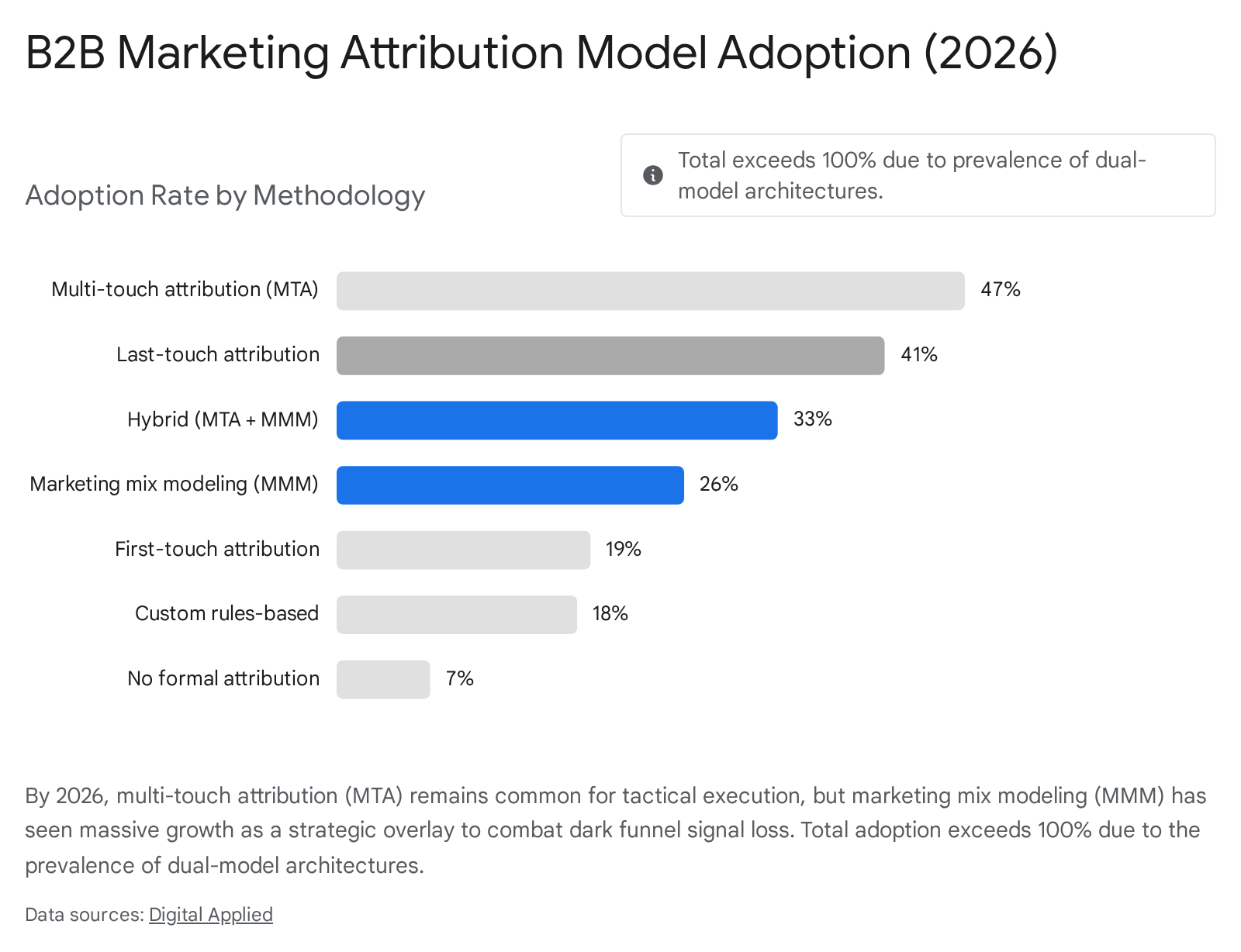
It has not been abandoned entirely because it remains highly useful for short-term, tactical optimizations and granular, day-to-day channel adjustments in environments where user-level tracking manages to survive 450. However, sophisticated organizations no longer utilize MTA data to dictate long-term strategic budget allocation.
The Resurgence of Marketing Mix Modeling
To combat pervasive signal loss, the industry has experienced a massive resurgence in the adoption of Marketing Mix Modeling (MMM). Statistical adoption of MMM tripled from a marginal 9% in 2023 to 26% in 2026 among B2B marketing teams 4. Historically viewed as a slow, prohibitively expensive process utilized primarily by fast-moving consumer goods (FMCG) enterprises, MMM has been democratized and modernized by advanced machine learning, real-time cloud-computing pipelines, and the release of open-source analytical frameworks by major technology companies 4543132.
Marketing Mix Modeling operates on a top-down, macroeconomic paradigm. Rather than attempting to track individual user journeys through broken dark social links and privacy barriers, MMM aggregates large volumes of historical time-series data 505433. It analyzes total marketing spend, gross impressions, macroeconomic indicators, competitor pricing, and seasonality against aggregate business outcomes (total sales, lead generation, or revenue) to determine deep correlation and causality through Bayesian hierarchical regression 505431.
Because MMM never evaluates a user-level cookie, IP address, or URL parameter, it is fundamentally immune to Apple's Link Tracking Protection, the EU Digital Markets Act, ad blockers, and dark social obfuscation 50545859. If a brand launches a major influencer campaign, an out-of-home billboard, or a podcast sponsorship that relies entirely on word-of-mouth dark social sharing, the specific resulting clicks will be lost to the direct traffic bucket. However, the MMM algorithm will detect the correlated spike in aggregate revenue occurring in the weeks following the media spend, properly calculating the adstock (delayed effect) and attributing the financial lift to the correct overarching campaign 45460.
In 2026, modern MMM platforms ingest structured data daily, run automated budget scenario simulations, calculate marginal Return on Ad Spend (ROAS) curves, and identify exact channel saturation points 473261. This allows Chief Marketing Officers to make strategic budget reallocations based on probabilistic statistical truth rather than deterministic tracking fiction.
Server-Side Tagging and First-Party Data Infrastructure
In parallel to the adoption of statistical modeling, technical web execution has shifted rapidly toward server-side tracking infrastructure. Traditional client-side tracking relies on the user's web browser downloading and executing a third-party tracking script provided by an analytics vendor or ad network. Server-side tracking fundamentally alters this flow by establishing a dedicated, first-party server container managed directly by the brand (e.g., Google Tag Manager Server-Side) 5062.
When a user interacts with a website, the behavioral data is sent directly to the brand's own server container as a first-party data stream. The server then filters, anonymizes, enriches, and selectively routes the data to external ad networks via secure Server-to-Server Application Programming Interfaces (APIs), such as the Meta Conversions API 62.
This architecture successfully bypasses browser-based ad blockers, defeats Apple's Intelligent Tracking Prevention restrictions on cookie lifespans, and significantly improves cross-device match rates 62. Furthermore, it ensures stringent compliance with data privacy regulations like the GDPR and CCPA by maintaining absolute, centralized control over exactly what personal data is transmitted to third parties 62. However, while server-side tagging is critical for data hygiene, it cannot solve the fundamental problem of the dark funnel: it cannot retroactively discover an origin source or referral header that was already stripped by WhatsApp or Slack before the user arrived at the site. It secures the data collected on the site, but remains completely blind to the dark social path leading to the site.
Qualitative Validation through Self-Reported Attribution
Because Marketing Mix Modeling lacks the micro-level granularity to identify specific niche communities, exact podcast episodes, or individual micro-influencers driving demand, organizations have widely institutionalized Self-Reported Attribution (SRA) to bridge the gap between statistical models and human behavior 30.
Self-Reported Attribution involves capturing qualitative, zero-party data directly from the buyer through high-friction conversion points 34. Most commonly, this takes the form of implementing a required, free-text field on inbound lead capture forms asking, "How did you hear about us?" 14730. This qualitative data acts as the ultimate validation layer against flawed analytics platforms.
When a prospective buyer writes, "A former colleague recommended you in the Pavilion Slack group," or "I heard the CEO discussing supply chain logistics on a podcast," SRA overrides the CRM's default algorithmic attribution (which inevitably flagged the visit as unassigned direct traffic) 147. While SRA is subject to human memory errors and bias, in 2026, advanced revenue platforms utilize specialized Large Language Models to automatically parse, categorize, and ingest these free-text responses at scale, deterministically reassigning the credit to the correct offline or dark channel without requiring manual review 4730.
To fully validate these findings, sophisticated marketing teams also deploy incrementality testing. By running controlled geo-holdout experiments - where a specific market is intentionally deprived of advertising spend while a statistically similar market receives a targeted dark social investment - analysts can measure the true causal lift of specific marketing activities independent of any attribution software tracking 473061.
| Measurement Framework | Foundational Data Source | Primary Enterprise Use Case | Effectiveness in Dark Social | Core Limitations |
|---|---|---|---|---|
| Multi-Touch Attribution (MTA) | Deterministic, user-level tracking (pixels, cookies, UTM parameters) 4850. | Short-term tactical campaign optimization and day-to-day channel adjustments 450. | Poor. Completely blind to encrypted messaging, zero-click LLM environments, and off-platform touchpoints 147. | Highly brittle under evolving privacy laws (DMA, GDPR) and iOS tracking protection 1050. |
| Marketing Mix Modeling (MMM) | Aggregated, top-down historical time-series data and macroeconomic variables 3360. | Strategic budget allocation, scenario planning, forecasting, and calculating marginal ROAS 45054. | Excellent. Captures aggregate revenue lift from word-of-mouth without requiring URL parameters or cookies 458. | Operates with a reporting time lag; lacks micro-level granularity to evaluate specific ad copy or creative assets 60. |
| Self-Reported Attribution (SRA) | Qualitative, zero-party data (free-text surveys, post-purchase questionnaires) 473034. | Validating offline/dark channel influence and identifying specific referral communities 4730. | Excellent. Directly asks the consumer to identify un-trackable podcast, Slack group, or influencer referrals 147. | Subject to human memory errors, recency bias, and inevitably lowers form completion rates 30. |
| Incrementality Testing | Controlled scientific experiments (e.g., geographic holdouts, A/B splits) 4730. | Proving the true causal lift of specific campaigns versus an organic, non-exposed baseline 4730. | Moderate. Can definitively prove if targeted dark social investments caused net-new revenue 30. | Expensive, computationally complex to design, and highly disruptive to execute continuously across all channels 30. |
Conclusion
The pursuit of perfect, deterministic marketing attribution in 2026 is an exercise in futility. A global convergence of privacy-focused consumer behavior, stringent regulatory frameworks like the European Union's Digital Markets Act, and aggressive technological interventions by operating system gatekeepers has expanded the dark social ecosystem to encompass the vast majority of the modern business buying journey. Platforms such as WhatsApp, Slack, Signal, and emerging generative AI tools systematically strip the tracking metadata required by traditional analytics platforms, resulting in massive quantities of highly valuable traffic being erroneously categorized as direct or unassigned.
However, the permanent loss of deterministic tracking does not equate to the loss of accurate financial measurement. Marketing organizations that successfully navigate the complex 2026 landscape have largely abandoned the false precision of legacy Multi-Touch Attribution in favor of unified, multi-layered measurement architectures. By deploying Marketing Mix Modeling to understand aggregate macroeconomic causality, implementing server-side tagging to secure compliant first-party data flows, and institutionalizing Self-Reported Attribution to capture qualitative dark channel intent, brands can maintain deep visibility into what actually drives sustainable revenue. Ultimately, the survival of digital marketing analytics depends on the industry's acceptance that while individual user journeys are increasingly untrackable, aggregate business impact remains entirely measurable.