Cultural influences on existential threat perception
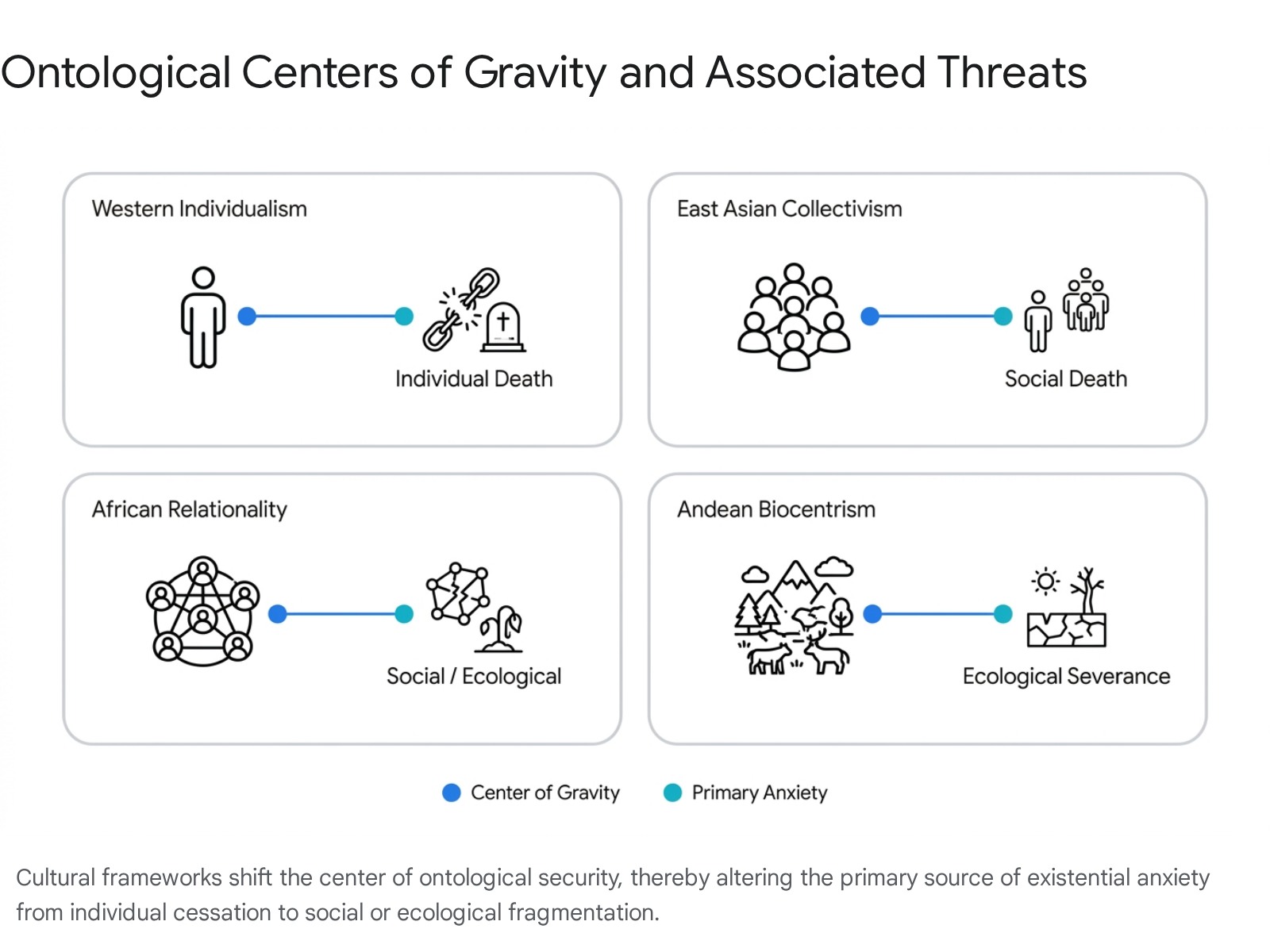
The human experience is inextricably linked to the awareness of mortality, vulnerability, and the fundamental unpredictability of the future. While existential anxiety is often characterized as a universal psychological condition, the specific phenomena that trigger the deepest fears - and the mechanisms deployed to mitigate them - are profoundly shaped by cultural paradigms. Historically, Western existentialist thought and psychological frameworks have positioned the individual at the center of the ontological universe, framing the cessation of the individual self as the ultimate existential dread. However, cross-cultural research demonstrates that this individualistic locus of fear is far from universal. Across different global contexts, the primary source of existential anxiety shifts dynamically from the annihilation of the individual to the fragmentation of the community, the severing of ecological balance, the erasure of cultural memory, or the failure to fulfill socially mandated roles. Cultural systems function primarily to provide a meaningful response to these existential realities, acting as an anxiety-buffer that offers structures of meaning to shield individuals from the paralyzing reality of their own fragility 12. When these cultural meaning systems are threatened by external forces, demographic shifts, or global crises, communities experience heightened existential terror.
Theoretical Frameworks of Cultural Anxiety
To understand how different societies process fear and unpredictability, empirical frameworks such as Geert Hofstede's Cultural Dimensions and the Inglehart - Welzel Cultural Map provide foundational metrics. These models demonstrate that macro-level societal values directly influence how populations perceive ambiguity, structural change, and external threats.
The Hofstede Uncertainty Avoidance Index
Geert Hofstede's concept of Uncertainty Avoidance (UAI) measures the extent to which members of a culture feel threatened by ambiguous, unstructured, or unknown situations 34. The fundamental issue underlying this dimension is how a society deals with the reality that the future can never be known, oscillating between attempts to control the future and pragmatic acceptance of unpredictability 56. Societies with high UAI scores - such as Japan, Russia, and Italy - experience significant nervous stress regarding the unknown and seek predictability through rigid social rules, comprehensive legal frameworks, and orthodox religious dogmas 367. In these cultures, the introduction of novel technologies or deviations from established social norms triggers acute anxiety, as ambiguity itself is perceived as a direct threat 45. Individuals in high-UAI cultures demonstrate a marked preference for structured learning, absolute truths, and risk-averse behavior, relying heavily on traditional coping mechanisms to alleviate the dread of the unknown 56.
Conversely, cultures with lower UAI scores, such as the United States and China, demonstrate a higher tolerance for unpredictability and exhibit a more pragmatic, relaxed attitude toward the future 567. Cross-cultural studies indicate that individuals in these societies do not feel inherently threatened by ambiguity, which allows them to experience lower baseline levels of anxiety and stress regarding long-term uncertainties 7. When individuals in low-UAI cultures face crises, they are more likely to adapt pragmatically rather than attempting to exert absolute control over the environment 58. It is important to note, however, that the UAI metric is not without limitations; modern psychological research suggests that within any given national culture, subcultural groups and individual differences can significantly modulate the expression of uncertainty avoidance, necessitating a nuanced application of Hofstede's framework in policy and clinical settings 910.
The Inglehart-Welzel Cultural Map
The World Values Survey (WVS), under the framework developed by political scientists Ronald Inglehart and Christian Welzel, visualizes global existential security through two primary axes: traditional versus secular-rational values, and survival versus self-expression values 111213. This model asserts that socioeconomic development is inextricably linked to predictable changes in a society's worldview and its perception of existential threats 1415.
Survival values, which focus heavily on physical and economic security, dominate in societies facing ongoing existential threats, extreme poverty, or socio-political instability 1416. In populations where basic survival is not guaranteed, cultural values tend toward ethnocentrism, intolerance of out-groups, and strict deference to authority, as the community prioritizes cohesion and security over individual liberties 141617. As societies transition from agrarian to industrial economies, and eventually to post-industrial knowledge economies, they undergo a shift in threat perception. The accumulation of unprecedented wealth and security allows successive generations to take basic survival for granted, precipitating a shift toward self-expression values 1113. These values prioritize environmental protection, gender equality, diversity, and participatory governance, replacing the fear of physical collapse with concerns over quality of life and human rights 131416.
The vertical axis of the Inglehart-Welzel map captures the shift from traditional values - which emphasize religion, parent-child ties, and national pride - to secular-rational values, where bureaucratic and scientific authority replaces religious dogma 1218. Consequently, macro-level existential security directly dictates whether a society perceives systemic change and diversity as a threat to its survival or as a mechanism for cultural growth 1617.
| Value Dimension | Primary Focus | Characteristics of Associated Societies | Perceived Existential Threats |
|---|---|---|---|
| Survival Values | Economic and physical security | Ethnocentric, low interpersonal trust, highly nationalist | Physical instability, foreign influence, economic collapse |
| Self-Expression Values | Quality of life, autonomy, diversity | Tolerant of out-groups, demand democratic participation | Environmental degradation, loss of civil liberties, inequality |
| Traditional Values | Religion, family authority, absolute standards | Rejection of divorce/abortion, high national pride | Secularization, breakdown of family structures, moral decay |
| Secular-Rational Values | Pragmatism, scientific authority | Separation of church and state, adaptable social norms | Dogmatism, authoritarian overreach, scientific ignorance |
Western Individualism Versus Relational Ontologies
In stark contrast to the Western emphasis on the autonomous individual, many global cultures operate on relational ontologies. In these frameworks, the individual does not exist prior to or independent of the community. Consequently, the greatest existential threat is not physical death, but social death - the severing of the ties that grant a person their humanity and identity.
Existentialism and the Autonomous Self
Western existentialist philosophy, forged largely during the nineteenth and twentieth centuries in Europe, is deeply rooted in the concept of individualism and the breakdown of traditional meaning structures 1920. Thinkers such as Jean-Paul Sartre, Albert Camus, and Martin Heidegger framed human existence around the isolated, finite individual who is "thrown" into an absurd universe 2122. Within this atheistic existentialist paradigm, physical death is viewed as the absolute limitation to human existence - a finality that closes the door on all possibilities and renders life inherently meaningless unless the individual actively constructs their own subjective purpose 1921.
This viewpoint relies on the premise that "existence precedes essence," meaning humans have no predetermined purpose or inherent nature; they exist first and must define themselves through autonomous choices 1922. Therefore, the primary existential anxieties in the Western paradigm revolve around individual mortality, the burden of absolute freedom, and the dread of failing to achieve authentic self-actualization before biological cessation 21922.
Ubuntu and Communitarian Survival in Sub-Saharan Africa
In sub-Saharan African philosophy, the concept of personhood is inherently relational, standing in direct opposition to Western individualism. This relationality is best captured by the Nguni philosophy of Ubuntu, frequently translated as "I am because we are" 232425. Ubuntu emphasizes that human identity, dignity, and survival are entirely dependent on community integration, shared responsibilities, and reciprocal care 2526. Rather than measuring psychological health through Maslow's hierarchy of needs - which posits that individuals must fulfill their own basic needs before extending themselves to others - Ubuntu operates on a socialistic premise where survival is achieved through brotherly care and collective resilience 2327.
Within this ontological framework, Western-style individualism - characterized by self-reliance, the pursuit of individual ambition, and the elevation of the ego - is viewed as an active existential threat to societal harmony 232426. The erosion of communal solidarity presents a deeper crisis than individual mortality, as an individual disconnected from the community effectively ceases to be fully human 2526. African scholars argue that the aggressive pursuit of capitalist individualism has introduced unprecedented existential anxiety into societies that previously relied on the structural safety net of the extended family and the philosophy of mutual trust 2427.
Yoruba Eschatology and the Dread of Social Erasure
This relational center of gravity is vividly illustrated in the indigenous thought of the Yoruba people of West Africa. Unlike Western existentialists who reject the spiritual world and view death as absolute finality, Yoruba ontology embraces the continuous, complementary existence of the physical and spiritual realms 21. The Yoruba view physical death (Iku) not as an end, but merely as a transition to the spiritual realm and a continuation of existence among the ancestors 1921. Because the soul (emi) is immortal and reincarnation (Atun-wa or Aku-da-aya) is anticipated for those who live righteous lives, the cessation of the biological body (ara) does not invoke the same absolute terror found in Western existentialism 192228.
Furthermore, Yoruba thought directly contradicts the Sartrean notion of absolute freedom, operating instead on a belief in predetermination and destiny. In this view, "essence precedes existence" - individuals are born to unfold a predetermined destiny 1922. The true existential dread in Yoruba culture is not death itself, but biological and social discontinuity - specifically, dying without children 2829. Barrenness is considered the "ultimate evil" (ai romo bi, opin isoro) because it implies that a person's entire being has been permanently removed from the lineage cycle, effectively erasing their existence from the fabric of the community and denying them the transition to honored ancestor status 29. Additionally, social shame is considered a fate worse than physical death. The Yoruba proverb iku ya j'esin signifies that death is a preferable alternative to living in disgrace, underscoring that social and moral annihilation is feared far more than biological mortality 21.
Collectivism, Face, and Social Integration in East Asia
Similar relational anxieties dominate East Asian collectivist societies, though they manifest uniquely through the deeply ingrained cultural concept of "face." Face represents a person's sense of worth, dignity, and identity within a hierarchical social network, heavily influenced by Confucian moral ideals 3031.
The Dual Nature of Face: Mianzi and Lian
In Chinese culture, face is conceptualized in two closely related forms: mianzi and lian 30. Mianzi refers to a person's social status, power, wealth, and prestige, while lian is explicitly connected to the community's evaluation of an individual's moral character and behavior 30. It is entirely possible for an individual to possess high mianzi due to wealth, but lack lian due to unethical conduct. Because East Asian selfhood is defined by enduring social networks rather than isolated autonomy, face is frequently shared across families, peer groups, and professional organizations 3132.
The loss of face (diu lian) functions as a profound existential threat to the social self. When individuals fail to meet societal expectations or perform their roles adequately in the presence of others, the resulting loss of face threatens to sever their social integration and invites communal shame 3334. This dynamic generates intense social anxiety, which operates differently from social anxiety in individualistic cultures. Studies show that individuals in collectivistic East Asian environments experience significant psychological exhaustion directly tied to the hyper-vigilant burden of preserving their reputation and the reputation of their in-group 3235. For instance, Chinese youth frequently report high levels of social anxiety regarding their self-presentation on digital platforms like WeChat, driven by the fear of negative evaluation from their broader social circle 32. In this cultural paradigm, the fear of being ostracized leads to behaviors heavily oriented toward face-saving, conflict avoidance, and submission to group harmony, as physical survival without social face is considered a state of profound alienation 3234.
National Face and Cross-Cultural Conflict
The concept of face extends beyond the individual and the immediate family, operating significantly at the macro-national level. Because identity in East Asia is heavily tied to group membership, citizens frequently experience feelings of face gain or face loss on behalf of their nation 31. This "national face" dictates geopolitical responses and international relations. A seminal example is the 2001 collision between a Chinese F-8 fighter jet and a U.S. EP-3 spy plane over Hainan Island. The diplomatic standoff that followed was fundamentally a crisis of national face; both nations viewed the event as a threat to their global prestige, and the resolution required the U.S. government to carefully calibrate its expressions of regret to provide a "face-saving" exit for both sides 31. This demonstrates that threats to social perception and collective honor can provoke crises as severe as direct material or physical threats.
Collectivism, Meaning-Making, and Misinformation
The psychological structures of collectivism also influence cognitive responses to uncertainty and threat. Cultural mindsets prioritizing group harmony and belonging frequently engage in heightened "meaning-making" when confronted with ambiguity 36. Research indicates that individuals primed with collectivist mindsets are more likely to seek common ground and generate explanations for vague or empty claims 36. While this facilitates social cohesion, it also creates an unintended vulnerability: high-collectivism environments can become fertile territory for the spread of misinformation, pseudoscience, and fake news 36. Because the existential drive to connect and agree with the in-group is so strong, individuals may validate objectively false information if it serves to maintain group harmony or alleviate collective anxiety 3637. This reveals a complex paradox where the mechanism designed to provide social security simultaneously exposes the group to epistemic risks.
Biocentrism and Ecological Vulnerability
While collectivism expands the locus of the self to encompass the human community, biocentric worldviews expand it further to include the entire natural environment. In the Andean and Amazonian regions of Latin America, the indigenous paradigm of Buen Vivir (translated conceptually as "Good Living," or Sumak Kawsay in Quechua, Suma Qamaña in Aymara, and Teko Kavi in Guaraní) offers a radical departure from anthropocentric models of security 383940.
Buen Vivir and the Rejection of Extractivism
Buen Vivir rejects the Western linear model of economic development, accumulation, and extractivism, which views the natural world merely as an inexhaustible supply of resources available for exploitation 3941. Instead, it defines well-being through strict harmony, reciprocity, and interconnectedness between individuals, communities, and nature, recognizing the natural environment as a subject possessing inherent legal and moral rights 404142. From the perspective of Buen Vivir, the preeminent existential threat to humanity is not a lack of economic growth or the cessation of the individual, but the anthropocentric, individualistic perspective of the liberal self 3841.
Latin American scholarship critiques traditional Critical Security Studies (CSS) for its excessive focus on the individual referent of security ("me"), arguing that this individualistic bias renders modern institutions incapable of addressing systemic global insecurities such as catastrophic climate change, pandemics, and widespread hunger 38. Because Buen Vivir posits that humans and non-human entities are inextricably linked, the degradation of the ecological balance represents an immediate, existential threat to survival 384041. The anxiety here is generated by the commodification of life and the unbridled industrialization resulting from Western accumulation models, which indigenous populations view as a path to mutually assured destruction rather than a solution to human vulnerability 4142.
Constitutional Enshrinement in the Andes
The principles of Buen Vivir have transcended indigenous philosophy to become powerful political and pedagogical tools. In an effort to mitigate the existential dread generated by globalized extractivist capitalism, Ecuador (2008) and Bolivia (2009) revised their state constitutions to enshrine Buen Vivir as a fundamental right, alongside the rights of nature 4142. By legally mandating a new form of citizen coexistence based on diversity and harmony with nature, these constitutional processes represent a systemic attempt to subvert colonial patterns of power and redefine what constitutes security and development in the twenty-first century 384142.
Theological Ontologies and Eschatological Anxieties
In populations where religious frameworks provide the dominant lens for interpreting reality, existential threats are processed through specific theological and eschatological doctrines. The nature of the threat depends entirely on the ontological reality postulated by the religion, challenging secular assumptions about the universality of fear.
The Illusion of Self in Buddhism and Hinduism
In Eastern spiritual traditions, particularly Hinduism and Buddhism, the fundamental problem of existence is not biological death, but the endless cycle of rebirth and suffering known as Samsara 434445. However, their respective anxieties and ultimate goals diverge based on their divergent views of the self.
In Hinduism, the core existential delusion is the belief that the individual soul (Atman) is separate and distinct from the ultimate cosmic reality or universal soul (Brahman) 4445. The anxiety stems from spiritual ignorance and the accumulation of negative karma, which traps the eternal soul in the physical suffering of the material world. The resolution to this dread is Moksha - the liberation from the cycle of reincarnation and the realization of eternal union with the divine 434446. Because the self is permanent and eternal, the fear is merely its temporary delusion and prolonged suffering.
Buddhism, conversely, explicitly rejects the existence of a permanent, eternal self, operating on the doctrine of Anatta (non-self) 4644. From a Buddhist perspective, existential angst and suffering (Dukkha) are generated entirely by humanity's ignorant clinging to the illusion of a stable ego in a universe characterized by absolute impermanence 4644. The threat is not the loss of the self, but rather the desperate, futile attempt to preserve it. The ultimate goal, Nirvana (derived from the Sanskrit for "blown out" or "extinction"), is the cessation of craving, ignorance, and the false sense of self, leading to liberation from rebirth 4345. To a Western existentialist, the annihilation of the ego represents the ultimate dread; to a Buddhist, the realization of emptiness represents the ultimate liberation from dread 454644.
Islamic Epistemology and Global Risk Perception
While the contemporary field of existential risk studies - which examines catastrophic threats like nuclear war, unchecked artificial intelligence, and ecological collapse - is predominantly framed through a Western, secular-rational, and scientific lens, religious communities process these same threats through distinct moral and theological imperatives 4546.
Recent anthropological research investigating Muslim communities in France and the United Kingdom highlights that Islamic traditions utilize the multifaceted concept of 'ilm (knowledge, encompassing both the spiritual and the material) to conceptualize humanity's vulnerability to global catastrophes 4546. Instead of viewing an existential threat strictly as an engineering problem or a policy failure, theologically informed perspectives interpret these crises through the lens of human stewardship, moral failing, and divine sovereignty, drawing upon traditional sources such as the Qur'an, sunna, fiqh (jurisprudence), and tasawwuf (Sufism) 4546. The secular assumption that modern technological risks require exclusively secular, scientific solutions often dismisses the value-based, eschatological frameworks that drive radical action, ethical restraint, and psychological resilience within highly religious populations 4546.
Economic Security and Secularization in Muslim Regions
Interestingly, the influence of religious framing on threat perception remains sensitive to underlying economic conditions. Applying the Inglehart-Welzel hypothesis regarding survival versus self-expression values to Muslim-majority republics within the Russian Federation, researchers found that economic prosperity directly correlates with higher secularization and lower objective religiosity 47. Wealthier regions such as Tatarstan and Bashkiria exhibit lower adherence to behavioral religiosity (e.g., fasting, frequent prayer, mosque attendance) and subjective religiosity compared to less economically secure regions in the North Caucasus, such as Chechnya and Dagestan 47. This dynamic reinforces the sociological principle that as existential, physical, and economic security increases, societies gradually shift reliance away from traditional theological safeguards, altering how the population conceptualizes and manages existential dread 1447.
| Theological Framework | Nature of the Self | Primary Existential Threat | Ultimate Resolution |
|---|---|---|---|
| Hinduism | Atman (eternal soul identical to Brahman) | Ignorance of divine unity; entrapment in Samsara | Moksha (liberation and union with the universal soul) |
| Buddhism | Anatta (impermanent, illusory ego) | Clinging to the illusion of self; suffering (Dukkha) | Nirvana (cessation of craving and ego extinction) |
| Islam | Created being entrusted with divine stewardship | Moral failing; lack of 'ilm; neglecting stewardship | Submission to divine will; ethical living in preparation for the hereafter |
Modernity and the Threat of Epistemic Erasure
Beyond physical mortality and ecological collapse, the advent of the algorithmic age has generated profound modern anxieties regarding cultural continuity, data sovereignty, and epistemic survival, particularly in the Global South. The rapid diffusion of Artificial Intelligence (AI) and centralized digital platforms - largely designed, owned, and controlled by multinational corporations based in the Global North - has given rise to the phenomenon of "digital colonialism" 484950.
The Mechanics of Digital Colonialism
Digital colonialism describes the systemic extraction of data from marginalized communities without reciprocal benefit, alongside the imposition of foreign technological infrastructures that exert control over local economies, behaviors, and cultures 485152. For populations in Latin America, Africa, and parts of Asia, this represents an existential threat to sovereignty and self-determination 4951. Because an estimated 98% of AI research originates from wealthy institutions in the West or China, the resulting algorithms inherently embed cultural assumptions, biases, and priorities that are frequently irrelevant, or actively harmful, to the Global South 53.
This asymmetrical power dynamic induces a profound anxiety of erasure. The Global South is increasingly treated as a source of cheap labor for data annotation, content moderation, and algorithmic training, while the economic wealth and computational sovereignty remain concentrated in established global power centers 5051. The dread associated with data colonialism mirrors historical imperialism: the fear is that developing nations will be relegated to passive testing grounds and digital resource mines, resulting in the homogenization of global thought and the loss of autonomous technological futures 485051. To combat this existential threat, scholars and activists advocate for South-South technology cooperation, the establishment of community-controlled data trusts, and investments in indigenous digital infrastructures to ensure that technology serves local welfare rather than external profit 4952.
Cultural Commodification and Linguistic Asymmetry
The threat of epistemic erasure is compounded by linguistic exclusion and the commodification of marginalized cultures. AI systems, content recommendation engines, and automated moderation tools chronically underperform in low-resource languages spoken predominantly in developing nations 51. Consequently, legitimate local speech is frequently suppressed by poorly trained algorithms, while culturally specific hate speech circulates unchecked due to the lack of linguistic and cultural context 51.
Furthermore, digital platforms actively facilitate the commodification of marginalized identities, a process where individuals with privilege claim ownership over traditions while the originating communities lose control of their own narratives 5455. A stark example of this digital cultural colonialism involves the appropriation of Transylvanian ethnography on social media platforms like TikTok, where foreign influencers exploit regional heritage for profit, branding themselves as authoritative cultural archivists despite lacking genuine ties to the community 54. This dynamic violates fundamental cultural rights, including the right to cultural self-determination and the transmission of traditional knowledge 54. Moreover, when large-scale digital infrastructures accumulate and prioritize biased cultural content, they reinforce dominant Western epistemologies, effectively rendering cultures outside the dominant system as "lesser" or merely exotic 5556. The existential anxiety here is not physical death, but the structural erasure of a community's historical memory and intellectual autonomy.
Generational Shifts in Global Threat Perception
Existential anxieties are not static within cultures; they evolve dynamically across generations, particularly as younger cohorts inherit systemic, planetary crises that older generations did not face during their formative developmental years. The interpretation of these threats often fractures along age and gender lines.
Climate Anxiety and the Emotional Divide
The most pronounced global generational divide regarding existential threat revolves around climate change. Polling data collected globally in 2024 and 2025 consistently reveals that Generation Z and Millennials bear a disproportionate emotional burden regarding environmental collapse compared to older cohorts 5758. According to a comprehensive GlobeScan study across 31 markets, 38% of Gen Z respondents report feeling stressed or anxious most or all of the time, more than double the rate (17%) reported by Baby Boomers and older adults 58. Nearly half (49%) of Gen Z respondents state they are "greatly personally affected" by climate change, viewing it as a direct, intimate threat to their future survival, compared to only 38% of older generations 58.
Crucially, this generational gap is primarily emotional rather than cognitive. Research conducted by Cardiff University and the University of Bath indicates that there is little generational difference in the actual belief in the causes and physical impacts of climate change 5960. In fact, data from the European Investment Bank (EIB) reveals that European respondents over the age of 30 actually demonstrated a greater technical knowledge of the causes and solutions to climate change (scoring 6.47/10) compared to those under 30 (5.99/10) 61. The divergence lies entirely in the emotional response: younger generations experience significantly higher rates of fear, guilt, and outrage regarding the phenomenon, driving a crisis of confidence, feelings of betrayal by political institutions, and a demand for radical action 58596062.
Furthermore, climate anxiety intersects significantly with gender and geography. Multiple cross-national studies indicate that women consistently report higher levels of climate-related worry, ecological sadness, and negative emotions than men 626364. Geographically, while the Global South is often more physically vulnerable to climate disasters, studies comparing European and African cohorts found that the personal, perceived experience of climate change impacts is a stronger predictor of acute climate anxiety than geographic location itself 63. However, respondents in nations like India, Nigeria, and the Philippines reported a stronger overall psychological impact from climate change than those in the United States or Finland, highlighting how regional exposure amplifies underlying dread 62.
When coping with these existential stressors, generational variations are stark. Studies indicate that Generation X tends to rely on pragmatic, problem-solving coping strategies and associates personal growth with career achievement and self-reliance 65. In contrast, Generation Z favors social support, mindfulness, and expressive coping approaches, showing a much greater openness to seeking professional psychological help and prioritizing emotional well-being over traditional markers of stability 65.
| Generation / Cohort | Primary Response to Climate Threat | Preferred Coping Mechanisms | View of Mental Health Support |
|---|---|---|---|
| Baby Boomers / Gen X | Higher technical awareness, lower emotional distress | Pragmatic problem-solving, self-reliance, career stability | Higher stigma, reliant on traditional resilience narratives |
| Millennials / Gen Z | High existential dread, outrage, feelings of institutional betrayal | Social support, mindfulness, expressive coping | Open to psychological help, focus on emotional well-being |
Ageism and the Demographic Context of Aging Anxiety
The fear of aging, cognitive decline, and social obsolescence is another potent anxiety that manifests differently depending on cultural attitudes toward the elderly (ageism) and specific demographic realities. Research comparing the United States and Japan reveals how the interplay of collectivism and national demographics modulates this fear 6667.
In highly individualistic cultures like the United States, where personal autonomy, self-reliance, and economic productivity are paramount, age bias tends to be more pronounced, and aging is often feared as a loss of independence 6668. However, a recent cross-cultural study indicated that the association between aging anxiety and explicit ageism operates differently between the two nations 67. In Japan - a "super-aging" society with the highest proportion of older adults globally and longer life expectancies - the level of aging anxiety is positively associated with higher levels of ageism across all age groups, regardless of whether the respondent is young or old 66676970.
While social identity theory suggests that collectivist cultures generally harbor less implicit age bias and greater warmth toward older adults due to traditional values of respect (e.g., filial piety) 6670, the severe demographic pressure of a rapidly aging population in Japan creates a systemic anxiety that permeates the entire culture. The overwhelming burden placed on the social infrastructure challenges traditional models of intergenerational support, causing both young and old Japanese citizens to view aging with significant apprehension 6970. In contrast, in the United States, aging anxiety is positively associated with higher ageism primarily among older adults themselves, rather than the youth 6667. This indicates that while cultural values (individualism vs. collectivism) shape baseline attitudes toward the elderly, the sheer demographic reality of a society can override traditional protections, elevating aging to a society-wide existential concern.
Conclusion
The perception of what constitutes an existential threat is not a universal biological constant, but a highly subjective construct shaped by the ontological, religious, and socio-economic foundations of a given culture. For societies rooted in Western individualism, the ultimate dread remains the cessation of the biological self, the loss of personal autonomy, and the failure to achieve self-actualization. However, an exhaustive global analysis reveals that billions of individuals locate their center of ontological security elsewhere, radically altering their threat perceptions. For communities practicing Ubuntu in Sub-Saharan Africa or Yoruba traditions in West Africa, physical death is viewed merely as a transition; true annihilation is defined by social isolation, barrenness, and communal shame. In East Asian cultures, the loss of social face threatens the deeply embedded relational self, generating profound psychological distress and driving hyper-vigilant social behaviors.
Furthermore, as the world transitions through advanced stages of modernity, new systemic threats interact with traditional cultural values in complex ways. In Latin America, biocentric philosophies such as Buen Vivir identify the commodification of nature and extractivism as the preeminent dangers to human continuity, seeking constitutional protections for the environment to ensure collective survival. In the Global South, the extraction of data and the imposition of foreign AI algorithms raise acute fears of digital colonialism and epistemic erasure, threatening the cultural sovereignty of marginalized populations. Meanwhile, globalized phenomena such as climate change are generating historically unprecedented levels of emotional distress among younger generations, transcending borders but fracturing societies along age and emotional lines. Ultimately, any attempt to address global crises - whether environmental, technological, or public health-related - must recognize that mitigating fear requires protecting not just physical survival, but the diverse, culturally specific frameworks of meaning that make human life tenable.