
Cross-regional analysis of young adults living with parents 2020-2026
1. Introduction: The Paradigm Shift in Modern Adulthood
The transition from adolescence to adulthood has historically been demarcated by a predictable succession of socioeconomic milestones: the completion of formal education, successful integration into the labor market, the achievement of financial independence, and ultimately, the establishment of an autonomous household. Throughout the latter half of the twentieth century, particularly within the Anglosphere and Western European democracies, this trajectory was heavily normalized. However, the first half of the 2020s has witnessed a profound and accelerating disruption of this traditional sequence. In the wake of the global COVID-19 pandemic, subsequent inflationary shocks, the normalization of remote work, and a pervasive decoupling of real estate costs from wage growth, the phenomenon of young adults remaining in or returning to their parental homes - often colloquialized as the "boomerang generation" - has solidified from a temporary crisis response into a permanent structural reality 122.
As of 2026, the assumption that the early twenties necessitate immediate residential independence has been thoroughly dismantled across both developed and developing economies. This shift is frequently filtered through a culturally restrictive, Western-centric lens that pathologizes delayed independence as a generational failure. Media narratives and cultural commentary frequently deploy tropes of a "lazy generation" or highlight contemporary workplace phenomena such as "quiet quitting" and "lazy girl jobs" to explain why young adults are seemingly refusing to participate in the traditional economy 45. Yet, empirical data harvested from global institutions - ranging from the Organisation for Economic Co-operation and Development (OECD) and the African Development Bank (AfDB) to the Asian Development Bank (ADB) and local demographic bureaus - reveals a vastly different reality. The delay in household formation is not a psychological aberration but a highly rational, strategic economic adaptation to hostile structural environments 23.
Furthermore, analyzing this trend purely through the lens of housing costs and post-2020 inflation ignores profound sociological evolutions. Declining fertility rates, extended higher educational timelines, delayed marital unions, and the hidden, rapidly growing burden of young adult caregiving are equally responsible for reshaping the modern household 456. This report provides an exhaustive, multi-regional analysis of the living arrangements of young adults, prioritizing post-2020 and recent 2023 - 2026 data. By distinguishing clearly between cultural commentary and institutional empiricism, and by broadening the analytical scope beyond Euro-centric frameworks to include Latin America, Sub-Saharan Africa, and East Asia, this document evaluates the structural redefinition of delayed adulthood in the twenty-first century.
2. Taxonomic Complexities: Defining "Young Adulthood" and Methodological Divergences
Before cross-national comparisons can be accurately drawn, it is imperative to address the taxonomic inconsistencies in how global research bodies define "young adults" and measure "co-residence." The age brackets utilized in demographic analyses often dictate the narrative outcomes, and failing to distinguish between emerging and established adulthood obscures the true severity of localized housing and labor crises.
2.1 The Stratification of Age Brackets
Demographic institutions generally bifurcate young adulthood into two distinct phases, though the exact parameters vary by region, agency, and longitudinal study:
- Emerging Adulthood (Ages 18 - 24): This cohort encompasses individuals primarily engaged in the transition from secondary education to higher education or initial labor market entry. High rates of parental co-residence in this bracket are largely expected globally and are heavily correlated with educational enrollment. In the United States, 2023 data from the Current Population Survey indicates that 57.1% of 18-to-24-year-olds resided in the parental home, dropping slightly from a pandemic peak of 59.2% in 2020 7. The convergence of part-time and full-time student co-residence rates (63.2% and 66.9%, respectively, in 2023) highlights that for this younger cohort, living at home is less a marker of economic failure than an educational necessity 7.
- Established Adulthood (Ages 25 - 34): This bracket represents the critical demographic for assessing structural economic friction. Historically, individuals in their late twenties and early thirties were expected to have achieved residential autonomy and begun family formation 89. Consequently, rising co-residence rates within the narrower 25 - 29 and broader 30 - 34 brackets serve as primary indicators of systemic barriers. For example, the United Kingdom saw the share of 25-to-29-year-olds living with parents rise from 20% in 2006 to 28% by 2024, representing a substantial delay in expected independence 3.
2.2 Methodological Variances in Institutional Data
Definitions of what constitutes a "household" and "co-residence" vary drastically across databases, complicating comparative analysis. The European Union's statistical office, Eurostat, measures young people "living with their parents or contributing to/benefiting from the household income," which captures a broader spectrum of financial dependency even if physical separation exists in some complex living arrangements 10. Conversely, the US Census Bureau and the American Community Survey (ACS) define parental co-residence strictly as living in a household headed by one's own parent(s) or a spouse's parent(s) 714.
In Asian and Latin American contexts, the very definition of the "nuclear family" differs. Data from the Hakuhodo Institute of Life and Living ASEAN (HILL ASEAN) regarding Vietnam, for instance, highlights a slow transition from traditional multi-generational households to flexible "startup" family structures, making it difficult to ascertain whether a 28-year-old living at home is demonstrating "delayed independence" due to economic stagnation, or simply fulfilling cultural expectations of filial piety 1112. Similarly, South Africa's Statistics South Africa (Stats SA) notes that "skip generation" households (grandparents living with grandchildren) comprise 4.2% of all households, while only 31.4% of children live with both biological parents, deeply complicating the traditional Western metric of a young adult "returning" to a nuclear parental home . These variances mandate a nuanced approach to cross-regional data interpretation.
3. Global Statistical Framework: Empirical Rates of Co-residence
To fully grasp the magnitude of the shift in established adulthood, an examination of the 25 - 29 age bracket globally is essential. The data reveals a staggering variance driven by a complex interplay of local real estate markets, labor opportunities, and entrenched cultural baselines.
3.1 Comparative Analysis of Established Adulthood (Ages 25 - 29)
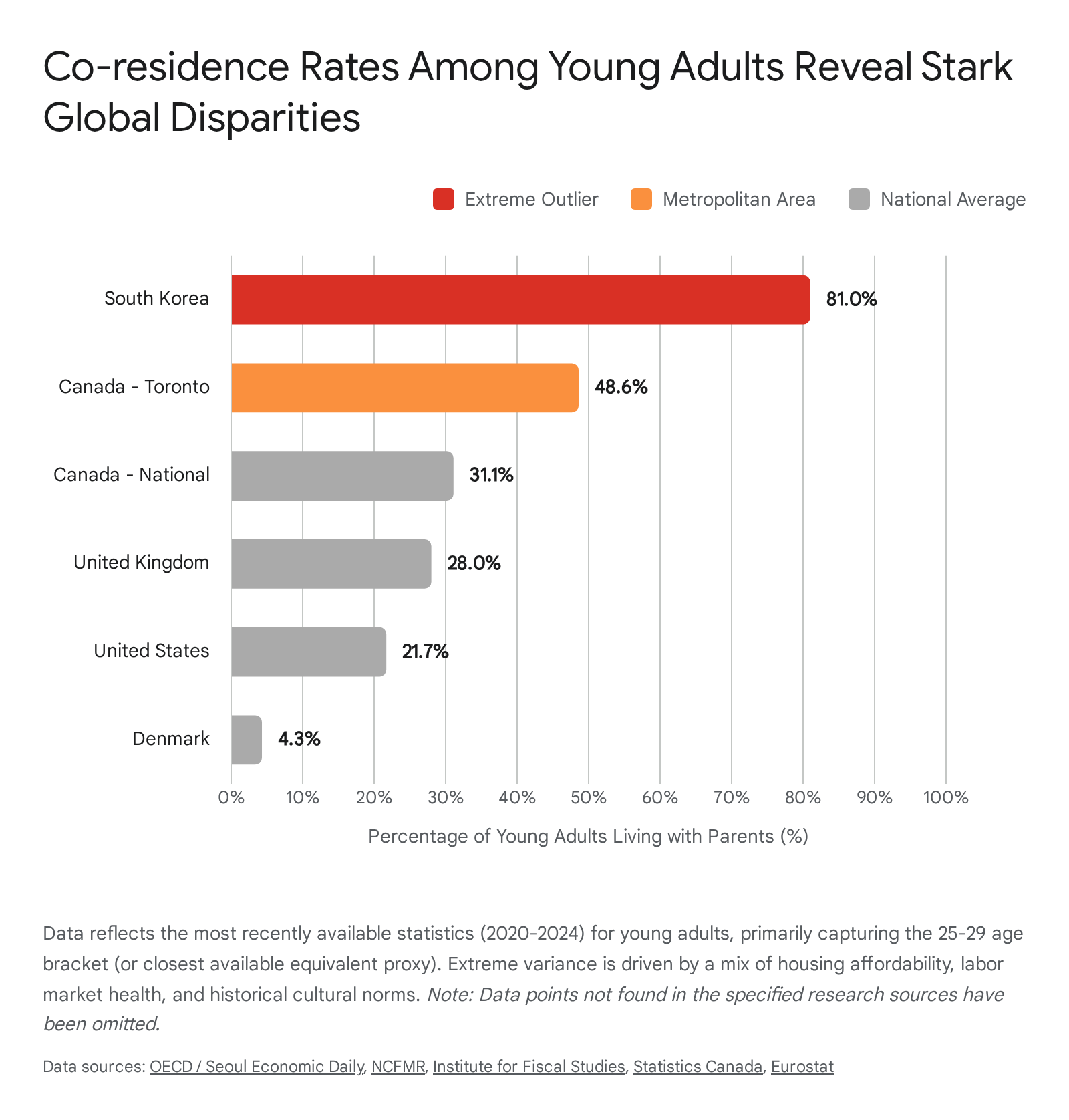
The following table synthesizes recent data (2021 - 2026) across diverse global economies, illustrating the percentage of young adults in the critical 25 - 29 age bracket who remain in the parental home.
| Region / Country | Age Bracket | % Living with Parents | Reporting Year | Primary Catalysts & Institutional Notes | Data Source / Institution |
|---|---|---|---|---|---|
| South Korea | 20 - 29 | 81.0% | 2024/2026 | Extreme labor market bottlenecks; high housing costs; cultural shifts. Highest reported rate in the OECD. | KOSTAT / OECD 1314 |
| Mexico | 25 - 29 | ~60.0%+ | 2023/2025 | Deep cultural norm of multi-generational support; economic necessity; housing speculation. | INEGI / Census 20 |
| European Union (Avg) | 15 - 29 | 26.5% (Overcrowded) | 2024 | Averages mask deep divides. South/East EU heavily reliant on co-residence. Over 60% of 25-29 cohort in specific southern nations. | Eurostat 10 |
| Canada (Toronto) | 25 - 29 | 48.6% | 2021/2026 | Acute metropolitan housing affordability crisis decoupling from local wages. | Statistics Canada 15 |
| Australia | 20 - 24 | 51.0% (M) 43.0% (F) |
2021/2023 | Housing unaffordability; declining full-time entry-level roles. Sharpest increase in two decades. | ABS / AIFS 16 |
| Japan (Tokyo Metro) | 20 - 29 | 37.7% | 2025 | Exorbitant urban living costs; explicit desire among youth to accumulate savings. | Lifull / Stat Bureau 17 |
| Canada (National) | 25 - 29 | 31.1% | 2021/2026 | Down-payment barriers; educational prolongation. Double the rate of Baby Boomers at the same age. | Statistics Canada 15 |
| United Kingdom | 25 - 29 | 28.0% | 2024 | Rising rent burdens; notable ethnic variances (e.g., Bangladeshi communities at 41%). | Inst. for Fiscal Studies 3 |
| United States | 25 - 29 | 21.7% | 2023 | High urban rents; interest rates; student debt. Down from 2020 peak but historically elevated. | US Census / NCFMR 7 |
| Denmark / Finland | 25 - 29 | 4.3% / 6.4% | 2024 | Robust social safety nets; subsidized student housing; cultural emphasis on early autonomy. | Eurostat 10 |
The data underscores a critical reality: the Anglosphere's historical expectation of residential independence by age 25 is increasingly an anomaly when viewed through a global lens. In Canada, Millennials aged 25 to 39 in 2021 were twice as likely (16.3%) to live with their parents as Baby Boomers were at the exact same age in 1991 (8.2%) 215. When drilling down into the 25 - 29 cohort, the Canadian national average reaches 31.1%, spiking to an astonishing 48.6% in the high-cost Toronto metropolitan area 15. Similarly, in the United States, 19.1% of all adults aged 25 - 34 lived in parental homes in 2022, totaling approximately 8.5 million individuals, a figure that remains highly elevated compared to the sub-12% rates seen two decades prior 1.
4. The Economics of Delayed Independence: Structural vs. Behavioral Factors
The primary catalysts for the expansion of the boomerang generation are deeply structural, rooted in macroeconomic shifts that have functionally altered the wealth-building capacity of young adults in the 2020s. While cultural commentary often attributes delayed independence to a shift in generational work ethic, the empirical evidence points to insurmountable mathematical barriers in housing and labor markets.
4.1 The Decoupling of Real Estate and Wage Growth
The most universally cited driver of delayed household formation is the global housing affordability crisis. Over the past decade, urban rents have vastly outpaced wage growth. In the United States, analyses indicate that urban rents climbed by approximately 4% annually over the last decade, while real wages for full-time workers increased by a mere 0.6% per year 2. Simultaneously, the median home price in the US surged by roughly 90% over ten years - surpassing $400,000 - pushing the median age of a first-time homebuyer from 31 to 38 2.
This dynamic is not isolated to North America. In Japan, 37.7% of respondents in their twenties living in the Tokyo metropolitan area reside with their parents 17. For this demographic, the primary motivation (cited by 48.6% of twenty-somethings and 47.0% of thirty-somethings) is the explicit desire to save money against exorbitant living costs, even when it requires commuting 60 minutes or more to work 17. In the UK, the Institute for Fiscal Studies (IFS) reported in 2025 that young adults living with parents would face an average of £560 per month in rent if they lived independently - a figure that scales to £1,000 in London 3.
The COVID-19 pandemic introduced an entirely new catalyst: the mass adoption of remote work. While initially hailed as a democratizing force for labor, remote work un-tethered highly compensated professionals from core urban centers, allowing them to migrate to secondary markets and suburban zones. This influx of capital artificially inflated housing markets across historically affordable areas, exacerbating the housing shortage and pricing local young adults out of their hometowns 29.
The impact of housing supply on co-residence is empirically verifiable and highly sensitive to localized zoning regulations. In US municipalities that have radically deregulated zoning to allow rapid housing construction, such as Austin, Texas, rents fell by up to 22% over two years, resulting in a regional co-residence rate among working young adults of just 6%, compared to nearly 20% in the constrained, highly regulated market of Greater Los Angeles 2. Similarly, Eurostat data reveals that in 2024, 9.7% of young people (aged 15-29) in the EU lived in households that spent 40% or more of their disposable income on housing, highlighting severe housing cost overburden 10.
4.2 Labor Market Frictions and the "Kangaroo Tribe"
While Western analyses focus heavily on real estate, labor market friction is the dominant variable driving co-residence in many advanced Asian economies and the Global South. South Korea presents the most extreme case study of delayed independence among OECD nations, with 81% of 20-to-29-year-olds living with their parents as of recent data 1314.
South Korean society has coined the term "Kangaroo Tribe" to describe adults who have completed higher education but remain financially tethered to the parental pouch due to intense employment competition and precarious labor conditions 1318. The structural bottleneck is severe: in 2024, it took South Korean youth aged 15 - 29 an average of 11.5 months to secure their first job after graduation from their final educational institution - the longest delay recorded since 2004 19. Furthermore, by mid-2024, nearly 238,000 young South Koreans had been searching for work for over three years, accounting for 18.4% of the unemployed youth demographic 19. Consequently, housing becomes a secondary issue; without initial labor market entry, residential independence is mathematically impossible.
In Sub-Saharan Africa, the demographic window is heavily constrained by systemic underemployment rather than aging populations. The African Development Bank (AfDB) notes that Africa possesses the world's youngest population, projected to reach 830 million youth by 2050, presenting an unparalleled demographic window of opportunity 2021. However, these assets remain largely untapped. Between 10 and 12 million young Africans enter the labor market annually, competing for only 3 million formal sector jobs created each year 20. Two-thirds of Africa's young people are unemployed, discouraged, or trapped in precarious informal work 20. This structural deficit renders independent household formation unattainable for the vast majority, sustaining the multi-generational household as an absolute necessity for survival and driving the motivation for out-migration, which the AfDB notes can lead to appalling regional tragedies 2022.
In South Africa, the extreme lack of youth opportunity has resulted in a deep reliance on the state. By 2024, 40.1% of individuals relied on government funding, a surge driven by the introduction of the special COVID-19 Social Relief of Distress (SRD) grant . This level of dependency ensures young adults remain tethered to extended family networks, pooling microscopic state resources to manage basic household survival.
5. Cultural Commentary vs. Empirical Reality: Deconstructing the "Lazy" Narrative
The friction between empirical economic data and prevailing cultural commentary forms a major subtext of the boomerang phenomenon. Across Western media, Generation Z and Millennials are frequently subjected to narratives characterizing them as entitled, adverse to hard work, or inherently "lazy." Phenomena such as the viral "lazy girl jobs" trend, the embrace of "quiet quitting," and the rise of crypto-bro culture are often cited by older generations as evidence of a moral and psychological decay regarding labor 45.
However, sociological and economic analyses reveal that these behavioral shifts are not symptoms of laziness, but rather logical, rational adaptations to an economic system that no longer rewards traditional labor with traditional milestones 429. As noted in critical sociopolitical commentary, "That doesn't make Gen Z lazy or entitled - it makes them collateral damage in a system built to exhaust, not sustain... Gen Z's fight is not against Baby Boomers - it's against the architecture that made their decline inevitable" 29. Young adults are disengaging from the hyper-competitive corporate ladder precisely because the historical reward for climbing it - a single-family home and financial security - has been structurally removed.
Empirically, living at home is functioning as a highly effective wealth-preservation strategy in a hostile macroeconomic environment. According to 2025 IFS data in the UK, 14% of young adults living with their parents managed to save more than £10,000 in net financial wealth over a two-year period (effectively an additional £400 monthly) 3. This savings rate is more than a third higher than the 10% rate achieved by demographically similar young adults forced into the private rental market 3. Therefore, the choice to remain in the parental home is rarely a symptom of indolence; rather, it is a calculated financial hedge against inflationary pressures, allowing young adults to accumulate the capital necessary to eventually bypass the rental trap and enter homeownership directly.
Furthermore, contrary to narratives suggesting young adults are anti-social isolates, Pew Research (2024) indicates a high degree of domestic harmony in these arrangements. Most parents (45%) say living with their young adult child has a "very positive" impact on their relationship, while 69% of young adults report they can be their "true self" with their parents all or most of the time 9.
6. Sociological Shifts: The Transformation of Demographic Milestones
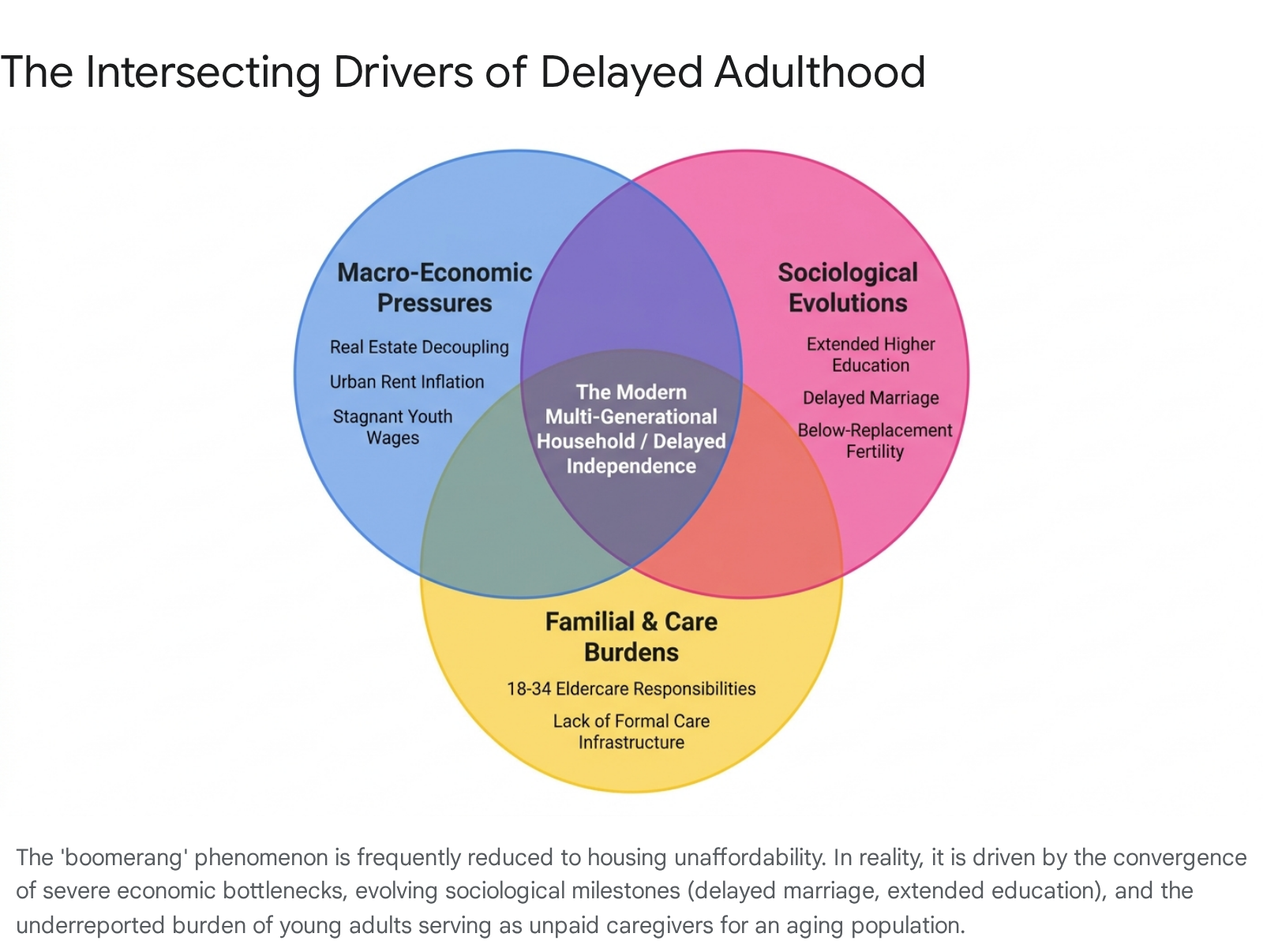
While housing and labor constraints provide the immediate catalysts for co-residence, they act as accelerators upon deeper, underlying sociological tectonic shifts. The delay in household formation is intrinsically linked to global shifts in marriage, fertility, higher education, and familial caregiving.
6.1 Nuptiality and the Fertility Collapse
Household formation is historically triggered by marriage and childbearing. As union formation is delayed globally, the impetus to leave the parental home diminishes.
| Region / Nation | Historical Nuptiality/Fertility Metric | Contemporary Metric (2020s) | Sociological Implication |
|---|---|---|---|
| United States | 50% of 25-to-29-year-olds married (1993) | 29% married (2023) | Massive drop in dual-income household leverage, delaying independence. 9 |
| Japan | Maternal age at first birth < 25 (1970s) | Maternal age 31.0 (2023) | Marriage rate dropped to 3.9 per 1,000; total population projected to fall below 90M by 2070. 6 |
| India | Total Fertility Rate (TFR) > 2.2 (NFHS-4) | TFR 2.0 (NFHS-5) | Birth rates dropping below replacement level (2.1) alongside rising contraceptive use (56%). 2324 |
| Vietnam | TFR > 3.0 (Historical) | TFR 2.0 (2024) | Demographic window expected to close by 2039, accelerating population aging. 25 |
In the United States, only 29% of young adults aged 25 to 29 were married in 2023, a massive collapse from the 50% marriage rate among that exact cohort in 1993 9. Furthermore, only 27% of adults ages 30 to 34 had a child in their household in 2023, compared with 60% thirty years prior 9. Consequently, single adults lack the dual-income leverage traditionally required to secure modern housing, reinforcing the logic of parental co-residence.
This trend is starkly visible in Asia. In Japan, the average age of mothers at the birth of their first child has risen to 31.0 years as of 2023, while the overall marriage rate has plummeted to 3.9 per 1,000 people 6. In India, despite historical norms of early marriage, the National Family Health Survey (NFHS-5) demonstrates a total fertility rate (TFR) that has dipped to 2.0 (below the replacement level of 2.1), with modern contraceptive use rising significantly 2324. As the urgency of child-rearing is deferred through enhanced family planning and cultural shifts prioritizing individual career development, the necessity of securing an independent familial dwelling is simultaneously deferred.
6.2 Extended Educational Timelines
The knowledge economy demands significantly higher levels of credentialing than the industrial economy. As the global workforce upskills, young adults are spending an increasing portion of their twenties in post-secondary and graduate education 2026. In Australia, the Household, Income and Labour Dynamics in Australia (HILDA) survey identifies rising higher education participation as a core driver for the delay in traditional adulthood markers, keeping students anchored to the family home well into their mid-twenties to avoid devastating debt accumulation 27. In the Netherlands, Statistics Canada and CBS data indicate a direct correlation between the 2015 introduction of a new student loan system and a rapid spike in 18-to-20-year-olds remaining at home, particularly among higher professional education (HBO) and university students seeking to minimize tuition burdens 28.
6.3 The Hidden Caregiving Economy
Perhaps the most overlooked sociological driver of the boomerang generation is the rising prevalence of young adults serving as unpaid caregivers for elder relatives. As global life expectancy increases and formal long-term care becomes prohibitively expensive or inaccessible, the burden of care is shifting downward onto millennials and Generation Z.
Recent 2024 global estimates reveal a striking demographic reality: young adults aged 18 to 34 now make up a massive, hidden sector of the caregiving workforce. In the United States alone, estimates suggest between 2 million and 10 million young adults are providing care for older relatives, constituting up to 26% of self-identified caregivers for those over 50 45. Data from a two-study report by Harvard/UHF and NAC/AARP indicates that the average age of a young caregiver is 21, with over half being male - upending traditional stereotypes of the middle-aged female caregiver, though UK longitudinal studies suggest women remain slightly more burdened globally 436.
These young caregivers often assist with highly intimate medical and personal care needs, severely restricting their ability to relocate for employment, pursue full-time education, or engage in the social activities required for partner formation 436. Global systemic reviews demonstrate that up to 12% of younger adolescents (under 15) are involved in providing unpaid care globally, suffering negative impacts on educational achievement and psychosocial development as a result of their domestic responsibilities 29.
In Australia, young men and women living with their parents are statistically more likely to be carers; for instance, 11% of women aged 25 - 29 living with parents were identified as carers, actively tethering them to the domestic sphere for altruistic rather than selfish reasons 30. Interestingly, Pew Research corroborates the emotional weight of this dynamic, revealing that 35% of young adults report their mothers rely heavily on them for emotional support, highlighting a deep, bidirectional dependency within the modern multi-generational home 9.
7. Regional Divergence: Cultural Baselines vs. Acute Disruptions
Analyzing the boomerang generation strictly through an Anglosphere lens distorts the global reality. In many regions, multi-generational living is the historical baseline, not a recent disruption. Understanding the cultural nuance of why young adults live at home requires geographic segmentation.
7.1 Latin America and the Global South: Economic Necessity and Familial Solidarity
In Latin America, the multi-generational household has long served as a crucial socioeconomic shock absorber. In Mexico, census data indicates that upward of 60% of individuals under the age of 34 live with their parents 20. Within this cultural context, living with parents is rarely viewed as a "failure to launch." Rather, it reflects deep-seated values of community support, eldercare, and the pooling of resources in an environment characterized by systemic poverty and severe housing speculation 20.
Similarly, in Brazil, the nuclear family structure is evolving rapidly. While single-person households grew from 12.2% in 2012 to 18% in 2023, the sheer cost of living forces many young adults to remain at home 3132. By 2013, IBGE data showed 24.5% of 25-to-34-year-olds lived at home, driven by severe urban rent burdens where 25% of rents represent an "excessive burden" on family budgets 41. Furthermore, the traditional family model in Brazil is changing; in 2022, for the first time, families formed by couples with children represented less than half (42.0%) of the total families in the country, declining from 56.4% in 2000 32. In these nations, the extended family acts as a vital substitute for inadequate state welfare.
Using demographic formulas commonly applied to developing nations - such as the Total Dependency Ratio, calculated as $([Population_{0-15} + Population_{65+}] \div Population_{16-64}) \times 100$ 33 - it is evident that as Latin American and Southeast Asian populations age rapidly, the dependency burden will increasingly force working-age youth to remain in the home to subsidize both child and elder care.
7.2 East and Southeast Asia: Patrilocality vs. the Modern Squeeze
In Asia, traditional patrilocality - where a married son remains in his parents' home alongside his new spouse - has historically driven high co-residence rates. In countries deeply influenced by Confucianism, filial piety dictates that children secure emotional and financial support for their aging parents 34. In India, Vietnam, and the Philippines, this remains the cultural baseline, though rapid urbanization is sparking a transition toward nuclear families 113334. A 2025 Sei-katsu-sha survey of Vietnamese households notes a distinct shift toward flexible "startup" family structures, as younger generations prioritize individuality over the self-sacrifice demanded by traditional filial piety, seeking to blend tradition with modern influences 1112.
Conversely, in highly developed Asian economies like Japan and South Korea, the modern squeeze has mutated the traditional model. The South Korean "Kangaroo Tribe" is viewed with significant social anxiety, as it represents a failure to achieve the highly competitive milestones of the modern chaebol-dominated economy rather than a harmonious continuation of Confucian ideals 1819. The OECD report on South Korea notes that structural weaknesses persist in "well-being indicators," pointing directly to the fact that Korea suffers the highest suicide rate among member countries, alongside deepening social isolation among youth unable to secure jobs 14.
Chinese data from the CGSS highlights a distinct urban-rural divide; while rural-to-urban migrants generally move out of the parental home, overall co-residence rates in China stopped declining and began to rise again around 2017 due to intense economic pressures and the unaffordability of megacities 35.
7.3 Europe: The North-South Divide
Europe presents a fascinating, polarized dichotomy. Eurostat data reveals that in Southern and Eastern European nations (Croatia, Slovakia, Italy, Spain, Greece), vast majorities (over 80%) of 16-to-29-year-olds live with their parents 10. The average age of leaving the parental home in Croatia is a staggering 31.3 years 10. This retention is driven by a combination of Catholic/Orthodox familial traditions, notoriously high youth unemployment, and regional economies that rely heavily on tourism, offering only low-paying, seasonal labor that cannot sustain independent household formation 1045. Furthermore, overcrowding is a massive issue in these regions; 26.5% of young people in the EU lived in overcrowded dwellings in 2024, reaching a peak of 58.3% in Romania 10.
In stark contrast, Nordic countries champion individual autonomy, backed by immense state support. In Finland, the average age of leaving home is just 21.4 years; in Denmark, a mere 4.3% of 25-to-29-year-olds live with their parents 10. The Nordic model heavily subsidizes higher education and student housing, completely severing the financial dependency link between parent and child early in emerging adulthood and allowing young adults to achieve independence regardless of personal wealth.
7.4 The Anglosphere: The Disruption of the Post-War Dream
In the United States, Canada, the UK, and Australia, the current high rates of co-residence are culturally jarring because they explicitly violate the post-WWII economic compact, which promised rapid suburban homeownership for single-earner households by the age of 25.
In Australia, the HILDA survey tracking 17,500 people notes a "seismic shift" since 2001, with women's co-residence rates (ages 18 - 29) jumping from 36% to 54% by 2017, completely erasing historical gender gaps in home-leaving 2746. The Australian Institute of Family Studies (AIFS) reported in 2023 that 72% of 19-year-olds now live at home, accelerating rapidly due to pandemic lockdowns, lack of affordable housing, and declining full-time employment opportunities 1627.
Because residential independence is so highly culturally valued in the Anglosphere, returning home is often accompanied by significant psychological friction. As noted previously, while parents often view the arrangement positively, young adults report mixed impacts on their social lives and romantic prospects 89. The delay in achieving these "traditional markers" of adulthood can leave young people feeling permanently behind, heavily impacting their overall well-being and job satisfaction 227.
8. Conclusion and Strategic Implications
The global increase in young adults remaining in the parental home represents a profound structural realignment of the life course, not a transient cultural anomaly or a manifestation of generational lethargy. From the hyper-competitive labor markets of Seoul to the acute housing shortages of Toronto, and the vast, undocumented familial caregiving networks of the United States, the "boomerang generation" is engaged in a highly rational strategy of economic adaptation and wealth preservation 31519.
As the definitions and timelines of adulthood fundamentally shift in the mid-2020s, several critical implications emerge for policymakers, economists, and urban planners:
- Housing Policy and Zoning Reform: Supply-side constraints are directly throttling household formation across the Western world. The empirical evidence from deregulated zones like Austin, Texas, proves that aggressive zoning reform and the rapid construction of high-density urban housing directly correlate with youth residential independence and declining rent burdens 2.
- Labor Market Integration in the Global South: In regions plagued by massive youth unemployment, particularly in Sub-Saharan Africa and Southern Europe, macroeconomic policies must pivot from generic GDP growth toward "growth-induced job creation." As the AfDB notes, integrating the 10 to 12 million youth entering the labor market annually requires massive upskilling programs to match the demands of the modern formal sector, preventing the squandering of the demographic dividend 2021.
- Formal Recognition of Young Caregivers: The hidden demographic of 18-to-34-year-old unpaid caregivers requires immediate policy intervention. Without state-subsidized eldercare, robust social safety nets, and flexible employment protections, millions of young adults will remain permanently sidelined from optimal economic and social participation to fulfill familial obligations 45.
Ultimately, the traditional markers of adulthood have not been abandoned; they have simply been deferred by economic necessity. The modern multi-generational household serves as a vital private safety net compensating for the systemic failures of public policy, real estate markets, and wage stagnation across the globe.