
Cross-cultural research on the universality of romantic love
Introduction to the Universality Debate
The fundamental nature of romantic love has long been a subject of rigorous debate across the disciplines of anthropology, evolutionary psychology, and sociology. Historically, scholarship has been divided between two distinct theoretical paradigms: the evolutionary biological model and the cultural constructivist model 12. The evolutionary perspective asserts that romantic love is a biological adaptation, functioning as a neurological and behavioral mechanism that evolved to facilitate long-term pair-bonding, ensure biparental care, and maximize reproductive success 345. Conversely, extreme cultural constructivism has posited that romantic love is largely an invention of Western civilization, tracing its conceptual origins to the European tradition of courtly love in the Middle Ages, and arguing that the emotion is a culturally specific script rather than a biological imperative 678.
In recent decades, comprehensive cross-cultural research has facilitated a synthesis of these opposing views, leading to a biocultural framework 910.
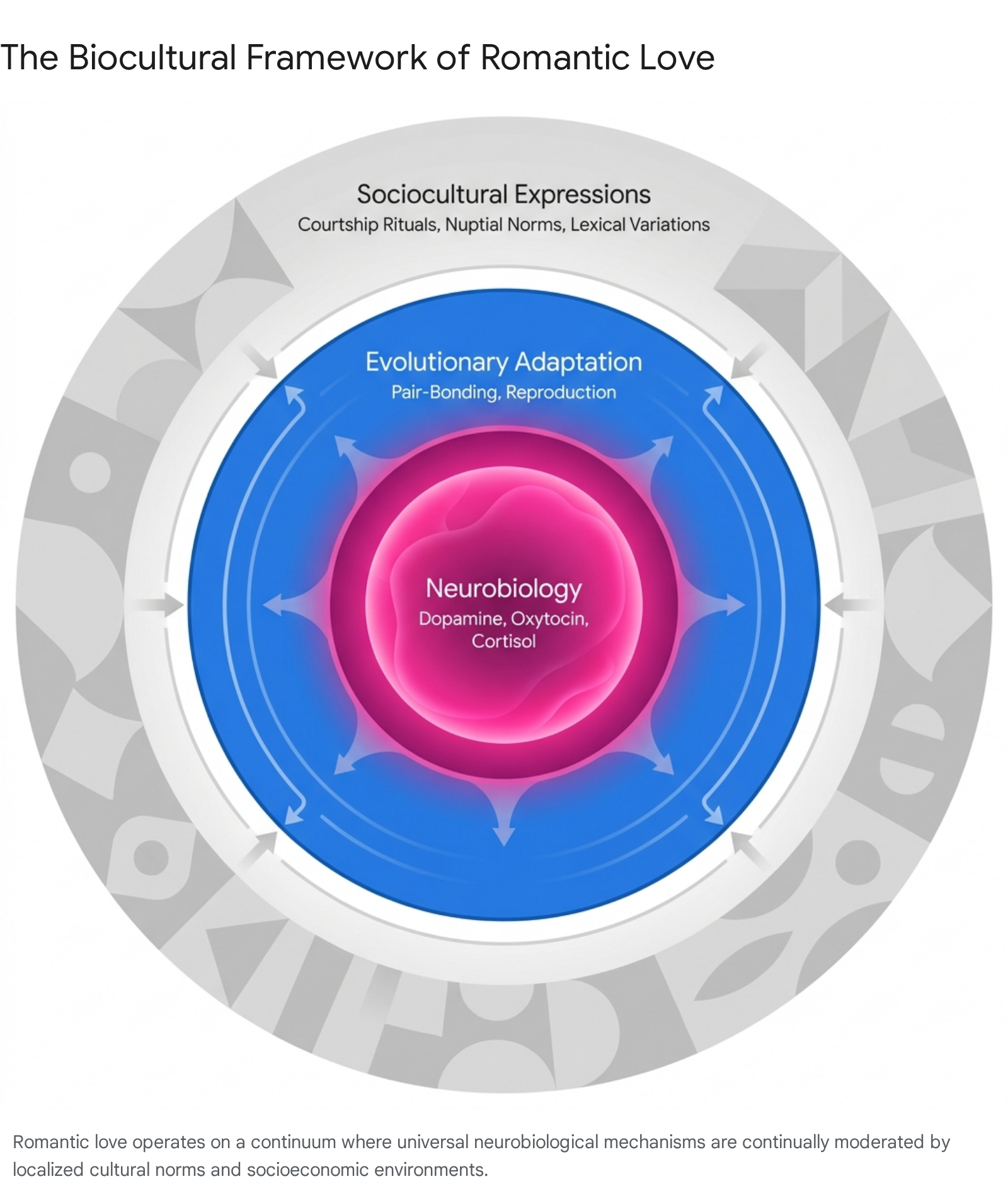
This contemporary consensus holds that the physiological and cognitive capacity for passionate romantic love is a human universal, hardwired into the neurological architecture of the species 111213. However, while the biological drive is innate, its behavioral expression, social valuation, and integration into institutions like marriage are profoundly dictated by cultural context, socioecology, and historical periods 14. To properly assess the cross-cultural consensus on love, one must disentangle the universal neurobiological mechanisms from the highly variable cultural frameworks that govern mating and emotional articulation 1516.
Neurobiological and Evolutionary Foundations
The Neurological Architecture of Love
To evaluate whether love is a cultural invention or a biological universal, researchers frequently examine the neurological mechanisms that underpin romantic attachment. Neurobiological studies consistently demonstrate that the experience of romantic love activates distinct, ancient regions of the mammalian brain, particularly the mesocorticolimbic pathway 41718. The neurobiology of romantic love is generally categorized into three interconnected but distinct systems: lust, attraction, and attachment 41319.
Lust, or sexual desire, is primarily modulated by sex hormones such as testosterone and estrogen, driving the basic biological urge for sexual gratification and engaging the amygdala 417. Attraction, which corresponds to early-stage passionate love, is characterized by a surge in dopamine within the brain's reward circuitry, specifically the ventral tegmental area and the nucleus accumbens 417. This dopaminergic activation facilitates focused attention, euphoria, and the intense motivation to pursue a specific partner, sharing neurochemical similarities with addiction pathways 3417. Concurrently, elevated norepinephrine produces physiological arousal, such as a racing heart and heightened alertness, while a temporary reduction in the serotonin transporter 5-HT contributes to the obsessive, intrusive thinking characteristic of early infatuation, mirroring patterns seen in obsessive-compulsive disorder 1719.
Attachment, the system that sustains long-term pair bonds, is mediated by neuropeptides such as oxytocin and vasopressin 419. Oxytocin is released through physical closeness, shared laughter, and sexual intimacy, promoting feelings of secure belonging and dampening fear responses 1719. Vasopressin is heavily linked to territorial behavior, monogamy, and partner protection, heightening a sense of loyalty 419. Brain imaging studies tracking couples over time indicate that the chaotic neurochemistry of early love eventually stabilizes; serotonin levels return to normal after 12 to 18 months 17. However, in couples who maintain long-term romantic engagement, dopaminergic reward pathways can remain active for decades, supplemented by the calming activity of oxytocin and opioid receptors 317.
Evolutionary Adaptations and Commitment
Because this intricate biochemical architecture is shared across the human species, the assertion that romantic love is purely a socio-linguistic invention is scientifically untenable. The biological pathways of reward, motivation, and social bonding operate universally, serving specific evolutionary functions 1620.
From an evolutionary standpoint, romantic love functions as a critical commitment device 521. Early human ancestors who exhibited signals of romantic love were more likely to form enduring pair bonds, which maximized reproductive success by ensuring that both parents invested resources in highly dependent offspring 52122. The intense focus generated by passionate love down-regulates an individual's interest in alternative mates, serving as a reliable signal of dedication 5. Cognitive biases inherent in romantic love, such as positive illusions and confirmation bias, are not irrational flaws but adaptive mechanisms designed to preserve relationship stability and prevent the dissolution of the pair bond during periods of external stress 16.
Historical Anthropological Perspectives
The Jankowiak and Fischer Analysis
For much of the 20th century, anthropological orthodoxy maintained that romantic love was an artifact of modern Western societies, while non-Western societies were assumed to base mating solely on utilitarian kinship networks, economic alliances, and arranged marriages 167. This paradigm shifted significantly following a landmark 1992 study by anthropologists William Jankowiak and Edward Fischer, which analyzed ethnographic data from 166 historically independent cultures 72324.
Jankowiak and Fischer systematically looked for behavioral and linguistic indicators of passionate love, such as love poetry, accounts of elopement, the singing of love songs, and the cultural recognition of the anguish of infatuation 24. To ensure accuracy, they carefully distinguished between mere sexual lust and genuine romantic attachment 25. The researchers found unambiguous evidence of romantic love in 147 of the 166 cultures, representing 88.5% of the sample 24. In the remaining 19 cultures where evidence was not explicitly found, the researchers noted that this was likely due to ethnographic omission - researchers simply not asking the right questions or documenting the behavior - rather than the actual absence of the emotion 724. This study established that romantic love is a "near cultural universal," existing even in societies with strict prohibitions against it 924.
Contemporary Global Data Collection
Subsequent large-scale global studies have corroborated and expanded upon these historical findings. In a massive cross-cultural investigation utilizing Sternberg's Triangular Theory of Love - which posits that love consists of Intimacy, Passion, and Commitment - Sorokowski et al. surveyed over 9,400 individuals across 45 countries 272627. The results demonstrated that all three components of love are universally recognized and experienced 2728. The average intensity of romantic love across diverse global populations was remarkably high, exceeding 75 on a 0-100 scale, challenging the notion that love is an exclusively Western pursuit 29.
More recently, Kowal et al. compiled an extensive dataset involving 117,293 participants from 175 countries, collecting data in 45 languages 21303132. This research provides definitive evidence that people worldwide place a premium on romantic love as a prerequisite for long-term partnership. On average, participants across all regions expressed an unwillingness to commit to a long-term relationship in the absence of romantic love, confirming its universal function as a mechanism for mate selection and relational maintenance 521. Regardless of the cultural rituals surrounding marriage, the psychological prerequisites for a satisfactory bond remain highly consistent 33.
The Influence of the WEIRD Bias on Relationship Science
Overrepresentation of Western Samples
Despite the universality of love, the scientific understanding of romantic relationships has historically suffered from extreme sampling bias. The acronym "WEIRD" - standing for Western, Educated, Industrialized, Rich, and Democratic - was coined to describe the narrow demographic that dominates psychological research 34353637. While WEIRD populations constitute roughly 12% of the global population, between 68% and 96% of studies in top psychology and sexuality journals draw exclusively from these backgrounds 3438. In contrast, entire continents are marginalized; for instance, Africa, representing 17% of the global population, contributes to less than 1% of these research samples 3439.
This massive overrepresentation has led researchers to erroneously assume that Western relationship norms are the standard baseline for human psychology 344041. The uncritical generalization of WEIRD data obscures the fact that subjects from these societies often deviate significantly from the rest of humanity in how they perceive the world and navigate social obligations 3437. Consequently, the scientific literature has frequently conflated the biological emotion of love with the cultural institution of Western marriage 5.
The Progression Bias and Soulmate Construct
In individualistic Western cultures, romantic love is highly idealized and forms the primary acceptable justification for marriage 142025. This cultural script emphasizes personal autonomy, self-expression, and the fulfillment of deep psychological needs through a single partner, often referred to as a "soulmate" 4243. Because coupling is viewed as an essential life milestone in the West, psychological studies often detect a "progression bias" - a tendency for individuals to advance and maintain relationships even when ideals are not met, driven by societal pressure and the stigma of singlehood 4144.
This hyper-individualistic pursuit of love creates unique sociological outcomes. While Westerners expect marriage to facilitate personal growth and emotional completion, this immense pressure often leads to relationship dissatisfaction and high divorce rates when passion inevitably fluctuates 4245. By contrast, applying this soulmate framework to non-Western populations misrepresents how love functions globally. In many non-WEIRD contexts, marriage may be initiated through familial arrangement or social obligation, with companionate and passionate love expected to grow steadily over time rather than serving as the volatile catalyst for the union itself 414546.
Linguistic and Conceptual Variations Across Cultures
While the neurobiological mechanisms and evolutionary functions of love are universally shared, the phenomenological experience, aesthetic interpretation, and linguistic categorization of love are subject to profound cultural variation 1520. Different societies prioritize distinct emotional valences, demonstrating that love is socially interpretable and confirmed through culturally organized frameworks 15.
Arabic and Islamic Contexts: Ishq, Muhabba, and Ghayra
In Arabic and broader Islamic cultural traditions, love is a highly delineated concept with varying degrees of spiritual and social acceptability. The term Muhabba (or Hubb) denotes a broad, socially sanctioned affectionate love and compassion 4750. In contrast, Ishq refers to a consuming, passionate, and often devastating form of romantic love 4751. Historically, Ishq carried negative connotations because its overwhelming, irrational nature could cause individuals to abandon social duty and moral discernment. However, within Sufi mysticism and regional poetry, Ishq was elevated to signify a supreme, ego-annihilating love. It is often divided into Ishq-e-Majazi (allegorical or earthly love directed toward a human beloved) and Ishq-e-Haqeeqi (the ultimate, real love directed toward the Divine) 4849.
Furthermore, romantic possessiveness in the Arab-Islamic context is deeply tied to the concept of Ghayra (often translated as jealousy or protective zeal) 5055. Unlike in contemporary Western psychology, where jealousy is frequently pathologized as a sign of insecurity or a maladaptive trait, appropriate Ghayra has historically been conceptualized as a normative masculine virtue. It represents a moral obligation to protect the modesty and honor of female kin and romantic partners, rooted in a broader zeal for defending religious commandments and social boundaries against violation 5051.
The Indian Aesthetic Tradition: Sringara
In classical Indian aesthetics, romantic love is encapsulated by the concept of Sringara, the supreme rasa (emotional essence or sentiment) in literature, dance, and art 5258. Sringara translates roughly to erotic love, romantic beauty, or amorous sentiment, and captures the profound delight derived from intimacy and aesthetic pleasure 5258. It is conceptually divided into two primary states: Sambhoga Sringara (love in union, characterized by harmony, sensory delight, and fulfillment) and Vipralambha Sringara (love in separation, characterized by unfulfilled desire, anticipation, and longing) 58.
Rather than viewing romantic love purely as an internal psychological state, the Indian aesthetic tradition frames Sringara as a deeply spiritual and sensory experience that bridges the physical and the divine. The intense affection directed toward a partner is believed to possess the power to dissolve the ego, transforming superficial attraction into spiritual devotion 5259. This conceptualization emphasizes inherent beauty and harmonious union, contrasting with Western narratives that frequently focus on individualistic conquest.
Conceptions of Love in Sub-Saharan Africa
Cross-cultural research involving African populations has frequently been distorted by an external, Eurocentric gaze. Anthropological literature has historically overemphasized "transactional" or "provider love" in sub-Saharan Africa, implying that relationships are driven purely by resource exchange and economic necessity, thereby suggesting that Africans lack the capacity for romantic passion 5361. This assumption is demonstrably false and reflects a misunderstanding of how affect and material provisioning intertwine in collectivist settings 53.
Historical linguistic evidence demonstrates that pre-colonial African societies possessed rich vocabularies for lust, infatuation, and enduring passionate affection 5354. Focus group studies with young South African males, for example, reveal strict linguistic demarcations between terms for casual liking and expressions reserved exclusively for proposing serious romantic commitment 53. Furthermore, traditional Swahili poetry is replete with themes of passionate loss, unrequited love, and intense longing, mirroring the universal symptoms of romantic infatuation documented globally 53.
Variations in Emotional Signifiers
The cognitive and emotional associations attached to the word "love" shift significantly across borders. A comparative study analyzing the social representations of love among highly educated citizens of Brazil, Russia, and the Central African Republic found striking variations at the core of how the emotion is perceived, despite all three cultures sharing collectivist tendencies 555657.
| Cultural Context | Conceptualization of Love | Primary Associated Emotion |
|---|---|---|
| Brazil | Intrapersonal, intimate, and a sensual moral choice. | Honesty 5556 |
| Russia | Inherent, family-oriented obligation; often viewed as an obstacle or problem. | Suffering 5556 |
| Central African Republic | A divine, ennobling force given by God to elevate the person. | Tenderness 5556 |
These findings illustrate that while the underlying physiological arousal of love is universal, culture dictates the semantic framework through which these physical sensations are interpreted, valued, and socially expressed 555657.
Socioecological Factors Influencing Love
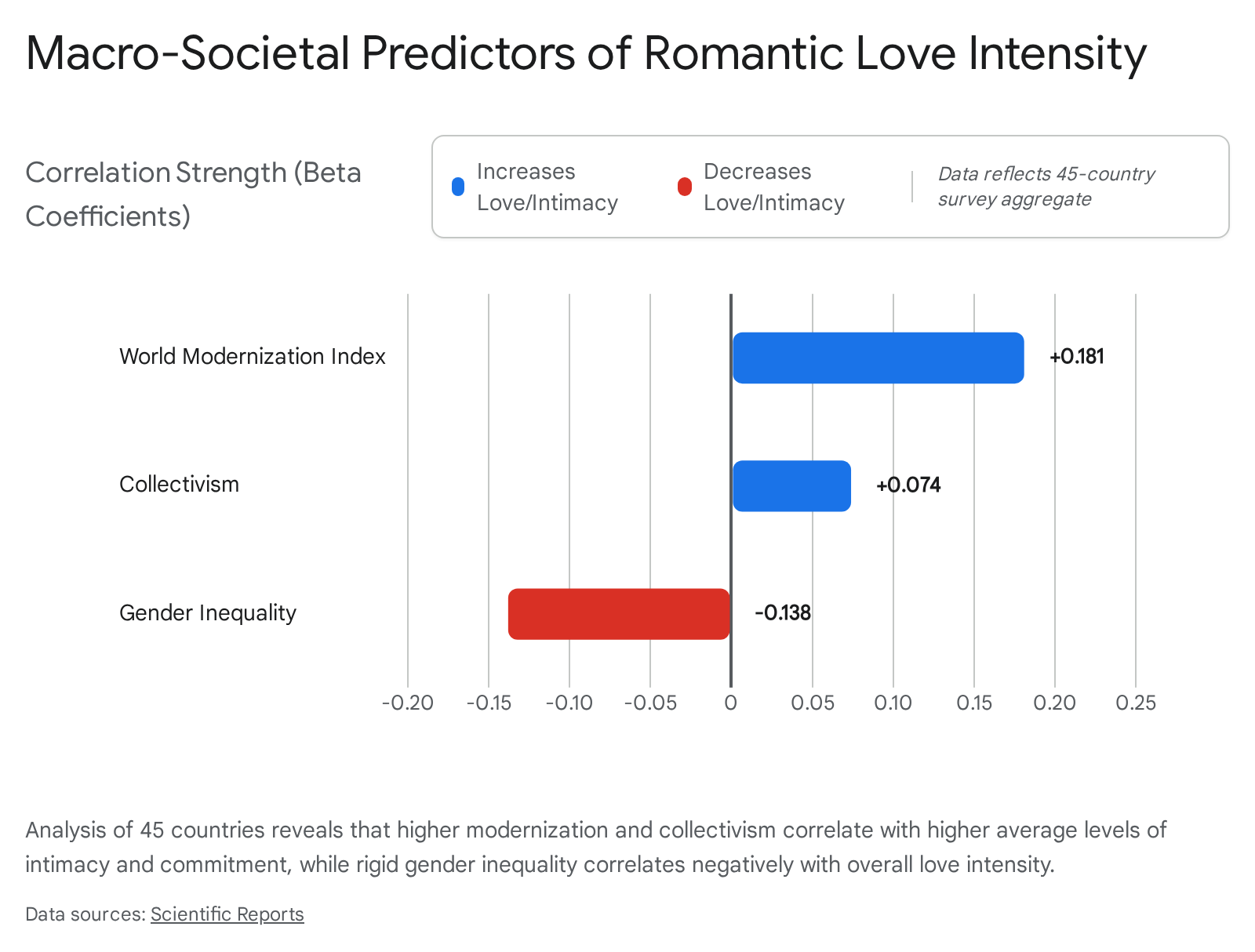
If romantic love is a universal biological capacity, cross-cultural research seeks to explain why its intensity, frequency, and behavioral manifestations differ from one population to another. Recent large-scale studies point to several socioecological variables that act as macro-level moderators of romantic love 2627.
Modernization and Economic Development
The degree of modernization within a country - measured by indices such as the Human Development Index (HDI) and the World Modernization Index - positively predicts the intensity of love experienced by its citizens 272627. When societies transition into industrialized environments with sufficient healthcare, education, and resources, individuals are freed from the immediate pressures of survival 26. This systemic stability allows for greater psychological bandwidth to cultivate intimacy, passion, and emotional engagement with a partner 2627. However, this relationship exhibits non-linear characteristics; at the extreme highest levels of modernization, the average intensity of reported love drops slightly, potentially due to the alienating effects of hyper-individualism or shifting priorities in highly developed nations 2727.
Interestingly, there is a divergence between the idealization of love and the actual experience of love across socioeconomic statuses (SES). Individuals of lower SES often place a higher conceptual value on romantic love as a prerequisite for commitment 5. Because they lack material resources to secure partnerships, they may rely more heavily on the emotional signal of love to ensure loyalty and mutual support 5. Nevertheless, the daily stressors and financial struggles associated with lower SES can cause relationship conflict, meaning that while these individuals value love highly, they may experience lower actual intensity of romantic feelings compared to their wealthier counterparts 22.
Individualism Versus Collectivism
A persistent anthropological myth assumes that highly individualistic cultures experience more love because they champion love-based marriages, whereas collectivist cultures suppress love in favor of arranged marriages and kinship ties 727. Large-scale empirical data contradicts this binary. In fact, country-level collectivism is positively correlated with higher levels of intimacy and belonging between partners 272627.
In collectivist societies, the prioritization of group harmony and extended family networks provides a robust support system. This structural support can reduce the functional burden placed on the marital dyad, allowing deep companionate love and intimacy to flourish organically 2758. In contrast, highly individualistic cultures place immense pressure on the romantic partner to fulfill all emotional, social, and psychological needs 4267. When a partner fails to meet these extraordinary expectations, relationship dissatisfaction and dissolution frequently follow.
| Societal Structure | Mate Selection Priority | View of Romantic Love | Marital Stability Dynamics |
|---|---|---|---|
| Highly Individualistic (e.g., USA, Western Europe) | Personal fulfillment, mutual attraction, soulmate compatibility. | Idealized as the sole foundation for marriage; love must precede commitment. | Lower stability; marriages frequently dissolve if individual psychological needs or passion fades. 4245 |
| Collectivistic (e.g., China, India, West Africa) | Family alignment, social harmony, resource stability. | Viewed as potentially disruptive to kinship if unchecked; love often grows after commitment. | Higher stability; supported by extended family networks; deep intimacy and companionate love develop over time. 74559 |
Gender Equality and Environmental Variables
Gender equality operates as another robust predictor of love experiences. In nations with higher gender equality, citizens generally report higher levels of intimacy and overall love 2627. However, adherence to traditional gender roles influences the specific type of love reported. Research indicates that individuals adhering to traditional gender role divisions report the highest levels of passion - likely driven by distinct, polarized gender dynamics and differences in power - whereas those in egalitarian societies report lower passion but significantly higher emotional intimacy, friendship, and commitment 60.
Furthermore, environmental factors such as mean annual temperature have been shown to correlate with the intensity of love. Warmer climates are associated with higher emotional expressiveness, increased social closeness, and more frequent physical touch. This increased tactile interaction biologically stimulates oxytocin release, subsequently heightening reported feelings of love and belonging across the population 2726.
Conclusion
Cross-cultural research decisively answers the question of whether romantic love is a universal phenomenon or an invented cultural script: it is a complex, dynamic synthesis of both.
At its core, romantic love is a biological reality. It is an evolved neurochemical drive utilizing dopamine, oxytocin, and cortisol to facilitate pair-bonding, secure biparental care, and ensure the survival of offspring in a dangerous ancestral environment. The physiological and behavioral symptoms of passionate love - euphoria, intrusive thinking, and intense motivation to be near a partner - have been documented in the vast majority of human societies, spanning from the indigenous tribes of the Amazon to the urban centers of East Asia and the industrialized West.
However, asserting that love is biologically universal does not mean it is experienced uniformly. Culture acts as the ultimate architect of how this biological capacity is interpreted, regulated, and expressed. While the West has constructed a modern narrative where romantic love is synonymous with individualism, personal salvation, and the mandatory foundation of marriage, other cultures contextualize love through highly distinct socio-ecological frameworks. Whether it is regulated through the protective zeal of Ghayra in Arab societies, elevated to divine aesthetic beauty through Sringara in India, or carefully managed so as not to disrupt the vital kinship networks of collectivist cultures, the semantic and structural framework surrounding love is highly malleable.
Ultimately, romantic love is not an invention of European poets, nor is it a rigid biological reflex immune to the environment. It is a powerful biosocial mechanism. As global modernization, economic development, and shifts in gender equality continue to reshape human environments, the ways in which human beings negotiate, experience, and articulate romantic love will undoubtedly continue to evolve, reflecting the profound and inextricable interplay between human nature and human culture.