
Cross-cultural language effects on spatial and mathematical cognition
The extent to which language shapes human cognition remains one of the most rigorously investigated subjects in cognitive science, psycholinguistics, and anthropology. Historically framed by the Sapir-Whorf hypothesis, the premise that linguistic structures define cognitive boundaries has evolved from strict determinism into a nuanced understanding of linguistic relativity. Modern research establishes that the structural and lexical properties of a language influence habitual thought, organize memory, and direct attention. This influence is highly visible in two fundamental domains of human reasoning: spatial cognition and mathematical calculation. Cross-cultural studies investigating indigenous languages with unique spatial coordinate systems, as well as comparative analyses of numerical transparency across languages, reveal that linguistic frameworks act as cognitive technologies. While they do not create the biological capacity for spatial navigation or magnitude estimation, they provide representational tools that significantly alter how these capacities are deployed in working memory, orientation, and arithmetic tasks.
Theoretical Foundations of Linguistic Relativity
The interaction between language and thought has provoked intense theoretical debate for a century. Early twentieth-century linguistics posited a strong determinist view, suggesting that language strictly limits what humans can perceive or think. However, contemporary cognitive science generally rejects strict linguistic determinism in favor of frameworks that interpret language as an interactive layer operating over pre-existing, biologically hardwired cognitive systems 123.
The modern understanding of linguistic relativity operates primarily through two mechanisms. First, the "thinking for speaking" framework suggests that in the process of formulating an utterance, speakers must attend to the specific environmental features that their language obligatorily encodes 1. Over time, this repeated attentional deployment creates cognitive routines, influencing how individuals perceive and remember scenes even when they are not actively formulating speech. Second, the label-feedback hypothesis posits that lexical labels actively modulate lower-level perceptual processes via feedback loops, enhancing the brain's ability to categorize and track specific phenomena 4. In this model, speakers of different languages do not possess fundamentally different neural hardware. Rather, their behavior is nudged by grammar and terminology, leading to measurable differences in non-linguistic tasks ranging from visual discrimination to spatial memory 14.
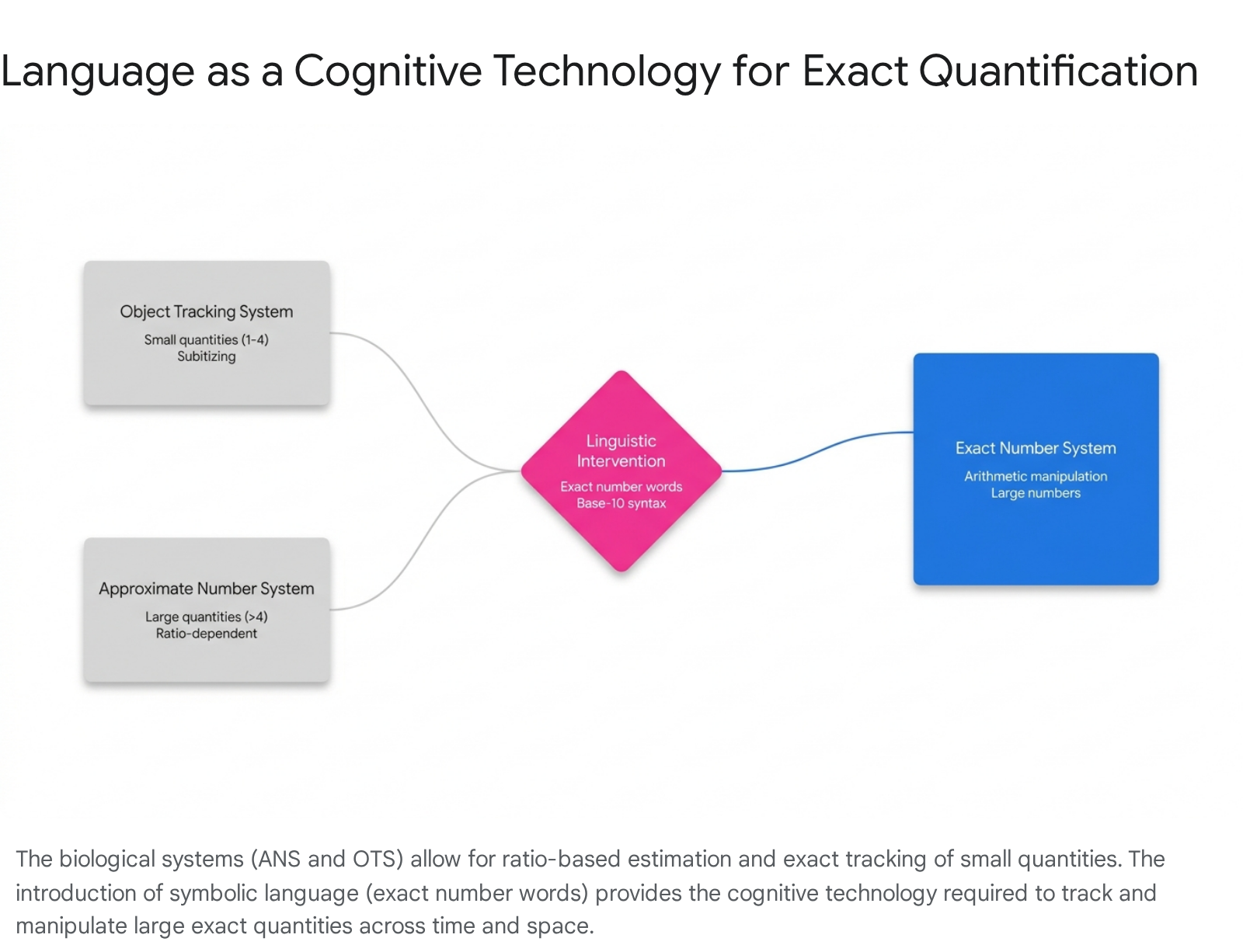
In both spatial and mathematical domains, language functions as an external cognitive technology 56. Biological imperatives endow humans with core knowledge systems, such as the Approximate Number System for estimating magnitudes and basic egocentric tracking for immediate spatial awareness 78. Language provides a symbolic overlay that allows these primitive systems to be extended. Words for exact numbers or absolute spatial directions allow the brain to store complex information across time, space, and changes in modality, acting as placeholders that significantly offload working memory demands 56.
Spatial Frames of Reference
The most robust evidence for linguistic relativity at the structural level emerges from cross-linguistic variations in spatial frames of reference. A frame of reference is a coordinate system used to compute and describe the spatial relationship between a referent (the object being located) and a relatum (the landmark or background) 910.
Languages globally employ three primary spatial frames of reference. While some languages use a mix of all three, others rely almost exclusively on one or two, fundamentally altering how speakers conceptualize spatial arrays 91112.
| Frame of Reference | Coordinate Anchor | Example Phrase | Cognitive Implication |
|---|---|---|---|
| Relative (Egocentric) | The viewer's body and perspective. | "The ball is to the left of the tree." | Requires calculating positions based on the observer's location. Common in English and Dutch 91113. |
| Intrinsic (Object-centered) | The inherent features or anatomy of the relatum object. | "The ball is at the front of the tree." | Topological and binary; relies on identifying the intrinsic 'front', 'back', or 'side' of an object regardless of observer position 91114. |
| Absolute (Geocentric) | Fixed environmental or cardinal coordinates. | "The ball is north of the tree" or "downhill of the tree." | Euclidean and ternary; requires constant background calculation of global orientation. Independent of observer rotation 91112. |
The relative frame requires calculating positions based on an observer projecting a "left" or "right" vector. The intrinsic frame relies on the inherent anatomy of the reference object, identifying a "front" or "back" zone. The absolute frame utilizes fixed environmental bearings, acting as a mental compass rose overlay regardless of observer or object orientation.
Cognitive Impacts of Absolute Spatial Systems
The cognitive impact of relying on an absolute spatial system is profound. Western urban populations predominantly utilize an egocentric (relative) mode of wayfinding 1516. In contrast, speakers of languages that obligatorily use absolute frames exhibit exceptional navigational tracking and spatial memory 916.
A foundational case study is the Guugu Yimithirr language of North Queensland, Australia. The Guugu Yimithirr language lacks relative terms like "left" or "right" and relies exclusively on four cardinal direction roots 15161717. Approximately one in ten words in typical Guugu Yimithirr discourse is a cardinal direction term 15. Because the linguistic environment demands constant geocentric orientation, speakers develop a continuous background computation of orientation, allowing them to dead-reckon and maintain their sense of direction in complex, unfamiliar environments 1416. Researchers mapping Guugu Yimithirr pointing gestures onto survey maps have revealed that their communicative gestures are driven directly from a highly accurate hippocampal cognitive map 15. Memories in this culture are stored with absolute directional information; a speaker recalling an event years later will gesture in the exact cardinal directions the event originally occurred in, regardless of which way the speaker is currently facing 16.
Similar cognitive effects are observed among speakers of Tzeltal, a Mayan language spoken in the mountainous Tenejapa region of Mexico. Tzeltal uses an absolute frame based on the topographic slope of the land ("uphill" meaning south, "downhill" meaning north, and "across") alongside an intrinsic frame, completely lacking a relative left/right frame 13141819. In classic table-rotation experiments conducted by Levinson, Tzeltal speakers and Dutch speakers (who use a relative frame) were shown an array of objects on a table, rotated 180 degrees, and asked to recreate the array 91314. Dutch speakers recreated the array egocentrically (maintaining the objects' positions relative to their own bodies), whereas Tzeltal speakers overwhelmingly recreated the array allocentrically (maintaining the objects' absolute cardinal positions) 914.
Environmental Affordances and Referential Promiscuity
While absolute coordinate systems influence non-linguistic spatial memory, researchers debate whether this is purely a linguistic effect or a product of environmental determinism. Skeptics of linguistic relativity argue that environmental affordances, rather than language, drive these cognitive differences, suggesting that any human will adopt absolute strategies if navigating a rural, landmark-heavy environment 1418.
However, studies on "referential promiscuity" in languages like Yucatec Maya demonstrate that language and environment interact in complex ways. Yucatec Maya speakers have unrestricted availability to all three spatial frames (relative, intrinsic, and absolute) 1221. In referential communication tasks, speakers switch freely between frames, yet in memory recall experiments, they still show a strong bias toward geocentric responses 21. Furthermore, within different Tzeltal communities, the frequency of absolute frame use varies drastically in direct correlation with the salience of local topographic features 18. This indicates that while language provides the requisite cognitive tools, the physical environment constrains and reinforces their use, leading to occupational and gender-based differences in frame selection 1218.
Neurological Basis of Spatial Representation
The neurological mechanisms underlying these frames of reference are distinct. Spatial memory is intrinsically linked to these frames, as the brain requires specific coordinate systems to encode object locations 2023. Egocentric representations are critical for controlling movement in peripersonal space, such as reaching for objects, and rely heavily on the parietal cortex 2024. Neurofunctional studies of brain-lesioned patients demonstrate a double dissociation: right-parietal lesions often devastate egocentric spatial judgments while sparing allocentric judgments, suggesting right-hemisphere specialization for self-centered spatial processing 202421. Allocentric representations, conversely, are essential for recognizing scenes and planning movements outside arm-reaching distance, utilizing complex fronto-parietal networks and hippocampal cognitive maps 202321. The intensive utilization of absolute spatial languages may demand greater reliance on these allocentric neural networks 15.
Spatiotemporal Conceptualization
Because time is an invisible, intangible domain, human cognition universally borrows concepts from the concrete domain of space to talk and think about it 2223. The structural mappings between space and time, known as spatiotemporal metaphors, differ significantly across cultures, representing a highly contested area of linguistic relativity research.
In English, time is predominantly conceptualized horizontally and egocentrically: the future is "ahead" or "forward," and the past is "behind" or "back" 11322. In contrast, the Aymara language conceptualizes the past as in front (because it is known and visible) and the future as behind (because it is unknown and unseen) 122. Mandarin Chinese utilizes horizontal metaphors but also frequently employs vertical spatial metaphors for time, referring to earlier events as "up" (shàng) and later events as "down" (xià) 1132425. The physical embodiment of language also influences this mapping; native Mandarin speakers who learn Chinese Sign Language (CSL) show a shift from lateral to sagittal space-time mappings, adapting to the bodily experience of the signs 22.
The Metaphoric Structuring Debate and Replication Issues
The hypothesis that habitual use of spatial metaphors reshapes internal temporal cognition was popularized by early cognitive psychology research reporting that English speakers were faster to verify temporal propositions after being primed with horizontal spatial images, whereas Mandarin speakers were faster after being primed with vertical spatial images 132425. This asymmetric effect was widely cited as evidence that language permanently structures the representation of abstract domains.
However, the empirical stability of these specific findings is highly contested. Multiple extensive, pre-registered replication attempts have failed to reproduce the effect. Research examining the English horizontal priming effect reported six separate unsuccessful replication attempts, finding no significant benefit for English speakers in horizontal prime conditions across varied iterations of the task 24. Similarly, attempts to replicate the findings with Chinese speakers resulted in four consecutive failures 2526. Corpus analyses further undermined the foundational premise by demonstrating that Chinese speakers actually use horizontal spatial metaphors for time significantly more frequently than vertical ones in natural discourse 2526.
Recent registered replications regarding the broader asymmetric relationship between space and time (the hypothesis that space influences time more than time influences space) have also yielded symmetrical relationships 27. These symmetrical findings align more closely with A Theory of Magnitude (ATOM) - which posits a general, language-independent magnitude system in the brain - rather than metaphor-driven cognitive restructuring 27. Thus, while language undoubtedly provides specific spatial vocabularies for discussing time, the assertion that these linguistic metaphors permanently rewrite non-linguistic temporal reasoning remains an unsettled matter requiring significant calibrated uncertainty 242532.
The Approximate Number System and Exact Quantification
The most profound theoretical insights regarding language and mathematical cognition derive from delineating the boundaries between biological magnitude estimation and culturally acquired arithmetic. Human infants, alongside many non-human animals, are born with an innate cognitive mechanism known as the Approximate Number System (ANS) 67828.
The ANS supports the non-symbolic estimation of magnitude. It operates according to Weber's Law: the ability to discriminate between two quantities is dependent on the ratio between them, rather than their absolute difference 782829. The precision of the ANS improves throughout childhood, eventually reaching an adult level of approximately 15% accuracy, allowing an individual to distinguish 100 items from 115 without counting 8. The ANS operates in parallel with the Object Tracking System (OTS), which allows for the exact, rapid tracking of small quantities (typically one to four objects) through a process called subitizing 830.
Crucially, the ANS represents numbers imprecisely. Behavioral studies measuring participants' ability to multiply quantities non-symbolically show success within the subitizing range, but performance falls to chance levels when manipulating numbers strictly within the ANS range (five and above) 3031. Two ANS representations cannot be reliably multiplied together, emphasizing its role as a mechanism for estimation rather than formal arithmetic 3031.
Anumeric Languages and the Limits of Quantity Perception
To determine whether the acquisition of exact number words creates the underlying concept of exact quantity, researchers have studied the Pirahã, an isolated indigenous hunter-gatherer group in the Brazilian Amazon 63233. The Pirahã language is uniquely "anumeric"; it entirely lacks numerals, grammatical number (singular/plural), and exact quantifiers 53435. Instead, the language uses terms for relative quantities, typically distinguishing between small and large amounts 3341.
Early psycholinguistic assessments observed that Pirahã adults could not consistently perform one-to-one matching tasks for quantities greater than three, displaying an error rate indicative of analog magnitude estimation 636. This led to the conclusion that numerical cognition is strictly determined by the presence of a counting system 36. However, subsequent rigorous testing refined this paradigm. When re-tested on matching tasks with no working memory component (where the target objects remained completely visible), Pirahã speakers performed exact one-to-one matches with large numbers perfectly 56. Their performance collapsed into approximation only when objects were hidden, forcing them to recall the exact cardinality without linguistic placeholders 56.
These findings indicate that human populations possess the cognitive capacity to comprehend exact quantity independently of language; they understand that adding or subtracting a single object changes a set 6. However, without the linguistic mechanism to store that exact cardinality over time, calculations default to the approximate number system. Exact number words are therefore not innate linguistic universals or strict prerequisites for perceiving quantity; rather, they are a profound cultural invention that allows humans to manage complex numerical sets across time, space, and changes in modality 56.
The anumeric nature of Pirahã has also fueled a highly polarizing theoretical debate regarding Universal Grammar. Researchers have argued that the Pirahã language lacks recursion (the ability to embed clauses infinitely), a feature historically posited as the core biological component of human language 32333738. Proponents suggest that the lack of numbers, colors, and recursion is constrained by a strict cultural axiom of immediate, empirical experience 3438. This claim remains heavily contested, severely fracturing the linguistics community and highlighting the complex difficulty of parsing biological language faculties from deep cultural constraints 3745.
Linguistic Transparency and Arithmetic Development
Beyond bridging the gap between approximation and exact measurement, linguistic structure exerts a quantifiable influence on early arithmetic development. Cross-national studies consistently highlight a discrepancy in early mathematical performance between children from East Asian nations and children from Western nations 39404142. A leading explanatory variable for this discrepancy is the numerical transparency of counting systems.
Base-10 Transparency in Counting Systems
A regular, transparent counting system is purely multiplicative and additive, mirroring the base-10 Arabic numeral structure perfectly. In such systems, a learner only needs to memorize the digits one through ten, and the multipliers for tens, hundreds, and thousands 4043.
| Number | English (Opaque) | French (Opaque) | Mandarin Chinese (Transparent) | Vietnamese (Transparent) |
|---|---|---|---|---|
| 11 | Eleven | Onze | Shi-yi (Ten-one) | Mười một (Ten-one) |
| 12 | Twelve | Douze | Shi-er (Ten-two) | Mười hai (Ten-two) |
| 20 | Twenty | Vingt | Er-shi (Two-ten) | Hai mươi (Two-ten) |
| 72 | Seventy-two | Soixante-douze (Sixty-twelve) | Qi-shi-er (Seven-ten-two) | Bảy mươi hai (Seven-ten-two) |
In opaque systems like English and French, children must memorize distinct lexical items for numbers between 11 and 19, and unique decade names (e.g., twenty, thirty) that obfuscate their base-10 composition 394452. Transparent systems directly encode the underlying cardinality into the word, making the hierarchical structure linguistically explicit 394546.
Developmental Timelines and Mathematical Performance
This linguistic transparency grants a measurable developmental advantage in early numeracy acquisition. Studies demonstrate that preschool-aged Chinese and Vietnamese children can count significantly higher than their American and European peers, traversing the challenging "teens" numbers with fewer errors 41424647. The advantage extends beyond rote counting to the mental representation of quantity. When representing two-digit numbers using base-10 blocks, children speaking transparent Asian languages are significantly more likely to use a combination of tens and units, whereas English-speaking children tend to rely on single-unit blocks, treating the number as an un-chunked aggregate 3944.
To isolate the effect of language from broader cultural variables like parental instruction and curriculum intensity, researchers have utilized natural linguistic experiments within single educational jurisdictions. Studies examining children in Wales, where schools teach the exact same curriculum through either Welsh (a transparent counting system) or English (an irregular system), demonstrate distinct cognitive divergence 4048. The Welsh-medium children performed significantly better on non-verbal number line estimation tasks (locating a target number's position on a blank 1 - 100 line) compared to the English-medium children. This superiority was specifically isolated to numbers over 20, directly aligning with the onset of the base-10 transparency advantage 4048.
Boundaries of the Transparency Advantage
Despite clear benefits for early number representation, the transparency of a counting system is not a permanent catalyst for global mathematical proficiency. The advantage is heavily front-loaded in childhood and is highly task-specific.
In the Welsh-English comparison, while Welsh-speaking children excelled at number line estimation, there was no evidence of superiority in global arithmetic test performance or transcoding skills 4048. Similarly, comparisons between Vietnamese children and French-speaking Belgian children revealed that while the Vietnamese cohort mastered basic rote counting faster, they did not outperform their Belgian peers in non-symbolic numerical abilities, simple addition, or complex numerical tasks 425246. Studies contrasting children in Hong Kong who learn math in Chinese versus English also found that transparency aids place-value learning in younger children, but the advantage is not sustainable and does not necessarily translate into better complex arithmetic performance in older grades 41.
Comprehensive meta-analyses comprising hundreds of longitudinal studies clarify that the development of arithmetic skill relies on different neural pathways than complex mathematical reasoning 49585051. Symbolic number skills (facility with number words and Arabic digits) are the strongest predictors across all math categories 49. Non-symbolic ANS acuity serves as a weak predictor strictly for basic arithmetic calculations in early development 49. As mathematics advances into algebra and word problem solving, spatial skills and language comprehension adopt dominant roles. Spatial skills show strong links to logical mathematical reasoning and geometry 50. Language comprehension and syntactic awareness become primary drivers for solving complex word problems, as language is required to extract semantic logic before numerical algorithms can be applied 495850. Language acts as an internal medium to communicate, represent, and retrieve mathematical knowledge, facilitating working memory during complex cognitive tasks 58.
Consequently, linguistic transparency eliminates a cognitive hurdle in early base-10 representation, but long-term mathematical superiority relies on a convergence of instructional quality, spatial reasoning, and broader language comprehension 40415258. Cross-cultural studies decisively establish that while language does not create the foundational human capacities for spatial orientation or magnitude estimation, it provides the specialized cognitive technologies required to manipulate those domains. Whether utilizing geocentric coordinates for absolute navigation or transparent integer words for rapid calculation, linguistic structures guide attentional habits, offload working memory, and fundamentally alter the sophistication with which humans interact with their environment.