
Creative cognition and age
Foundations of Intelligence and Lifespan Development
The prevailing cultural paradigm often equates creativity with youth, operating under the assumption that the capacity for radical innovation diminishes alongside physical vitality. However, cognitive science, neurobiology, and lifespan development research suggest a vastly more complex reality. Creativity does not universally decline with age; rather, the underlying cognitive mechanisms that drive it transform as the brain matures. This transformation is best understood through the distinction between fluid and crystallized intelligence, a dichotomy first proposed by Raymond Cattell in 1943 and subsequently elaborated by John Horn and other cognitive psychologists 123. Human cognitive development does not follow a single arc that rises in youth and falls in old age, but rather consists of multiple trajectories where different strengths emerge at different life stages 23.
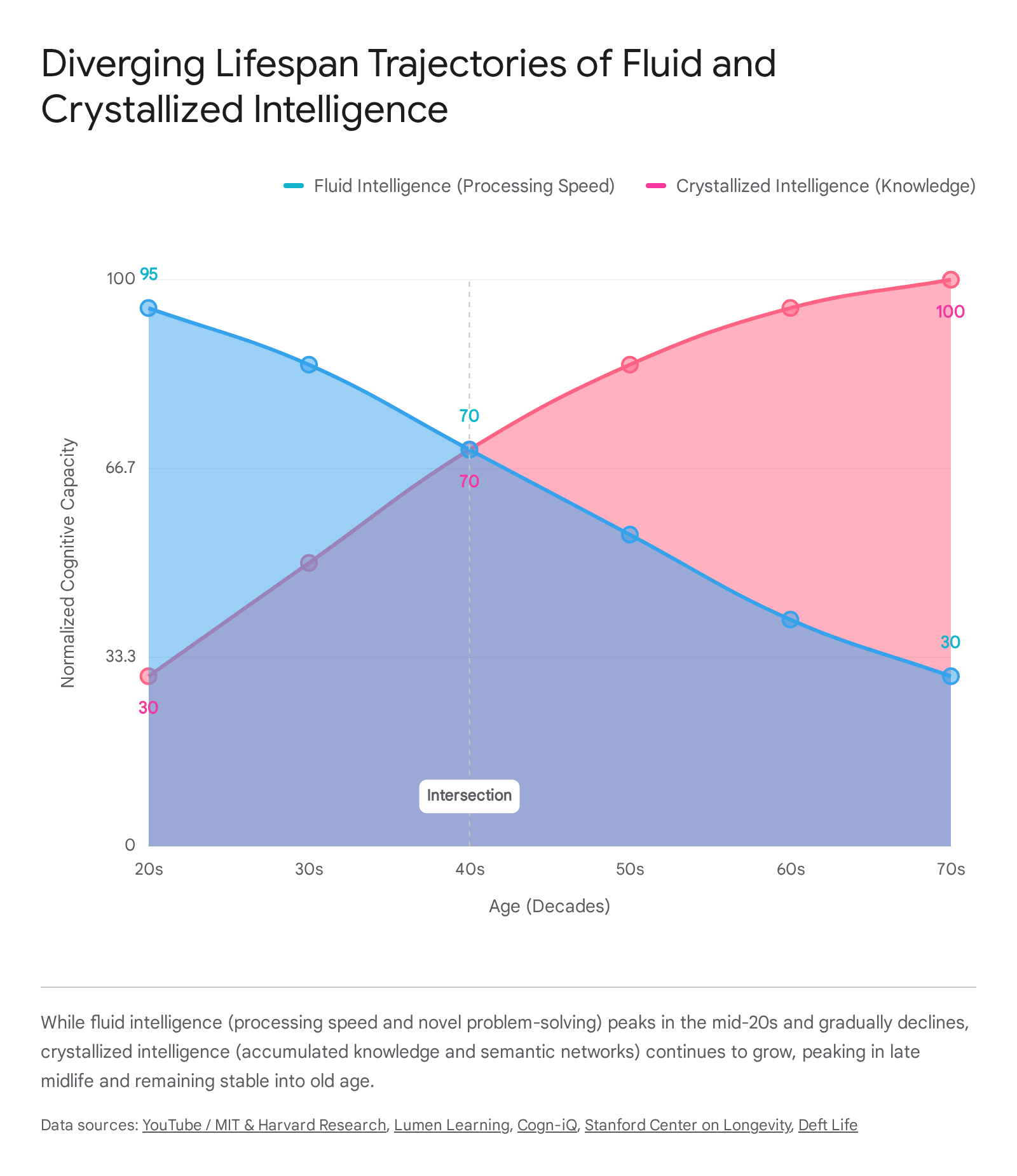
Fluid intelligence refers to the raw capacity for novel reasoning, rapid information processing, and the ability to solve abstract problems without prior experience. It represents the brain's baseline processing speed and heavily relies on the biological efficiency of neural transmission, working memory capacity, and the integrity of prefrontal cortex circuits 24. Empirical evidence, including data from longitudinal studies, consistently demonstrates that fluid intelligence peaks in early adulthood - typically around age 25 - and undergoes a gradual decline thereafter 125. Because fluid intelligence enables individuals to handle new information quickly and think abstractly outside of established paradigms, its early peak explains why prodigies in pure mathematics and theoretical physics often make their most groundbreaking discoveries in their twenties 567.
Conversely, crystallized intelligence encompasses accumulated knowledge, semantic networks, vocabulary, and learned problem-solving strategies. Unlike fluid intelligence, which is sensitive to the biological degradation of processing speed, crystallized intelligence is distributed across resilient cortical networks. It continues to increase throughout middle age, often plateauing or even growing into the sixth and seventh decades of life 123. Older adults generally outperform younger cohorts on measures of historical knowledge, spatial geography, and complex semantic tasks because their cognitive architecture prioritizes accumulated wisdom and pattern recognition over raw computational speed 14.
When individuals learn and apply new information over a lifetime, neuroplasticity facilitates the thickening of myelin - the insulation around neural axons - which enhances the efficiency of established neural pathways 5. This accrued mental scaffolding allows older creators to connect distinct domains of knowledge with greater ease than younger individuals who may possess faster processing speeds but fewer semantic anchors 5. Consequently, creativity in later life relies heavily on the synthesis of disparate concepts rather than the rapid generation of entirely novel abstractions, enabling older adults to excel in environments requiring judgment, interdisciplinary thinking, and deep contextual understanding.
Neurobiological Correlates of Creative Thought
The behavioral divergence between fluid and crystallized intelligence is underpinned by shifts in specific neural networks over the lifespan. Neuroimaging studies have identified the default mode network (DMN) and the executive control network (ECN) as critical drivers of the creative process 56. The DMN, a web of brain regions including the medial prefrontal cortex and posterior cingulate cortex, activates during mind-wandering, internal reflection, and spontaneous thought 67. It is structurally optimized for lateral thinking, capable of connecting seemingly remote concepts to generate unique ideas in a free-flowing manner 8. The vital role of the DMN in creativity was further confirmed by studies utilizing deep brain stimulation on awake patients; when specific parts of the DMN were temporarily suppressed, participants lost their ability to perform lateral thinking tasks, such as generating novel uses for everyday items 8.
The ECN, conversely, encompasses prefrontal and posterior parietal regions and is engaged during tasks requiring externally directed attention, working memory, and rule-based evaluation 5. Creativity demands a dynamic coupling of these typically antagonistic networks: the DMN generates spontaneous variations of ideas, while the ECN applies top-down cognitive control to evaluate, filter, and refine those ideas for utility 567. High divergent thinking ability has been closely associated with increased functional connectivity between the inferior frontal gyrus (a key hub of the ECN) and the DMN, highlighting that structural evaluation is just as vital to creative output as uninhibited ideation 7.
As the brain ages, these neurocognitive dynamics undergo significant alterations. The Default-Executive Coupling Hypothesis of Aging (DECHA) models the age-related shifts in network connectivity associated with cognitive performance. According to DECHA, older adults rely increasingly on cognitive-control processes mediated by prefrontal brain regions, often suppressing the DMN more rigidly than younger adults 9. While younger adults exhibit greater neurocognitive flexibility in toggling bi-directionally between the DMN and ECN, older adults may struggle to modulate this coupling based on varying task contexts 9. This diminished flexibility can inhibit the spontaneous, highly divergent ideation associated with early-stage creativity. However, the increased reliance on the ECN, combined with a vast semantic reservoir of crystallized knowledge, allows older adults to excel in the later stages of the creative process - evaluating, synthesizing, and executing complex, highly structured creative projects 5910.
Taxonomies of Creative Innovation
To interpret the shifting neural and cognitive landscapes of the aging brain, researchers have moved beyond monolithic definitions of creativity to establish typologies of innovation. The most prominent framework, developed by economist David Galenson and supported by researchers such as Bruce Weinberg, systematically distinguishes between "conceptual" and "experimental" innovators based on the methodology and life cycle of the creator 11121314.
Conceptual Innovation
Conceptual innovators operate deductively. They begin with a specific, abstract idea, problem, or emotion they wish to communicate, plan their approach precisely, and execute it rapidly 111418. These individuals challenge conventional wisdom, formulate clear deviations from accepted norms, and typically produce their most groundbreaking work before becoming deeply entrenched in the orthodoxies of their field 71214. Because this approach relies heavily on fluid intelligence - the ability to manipulate abstract variables and disregard established paradigms - conceptual innovators overwhelmingly reach their creative peak early in life, typically in their mid-to-late twenties 111214.
Historical analysis identifies figures like Pablo Picasso, Albert Einstein, and T.S. Eliot as classic conceptual innovators 11141815. Picasso's abrupt stylistic shifts and meticulously planned compositions reflect a deductive, goal-oriented mindset. Conceptual artists rarely repeat themselves iteratively on a single canvas; once an abstract problem is solved, they confidently move on to the next paradigm 1418.
Experimental Innovation
Experimental innovators operate inductively. They rarely begin with a precisely articulated goal or a clear linear plan. Instead, they accumulate knowledge over decades, relying on trial and error, continuous drafting, and gradual synthesis to discover what they wish to express through the process of creation itself 11121418. This iterative process is deeply reliant on crystallized intelligence. Experimental innovators build upon accumulated data, slowly unearthing profound connections that younger minds, lacking a deep semantic database, cannot yet perceive 71215. Consequently, experimental innovators tend to reach their creative zenith much later in life, often in their mid-fifties or beyond 7111214.
Figures such as Paul Cézanne, Charles Darwin, and Virginia Woolf exemplify the experimental approach 131815. Cézanne spent decades painting the same landscapes and subjects, adjusting his technique incrementally; notably, his most valuable and historically significant works were produced in the final year of his life at age 67 18. Experimental innovators are characterized by persistent doubt, continuous revision, and the integration of lifelong wisdom into their final outputs, proving that groundbreaking creativity can be an emergent property of aging rather than a casualty of it 131418.
Comparison of Innovator Profiles
The following table summarizes the distinct characteristics of conceptual and experimental innovators based on Galenson's theoretical framework, illustrating how divergent cognitive approaches yield vastly different creative life cycles 12141815.
| Characteristic | Conceptual Innovators | Experimental Innovators |
|---|---|---|
| Cognitive Approach | Deductive (starts with a defined solution/concept) | Inductive (arrives at a solution through process) |
| Primary Intelligence | Fluid Intelligence (Gf) | Crystallized Intelligence (Gc) |
| Peak Age of Output | Early career (mid-20s to early 30s) | Late career (mid-50s and beyond) |
| Methodology | Rapid execution, precise planning, sudden leaps | Trial and error, drafting, gradual synthesis |
| Relationship with Goals | Highly specific, predetermined goals | Vague goals discovered through experimentation |
| Attitude Toward Work | Confident, quick to abandon solved problems | Plagued by doubt, repetitive, perfectionistic |
| Historical Examples | Pablo Picasso, Albert Einstein, T.S. Eliot | Paul Cézanne, Charles Darwin, Virginia Woolf |
Domain-Specific Variations in Creative Output
The manifestation of peak creativity is highly contingent upon the specific demands of the professional or artistic domain. Psychologist Dean Keith Simonton's extensive research into the life cycles of creative individuals reveals that different disciplines require different balances of fluid and crystallized intelligence, thereby dictating the typical age of peak productivity 61617. Research generally indicates that an individual's level of creativity is not necessarily a condition of absolute age, but a reflection of the optimal intersection of cognitive capacity and domain complexity 17.
Scientific and Artistic Disciplines
In fields where creativity relies on the formulation of entirely new abstract systems or pure mathematical logic, peaks occur early. Poets, theoretical physicists, and pure mathematicians generally experience a steep ascent in creative output in their mid-twenties, a sharp peak in their late twenties to early thirties, and a relatively rapid decline 671718. The "harder" the science, the earlier the anticipated peak, as these fields demand high raw processing speed and the ability to conceptualize independently of accumulated literature 19.
Conversely, disciplines that require the assimilation of vast amounts of prior knowledge - such as history, philosophy, evolutionary biology, and novel writing - exhibit later peaks and much more gradual trajectories 61718. A novelist often requires decades of lived experience, semantic network building, and emotional maturation to produce a masterpiece, leading to peak productivity spanning the mid-forties to the sixties 18. Moreover, the increasing complexity of modern scientific disciplines means that the time required to master dense knowledge bases is stretching the peak age of scientific innovation later into the forties and fifties for many researchers 18. A comprehensive analysis of 90 Nobel literature laureates, 100 classical composers, and 221 highly valued painters found that, on average, these individuals produced their most notable work at age 42, typically after having lived roughly 61 percent of their total lifespans 20.
Leadership, Business, and Entrepreneurship
In the corporate and organizational spheres, creativity is intricately tied to leadership, risk assessment, and complex decision-making. Despite the cultural fixation on youthful founders in the technology sector - often fueled by the early successes of conceptual innovators like Mark Zuckerberg or Steve Jobs - empirical research thoroughly debunks the youth myth in entrepreneurship and corporate leadership 2021.
A comprehensive analysis of high-growth startups indicates that the average age of a highly successful founder is 43 21. Furthermore, the likelihood of entrepreneurial success rises consistently with age, primarily driven by prior industry experience and the accumulation of social and intellectual capital 21. Similarly, psychologists assessing the cognitive and personality traits necessary for effective leadership - such as emotional intelligence, financial literacy, moral reasoning, and cognitive flexibility - found that the optimal balance of these capabilities occurs between ages 55 and 60 322. While raw intellectual processing speed may decline, traits like conscientiousness, emotional stability, and the ability to navigate ambiguity increase well into the sixth decade 322. Meta-analyses of CEO age and organizational performance indicate that older leaders often compensate for potential cognitive slowing with sophisticated heuristics, extensive industry knowledge, and superior ethical judgment, leading to more stable innovation outcomes 232425.
Expected Peak Productivity Ages by Domain
The following table synthesizes research findings regarding the average ages of peak creative productivity across various domains, illustrating the spectrum of early to late bloomers 718202122.
| Professional Domain | Average Peak Age Range | Primary Driver of Peak Timing |
|---|---|---|
| Pure Mathematics & Theoretical Physics | Mid-20s to early 30s | Heavy reliance on abstract fluid intelligence. |
| Poetry & Lyricism | Mid-20s to early 30s | Drive for immediate emotional/conceptual expression. |
| Visual Arts (Painters/Sculptors) | Mid-30s to early 40s | Blend of fresh conceptual vision and refined technique. |
| Classical Music Composition | Mid-30s to early 40s | Mastery of complex structural rules paired with emotional range. |
| Novel Writing & Literature | Mid-40s to early 50s | Requires deep life experience and complex narrative synthesis. |
| High-Growth Entrepreneurship | Early 40s (Average: 43) | Reliance on prior industry experience and accumulated networks. |
| Executive Leadership & Management | Mid-50s to early 60s | Synthesis of emotional intelligence, moral reasoning, and heuristics. |
| Philosophy & History | Late 50s and beyond | Requires maximal accumulation and analysis of existing literature. |
Methodological Limitations in Creativity Research
Assertions regarding the decline of creativity with age must be critically evaluated against the profound methodological limitations of the studies producing them. The measurement of creativity, particularly across the lifespan and throughout history, is fraught with statistical, epistemological, and cultural challenges 2627.
Historiometric Methods and Survivorship Bias
Much of the foundational research on the lifespan of creative genius relies on historiometrics - a method that applies quantitative statistical analysis to archival data concerning historical individuals 282930. Historiometricians often operationalize concepts like "creativity" and "eminence" by measuring the amount of space allotted to an individual in encyclopedias, dictionaries, biographical indexes, or modern citation counts 2830.
While historiometrics provides valuable macro-level insights, it is inherently flawed and highly susceptible to survivorship bias 313237. Survivorship bias in this context means that researchers focus exclusively on successful, highly visible historical figures (the "survivors") while ignoring the vast majority of creators whose work was lost, marginalized, or unrecognized during their lifetimes 3132. Older adults who practice "experimental" creativity often produce subtle, iterative advances that may not generate the immediate, disruptive historical impact required to secure extensive encyclopedia entries, leading to an undercounting of late-life creative output 1332. Furthermore, historiometric datasets are predominantly Western-centric, culturally biased, and heavily skewed toward male creators, severely limiting the generalizability of the findings to broader populations and diverse cultural expressions of creativity 2628. Critics note that historiometrics often confuses the sociological phenomenon of fame with the psychological capacity for creativity 2833.
Psychometric Limitations and Assessment Bias
In laboratory and clinical settings, psychometric tests of creativity - such as the Alternate Uses Task (AUT), which measures divergent thinking - often impose strict time limits 52634. Because fluid intelligence and processing speed naturally decline with age, older adults are inherently penalized by timed assessments 12. If a psychological study defines creativity purely by the rapid generation of numerous divergent ideas in a short span (fluency), older adults will mathematically appear less creative. However, if creativity is measured by the depth, utility, complexity, and synthesis of ideas (originality and appropriateness), older adults often perform equally well, or better, than their younger counterparts 1026. As the scientific community shifts its focus from the mere quantity of ideas to the quality and context-appropriateness of creative outputs, the supposed "decline" in late-life creativity flattens significantly, revealing that older minds simply optimize for quality over speed 10.
Cross-Cultural Paradigms of Late-Life Creativity
The definition and valuation of creativity are not culturally universal. The perception that creativity is the exclusive domain of youth is largely an artifact of Western, industrialized societies that prioritize disruptive innovation, individualism, and rapid economic output 354136. A broader cross-cultural examination reveals entirely different paradigms in which late-life creativity is not only recognized but revered.
Western Versus Non-Western Frameworks
Western societies generally adhere to an analytical, problem-oriented view of creativity, favoring conceptual leaps and technological disruption that frequently map onto the capacities of younger minds 353637. In contrast, many Eastern, African, and Indigenous cultures view creativity through the lens of collectivism, wisdom, and generativity 35413638. In these frameworks, the elderly are revered as the custodians of cultural heritage, and their continuous creative outputs are viewed as vital to the survival, education, and cohesion of the community 3541.
A 2024 meta-analysis encompassing 221 effect sizes from 41 studies explored cross-cultural differences in creativity between Western and Eastern populations 394041. While the analysis found a statistically significant small-to-medium advantage for Western individuals on standardized creativity tests (g = 0.329), the researchers explicitly noted that assessment biases play a massive role in these outcomes 3940. Specifically, task framing heavily moderated the effect: when creativity tasks were presented as formal, intelligence-like "tests," Westerners excelled, but when the exact same tasks were framed as "games" or open-ended activities, the regional differences vanished 3940. This indicates that cultural orientation toward testing and individual performance dictates apparent creative output far more than innate, geographic cognitive differences.
Generativity and Oral Traditions
In non-Western contexts, late-life creativity is frequently expressed through "generativity" - the intrinsic motivation and behavioral tendency to guide, nurture, and create lasting value for future generations 42434445. Generativity relies heavily on crystallized intelligence, and its expression requires the deep synthesis of life experience.
In West Africa, the oral tradition is maintained by griots or jelis (hereditary poet-musicians and storytellers) 524647. Elder griots do not merely repeat rote histories; they dynamically weave genealogy, folklore, and moral philosophy into highly creative, extemporaneous performances - often accompanied by the Kora - tailored to address contemporary community issues 524647. This requires immense cognitive flexibility and semantic retrieval, representing a continuous, lifelong creative practice that peaks in old age as the griot's knowledge base expands.
Similarly, among Aboriginal Australian communities, the creation of visual art and the recounting of Dreamtime stories are deeply generative acts largely stewarded by elders 484950. Aboriginal elders utilize visual storytelling - where every brushstroke and symbol conveys complex ancestral, ecological, and spatial knowledge - to transmit culture 48. The creation of this art is not viewed as a disruptive individualistic achievement but as a collaborative, ongoing process of maintaining the spiritual and social fabric of the community 485051. Efforts by researchers to map this knowledge through video ethnography highlight that this elder wisdom is continuously evolving, mixing ancient traditions with contemporary experiences to create new, relevant knowledge frameworks 49.
Systemic Ageism and Environmental Constraints
If cognitive science confirms that older adults remain highly capable of creative output, and cross-cultural analyses prove that late-life creativity is thriving globally, why is it seemingly less prevalent in Western public and professional spheres? The answer lies heavily in sociology rather than neurobiology. Systemic ageism establishes profound structural barriers that artificially suppress the creative potential of older adults 525354.
Institutional Barriers to Late-Life Innovation
Systemic ageism manifests in laws, workplace practices, and cultural norms that systematically marginalize older individuals, making continued creative output practically difficult 525354. In the workforce, mandatory retirement ages force highly competent, experienced individuals to halt their professional creative pursuits prematurely 5253. Furthermore, hiring practices and resource allocation heavily favor youth. For example, venture capital funding is disproportionately directed toward young founders, despite clear economic data proving that middle-aged founders have a statistically higher likelihood of success 21. In academia, the sciences, and the arts, grants and training opportunities are frequently restricted for older applicants under the false, stereotyped assumption that they cannot adapt to new methodologies or technologies 525355.
These structural barriers limit the resources, platforms, and financial security required to sustain a creative career into late adulthood. Consequently, the apparent drop in creative productivity among older adults is heavily confounded by a lack of institutional support, diminished access to the tools of production, and social isolation 525556.
The Model of Creative Aging (MOCA)
To address how environmental, physical, and psychological factors interact with late-life creativity, researchers have developed the Model of Creative Aging (MOCA) 105758. MOCA is built on a fascinating psychological paradox: while aging undeniably introduces physical and cognitive constraints, constraints themselves are widely known to enhance creativity by forcing the brain into novel problem-solving pathways 10.
According to MOCA, the continuation of creativity into old age depends largely on how an individual frames their limitations. If an older adult internalizes systemic ageist stereotypes, viewing constraints as "exclusionary" (e.g., "I can no longer paint because my hands shake"), creative output ceases 1058. However, if the individual possesses high creative expertise and frames constraints as "focusing" (e.g., "My hands shake, so I will adopt a looser, more abstract painting style"), late-life constraints act as a powerful catalyst for profound creative evolution 1058. Historical examples, such as Claude Monet adapting to a highly abstract style in response to failing vision, or Henri Matisse utilizing paper cut-outs when confined to a wheelchair, perfectly illustrate the power of focusing constraints 66. MOCA emphasizes that maintaining creativity in later life is largely a function of psychological resilience, sophisticated metacognition, and the availability of supportive sociocultural environments that encourage adaptation rather than withdrawal 1057.
Conclusion
The assertion that creativity inevitably declines with age is a myth rooted in a narrow, historically contingent understanding of what constitutes innovation. While the raw, rapid processing power of fluid intelligence peaks in early adulthood - fueling the sudden, deductive leaps characteristic of conceptual innovators and theoretical scientists - this represents only a fraction of the human creative spectrum. Crystallized intelligence, enriched by decades of experience, emotional maturation, and dense semantic networking, continues to grow well into late adulthood. This cognitive architecture allows experimental innovators, seasoned leaders, and cultural elders to produce highly synthesized, deeply impactful, and generative creative work. The perceived absence of late-life creativity is less a biological inevitability than a symptom of systemic ageism, methodological biases in historical research, and a cultural failure to recognize the inductive, collaborative forms of creativity that define human wisdom in its most mature state.