
Comparative cognition and animal intelligence
The Dismantling of the Scala Naturae and the Evolution of Comparative Cognition
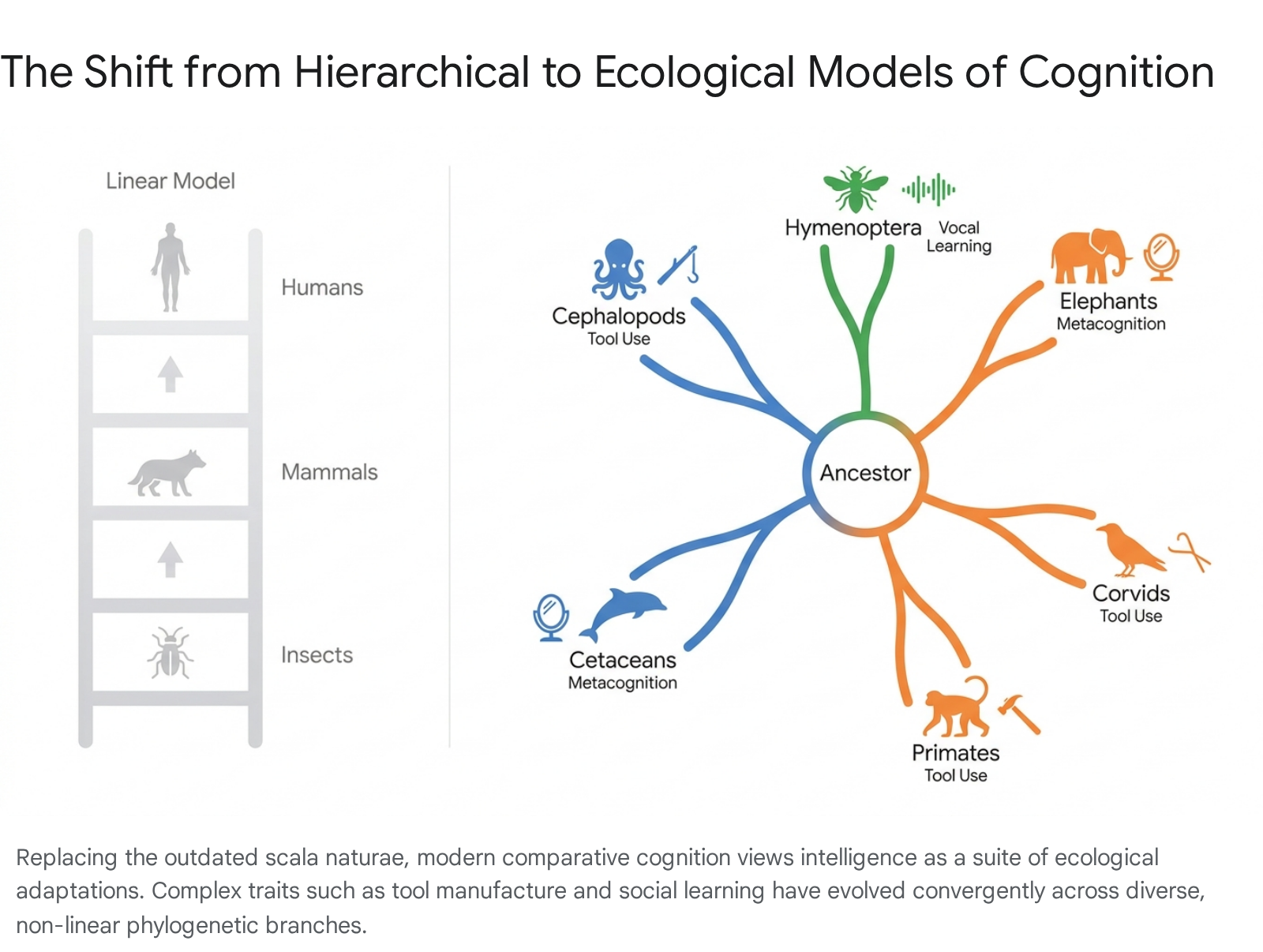
For centuries, the study of animal intelligence was intellectually constrained by the scala naturae, or the "Great Chain of Being" - an Aristotelian framework that arranged all living organisms in a linear, hierarchical progression 12. This anthropocentric paradigm inherently positioned human cognition as the ultimate evolutionary endpoint, effectively reducing the mental capacities of all other species to inferior, incomplete, or merely associative versions of human intelligence. However, modern comparative cognition fundamentally rejects this unilinear trajectory. Intelligence is no longer viewed as a single, quantifiable substance that species possess in varying quantities. Instead, cognition is understood as an ecological adaptation - a highly specialized suite of sensory, neural, and behavioral toolkits forged by specific evolutionary pressures to solve distinct environmental and social challenges 34.
The dismantling of the scala naturae was catalyzed by a generation of foundational researchers who challenged the assumption that advanced cognition was the exclusive domain of the primate lineage. Irene Pepperberg's groundbreaking work with African grey parrots demonstrated that avian species possess complex numerical, categorical, and linguistic understanding previously thought impossible outside of hominids. Nicola Clayton revolutionized the understanding of avian memory by providing the first empirical evidence of episodic-like memory and mental time travel in scrub jays. Christophe Boesch provided extensive evidence of distinct, socially transmitted cultural traditions and tool-use variations in wild chimpanzees, demonstrating that culture is not a uniquely human phenomenon. Concurrently, Alex Taylor's investigations illuminated the sophisticated causal reasoning and meta-tool manufacture in New Caledonian crows, proving that advanced physical cognition can arise in brains lacking a neocortex 5678.
Building upon this foundation, contemporary research has aggressively expanded its taxonomic scope. By investigating the cognitive architectures of cetaceans, cephalopods, elephants, and insects, the scientific community has revealed that advanced cognitive traits - such as metacognition, sequential planning, and cumulative culture - have evolved convergently across vastly divergent phylogenetic lineages 18910. This convergent evolution is driven by shared socio-ecological challenges. For instance, the Ecological Intelligence Hypothesis suggests that the demands of locating and extracting unpredictable food resources drive the evolution of physical cognition, while the Social Intelligence Hypothesis posits that navigating complex, fission-fusion societies drives the evolution of sophisticated communication, theory of mind, and social learning 19. Consequently, an organism's intelligence cannot be measured on a vertical scale against humanity; it must be mapped radially, acknowledging that the alien intelligence of an octopus or the hive-mind optimization of a honeybee represent different evolutionary peaks of cognitive specialization.
The Umwelt Problem and the Fallacy of Anthropocentrism in Cognitive Testing
To accurately and fairly measure animal intelligence, researchers must overcome the Umwelt problem. Coined by the early 20th-century ethologist Jakob von Uexküll, the Umwelt refers to the unique, species-specific perceptual world that an organism inhabits, defined by its specialized sensory organs and neural processing systems. Because human researchers inherently design experiments based on the human Umwelt - which relies heavily on binocular vision, manual dexterity, and terrestrial spatial mapping - cross-species cognitive comparisons frequently suffer from profound anthropocentric biases 811. If a cognitive test requires a subject to manipulate a touchscreen or hold a stick, an animal lacking hands or forward-facing eyes will likely fail. This failure does not represent a lack of cognitive capacity, but rather a severe mismatch between the task's sensorimotor demands and the animal's physical and perceptual affordances 8.
This disconnect has historically been glaring in studies of elephants. Early experiments on elephant intelligence often yielded poor results because they relied on visual discrimination tasks more suited to primates 11. When comparative psychologists redesigned tests to leverage the elephant's primary sensory modalities - olfaction and acoustic processing - and their anatomical interface with the world (the trunk), the data shifted dramatically. It became clear that elephants possess exceptional working memory, mirror self-recognition (MSR), and the ability to track the spatial locations of up to 30 conspecifics via scent cues alone 39.
Furthermore, anatomical variations even within closely related taxonomic families dictate how they interact with their environment and, consequently, how they must be tested. Differences between African savannah elephants (Loxodonta africana) and Asian elephants (Elephas maximus) extend beyond size and habitat into functional morphology. African elephants possess two triangular protrusions at the tip of their trunks, enabling precise, finger-like pinching of objects. Asian elephants possess only a single upper protrusion, necessitating a full-trunk wrapping motion to grasp items 12. In problem-solving tests conducted at Zoo Miami involving out-of-reach food, neither species utilized sticks as intended by human designers. However, African elephants successfully utilized heavy rocks to displace physical barriers, a behavior aligned with their morphological strengths 14.
| Morphological Feature | African Elephant (Loxodonta africana / cyclotis) | Asian Elephant (Elephas maximus) | Impact on Physical Affordance / Tool Use |
|---|---|---|---|
| Trunk Morphology | Two triangular "fingers" at the tip | Single upper "finger" at the tip | African elephants can perform precise pinching; Asian elephants rely on wrapping motions 12. |
| Ear Size and Function | Up to 1.8m long, 1.2m wide; prominent capillary network | Much smaller, rounded shape | Thermal regulation dictates varying energetic demands based on habitat 12. |
| Body Mass (Male) | 4,500 to 6,100 kg (Savannah) | 2,000 to 5,500 kg | Alters the mass of objects that can be manipulated in problem-solving tests 1214. |
| Social Structure | Strict hierarchy; herds up to 70 individuals | Fluid fission-fusion; 5-15 related females | Dictates differences in social connectivity and cognitive network processing 1213. |
The tension between controlled laboratory testing and ecological validity remains a central challenge in comparative cognition. Captive environments frequently lack the dynamic complexity of the wild, potentially stunting the development of certain cognitive traits while artificially enhancing others. This phenomenon, known as the "captivity bias," suggests that captive apes, for instance, may exhibit higher rates of specific object manipulations due to increased free time, reduced predation pressure, and human provisioning, yet they may fail to display the complex spatial navigation or socially transmitted survival strategies critical to their wild counterparts 1415. A comparative study of captive versus wild fathead minnows (Pimephales promelas) reinforced this bias: while associative learning was similar across both groups, wild fish were three times more likely to successfully complete complex reversal learning tasks, a cognitive flexibility essential for adapting to highly fluctuating, predator-rich natural environments 14. Consequently, integrating the data-mining of long-term wild observational studies with controlled, ecologically relevant field experiments is vital for a holistic understanding of an animal's natural cognitive repertoire 311.
Reassessing Cognitive Benchmarks: Delay of Gratification Across Taxa
To map the cognitive landscape across diverse taxa, ethologists frequently employ standardized benchmarks, though the interpretation of these benchmarks is highly context-dependent. The delay of gratification paradigm - popularized by the Stanford marshmallow experiment conducted by Walter Mischel in the 1970s - tests an individual's self-control, inhibitory control, and future-oriented decision-making 161920. In humans, the original studies indicated a large correlation between delay time (waiting 15 minutes for a preferred second treat) and later adolescent SAT scores, lower BMI, and advanced socio-emotional competence 161917. However, recent conceptual replications have complicated this narrative. Studies between 2018 and 2024 involving larger, more diverse samples revealed that economic background, family stability, and early cognitive ability explained a significant portion of the effect, severely challenging the predictive power of sheer willpower 161917. Furthermore, cross-cultural assessments show distinct behavioral profiles: Japanese children wait three times longer for food rewards (driven by cultural dining habits) while US children excel at waiting for wrapped gifts 22.
When this paradigm is translated into comparative animal studies, it reveals profound cognitive differences rooted not just in "brain power," but in strict evolutionary and foraging pressures. In the vertebrate world, primates, corvids, and psittacines (parrots) generally demonstrate high self-control, capable of enduring multi-minute delays for preferred rewards. This capacity is critical, as it underlies decision-making, social competence, and future planning in complex environments 2.
However, applying the delay of gratification test to invertebrates highlights the friction of ecological constraints. In a 2025 study, researchers assessed the delay maintenance capacity of the bumblebee (Bombus terrestris). The insects were individually trained to associate differently colored artificial flowers with either an immediate small sucrose reward (a 5 μl drop) or a delayed, much larger reward (four 5 μl drops with a 15-second delay) 18. The results were highly illuminating. While a small subset of bees exhibited profound self-control, enduring extended delays of up to 364 seconds - a performance rivaling large-brained mammals and birds - the overall population proved highly inconsistent, frequently defaulting to the immediate, smaller reward 18.
This variance does not inherently indicate a failure of general intelligence. Rather, it is a localized ecological calculation. A foraging bee in the wild operates under severe time constraints, high metabolic burn rates, and constant predation risks. Passing up an immediate, guaranteed nectar source for a hypothetical future reward violates optimal foraging theory for a short-lived insect operating in a highly competitive, fast-paced environment 1824. Thus, poor performance in delayed gratification reflects an adaptive metabolic strategy molded by life history, rather than an underlying cognitive deficit.
| Taxonomic Group | Example Species | Delay of Gratification Performance | Ecological/Cognitive Driver |
|---|---|---|---|
| Primates | Chimpanzee (Pan troglodytes) | High (Multi-minute tolerance) | Long lifespan, stable social hierarchies, complex foraging 2. |
| Corvids | New Caledonian Crow (C. moneduloides) | High (Multi-minute tolerance) | Future planning, caching behavior, tool valuation 219. |
| Cephalopods | Common Octopus (Octopus vulgaris) | Moderate (Context-dependent) | Predatory patience vs. high metabolic turnover 20. |
| Hymenoptera | Bumblebee (Bombus terrestris) | Variable/Low (Default to immediate) | Short lifespan, high predation risk, metabolic constraints 18. |
Similarly, the exploration of metacognition - the ability to evaluate one's own certainty or knowledge - has yielded surprising results in bees. Honey bees demonstrate a capacity to gauge the reliability of available evidence before making a choice. When presented with difficult visual discriminations, bees take significantly longer to decide and are more likely to reject a landing if the penalty for failure or predation risk is high, mimicking the confidence-based decision-making previously thought exclusive to primates 24.
Conversely, tests for self-awareness, specifically the Mirror Self-Recognition (MSR) mark test, continue to highlight the boundaries of cross-taxa comparisons. While apes, dolphins, and Asian elephants have demonstrated the ability to use mirrors to inspect hidden marks on their bodies, recent attempts to find MSR in invertebrates have proven inconclusive. In a 2026 study, researchers applied a paint mark to the clypeus (a facial plate invisible without a mirror) of western honeybees. While grooming behavior increased when facing the mirror, critical direct comparisons indicated that this was likely a generalized orienting response to a novel stimulus, tactile irritation, or agitation from a perceived conspecific, rather than true abstract self-conceptualization 2721.
Advanced Physical Cognition: Tool Manufacture and Sequential Architectures
Tool use was once the defining metric separating humanity from the rest of the animal kingdom. Today, behavioral ecology categorizes physical cognition across a spectrum of complexity, moving from stereotyped, innate behaviors to highly flexible, sequential, and constructive tool manufacture 5829. Sequential tool use - using one tool to acquire a second, more effective non-food object to ultimately achieve a goal - demands a sophisticated mental representation of sub-goals and non-adjacent dependencies.
Chimpanzees exhibit this capacity in the wild. For example, the chimpanzees of Bossou, Guinea, organize their nut-cracking behaviors into hierarchical "chunks." Through analysis of over 8,000 tool-use actions, researchers discovered that chimps pause sequences to readjust tools in a manner that bypasses simple Markov chain (reaction-based) models, demonstrating long-range behavioral dependencies. This flexibility implies an ability to plan, embed subgoals, and selectively skip steps based on context, an architectural prerequisite long thought unique to human syntax and linguistic structure 302223.
However, avian physical cognition rivals, and in some aspects exceeds, that of non-human primates. The New Caledonian crow (Corvus moneduloides) is capable of both sequential tool use and compound tool manufacture 6733. In laboratory settings, these corvids spontaneously combine two or more non-functional short items to create a long-reaching pole, a constructive feat requiring the anticipation of the physical properties of an unobserved final object - an ability archeologically linked only to late hominid evolution, specifically the Middle Palaeolithic 24. In the wild, they follow precise, multi-step sculpting procedures to transform Cunonia vieillardii twigs into functional hooks 33.
Furthermore, these crows exhibit a behavior known as tool "safekeeping," which implies advanced object valuation. Wild-caught crows strongly prefer hooked stick tools manufactured from Desmanthus virgatus stems (which are highly efficient but costly in time and effort to procure) over simple, non-hooked twigs sourced from leaf litter. After using a hooked tool, they purposefully store it securely underfoot or in a tree crevice. By preserving preferred tools across successive foraging episodes, the crows demonstrate that they ascribe relative value to their tools and plan for future, mutually exclusive foraging outcomes 19. This ability to plan for mutually exclusive outcomes is also observed in elephants. In recent experiments utilizing forked-tube paradigms, Asian elephants displayed the capacity to prepare for uncertain future events, coordinating behaviors to secure food regardless of which trajectory it randomly followed 25.
In the invertebrate realm, cephalopods challenge the fundamental assumption that a vertebrate, centralized brain is required for advanced physical cognition. Octopuses, separated from humans by over 500 million years of evolutionary history, excel at solving multi-step puzzle boxes. In trials, Octopus vulgaris not only learned to unlock multi-component puzzles, but actively refined their physical techniques and readily abandoned failed strategies when the puzzle rules were altered, demonstrating high cognitive flexibility rather than rote memorization 2026.
The veined octopus (Amphioctopus marginatus) exhibits a rare form of sequential, future-oriented invertebrate tool use. It actively unearths, cleans, and stacks coconut shell halves, carrying them awkwardly across the sea floor in a posture termed "stilt-walking." Because the octopus incurs an immediate energetic cost and increased vulnerability during transport for a delayed benefit (assembling the shells later for shelter), this behavior fulfills the criteria for genuine tool use 2027. This immense physical dexterity is mediated by a unique, highly decentralized nervous system. Recent studies utilizing advanced microscopy have revealed that the axial nerve cords in cephalopod arms are highly segmented into modular units. This segmentation grants each individual sucker autonomous sensory and motor control, enabling the octopus to seamlessly multitask - reaching, grasping, and manipulating multiple objects simultaneously - without requiring continuous, processing-heavy top-down commands from the central brain 3828.
Social Cognition, Cumulative Culture, and the Self-Domestication Hypothesis
The assumption that complex, accumulating culture is a uniquely hominid trait has been forcefully dismantled by recent discoveries in both the smallest and largest of creatures. Cumulative culture occurs when an individual makes an innovation that is socially learned and subsequently built upon by others across generations, leading to behaviors too complex for any single individual to invent independently through trial and error 10.
Astonishingly, this phenomenon was recently documented in bumblebees. In a landmark 2024 experimental paradigm, buff-tailed bumblebees (Bombus terrestris) were presented with a complex two-step puzzle box. To access a sucrose reward, the bees had to first push a blue tab out of the way (an unrewarded action) before they could push a red tab to release the lid. Naive bees failed entirely to solve the puzzle, even after 24 days of extended exposure 102930. However, when trained "demonstrator" bees modeled the sequential solution, a third of the naive observer bees rapidly acquired the complex two-step behavior. This proves that insects are capable of socially acquiring skills beyond their individual capacity to innovate, laying the necessary groundwork for cultural accumulation 1031.
This social acquisition extends to their symbolic language. The honeybee waggle dance - a figure-eight motion communicating distance, direction relative to the sun, and resource quality - was long assumed to be strictly instinctual. However, researchers creating experimental colonies isolated from older bees found that while the juvenile bees innately knew how to dance, their spatial mapping and directional precision were highly erratic. Without social learning and feedback from experienced elders, the bees failed to accurately convey distance, proving that insect language requires social transmission and environmental tuning 454632. Advanced numerical cognition also plays a role in their foraging ecology; experiments adjusting for insect visual perception confirm that bees possess genuine sensitivity to numbers, demonstrating the ability to count shapes, perform basic addition, and even comprehend the abstract concept of zero 11.
In long-lived mammals, the loss of cultural transmission and elder knowledge can be devastating. Elephants live in complex fission-fusion matriarchal societies relying heavily on the accumulated ecological and social memory of older females. Populations decimated by poaching or culling - such as the orphaned groups moved to Pilanesberg in South Africa in the 1990s - where young elephants grow up without elders, exhibit severe socio-cognitive deficits. These herds display erratic, inaccurate responses to predator calls, heightened aggression, and an increase in self-directed behaviors (SDBs) such as compulsive scratching, which serves as a behavioral marker for chronic social stress and anxiety 483334.
The profound prosociality, extended juvenile learning period, culturally transmitted behavior, and socially regulated stress responses in elephants have led researchers to propose the elephant as an animal model for the human self-domestication hypothesis (HSD) 9. Just as humans evolved advanced cooperation, reduced reactive aggression, and complex language by undergoing an evolutionary process of self-domestication, elephants appear to have undergone a similar trajectory. Genetic evidence indicates that elephants show positive selection in pathways associated with domestication traits, resulting in sophisticated vocal communication, targeted helping, and rich cultural traditions 9.
Cultural continuity is similarly vital to cetaceans. Long-term field studies mapping the "blue corridors" of the Southern Ocean have revealed distinct regional foraging cultures and migration routes. Southern right whales (Eubalaena australis) exhibit highly variable, socially learned migration paths ranging from Western Australia to the Subtropical Front, and down to the Antarctic ice edge 35. However, these culturally transmitted routes are currently under severe threat. A 33-year study in the Great Australian Bight, alongside parallel data from South Africa and Argentina, indicates that climate-driven changes, including persistent positive Antarctic Oscillation and rapid sea ice loss, are depleting krill stocks. This forces whales to alter generations-old migration patterns to hunt copepods in mid-latitude regions, leading to severe nutritional stress and significantly prolonged calving intervals, which have risen from an average of 3.4 to 4.1 years 3536373839.
Decoding the Non-Human Umwelt: Bio-logging and Artificial Intelligence
The frontier of comparative cognition has rapidly shifted from analog behavioral observation to algorithmic translation. The convergence of advanced bio-acoustics, non-invasive robotics, and artificial intelligence is providing unprecedented access to animal communication, pushing the boundaries of what constitutes "language."
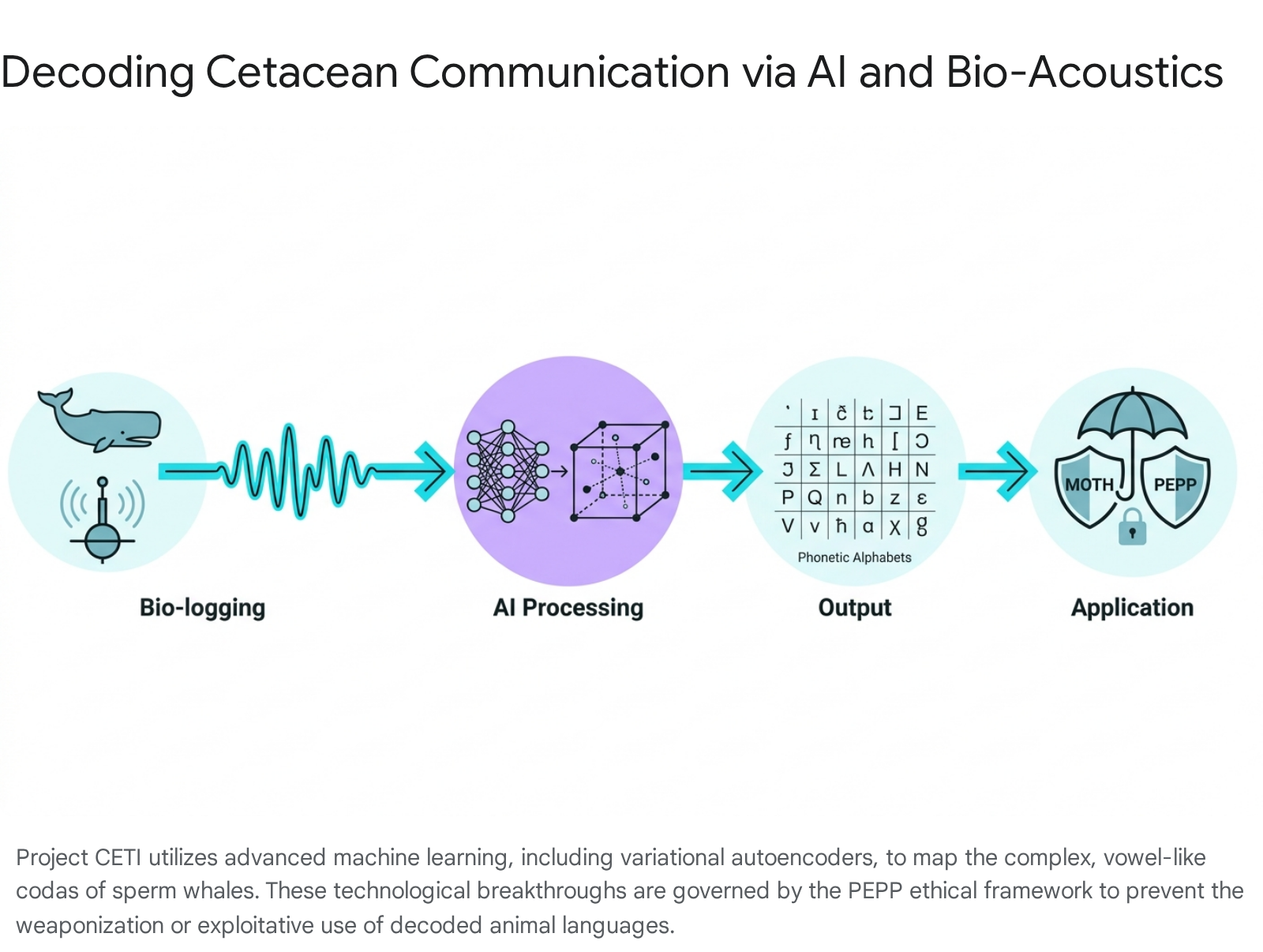
Leading this charge is Project CETI (Cetacean Translation Initiative), an interdisciplinary effort utilizing machine learning to decode the communication of sperm whales (Physeter macrocephalus) off the coast of Dominica 40414243. Sperm whales communicate using "codas" - rapid, rhythmic bursts of broadband clicks produced when air is pushed through their nasal passages and over phonic lips 43. Historically dismissed as simple Morse code or basic echolocation, AI analysis has revealed a staggering depth of structural complexity. Utilizing deep learning models, researchers have mapped a latent space of whale vocalizations, pulling click sequences out of background ocean noise with 99.5% accuracy. They discovered that variations in click rhythm, tempo, and rubato function analogously to human vowels, effectively forming a complex phonetic alphabet capable of conveying distinct dialects and social meaning 414243.
Furthermore, machine learning models like the Python-based Chatter library are shifting analysis away from static categorization. Traditional methods forced animal calls into neat boxes, missing subtle gradations in meaning. By analyzing vocal sequences as continuous, evolving patterns through advanced algorithms like vision transformers and variational autoencoders, researchers can identify non-adjacent dependencies, predictability, and contextual syntax in bat, bird, primate, and whale calls without the need for manual, human-biased labeling 444546.
This capability to eavesdrop on the precise meaning of animal communication has profound legal, ethical, and conservation implications. If AI enables humans to decode cetacean distress calls resulting from shipping noise, or to understand the synchronized communication involved in a sperm whale birth, the legal status of these animals may shift radically. Initiatives like the MOTH (More Than Human Life) Program at NYU Law argue that recognizing the linguistic and cultural complexity of cetaceans demands an evolution in environmental law, potentially granting animals the legal right to participate in their own culture free from anthropogenic interference 4147.
However, the power to translate animal communication carries the inherent risk of exploitation. Tools designed for translation could be weaponized for military programs, invasive tourism, or commercial control. To mitigate this, researchers have established the PEPP Framework (Prepare, Engage, Prevent, Protect), a set of foundational ethical guidelines designed to ensure AI is used strictly to advocate for animal welfare rather than to manipulate wild populations 4748.
Next-Generation Neural Imaging: Observing the Active Animal Mind
Historically, comparing the neurobiological substrates of intelligence across diverse species was severely hindered by the need for destructive sampling or highly restrictive imaging techniques. While functional Magnetic Resonance Imaging (fMRI) successfully mapped human cognition by measuring changes in blood oxygenation (BOLD contrast), its reliance on massive magnetic fields and absolute subject immobility rendered it nearly impossible to use on awake, behaving animals performing complex cognitive tasks or natural vocalizations 496650.
Recent technological leaps are overcoming these limitations, offering unprecedented, non-invasive windows into animal cognition. Functional ultrasound imaging (fUSi) has emerged as a revolutionary neuroimaging technique. By emitting high-frequency sound waves to map blood volume dynamics with high spatiotemporal resolution (approaching 100 μm), lightweight fUSi probes can be mounted directly on an animal's head. This allows researchers to monitor brain-wide neural activity in real-time while the subject moves and behaves. Recently, this technique was successfully applied to map the Field L complex - the avian equivalent of the mammalian auditory cortex - in awake, vocalizing corvids, bridging the gap between neuroanatomy and complex socio-vocal behavior without the constraints of fMRI 4966.
| Imaging Technology | Primary Mechanism | Applications in Comparative Cognition | Key Advantages |
|---|---|---|---|
| fMRI / MRI | Measures blood oxygenation (BOLD) via magnetic fields | Broad mapping of vertebrate brain structures 4950. | Non-invasive, high resolution, deep tissue mapping. |
| Functional Ultrasound (fUSi) | Maps blood volume dynamics via high-frequency sound waves | Tracking auditory processing (Field L complex) in awake, behaving corvids 4966. | Extremely lightweight probes; allows for movement during complex cognitive tasks. |
| Serial Two-Photon (STP) Tomography | High-powered microscopy paired with automated tissue slicing | Creating 3D digital brain atlases of migratory birds (Eurasian blackcap) 6851. | Ultra-high resolution (voxel size 2x2x5 μm); provides a universal coordinate map for global research. |
| Micro-Computed Tomography (Micro-CT) | X-ray scanning of skeletal structures to create digital endocasts | Reconstructing the pallium and brain volume of rare or extinct bird species 7052. | Non-destructive; requires only dry museum skulls, eliminating the need for preserved brain tissue. |
| Calcium Imaging | Fluorescent dyes bind to calcium ions during neural firing | Visualizing neural activity in the optic lobes of squids and octopuses 53. | Maps visual processing in decentralized, soft-bodied invertebrate nervous systems. |
Other innovations are penetrating biological barriers previously deemed impenetrable. The PACMes system, developed by Chinese researchers, integrates near-infrared optical excitation with low-frequency acoustic detection to penetrate the intact scalp and skull of mice. Operating without exogenous contrast agents, it provides high-resolution, long-term monitoring of the cerebral cortex, offering dynamic observations of vascular repair mechanisms over several months 73. Concurrently, MIT researchers have developed a photoacoustic imaging system capable of detecting the molecular activity of NAD(P)H - a molecule associated with neural electrical activity - at unprecedented depths of 1.1 millimeters within live brain tissue, effectively using sound to detect single-cell metabolism 54.
In the realm of invertebrates, where the brain is distributed and soft-bodied, novel applications of existing technologies are yielding breakthroughs. Neuroscientists studying cephalopod vision have successfully adapted calcium imaging. By infiltrating the mantle with a calcium indicator dye, researchers can finally visualize neural firing in the optic lobes of squids and octopuses as they process visual space and jet across their environment, unlocking the secrets of an alien visual system 53. For extinct or highly rare species, non-destructive micro-computed tomography (micro-CT) scanning is being used to generate high-resolution digital endocasts of skulls. By creating 3D digital atlases of the cranial spaces of birds - such as the Eurasian blackcap (Sylvia atricapilla) - evolutionary biologists can accurately map the size of specific computational centers in the avian brain, enabling massive cross-species comparisons of neurological evolution without needing physical brain tissue 68517052.
Conclusion
The investigation into comparative cognition has matured far beyond a mere search for human-like traits in animals. By adopting an ecological framework, the scientific community recognizes that intelligence is an evolutionary response to environmental friction, not a hierarchical ladder. A bumblebee's ability to selectively engage in cumulative culture and numeric calculation, an octopus's capacity to navigate sequential puzzles with a decentralized nervous system, and an elephant's reliance on culturally transmitted ecological memory all demonstrate that sophisticated cognition is deeply pluralistic.
As artificial intelligence decodes the syntax of cetacean codas and next-generation neural imaging allows researchers to non-invasively penetrate the Umwelt of diverse taxa, it is evident that the natural world contains a vast, interconnected network of highly specialized, thinking minds. Continued integration of rigorous, ecologically valid field studies with advanced computational modeling will be paramount in preserving the cultural and cognitive diversity of the biosphere in the face of rapid anthropogenic and climatic changes.