
Chaos theory and deterministic unpredictability in 2024
Introduction to Nonlinear Dynamics and Deterministic Predictability
For decades, the popular understanding of chaos theory has been dominated by the butterfly effect - the concept that minuscule perturbations in initial conditions can compound exponentially, resulting in macroscopic divergences in deterministic systems. Formulated in the mid-twentieth century through the work of mathematicians and meteorologists such as Henri Poincaré and Edward Lorenz, classical chaos theory established that predictability is practically finite, even when governing equations are strictly deterministic and devoid of inherent randomness 1233. By 2024, however, the study of nonlinear dynamics has transcended the mere identification of sensitive dependence on initial conditions.
Contemporary research in chaos theory focuses on managing, predicting, and leveraging deterministic unpredictability across disciplines ranging from quantum mechanics to machine learning. Instead of viewing chaos solely as an insurmountable barrier to forecasting, modern physicists and computational scientists approach chaotic systems as complex, structured geometries that can be learned, mapped, and, under specific conditions, mathematically stabilized. This shift involves high-dimensional data assimilation, the identification of invariant topological structures, and the extraction of governing equations from raw observational data using advanced regression and reservoir computing algorithms 456.
The frontiers of nonlinear dynamics now encompass the theoretical reconciliation of chaos with quantum uncertainty, the emergence of partial synchronization in neurological networks, and the application of chaos control algorithms in highly stochastic biological environments 78911. Furthermore, chaos theory remains the central framework for defining the epistemological limits of climate modeling, specifically concerning how anthropogenic atmospheric warming actively compresses the temporal horizon of weather predictability by altering the propagation of simulation errors 10.
Epistemological Boundaries Between Chaos and Stochasticity
A persistent theoretical challenge in nonlinear dynamics involves delineating the boundary between deterministic chaos and pure stochasticity. In dynamical systems theory, these two concepts describe fundamentally distinct phenomena, although they frequently produce observationally similar outputs - namely, highly complex, aperiodic, and unpredictable time series data 31314.
Deterministic chaos arises in systems governed by precise, non-random mathematical laws where future states are entirely dictated by initial conditions 23. The unpredictability inherent in a chaotic system is epistemic; it stems from the physical impossibility of measuring initial conditions with infinite precision. This lack of perfect measurement leads to the exponential amplification of infinitesimal errors over time, a divergence mathematically quantified by the Lyapunov exponent 113. In contrast, stochastic systems incorporate inherent ontological randomness or noise, meaning that state transitions are governed by probability distributions rather than fixed algebraic trajectories 1314.
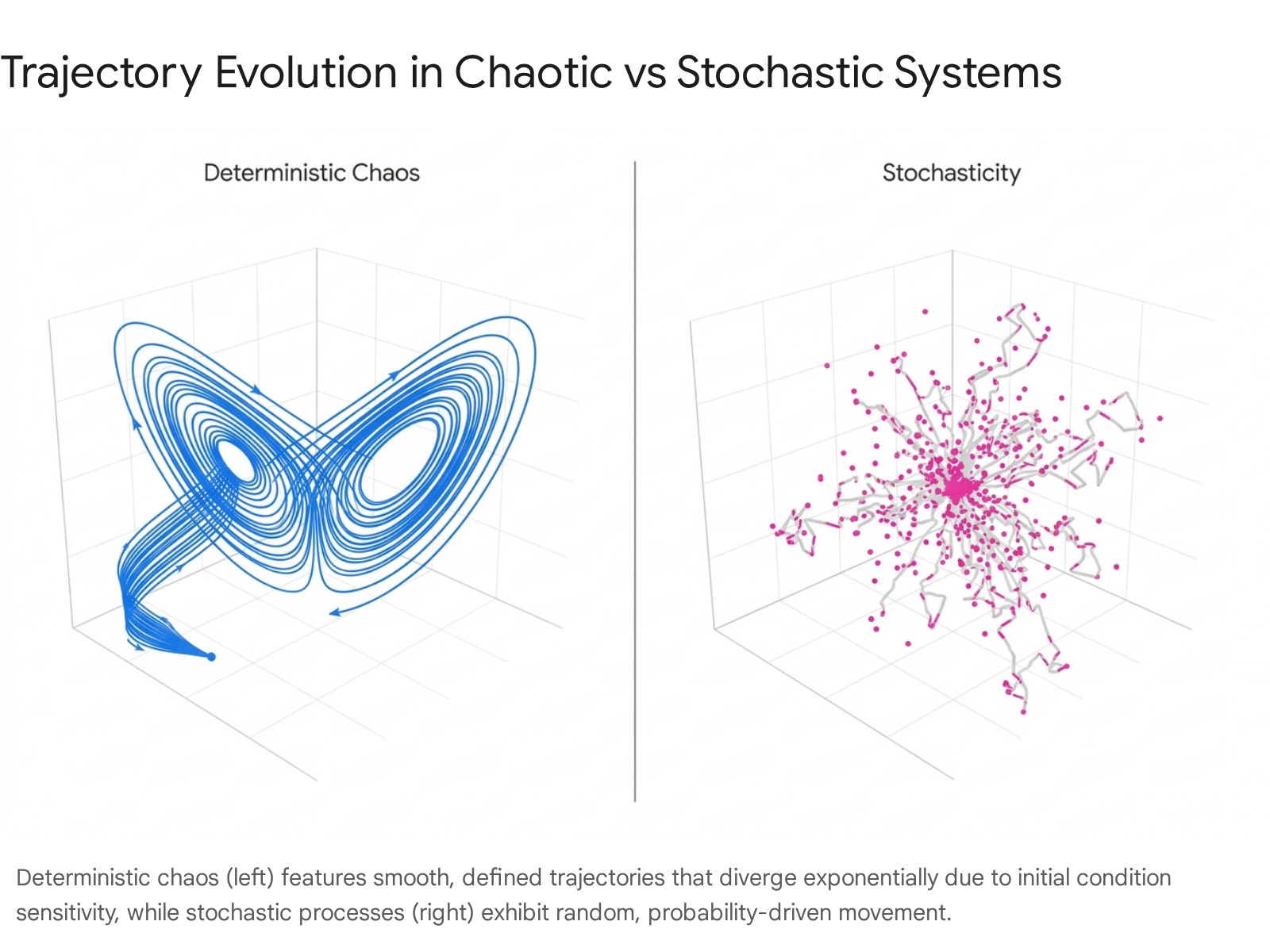
At the macroscopic level, physical phenomena that are frequently modeled as stochastic processes - such as weather patterns, population dynamics, or turbulent fluid dynamics - are often high-dimensional deterministic chaotic systems 141116. Probabilistic models are routinely applied to these systems not because the underlying physical laws are truly random, but because statistical approximations offer superior practical utility when the sheer volume of interacting variables renders deterministic tracking computationally intractable 1411.
The Supersymmetric Theory of Stochastic Dynamics
Recent theoretical physics has attempted to formally bridge the mathematical frameworks of chaos and stochasticity to explain complex behaviors without relying entirely on either paradigm in isolation. An emerging framework is the supersymmetric theory of stochastic dynamics (STS). This theory proposes that chaos is fundamentally a phenomenon of spontaneous order associated with the breakdown of topological supersymmetry (TS), a property hidden within all stochastic and partial differential equations across physical domains 17.
In the STS framework, chaos manifests when this inherent topological supersymmetry is spontaneously broken. The order parameter (OP) that emerges from this symmetry-breaking event is theorized to be the field-theoretic embodiment of the butterfly effect - representing the infinitely long dynamical memory that characterizes deterministic chaotic trajectories 17. If empirically validated across broader systems, the supersymmetric theory of stochastic dynamics could provide the first consistent physical and field-theoretic description of the butterfly effect. This would place deterministic chaos in the same physical category as phenomena like superconductivity and ferromagnetism, which also arise from the spontaneous breakdown of fundamental symmetries in nature 17. The development of corresponding effective theories for this order parameter provides new mathematical avenues for explaining empirical phenomena such as $1/f$ noise and self-organized criticality across complex environments.
Quantum and Relativistic Frontiers in Nonlinear Dynamics
The classical understanding of chaos has historically struggled to integrate with quantum mechanics. In classical macroscopic systems, trajectories can be tracked continuously in phase space, and two nearly identical initial states will predictably diverge at an exponential rate. However, quantum mechanics operates via probability wavefunctions governed by the linear Schrödinger equation, and the Heisenberg uncertainty principle fundamentally forbids the simultaneous precise measurement of position and momentum 111318. Because the exact coordinates of a system cannot be known, the concept of precise "initial conditions" and continuous "trajectories" does not seamlessly apply to the subatomic realm 111318.
Quantum Chaos and Information Scrambling
Recent breakthroughs in 2024 have provided empirical evidence illustrating how chaotic dynamics manifest at the quantum scale, challenging earlier assumptions that subatomic environments are entirely dominated by unstructured probability. A landmark study published in Nature utilized a scanning tunneling microscope to confine electrons within a graphene surface, successfully verifying a 40-year-old theoretical prediction regarding quantum chaos 8. The research demonstrated that, rather than producing a chaotic, random jumble of overlapping trajectories as previously assumed, electrons confined in quantum spaces experience wave interference that concentrates their movements into specific, predictable geometric patterns 8.
Physicists refer to these common paths as "unique closed orbits" or "quantum scars." This phenomenon proves that beneath apparent quantum stochasticity, specific periodic structures govern electron dynamics 8. Achieving this required an intricate combination of advanced imaging techniques to manipulate electron behavior within graphene, a material chosen for its unique two-dimensional structure and capacity to preserve subatomic properties during movement 8. Researchers aim to build upon the visualization of quantum scars to harness chaotic quantum phenomena for selective electron delivery at the nanoscale, innovating new modes of quantum control for highly dense nanoelectronic transistors 8.
To quantify quantum chaos mathematically, physicists employ out-of-time-ordered commutators (OTOCs). Originally developed in condensed matter physics, OTOCs measure the rate of information scrambling within quantum circuits and many-body systems 11. The exponential growth of an OTOC serves as the quantum analogue to classical Lyapunov exponents, signaling rapid operator growth and chaotic loss of information 11. To directly bridge these two realms, researchers have utilized spectral graph theory and ergodic theory to construct a "Poincaré-Markov map." This constructs an energy-dependent unitary map that replaces quantum transition amplitudes with their absolute squares, generating a stochastic matrix 11. This transition allows physicists to calculate a classical Lyapunov exponent from a purely quantum foundation, providing an alternative to standard quantum-classical correspondence models that rely on a classical limit ($\hbar \rightarrow 0$), which does not exist in all chaotic systems 11.
General Relativistic Chaos and Spacetime Topology
Nonlinear dynamics are increasingly being applied to the macroscopic extremes of general relativity. Einstein's field equations are highly non-linear, making the evolution of curved spacetime exceedingly difficult to model and predict when gravitational forces become violent, such as during neutron star mergers or black hole collisions 19. In 2026, research published in Physical Review Letters introduced a framework that treats specific geometric structures of spacetime similarly to an electrically conducting fluid governed by magnetohydrodynamics and nonlinear electrodynamics 19.
By applying fluid motion parallels to gravity, this framework identified "gravitational field connections" - topological invariants and conserved quantities that place strict limits on how curved spacetime can evolve 19. By demonstrating the existence of gravitational helicity, which mathematically measures the twist, writhe, and linkage of gravitational field lines, researchers proved that certain topological structures in the gravitational field remain preserved 19. These structures cannot simply dissolve or randomly reconnect as spacetime evolves, even under extreme gravitational stress. This application of nonlinear fluid dynamics to general relativity provides stringent topological boundaries on gravitational chaos, aiding the interpretation of complex numerical simulations involving gravitational waves and universe expansion 19.
Structural Complexity and Chimera States
A major advancement in the modeling of highly complex, multi-agent dynamical systems is the formalization and identification of "chimera states." In classical physics, networks of identical, symmetrically coupled oscillators were generally expected to settle into one of two uniform conditions: either a state of total global synchronization or a state of total uniform asynchrony 2012. Chimera states disrupt this binary expectation by representing a state of partial, frustrated synchronization where a network of identical nodes spontaneously segregates into two distinct domains: a highly coherent (synchronized) group and an incoherent (desynchronized) group 92012.
Topologies and Spectral Dimensions
Chimera states have proven mathematically crucial for modeling modular and hierarchical networks where interactions occur both within densely packed local communities and across distant structural clusters. Research utilizing Kuramoto-like mathematical models has established that chimera states are highly likely to emerge when the spectral dimension ($d_s$) of the underlying network graph is relatively low, specifically $d_s < 4$ 9. The spectral dimension governs the return probability of random walks on the graph and dictates diffusion processes. Notably, recent numerical evidence reveals that chimera-like states and partial synchronization patterns emerge consistently even when the physical graph dimension ($d_g$) is significantly higher than the spectral dimension 913.
In modular networks - such as neurological configurations connected by electrical synapses within localized communities and chemical synapses across inter-hemispheric divides - the intrinsic dynamics of chaotic bursting nodes coordinate to create localized synchrony alongside localized chaos 12. To effectively quantify this behavior, researchers employ tools beyond the standard Kuramoto order parameter ($\rho$), utilizing the chimera-like index ($\chi$) to measure the degree of synchronization among distinct communities and the metastability index ($\lambda$) to quantify variation along time 12.
Applications in Neurological and Infrastructure Networks
The modeling of chimera states has deep implications for real-world complex systems. Extensive numerical solutions of first- and second-order (Shinomoto) Kuramoto models identified chimera states in various biological and infrastructural networks in 2024.
| Network Application | System Properties & Dimensions | Significance of Chimera State Findings |
|---|---|---|
| European High-Voltage Power Grid | Spectral dimension $d_s < 2$; Graph dimension $d_g \simeq 2.6(1)$. | Partial synchronization indicates localized grid stability coexisting with regional voltage phase desynchronization. Identifying these states helps engineers develop failsafes against cascading network failures 913. |
| Human Connectome (KKI113) | Spectral dimension $d_s < 4$; Graph dimension $d_g \simeq 3.4(1)$. | Explains localized synchronization associated with consciousness and focused cognitive processing occurring alongside asynchronous background neural activity 913. |
| Fruit-Fly (Drosophila) Connectome | Spectral dimension $d_s < 4$; Graph dimension $d_g \simeq 5.4(1)$. | Verifies that chimera states exist in the largest fully mapped biological brain network, supporting theories of spontaneous neurological self-organization 913. |
| Epileptic Seizure Propagation | Modeled via multi-layer stochastic chimera networks using EEG recording phases. | The collapse of a chimera state into full synchronization mirrors the onset of an epileptic seizure. Multi-layer coupling demonstrates how focal chaotic signals entrain healthy brain regions, assisting in the localization of the seizure onset zone (SOZ) 2012. |
Beyond the structural systems listed above, chimera states function as excellent theoretical frameworks for biological phenomena such as unihemispheric sleep in cetaceans and birds. In these animals, one brain hemisphere exhibits highly synchronized slow-wave sleep patterns while the other hemisphere remains awake, alert, and dynamically desynchronized 20. Similarly, neurodegenerative conditions such as Parkinson's and Alzheimer's diseases are increasingly being analyzed through the lens of chimera states, as these disorders are characterized by the pathological breakdown of optimal synchronization boundaries within the cortex 20.
Advancements in Data-Driven Discovery and Machine Learning
The most significant methodological shift in nonlinear dynamics during the 2020s is the extensive integration of machine learning (ML) to execute system identification, reduced-order modeling, and system control. Historically, predicting chaotic trajectories, computing Lyapunov exponents, or applying control algorithms required an explicit, highly accurate mathematical model of the target system 6. Machine learning techniques now enable researchers to construct high-fidelity surrogate models derived entirely from time-series observation data, mapping the underlying phase space without requiring any prior knowledge of the governing physical or differential equations 461415.
Sparse Identification of Nonlinear Dynamics (SINDy)
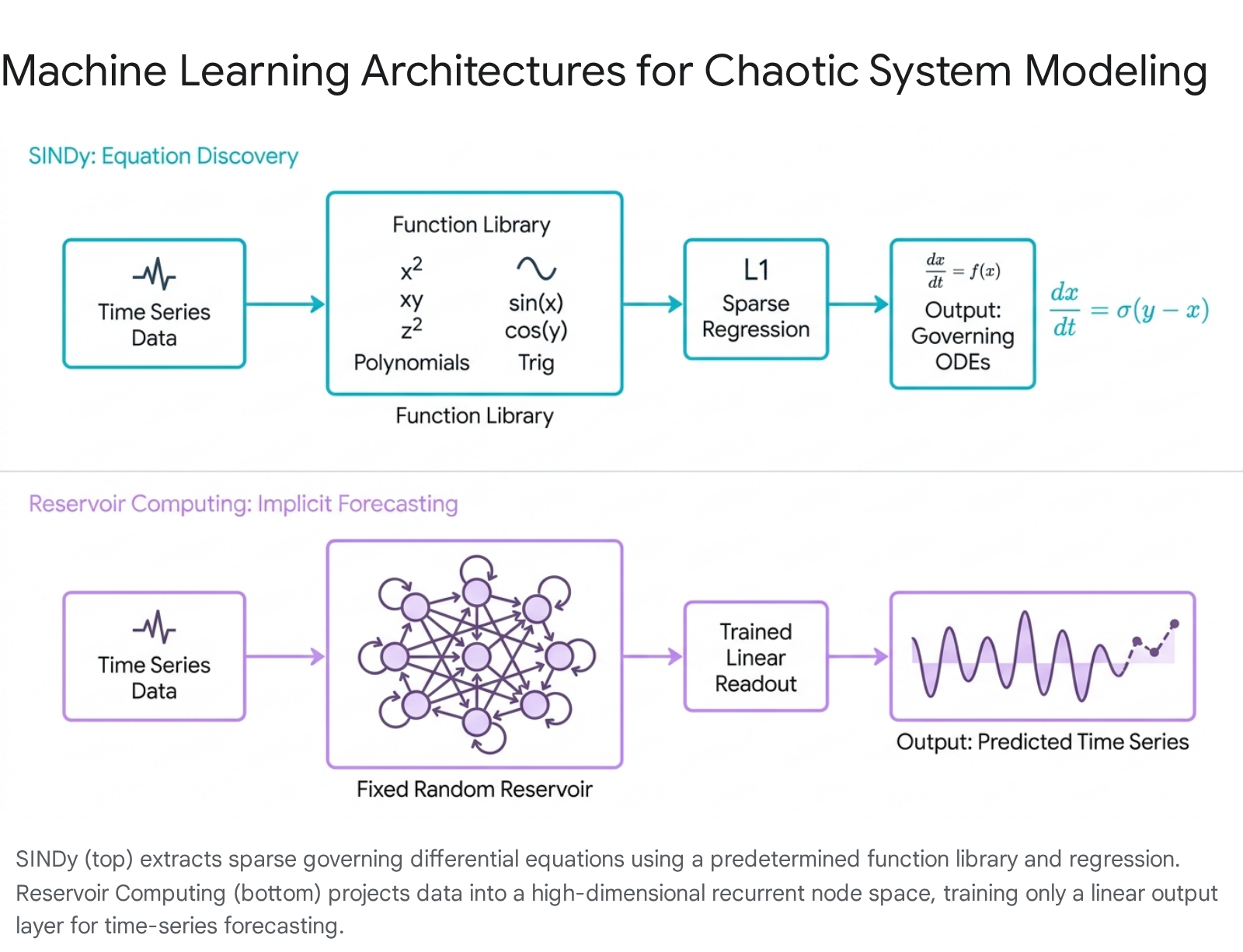
The Sparse Identification of Nonlinear Dynamics (SINDy) algorithm formulates the discovery of dynamical systems as a sparse regression problem 1626. The algorithm operates on the assumption that the governing physics of most complex systems can be described by a relatively small number of active terms - such as polynomials, trigonometric functions, or gradients. SINDy takes time-series data and constructs a large matrix library of these potential candidate functions. It then employs L1 regularization (sparse regression techniques) to eliminate inactive terms, identifying the minimal combination of functions that accurately describes the time evolution of the observational data 162627.
The primary advantage of the SINDy architecture is its strict interpretability. Unlike dense neural networks, which produce black-box weight matrices, SINDy yields "grey box" continuous-time differential equations 1516. In experiments simulating the chaotic Lorenz and Kuramoto-Sivashinsky systems, SINDy outperforms conventional deep learning models in short-term prediction accuracy by successfully capturing the explicit algebraic form of the local dynamics 16.
However, the methodology possesses strict operational limitations. SINDy relies heavily on calculating derivatives from input data, making it highly sensitive to signal noise 152627. It also struggles significantly with hidden (unobserved) states and non-smooth dynamics - such as hysteresis or sudden structural impacts - where the necessary basis functions cannot be accurately pre-defined in the library 15. Furthermore, because chaotic systems exhibit sensitive dependence on system parameters as well as initial conditions, minor inaccuracies in the coefficients computed by SINDy's machine learning regression compound rapidly, causing long-term predictive trajectories to deviate from the true underlying attractor 27.
Reservoir Computing and Neural Phase-Space Mapping
Reservoir Computing (RC) bypasses the need to identify explicit governing equations. An RC is a specialized variant of a recurrent neural network (RNN) distinguished by its core structure: a high-dimensional, randomly connected internal "reservoir" of nodes with fixed, untrained weights 517. During the training phase, data is fed into the reservoir, and only the linear output layer (the readout) is optimized using standard, computationally inexpensive least-squares regression 51718.
From a nonlinear dynamics perspective, the RC framework operates via generalized synchronization. The reservoir acts as a response system driven by the input observational data; through this one-way coupling, the high-dimensional reservoir dynamically embeds the target chaotic attractor 171920. While SINDy excels at short-term accuracy, RC excels at learning the long-term "climate" of chaotic models 51421. An appropriately tuned RC can reproduce the ergodic properties, correlation dimensions, and full Lyapunov spectrum of a system, forecasting spatiotemporal chaos for many Lyapunov time units into the future 51821.
Despite its high efficacy, traditional RC relies on large, randomly sampled connection matrices. This reliance introduces high variance between training initializations and necessitates the optimization of multiple hyper-parameters, including the spectral radius, leaking rate, and network sparsity, to ensure the reservoir operates optimally at the "edge of chaos" 61733.
Next-Generation Reservoir Computing (NG-RC)
To resolve the computational bottlenecks of traditional reservoir tuning, researchers recently introduced Next-Generation Reservoir Computing (NG-RC). Mathematical analyses demonstrate that traditional RC networks are functionally equivalent to nonlinear vector autoregression (NVAR) when operating on temporal data 61734. Leveraging this, NG-RC eliminates the randomized recurrent neural network entirely. Instead, it utilizes nonlinear vector autoregression based on a truncated Volterra series, constructing a state vector that consists of a linear combination of delayed input monomials 61734.
The NG-RC architecture dramatically reduces training data requirements and hyper-parameter complexity. For example, in experiments involving the chaotic Hénon map, an NG-RC algorithm successfully learned the underlying dynamics using as few as 10 training data points and optimized only seven model weights 46. This allowed the NG-RC to execute system control tasks - such as stabilizing the system between unstable fixed points or driving it to a targeted higher-order periodic orbit - in a single iteration with relative errors as low as $10^{-15}$ 6.
In noiseless numerical simulations of the Lorenz equations, finely tuned NG-RC models have demonstrated Valid Prediction Times (VPT) exceeding 30 Lyapunov times, representing a massive increase over older RNN architectures 2236. However, the primary limitation of NG-RC is the exponential explosion of required parameters when the maximum monomial degree is increased to capture more intricate dynamics 34. To mitigate this "curse of dimensionality," researchers in 2024 have successfully integrated tensor networks - mathematical structures that decompose multidimensional arrays into low-dimensional representations - to optimize NG-RC architectures, preserving computational efficiency without sacrificing accuracy 34. Hybrid RC-NGRC approaches are also under development, merging traditional random reservoirs with autoregressive features to maximize Valid Prediction Times across multiple chaotic regimes 23.
| Feature / Metric | Sparse Identification (SINDy) | Traditional Reservoir Computing (RC) | Next-Generation RC (NG-RC) |
|---|---|---|---|
| Model Output Type | Explicit, continuous-time differential equations. | Implicit time-series forecast generated via neural weights. | Implicit time-series forecast generated via autoregressive vectors. |
| Primary Computational Mechanism | Sparse regression over a library of predefined basis functions. | Fixed, randomized recurrent neural network with a trained linear output layer. | Nonlinear vector autoregression utilizing a truncated Volterra series. |
| Data Requirements | Requires high temporal resolution to calculate accurate derivatives. | Highly data-hungry; requires extended time-series data to adequately train the output layer. | Highly efficient; can stabilize and predict chaotic models with as few as 10 observational data points 617. |
| Primary Strengths | Highly interpretable, physics-based mathematical models; excellent short-term prediction capabilities 1516. | Robust capability for long-term "climate" prediction; accurately captures the full invariant sets of chaotic attractors 1420. | Low computational cost; few hyper-parameters; highly suitable for edge computing hardware 61734. |
| Known Weaknesses | Fails in the presence of high noise, unobserved system states, or incorrectly specified function libraries 1527. | Requires massive random matrices; high overhead associated with tuning network spectral radius and sparsity 61733. | Experiences parameter explosion as required polynomial complexity increases (partially mitigated by tensor networks) 34. |
Limitations of Chaos Control in Biological Systems
A defining geometric feature of any chaotic attractor is that its phase space is densely populated with an infinite number of unstable periodic orbits (UPOs). The dynamics of a chaotic system consist of continuous motion where the system state naturally wanders into the local neighborhood of one of these orbits, diverges exponentially along an unstable manifold, and subsequently falls into the neighborhood of a different UPO, resulting in aperiodic wandering over long temporal scales 24. Recognizing this dense skeletal structure, mathematicians established that chaos could be actively managed and controlled rather than merely observed.
The OGY Method and Its Classical Successes
The Ott-Grebogi-Yorke (OGY) method, formulated in 1990, remains the foundational technique for the control of chaos. The OGY approach operates on the principle that because chaotic attractors contain arbitrarily rich arrays of distinct UPOs, a chaotic system can be coaxed into following a highly desirable periodic trajectory using exceedingly small, precisely calculated parameter perturbations 2425. These tiny kicks are applied infrequently - typically once per cycle when the system trajectory crosses a carefully defined Poincaré section - preventing the system from diverging from the target orbit 2425.
The primary operational advantage of the OGY method is that it is model-free. It does not require a comprehensive set of global governing equations for the entire phase space; instead, it relies exclusively on estimating the local linear dynamics and eigenvectors around the target orbit using empirical time-series data 624. Over the past three decades, the OGY algorithm has been highly successful in stabilizing physical and engineered systems, including nonlinear optical lasers, turbulent fluid dynamics, and magneto-mechanical devices 725. Furthermore, it has demonstrated success in highly reduced, isolated biological preparations, such as pacing in vitro cardiac monolayers and controlling epileptiform bursting in isolated hippocampal brain slices 7.
High-Dimensional Noise in In Vivo Neural Circuits
Despite its theoretical elegance and laboratory successes, empirical studies reveal fundamental limitations of classical chaos control algorithms when applied to complex, intact biological organisms 7. OGY control strictly necessitates a state of "dynamical quietude" - the system must possess a stable, low-dimensional geometry wherein a linear approximation around the fixed point remains valid during the wait time between control kicks 7.
Recent neurophysiological experiments attempted to apply the real-time OGY algorithm to regulate the amplitude variability of monosynaptic reflexes (MSRs) in the spinal cords of anesthetized cats. The objective was to stabilize the seemingly chaotic fluctuations of reflex outputs using targeted, continuous electrical stimulation of afferent nerves 7. The implementation failed to reduce the system's variability. The coefficient of variation in reflex amplitudes remained unchanged between baseline and OGY-control conditions, and Poincaré return maps indicated no evidence of orbit stabilization, presenting only a widely dispersed, structureless cloud of points 7.
This systemic failure occurs because biological systems in vivo are not cleanly deterministic low-dimensional chaotic attractors. The trial-to-trial fluctuations in living neural circuits are driven by intense, ongoing synaptic bombardment from surrounding networks (e.g., the complex dorsal horn circuitry) 7. This activity manifests as high-dimensional physiological noise rather than the small, deterministic parameter variations required by the OGY algorithm 7. In balanced recurrent networks, correlated shared synaptic drive continually pushes the biological system violently out of the narrow capture window where the local linear approximations of OGY apply, effectively destroying the requisite low-dimensional geometry 7. These findings delineate a severe boundary condition for classical chaos-control strategies: when embedded in systems governed by massive, correlated network activity, apparent chaos is inextricably fused with overwhelming stochastic noise, rendering algorithmic stabilization impossible without first isolating the underlying physical structures 7.
Macro-Scale Applications in Climate and Atmospheric Predictability
At the macroscopic scale, chaos theory dictates the methodological and practical boundaries of meteorology and climatology. Edward Lorenz's foundational discovery in 1963 - that the atmosphere behaves as a complex fluid highly sensitive to initial conditions - permanently curtailed the scientific pursuit of infinitely accurate, long-term weather forecasting 21026.
Macroweather and Predictability Horizons
A prevalent misunderstanding in public discourse is that atmospheric chaos renders all long-term climate predictions invalid. However, chaos theory clearly distinguishes between forecasting the exact, continuous trajectory of a system (the weather) and determining the global boundary conditions and statistical properties of the system's attractor (the climate) 12627.
Atmospheric behavior operates across distinct temporal regimes governed by varying predictability profiles. Analytical research delineates three broad scales based on statistical variability over time 28. * Weather (0 to 10 Days): For time scales of fewer than 10 to 15 days, the atmosphere is highly chaotic. Small perturbations, limited observational data grids, and the compounding growth of floating-point errors in computational simulations make specific, localized forecasts impossible beyond this predictability horizon 1028. * Macroweather (10 Days to 100 Years): In this intermediate regime, the chaotic high-frequency fluctuations of daily weather average out, and the atmospheric system behaves in a statistically stable, non-chaotic manner 28. * Climate (>100 Years): Beyond a century, the global climate system begins to exhibit chaotic, nonlinear behavior again due to the influence of slow-moving Earth system variables, such as deep ocean current circulation, tectonic shifts, and continental ice sheet dynamics 28.
Climate models, known as General Circulation Models (GCMs), do not attempt to forecast daily weather events decades in advance. Instead, climatologists run ensembles of simulations - dozens of models operating simultaneously with slightly perturbed initial conditions - to map the probability density function (PDF) of the climate attractor 1326. While the precise trajectory of fluid turbulence remains chaotic, the greenhouse effect imposes a deterministic, predictable energetic forcing that shifts the entire boundary of this chaotic attractor over decades, allowing for highly reliable predictions of global average trends 2629.
Impact of Climate Change on Chaos Margins
A critical insight published by atmospheric scientists in the 2020s is that the macroscopic state of the climate directly dictates the microscopic predictability limit of its weather. Researchers have demonstrated that error propagation - the rate at which small uncertainties multiply exponentially in atmospheric models - accelerates as average atmospheric temperatures rise 10.
Computer simulations utilizing simplified Earth systems alongside comprehensive global climate models reveal that higher global temperatures significantly intensify the chaotic nature of the midlatitudes, where the majority of the human population resides. Specifically, the predictability horizon for weather forecasts is systematically compressed as the planet warms 10.
| Meteorological Variable | Predictability Loss per Degree of Warming | Driving Mechanism in the Chaotic System |
|---|---|---|
| Precipitation | 1 day of prediction reliability lost per 3°C rise. | Higher temperatures exponentially increase atmospheric moisture capacity, leading to faster error propagation in hydrological cycle modeling 10. |
| Wind Speed | 1 day of prediction reliability lost per 5°C rise. | Increased thermal energy gradients amplify fluid turbulence, causing predictive models to lose memory of initial conditions more rapidly 10. |
| Ambient Temperature | 1 day of prediction reliability lost per 5°C rise. | Changes in large-scale convection patterns disrupt historical baseline periodicities 10. |
Warmer atmospheric conditions increase overall kinetic energy and moisture capacity, causing initial modeling errors to propagate more rapidly through the numerical simulation. Consequently, the simulation "loses memory" of its starting state, and diverging trajectories become indistinguishable from predictions based on entirely random starting conditions significantly faster 10. Therefore, as the global climate shifts, the intrinsic boundary of the butterfly effect moves closer to the present, shrinking the lead time infrastructure systems and populations have to mobilize against extreme, catastrophic weather events 10.
Global Hubs and Collaborative Initiatives in Nonlinear Dynamics
The rapid expansion of nonlinear dynamics - crossing from pure mathematics into quantum physics, machine learning, and climate science - is actively supported by a heavily distributed network of global research hubs. In 2024 and beyond, scientific acceleration is driven by cross-disciplinary centers and conferences that merge theoretical physics with heavy computational sciences.
In Europe, Germany serves as a primary focal point for this integration. Facilities such as the European XFEL in Schenefeld drive cutting-edge research into nonlinear X-ray interactions and attosecond electron dynamics 45. Furthermore, dedicated institutions like the Potsdam Institute for Climate Impact Research and the various Max Planck Institutes are pioneering the application of advanced time-series analysis and dynamical network theory. Their primary directives include predicting catastrophic tipping points in climate systems, analyzing emergent social dynamics, and mapping neurobiological behaviors 30.
In Asia, robust research clusters have formed around major universities and engineering institutes. Japan regularly hosts prestigious international symposiums - such as the IUTAM Symposium in Tsukuba - which focus on exploiting nonlinear dynamics in mechanical design and modeling extreme physical phenomena, such as relativistic particle motions and Heisenberg uncertainty constraints 313233. In India, dedicated research bodies like the Centre for Nonlinear Science (CeNSc) and various regional chapters of the Indian Statistical Institute heavily fund investigations into stochastic mechanics, complex fluid dynamics, variable coefficient Gross-Pitaevskii equations, and non-smooth non-equilibrium systems 305034.
In North America, foundational research is frequently channeled through established organizations like the American Physical Society (APS) and the Gordon Research Conferences (GRC) 3536. These organizations facilitate intimate, pre-publication forums for scientists to debate the frontiers of chaos - from the limitations of biological control mechanisms to algorithmic innovations in reservoir computing and the topological constraints of general relativity 3537. These interconnected global hubs ensure that the mathematical abstraction of chaos theory is continuously translated into physical experiments and scalable computational tools.
Conclusion
Chaos theory in 2024 has matured far beyond the philosophical realization of deterministic unpredictability; it has evolved into a rigorous, operational science for managing complex systems. The romanticized notion of the butterfly effect has been supplemented by precise mathematical and computational frameworks designed to measure, model, and actively mitigate uncertainty. In the quantum and relativistic realms, physicists are uncovering the topological laws and structural invariants that restrict chaotic behavior, demonstrating that what appears as subatomic or gravitational chaos is often governed by highly patterned geometric evolution 81719.
Through the lens of network science, the formal study of chimera states has provided vital diagnostic tools for understanding systems that exist on the unstable border between perfect order and total randomness, offering profound insights into the hierarchical functioning of human brains and the vulnerabilities of global power grids 1213. Simultaneously, the integration of Next-Generation Reservoir Computing and algorithms like SINDy has revolutionized empirical modeling. These architectures allow scientists to bypass the need for explicit theoretical models, enabling raw observational data to directly construct sparse differential equations and accurately map highly complex phase-space attractors 61617.
However, alongside these technological triumphs, modern chaos theory has strictly defined its own limitations. The total failure of classical chaos control algorithms in live, in vivo biological environments highlights that biological complexity is frequently dominated by high-dimensional stochastic noise rather than elegant, easily manipulable low-dimensional attractors 7. Finally, in the macro-scale arena of climatology, researchers are confronting the reality that anthropogenic climate change is not merely altering average temperatures - it is actively intensifying the chaotic nature of the atmosphere itself, tangibly shrinking the human window of foresight 10. In navigating these expanding boundaries, the science of nonlinear dynamics continues to reveal the intricate, deterministic architecture that governs an increasingly complex universe.