
Causal dynamical triangulations in quantum gravity
The formulation of a consistent, predictive theory of quantum gravity remains the most prominent unresolved problem in theoretical physics. General relativity describes gravity as the continuous, dynamical curvature of spacetime, a macroscopic framework that spectacularly breaks down at the Planck scale. Conversely, the Standard Model of particle physics operates within the rigid, flat, and background-dependent framework of quantum field theory (QFT). Attempts to naively quantize general relativity via perturbative methods invariably fail, as the Einstein-Hilbert action leads to unmanageable ultraviolet divergences, rendering the theory non-renormalizable 12.
To circumvent the failures of perturbative expansions, physicists have sought non-perturbative, background-independent approaches. Causal Dynamical Triangulations (CDT) represents a rigorous methodology designed to define and compute the gravitational path integral non-perturbatively 34. By constructing spacetime from a vast ensemble of discrete, flat simplicial building blocks - while strictly enforcing a causal arrow of time - CDT provides a mathematically well-defined blueprint for lattice quantum gravity. Extensive numerical simulations of the CDT framework have revealed that an extended, four-dimensional macroscopic universe dynamically emerges from Planckian quantum fluctuations, alongside profound microscopic phenomena such as dynamical dimensional reduction 344.
The Framework of Lattice Quantum Gravity
The fundamental strategy of lattice quantum field theory is to regulate ultraviolet divergences by introducing a discrete lattice with a fixed short-distance cutoff, allowing continuous spacetime theories to be evaluated through statistical mechanics and numerical methods 45. Applying this to gravity requires discretizing the geometry of spacetime itself.
Discretization via Simplicial Geometry
In CDT, the smooth metric manifold of continuous spacetime is replaced by a piecewise linear simplicial manifold 67. A simplex is the simplest possible geometric figure in any given dimension: a 0-simplex is a point, a 1-simplex is a line segment, a 2-simplex is a triangle, a 3-simplex is a tetrahedron, and a 4-simplex (or pentachoron) is the four-dimensional analogue 8910.
The CDT framework utilizes flat, Minkowskian 4-simplices as its indivisible building blocks 311. Unlike classical Regge calculus, where the connectivity of the lattice is fixed and the lengths of the edges vary to encode curvature, the dynamical triangulations approach fixes the edge lengths to a constant cutoff scale $a$ and encodes the geometric degrees of freedom entirely in the connectivity - the combinatorial incidence matrices detailing how the simplices are glued together face-to-face 37. This coordinate-free formulation is intrinsically diffeomorphism-invariant, sidestepping the gauge redundancies that complicate continuum general relativity 311.
The Gravitational Path Integral
The objective of any quantum gravity path integral is to compute the transition amplitude between two spatial boundary geometries, or to define the vacuum state of the universe, by summing over all possible interpolating spacetime geometries 46. The formal continuum path integral takes the form:
$Z = \int \mathcal{D}[g] \, e^{i S_{EH}[g]}$
where $\mathcal{D}[g]$ represents the integration measure over all metric fields modulo diffeomorphisms, and $S_{EH}$ is the Einstein-Hilbert action 4. In the regularized lattice theory of CDT, this continuous functional integral is replaced by a discrete sum over all permissible triangulations $T$:
$Z = \sum_{T} \frac{1}{C_T} e^{i S_{Regge}[T]}$
where $C_T$ is the size of the automorphism group of the triangulation, and $S_{Regge}$ is the Regge action, a discretized analogue of the Einstein-Hilbert action where curvature is measured by the deficit angles distributed around the $(d-2)$-dimensional hinges (the triangular faces in four dimensions) of the glued simplices 711.
The Precursor: Euclidean Dynamical Triangulations
To understand the necessity of the causal constraints defining CDT, it is essential to review the failures of its predecessor, Euclidean Dynamical Triangulations (EDT) 4. EDT attempted to define the path integral by summing over all possible four-dimensional Euclidean geometries of a fixed topology, without any restriction on a preferred time direction or causal structure 12.
The Phase Structure of EDT
Extensive Monte Carlo simulations of the EDT parameter space, governed by the bare gravitational coupling $\kappa$ and a measure parameter $\beta$, revealed two dominant geometrical phases, neither of which resembles classical spacetime 1213. * The Branched Polymer Phase: At large values of the bare gravitational coupling, the geometries become completely elongated and "tree-like." The volume diverges along narrow, branched structures that lack extended macroscopic dimensions. In this phase, the Hausdorff dimension is exactly 2, and the spectral dimension is approximately $4/3$ or near 1.82 to 2.52 in the infrared regime 121314. * The Crumpled Phase: At low values of the coupling, the geometry collapses into an ultra-compact, highly connected mass. A typical configuration contains a single "mother universe" with outgrowths of negligible size. The distance between any two 4-simplices is exceptionally short, resulting in a formally infinite Hausdorff dimension 215.
The First-Order Transition Barrier
The extraction of continuum physics from a lattice theory requires the identification of a second-order (or higher) phase transition, where the correlation length of the system diverges, rendering the discrete lattice artifacts irrelevant 416. In pure EDT, the boundary separating the crumpled and branched polymer phases was definitively shown to be a first-order phase transition 415. At a first-order boundary, the transition is discontinuous, the correlation length remains strictly finite, and no smooth continuum limit can be taken 415.
Efforts to suppress pathological topologies in EDT involved introducing non-trivial measure terms to penalize specific configurations. This yielded an intermediate "crinkled" phase 1213. However, simulations revealed that the maximal order of simplices in this region scales with the total volume, producing dense networks of baby universes. The susceptibility exponent $\gamma$ effectively drops to $-\infty$, indicating that the crinkled phase cannot support a macroscopic, four-dimensional continuum interpretation 2. Consequently, the lack of a causal structure in EDT leads predominantly to non-physical, degenerate geometries.
The Causal Structure of CDT
The defining breakthrough of Causal Dynamical Triangulations was the realization that imposing a strict Lorentzian causal structure on the microscopic building blocks suppresses the pathological geometries that dominate Euclidean models 467.
Foliation and the Arrow of Time
In CDT, the simplicial manifold is explicitly foliated into a sequence of spacelike hypersurfaces, denoted as $\Sigma(t)$, separated by discrete proper-time steps 4. Each spatial slice possesses a fixed topology, most commonly a three-sphere ($S^3$) or a three-torus ($T^3$) 1116. The preservation of this topology across all time slices explicitly forbids the spontaneous creation of baby universes, wormholes, and spatial branching, thereby enforcing a lattice analogue of global hyperbolicity 4617.
Geometry of the Building Blocks
Because all vertices in the CDT lattice must lie on the integer time slices, the permissible 4-simplices are strictly categorized by how their five vertices are distributed across adjacent slices $t$ and $t+1$ 411.
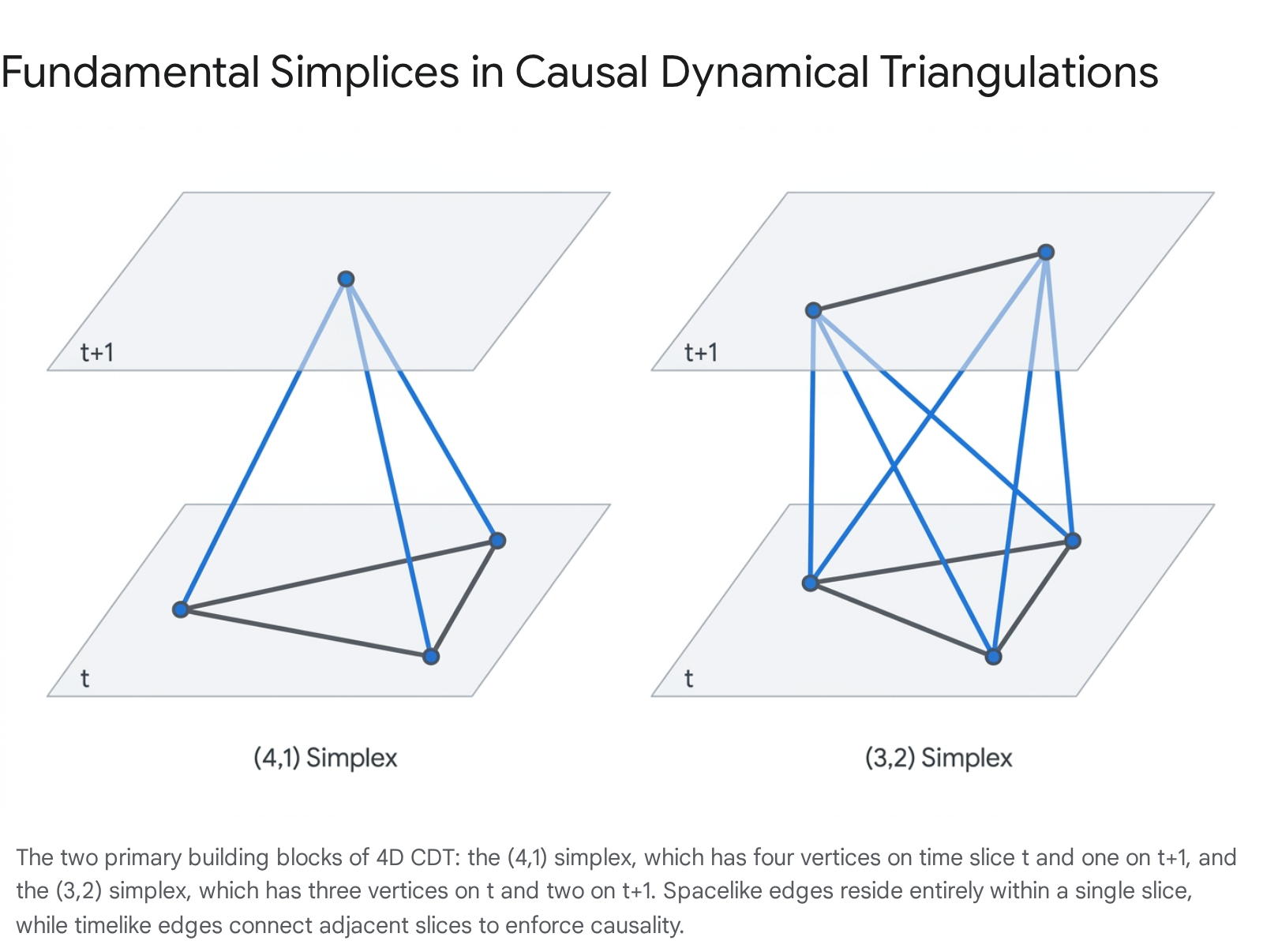
- The (4,1)-Simplex: Features four vertices located on spatial slice $t$ (forming a spatial tetrahedron) and one apex vertex located on slice $t+1$ 1117.
- The (3,2)-Simplex: Features three vertices on slice $t$ (forming a spatial triangle) and two vertices on slice $t+1$ (connected by a spacelike edge) 1117.
These simplices are complemented by their time-reversed counterparts, the (1,4) and (2,3) simplices 411. The edges connecting vertices within the same spatial slice are spacelike, possessing a squared proper length of $a^2$. The edges connecting adjacent slices are timelike, assigned a squared proper length of $-\alpha a^2$, where $\alpha$ is a positive asymmetry parameter that controls the relative length of spatial and temporal links 411.
The gluing rules dictate that these simplices must be assembled face-to-face such that spacelike faces only glue to spacelike faces, and timelike faces glue to timelike faces. The rigid directional arrows of the timelike edges must perfectly align throughout the structure, preventing causal loops and ensuring that an unambiguous time direction is maintained globally 611.
Analytic Continuation and Monte Carlo Simulation
In standard continuum physics, evaluating the Lorentzian path integral is computationally impossible because the highly oscillatory weighting factor $e^{iS}$ prohibits conventional integration techniques 47. To make the integral mathematically well-defined, one typically performs a Wick rotation, taking real time $t \to i\tau$ to convert the complex exponential into a real Boltzmann weight $e^{-S}$, yielding a Euclidean path integral 34.
However, in generic geometries without a global time parameter, a Wick rotation is poorly defined. The explicit causal foliation in CDT solves this problem gracefully. By analytically continuing the asymmetry parameter $\alpha \to -\alpha$, all timelike edges are analytically rotated into spacelike edges, rendering the entire geometry Euclidean while preserving the topological memory of its Lorentzian origin 47.
Once rotated into the Euclidean sector, the system is directly amenable to numerical analysis using Markov Chain Monte Carlo (MCMC) simulations 318. The algorithms perform local topological updates - known as Pachner moves - which locally reconfigure the incidence matrices of a small neighborhood of simplices while leaving the global topology invariant 15. Configurations are generated according to the Boltzmann probability distribution defined by the discrete Regge action, allowing researchers to study the behavior of the geometric ensemble in the infinite volume limit 715.
The Phase Diagram of Causal Dynamical Triangulations
The dynamical properties of CDT are explored by mapping its phase diagram as a function of its bare coupling constants. The partition function depends primarily on three parameters: $k_0$ (inversely related to the bare Newton constant), $\Delta$ (the asymmetry parameter), and $k_4$ (the bare cosmological constant used to fix the total four-volume $N_4$ to prevent the simulations from diverging or collapsing) 4. The tuning of $k_0$ and $\Delta$ has revealed four distinct phases of quantum geometry 416.
Phase A: The Uncorrelated Phase
Located in the region of large $k_0$, Phase A is characterized by a breakdown of temporal correlation 1619. The spatial slices fluctuate independently from one another. The typical geometry is dominated by a sequence of essentially uncorrelated, rapidly changing spatial volumes. The geometry of the spatial slices themselves closely resembles the highly branched, polymer-like configurations seen in the pathological phases of 3D Euclidean quantum gravity 19. Phase A exhibits no stable, macroscopic classical limit.
Phase B: The Crumpled Phase
Observed at small values of $\Delta$, Phase B represents a regime where the spatial volume collapses almost entirely onto a single, highly dense spatial slice 16. The vast majority of vertices cluster together with enormous coordination numbers, yielding a state where the temporal dimension collapses and the spatial dimension becomes infinitely dense 20. Similar to the crumpled phase in EDT, this geometry is deeply unphysical.
Phase C: The de Sitter Phase
Phase C is the physically relevant sector of the parameter space 416. In this region, despite the absence of any background geometry imposed by hand, the individual microscopic, highly fluctuating simplices dynamically assemble into a smooth, macroscopic, four-dimensional extended universe 3418.
Measurements of the expectation value of the spatial volume as a function of time, $\langle N_3(t) \rangle$, perfectly map onto the scale factor of a classical Euclidean de Sitter universe (a universe governed purely by a positive cosmological constant) 31621. This stands as a hallmark achievement of the CDT program: the unambiguous, dynamical derivation of classical spacetime from the quantum superposition of structureless simplicial blocks 1824. The quantum fluctuations surrounding this mean background geometry precisely match the theoretical predictions of mini-superspace models 19.
Phase $C_b$: The Bifurcation Phase
Recently, refined simulations using higher lattice volumes uncovered a subtle transition within the boundaries of what was originally considered Phase C, leading to the identification of the bifurcation phase, $C_b$ 420.
The $C_b$ phase retains an extended macroscopic volume profile but violates the geometric homogeneity expected in classical relativity 416. It is characterized by the spontaneous emergence of distinguished, string-like geometric structures consisting of high-order vertices (simplices sharing exceptionally high numbers of neighbors) that loosely connect across time 416. This behavior indicates a spontaneous symmetry breaking of the isotropic spatial geometry 16.
Analyses of the effective transfer matrix - which dictates the transition amplitudes between adjacent spatial slices - show that the kinetic term undergoes a definitive sign change when moving from Phase C to Phase $C_b$ 422. This sign reversal is interpreted as an effective, dynamical Wick rotation, suggesting that the metric undergoes a spontaneous signature change at the phase boundary, losing its strict Lorentzian causality 42226.
Importantly, evidence indicates that the phase transition separating the de Sitter phase (C) from the bifurcation phase ($C_b$) is a second-order, or higher-order, transition 1620. A second-order phase transition is a prerequisite for extracting a universally valid continuum field theory, marking the $C-C_b$ boundary as the critical locus for defining non-perturbative quantum gravity 41622. Extensive research confirms that these phase structures remain consistent whether the spatial topology is spherical ($S^3$) or toroidal ($T^3$), emphasizing that the dynamics are driven by bulk physics rather than topological boundary conditions 1620.
Microscopic Geometry and Dynamical Dimensional Reduction
While CDT elegantly recovers four-dimensional general relativity at macroscopic scales, probing the microscopic structure of Phase C uncovers radically non-classical phenomena. The most significant of these is the scale-dependent nature of spacetime dimensionality, known as dynamical dimensional reduction 12324.
Measuring the Spectral Dimension
In a highly non-smooth, fluctuating quantum geometry, conventional coordinate distance is an ill-defined metric. Instead, the effective geometry must be probed using diffusion processes 1225. The spectral dimension, $D_s$, describes the dimension perceived by a random walker diffusing through the simplicial lattice 2631.
If a particle undergoes a random walk, the probability of returning to its starting simplex after $\sigma$ diffusion steps (where $\sigma$ acts as an effective diffusion time or scale) is denoted as $P(\sigma)$ 19. The spectral dimension is extracted via the logarithmic derivative:
$D_s(\sigma) = -2 \frac{d \log P_r(\sigma)}{d \log \sigma}$ 19.
For large diffusion times, the walker probes the macroscopic structure of the ensemble. In Phase C, the spectral dimension robustly asymptotes to $D_s(\sigma \to \infty) \approx 4.02 \pm 0.10$, brilliantly confirming that the large-scale limit is four-dimensional 14.
The Ultraviolet Reduction
As the diffusion time approaches zero, the random walker probes the ultra-short, Planck-scale geometric fluctuations. In this extreme ultraviolet (UV) regime, the spectral dimension smoothly and dynamically reduces from 4 to approximately 2 314. Mathematical fits to the diffusion data along the central curve of the path integral yield functions such as $D_s(\sigma) = 4.02 - 119/(54 + \sigma)$ 14. Although some independent variations of the model tuning specific bare parameters have reported short-distance spectral dimensions nearer to 1.5 or 1.8 , the broad consensus points firmly to a non-integer, fractal-like dimensionality near $D_s \approx 2$ at the Planck scale 3723.
This dimensional reduction has profound physical implications. Conventional quantum field theory in four dimensions is plagued by non-renormalizable ultraviolet divergences because the gravitational coupling constant carries a negative mass dimension. However, in two dimensions, gravity is formally strictly renormalizable (and topologic) 1423. The dynamic collapse of dimensionality at the Planck scale provides a natural, emergent UV cutoff. It suggests that quantum gravity is "self-renormalizing"; the geometry intrinsically alters its own fabric to prevent the infinities that derail perturbative approximations 714.
Comparisons Across Quantum Gravity Theories
The phenomenon of Planck-scale dimensional reduction is not an artifact of the CDT lattice; it has been increasingly recognized as a universal feature across multiple disparate approaches to quantum gravity 624.
| Characteristic | Causal Dynamical Triangulations (CDT) | Euclidean Dynamical Triangulations (EDT) | Loop Quantum Gravity (LQG) | String Theory | Asymptotic Safety |
|---|---|---|---|---|---|
| Quantization Method | Discretized Path Integral (State Sum) | Discretized Path Integral | Canonical Quantization / Spin Foams | Perturbative S-Matrix on Worldsheet | Renormalization Group Flow |
| Background Independence | Strictly Independent | Strictly Independent | Strictly Independent | Highly Background Dependent | Strictly Independent |
| Lorentzian Causality | Explicitly enforced via time foliation | Absent | Addressed via transition amplitudes | Inherited from fixed target space | Not explicitly discretized |
| Macroscopic Dimension (IR) | 4D (Dynamical de Sitter emergence) | No stable 4D macroscopic limit | 4D | 10D / 11D (requires compactification) | 4D |
| UV Spectral Dimension ($D_s$) | $\approx 2$ (Fractal structure) | $\approx 2$ (in branched polymer phase) | $\approx 2.0$ to $2.5$ | $\approx 2$ (dominated by worldsheet QFT) | $\approx 2$ (at UV fixed point) |
In Loop Quantum Gravity (LQG), spatial geometry is quantized into discrete spin networks, with areas and volumes exhibiting discrete spectra 1832. When evaluated through effective Hamiltonian theories or covariant spin foam models, the spectral dimension of the LQG spatial sections also runs from 4 in the infrared down to between 2 and 2.5 in the deep ultraviolet 2433.
In the Asymptotic Safety scenario (Quantum Einstein Gravity), which relies on the existence of a non-trivial UV fixed point for the renormalization group flow of the gravitational action, calculations similarly predict a fractal spacetime structure where the effective dimension reduces to 2 at high energies 62627. Even in String Theory, the high-energy scattering of fundamental strings is entirely dictated by the two-dimensional conformal field theory living on the string worldsheet, functionally reducing the extreme high-energy behavior of the theory to 2D dynamics 3128. The convergence of these distinct methodologies upon a 2D UV limit provides compelling circumstantial evidence that CDT accurately captures the fundamental nature of Planckian geometry 63233.
Coupling Matter to Fluctuating Geometry
A strictly vacuum theory of gravity is insufficient to describe the universe; a viable quantum gravity framework must permit the coupling of the Standard Model matter fields. Integrating matter into the wildly fluctuating geometric background of CDT presents complex algorithmic and theoretical challenges, which have been the focus of intense recent research extending into 2024 - 2026 336.
Scalar and Gauge Fields
The incorporation of continuous scalar fields into CDT is relatively straightforward. A scalar field assigns a continuous variable to the geometric center of each 4-simplex. When the scalar field action is included alongside the Regge action in the path integral, the fields dynamically backreact on the geometry 416. Simulations demonstrate that dynamic scalar fields can significantly impact the stability of the CDT phase boundaries. Depending on the coupling parameters, they can drive the formation of the $C_b$ bifurcation phase and distinctly alter the volume profile across toroidal spatial topologies 16.
Coupling gauge fields - such as the Abelian $U(1)$ field of electromagnetism and the non-Abelian $SU(2)$ and $SU(3)$ fields of the weak and strong forces - requires mapping the continuous Yang-Mills action onto the discrete lattice 436. This is achieved by defining parallel transport along the links between adjacent simplices. The gauge field degrees of freedom are represented by group elements assigned to the edges, and the gauge action is constructed from Wilson loops calculated around the triangular faces of the simplices 436. Recent algorithmic advances have successfully coupled $U(1)$ and $SU(2)$ fields to low-dimensional CDT ensembles, confirming that gauge field dynamics can be consistently simulated on highly fluctuating, non-static backgrounds 3629.
The Fermion Doubling Problem
Coupling fermionic matter - quarks and leptons - to any lattice theory is notoriously plagued by the Nielsen-Ninomiya theorem 38. The theorem posits a rigorous no-go constraint: when formulating chiral fermions on an even, regular lattice with translational symmetry, the discretization process inevitably generates unphysical, degenerate copies of the fermions, an artifact known as "fermion doubling" 38.
In conventional Lattice QCD, this is resolved by introducing explicit symmetry-breaking terms (such as Wilson fermions) or complex formulations (like staggered or domain wall fermions) 5. However, CDT inherently circumvents the primary assumption of the Nielsen-Ninomiya theorem: the lattice possesses absolutely no continuous translational invariance. The random, fluctuating nature of the dynamically glued simplices fundamentally disrupts the regularity required to produce degenerate momentum modes 38.
Because the gravitational path integral forces a sum over all possible triangulated configurations, the interference patterns generated across the ensemble are hypothesized to naturally suppress the propagation modes of the doubled chiral fermions, leading organically to an effective chiral theory at macroscopic scales 38. Recent breakthrough formalisms (2025 - 2026) have successfully defined local reference frames (tetrads) on individual 4-simplices. This allows the formulation of Grassmann variables directly onto the CDT lattice, facilitating the explicit computation of fermion amplitudes coupled to the quantum metric 34. These techniques deeply parallel advancements in spin foam models, where fermion tunneling probabilities have recently been mapped across bounded quantum geometries 39.
Cosmological Implications and Dynamical Dark Energy
One of the most stringent tests for any quantum theory of gravity is its ability to reproduce and explain cosmological phenomena, specifically the evolution of the early universe and the late-time acceleration driven by dark energy.
Primordial Fluctuations
The de Sitter phase (Phase C) of CDT provides an ideal, rigorous testing ground for the origins of the universe. In standard cosmology, the large-scale structure of the universe originated from quantum fluctuations generated during cosmic inflation. In CDT, because the geometry is explicitly constructed from quantum fluctuations at the Planck scale, the primordial power spectrum can theoretically be derived directly from the fundamental lattice dynamics, rather than being inserted via an ad-hoc inflaton field 329. The spatial volume profile naturally exhibits a "stalk" connecting to the main bulk of the universe, providing a non-perturbative mechanism to study the tunneling processes relevant to quantum cosmology 40.
The Running Cosmological Constant
A glaring discrepancy in modern physics is the cosmological constant problem: the vacuum energy predicted by QFT is 120 orders of magnitude larger than the astronomically observed value driving the acceleration of the universe. Recent high-precision computational studies of Euclidean and Causal Dynamical Triangulations (2024 - 2025) have provided compelling evidence for non-trivial vacuum dynamics natively emerging from the lattice constraints 30.
By pushing algorithmic efficiency to higher lattice volumes, researchers have been able to probe the emergent de Sitter geometries with unprecedented resolution 30. While the macroscopic geometry aligns closely with classical de Sitter space, finely calibrated measurements reveal distinct quantum deviations. These deviations are highly consistent with an effective cosmological constant that is not static, but runs with scale 30.
The lattice simulations demonstrate that the dominant running of the cosmological constant is quadratic, and its characteristic scale can be explicitly identified with the Hubble rate 30. Because this dynamical dark energy model is derived entirely from the foundational principles of the lattice regularized state sum - without the manual insertion of scalar quintessence fields - the parameters governing the running are fully determined by the geometry itself 30. When extrapolated to macroscopic cosmological scales, this scale-dependent vacuum energy predicts precise deviations from the standard $\Lambda$CDM model at the $\mathcal{O}(10^{-3})$ level 30.
The ability to extract highly specific, testable cosmological parameters from a background-independent discretization of spacetime solidifies Causal Dynamical Triangulations not merely as a mathematical curiosity, but as an empirically viable candidate for a complete theory of quantum gravity 330. By continuing to map the boundary of the bifurcation phase and refining the integration of chiral matter, the CDT program stands at the threshold of bridging the gap between Planck-scale discrete geometry and the observable macroscopic universe 3416.