
Business impact of thought leadership marketing
Conceptual Framework and Market Definitions
Thought leadership marketing is a specialized discipline within business-to-business (B2B) strategy, defined by the systematic formulation and distribution of original, evidence-based perspectives that reframe how target audiences understand industry challenges and market opportunities. Research firm Forrester defines thought leadership marketing as the process of formulating significant ideas on buyer issues, capturing those ideas in various vehicles, and sharing them to position a company as a trusted resource 1. Rather than participating in existing market conversations, effective thought leadership establishes the intellectual frameworks that guide those conversations. In highly competitive sectors, it functions as a primary mechanism for building market authority, reducing perceived buyer risk, and influencing purchasing criteria long before formal procurement processes commence 234.
The discipline is frequently, and incorrectly, conflated with general content marketing, search engine optimization (SEO) strategies, and influencer marketing. This conceptual blurring dilutes its strategic application and often leads to misallocated resources. Understanding the strict boundaries of thought leadership requires delineating it from adjacent marketing methodologies 45.
Delineation from Content Marketing
While thought leadership and content marketing utilize the same distribution infrastructure, they serve fundamentally different functions within the B2B marketing funnel. Content marketing is primarily topic-driven and tactical; its objective is to capture existing demand by answering established questions that prospective buyers are already searching for via digital platforms 456. It relies heavily on audience segmentation, keyword targeting, and algorithmic visibility to assist the buyer's journey 67.
Thought leadership, conversely, is framework-driven. It does not answer existing questions; rather, it introduces new paradigms that buyers had not previously considered 458. If content marketing is the distribution system, thought leadership is the intellectual wellspring that fuels it. True thought leadership requires subject-matter expertise, original research capabilities, intellectual courage to challenge industry orthodoxy, and a strategic vision to identify emerging trends before they become mainstream 7. Content marketing without thought leadership risks becoming hollow and undifferentiated, while thought leadership without content marketing lacks the amplification necessary to influence the market 7.
Differentiation from Influencer Marketing
A secondary point of confusion exists between thought leadership and influencer marketing. Influencer marketing leverages popularity, high visibility, and the ability to generate rapid engagement to drive immediate, top-of-funnel consumer behavior 9. Influencers monetize their audience reach and capitalize on current trends, measuring success through likes, shares, and algorithmic performance 9.
Thought leaders do not rely on trending popularity; they rely on established competence, original research, and domain authority 9. While an influencer promotes a product to a broad audience, a thought leader shapes the strategic agenda of a highly specialized, niche target market 910. In B2B contexts, thought leaders are typically senior executives, subject matter experts, or specialized research institutions whose credibility stems from rigorous methodology, proprietary data, and professional track records 101112. Their content serves the sales funnel process by establishing deep credibility and creating pathways for high-value offline interactions 10.
| Strategic Dimension | Content Marketing | Thought Leadership | Influencer Marketing |
|---|---|---|---|
| Primary Objective | Capture existing demand; drive organic traffic 46. | Shape market perception; influence decision frameworks 267. | Generate rapid awareness and promote specific products 910. |
| Information Focus | Topic-driven; answers known customer queries 45. | Story- and framework-driven; challenges conventional wisdom 45. | Personality-driven; capitalizes on existing trends 9. |
| Value Proposition | Utility and education; helping buyers execute processes 58. | Innovation and strategic foresight; rethinking business models 67. | Social validation and audience reach 910. |
| Primary Metric | Search rankings, traffic volume, lead generation 47. | Brand equity, executive engagement, pipeline acceleration 1112. | Engagement rates, impressions, immediate conversions 910. |
The Psychology of Trust and Risk Reduction
The efficacy of thought leadership in B2B markets is rooted in consumer psychology and organizational behavior. In high-consideration purchasing environments, buyers do not evaluate options in a purely rational, feature-by-feature comparison. Instead, they rely on heuristics and signaling mechanisms to mitigate risk.
Risk Mitigation and Category Placement
When procurement committees and executive buyers evaluate suppliers for complex solutions, the decision architecture depends heavily on risk mitigation. Buyers are often less concerned with selecting the objectively superior capability and more focused on avoiding a decision that could result in operational failure or professional embarrassment 2. The commitment-trust theory of relationship marketing indicates that trust reduces perceived risk, making long-term organizational commitments more likely in environments characterized by high uncertainty 1314.
Thought leadership acts as a structural risk-reduction mechanism.
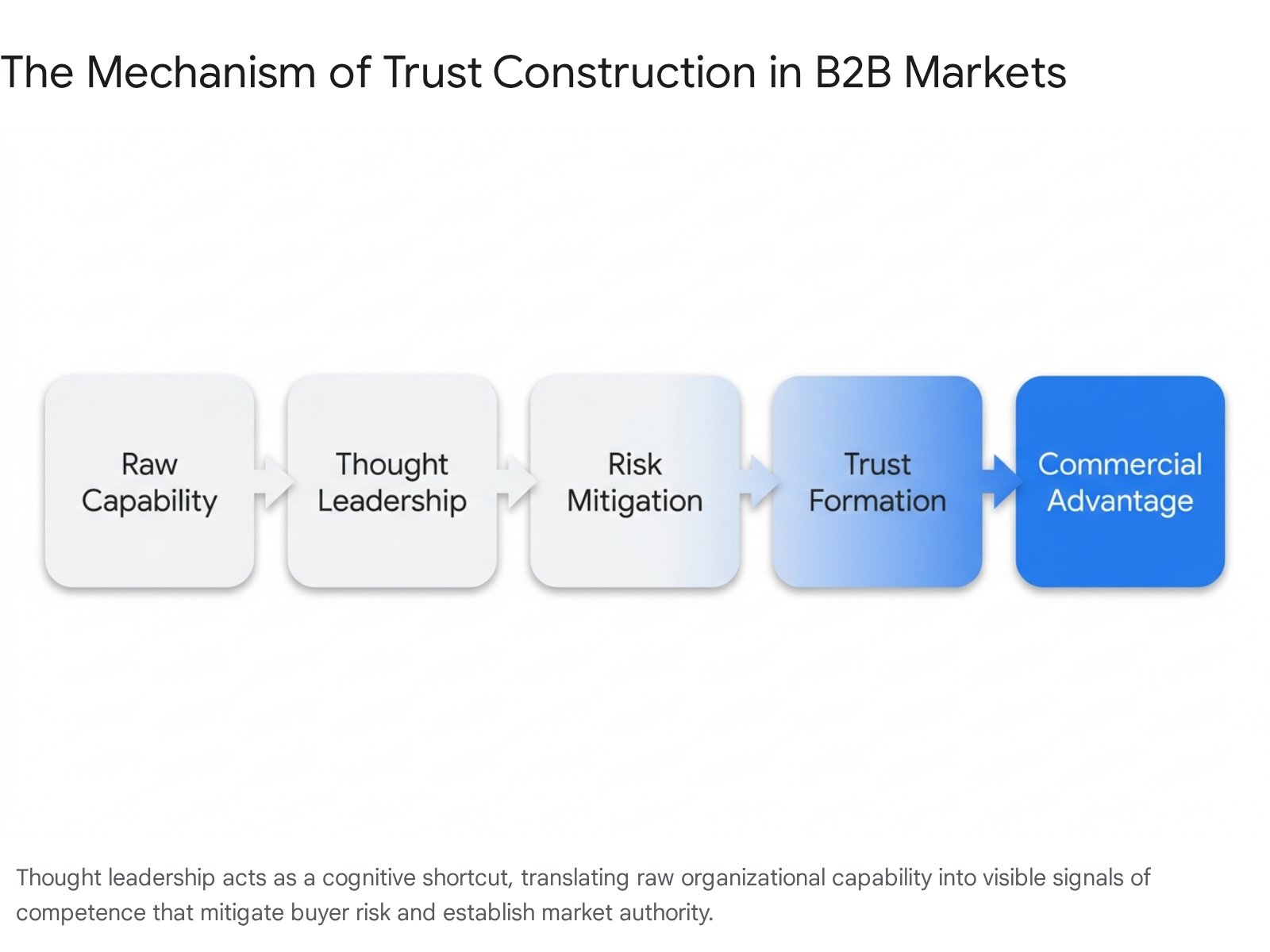
By consistently publishing rigorous, data-backed perspectives, a firm signals that it possesses a deep, nuanced understanding of the buyer's industry 21113. The mechanism is pattern-matching against signals that indicate the supplier possesses category mastery 2. When a firm's intellectual property becomes the standard framework buyers use to evaluate their own problems, that firm bypasses traditional capability comparisons. The buyer's pattern-recognition systems categorize the firm as a legitimate, safe authority before the competitive pitch even begins 2.
Signaling Competence and Authority Bias
Drawing on signaling theory and authority bias, research demonstrates that cognitive efficiency favors shortcutting complex evaluations through recognized signals of expertise 215. In B2B contexts, this manifests as buyers deferring to suppliers who demonstrate category mastery through market-shaping commentary rather than suppliers simply listing superior credentials 2. Data from the Stanford Web Credibility Project highlights that when evaluating unfamiliar professional service firms, decision-makers form trust judgments within 50 milliseconds of encountering brand signals, well before they read detailed capability descriptions 2.
However, the fluency effect dictates that if thought leadership is overly dense, jargon-heavy, or difficult to process, it creates cognitive friction that actively erodes trust 2. Effective thought leadership must distill complex, proprietary data into accessible, actionable concepts that allow the buyer to feel intelligent and informed without requiring excessive processing effort 215.
Mechanisms of Value Appropriation and Premium Pricing
The psychological trust established through thought leadership directly enables value appropriation and premium pricing strategies. In industrial organization economics and B2B pricing theory, pricing innovation alters the structure, timing, and risk allocation of customer payments 1617. Traditional entry strategies relying on cost leadership or channel innovation are easily countered by incumbents, but establishing high entry barriers through perceived intellectual superiority creates the opportunity to capture the perceived value generated via higher prices 1617.
Research utilizing Stimulus-Organism-Response (SOR) theory and equity theory suggests that consumers evaluate fairness by comparing the financial cost with the perceived value and risk reduction provided by the vendor 1819. By transferring or mitigating risk through established frameworks, thought leadership operates as a market entry strategy in concentrated global industries, allowing emerging brands to command price premiums that would otherwise require decades of historical performance to justify 161720.
Empirical Business Impact: Edelman-LinkedIn Data Analysis
To quantify the commercial impact of thought leadership, public relations firm Edelman and professional network LinkedIn have conducted an annual B2B Thought Leadership Impact Report since 2017. Surveying thousands of management-level professionals and C-suite executives globally, the longitudinal data reveals that high-quality thought leadership consistently drives full-funnel business outcomes, from initial demand generation to final vendor selection and customer retention 2122.
Demand Generation and Bypassing the Sales Funnel
Contemporary B2B buying behavior is increasingly self-directed. According to LinkedIn's "95:5 rule," at any given time, approximately 95% of business clients are out-of-market and not actively seeking to purchase goods or services 132123. Furthermore, buyers now complete an estimated 60% to 67% of their journey independently before ever engaging a sales representative, rendering traditional outbound sales tactics less effective 2425.
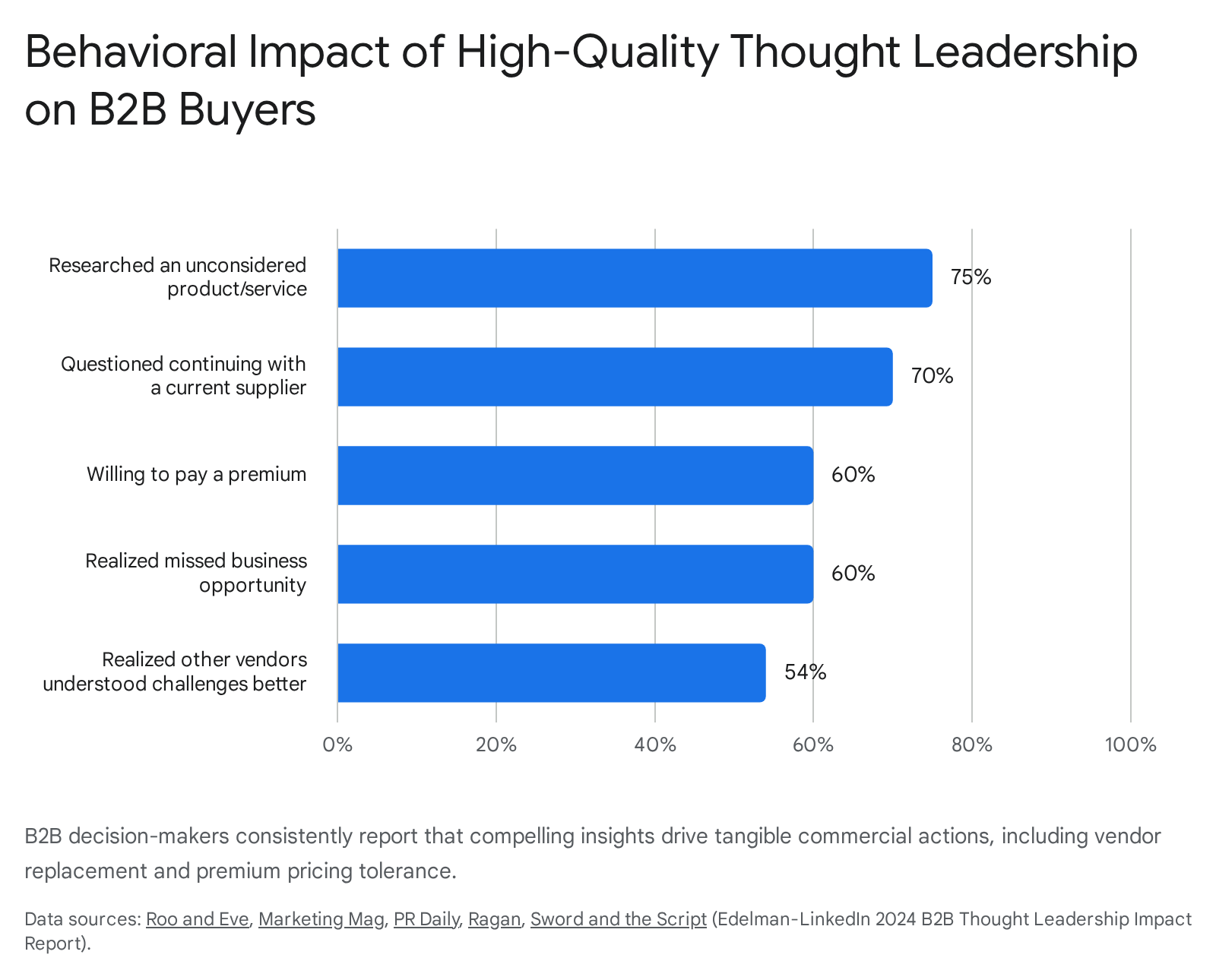
In this environment, waiting to demonstrate expertise until a formal Request for Proposal (RFP) is issued is a failing strategy. Thought leadership bridges this gap by maintaining brand salience and capturing the attention of the 95% of buyers who are currently on the sidelines 1321. The 2024 Edelman-LinkedIn report demonstrates that 75% of decision-makers and C-suite executives stated that a piece of thought leadership led them to research a product or service they had not previously considered 26272829. Furthermore, 60% of executives reported that thought leadership made them realize their organization was missing out on a significant business opportunity, and 29% realized they were more vulnerable to a potential threat than they had previously understood 23.
Shortlist Inclusion and Premium Pricing Power
The realization of market vulnerabilities directly impacts vendor shortlisting and pricing leverage. Nine in ten B2B buyers reported being moderately or very likely to be more receptive to sales and marketing outreach from a company that consistently produces high-quality thought leadership 23. Critically, 86% of decision-makers stated they would be moderately or very likely to invite organizations producing such content to participate in the RFP process 2327.
Beyond awareness and lead generation, robust thought leadership correlates with value appropriation. In highly commoditized B2B sectors, establishing industry authority alters the buyer's price sensitivity. Approximately 60% of decision-makers indicate that high-quality thought leadership makes them willing to pay a premium to work with that specific supplier 23293032. In the context of economic downturns, this effect is amplified. Data from the 2022 and 2023 reports demonstrated that 50% of C-suite executives state that high-quality thought leadership has a greater impact on their purchase decision-making during economic contractions than during periods of growth, as buyers seek reassurances of vendor stability and operational excellence 2233.
Vendor Displacement and Competitive Defensibility
Thought leadership serves dual functions: offensive market capture and defensive customer retention. If a firm fails to help its existing customers reframe their challenges and anticipate industry shifts, competitors will fill that intellectual void 21.
The Edelman-LinkedIn research quantifies the threat of intellectual complacency. A striking 70% of C-suite executives admitted that a piece of thought leadership occasionally led them to question whether they should continue working with an existing supplier 2326272829. Furthermore, 54% stated that consuming a competitor's thought leadership made them realize that other suppliers possessed a better understanding of the operational challenges their organization was facing 2326272829. In complex, high-value B2B relationships, customers require continuous reassurance that their partners operate at the cutting edge of industry capability. Absent ongoing thought leadership, existing vendors risk displacement by intellectually agile challengers 2732.
The Dynamics of the Hidden Buyer
As enterprise solutions grow in complexity, B2B purchasing is no longer a localized decision made by a single functional lead. The 2025 Edelman-LinkedIn B2B Thought Leadership Impact Report explicitly highlights a rising challenge: the expansion of the buying committee and the critical role of "hidden buyers" 3132.
Expanding Committees and Internal Misalignment
The 2025 report reveals that more than 40% of B2B deals stall or fail due to internal misalignment within the buying group 323334. A primary cause of this friction is the hidden buyer - internal stakeholders who wield significant veto power over a purchase but are not the primary, functional users of the product or service being acquired 313438. While "target buyers" understand the technical nuances of the solution, hidden buyers usually reside in functions such as finance, operations, legal, compliance, or procurement 3134.
Hidden buyers think beyond features, focusing on enterprise-wide risk, return on investment, data security, and strategic fit 3439. Because traditional B2B marketing and sales outreach is highly tailored to the functional target buyer, these critical stakeholders are frequently overlooked, leading to unexpected deal stagnation late in the procurement process 3438.
Influencing Stakeholders Outside the Sales Funnel
Hidden buyers are notoriously difficult for sales teams to engage directly. According to the data, 71% of hidden buyers report having little to no direct interaction with vendor sales representatives 3134. However, they are avid consumers of independent information. The 2025 study found that 63% of hidden buyers spend more than an hour a week consuming thought leadership - nearly identical to the 64% engagement rate of target buyers 3134.
Crucially, 64% of these stakeholders prefer thought leadership over traditional product sheets when assessing a supplier's core capabilities, and 55% factor it heavily into their evaluation process 3334. Because hidden buyers evaluate vendors through a lens of risk and strategic alignment rather than feature comparisons, thought leadership serves as a subtle trust-building mechanism long before the procurement review 3238.
| Buyer Characteristic | Target Buyers | Hidden Buyers |
|---|---|---|
| Organizational Role | Functional experts, primary end-users of the solution 3134. | Finance, operations, legal, procurement, compliance 3134. |
| Evaluation Criteria | Technical features, implementation, specific capabilities 3134. | Enterprise risk, strategic fit, ROI, organizational impact 3439. |
| Sales Interaction | High frequency of direct contact with vendor representatives 3134. | 71% report little to no direct interaction with sales teams 3134. |
| Thought Leadership Engagement | 64% spend >1 hour/week consuming thought leadership 3134. | 63% spend >1 hour/week consuming thought leadership 3134. |
| Receptivity Impact | Use content to validate technical competence 31. | 95% say strong thought leadership makes them receptive to outreach 313435. |
Industry Variations: Professional Services vs. SaaS
While the psychological mechanics of thought leadership apply broadly across B2B environments, its strategic deployment varies significantly between industries, most notably between Professional Services firms and Software as a Service (SaaS) providers.
Deployment in Professional Services
In professional services organizations - such as management consulting, legal advisory, and enterprise accounting - the firm's inventory is invisible. The product being sold is human expertise, methodology, and intellectual capital 1536. Because services cannot be physically demonstrated or beta-tested prior to purchase, buyers face exceptionally high levels of uncertainty 11.
For these firms, thought leadership is not merely a marketing tactic; it is a direct sample of the service itself. When a consultancy publishes a comprehensive framework on digital transformation, they are effectively pre-delivering a portion of their consultative value 236. This externalization of knowledge capital serves a vital signaling function, differentiating the firm from competitors who rely on similar talent pools and standard methodologies 1136. However, because thought leadership is the traditional domain of professional services, the sector is heavily saturated. Industry data indicates that marketers in professional services report significantly lower effectiveness in utilizing thought leadership for brand building compared to their peers in technology, requiring these firms to move beyond basic commentary and provide deep, data-backed frameworks 1537.
Deployment in Software as a Service (SaaS)
The SaaS industry faces a different paradigm. Historically, software marketing relied heavily on product-led growth (PLG), emphasizing feature sets, technical specifications, and free trials. However, as software categories have matured and become hyper-competitive, feature-level differentiation has eroded 383940. The modern SaaS buying cycle has elongated to an average of 6.5 to 10 months, involving expanding buying committees 2425.
B2B SaaS buyers are demanding "customer-led growth," expecting software vendors to act as trusted strategic advisors who understand overarching business challenges, rather than just acting as tool providers 243940. For SaaS companies, thought leadership is deployed to elevate the brand above commodity status. By addressing industry-wide challenges or regulatory shifts, SaaS firms build trust with C-suite executives who authorize major expenditures but may never log into the software directly 3840. High-quality thought leadership in SaaS accelerates pipeline velocity by establishing vendor credibility early in the self-directed research phase 2538.
The Risks of Content Saturation and Automation
The rush to capitalize on the commercial benefits of thought leadership has created an unintended consequence: a market saturated with low-quality, derivative content. This phenomenon presents severe reputational and financial risks for B2B brands.
Reputation Degradation and Negative ROI
While high-quality insights generate pipeline and pricing power, low-quality content actively destroys brand equity. Research indicates that 73% of executives agree that poor-quality thought leadership damages the producer's brand reputation 3041. When decision-makers encounter content that is poorly researched, heavily biased, or simply a disguised sales pitch, the backlash is severe and immediate.
According to the Edelman-LinkedIn data, 38% of decision-makers report that they have actively removed a potential vendor from consideration after losing respect for them due to poor thought leadership 47. Furthermore, 73% of buyers indicate they would not recommend a provider whose thought leadership is substandard, and 66% state they would refuse to work with a new provider based on poor intellectual output 42. The pervasive issue is the "sea of sameness." A significant 59% of B2B buyers report encountering almost identical content from at least two competing providers, leading to market fatigue 42. Just 15% of executives currently rate the overall quality of the thought leadership they consume as "very good or excellent" 2647.
The Generative AI "Slop" Phenomenon
The rapid adoption of Generative Artificial Intelligence (GenAI) in marketing workflows has exacerbated the quality crisis. With nearly three-quarters of B2B marketers utilizing generative tools to scale content production, the market is experiencing a deluge of what industry analysts term "AI slop" - mass-produced, generic content optimized for volume rather than insight 2643.
According to Forrester Research, 63% of Chief Marketing Officers report that while their overall content volume has increased, their qualified lead flow has stagnated or declined 50. The Content Marketing Institute similarly notes that while average brand content output increased by 280% between 2022 and 2025, average audience engagement dropped by nearly 40% 50. Generative AI algorithms operate by synthesizing and predicting existing information; by definition, they cannot produce the novel, contrarian, or proprietary insights required for true thought leadership 1235. Organizations that delegate their intellectual capital generation to AI risk blending into an undifferentiated digital landscape 3543.
Furthermore, poor underlying data quality compounds the issue. Gartner research indicates that organizations attribute an average of $15 million per year in losses to poor data quality, which hampers productivity and erodes the foundational credibility required to produce authoritative market research 5144.
Measurement Frameworks and Organizational Alignment
A persistent challenge in B2B marketing is the accurate measurement and attribution of thought leadership initiatives. Because the buying journey is non-linear and spans multiple stakeholders over extended periods, direct attribution requires sophisticated tracking methodologies.
Shifting from Vanity Metrics to Funnel Attribution
Many organizations evaluate thought leadership using standard content marketing metrics, such as page views, click-through rates, and social media impressions 2728. The Edelman-LinkedIn research indicates that 42% of producers measure effectiveness purely through website and social media traffic, while a full 20% have no measurement systems in place at all 2728. Only 29% of marketers claim they can directly trace closed sales back to specific thought leadership pieces 2728.
This inability to link intellectual output to business impact creates a destructive cycle. Without a clear Return on Investment (ROI) narrative, marketing teams struggle to secure the necessary budgets and executive buy-in required to produce high-quality, research-intensive content 2728. Consequently, they default to producing lower-cost, generic content, which fails to influence buyers, further depressing measurable ROI 2728. To accurately capture value, organizations must shift from volume metrics to pipeline metrics. Effective measurement involves tracking how thought leadership influences qualitative deal dynamics: acceleration of sales cycle velocity, increases in average contract value, improvements in win rates, and the ability to access and influence hidden decision-makers during the sales process 111638.
Extracting Subject Matter Expertise
True thought leadership cannot be outsourced entirely to a marketing department or an external agency; it requires the extraction of genuine expertise from within the organization. Subject matter experts (SMEs), product architects, and senior executives must be actively involved in the ideation and validation processes 123640.
However, internal experts often lack the time or storytelling capability to translate their technical knowledge into compelling market narratives 5829. The strategic mandate for B2B marketers is to act as journalists and facilitators - extracting raw, proprietary knowledge from internal experts and packaging it into accessible, high-impact formats that resonate with the target audience's business objectives 745. By aligning organizational expertise with rigorous research methodologies, B2B brands can elevate their thought leadership from a mere marketing expense to a core driver of enterprise value and competitive defensibility.