
Brand building science and long-term marketing effectiveness
The discipline of marketing has undergone a profound transformation, moving from a practice heavily reliant on intuition to an empirically grounded science. Over the past few decades, the aggregation of robust datasets - encompassing longitudinal consumer panels, econometrics databanks, and single-source advertising tracking - has facilitated the identification of law-like patterns in consumer behavior and corporate growth. Central to this scientific inquiry is the fundamental tension between short-term sales activation and long-term brand building. By analyzing comprehensive market data, researchers have established predictive frameworks demonstrating how memory structures are formed, how market share is systematically captured, and how different modalities of marketing investment decay over time.
Principles of Marketing Effectiveness
The foundational premise of contemporary marketing effectiveness rests on the empirical observation that marketing communications operate through two distinct mechanisms. These mechanisms function on entirely divergent timescales, necessitate different creative and cognitive strategies, and yield separate commercial outcomes.
Brand Building versus Sales Activation
Brand building is structurally focused on creating, reinforcing, and refreshing memory structures that exert a lasting influence on consumer behavior. It is fundamentally an exercise in generating future demand. Because the vast majority of consumers in any given category are not actively in the market to purchase at the exact moment they encounter brand advertising, effective brand building relies on broad reach, emotional resonance, and high creative engagement. This approach is designed to bypass cognitive filters and lodge the brand in the consumer's long-term memory 123.
Conversely, sales activation is designed to harvest existing demand. It targets the small percentage of category buyers who are actively exhibiting purchase intent. Activation campaigns rely on tight demographic or behavioral targeting, rational messaging, promotional incentives, and clear calls to action. The commercial effects of sales activation are immediate and highly measurable, yielding rapid spikes in transaction volume. However, these effects decay almost instantly once the marketing stimulus is removed or the campaign budget is exhausted 456.
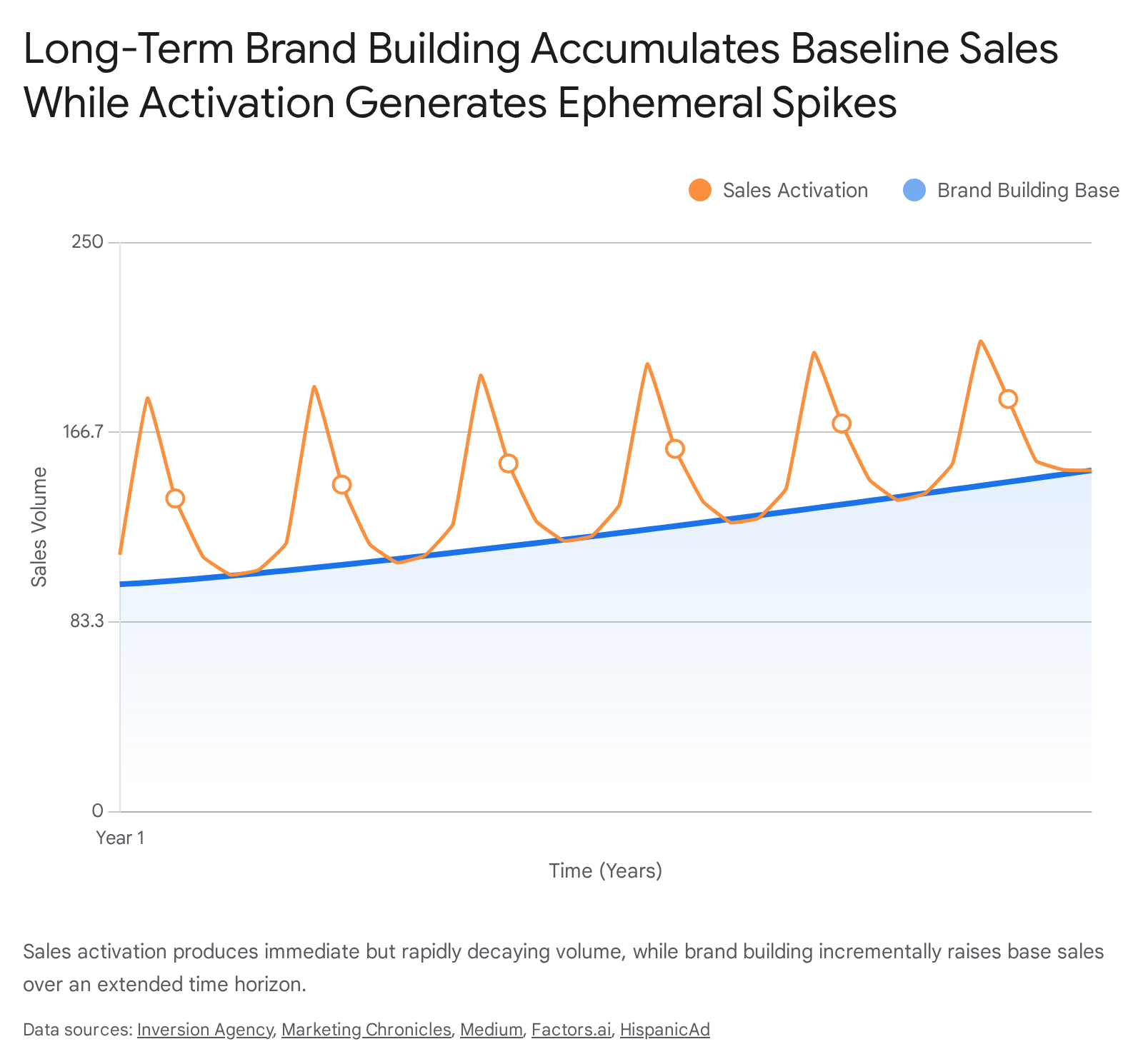
The distinction between these two modalities is critical because they are mutually antagonistic in their operational execution. Activation requires the precise targeting of in-market buyers, whereas brand building fundamentally requires reaching out-of-market buyers 26. Prioritizing activation at the expense of brand building creates a dangerous efficiency cycle. While short-term Return on Investment (ROI) and performance metrics may appear robust initially, the brand's overall mental availability slowly erodes. As the brand becomes less familiar to future buyers, the customer acquisition cost (CAC) for activation campaigns inevitably rises, profit margins collapse, and the enterprise is forced to rely increasingly on price promotions to sustain transaction volume 745.
Cognitive Mechanisms and Mental Availability
To understand why broad reach and emotional brand building drive market penetration, effectiveness science looks to cognitive psychology and behavioral economics, specifically focusing on bounded rationality and intuitive processing. Consumer choice in crowded markets is heavily dictated by availability. A brand achieves growth by systematically increasing two specific forms of availability: physical availability and mental availability 611.
Physical availability denotes the breadth and depth of a brand's distribution. The product or service must be easy to find and seamless to purchase in the physical retail or digital environments where the actual shopping behavior occurs 1112. Mental availability, conversely, is the propensity of a brand to be noticed or thought of in various buying situations. It serves as the cognitive equivalent of physical distribution 1112.
The human brain consumes roughly 20% of the body's energy while accounting for only 4% of its mass; consequently, it relies heavily on heuristic shortcuts and fast, intuitive (System 1) thinking to navigate complex environments and conserve cognitive resources 7. Most everyday commercial experiences and advertising exposures do not form long-term memories. Marketing communications must overcome an intense attention filter to build mental availability. Advertising achieves this not by persuading consumers through complex rational arguments, but by building associative memory structures that render the brand highly salient when a relevant purchase trigger eventually arises 789.
Distinctive Assets and Category Entry Points
The foundational components of mental availability are Distinctive Brand Assets (DBAs). These are non-name sensory cues - such as logos, specific colors, typography, sonic branding, characters, or unique packaging shapes - that reliably trigger the brand in the consumer's memory 7161011.
From an empirical effectiveness standpoint, DBAs serve to increase visual and cognitive salience. When a buyer is at the point of purchase, they rarely engage in extensive, deliberate comparative analysis. Instead, they rely on immediate recognition. Strong, consistently applied DBAs anchor advertising to the brand, ensuring that when an emotional, broad-reach advertisement is viewed, the resulting memory structure is correctly attributed to the specific brand rather than the category in general 910. Consistency over time and across all media channels is paramount for reinforcing these assets, as repetition is required to strengthen the neural pathways associated with the brand 79.
Mental availability is operationalized and measured in marketing science through Category Entry Points (CEPs). Formulated by researchers at the Ehrenberg-Bass Institute, CEPs are the internal cues (motives, emotions) and external cues (locations, times of day, social contexts) that prompt a consumer to enter a category and consider a purchase 1219. A brand's overall health and competitive strength are determined by the size and quality of its memory network, which can be quantified through specific survey-based metrics rather than traditional brand funnel indicators.
Mental Penetration is the percentage of category buyers who can link the brand to at least one CEP. Network Size measures the average number of distinct CEPs that buyers associate with the brand. Mental Market Share represents the brand's share of all mental associations across all CEPs within the total category, a metric that has been shown to highly correlate (up to r = .83) with actual sales market share 12191213. Brand building effectiveness is achieved by consistently linking the brand's distinctive assets to a wide array of CEPs through mass-reach communications, ensuring the brand automatically comes to mind in more buying scenarios than its competitors 1219.
Budget Allocation and the Investment Framework
Determining the optimal allocation of capital between long-term brand building and short-term sales activation is a central operational problem in marketing finance. Extensive econometric modeling of campaign performance provides an empirical framework for this allocation.
The Empirical Basis of the 60/40 Rule
The most widely cited heuristic in marketing effectiveness is the 60/40 rule, derived from the comprehensive analysis of the Institute of Practitioners in Advertising (IPA) Databank. Researchers Les Binet and Peter Field analyzed thousands of effectiveness case studies spanning over three decades (1980 - 2016). They established that across a broad spectrum of consumer categories, overall profit maximization is generally achieved when approximately 60% of the marketing budget is allocated to broad-reach brand building and 40% is allocated to targeted sales activation 127.
This specific ratio optimizes the total "profit gain" by ensuring that the brand maintains sufficient mental availability to fuel the lower funnel in the future, while simultaneously capturing enough immediate sales to fund ongoing operations and demonstrate short-term ROI. The data indicates that moving from a purely performance-marketing strategy to a balanced brand-and-performance strategy yields an average ROI uplift of 90%, a phenomenon referred to in effectiveness literature as the "Multiplier Effect" 7. Conversely, shifting the entirety of a budget to sales activation exacts a heavy toll on long-term effectiveness, severely damaging the brand's ability to maintain premium pricing 75.
Contextual Variations in Budget Allocation
While the 60/40 ratio serves as a robust baseline, effectiveness science dictates that it is a statistical average rather than a universal dogma. The optimal capital allocation flexes significantly based on the structural context of the category, the nature of the purchase model, and the maturity of the brand itself 114.
For established market leaders, the data suggests an even higher skew toward brand building - often reaching 72% brand and 28% activation. This heavy investment in brand is necessary to sustain their dominant market position, justify premium pricing margins, and defend against new market entrants. Conversely, new entrants, startups, and challenger brands may require a significant initial skew toward activation (e.g., 30% brand to 70% activation) in their earliest lifecycle stages to generate vital cash flow and establish initial physical availability before transitioning to a more balanced brand-building approach as they scale 715.
The rise of e-commerce and digital-first business models has surprisingly not reduced the mathematical requirement for brand building; in many cases, it has amplified it. Because online sales activation is highly efficient - capturing existing search intent and converting it with minimal transactional friction - it requires a proportionally smaller percentage of the total marketing budget to execute effectively. Consequently, the optimal split for established direct-to-consumer and digitally native brands often shifts closer to 70% brand and 30% activation to continuously feed the highly efficient digital conversion funnel 45. In high-involvement categories, such as financial services or complex B2B technology, trust and emotional reassurance are paramount. These sectors typically require a higher allocation to brand building, frequently resting in the 70% to 80% range to mitigate perceived consumer risk 114.
A significant development in effectiveness research is the application of these principles to Business-to-Business (B2B) marketing. Historically, B2B marketing has been dominated by highly rational, bottom-of-the-funnel lead generation tactics, operating under the assumption that B2B buying committees are purely logical, information-driven actors 68. However, comprehensive studies commissioned by the LinkedIn B2B Institute, utilizing a specific B2B cut of the IPA Databank, proved that B2B marketing operates under the exact same foundational effectiveness principles as consumer marketing. Mental availability, broad category reach, and emotional storytelling are the primary drivers of long-term B2B growth 82416.
Because B2B purchase cycles are significantly longer than consumer cycles and involve highly complex buying committees, the vast majority of target buyers are "out-of-market" at any given time. Consequently, a total reliance on short-term sales activation is fundamentally inefficient. The optimum budget allocation in B2B shifts slightly from the standard B2C rule to an average of 46% brand building and 54% sales activation 782426. B2B brands that fail to invest adequately in upper-funnel brand building find that every negotiation starts from a baseline of zero awareness, forcing the enterprise to compete solely on price, resulting in chronically high acquisition costs and highly prolonged sales cycles 726.
| Market Context / Category | Recommended Brand Building Allocation | Recommended Sales Activation Allocation | Primary Rationale |
|---|---|---|---|
| Standard B2C Average | 60% | 40% | Balances long-term demand creation with short-term demand harvesting. |
| Business-to-Business (B2B) | 46% | 54% | Adjusts for longer purchase cycles and higher information requirements. |
| Established Market Leaders | 72% | 28% | Protects dominant market share and sustains premium pricing margins. |
| Financial Services | 70% - 80% | 20% - 30% | High-risk categories require immense emotional trust and reassurance. |
| Digital / E-commerce Brands | 70% | 30% | Highly efficient digital activation funnels require less relative capital. |
| New Entrants / Challengers | 30% - 40% | 60% - 70% | Immediate cash flow and initial physical availability are existential priorities. |
Table 1: Contextual variations in optimal marketing budget allocations across different sectors and brand lifecycles 17814152426.
The Impact of Retail Media Networks on Budget Allocation
The rapid fragmentation of digital media, combined with the systematic deprecation of third-party cookies and heightened data privacy regulations, has fueled the explosive growth of Retail Media Networks (RMNs). By 2025, global retail media advertising expenditure exceeded $100 billion, capturing upwards of 20% of total global digital advertising budgets, rivaling established search and social media channels 27281718.
Retail media networks represent a paradigm shift because they offer advertisers highly valuable, deterministic first-party data combined with closed-loop attribution. This infrastructure effectively links media exposure directly to point-of-sale conversions within the retailer's own digital and physical ecosystem 192021. From an effectiveness standpoint, RMNs operate as exceptionally potent sales activation vehicles. They are capable of achieving unprecedented short-term Return on Ad Spend (ROAS) by targeting consumers precisely at the moment of intent, often utilizing Dynamic Creative Optimization (DCO) to personalize messaging in real-time based on browsing history and past purchases 2223.
However, the rapid proliferation and integration of RMNs present a severe structural risk to long-term marketing effectiveness. Because RMNs deliver highly visible, immediate, and easily quantifiable performance metrics, they heavily incentivize short-termism within corporate marketing departments. Brands that reallocate their upper-funnel brand-building budgets into bottom-funnel retail media - chasing immediate ROAS - risk systematically stalling their long-term organic growth. Effectiveness science dictates that physical and digital availability (such as prominent RMN placement) must be preceded by mental availability. If consumers do not already harbor positive brand associations and memory structures before encountering the brand on the digital shelf, performance media costs will inevitably rise, and conversion rates will suffer 1124.
To mitigate this strategic imbalance, sophisticated retail platforms are evolving from simple sponsored product listings (Retail Media 1.0) into comprehensive omnichannel ecosystems (Retail Media 3.0). These advanced networks are expanding their offerings to include off-site programmatic placements, connected TV integrations, and in-store digital screens, attempting to span the full marketing funnel and blur the traditional lines between brand building and commerce activation 192538.
Empirical Laws of Buyer Behavior
A parallel and equally critical stream of marketing science, pioneered by the Ehrenberg-Bass Institute for Marketing Science, utilizes vast longitudinal consumer panel data to establish empirical, law-like regularities in buyer behavior. These mathematical regularities fundamentally challenge traditional marketing orthodoxies surrounding deep demographic segmentation and the pursuit of exclusive brand loyalty 626.
The NBD-Dirichlet Model
The statistical foundation of evidence-based marketing is the NBD-Dirichlet model. Developed by Andrew Ehrenberg and his colleagues in the 1970s and 1980s, the model mathematically describes and predicts purchase incidence and brand choice within virtually any stationary, unsegmented consumer market 2640.
The model relies on the interaction of two specific probability distributions. The Negative Binomial Distribution (NBD) describes the frequency of purchases within a product category. It empirically demonstrates that in any given category, the vast majority of consumers buy infrequently (constituting a massive base of light buyers), while a very small percentage buy frequently (heavy buyers) 2640. The Dirichlet Distribution models how consumers allocate their purchases across different competing brands. It proves that buyers are rarely strictly monogamous to a single brand; instead, they purchase from a repertoire of acceptable brands, distributing their choices largely in proportion to the overall market shares of the brands within that repertoire 2640.
The Double Jeopardy Law
The most profound empirical generalization derived from the NBD-Dirichlet model is the Double Jeopardy Law. Formulated originally by social scientist William McPhee in 1963 and subsequently generalized to consumer purchasing by Ehrenberg, Double Jeopardy states that smaller brands in a market suffer two distinct penalties: they have far fewer buyers than larger brands (lower market penetration), and those few buyers are fractionally less loyal (exhibiting lower purchase frequency) 26402728.
The strategic implications of the Double Jeopardy Law are severe. It mathematically demonstrates that market share is primarily a function of penetration - the total size of the customer base - rather than deep loyalty 2627. A brand cannot simply engineer its way to growth by focusing exclusively on retaining its current customers or increasing their purchase frequency. Brand managers overseeing small-share brands should not interpret lower loyalty metrics as a failure of product quality or customer satisfaction; it is a statistical inevitability of operating a small brand. Conversely, as a brand successfully increases its overall penetration, a fractional, highly predictable increase in loyalty naturally and automatically follows 4027.
While the law is nearly universal, empirical observations identify rare exceptions. Niche brands may exhibit unusually low penetration combined with higher-than-expected loyalty, typically due to highly restricted physical distribution (e.g., private label retailer brands). Alternatively, change-of-pace brands may exhibit unusually high penetration but extremely low repeat-purchase rates 27.
Duplication of Purchase and Natural Monopoly
A critical corollary to the NBD-Dirichlet model is the Duplication of Purchase Law, which states that brands share customers with competing brands directly in line with those competitors' market shares. This reveals that competing brands are largely substitutable and sell to the exact same types of people, severely undermining the traditional marketing concept of strict market partitioning or deep demographic segmentation 264027. Furthermore, the Natural Monopoly Law indicates that in any given purchase occasion, larger brands have a slightly higher mathematical probability of being chosen simply by virtue of their size and resulting cognitive salience 26.
Because a brand's customer base decays naturally over time due to normal market friction, and because light buyers account for the vast majority of category sales volume, long-term brand growth is entirely dependent on continuous, aggressive customer acquisition 629. Effectiveness science demonstrates that broad-reach marketing - targeting all potential category buyers, including those who rarely purchase - is vastly more effective at driving systemic growth than tight segmentation or loyalty programs aimed only at heavy buyers 68.
Predictive Metrics for Market Share
While final business outcomes such as revenue, profit margins, and market share are the ultimate arbiters of marketing effectiveness, they are inherently lagging indicators. Marketing science has established reliable leading indicators that predict future market share movements based on current investment levels and digital behavior.
Share of Voice and Excess Share of Voice
Share of Voice (SOV) is a metric representing a brand's total media expenditure expressed as a percentage of the total media expenditure within its competitive category 4445. Extensive longitudinal analysis of the IPA Databank has revealed a remarkably strong correlation between a brand's SOV and its Share of Market (SOM). In a stable state of equilibrium, a brand's SOV generally matches its SOM 4446.
The critical predictive metric for growth is Excess Share of Voice (ESOV), defined mathematically as SOV minus SOM. When a brand sets its SOV higher than its current SOM (resulting in a positive ESOV), it effectively purchases excess mental availability, which eventually translates into tangible market share gains. Empirical analysis demonstrates that, on average, a consumer brand gains 0.5% in market share for every 10 points of ESOV maintained over a year.
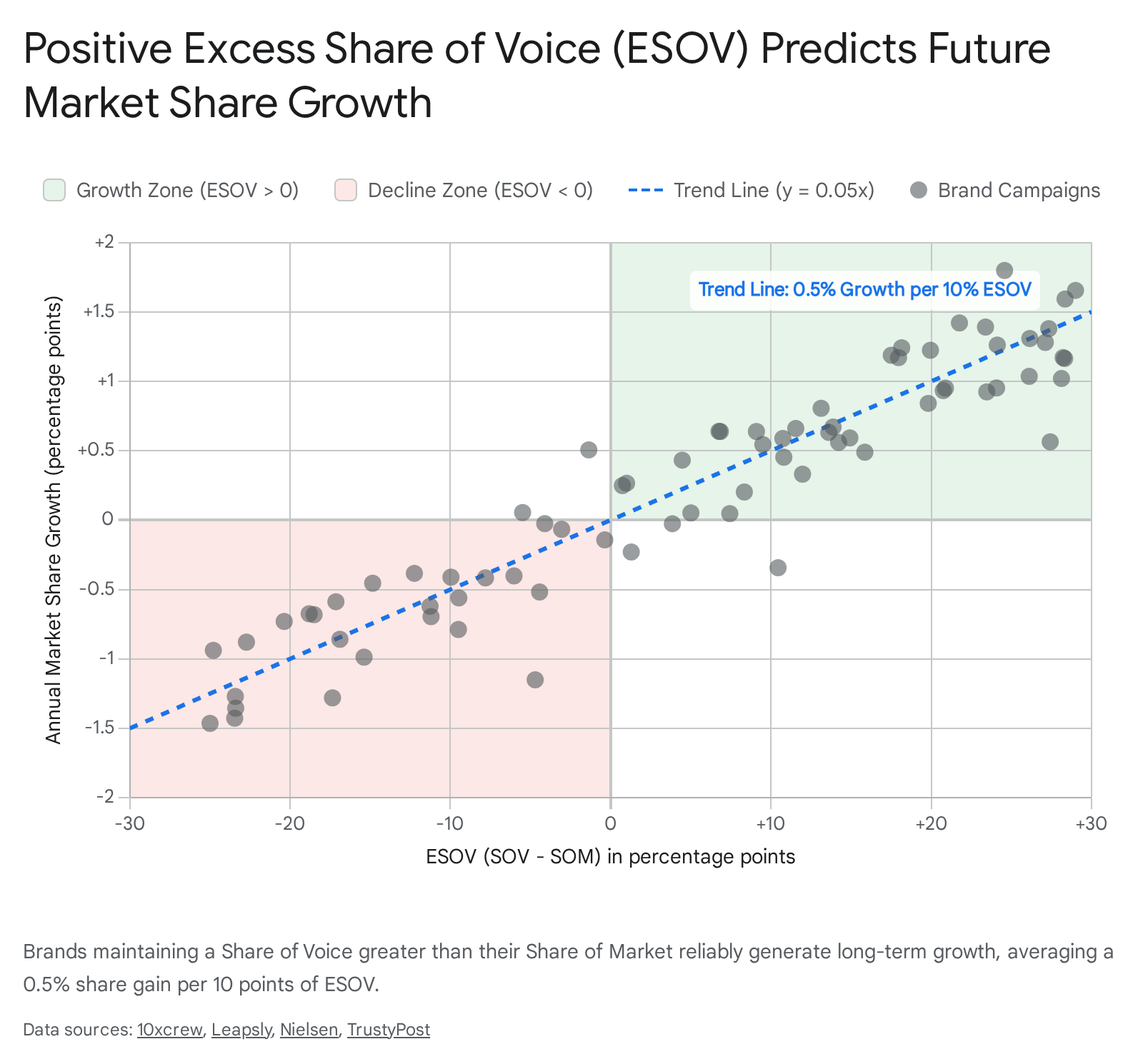
In B2B markets, this effect is slightly more pronounced, yielding a 0.6% gain 744454630. Conversely, brands that underspend and maintain a negative ESOV reliably lose market share over time, with research indicating that approximately 80% of brands sitting below their market share line experience contraction 4530.
Share of Search as a Forward Indicator
In contemporary digital ecosystems, calculating traditional SOV accurately is increasingly difficult due to the severe fragmentation of media channels, opaque programmatic ad spending, and the walled gardens of major tech platforms. Consequently, marketing science has increasingly adopted "Share of Search" (SoS) as a highly accurate, freely available proxy for SOV and a robust leading indicator of market share 314932.
Share of Search measures the volume of organic branded search queries for a specific brand relative to the total branded search volume for all defined competitors within that category 443133. Extensive research confirms that SoS strongly correlates with actual market share, averaging an 83% correlation across more than 30 studies covering 12 different industries 31.
Because consumer search intent systematically precedes transaction intent, a divergence between a brand's SoS and its SOM serves as a powerful signal of future market movement. The specific latency of this indicator depends heavily on the category's typical purchase cycle. In high-velocity digital sectors, such as iGaming, SoS changes predict market share movements with a highly accurate 1-to-4 month lag, boasting a 95% correlation 31. In slower, high-consideration sectors like luxury automotive, the predictive lag extends to 6-to-12 months 31.
| Industry Sector | Share of Search to Market Share Correlation | Predictive Lag Time |
|---|---|---|
| iGaming | 95% | 1 to 4 months |
| Restaurants | 96% | Less than 1 month |
| Luxury Automotive | 90% | 6 to 12 months |
| Hotels & Hospitality | 78% - 80% | 1 to 3 months |
Table 2: Share of Search predictive validity and latency variations across selected consumer categories 31.
Temporal Dynamics and Decay Rates
Measuring the precise temporal decay of different marketing activities is critical for accurate marketing mix modeling (MMM) and optimal budget pacing. Effectiveness science utilizes rigorous statistical modeling to separate transient sales spikes from permanent baseline shifts.
The Half-Life of Advertising Exposure
Single-source data methodologies - which technologically track both the exact media exposure and the subsequent real-world purchasing behavior of the same individual households over time - allow researchers to isolate the specific duration of an advertising exposure's effect without experimental contamination 5234.
Empirical generalizations derived from these split-cable field experiments demonstrate that the short-term sales effect of a specific advertising exposure has a half-life of approximately three to four weeks 523435. This indicates that the mathematical probability of a single advertisement influencing a discrete purchase drops by 50% within roughly one month, continuing to decay exponentially thereafter. This rapid decay necessitates a continuity scheduling strategy - an "always-on" approach - for sales activation campaigns to maintain their contribution to base volume 245234.
However, this short-term behavioral half-life must not be conflated with the long-term duration of advertising effects on structural brand equity. While the immediate behavioral nudge decays in mere weeks, the memory formations and mental availability generated by highly creative, emotional brand building decay at a fraction of that speed. These memory structures persist for years, allowing the brand to incrementally accumulate market share over multiple, extended buying cycles 2536.
Decay Profiles of Price Promotions
While brand advertising builds baseline sales, price promotions are frequently utilized by marketers to force immediate transaction volume. Rigorous marketing science reveals profound differences in the decay profiles and long-term impacts of these two interventions.
Promotional activities undeniably result in massive, immediate spikes in category incidence, brand choice, and purchase quantity (stockpiling) 3738. However, unlike brand advertising, empirical evidence demonstrates that price promotions possess virtually no enduring, long-term positive effects on base sales. Furthermore, promotions frequently result in a significant "post-promotion dip" - a prolonged period of negative sales adjustment as consumers slowly consume the inventory they stockpiled during the discount period 373839.
More critically, heavy reliance on price promotions exerts a severely negative usage effect over the long term. It systematically increases consumer price sensitivity, diminishes perceived brand quality (particularly damaging for premium product brands), and erodes overall brand equity, making consumers mathematically less likely to purchase the product at full price in future periods 43740.
Interestingly, recent research into the unintended psychological effects of promotions reveals a complex competitive dynamic: when a brand runs an aggressive price promotion that ultimately fails to induce a consumer to switch away from their preferred incumbent brand, that consumer's resistance to the discount actually strengthens their psychological loyalty to, and future spending with, their incumbent brand 41.
Academic Debates and Methodological Critiques
The science of marketing effectiveness is not entirely monolithic; it is characterized by ongoing, rigorous academic debate, particularly regarding the tension between the mass-marketing doctrines of the Ehrenberg-Bass Institute and classical marketing strategy.
Mass Reach versus Segmentation Strategies
A primary point of academic contention involves the traditional STP model (Segmentation, Targeting, Positioning) popularized by Philip Kotler. The empirical laws championed by Byron Sharp and the Ehrenberg-Bass Institute fundamentally clash with traditional STP theory. Sharp argues that because brands grow primarily via penetration, and because duplication of purchase laws prove that consumers are inherently non-exclusive, marketers should abandon tight demographic targeting and prioritize continuous, universal reach across all light and heavy category buyers 66142.
Critics of this universal approach, including marketing professors Peter Fader and Dominique Hanssens, argue that while Sharp's broad empirical generalizations hold undeniable truth for fast-moving consumer goods (FMCG), they gloss over highly relevant nuances in other sectors. Fader notes that Sharp's specific theories on mental availability lack the rigorous peer-reviewed validation in top quantitative marketing journals that characterize more traditional econometric models 43. Furthermore, critics argue that in niche markets, luxury sectors, or subscription-based business models, highly heterogeneous consumer preferences exist. In these specific contexts, distinct positioning and targeted segmentation can yield superior profitability and Customer Lifetime Value (CLV), even if such strategies appear to violate the mass-reach directives of the NBD-Dirichlet model 66144.
Award Data Validity versus Longitudinal Panels
A second prominent methodological debate concerns the validity of the datasets used to derive various effectiveness laws. The Binet and Field 60/40 rule is derived exclusively from the IPA Databank, which consists of detailed case studies submitted by agencies for effectiveness awards 76566.
Critics, most notably Byron Sharp, argue that award submissions represent a highly biased, self-selecting sample of exceptionally successful, creatively driven campaigns rather than a representative baseline of normal market activity. Sharp contends that formulating strict budget ratios based on award data is statistically unsound, suggesting instead that marketers should rely purely on single-source longitudinal panel data to determine underlying effectiveness 45.
Despite these ongoing methodological critiques, the broader consensus within the effectiveness community holds that both schools of thought are largely complementary rather than mutually exclusive. The Ehrenberg-Bass Institute provides the immutable mathematical laws of how buyers behave - the absolute necessity of penetration, mental availability, and distinctiveness. Concurrently, the IPA Databank provides highly practical, tactical guidelines on what types of communications - specifically emotional, broad-reach video and creative storytelling - are most likely to achieve that necessary mental availability efficiently over time 251213.
Emerging Market Contexts and Future Trajectories
As the science of marketing effectiveness matures, its principles are increasingly being tested and adapted in rapidly evolving, heterogeneous global markets.
Effectiveness in the Asia-Pacific Region
The application of marketing effectiveness principles in the Asia-Pacific (APAC) region presents unique challenges and opportunities. APAC represents the fastest-growing market research and insights industry globally, expanding at 9.5% in 2023, driven heavily by investments in India, Vietnam, and Kazakhstan 46. Between 2019 and 2023, global business expansion into APAC grew by 35%, significantly outpacing growth in both Europe and the United States, dominated largely by professional services and technology sectors seeking to leverage the region's expanding middle class 47.
However, applying standard Western effectiveness models to APAC requires careful calibration. Unlike the relatively homogenous markets where much of the NBD-Dirichlet modeling was originally validated, APAC is characterized by extreme heterogeneity. Indonesia alone possesses over 700 spoken languages, while China exhibits vast cultural divides between its northern and southern regions. Furthermore, stark urban-rural divides in digital access and socio-economic status complicate the measurement of physical and mental availability 70.
Despite these complexities, the fundamental laws of growth remain operative. Brands expanding into APAC must still prioritize penetration and broad reach, but the execution of Distinctive Brand Assets and the identification of Category Entry Points must be highly localized to account for cultural nuances and differing levels of digital adoption. The integration of advanced AI with localized human expertise is becoming critical for effectively measuring Share of Voice and Share of Search in these highly fragmented, hyper-digital environments 70. Furthermore, macroeconomic volatility in the region - including shifting trade policies, varying central bank interest rates, and China's moderated GDP growth forecasts - requires marketers to maintain a long-term brand-building focus to insulate against short-term economic shocks 4849.
Ultimately, the rigorous science of marketing effectiveness proves that long-term commercial success cannot be achieved through hyper-targeted, short-term performance marketing alone. It requires a sustained, financially calibrated commitment to building deep memory structures in the minds of future buyers, balanced precisely against the tactical, data-driven activation of current market demand.